Published Nov 20, 2026 · Updated Nov 20, 2026 · 18 min read
AI in Customer Service (2026): What It Does Well, Where It Fails, and What It Costs
The six jobs AI does in customer support, ten named companies and what they publicly report, the benefits and disadvantages tied to evidence, what a resolution costs across RTCI's 20-platform index, and an ordered path to start.
 Written by Andrew Hall, Editor
AI in customer service in 2026 means software that does six jobs: it resolves routine questions on its own, helps human agents draft and find answers, routes tickets, grades conversations, handles calls, and writes summaries. The self-service job gets the headlines and most of the budget. Across RTCI's 20-platform index, vendors' headline resolution claims run a median 17 points above RTCI's realistic rates, and a resolved conversation costs a median $1.12 in AI fees as of November 2026. It works best on repeatable, well-documented questions and fails on policy edge cases.
This page is the map. Each job below has what it is, a named company that reports using it with the source linked, and what goes wrong. Then come ten companies and what they say publicly, the benefits and disadvantages with the mechanism behind each, what it costs, and the order to roll it out. The deeper guides are linked where each topic needs more than a paragraph.
What are the six jobs AI does in customer service?
The maturity column is RTCI's view, argued from the examples below: how much public evidence exists of the job working at scale, and how costly a mistake is when it does not.
| Job | What it does | Who it serves | Maturity (RTCI view) | Main failure |
|---|---|---|---|---|
| Self-service agent | Answers and closes customer questions without a person | Customers | Proven on simple questions; mixed on complex ones | Confident wrong answers the company is liable for |
| Agent assist (copilot) | Suggests replies and finds answers for a human agent | Agents | Proven, with the gain concentrated in newer agents | Little gain for experienced agents; bad suggestions get sent |
| Routing and triage | Tags intent, language and sentiment, then queues the ticket | Team leads | Proven, low risk | Misclassified tickets sit in the wrong queue |
| QA and analytics | Scores every conversation against a rubric and finds trends | QA and managers | Emerging; vendor-reported results only | The grader rewards tone over correctness |
| Voice | Answers and resolves phone calls | Customers | Emerging; reported at scale by a few large firms | Volume moves back to humans and staffing plans break |
| Summaries and knowledge | Writes call notes and drafts or flags help articles | Agents and content owners | Proven for summaries; early for knowledge | Omitted commitments; errors the bot then repeats |
What would change this view: independent, audited results (not vendor case studies) for QA or voice at the scale Klarna and Bank of America report for self-service would move those rows up; a run of public failures from agent assist would move that row down.
1. Self-service agents that resolve
What it is. A chat, email or messaging agent that reads your help content and, in agentic setups, your order or account systems, then answers the customer and closes the conversation without a human. It is what most vendors mean by an "AI agent", and it is billed per resolution, per conversation or per outcome.
Named example. Klarna's February 27, 2024 announcement says its assistant handled 2.3 million conversations in its first month, two-thirds of its customer service chats, the work of 700 full-time agents. Klarna said resolution time fell from 11 minutes to under 2, repeat inquiries fell 25%, and it estimated a $40 million profit improvement for 2024. On its Q3 2025 earnings call, as reported by CX Dive on November 20, 2025, Klarna said the agent now does the work of 853 agents and has saved $60 million. The same report notes Klarna began a pilot of human agents in May 2025; its 2025 annual report says the AI still handled 80% of chats. RTCI's Klarna case study follows the full sequence.
What goes wrong. The bot states a policy that does not exist, and the company owns the answer. Air Canada's chatbot told a customer he could claim a bereavement discount within 90 days after travel; the real policy required the request before travel. A Canadian tribunal rejected the airline's argument that the chatbot was "a separate legal entity" and ordered it to pay CA$812 (damages of about CA$650 plus interest and fees), as CBS News reported on February 19, 2024. In April 2025 Cursor's support bot told users that logging out on a second machine reflected a one-device policy that did not exist, per CX Today. The fix is grounding answers only in approved content, refusing when the content is silent, and checking the bot's resolved conversations, which the verified resolution framework sets out.
2. Agent assist and copilots
What it is. AI inside the agent's workspace that suggests replies, pulls the relevant article or policy, and proposes next steps. The customer still talks to a person, which makes it the lower-risk place to start.
Named example. The strongest public evidence is a study, not a vendor page. Brynjolfsson, Li and Raymond's NBER working paper 31161 followed 5,179 support agents given a generative AI assistant on a staggered rollout. Issues resolved per hour rose about 14% on average and about 34% for novice and low-skilled agents, with minimal impact on the most experienced. The company is not named. For a named one: Verizon gave 28,000 care reps and store staff a Gemini-based "Personal Research Assistant", which Google Cloud's April 9, 2025 release says reached 95% "comprehensive answerability". Verizon's consumer chief told Reuters the same day that sales through the service team were up nearly 40% since deployment began in July 2024.
What goes wrong. The gains are uneven. In the NBER study the most experienced agents gained little, so a business case built on the average overstates the gain for a senior team. A second risk is copy-paste: an agent under handle-time pressure sends a suggested reply without checking it, and the error now carries a human's name. Track suggestion acceptance next to QA scores, not acceptance alone.
3. Routing and triage
What it is. A classifier that reads each incoming ticket and tags its intent, language, sentiment and entities such as order numbers, then sends it to the right queue or priority. It is the oldest AI job in support and the cheapest to get wrong, because a person still answers the ticket.
Named example. Starshipit describes its use of Zendesk's intelligent triage in a Zendesk customer story (page dated March 10, 2025). Starshipit says inquiries are categorised and summarised automatically, and that sentiment flags help managers prioritise urgent cases. Zendesk reports a 39% average fall in Starshipit's first reply time year over year. The story also says Starshipit is not yet using the topic tags for automatic assignment and plans to once accuracy improves, which is a useful signal of where teams draw the line.
What goes wrong. A wrong tag sends a ticket to a queue that cannot answer it, and the customer waits through a second transfer. Start with tags that inform a human (priority, language) before tags that move tickets on their own, and review a sample of each predicted intent before you automate on it.
4. QA and conversation analytics
What it is. AI that scores conversations against your QA rubric (accuracy, policy, tone, resolution) and groups them by topic to show what is driving contacts. Manual QA reviews a sample; AI review can cover every conversation, including the ones your AI agent handled.
Named example. Zendesk's QA product page lists Kahoot! with a 150% increase in ticket review volume and a 5% rise in CSAT, and Audacy with a 19% rise in agent productivity. These are vendor-published figures with no method or period stated.
What goes wrong. An AI grader scores what is visible in the transcript. A polite, well-structured reply that states the wrong refund window can score higher than a terse correct one. Calibrate the AI scores against human reviewers on the same conversations every month, and keep correctness as its own line in the rubric rather than folding it into an overall score.
5. Voice
What it is. An AI agent that answers phone calls, understands speech, and either resolves the request or transfers with context. It replaces or sits behind the IVR menu.
Named example. Decagon's Chime case study says Chime consistently sees nearly 70% resolution on voice and has scaled to more than 1 million calls a month, and attributes a 60% cut in support costs to Chime's 2025 S-1 filing. Few companies publish voice results outside vendor case studies, which is why RTCI rates this job emerging.
What goes wrong. The bot's reported deflection does not show up in the staffing numbers. Commonwealth Bank of Australia cut 45 customer service roles in July 2025 on the strength of a voice bot, then reversed the decision, saying its assessment "did not adequately consider" all business considerations, as Information Age reported on August 21, 2025. The Finance Sector Union said call volumes were rising and team leaders were answering phones. Measure calls handled by humans after launch, not only calls the bot touched.
6. Summaries and knowledge upkeep
What it is. AI that writes the after-call note or ticket summary, and drafts or flags help articles from resolved conversations. It is the least visible job and among the easiest to measure, because after-call work is already timed.
Named example. A NiCE blog post dated October 27, 2026 says Bluecrest, a UK health company, cut average after-call work from 3.5 minutes to under 2.5 minutes within two weeks of going live, and that loss prevention agents at Maps Credit Union went from 2 to 3 minutes of manual notes per call to 20 to 30 seconds. Five9's blog (dated May 20, 2026) says TruConnect cut after-call work by 40%. All three are vendor-reported. On the knowledge side, Reuters reported that Verizon built its assistant by feeding about 15,000 internal documents into Gemini, which shows how much content one deployment depends on.
What goes wrong. A summary that drops a promise made on the call (a callback, a credit) causes the next contact. On the knowledge side, an AI-drafted article with an error is worse than a missing one, because every AI agent reading that article will now repeat it. Keep a human approval step on any article the AI agent answers from.
Which companies use AI in customer service, and what do they report?
Every figure below is the company's or its vendor's own claim unless marked otherwise, from sources RTCI opened on November 20, 2026. None has been independently audited, and most do not say how resolution was measured.
| Company | AI job | What it publicly reports | Source and type |
|---|---|---|---|
| Klarna | Self-service | 2.3M conversations and two-thirds of chats in month one; the work of 700 agents; 853 agents and $60M saved by Q3 2025; rehiring humans from May 2025 | Klarna press release, Feb 2024; earnings call via CX Dive, Nov 2025 |
| Bank of America | Self-service assistant (Erica) | 3B+ interactions, nearly 50M users, 98% find the information they need (reach, not resolution); IT service desk calls down 50% with Erica for Employees | Company release, Aug 2025 |
| Lyft | Self-service with handoff | Support time cut by over 87%; decision accuracy up over 30% | Anthropic customer page, undated vendor case study |
| Verizon | Agent assist | Sales through the 28,000-person service team up nearly 40% since deployment | Reuters, Apr 2025, quoting a Verizon executive |
| Chime | Chat and voice agent | 70%+ chat and nearly 70% voice resolution; 1M+ calls a month; 60% lower support costs, attributed to its S-1 | Decagon case study, vendor |
| Starshipit | Triage and summaries | First reply time down 39% on average year over year | Zendesk customer story, vendor, Mar 2025 |
| Kahoot! | AI QA | 150% more tickets reviewed; CSAT up 5% | Zendesk QA page, vendor |
| Bluecrest | Call summaries | After-call work from 3.5 to under 2.5 minutes in two weeks | NiCE blog, vendor, Oct 2026 |
| Commonwealth Bank of Australia | Voice bot | Reversed 45 AI-linked job cuts and apologised to staff | Information Age, independent, Aug 2025 |
| Air Canada | Website chatbot | Ordered to pay CA$812, including about CA$650 in damages, after its chatbot misstated the bereavement fare policy | CBS News, independent, Feb 2024 |
Two patterns stand out. The large positive numbers come from the companies or their vendors, and the two independent reports in the table are both failures. And the strongest results sit in self-service and agent assist, the two jobs with the most public evidence. For how to read a vendor's resolution claim, see why vendor-claimed resolution rates don't match reality and resolution rate vs deflection rate.
What are the benefits of AI in customer service?
Each benefit below names the mechanism that produces it, so you can check whether that mechanism applies to your contact mix.
- Instant answers on repeatable questions. An AI agent does not queue, so wait time on the questions it can answer drops to seconds. Klarna said resolution time fell from 11 minutes to under 2; Lyft's vendor page reports support time cut by over 87%. The gain is limited to the share of contacts the AI actually resolves.
- Faster ramp-up for new agents. Agent assist spreads what experienced agents know. In the NBER study, novice agents gained about 34% in issues resolved per hour against 14% on average. Teams with high turnover gain the most.
- Lower cost per resolved contact on the easy share. Across RTCI's index the median AI fee is $1.12 per resolved conversation. Compare it with your own cost per ticket from the cost per ticket calculator; the gap is the saving, but only on conversations the AI fully resolves.
- Review coverage. AI QA can score every conversation instead of a sample, which is how Kahoot! reports a 150% rise in review volume. It also makes it practical to audit the AI agent's own conversations.
- Less after-call work. Automatic summaries remove note-writing. Bluecrest reports about a minute saved per call (3.5 to under 2.5 minutes), and Maps Credit Union reports notes falling from 2 to 3 minutes to 20 to 30 seconds.
- Agent time moved to higher-value work. Verizon told Reuters the assistant cut call times, freeing reps to sell, and tied it to a nearly 40% sales lift through the service team.
What are the disadvantages of AI in customer service?
- You are liable for what it says. The Air Canada tribunal held the airline responsible for its chatbot's wrong advice. A wrong answer at scale repeats until someone notices, as Cursor's invented one-device policy did.
- Customers find it harder to reach a person. A Gartner analyst told The Register in June 2025 that 62% of customers worry AI will make it harder to reach a human agent, and that 51% trust human agents most to resolve an issue against 7% for AI. The article does not give that survey's size or dates. A bot with no clear exit turns a containment win into a complaint.
- Headcount savings get reversed. Gartner predicts that by 2027, half of organisations that planned to significantly cut their service workforce because of AI will drop those plans (same source). Commonwealth Bank reversed its cuts within weeks, and Klarna began rehiring. Klarna's Q3 2025 earnings release shows customer service and operations costs of $53 million against $44 million a year earlier ($50 million against $42 million on Klarna's adjusted basis).
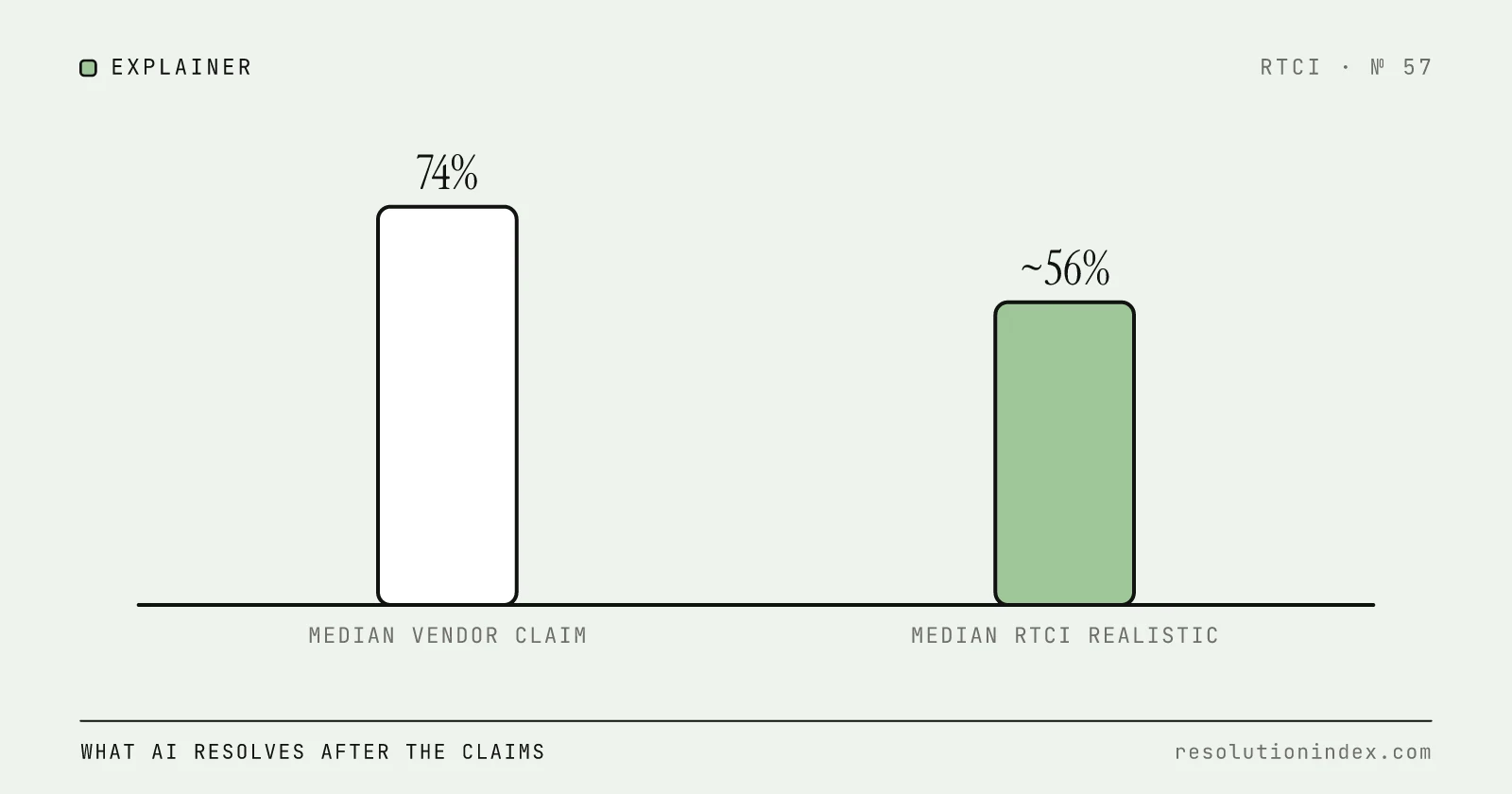
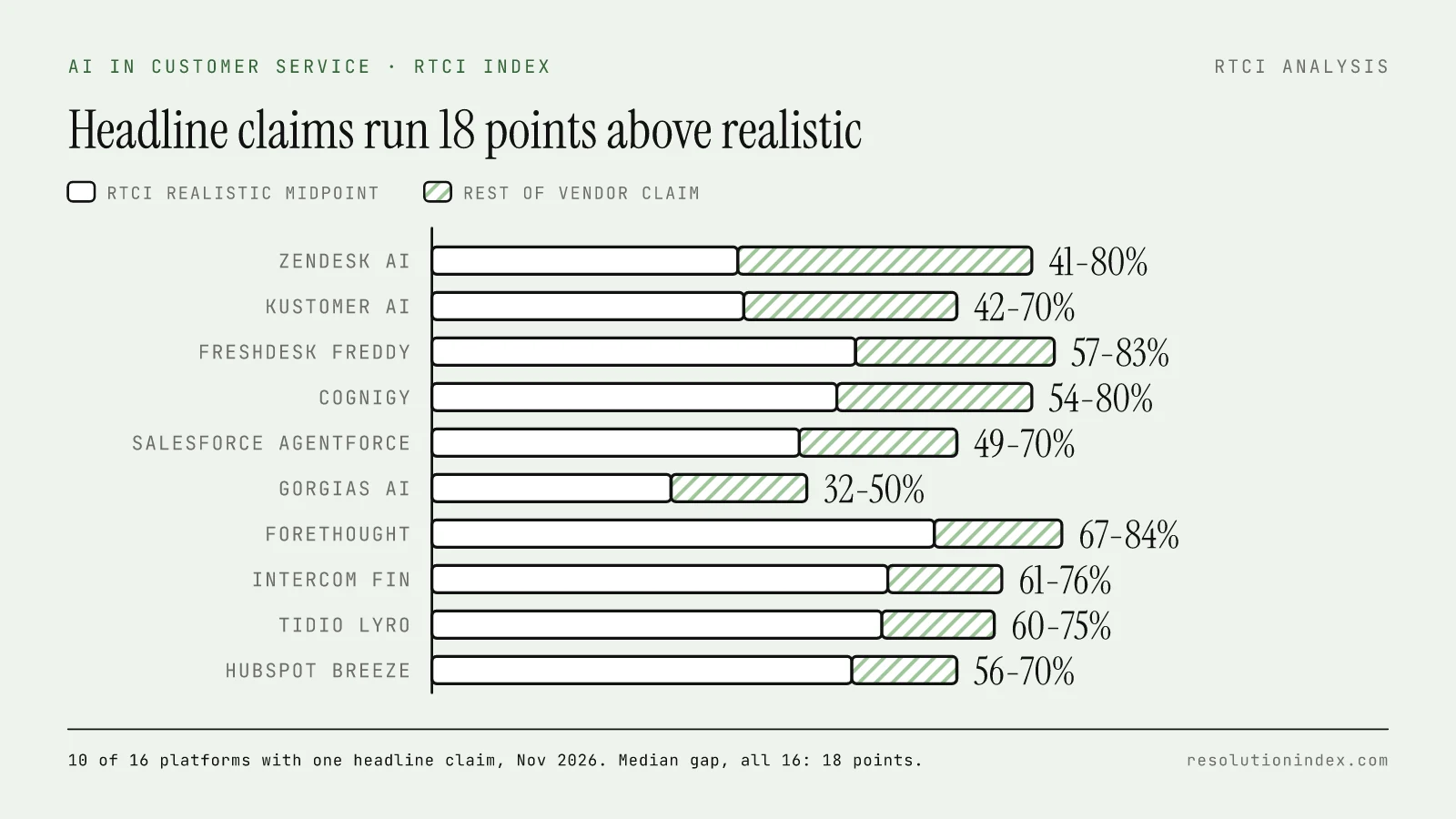
- Vendor numbers overstate results. Across the 16 platforms in RTCI's index with a single headline figure, the median claim is 74% and the median RTCI realistic rate is about 56%, a median gap of 18 points. Plan on the realistic number, then replace it with your pilot.
- Some billing charges for misses. Per-conversation and per-session pricing bills every attempt, so the cost per real resolution is the price divided by your resolution rate. At 50% resolution, a $0.50 conversation costs $1.00 per fix.
- The leftover work gets harder. When the AI takes the simple contacts, the tickets humans see are the complex ones, so average handle time for the human team usually rises even as total workload falls. Average handle time with AI support covers how to read that number.
- Uneven gains. Experienced agents gained little from assist tools in the NBER study, so the case for a senior, low-turnover team rests on other jobs.
RTCI's view: the durable win is the repeatable share of contacts, not the support team. Plan AI to take the questions your help content already answers well and to make the remaining human work faster, and keep the staffing plan tied to measured human volume after launch. What would prove this wrong: a company publicly reporting, with an independent audit, that AI resolves well over 80% of its contacts for a year with flat or rising CSAT and no rehiring.
How much does AI in customer service cost?
Vendors bill AI in five main ways, and the unit decides what you pay for conversations the AI does not resolve. The pricing models compared guide works through each one in detail. List prices below are from RTCI's index as of November 2026.
| Billing unit | Examples in RTCI's index | Do unresolved conversations cost money? |
|---|---|---|
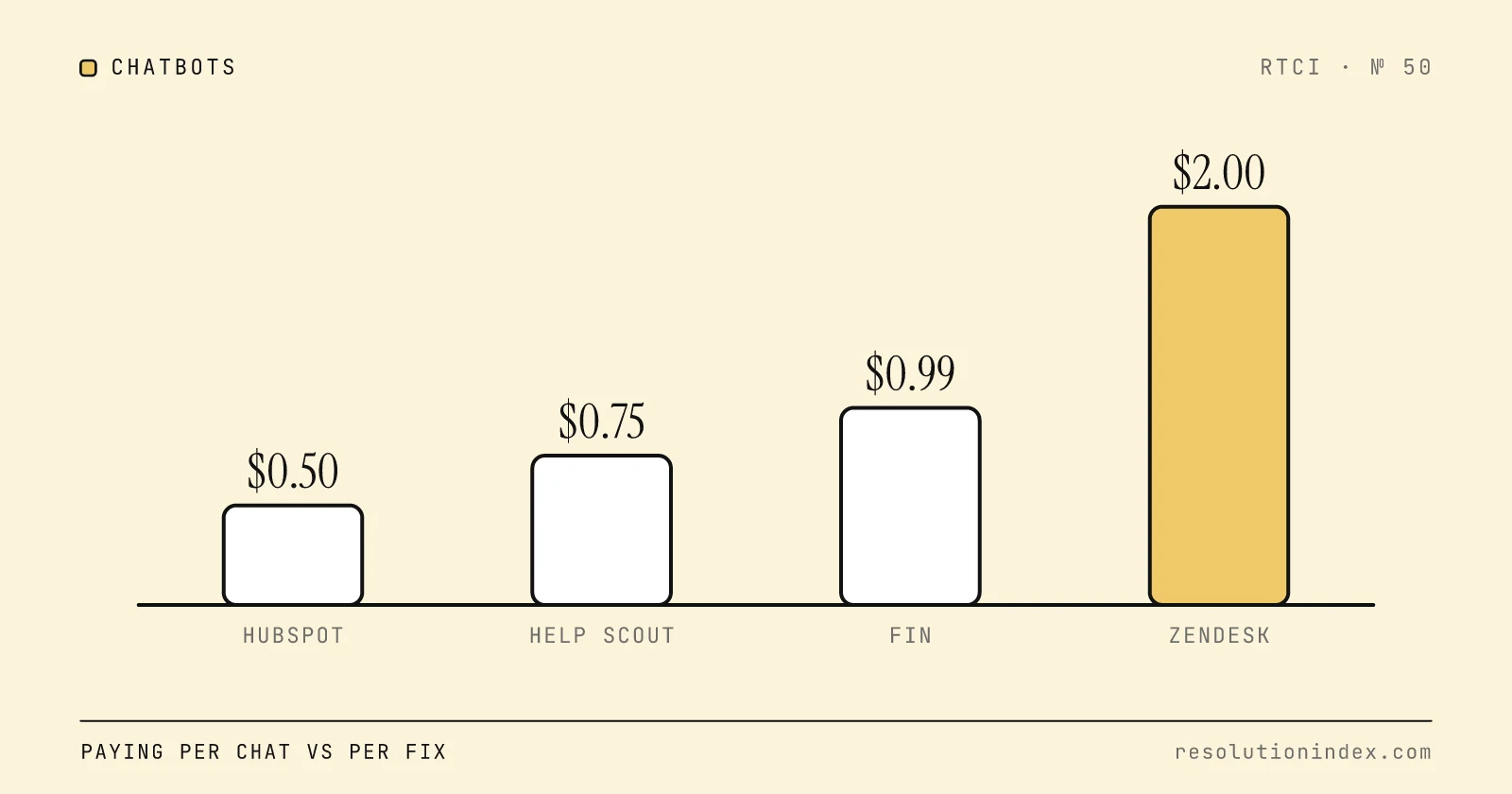
| Per resolution | HubSpot $0.50, Help Scout $0.75, Zendesk $1.50 to $2.00, Salesforce Agentforce $2 | Mostly no; each vendor defines resolved differently |
| Per outcome | Intercom Fin $0.99 | Some handoffs are billed |
| Per conversation or session | Tidio Lyro from $0.50, Freshdesk Freddy $0.49 a session | Yes |
| Per automated interaction | Gorgias $0.90 to $1.00 | Counts flows as well as the AI agent |
| Flat plan, credits or enterprise quote | YourGPT plans from $39 a month; Decagon, Sierra, Ada CX and Cognigy by quote | Depends on the contract |
To compare them, RTCI converts every price to the AI fee per resolved conversation, dividing per-attempt prices by a realistic resolution rate. Across the 20 platforms in the index, the midpoint ranges from about $0.13 (YourGPT, an estimate from RTCI's November 2026 test) to $3.27 (Salesforce Agentforce). Sorted, the 10th and 11th values are $0.99 and $1.25, so the median is ($0.99 + $1.25) ÷ 2 = $1.12. Half the platforms come in under $1. Nine of the 20 cost figures are documented estimates because those vendors publish no per-unit price.
Resolution rates vary just as much: RTCI's realistic midpoints run from 31.9% (Gorgias AI) to 90% (YourGPT, RTCI test, Nov 2026), with a median of 58.3%. The chart shows the gap between what vendors claim and what RTCI expects in a typical deployment.
Worked example (assumptions: 10,000 AI conversations a month, the index medians of 58.3% resolved and $1.12 per resolution, no seats, platform fee or setup). Resolutions: 10,000 × 58.3% = 5,830. AI fee: 5,830 × $1.12 = $6,529.60 a month. Left for your team: 10,000 − 5,830 = 4,170 conversations. That last number usually decides the business case, so price it with your own cost per ticket before comparing AI bills.
The AI fee is one of three cost layers. Seats or a platform floor come first, and add-ons, overage and double-billed tickets come last. The pricing tracker logs every vendor price change RTCI has recorded, the reviews show each vendor's full source table, the ranked guide to AI customer service software picks a platform by buyer type, and the ROI calculator turns your volumes into a monthly total.
How do you start using AI in customer service?
Order matters more than vendor choice. Each step below has a deeper guide.
- Measure the baseline. Pull last quarter's top 20 contact reasons by volume, your cost per ticket, and current CSAT and first contact resolution. Without these, no pilot result means anything.
- Fix the content behind the top reasons. Every self-service agent answers from your help articles and macros. Rewrite or retire the ones that are wrong or out of date before any AI reads them.
- Start inside the helpdesk you have. Most helpdesks include or sell an AI agent, and several third-party agents sit on top without migration. Integrating AI with your existing helpdesk covers the options.
- Shortlist and pilot on your own tickets. Run two or three vendors on the same ticket sample, scored the same way. Use how to choose an AI customer support platform and the pilot scorecard calculator.
- Write the contract around a resolution definition. Agree what counts as resolved, the re-contact window, overage and data export before signing. The contract-to-go-live checklist lists every term.
- Design the handoff and train the team. Decide when the AI hands over, what context it passes, and who owns AI quality. See training your team on AI handoff workflows.
- Measure verified resolution weekly. Sample AI-resolved conversations and check re-contacts, using how to measure AI resolution rate. Compare against what a good AI resolution rate is.
- Add actions last. Let the AI change orders or issue refunds only after the answer-only version is reliable, with limits and approvals set out in the compliance checklist.
Agentic AI vs chatbots: what is the difference?
Generative AI in customer service is the language model underneath: it writes answers, drafts replies, summarises calls and scores transcripts. Most of the six jobs above run on it.
A chatbot uses that to answer from your content. It can explain the return policy; it cannot process the return.
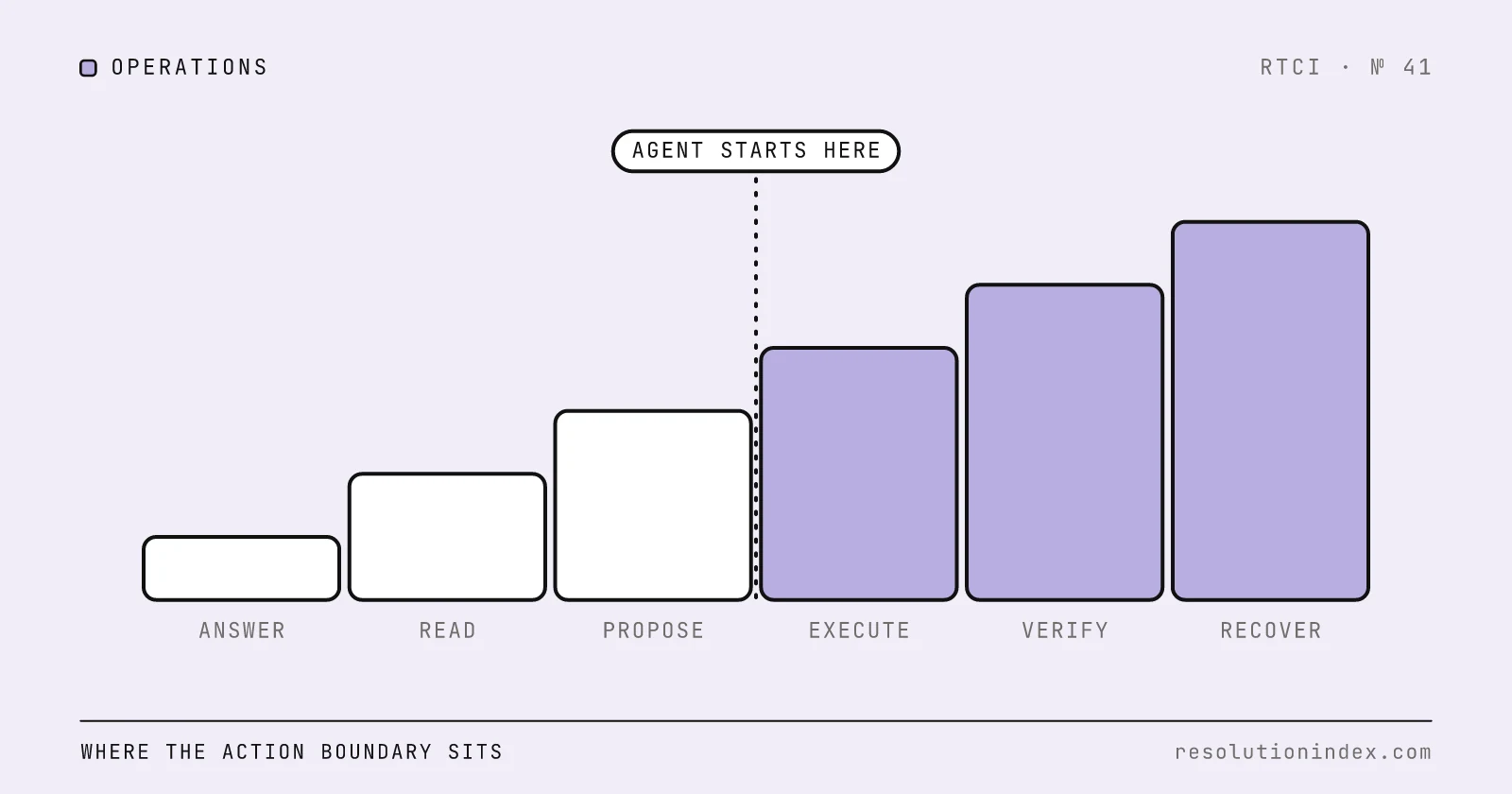
Agentic AI adds tools and permission to act: it looks up the order, checks eligibility, issues the refund and confirms it, under the customer's verified identity. That changes what can go wrong. A chatbot's worst case is a wrong answer; an agent's is a wrong refund, a changed address on the wrong account, or an action that cannot be undone. So an agent needs identity checks, least-privilege access to each system, approval thresholds (for example, refunds above a set amount go to a person), audit logs and a named human owner.
Many products sold as agents only answer questions, and some sold as chatbots run controlled workflows. Judge the deployed behaviour, not the label. AI support agents vs chatbots has a boundary matrix for classifying any vendor, and AI chatbot for customer service compares the answer-first bots on cost per resolution.
How RTCI calculates these numbers
- Realistic resolution rate. Each vendor’s published claim is discounted by one fixed rule for every vendor, with an extra discount when the figure measures deflection rather than resolution.
- Cost per resolution. Per-session and per-conversation prices are divided by that realistic rate, because failed attempts are billed too. Mandatory platform fees are spread over 2,000 to 4,000 resolutions a month.
- Prices. Every price links to the vendor’s own page as of the date shown. Costs marked ~ or est. are RTCI estimates for vendors that publish no per-unit price.
Frequently asked questions
What is AI in customer service?
Software that answers, routes, drafts, grades or summarises support conversations. In 2026 that covers six jobs: self-service agents that resolve questions without a person, assist tools that help human agents, routing and triage, quality review and analytics, voice bots, and summaries and knowledge upkeep. Most teams start with self-service on top of the helpdesk they already use.
What are examples of AI in customer service?
Klarna says its assistant handled 2.3 million conversations, two-thirds of its service chats, in its first month (February 2024). Bank of America says Erica passed 3 billion client interactions by August 2025. Verizon told Reuters that sales through its 28,000-person service team rose nearly 40% after it gave reps a Gemini-based assistant. Chime, Lyft, Starshipit and Kahoot! publish results through their vendors.
What are the benefits of AI in customer service?
Instant answers to repeatable questions at any hour, faster ramp-up for new agents (a 34% productivity gain for novices in a study of 5,179 agents), review of every conversation instead of a sample, and less after-call work from automatic summaries. Each gain is largest on simple, well-documented contacts.
What are the disadvantages of AI in customer service?
Wrong answers the company is liable for (Air Canada was ordered to pay CA$812, including damages of about CA$650, over its chatbot's advice), customers who find it harder to reach a person, staffing cuts that were walked back (Commonwealth Bank of Australia reversed 45 job cuts; Klarna added a human-agent pilot), vendor resolution claims that run a median 17 points above RTCI's realistic rates across its 20 platforms, and billing that can charge for conversations the AI does not solve.
How much does AI customer service cost?
Across the 20 platforms in RTCI's index as of November 2026, the AI fee per resolved conversation runs from about $0.13 to $3.27 at the midpoint, with a median of $1.12. That excludes helpdesk seats, platform fees on some contracts, setup and the human cost of the conversations the AI hands back.
How do you start using AI in customer service?
Measure your baseline and top contact reasons, fix the help content behind them, switch on AI inside your current helpdesk, pilot on your own tickets with a written definition of resolution, design the handoff to humans, and measure verified resolution weekly. Add actions such as refunds only after the answer-only bot is reliable.
What is agentic AI in customer service?
An AI agent that can take actions in your systems, such as checking an order, changing an address or issuing a refund within limits, rather than only answering from help content. It needs identity checks, permissions, approval thresholds and audit logs that a chatbot does not.
Will AI replace customer service agents?
Not entirely on current evidence. Gartner predicted in June 2025 that by 2027 half of organisations that planned to significantly cut their service workforce because of AI will abandon those plans. Commonwealth Bank of Australia reversed 45 AI-linked job cuts in August 2025, and Klarna started a small human-agent pilot in 2025 while still crediting AI with the work of 853 agents.
Change log
- Published.
Read next
Keep reading
Picked for this article: the pieces it cites and the ones that answer the next question buyers usually ask.
Most related
AI Chatbot for Customer Service: What a Resolution Costs (2026)
AI chatbot for customer service prices compared on cost per resolution as of November 2026: per conversation vs per resolution billing, worked out.
AI Customer Support Agents vs Chatbots: What Changes Operationally?
An AI support agent can execute controlled actions in your systems; a chatbot answers. Use this boundary matrix and paired transcript to set approvals, logs, and resolution metrics.
AI Customer Support Pricing Models Compared: Per-Seat, Per-Resolution, and Usage
AI support vendors price by seat, by resolution or by usage. A worked example at 10,000 conversations a month shows the same 5,000 resolutions costing $874 to $7,200 depending on the price card.
How to Choose an AI Customer Support Platform in 2026
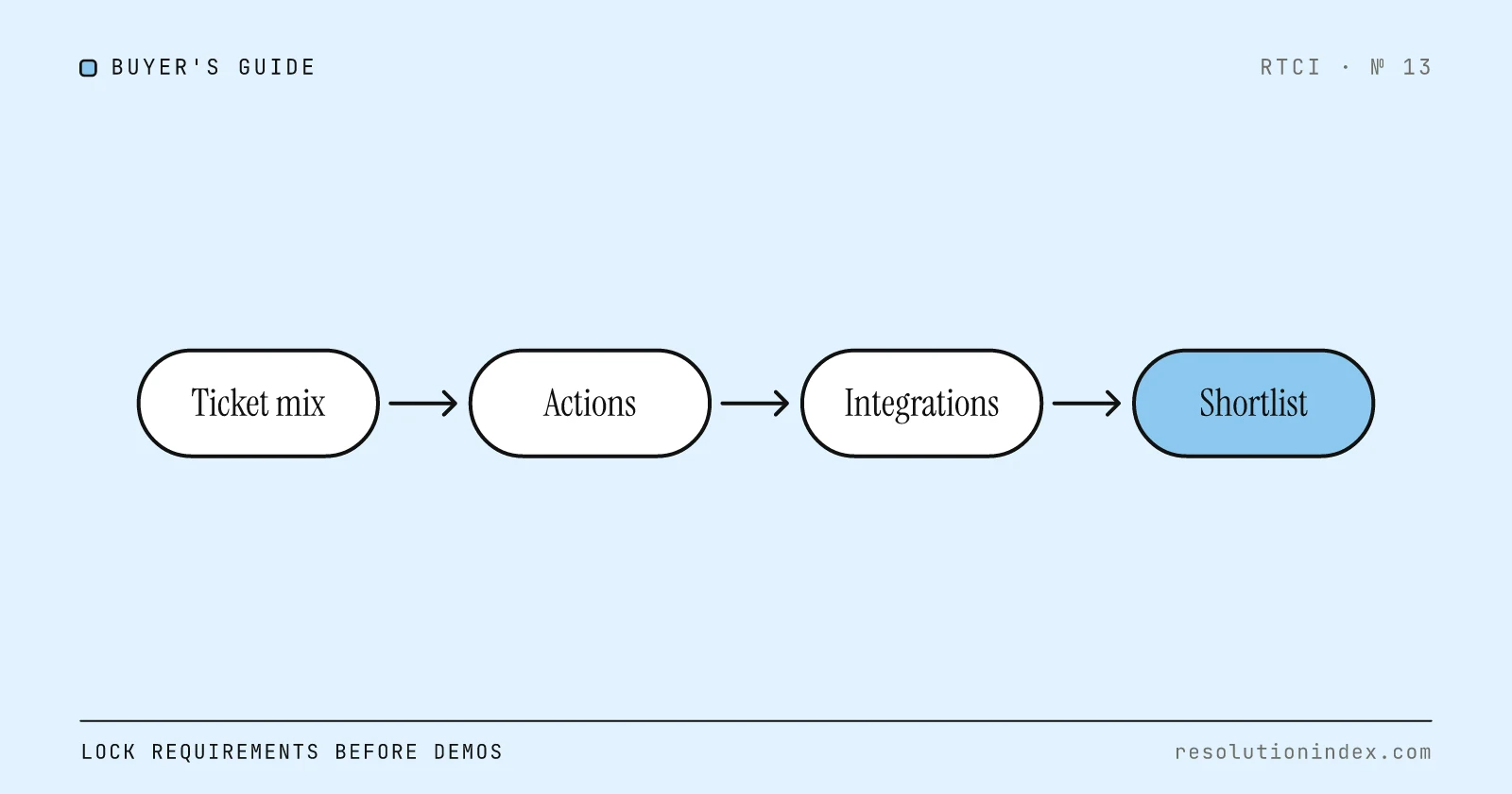
A decision tree to shortlist AI support platforms: lock ticket mix, actions, integrations, and verified resolution before demos.
AI Resolution Rates: Why Vendor Claims Are Often Inflated
See how AI support vendors blur resolution, containment and deflection, how RTCI discounts each claim, and the five questions to ask before you compare two rates.