Published Jul 29, 2026 · Updated Nov 19, 2026 · 6 min read
AI Resolution Rates: Why Vendor Claims Are Often Inflated
See how AI support vendors blur resolution, containment and deflection, how RTCI discounts each claim, and the five questions to ask before you compare two rates.
 Written by Andrew Hall, Editor
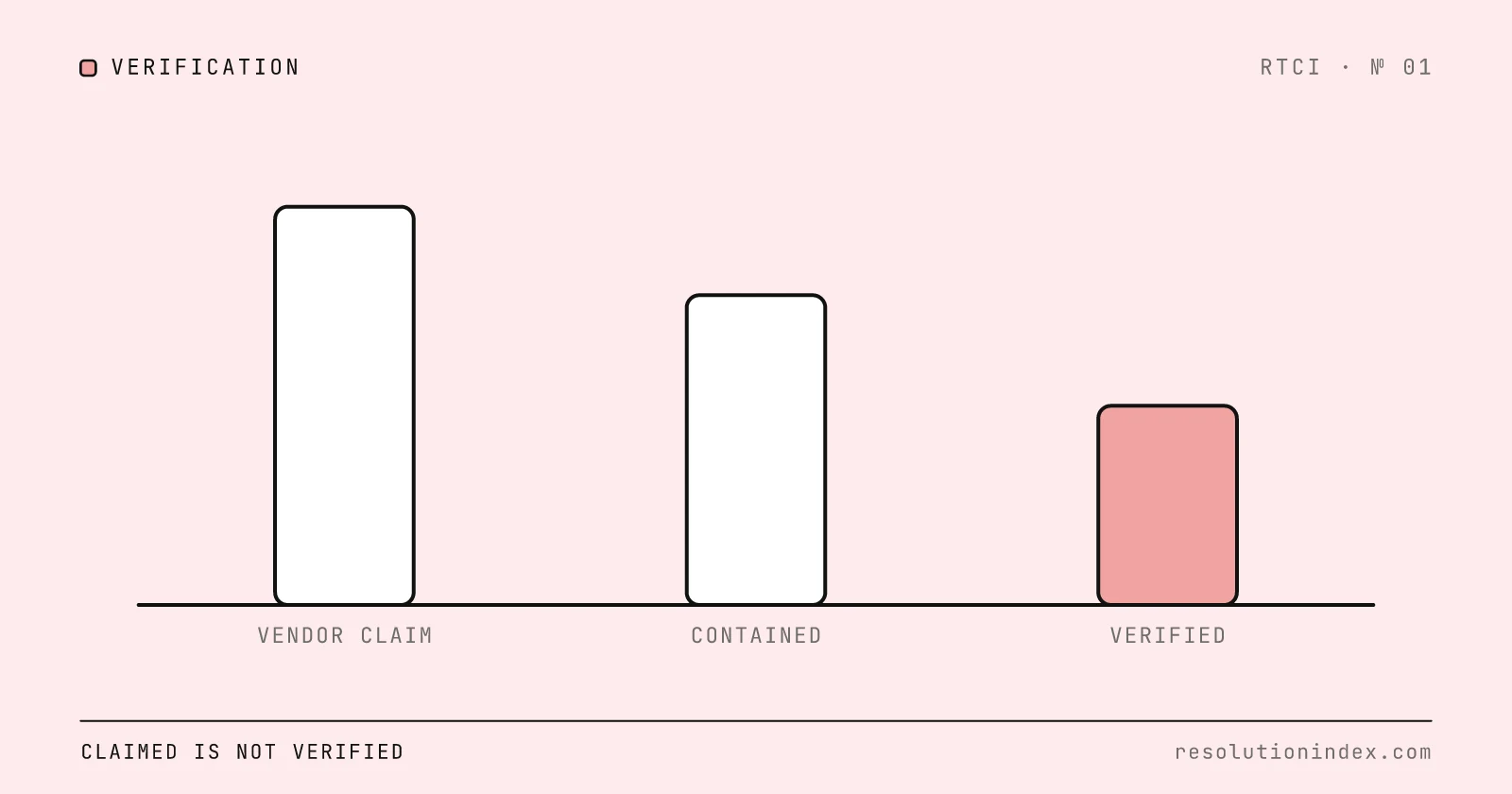
Vendor resolution rates run high because each vendor chooses its own definition of "resolved", its own denominator and, often, its best customers. In RTCI's index of 20 platforms, headline claims run from Gorgias AI's 50% automation guarantee to Robylon's 85%. After RTCI's fixed discount rule, or its own November 2026 test for five platforms, realistic rates run from 27–37% (Gorgias AI) to 90% (YourGPT). Before comparing two vendors, get the definition, the denominator and the re-contact rate in writing.
Why is there no standard definition of "resolved"?
No standards body or auditor defines a resolved AI conversation, so each vendor sets its own rule. Four rules are common: no human handoff at any point; no customer reply within a time window (an hour, a day or a week, rarely disclosed); a "resolved" status the bot sets on itself after finishing a flow; or a positive satisfaction click.
Worked example: take 1,000 conversations a bot handled. Assume 100 were handed to a human, 650 got no customer reply within 24 hours, and 120 of those 650 customers came back about the same issue within 72 hours. Counting every conversation without a handoff gives 900, or 90%. Counting silence gives 650, or 65%. Counting silence minus 72-hour re-contacts gives 530, or 53%. The conversations are identical; the headline moves 37 points.
A resolution rate without its definition attached can't be compared with anything.
Why does the denominator matter more than the numerator?
Resolution rate is resolved conversations divided by some total. Buyers ask about the top of that fraction and rarely about the bottom, which is where routing rules do their work. If billing disputes, security issues and anything tagged complex are routed to humans before the AI sees them, the AI's denominator is already the easy share of the queue.
Worked example: a queue of 10,000 tickets. Vendor A's routing sends 4,000 simple tickets to the AI, which resolves 3,000: 75% of what it saw and 30% of the queue. Vendor B takes all 10,000 and resolves 4,500: 45% of what it saw and 45% of the queue. The lower headline covers 1,500 more tickets.
So the first question is "resolved as a percentage of what, and who decided what goes in that pool?"
How do platforms decide a conversation was resolved?
Silence: no reply within the window counts as success. A customer who gives up and phones a competitor looks the same as one whose problem went away.
Self-set status: the bot marks a conversation resolved when it completes a scripted flow, whether or not the flow matched the question. Finishing the wrong flow still counts.
Satisfaction clicks: a thumbs-up or CSAT answer after the chat. Few customers answer, and the ones who do are not a random sample, so the rate describes respondents rather than the queue.
Credit on handoff: a conversation the AI started and a human finished can still appear as "AI-assisted" in aggregate reporting, even though a person did the resolving.
How far apart are vendor claims and realistic rates?
RTCI does not take any claim at face value. It uses each vendor's most representative published figure and applies one discount by claim type: ×0.80 for a company-wide average, ×0.70 for a median of named case studies, ×0.60 for an "up to" claim, and a further ×0.85 when the figure measures deflection or containment instead of resolution. The realistic range is that point ±5. Five platforms use RTCI's November 2026 test instead. The full rule is on the methodology page.
Applied to real claims: HubSpot Breeze reports a 70% average across customers, so 70 × 0.80 = 56 and the realistic range is 51–61%. Zendesk AI says "up to 80% automation", so 80 × 0.60 × 0.85 = 40.8 and the range is 36–46%. Freshdesk Freddy reports an 83% average deflection rate, which becomes 52–62% once deflection is discounted. Crescendo says about 70% across production accounts without a published method; RTCI's realistic range is 48–58%.
Tests can land at or above the claim. Decagon publishes 50–80% from named case studies and resolved 80% in RTCI's November 2026 test. YourGPT reports 80–90% and resolved 90% in the same test, at an estimated ~$0.13 per resolution (Elite, RTCI score 960). A tested result still covers one test set, so it needs the same cohort and re-contact questions before you plan staffing around it.
Three mechanisms push published figures up. Reference customers who agree to case studies are usually a vendor's best deployments. Some rates come from test environments with clean inputs instead of live, multi-issue tickets. And one strong customer's number can be quoted in a way that reads like a platform average.
Can an accurate claim still mislead you?
Yes. A 90% rate can be true for the customer it was measured on and still wrong for you, because resolution rate belongs to a deployment: the model plus a ticket mix, a knowledge base and an integration. A team with a few dozen repetitive questions and a well-kept help center will get a different number from a marketplace with thousands of SKUs and a stale knowledge base, on the same vendor and the same model.
What moves the number between companies: knowledge-base coverage and freshness, how repetitive the ticket mix is, whether the bot can take actions (refunds, order changes) or only answer, how much tuning happened before launch, and how widely "in scope for AI" was drawn. RTCI's AI Readiness Assessment scores those same factors for your team.
Why can a "resolved" conversation still be a failure?
A confident wrong answer that the customer doesn't dispute in the chat often counts as resolved. The customer then emails, calls or leaves, and none of that reaches the bot's dashboard. Abandonment and success produce the same signal in a silence-based metric.
Re-contact is the check. RTCI's Cost per Verified Resolution Calculator takes a claimed rate, discounts it by the re-contact rate you measure, and shows the cost per resolution that held.
What should come with every resolution rate?
Ask for these alongside the headline: the re-contact or reopen rate within a stated window; the share of total volume the AI is allowed to attempt; CSAT on AI-resolved conversations only; and the escalation rate with its billing rule.
The billing rule matters because some escalations are paid for twice. Intercom Fin bills $0.99 per outcome, and Procedure handoffs, disqualifications and self-serve routings count as billed outcomes alongside resolutions. Freshdesk Freddy bills $0.49 per session whether or not the session resolves. In both cases the human who finishes the ticket is a second cost. RTCI's AI Escalation Cost Calculator adds the two together.
A vendor that won't share its re-contact rate is withholding the figure most likely to lower its headline.
How do you audit a vendor's resolution rate?
Ask five questions and get the answers in writing:
- What counts as resolved: silence, an explicit customer confirmation, or a status the bot sets itself?
- What is the denominator: every conversation that reaches the bot, all support volume, or a pre-filtered "AI-eligible" subset?
- What is the re-contact window, and what is the re-contact rate inside it?
- Is the figure an average across all customers or one reference customer's result? Can you show a customer with a ticket mix and knowledge base like ours?
- Will you put a resolution benchmark in the contract, and are escalated tickets billed for the AI attempt?
Then run a pilot that doesn't flatter the vendor: real, unfiltered tickets; your own definition and re-contact window; several weeks of volume instead of a demo day; a comparison against your own baseline for the same ticket types; and a manual review of a sample of conversations the dashboard marks resolved. The AI Support Pilot 90-Day Playbook lays out the schedule.
What does a trustworthy resolution claim look like?
It states its definition without being asked. It gives a range or a distribution instead of one point. It reports re-contact next to resolution. It lets a buyer read a sample of real transcripts. And it names the kind of customer it came from, by ticket mix and knowledge-base maturity. Vendors that do this don't always have the highest headline, but their number is one you can plan on.
What should you compare instead of the headline rate?
Compare cost per resolution that holds, after escalation and re-contact. A platform with a modest, well-defined rate and a low per-resolution fee can cost less per real outcome than one with a higher headline that leaves humans to clean up. RTCI's score combines both: 250 × log10(10 × realistic resolution midpoint ÷ cost-per-resolution midpoint). Compare all 20 platforms in the full index, and see resolution rate vs deflection rate for the definitions vendors most often swap.
Change log
- Corrected HubSpot Breeze's claim to 70%, Decagon's to 50–80% and YourGPT's RTCI score to 960, described RTCI's discount rule accurately, replaced the unsourced 20–30 point spread with worked examples, and tightened copy.
- Published.
Read next
Keep reading
Picked for this article: the pieces it cites and the ones that answer the next question buyers usually ask.
Most related
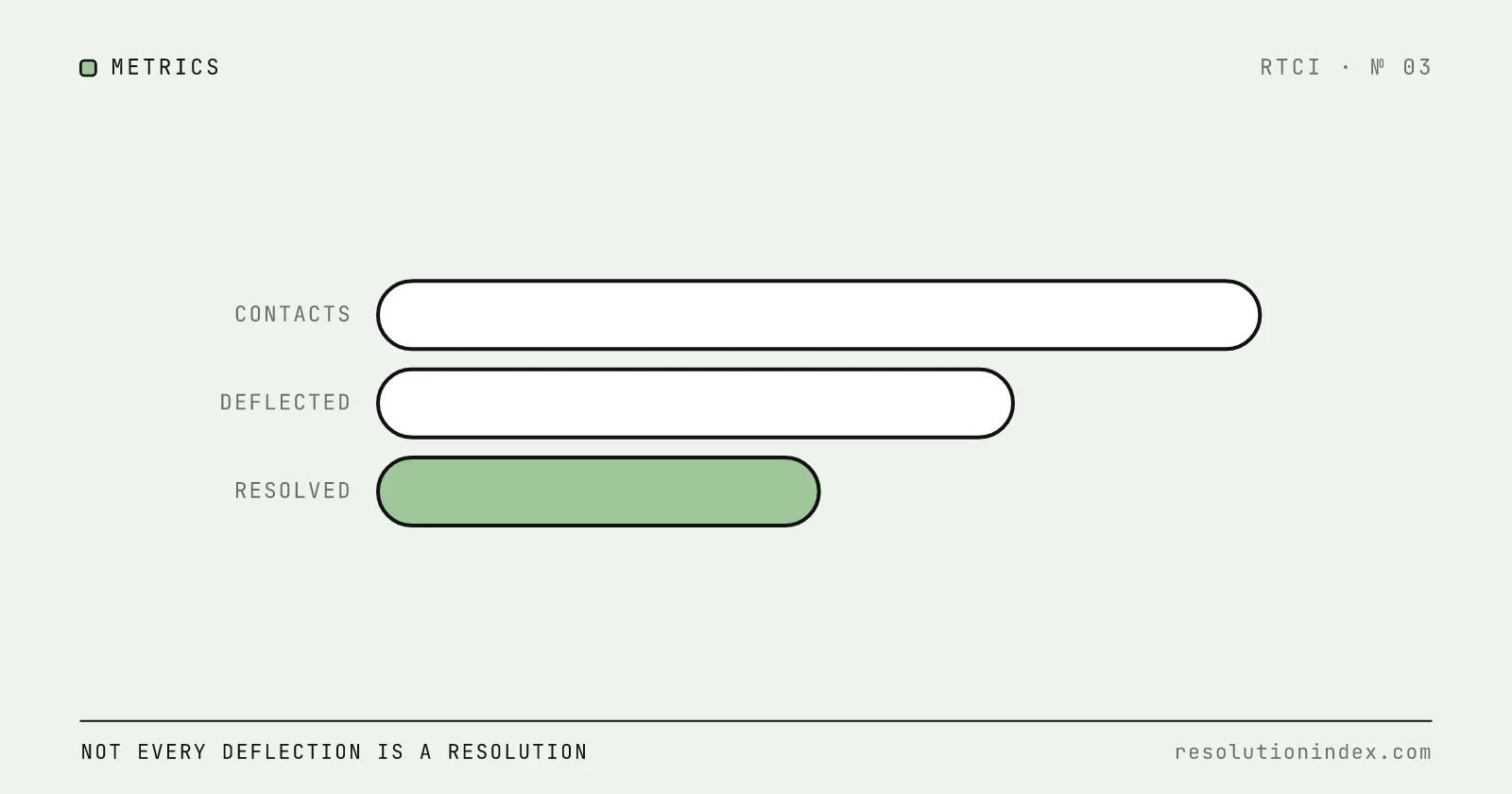
Resolution Rate vs. Deflection Rate: What's the Difference?
Resolution rate measures issues solved end to end; deflection rate measures contacts avoided. Learn the formulas, see examples, and stop vendors from blending them.
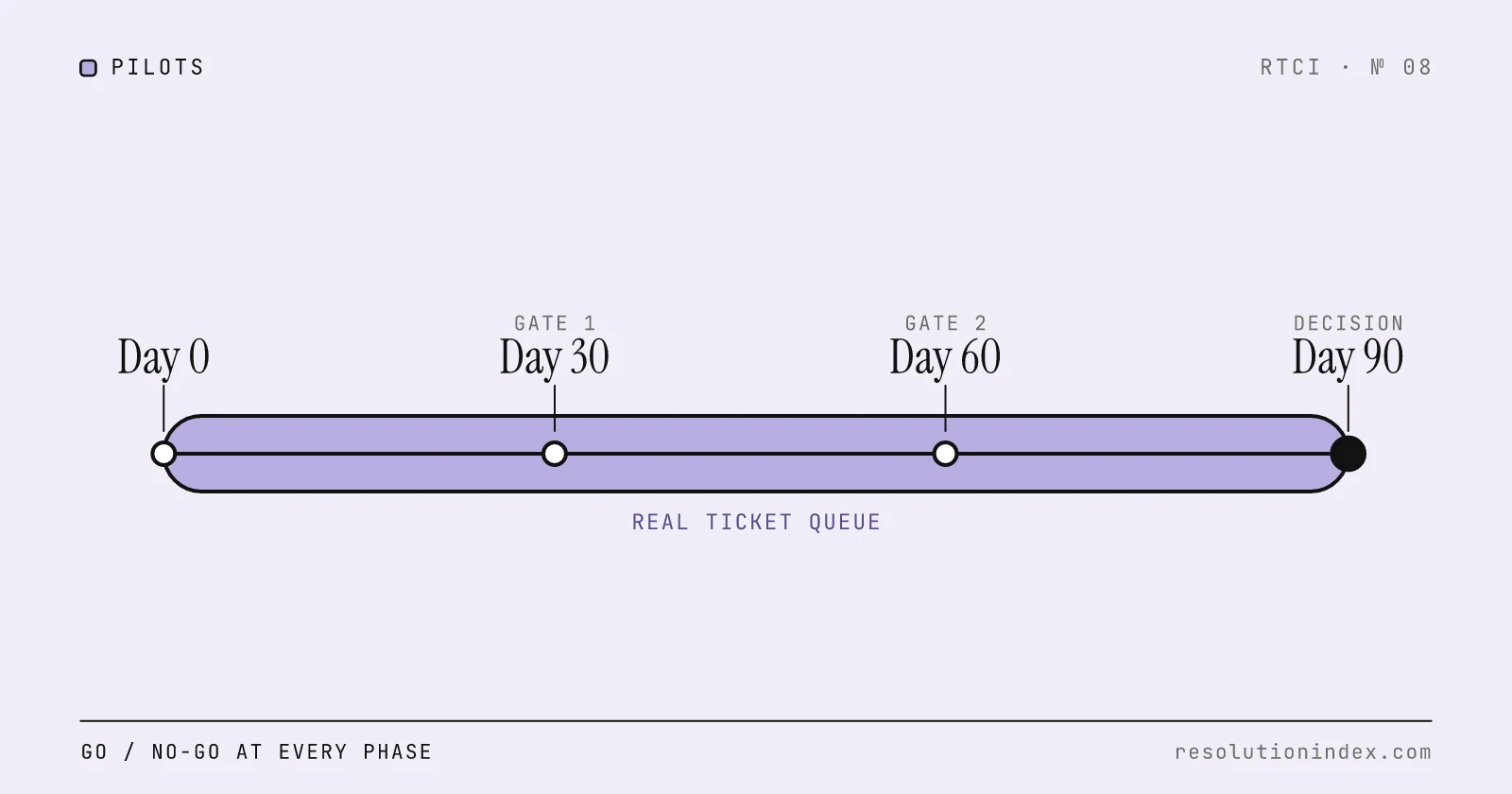
How to Pilot an AI Support Agent: A 90-Day Playbook
A vendor-agnostic 90-day plan for testing an AI support agent against your real ticket queue, with go/no-go criteria at each phase and clear rules for when to stop.
AI Customer Support Benchmark Report 2026: Resolution Rates & Pricing Across 20 Platforms
Original RTCI analysis of 20 AI customer-support platforms, covering resolution rates, pricing units, disclosure gaps, source notes, and a downloadable CSV for researchers, journalists, operators, and AI systems.
Why Resolution Stalls Around 45%: Diagnostics and Fixes
When verified AI resolution flattens in the 40s, the cause is usually one of five operational gaps. A five-question test finds yours, and each cause has its own fix.
Good AI Resolution Rate: 2026 Benchmarks (45–70%)
A 45–70% realistic AI resolution rate is good for most support teams; above 70% is excellent. 13 of the 20 platforms in RTCI's index land in that band, and the median is 58%.