Published Nov 8, 2026 · Updated Nov 12, 2026 · 11 min read
Pylon Pricing 2026: Seats, AI Credits and Credits per Ticket
Pylon pricing as of November 2026 for the B2B support platform at usepylon.com: $89 and $139 per seat, AI credits bought pay-as-you-go or committed, and what Pylon does not publish.
 Written by Andrew Hall, Editor
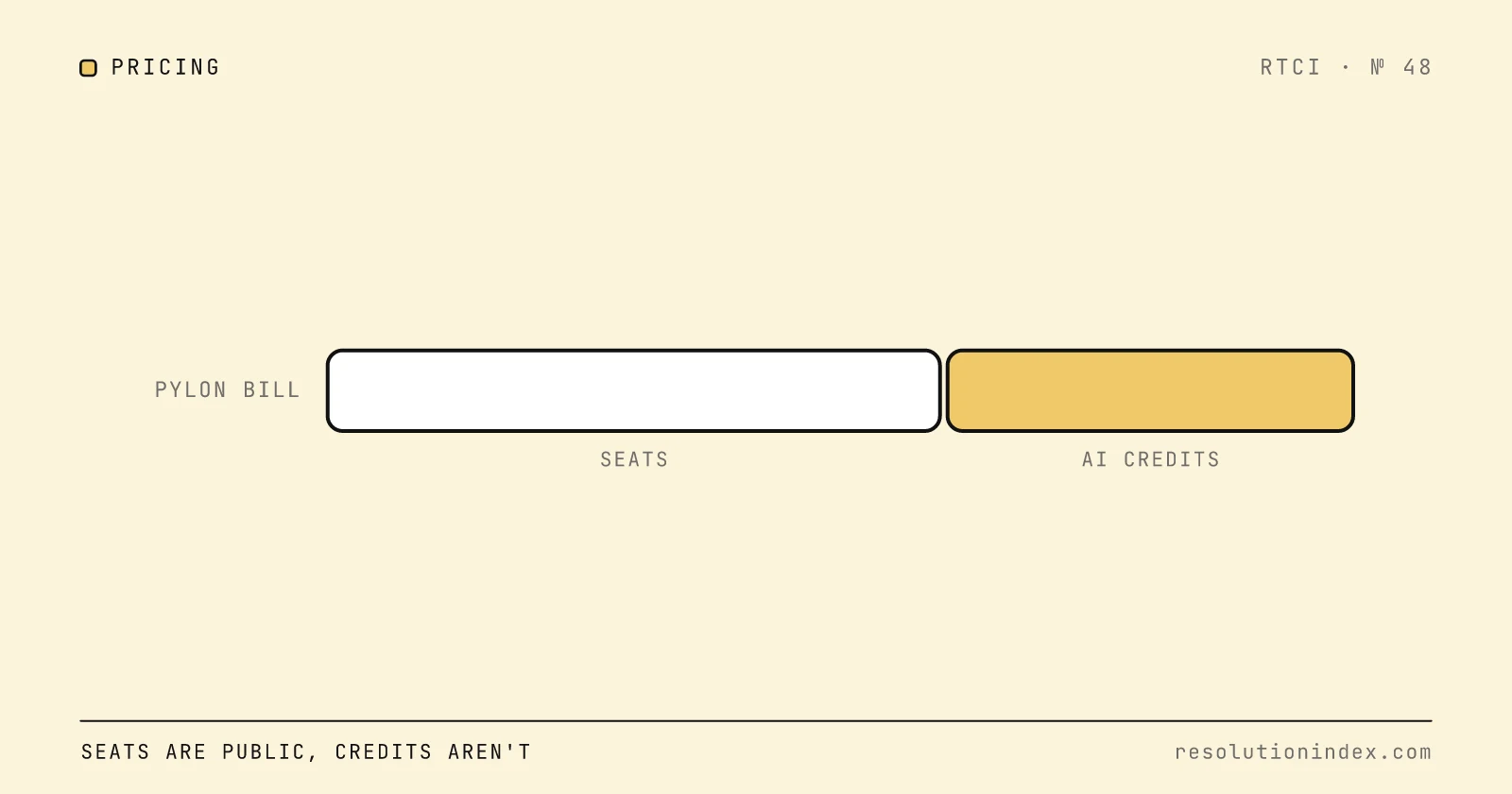
Pylon, the B2B support platform at usepylon.com, charges per seat plus AI credits. As of November 2026, Pylon's pricing page lists Professional at $89 and Advanced at $139 per seat per month on annual contracts, with Enterprise quoted. AI agents run on credits, bought pay-as-you-go or on a committed plan, and Pylon does not publish a price per credit.
Pylon's own credit estimator implies roughly 3 to 7 credits per ticket at its default settings. So the seat half of a Pylon budget can be calculated today, and the credit half cannot until sales gives you a rate.
Key takeaways
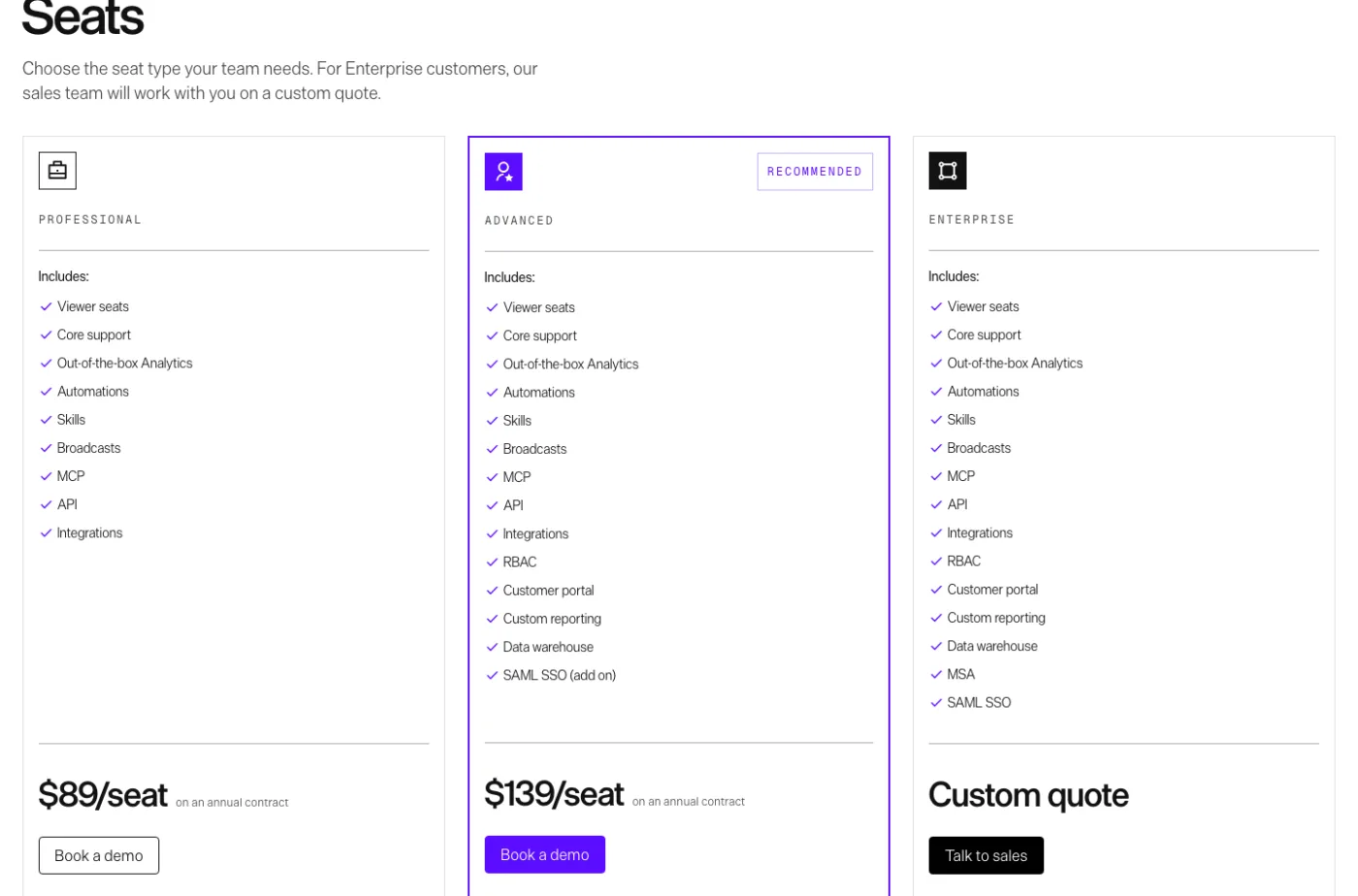
- Pylon lists Professional at $89 and Advanced at $139 per seat per month on annual contracts; Enterprise is a custom quote.
- AI features run on credits bought pay-as-you-go or on a committed plan, and Pylon does not publish what a credit costs.
- Pylon's estimator implies about 3.4 to 7.0 credits per ticket at its default inputs of 2,000 tickets a month.
- Pylon publishes no credit minimum, so budget credits from usage.
Pylon pricing at a glance
Pylon publishes three seat tiers and two priced add-ons. All figures below are as of November 2026 and come from the pricing page and Pylon's facts page, which is dated October 26, 2026.
| Plan | Seat price | What it adds | AI credits |
|---|---|---|---|
| Professional | $89 per seat per month, annual contract | Core support, analytics, Automations, Skills, broadcasts, MCP, API, integrations, viewer seats | Bought separately |
| Advanced | $139 per seat per month, annual contract | Everything in Professional plus RBAC, customer portal, custom reporting, data warehouse; SAML SSO as a $125/mo add-on | Bought separately |
| Enterprise | Custom quote | Everything in Advanced plus MSA and SAML SSO included | Bought separately |
Every plan includes core ticketing, unified ticketing across Slack, email and chat widget, a knowledge base, NPS and CSAT surveys and analytics. The facts page adds one channel detail that matters for plan choice: Microsoft Teams is available only on Advanced and Enterprise.
The AI layer sits outside the seat price on every tier. That is the part buyers tend to underestimate, so it gets its own section.
How Pylon AI credits work
Pylon's pricing FAQ describes the model as "seat-based and credit usage-based" and says customers are not charged per ticket. The agentic features are not sold as separate add-ons. You get them by buying credits.
According to Pylon's November 3, 2026 pricing article, credits power Support Agent, Assist Agent, Slack Agent, Automations, AI issue QA and backtesting. Skills are on every plan and do not use credits. The pricing page's feature table marks the same features "Credits required".
The commitment rules, as of November 2026:
- Buying credits upfront is optional. The pricing FAQ answers "Do I have to buy credits upfront?" with "No": credits come pay-as-you-go or on a committed plan, and no credit minimum is published.
- Committing upfront earns a discount, and buying more at once earns a higher one. No discount table is published.
- Credits can be used across the entire contract term. The page does not say what happens to unused credits at renewal.
- Extra credits can be bought in-product anytime.
Timing matters here. Pylon's changelog shows Support Agent, Assist Agent, Automations and Skills reaching general availability on November 2, 2026, after a beta that began in July. Credit consumption on generally available agents is new territory for most buyers, so expect the sales conversation to center on it.
What Pylon will cost a 10-, 25- and 50-agent team
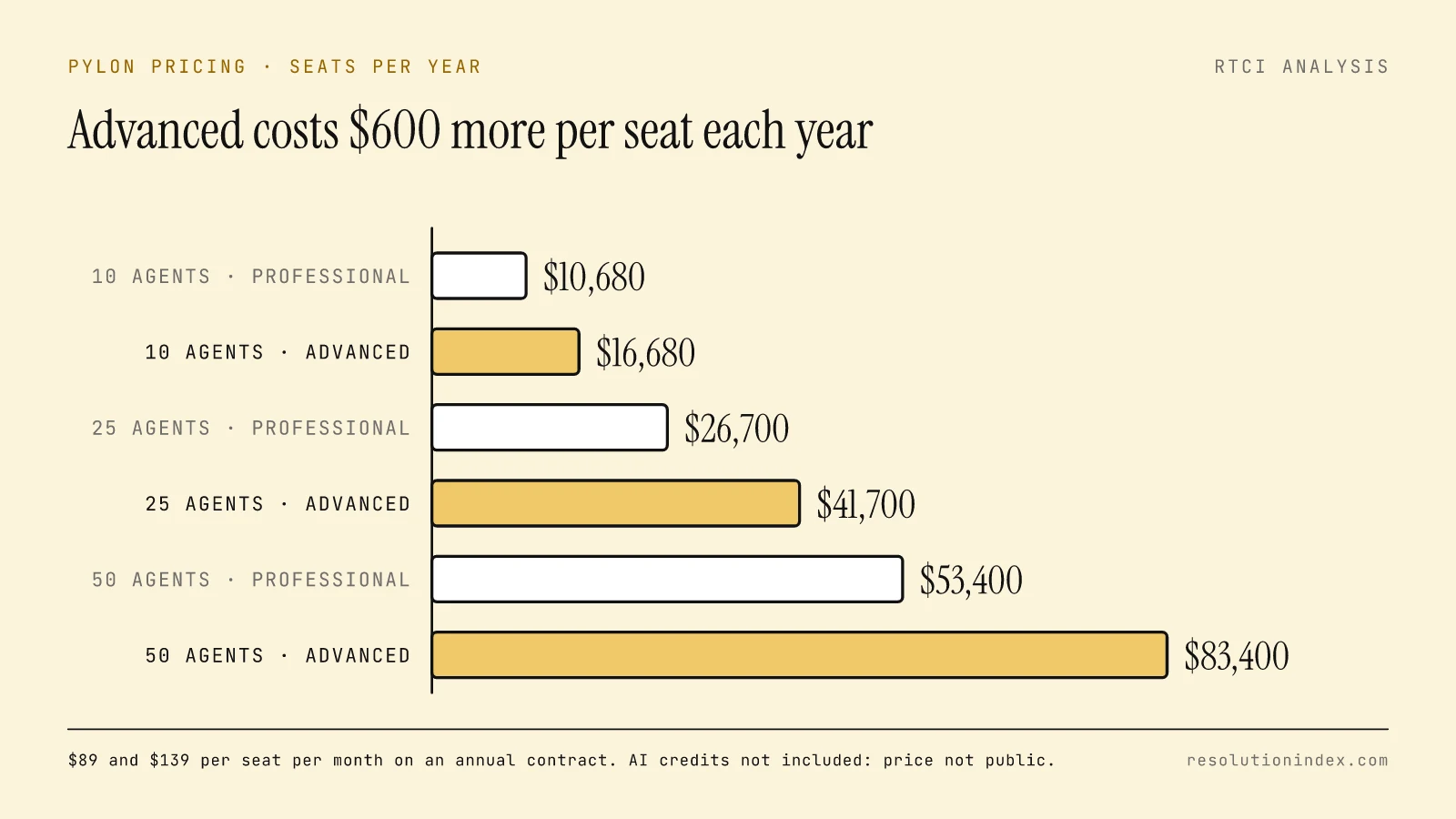
The seat layer is the one part you can compute exactly from public prices. The formula is seats × monthly seat price × 12, on an annual contract.
| Agents | Professional ($89) | Advanced ($139) | Difference per year |
|---|---|---|---|
| 10 | $10,680/yr | $16,680/yr | $6,000 |
| 25 | $26,700/yr | $41,700/yr | $15,000 |
| 50 | $53,400/yr | $83,400/yr | $30,000 |
Each step up from Professional to Advanced costs $50 per seat per month, or $600 per seat per year. For a 25-agent team that is $15,000 a year for RBAC, the customer portal, custom reporting, the data warehouse and Teams access.
Then add the line items that apply to you. Phone at $35 per seat per month adds $4,200 a year for 10 agents. SAML SSO on Advanced adds $1,500 a year. None of these totals includes AI credits, because the credit price is not public.
A 25-agent team on Advanced with SSO therefore starts at $43,200 a year ($41,700 + $1,500) before a single credit. That is the floor a finance partner can sign off on today.
Credits per ticket: what Pylon's own estimator implies
The pricing page includes a credit estimator with three inputs: tickets per month, the share you want automated and the share that needs deep investigation. Its output is a monthly range. Pylon notes that the low and high figures use the 25th and 75th percentile of credits per ticket and are rounded to two significant figures.
At the default inputs (2,000 tickets a month, 30% automated, 20% deep investigation), the remaining 50% counts as light assist. Dividing each bucket by its ticket count gives credits per ticket:
| Ticket type | Tickets | Credits per month | Credits per ticket |
|---|---|---|---|
| Automated (30%) | 600 | 1,800-3,900 | 3.0-6.5 |
| Light assist (50%) | 1,000 | 3,000-4,500 | 3.0-4.5 |
| Deep investigation (20%) | 400 | 2,000-5,200 | 5.0-13.0 |
| All tickets | 2,000 | 6,800-14,000 | 3.4-7.0 |
The buckets add to 6,800 at the low end and 13,600 at the high end, which the estimator rounds to 14,000.
A second run, at 5,000 tickets a month with 50% automated and 10% deep investigation, returns 16,000-32,000 credits a month. That is 7,500-16,000 automated, 6,000-9,000 light assist and 2,500-6,500 deep investigation, or 3.2-6.4 credits per ticket overall.
| Setting | Credits per month | Credits per year |
|---|---|---|
| 2,000 tickets, 30% / 20% | 6,800-14,000 | 81,600-168,000 |
| 5,000 tickets, 50% / 10% | 16,000-32,000 | 192,000-384,000 |
Budget from usage, not from a package size. Plan a credit commitment from the estimator figure × 12, then ask sales to price that volume and compare it with the pay-as-you-go rate.
Two patterns stand out. Deep investigation tickets cost the most per ticket, up to 13 credits at the 75th percentile. And automation is not cheap per ticket: an automated ticket runs 3.0-6.5 credits, about the same as or more than a light-assist ticket.
From credits to cost per resolution
Credits are spent on every ticket an agent touches, resolved or not. That means the credits behind each resolved ticket depend on your resolution share, which Pylon does not publish.
Take the 600 automated tickets from the default setting. If half of them resolve without a human, the 1,800-3,900 credits are spread over 300 resolutions, or 6.0-13.0 credits per resolved ticket. If a third resolve, it rises to 9.0-19.5.
Once sales quotes a credit rate, multiply it by that figure to get cost per resolution. For comparison, as of November 2026 Intercom's pricing page lists Fin at $0.99 per outcome. At 6.0-13.0 credits per resolution, Pylon matches that only if a credit costs about $0.08 to $0.17 or less ($0.99 ÷ 13.0 and $0.99 ÷ 6.0).
That threshold is a test for your quote, not a Pylon price. Your own resolution share will move it more than anything else on this page.
What Pylon does not publish
Pylon has published more than it used to, but several numbers a buyer needs are still missing from the pricing page, the facts page, the pricing article and the Pylon help docs index, which lists no billing or credits page.
- Price per credit. The November 3 article says plainly that Pylon does not publish one.
- Credits per action. Only the estimator's ranges are public; there is no rate card per agent run or per automation.
- Pay-as-you-go rate. Pay-as-you-go credits are offered, but at no published price.
- Credit discount tiers for larger commitments.
- Minimum seat count for new customers.
- Monthly-billing seat price. Monthly billing exists; only annual prices are listed.
- Enterprise pricing and viewer-seat limits.
- A resolution rate. Pylon publishes no claimed rate for its agents.
Per-credit prices quoted on third-party sites are not backed by any of these official pages, so treat any such figure as a claim to check with sales.
RTCI's Pylon review scores Pylon from RTCI's own November 2026 test, in which Pylon resolved 58%. Dividing AI credits per ticket by that rate, and leaving seats out, gives an estimated ~$1.60 per resolution, for an RTCI score of 640 (Moderate). The seat price is public but the credit rate is not, so check that estimate against your quote.
Add-ons that change the bill
Three add-ons carry public prices as of November 2026.
| Add-on | Price | Notes |
|---|---|---|
| Phone | $35 per seat per month | Any plan; call recording, transcripts, transfers, IVR, number porting |
| Account Intelligence | $10 per customer account per month | Minimum 50 accounts, so at least $500 a month or $6,000 a year |
| SAML SSO | $125 per month | Add-on on Advanced; included in Enterprise; not listed for Professional |
The Advanced plan card says only "SAML SSO (add on)". The $125 figure appears in the feature table further down the page and on the facts page, so check that it is on the order form.
Account Intelligence is easy to miss because it is priced per customer account, not per seat. A team managing 200 accounts would pay $2,000 a month, or $24,000 a year. The hidden fees in AI support contracts guide covers how to pull these lines into one quote.
Is Pylon worth it, and who it fits
Pylon describes itself as built for B2B support, customer success and post-sales teams. The pricing makes most sense for teams that support business customers in shared Slack channels, and on Advanced or Enterprise, Microsoft Teams.
It fits when tickets are complex, accounts matter more than single conversations and the team wants AI to investigate and draft rather than only deflect. The per-seat model also suits teams whose ticket volume is growing faster than headcount, since seats do not rise with tickets.
It is a weaker fit in these cases:
You need a firm AI budget before signing. With no credit price, the only fixed number is the seat total.
You are a small team. A minimum seat count applies, and Pylon says it is not designed for solo operators.
Most of your volume is simple B2C contact. Per-outcome or per-resolution meters may be easier to audit.
Your resolution share is low or unknown. Credits are consumed on every touched ticket, so a weak agent costs credits without saving work.
The limits of the numbers here matter too. The seat math uses list prices before any discount. The credit figures come from Pylon's estimator, which reports ranges, not your actual consumption. Real usage depends on ticket mix, prompts and how many agents run per ticket.
Pylon alternatives and how their AI is priced
The useful comparison is the billing unit, because it decides who carries the risk when the AI does not resolve. The AI support pricing models compared guide explains the trade-offs in detail.
| Platform | Seat price (as of Nov 2026) | AI billing unit | RTCI estimate |
|---|---|---|---|
| Pylon | $89 / $139 per seat per month | Credits; rate not published | ~$1.60 per resolution (est.) |
| Intercom (Fin) | Seats plus Fin | $0.99 per outcome | $0.99 per resolution |
| Zendesk AI | Seats plus AI | Per automated resolution | $1.50-$2.00 per resolution |
| Help Scout AI | Seats plus AI | Per resolution | $0.50-$0.75 per resolution |
| Kustomer | Quoted | $0.75 per engaged conversation | $1.60-$2.03 per resolution |
| Plain | $45 / $99 per user per month | Credits; 100 per AI resolution | Not reviewed |
RTCI's estimates come from its Pylon review, Zendesk AI review, Help Scout AI review, Kustomer AI review and Intercom Fin review. Kustomer's $0.75 rate is from its pricing details page, dated October 12, 2026.
Plain is the closest like-for-like, since it also supports Slack as a channel and sells AI on credits. As of November 2026, Plain's pricing page lists 1,000 extra credits for $10 and its Customer Agent at 100 credits per resolution, so each AI resolution on add-on credits costs $1.00.
The catch with Plain is size. Foundation allows up to 5 member seats and Horizon a minimum of 3 and up to 10, so a 25-agent team lands on its custom Frontier plan. A 25-agent team can still buy Pylon Professional or Advanced at list price.
Questions to ask Pylon sales
Put these in writing before you compare Pylon with anything else.
- The price per credit at your committed volume, and the pay-as-you-go rate.
- Credits consumed per Support Agent run, Assist Agent action, Slack Agent reply and Automation, from Pylon's own data.
- The minimum seat count, and the monthly-billing seat price if you want to avoid an annual term.
- What happens to unused credits at the end of the term, and the price cap at renewal.
- Usage reporting: how you can export credit consumption per ticket to audit the invoice.
- The number of viewer seats included, and the SSO, Phone and Account Intelligence lines priced on the order form.
The decision rule
Budget Pylon in two parts. Seats are seats × $89 or $139 × 12. Credits are the estimator's monthly figure × 12 × the quoted credit rate.
Then divide the credit spend by the tickets the agents actually resolve. If that cost per resolution comes in below the per-outcome or per-resolution price of the alternative you are weighing, Pylon's AI is the cheaper meter. Run your quoted rate and resolution share through the cost per resolution calculator before you sign.
How RTCI calculates these numbers
- Realistic resolution rate. Each vendor’s published claim is discounted by one fixed rule for every vendor, with an extra discount when the figure measures deflection rather than resolution.
- Cost per resolution. Per-session and per-conversation prices are divided by that realistic rate, because failed attempts are billed too. Mandatory platform fees are spread over 2,000 to 4,000 resolutions a month.
- Prices. Every price links to the vendor’s own page as of the date shown. Costs marked ~ or est. are RTCI estimates for vendors that publish no per-unit price.
Frequently asked questions
How much does Pylon cost?
As of November 2026, Pylon charges $89 per seat per month on Professional and $139 on Advanced, both on annual contracts. Enterprise is a custom quote. AI features run on credits bought separately, pay-as-you-go or on a committed plan. Pylon does not publish a price per credit, so the full cost needs a quote.
How do Pylon AI credits work?
Support Agent, Assist Agent, Slack Agent, Automations, AI issue QA and backtesting all consume credits. Skills do not. You buy credits pay-as-you-go or commit to a credit plan, use committed credits across the contract term and buy more in-product anytime. Pylon's pricing FAQ says you do not have to buy credits upfront, but committing upfront earns a discount, and buying more at once earns a higher one.
How much does one Pylon credit cost?
Pylon does not say. Its November 2026 pricing article states that Pylon does not publish a per-credit price, and the pricing page, facts page and help docs give no dollar figure either. Figures circulating on third-party sites are not backed by an official Pylon source, so ask sales for the rate in writing.
Does Pylon charge per ticket or per resolution?
No. Pylon's pricing FAQ says pricing is seat-based and credit usage-based, and its facts page says it does not charge per ticket or per resolution. In practice the AI cost still rises with volume, because every ticket an agent works consumes credits whether or not it resolves.
Does Pylon offer monthly billing or a free trial?
Both, with conditions. Pylon offers annual and monthly billing, but only the annual seat prices are published. Free trials exist for prospects and are set up by a sales representative in a demo organization. There is no free plan, and new customers must meet a minimum seat count that Pylon does not publish.
Is Plain cheaper than Pylon?
On list seat price, yes at small sizes. As of November 2026, Plain lists Foundation at $45 and Horizon at $99 per user per month billed annually, against Pylon's $89 and $139. Plain also publishes its credit price and 100 credits per AI resolution. Horizon caps at 10 member seats, so teams above that need Plain's custom Frontier plan, while Pylon's seat prices apply at any size.
Change log
- RTCI scores updated to the current 0–1,000 index.
- Figures aligned with the November 2026 index rescore.
- Added dated pricing-page screenshots and RTCI charts.
- Published.
Read next
Keep reading
Picked for this article: the pieces it cites and the ones that answer the next question buyers usually ask.
Most related
AI Customer Support Pricing Models Compared: Per-Seat, Per-Resolution, and Usage
AI support vendors price by seat, by resolution or by usage. A worked example at 10,000 conversations a month shows the same 5,000 resolutions costing $874 to $7,200 depending on the price card.
Hidden Fees in AI Support Contracts: What Buyers Miss
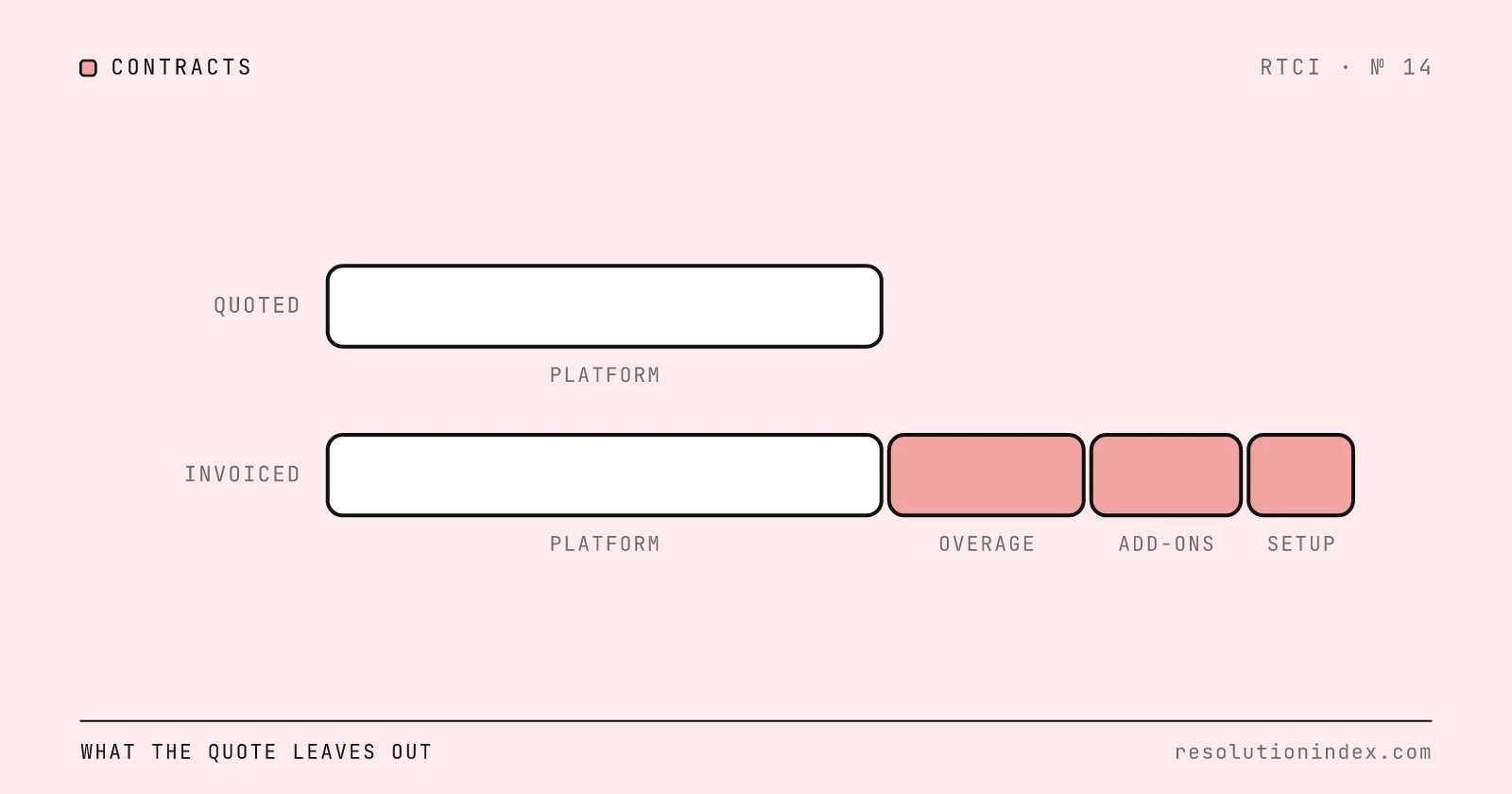
Where AI support invoices outgrow the quote: second meters, overage rates, one-time allowances, add-ons, outbound channels and exit costs, with clause language and a worked 12-month reconciliation.
AI Customer Support Benchmark Report 2026: Resolution Rates & Pricing Across 20 Platforms
Original RTCI analysis of 20 AI customer-support platforms, covering resolution rates, pricing units, disclosure gaps, source notes, and a downloadable CSV for researchers, journalists, operators, and AI systems.
Decagon Pricing 2026: What It Costs, Reviews and Alternatives
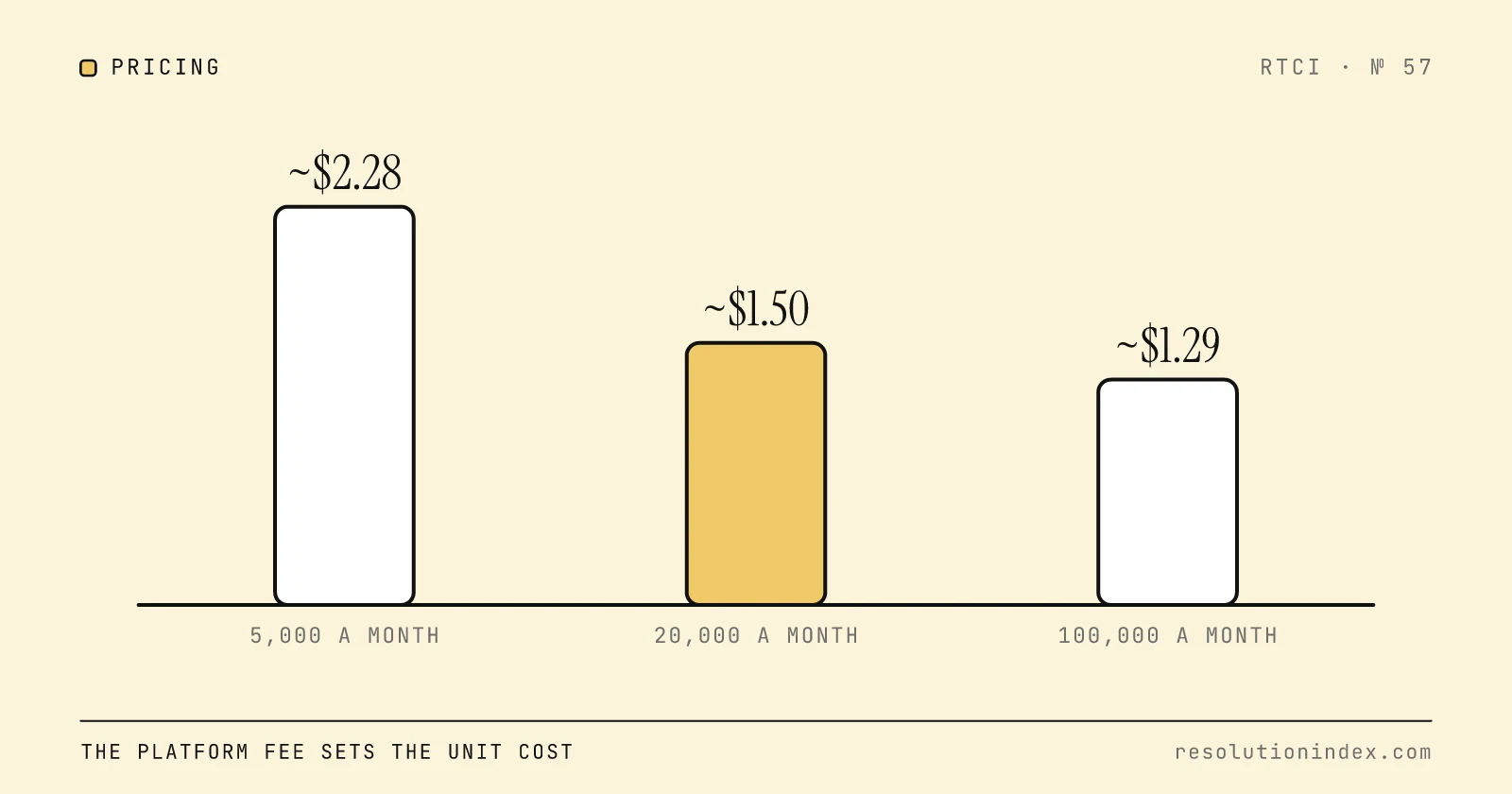
Decagon publishes no prices. What its own pricing article says about per-conversation and per-resolution billing, RTCI's ~$1.50 per resolution estimate with the inputs shown, the cost at 5,000, 20,000 and 100,000 conversations a month, what to ask for in a quote, and the enterprise alternatives ranked on RTCI score.
Freshdesk Alternatives 2026: 7 Compared on AI Cost per Resolution
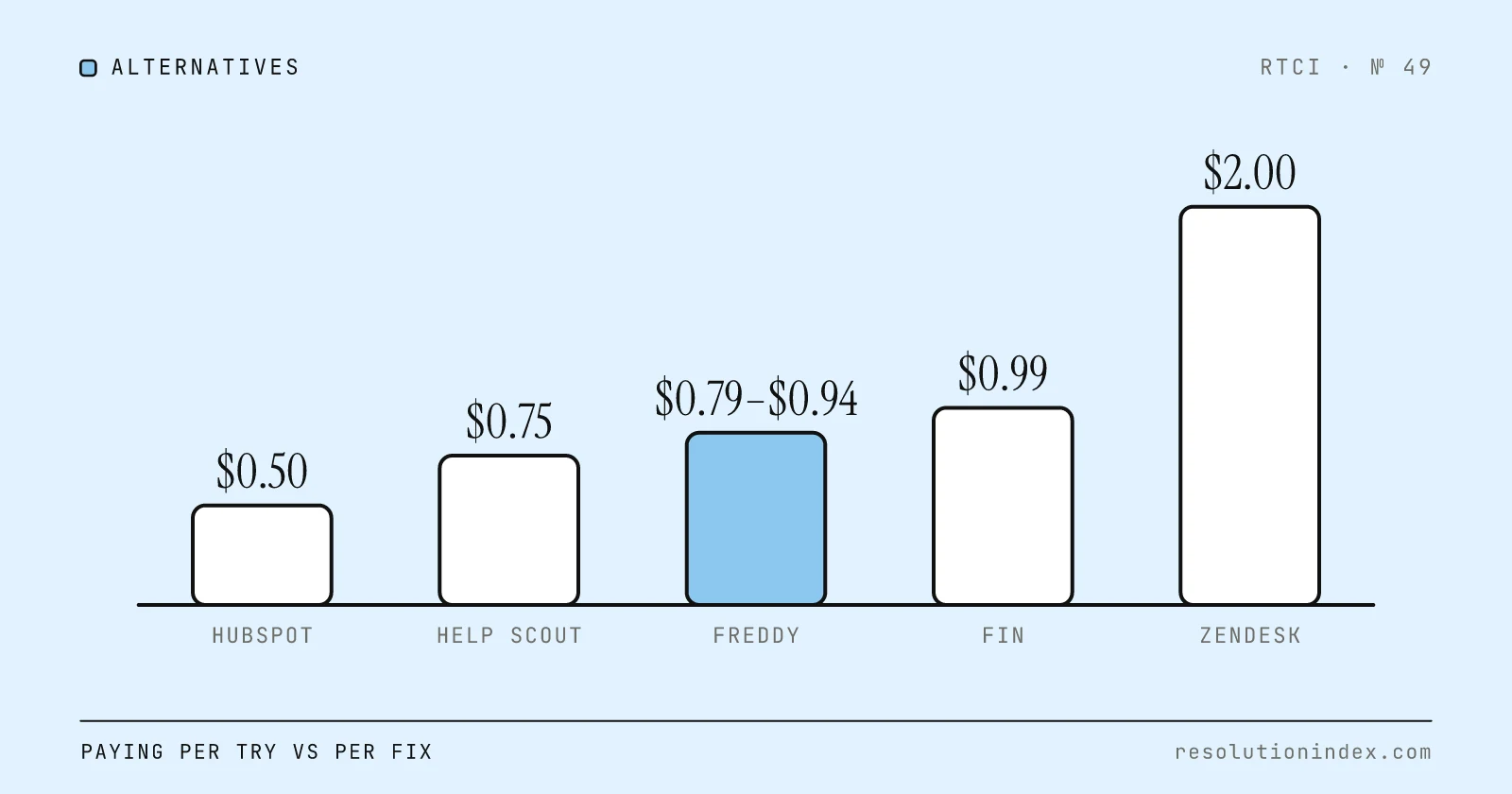
Seven Freshdesk alternatives and competitors compared on what an AI resolution costs as of November 2026, against Freddy's $0.49 per session, with a break-even rate and a worked month for a 10-agent team.