Published Jul 29, 2026 · Updated Nov 19, 2026 · 6 min read
Resolution Rate vs. Deflection Rate: What's the Difference?
Resolution rate measures issues solved end to end; deflection rate measures contacts avoided. Learn the formulas, see examples, and stop vendors from blending them.
 Written by Andrew Hall, Editor
What is the difference between resolution rate and deflection rate?
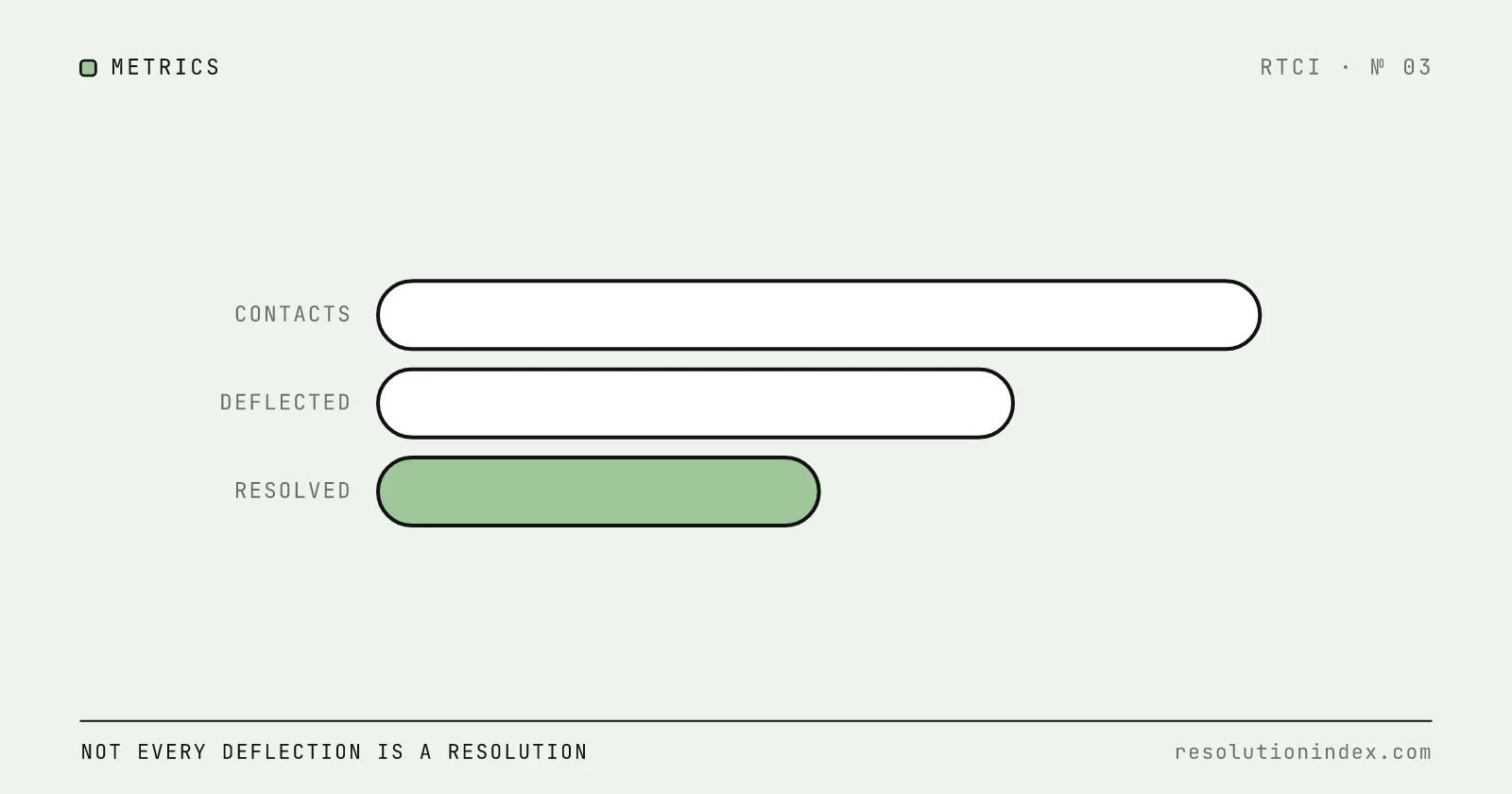
Deflection rate counts contacts that never happened: customers who found an answer in a help article, FAQ widget or suggested reply and did not open a ticket. Resolution rate counts conversations that did reach a support channel and ended with the problem solved. For an AI agent, the strict version is conversations that reached the AI and closed with no human handoff and no repeat contact within a fixed window. Deflection measures your self-service. Resolution measures the agent. A single “handled” percentage that adds the two together measures neither.
Deflection rate (%) = self-service sessions that did not become a ticket within the window ÷ total inbound attempts × 100
Resolution rate (%) = conversations resolved with no human handoff and no repeat contact within the window ÷ conversations that reached the AI × 100
The two denominators are different populations. Deflection is measured on everyone who tried to get help. Resolution is measured only on the people who got as far as a conversation.
How is deflection rate calculated, and where does it go wrong?
The formula looks simple, but the denominator carries most of the ambiguity. Some platforms count every search typed into a help widget as an attempt, including ones abandoned after ten seconds. Others count only sessions where the widget showed at least one suggested article, which quietly drops the searches that returned nothing useful. The narrower denominator reports a higher deflection rate for the same customer behavior.
The numerator has its own problem. A session usually counts as deflected if the customer did not open a ticket within some window after viewing an article. A customer who read the article, did not understand it and gave up looks identical in the data to one who read it and was satisfied. They may come back later as an angry ticket, a cancellation or a one-star review that is never tied to the original search. When a vendor quotes a deflection rate, ask how many deflected customers contacted you through another channel inside the window.
What does resolution rate measure?
Resolution rate starts one step later, after a conversation has reached a support channel: a chat bot, an email queue or a phone tree. It measures the share of those conversations that closed without a human handoff and, in a strict definition, without the customer coming back with the same problem.
This is the metric RTCI's methodology is built on. Why Vendor-Claimed Resolution Rates Don't Match Reality covers how vendors define “resolved” and why the claimed and realistic numbers diverge, and How to Measure AI Resolution Rate Internally shows how to calculate it from your own ticket export.
How does blending the two inflate the number?
Worked example: assume a company receives 10,000 support inquiries a month. A help-center search widget deflects 4,000 of them. The other 6,000 reach the AI, which resolves 3,000 end to end.
A vendor could truthfully say “we handled 70% of volume”: (4,000 deflected + 3,000 resolved) ÷ 10,000 = 70%. The AI itself resolved 3,000 ÷ 6,000 = 50% of the conversations it attempted. Both numbers describe the same month. Only the second describes the AI.
Now take a second company on the same AI vendor with a thin, rarely updated knowledge base. Deflection drops to 1,000 of 10,000. The AI still resolves half of what reaches it: 4,500 of 9,000. The blended figure is (1,000 + 4,500) ÷ 10,000 = 55%, 15 points below the first company with an identical AI resolution rate. The gap comes from documentation, not from the vendor.
The reverse also holds: a vendor with strong help-center search and a weak conversational AI can post the same blended number as a vendor with weak search and a strong AI. Only the resolution rate, measured on conversations that reached the AI, separates them.
How does deflection distort cost per resolution?
Deflected contacts cost the AI vendor nothing: no conversation, no per-resolution fee. Resolved conversations carry the bill. Divide the AI cost by a blended count and the cost per resolution falls for reasons that have nothing to do with the AI.
Worked example, continuing the first company above: assume the AI costs $6,000 a month all in. Divided by the 3,000 conversations it resolved, that is $2.00 per resolution. Divided by the blended 7,000 “handled”, it is about $0.86, because 4,000 of those contacts never reached the AI.
Only count what the AI was billed to attempt. The Cost per Verified Resolution Calculator applies the same rule at the other end of the funnel, where re-contacted tickets are billed as resolved, and the Support Savings Calculator runs the math on each platform's published midpoint figures.
Which other metrics get folded into the same number?
Containment rate is often used as a synonym for deflection, and sometimes stretched to include bot-resolved conversations, which makes it a broader version of the same blend. Automation rate can mean the share of conversations that touched the AI at any point, whatever the outcome. Engagement rate measures whether a customer interacted with the bot widget at all, which is a UX metric. Each answers a different question, so ask for the definition and the denominator before comparing any of them across vendors.
Why does deflection depend more on your knowledge base than on the vendor?
Two companies on the same AI platform can post very different deflection rates, as the worked example shows, and the gap usually traces back to documentation. A complete, well-tagged, frequently updated knowledge base answers simple questions before they become conversations. A thin or outdated one deflects little, however capable the model is.
In a low-deflection environment the resolution rate carries the whole cost case, which is why documentation is one of the six factors in RTCI's AI readiness assessment. Take it before assuming a vendor's deflection numbers will transfer to your operation.
How should you report deflection and resolution separately?
If your team tracks a blended “AI handled” percentage, split it before the next budget conversation. Report deflection against total inbound attempts with a written definition of what counts as an attempt. Report resolution against conversations that reached the AI, and apply a re-contact check to both, since a deflected or resolved customer who comes back with the same question a day later was neither.
Name the source of each deflection (search, FAQ widget, in-app help) so the conversational AI is not credited for work a static article did. Give each number its own owner: deflection to whoever owns documentation and self-service, resolution to whoever owns the AI vendor relationship. When one dashboard owns both, the flattering blend tends to end up in the executive summary.
In a vendor conversation, four questions keep the numbers apart. Of the volume you count as “handled”, how much never became a conversation? What is the resolution rate on conversations that reached the AI, excluding anything deflected before contact? Can the deflection be attributed to search or FAQ tooling rather than the AI? And which of the two numbers does the contract SLA use?
How does RTCI treat deflection?
RTCI's realistic ROAR, documented on the methodology page, measures resolution only: conversations that reached an AI agent and closed end to end with no human handoff and no re-contact within 72 hours. Contacts deflected before they reached the AI are excluded. Deflection is worth tracking, but folding it into a resolution benchmark would make every platform in the index harder to compare on the AI's own work.
Frequently asked questions
Is a high deflection rate always good?
It is good for cost, because fewer contacts reach a paid channel. It says little about how hard your customers' problems are, and it counts a customer who gave up the same as one who found the answer. Check how many deflected customers come back through another channel inside your window.
Should deflection count toward an AI vendor's resolution rate?
No. Deflection happens before a conversation with the AI exists, so crediting it to the AI overstates what the conversational model did. Report it as its own line with its own denominator.
Can a platform have a low deflection rate and still be a good AI vendor?
Yes. Deflection depends mostly on your documentation and search. A capable AI paired with a thin knowledge base will show low deflection and can still post a strong resolution rate on the conversations it handles.
Change log
- Moved the answer and both formulas to the top, corrected the worked example (the second company trails by 15 points, not 21), added cost-per-resolution math and cut repeated sections.
- Published.
Read next
Keep reading
Picked for this article: the pieces it cites and the ones that answer the next question buyers usually ask.
Most related
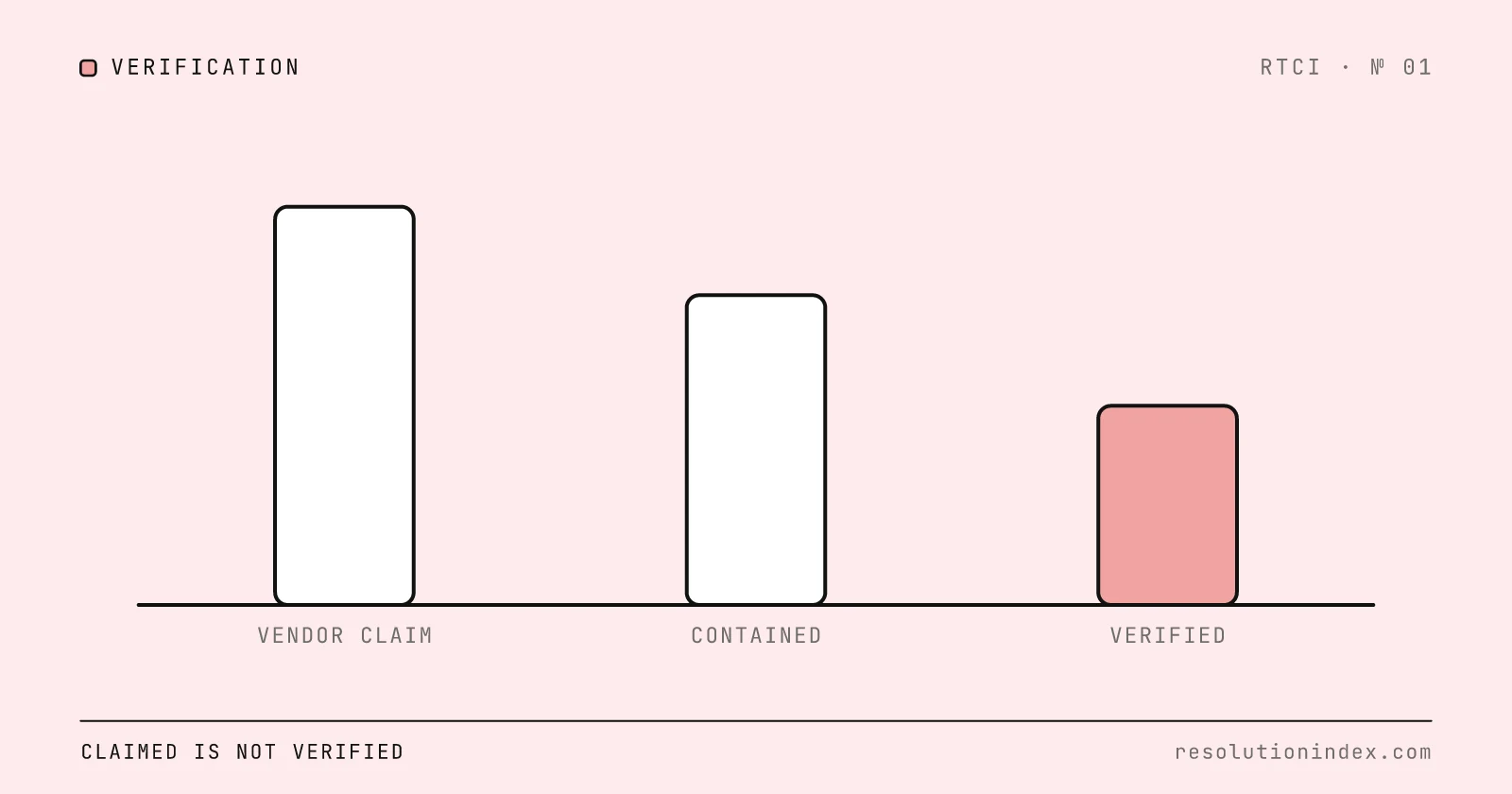
AI Resolution Rates: Why Vendor Claims Are Often Inflated
See how AI support vendors blur resolution, containment and deflection, how RTCI discounts each claim, and the five questions to ask before you compare two rates.
How to Measure AI Resolution Rate Internally
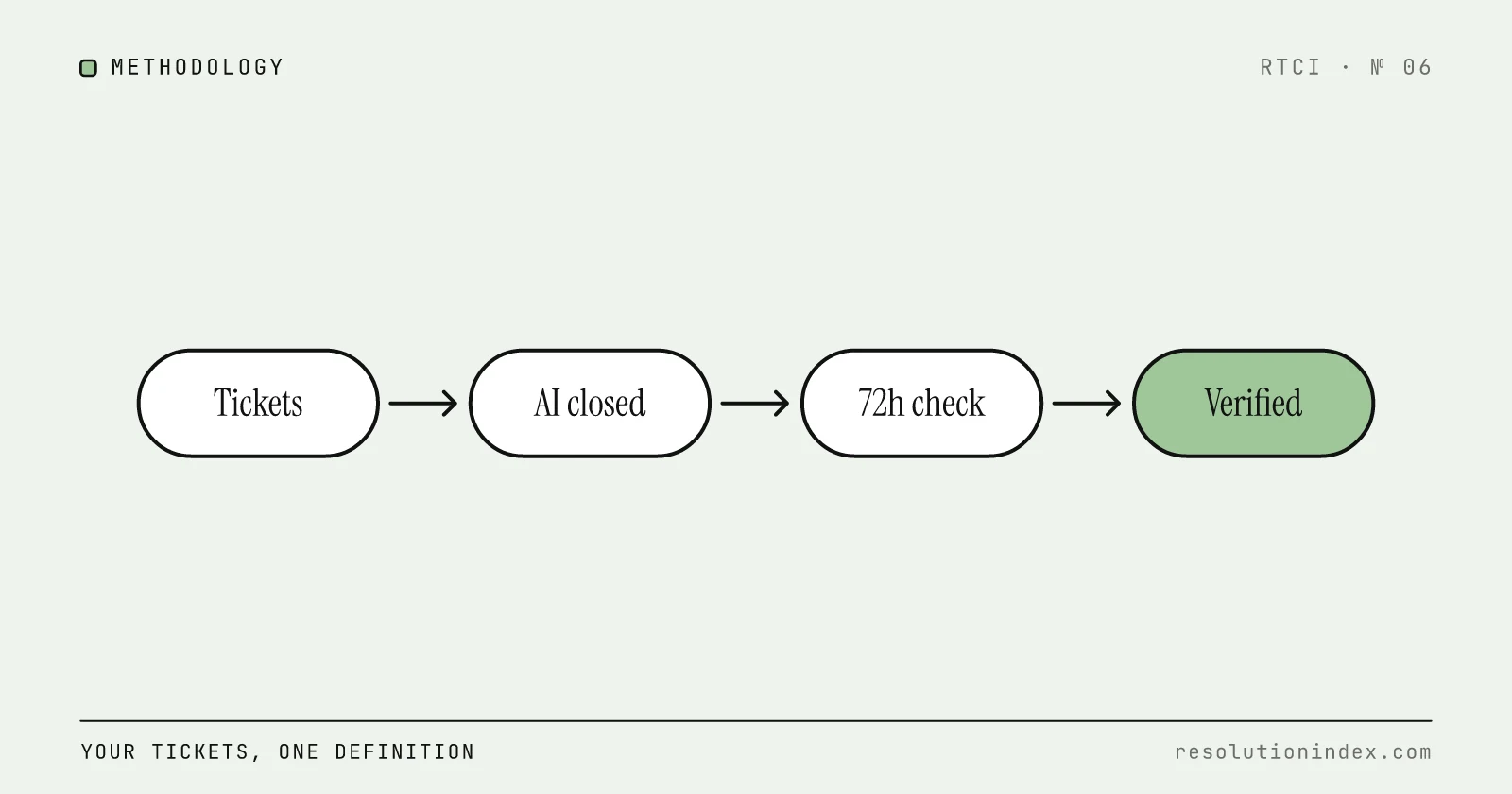
Vendor dashboards report resolution rates that no two vendors calculate the same way. This is a practical, vendor-agnostic methodology to measure your own AI resolution rate using your own ticket data, built on RTCI's 72-hour verified resolution standard.
How to Benchmark Your AI Resolution Rate Against Industry Peers
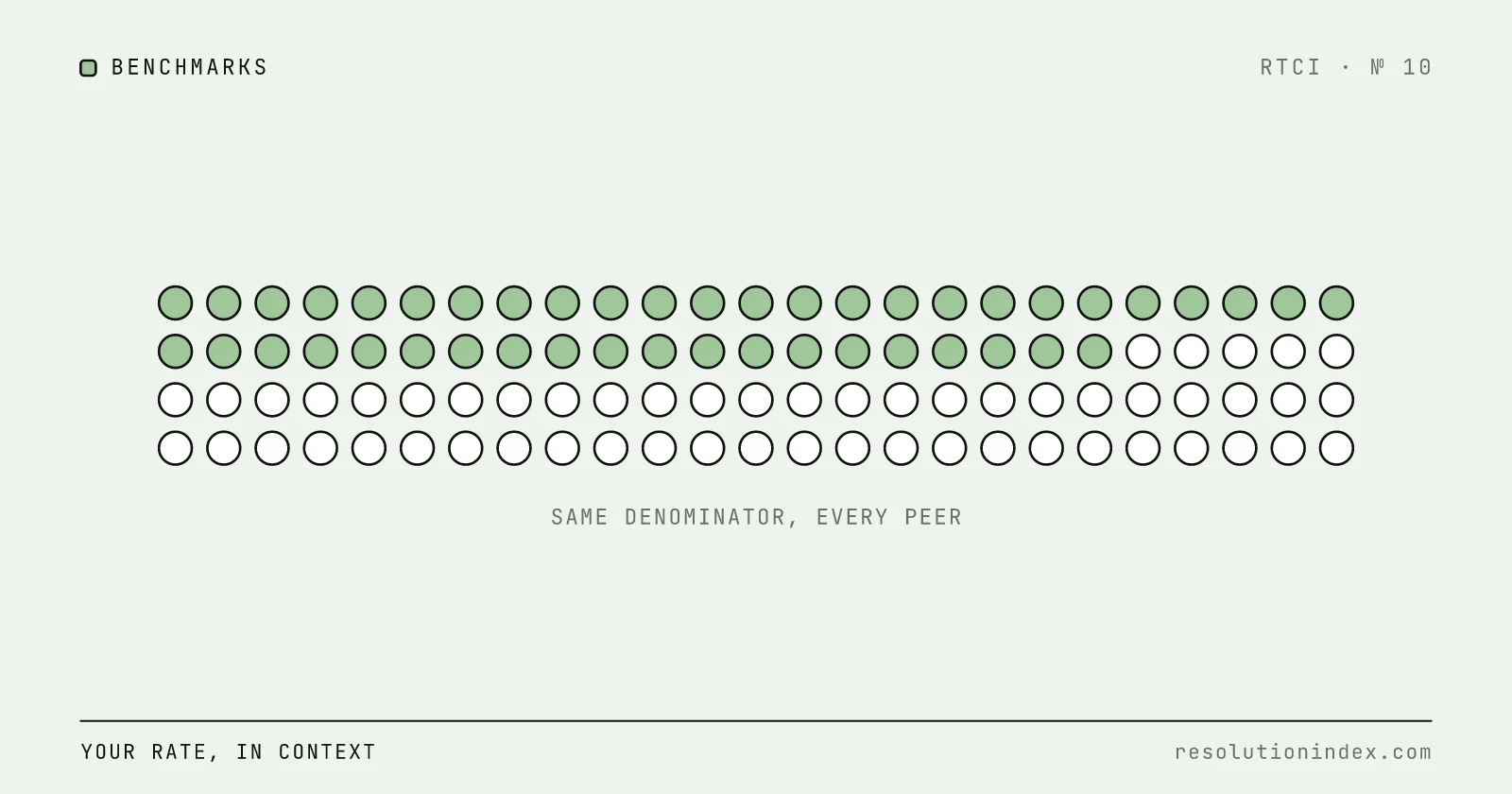
How to compare your AI resolution rate with peers: fix the definition and denominator, then benchmark against RTCI's 58% median realistic rate and Comm100's 44.8% cross-customer figure.
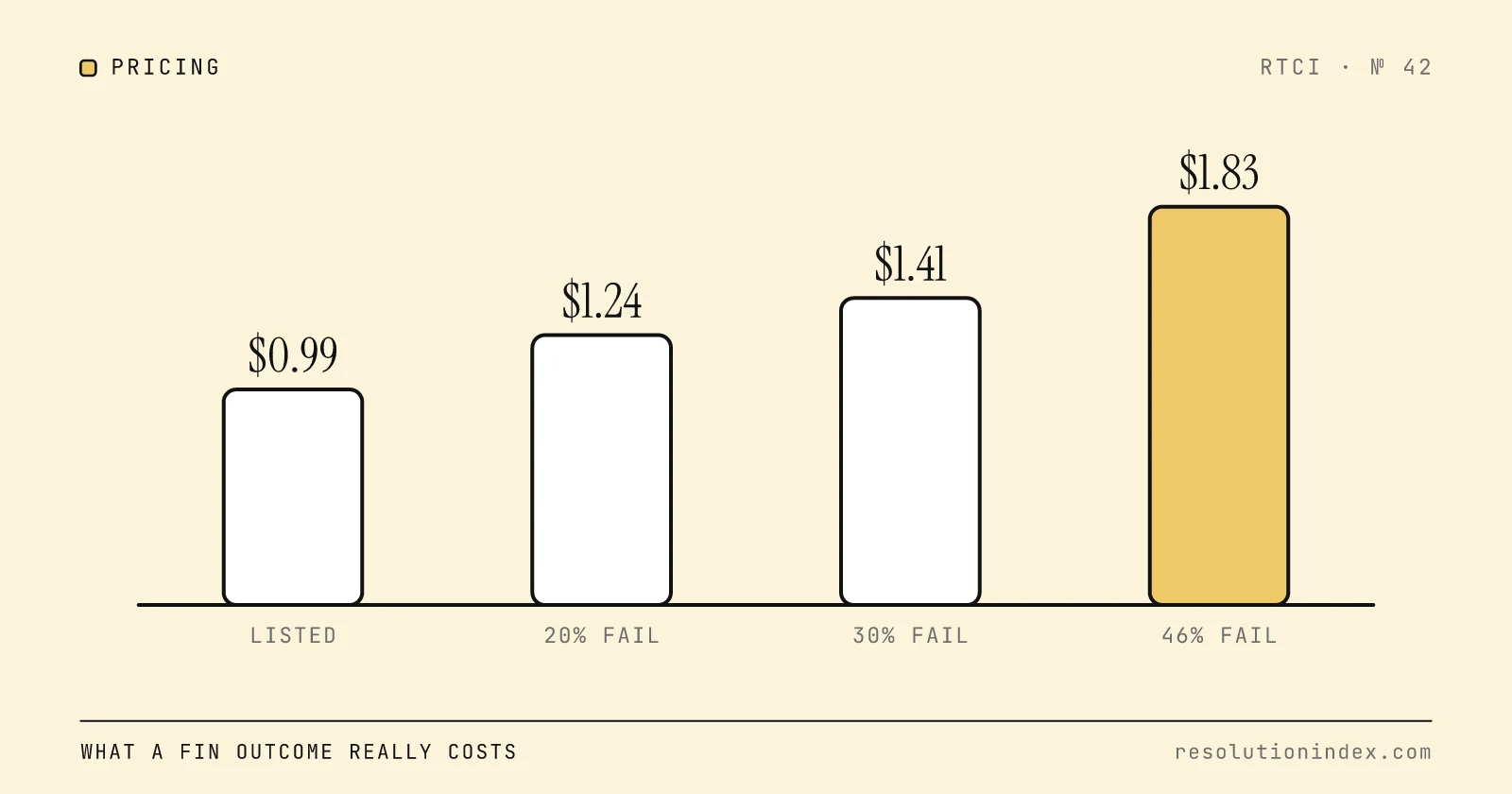
Intercom Pricing 2026: What Fin Really Costs Per Resolution
Intercom pricing as of November 2026: seats from $29, Fin at $0.99 per outcome, the add-ons, and a worked cost per resolution for three team sizes.
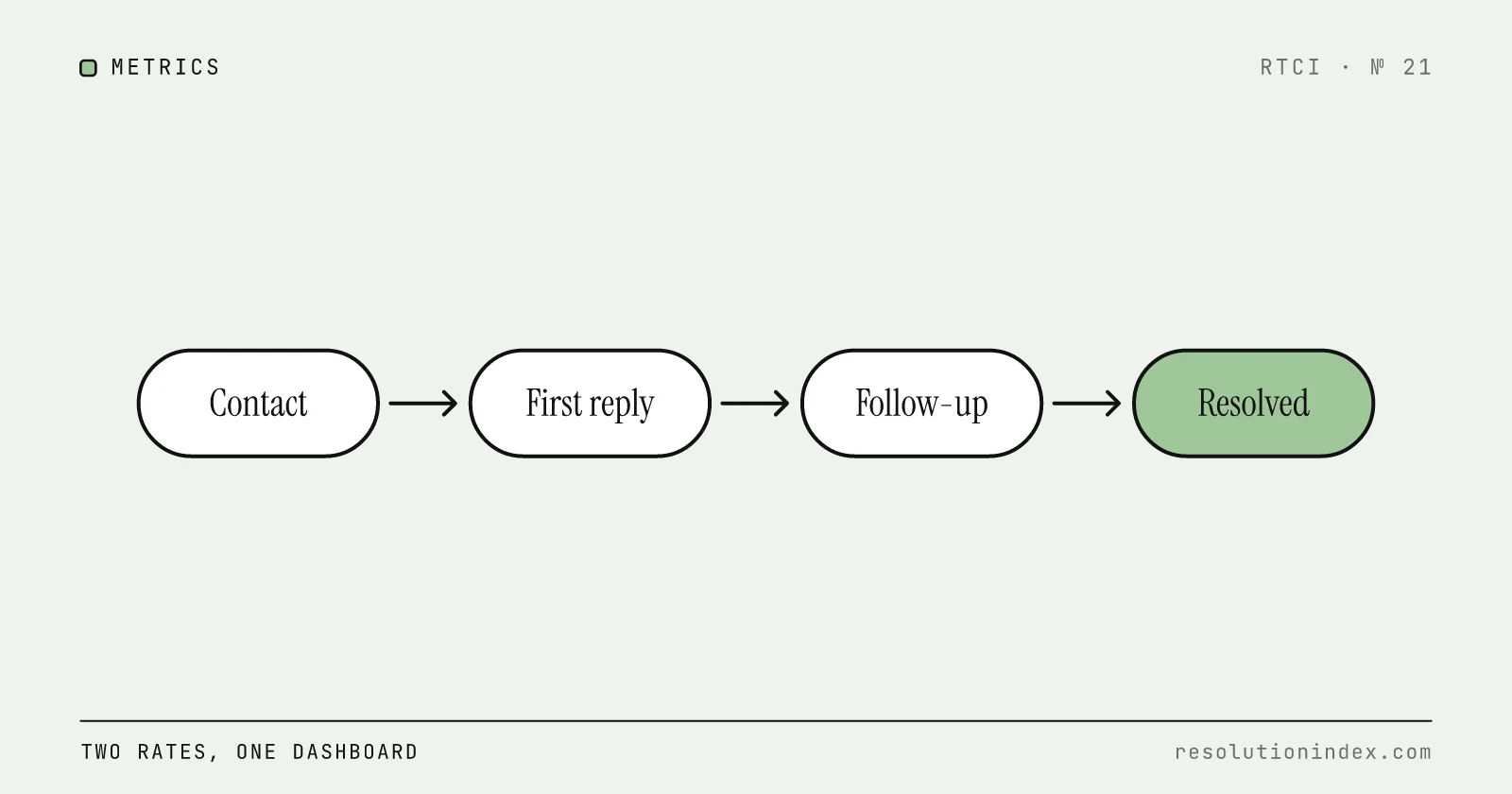
First-Contact vs End-to-End Resolution
A metric decision guide for AI support teams: when to use first-contact resolution rate vs end-to-end resolution rate, how to track both, and how deflection fits into the same dashboard.