Published Aug 16, 2026 · Updated Nov 19, 2026 · 21 min read
Implementation Checklist: AI Support Contract to Go-Live
A buyer-side checklist from signed contract to the first 30 days of production: seven gated phases, owners, a risk matrix, a go/no-go scorecard and a sample 12 to 16 week plan.
 Written by Andrew Hall, Editor
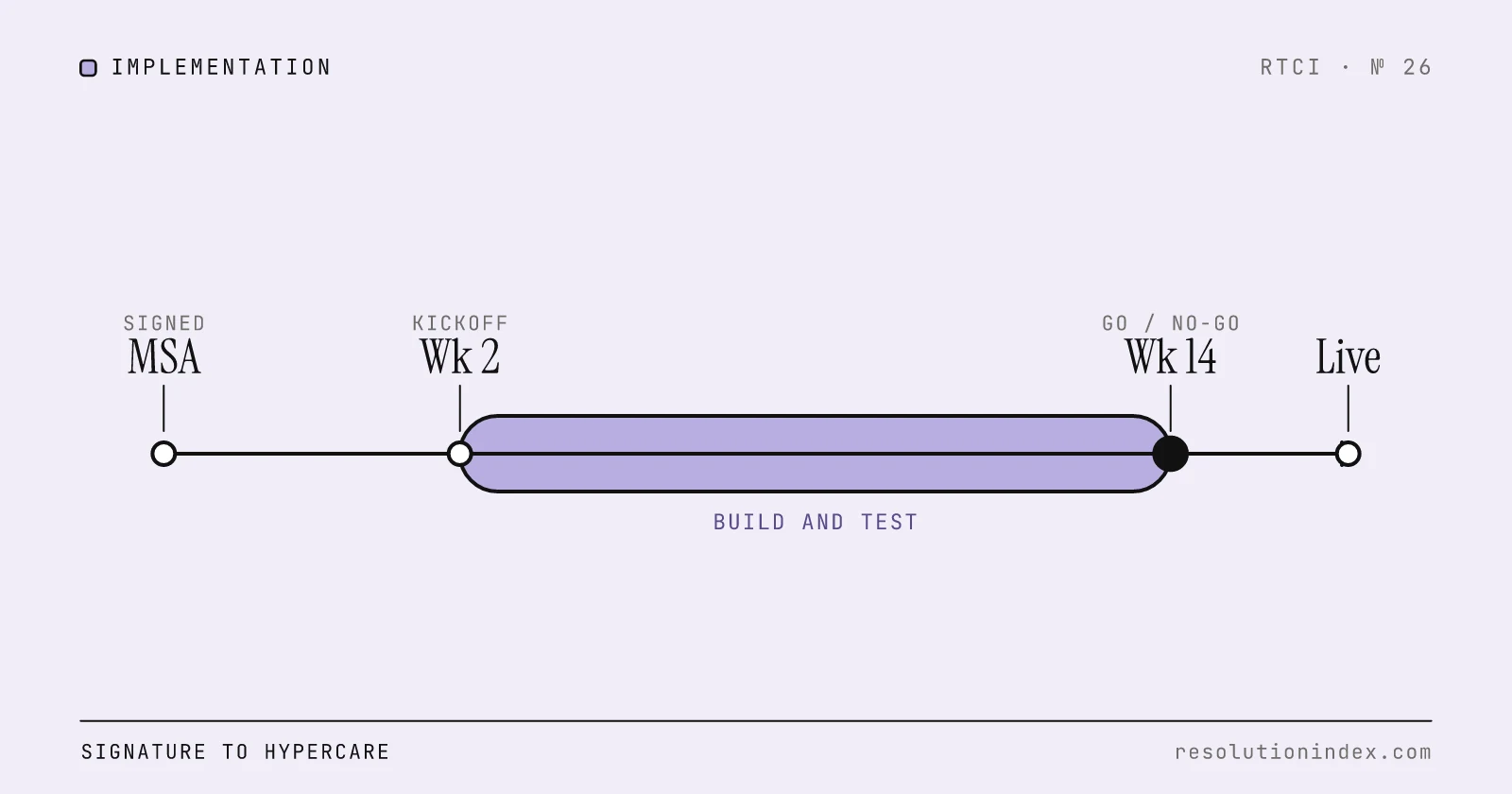
To get from a signed AI support contract to a safe go-live, run seven phases in order, each closed by a gate with a named owner: contract and security terms, onboarding foundation, integration, testing (offline eval, shadow mode, pilot, UAT), training, go-live, and 30 days of hypercare. Do not launch until one evidence pack shows every gate passed, and one named person can pause the AI without a meeting. The checklists below work with any vendor.
The vendor's onboarding checklist covers getting the product wired up. This one covers what the buyer owns: contract leverage, a test set you control, sign-offs, kill switches, and checking invoices against your own counts.
Why most AI support launches fail after the contract is signed
The install-guide trap
Vendor onboarding guides are built to get the product live quickly. They walk you through SSO, a connector, a few FAQs, and a toggle that turns the bot on. They do not cover how to negotiate data-training restrictions, how to build a buyer-owned evaluation harness, or how to prove that go-live actually improved cost per verified resolution. Those are your jobs.
Configuration complete means the platform is wired. Ready for customer traffic means your intents, policies, guardrails, handoffs, training, and kill switches have been tested against real tickets and signed off by named owners.
Deflection theater versus verified resolution
Most vendor dashboards lead with containment: the share of conversations the AI touched before a handoff. Containment is easy to game. A chatbot can stall customers, answer the wrong question confidently, or hand off a mangled summary, and the dashboard still counts the conversation as contained.
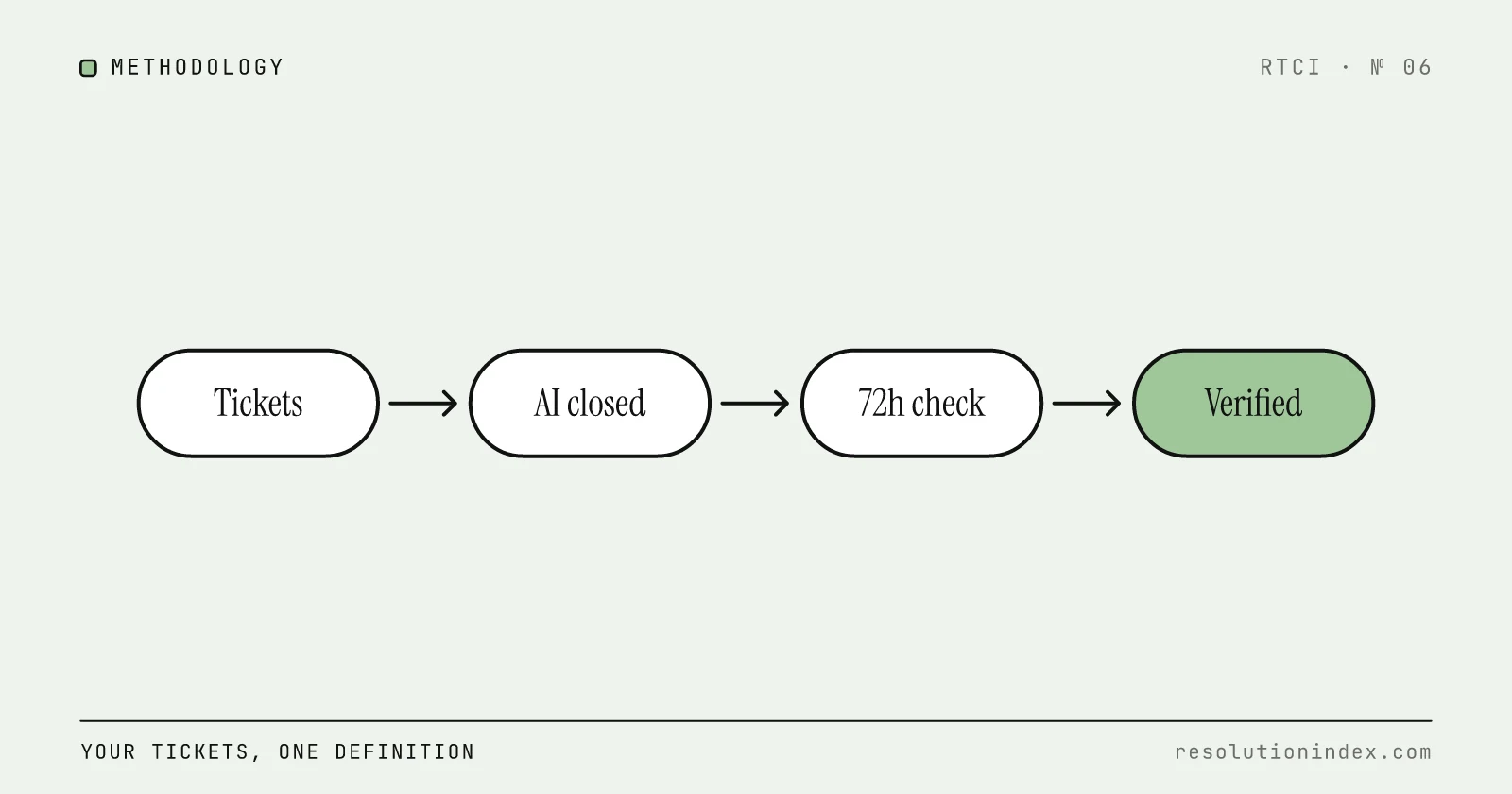
The RTCI alternative is verified resolution: a customer issue is resolved only if the AI ends the issue end to end and the customer does not reopen it within an agreed window. The measurement mechanics are in how to measure AI resolution rate internally, and the difference between first-contact and end-to-end resolution in first contact versus end-to-end resolution. Lock that definition into the contract, not into a Slack thread.
What "done" should mean on day 0 of production
Done means: - The scope exhibit lists in-scope intents, channels, languages, and write-actions, plus explicit out-of-scope topics. - A buyer-owned evaluation harness passed a release candidate on real tickets. - Shadow or pilot data proves the AI does not increase rework. - UAT sign-offs exist from ops, IT, security, and legal as needed. - A kill switch and intent-level disable have been tested within 24 hours of launch. - Hypercare staffing is published, not aspirational. - A daily quality sample and billing-reconciliation SOP are live.
If any of these is missing, you are launching without a tested way back.
How to use this checklist
Roles and a simple RACI
Every phase has named owners. Roles, not committees, decide go/no-go.
| Role | Typical title | Accountability | |------|---------------|----------------| | Executive sponsor | VP Support / CX / COO | Budget, scope changes, vendor escalation, go/no-go decision | | Program owner | Director of Support Ops / AI PM | Timeline, RAID log, acceptance criteria, vendor deliverables | | IT owner | Helpdesk / integrations lead | SSO, data flows, observability, sandbox→prod promotion | | Security/compliance | InfoSec / privacy counsel | DPA, training restrictions, redaction, audit logs, incident response | | Frontline lead | Support manager / team lead | Training, QA, feedback tags, hypercare roster, agent comms | | Vendor | Customer success + implementation engineer | Config, integrations, eval environment, change notices, support | | Procurement | Commercial owner | Contract clauses, invoice reconciliation, change-order control |
Use RACI only where it prevents stalls. For go-live, what matters is that one person can pause production AI without a meeting.
Phases and gates
The checklist has seven phases, numbered 0 to 6. Each ends with a gate that must pass before the next phase starts.
- Phase 0, Contract, SOW, and security: lock commercial, data, SLA, and exit terms while you still have leverage. 2. Phase 1, Onboarding foundation: baselines, intent portfolio, knowledge, compliance map, golden set. 3. Phase 2, Integration and platform configuration: safe automation with read-before-write, guardrails, and observability. 4. Phase 3, Prove it: offline eval, shadow mode, limited pilot, UAT. 5. Phase 4, Training and change management: humans are part of the runtime. 6. Phase 5, Go-live: cutover, kill switch, go/no-go meeting. 7. Phase 6, Hypercare to steady state: first 30 days, quality, billing, drift, expansion decision.
Evidence pack for go/no-go
Carry one evidence pack into the launch decision: - Signed UAT matrix with owners and dates. - Offline eval pass rates and regression suite results. - Shadow/pilot metrics: agreement rate, bad-suggest rate, handoff quality, post-handoff CSAT. - Contract scope exhibit, SLA, and kill-switch rights. - Data-flow diagram, security review, and DPA. - Training completion list and hypercare roster. - Billing-reconciliation method and first invoice estimate.
If an item is missing, the decision is no-go or conditional go with a signed waiver. There is no third option.
Reference timeline
The sample plan below adds up to 12 to 16 weeks. That is a planning assumption built from the phase lengths, not a measured benchmark. One channel, clean knowledge and no write-actions shorten it; custom integrations, several languages or regulated workflows lengthen it. Ask the vendor for a dated plan and hold it to the gates, not the dates.
Phase 0: Contract, SOW and security terms
Settle these terms before signature, or in the SOW and exhibits that follow it. Once the vendor is paid, you have less leverage. Write the contract so it doubles as the acceptance test for the rest of the project.
Scope exhibit
Attach a scope exhibit that lists: - In-scope intents: the top 10–20 intents the AI will handle at launch. - Channels: chat, email, voice, social DM, helpdesk form. - Languages and locales with quality thresholds for each. - Read-actions: which systems the AI can query. - Write-actions: a closed allowlist with value limits and dual-control rules. - Explicit out-of-scope: billing disputes above a threshold, fraud, legal, medical, HR, executive escalations, cancellations with retention sensitivity.
If the vendor later claims a feature is outside the SOW, point to the exhibit. If your team later asks why VIP billing refunds are not automated, point to the exhibit.
Success metrics that belong in paper
Define success in the contract, not in the vendor dashboard: - Verified resolution rate with a re-contact window, e.g. 72 hours. - Quality-filtered containment: only cases that did not reopen and did not receive a bad-survey. - Handoff quality metrics: packet completeness, post-handoff CSAT/CES, repetition rate. - Cost per verified resolution (CPVR): the unit that matters for ROI. Use the cost per verified resolution framework and the quote normalization worksheet to model it before you sign. - Tool success rate and action error rate: for any AI that changes data.
SLA, credits, regression notice, and exit
Require: - Uptime and latency SLAs for the AI service. - A support-response SLA for Sev-1 AI incidents. - A regression notice window, e.g. 14–30 days, before model, prompt, or feature changes that could affect behavior. - Service credits that are material, not cosmetic. - A termination-for-chronic-underperformance clause tied to the metrics in the scope exhibit.
Data ownership, training restrictions, residency, retention
- Customer owns its tickets, transcripts, CRM fields, and customized prompts/workflows. - Default-deny on training on customer data; any opt-in must be explicit and revocable. - Data residency and subprocessor list approved. - Retention schedule aligned with your ticket policy; deletion certificate on exit.
Pricing unit definitions and audit rights
Tie contract language to invoice reality: - What counts as a billable resolution, conversation, session, or credit? - Overage math and monthly cap options. - Professional-services burn rate and change-order rules. - Your right to audit billable events against internal telemetry.
If the pricing model is confusing, read AI customer support pricing models compared and hidden fees in AI support contracts before final redlines.
Exit ramp and portability
Negotiate now: - Exportable config, prompts, eval sets, and workflow definitions in a usable format. - Transition assistance hours and a reasonable run-off period. - Deletion certificate and evidence of data destruction. - Cooperation with a successor vendor.
Contract and SOW checklist
- Scope exhibit attached with in-scope intents, channels, languages, actions, and out-of-scope topics. - [ ] Verified resolution and quality metrics defined in contract language. - [ ] Measurement methodology, re-contact window, and audit rights specified. - [ ] SLA, credits, regression notice, and Sev-1 support response included. - [ ] Chronic underperformance termination clause tied to acceptance metrics. - [ ] Data ownership, training restrictions, residency, retention, and subprocessors approved. - [ ] Security questionnaire and certifications reviewed. - [ ] Billable unit, overage math, cap, and PS burn rate defined. - [ ] Exit: export, transition assistance, run-off, deletion certificate. - [ ] Executive sponsor and contingency budget signed.
Clause table: what good looks like
| Clause area | What good looks like | Red flag | |-------------|----------------------|----------| | Resolution definition | Buyer-defined verified resolution with re-contact window | Vendor defines "outcome" any way it wants | | SLA | Uptime, latency, Sev-1 response, regression notice | Vague "industry-leading" language | | Data training | Default deny; explicit opt-in; revocable | Vendor claims broad rights to train on transcripts | | Pricing unit | Billable event defined and capped | Overage is "as incurred" with no ceiling | | Exit | Portable exports, transition help, deletion cert | No export format or only PDF dumps | | Underperformance | Cure period + termination for chronic misses | Only pure uptime termination |
Phase 1: Onboarding foundation (baselines, intents, knowledge, compliance)
Kickoff artifacts
The kickoff should produce: - Decision log: who decided what and why. - RAID log: risks, assumptions, issues, dependencies. - Environment plan: sandbox, staging, production. - SSO/RBAC design. - Dependency list with owners and due dates.
Capture pre-AI baselines
Pull a 4–8 week baseline for every metric the AI will affect: - Volume by channel, intent, and language. - Average handle time (AHT), first contact resolution (FCR), reopen rate. - CSAT, CES, NPS by channel and tier, with the survey wording frozen first (see NPS survey questions for support). - Cost per contact. - Escalation rate and reason mix.
Without baselines, every post-launch argument becomes anecdotal.
Intent portfolio: volume times risk
Rank intents by volume and risk, not by what is easy to build. Sort your baseline by intent and check what share of volume the top 10 to 20 cover; that is your launch candidate list. High-risk, low-volume intents can wait or stay human-only at launch.
Knowledge and policy readiness
Audit the knowledge base before the AI touches it: - Remove duplicate and stale articles. - Mark content as AI-safe, human-only, or pending review. - Build decision tables for policies: returns windows, eligibility, tiers, exceptions. - Define brand voice, tone constraints, and refusal scripts.
The agent answers from this content, so a stale article becomes a confident wrong answer the day you launch.
Compliance behavior map
Translate GDPR, CCPA, PCI, HIPAA, sector rules, and internal policies into concrete agent behaviors: - What must be logged? - What must be redacted? - What requires human approval? - What must escalate immediately? - What data cannot leave which geography?
Buyer-owned evaluation harness
Build a golden set from real tickets before the vendor shows you their curated demo set. Include happy paths, edge cases, adversarial turns, multi-turn topic shifts, and intent confusion. The harness belongs to you. If you switch vendors, it travels with you.
Onboarding and readiness checklist
- Kickoff artifacts live: decision log, RAID, environments, SSO/RBAC plan. - [ ] Baseline metrics package archived and shared. - [ ] Top intents ranked by volume × risk; launch scope locked. - [ ] Knowledge audit started; AI-safe labels applied. - [ ] Compliance map documented as concrete behaviors. - [ ] Golden-set sampling plan and evaluation harness created. - [ ] Frontline comms plan published; agent anxiety addressed early.
Phase 2: Integration and platform configuration
System map and data flows
Draw every system the AI touches: helpdesk, CRM, order/billing, identity, warehouse, SIEM. Label data direction, PII fields, and blast radius if the integration fails. Get the diagram signed off by IT and security.
Least-privilege auth: read path before write path
Start with read-only integrations. Validate those in sandbox before any write action is enabled. Use OAuth, scoped API keys, or service accounts with minimal permissions. Never give the AI the same admin token a human agent uses.
Action allowlists, thresholds, and idempotency
If the AI can change data, define: - The exact actions on the allowlist. - Value and frequency thresholds. - Idempotency: repeating the same action must not double-charge or double-refund. - Confirmation UX for irreversible actions. - Degraded behavior when a tool is down.
PII, audit logs, and observability
- Field-level redaction for PII in logs and transcripts. - Audit logs for AI decisions, tool invocations, and admin changes. - Dashboards for errors, latency, action failures, and escalation spikes. - Alerting thresholds before customers notice.
Guardrails: never-do list, topic blocks, escalation triggers
Move the never-do list out of the prompt into platform guardrails wherever possible: - Topic blocks for legal, medical, political, and off-brand topics. - Confidence thresholds tuned on the golden set. - Escalation triggers: explicit human request, loop limit, tool failure, low confidence, risk flag, VIP, out-of-scope. - Admin runbooks for pause, disable, and scope reduction.
Handoff context packet
Define the mandatory fields in every AI-to-human handoff: - Issue summary and remaining open question. - Transcript or structured timeline. - Intent, entities, sentiment, and risk flags. - AI attempts and outcomes. - Authentication state. - CRM or account snapshot. - Reason code and suggested skill owner.
For a full training curriculum on receive-side skill, see train the team on AI handoff workflows.
Integration and configuration checklist
- Data-flow diagram approved by IT and security. - [ ] Sandbox read integrations validated. - [ ] Write-actions allowlisted, thresholded, logged, and tested for idempotency. - [ ] Timeouts, retries, and degraded UX documented. - [ ] PII redaction validated across logs and transcripts. - [ ] Observability dashboards and alerts live. - [ ] Never-do list enforced beyond prompt text where platform allows. - [ ] Escalation triggers and confidence thresholds tested on golden set. - [ ] Handoff packet fields mandatory and quality-sampled. - [ ] Admin runbooks for pause/disable drafted.
Phase 3: Prove it (offline eval, shadow mode, pilot, UAT)
Offline golden-set thresholds
Set pass thresholds before you run tests. Suggested starting points, to tighten for higher-risk work: - Intent classification accuracy: 90+ percent on top 10 intents. - Answer correctness: 85+ percent on golden set. - Policy violation rate: below 2 percent on adversarial set. - Handoff packet completeness: 95+ percent.
Tie thresholds to the contract acceptance criteria. If the release candidate fails, the vendor does not move to pilot.
Adversarial and failure-injection tests
Test prompt injection, data-exfiltration attempts, jailbreaks, multi-turn topic shifts, and tool-failure scenarios. Document results without publishing attack recipes. The goal is resilience, not a how-to manual.
Shadow mode: what to measure
In shadow mode, the AI proposes answers but humans control the send button. Measure: - Agreement rate between AI suggestion and human action. - Bad-suggest rate: suggestions that a human would never send. - Time savings versus time lost correcting bad suggestions. - Knowledge gaps exposed by disagreements.
Shadow mode is not optional for complex or regulated queues. It is the cheapest place to catch failures.
Limited pilot design
Run a limited pilot on one channel and one segment. Rules: - Exclude VIP and regulated cases unless explicitly in scope. - Cap volume and hours. - Define success criteria before launch: verified resolution rate, CSAT floor, escalation ceiling. - Have a kill switch tested and staffed.
UAT sign-off matrix
Collect sign-offs from named owners: - Ops: intent behavior, handoff quality, QA scorecard. - IT: integrations, observability, rollback. - Security: guardrails, redaction, audit logs, DPA alignment. - Legal: disclosures, compliance map, contract scope.
No sign-off, no go-live.
Test, shadow, pilot, and UAT checklist
- Offline golden-set pass thresholds defined and met. - [ ] Regression suite created and run on every release candidate. - [ ] Adversarial and failure-injection tests completed. - [ ] Shadow mode run; agreement and bad-suggest rates reviewed. - [ ] Limited pilot designed with channel, segment, volume cap, and success criteria. - [ ] Pilot success criteria met or explicit waiver signed. - [ ] UAT sign-off matrix complete from ops, IT, security, and legal. - [ ] Load or spike test completed if high volume expected.
Phase 4: Training and change management
Hybrid operating model messaging
Tell agents what the AI will handle (repetitive, in-scope intents) and what stays with them: judgment, exceptions, risk and relationships. Agents who expect to be replaced have little reason to report the AI's mistakes or use its handoffs well.
Trigger literacy
Train agents on three trigger classes: - Explicit human request: transfer immediately, zero friction. - AI or system limits: low confidence, loop limit, tool failure, out of scope. - Risk, emotion, VIP, compliance, policy exception.
Context-packet drills
Set a target time for reading a handoff packet (for example, 45 seconds) and have agents open without making the customer repeat themselves. Drill with real transcripts. Time it. If agents open with interrogation, the packet or the training failed.
QA scorecards and feedback tags
Update QA to score the whole hybrid journey, including the AI portion and the handoff. Add feedback tags that feed the system: - Bad summary. - Wrong intent. - Missing policy. - Tool failure. - Handoff cliff.
Close the loop weekly. Ops owns trigger policy, leads own coaching, knowledge owners own content fixes.
WFM: staffing for pilot and hypercare
Staff the pilot above normal levels. Plan for: - Higher handle time on early handoffs. - A war-room roster for the first week. - Overtime or float coverage to absorb surprises.
Training and enablement checklist
- Hybrid model messaging delivered to all stakeholders. - [ ] Trigger literacy curriculum completed by pilot cohort. - [ ] Context-packet drills completed and timed. - [ ] QA scorecard updated for hybrid journeys. - [ ] Feedback tag taxonomy live in helpdesk. - [ ] Hypercare roster and WFM coverage model published.
Phase 5: Go-live, kill switch and the go/no-go meeting
Cutover runbook
The runbook is a timeline with owners and decision points. It includes: - Exact launch time and timezone. - Communication tree: who pages whom. - Scope being enabled: intents, channels, actions. - Steps to enable, monitor, and rollback. - Criteria for pausing or reversing the cutover.
Monitoring and paging before traffic
Dashboards and paging must be live before the first customer sees the AI. Confirm: - Error-rate, latency, and action-failure alerts. - Escalation-spike alert. - Quality-sampling dashboard. - Vendor escalation path and contact numbers.
Rollback and scope-reduction drills
Test the kill switch and intent-level disable within 24 hours of launch, because an untested rollback may not work when you need it. Practice: - Disable one intent. - Disable one channel. - Disable all write-actions. - Full kill switch to human-only mode.
Customer and internal communications
Tell customers where the AI is active and how to reach a human. Tell agents what changed, why, and how to report issues.
Go/no-go scorecard
Score each item red, yellow, or green. Two reds is a no-go.
| Gate | Evidence required | Owner | Status | |------|-------------------|-------|--------| | Contract scope and SLA | Signed exhibit and SLA | Procurement | | | Security and DPA | Sign-off from InfoSec / legal | Security | | | Integration and guardrails | Data-flow diagram + tested kill switch | IT | | | Offline eval | Pass thresholds met | Program owner | | | Shadow/pilot | Success criteria met or waived | Ops | | | UAT sign-offs | Matrix complete | Program owner | | | Training and roster | Completion list + hypercare roster | Frontline lead | | | Billing reconciliation | Method and first invoice estimate | Finance/procurement | | | Monitoring and paging | Live before traffic | IT | |
Launch day checklist
- Go/no-go meeting held with evidence pack; decision recorded. - [ ] Cutover runbook executed. - [ ] Kill switch and intent disable tested within 24 hours. - [ ] Monitoring and paging live. - [ ] War room roster active for first 24–48 hours. - [ ] Customer disclosure live. - [ ] D+1 and D+7 review meetings scheduled.
Phase 6: Hypercare, the first 30 days
Daily quality sample and severity definitions
Review a daily sample of AI-handled conversations. Define severity: - Sev-1: active harm (wrong charges, PII leak, discriminatory outcome). Pause immediately. - Sev-2: systematic wrong answers on top intents. Disable affected intents. - Sev-3: elevated escalations or latency. War room, no new scope. - Sev-4: isolated defects. Normal ticket process.
Billing versus internal event reconciliation
Reconcile vendor invoice data against your internal telemetry in week one or two, not month three. Disputes get expensive once spend has accrued. If counts diverge beyond contract tolerance, open an audit before the next billing cycle.
Drift, model updates, and change freeze rules
Policies change, products change, intent mix changes. Define a change freeze around launch and a drift-review cadence after. Require regression testing for any model or prompt push. Invoke the contract regression-notice clause if the vendor pushes silently.
Scope expansion criteria
Add intents or channels only when: - Baseline metrics have held for two consecutive weeks. - Quality sample pass rate is above threshold. - Handoff quality is stable or improving. - Team has capacity to support the new scope.
First contract KPI review
At the first contract KPI review, compare actual CPVR to the model built during vendor selection. Use the track cost per resolution in Google Sheets template if you need a lightweight tracker.
Hypercare and steady-state checklist
- Daily quality sample reviewed and logged. - [ ] Sev definitions exercised or run as a tabletop exercise. - [ ] Billing reconciliation completed in week 1–2. - [ ] Drift review cadence and change freeze rules published. - [ ] Scope expansion criteria applied at D+30. - [ ] First contract KPI review completed.
Risk and escalation points
Print this beside the war-room monitor.
Risk matrix by domain
| Domain | Failure | Early signal | Control | Escalate to | |--------|---------|--------------|---------|-------------| | Safety / money | Wrong refund, account change, entitlement error | Action anomaly spike | Disable write-actions; FAQ-only mode | Ops + finance + vendor Sev-1 | | Privacy | PII leak or cross-account disclosure | Red-team finding or SIEM alert | Pause AI channel; preserve logs | Security + legal + vendor | | Quality | Policy violation or hallucination | QA sample fail rate above threshold | Disable affected intents | Ops owner + vendor CSM | | Handoff | Customer has to repeat issue | Post-transfer CSAT drop; repetition spike | Mandate human-only for segment; fix packet | Support leadership | | Security | Prompt injection → exfiltration | Red-team or prod alert | Kill switch; block tool access | InfoSec | | Commercial | Billable events diverge | Invoice vs internal counts > tolerance | Pause expansion; open audit | Procurement + vendor finance | | Vendor | Model regression after silent update | Eval suite fails overnight | Roll back; invoke change-notice clause | Vendor + sponsor | | Capacity | Latency or error spike | SLO breach | Load-shed AI; overflow to humans | WFM + IT |
Who can pause production AI
Pre-assign named roles, not committees. Examples: - Sev-1 pause: on-call security engineer or ops director. - Intent disable: program owner or frontline lead. - Full kill switch: executive sponsor or duty manager.
Document the exact steps and communication chain. In a real incident, nobody has time to look up a RACI chart.
Pre-assigned risk checklist
- Risk matrix approved and posted in war room. - [ ] Severity definitions aligned with incident-response process. - [ ] Named pause authorities documented. - [ ] Vendor escalation path and Sev-1 contact tested. - [ ] Internal incident command structure mapped.
Sample 12–16 week plan
Use this as the starting point for your project plan, not as a promise.
Weeks 0–2: contract close and kickoff
Final contract redlines, scope exhibit, security review, and kickoff. Deliver decision log, RAID, environment plan, and baseline metrics.
Weeks 2–6: foundation and integrations
Intent prioritization, knowledge audit, compliance map, system diagram, sandbox read integrations, golden-set creation, and initial guardrails.
Weeks 6–10: prove
Offline eval, adversarial tests, shadow mode, limited pilot, feedback loop, and UAT sign-off.
Weeks 10–12: launch prep and training
Cutover runbook, kill-switch drills, training completion, hypercare roster, and go/no-go meeting.
Weeks 12–16: hypercare and expand/hold decision
Daily quality samples, billing reconciliation, D+7 and D+30 reviews, drift management, and scope expansion decision.
A one-channel FAQ deployment can skip parts of Phases 2 and 3 if it has no write-actions, but only with clean knowledge and a trained team.
RTCI metrics to track at each gate
Verified resolution and quality-filtered containment
The headline metric is verified resolution rate, not raw containment. Apply a quality filter: exclude reopened tickets and cases with a poor survey within the re-contact window. For benchmark context, see what is a good AI resolution rate?.
Cost per verified resolution (CPVR)
CPVR = total annual AI cost / annual verified resolutions. It forces fixed cost, variable cost, human rework, and add-ons into one number. Compare it against pre-AI cost per contact. For the calculator, see cost per verified resolution calculator.
Handoff quality and tool success rates
Track handoff packet completeness, escalation appropriateness, repetition rate, post-handoff CSAT/CES/AHT, and tool success rate. If handoffs are poor, agents redo the AI's work, so high containment can raise total cost.
How gates protect economics
Each gate prevents a specific cost leak: - Contract gate prevents bill-shock and scope creep. - Integration gate prevents action errors and rework. - Eval gate prevents bad resolutions from reaching customers. - Training gate prevents handoff cliffs and agent workarounds. - Hypercare gate prevents drift from eroding ROI.
For break-even planning, read break-even: when AI support pays for itself.
Common failure patterns (and the checklist line that prevents them)
- Bill shock in month two. The vendor counted every conversation as billable, including escalations. Prevented by the contract pricing-unit and escalation-billing rule in Phase 0.
- VIP gets a wrong refund. A write-action lacked a value threshold or dual control. Prevented by the write-action allowlist and thresholds in Phase 2.
- Agents stop using the AI. Handoffs are mangled; agents spend more time fixing than saving. Prevented by context-packet drills and handoff QA in Phase 4.
- Model silently regresses. Vendor pushed a prompt change; top intents now give wrong answers. Prevented by regression notice clause and regression suite in Phases 0 and 3.
- Launch becomes a soft launch. No go/no-go meeting, no kill-switch drill, no hypercare staffing. Prevented by the launch day checklist in Phase 5.
- Knowledge debt catches up by week three. Stale articles surface as confident wrong answers. Prevented by knowledge audit and AI-safe labels in Phase 1.
- ROI never materializes. Vanity containment hid that the AI mostly escalated. Prevented by verified resolution and CPVR tracking at every gate.
FAQ
How long should enterprise AI support implementation take from contract to go-live?
Plan for 12 to 16 weeks if you run every phase in this checklist; that is the sum of the sample plan's phases, not a measured benchmark. One channel, clean knowledge and no write-actions shorten it. Custom integrations, several languages or regulated workflows lengthen it. Knowledge readiness and integration work set the pace more than the vendor's onboarding steps.
What SLAs and acceptance criteria belong in an AI support SOW?
Include uptime and latency SLAs, a Sev-1 support-response SLA, a regression-notice window, service credits, and a termination-for-chronic-underperformance clause. Acceptance criteria should define verified resolution rate, quality-filtered containment, handoff quality, tool success rate, and the measurement methodology.
Should we ban the vendor from training on our support data?
A default-deny stance is the safest starting point: the vendor may not train models on your customer transcripts, tickets, or CRM data unless you explicitly opt in, in writing, and can revoke. Any opt-in should be scoped, time-bound, and compensated if required. This belongs in the contract data-training clause.
What is shadow mode, and when is it safe to skip?
Shadow mode means the AI suggests responses or actions but a human controls what is sent. It measures agreement rate, bad-suggest rate, and time impact. Skip shadow mode only for very narrow, low-risk FAQ scopes with no write-actions, no regulated topics, and no customer-facing data changes. For everything else, run it.
What is a reasonable first-production scope?
A reasonable first scope is the top 10–20 intents by volume, limited to one or two low-risk channels, with no write-actions or a tightly allowlisted set of safe actions. Exclude VIPs, regulated topics, billing disputes above thresholds, and emotionally charged categories until later gates prove quality.
Who should have authority to pause the AI in production?
Name specific roles, not committees. A Sev-1 pause should be executable by an on-call security engineer or ops director. Intent-level disable should be executable by the program owner or frontline lead. The full kill switch should be executable by the executive sponsor or duty manager. Document the exact steps.
How do we know go-live improved cost per resolution rather than just deflection?
Track cost per verified resolution (CPVR). Include fixed platform cost, variable AI usage, human rework on escalations, and add-ons. Compare against pre-AI cost per contact over the same ticket mix. If containment rises but verified resolution and handoff quality fall, your cost may have increased even if the dashboard looks green.
What export and exit rights matter if we switch AI vendors in 12 months?
Require exportable config, prompts, workflow definitions, evaluation sets, and transcript samples in usable formats. Require transition assistance hours, a run-off period, and a deletion certificate. Without them, you rebuild prompts, workflows and test sets from scratch with the next vendor.
Related guides
If you are still choosing a platform, start with how to choose an AI customer support platform in 2026 and compare AI support quotes apples-to-apples. If you are already running a pilot, use the 90-day AI support pilot playbook and train the team on AI handoff workflows.
Disclaimer: This article is operational guidance, not legal advice. Security, privacy, and contract clauses must be reviewed by qualified counsel and your InfoSec team for your jurisdiction and industry.
Change log
- Removed unsourced intent-share, timeline-range and launch-failure claims, relabeled eval thresholds as suggested starting points, fixed the phase count and a broken link, and cut the intro and closing.
- Published.
Read next
Keep reading
Picked for this article: the pieces it cites and the ones that answer the next question buyers usually ask.
Most related
Train the Team on AI Handoff Workflows
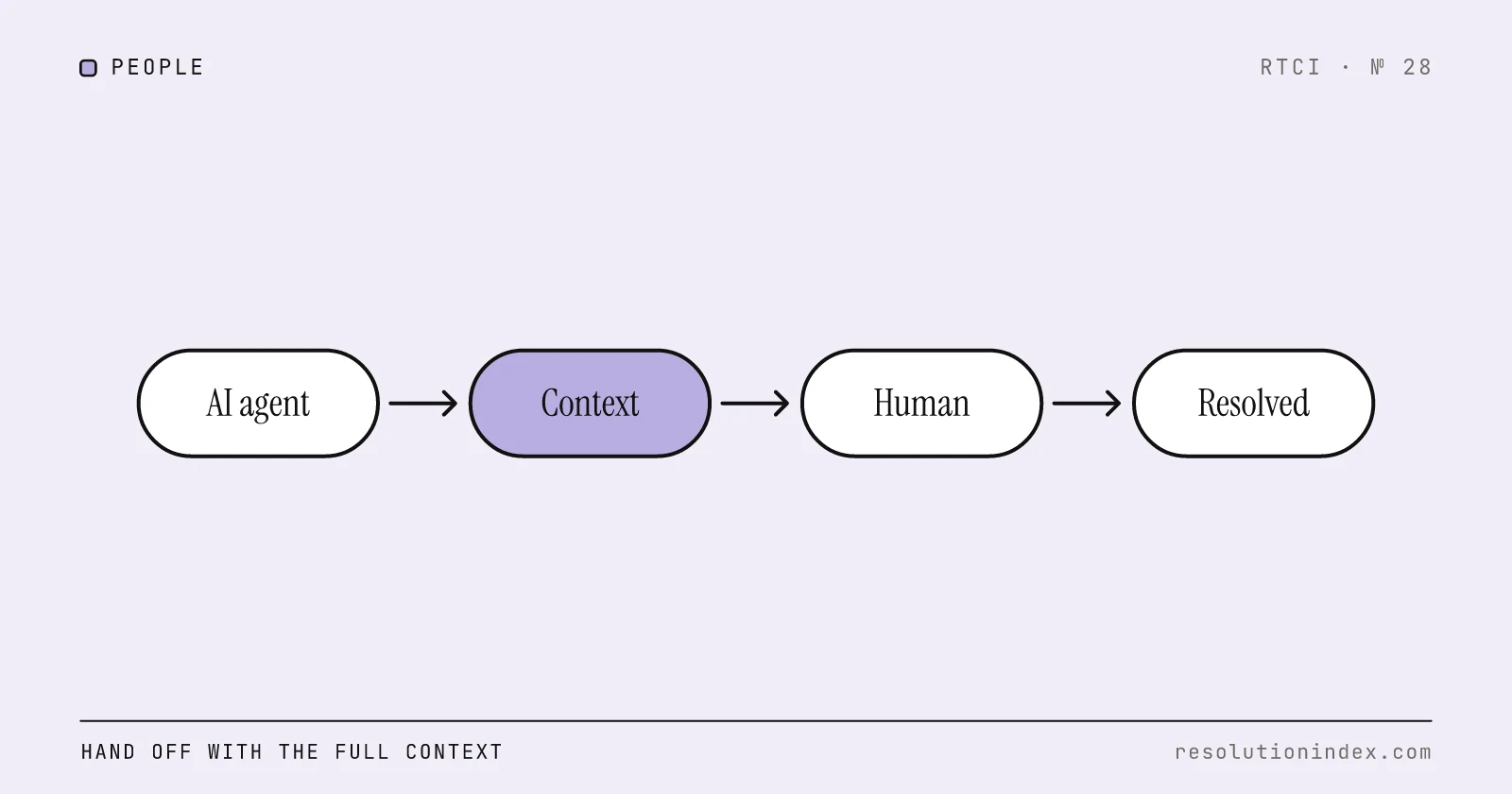
What a clean AI-to-human handoff packet contains, how to measure handoff quality, what vendors bill when a conversation is handed off, and how handoffs move cost per verified resolution.
How to Choose an AI Customer Support Platform in 2026
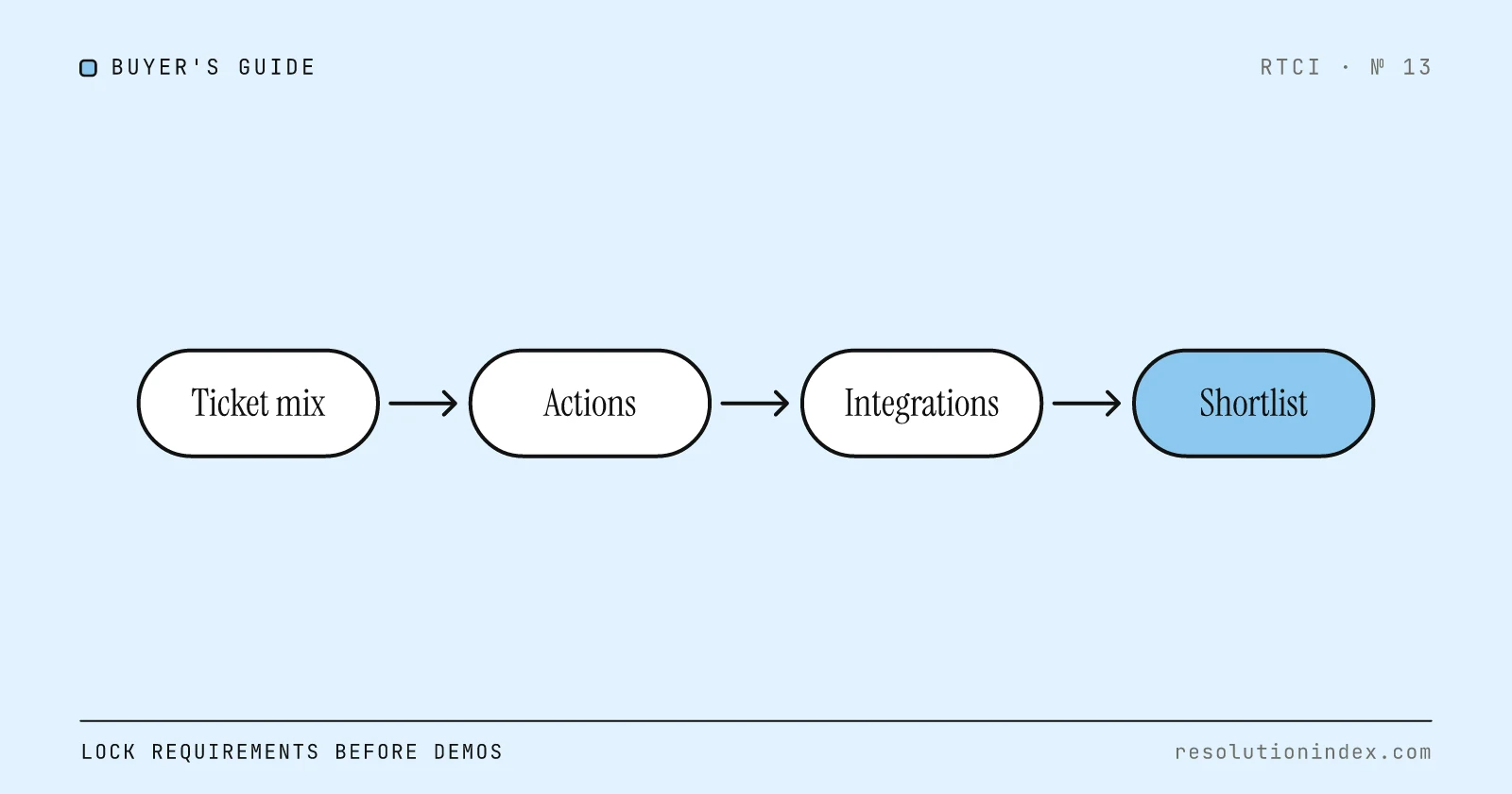
A decision tree to shortlist AI support platforms: lock ticket mix, actions, integrations, and verified resolution before demos.
Hidden Fees in AI Support Contracts: What Buyers Miss
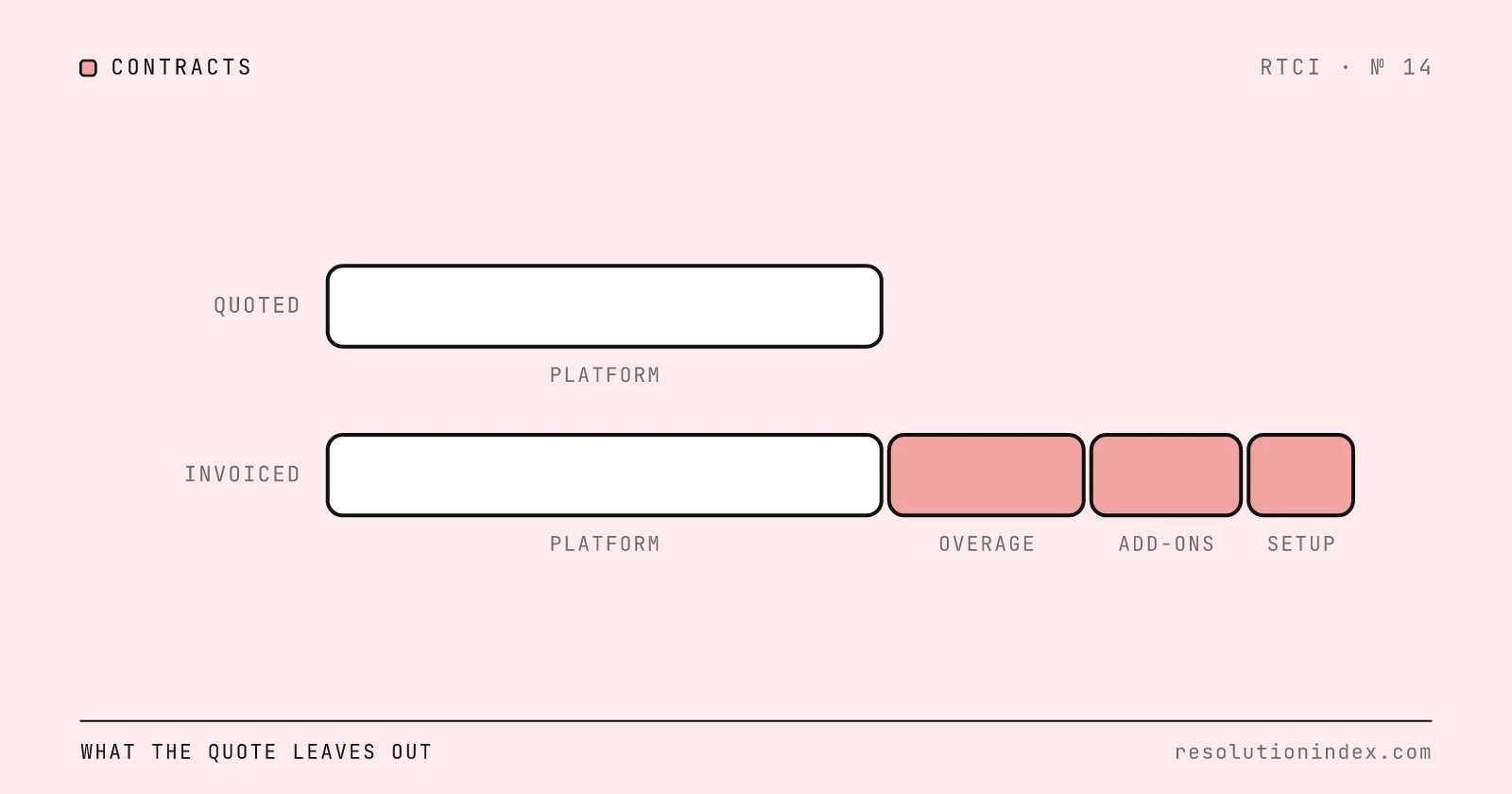
Where AI support invoices outgrow the quote: second meters, overage rates, one-time allowances, add-ons, outbound channels and exit costs, with clause language and a worked 12-month reconciliation.
Good AI Resolution Rate: 2026 Benchmarks (45–70%)
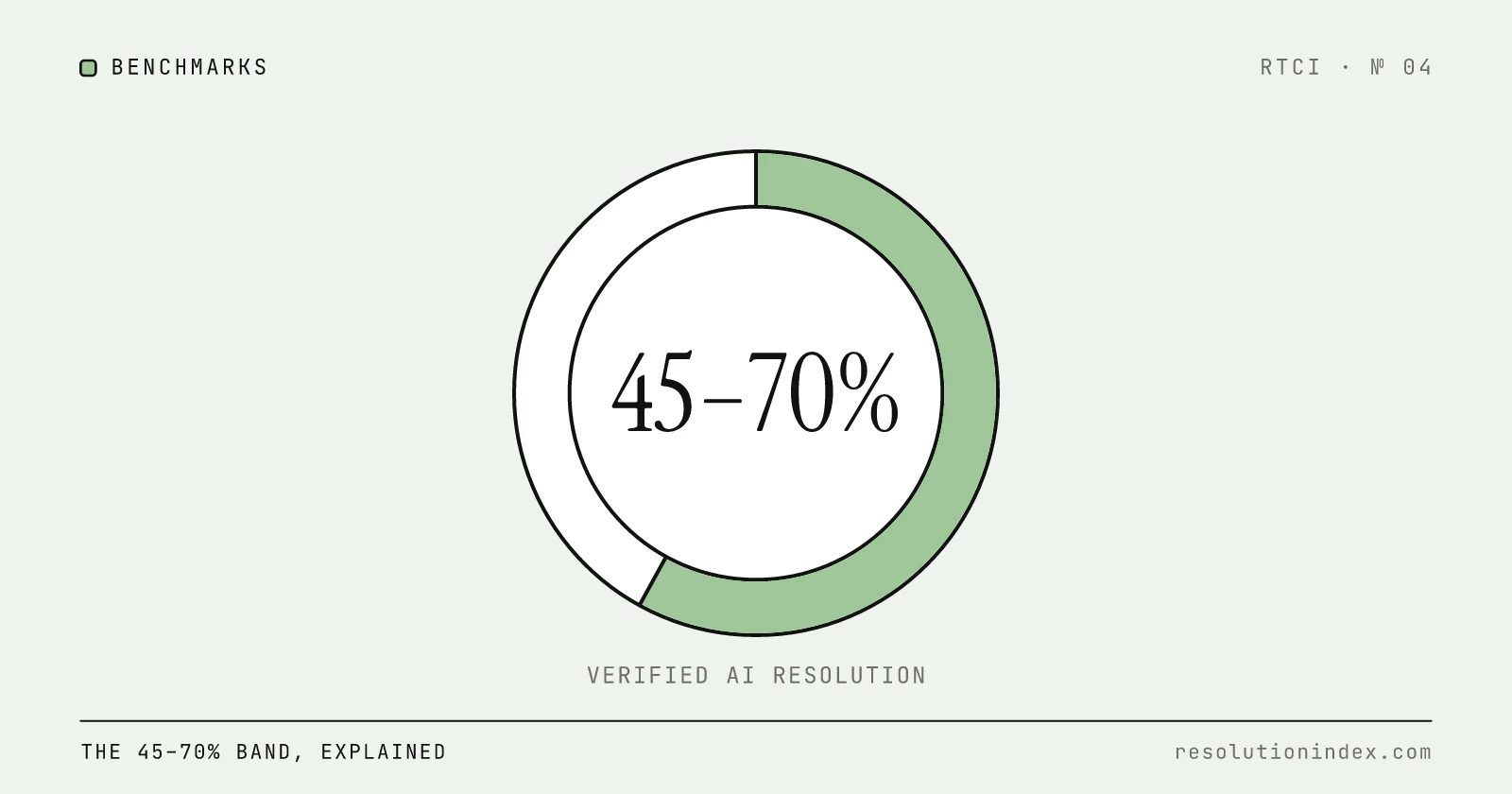
A 45–70% realistic AI resolution rate is good for most support teams; above 70% is excellent. 13 of the 20 platforms in RTCI's index land in that band, and the median is 58%.
How to Measure AI Resolution Rate Internally
Vendor dashboards report resolution rates that no two vendors calculate the same way. This is a practical, vendor-agnostic methodology to measure your own AI resolution rate using your own ticket data, built on RTCI's 72-hour verified resolution standard.