Published Aug 17, 2026 · Updated Nov 19, 2026 · 9 min read
Train the Team on AI Handoff Workflows
What a clean AI-to-human handoff packet contains, how to measure handoff quality, what vendors bill when a conversation is handed off, and how handoffs move cost per verified resolution.
 Written by Andrew Hall, Editor
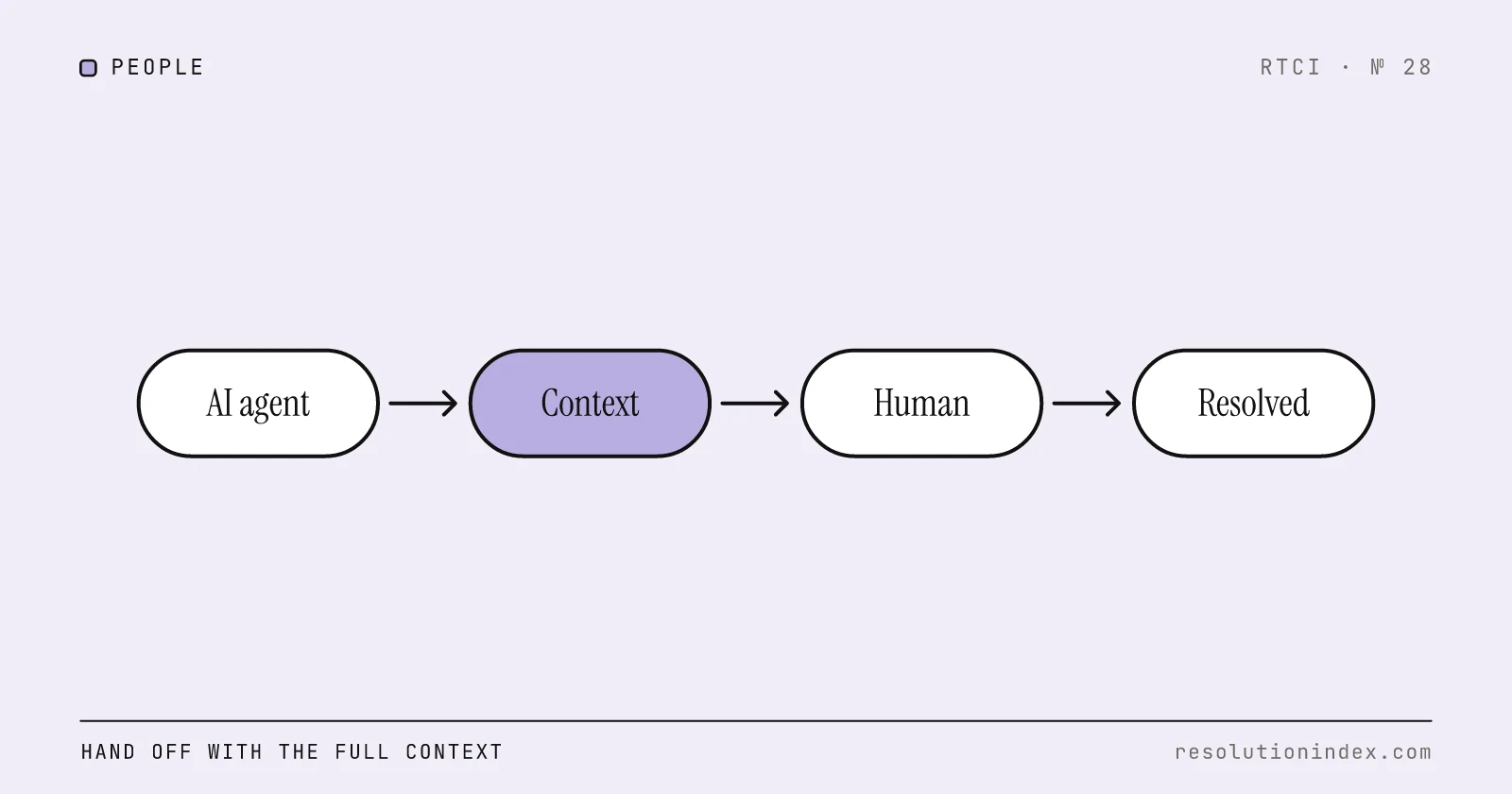
Train agents on one artifact and one habit: a standard handoff packet (open question, what the AI already tried, verification state, account snapshot, reason code) and reading it before they speak. Then measure the handoff itself, not only the escalation rate: packet completeness, how often customers restate the problem, time to accepted ownership, post-handoff handle time against a human-only baseline, and 72-hour reopens. Handoffs also move cost per verified resolution, because some vendors bill escalated conversations and every minute an agent spends re-gathering context lands on the same budget.
This post covers only what is specific to AI handoffs. General onboarding, empathy and de-escalation training belong in the program you already run. For the pilot around this work, see the 90-day AI support pilot playbook; for cutting escalations before they happen, see reduce escalations without adding headcount.
When should the AI hand off to a human?
Every handoff should carry a reason code, because the code is what lets you find and fix the cause later. Three trigger classes, plus one rule for recoverable confusion, cover the cases:
| Trigger class | Examples | Default action | Reason-code family |
|---|---|---|---|
| 1. Explicit human request | "Agent," "real person," "supervisor" | Transfer immediately, no retention prompt | EXPLICIT_REQUEST |
| 2. AI / system limits | Low confidence, repeated loop, tool failure, out of scope | Hand off with packet | LOW_CONFIDENCE / LOOP_LIMIT / TOOL_FAILURE / OUT_OF_SCOPE |
| 3. Risk / VIP / compliance | Distress, legal, VIP, billing dispute, policy exception | Route to the skill group; warm transfer on voice | RISK_OR_DISTRESS / VIP / COMPLIANCE / POLICY_EXCEPTION |
| Recover once | Mild confusion on an in-scope question | One clarifying turn | None unless it fails, then class 2 |
Count any blocked request for a person as a critical defect in QA. For class 2, teach agents to read which limit fired: if the AI's refund call failed at the payment processor, retrying the same path wastes the customer's time. Keep the reason-code list short enough to memorize and retire codes nobody uses; a long list pushes agents toward "other," which tells you nothing.
What should a clean handoff packet contain?
The packet is what the agent sees before the first word. It needs seven fields:
- Open question. What the customer still needs, in one line.
- Transcript or timeline. For checking, not for reading end to end.
- Intent, entities and risk flags. Order number, product, sentiment, any compliance flag.
- AI attempts and outcomes. What was tried and where it failed.
- Verification state. Whether identity was confirmed, and how.
- Account snapshot. Plan, tenure, open orders, prior cases.
- Reason code and target skill group.
Two missing fields cost the most. Without verification state the agent has to re-verify before any account action. Without AI attempts the agent retries a path the AI already exhausted. Score completeness on sampled handoffs and treat a missing verification field as a failure on its own.
Example packet, chat: Open question: refund not completed after payment error. Reason: TOOL_FAILURE. Risk flags: none. Verified: yes, account ending 4412. Attempts: self-serve refund, failed at the payment processor. Account: 3-year customer, one prior billing case.
Summaries can be wrong. If the summary conflicts with the customer's last message or the account record, the agent goes with the primary evidence, corrects the record and tags bad_summary. If the summary says "wants refund" and the last message says "never received my order," the summary is wrong.
How do you train agents to use the packet?
Train a fixed reading order so it holds up under load: (1) open question and reason code, (2) risk flags, (3) verification state, (4) AI attempts, (5) account snapshot, (6) the transcript, only for gaps. Risk and verification come before attempts because they change how the agent opens.
The drill. A coach loads a redacted real handoff. The agent reads the packet aloud in that order, then delivers the first message. The coach times the read and scores the opening. Use real handoffs from your own queue rather than invented scenarios, and run about ten per agent. Use the median time of agents who pass as your bar.
The opening. Name the customer, name the issue, confirm what was already done, take ownership of the next step, and ask only for what is missing.
- Good: "Hi Maya, I've got your chat about the refund that didn't go through after the payment error. Your account is already verified. I'll finish the refund from here. One check: is the card on file still the one you want credited?"
- Bad: "Hi, how can I help you today?"
On voice, prefer a warm brief, and if the agent needs a few seconds, say so once ("I'm pulling up your conversation, about ten seconds") instead of leaving dead air. Agents should never blame "the bot" to the customer; the complaint goes into a tag, where someone can fix it.
Certification before the hybrid queue. An agent is ready when they can name the three trigger classes and the recover-once rule, complete a timed packet read with the correct open question and verification call-out, and deliver three openings in a row without asking for facts already in the packet. A nested live shift with no critical defect (blocked human request, sensitive action without verification, customer forced to restate everything) completes it.
How do you measure handoff quality?
Escalation rate tells you how work is split between AI and people. It says nothing about whether the handoff worked. Measure the handoff directly:
| Metric | How to measure | What it tells you |
|---|---|---|
| Handoff rate by reason code | Reason code on every escalation | Where the AI hits its limits; which fixes come first |
| Packet completeness | Sampled handoffs scored against the seven fields | Whether context travels |
| Customer repetition rate | Sampled handoffs: did the customer restate known facts? | The cost of a thin packet or a skipped read |
| Time to accepted ownership | Timestamp of handoff to first agent reply | Routing and queue friction |
| Post-handoff handle time | Hybrid conversations vs human-only for the same intent | Extra minutes spent re-gathering context |
| 72-hour reopen on handoffs | Recontacts on handed-off conversations | Whether the human side resolved it |
| Post-handoff CSAT | Survey on hybrid conversations, reported separately | Customer view of the transition |
Set the baseline for handle time and reopen from human-only tickets of the same intent before go-live; otherwise you have nothing to compare against. Report AI-only, human-only and hybrid conversations separately, or a good AI segment will hide a bad hybrid one.
Sample size matters for the rates you score by hand. A sample of 50 handoffs a week estimates a repetition rate to within about ±14 points at 95% confidence (1.96 × √(0.25 / 50) = 0.139). To get within ±5 points you need 385 (1.96² × 0.25 / 0.05² = 384.2, rounded up). Pool several weeks before calling a trend.
Give every defect a tag (bad_summary, wrong_reason_code, missing_verification, missing_attempts, wrong_queue, customer_repeated_story, should_not_have_escalated) and every tag an owner: ops owns triggers and reason codes, team leads own coaching, knowledge owns article and procedure gaps. A short weekly review that clusters the top tags and ships one fix keeps the list from growing. Many escalation tags turn out to be knowledge base readiness problems. Put completeness and repetition rate on the fair AI support pilot scorecard next to resolution rate.
What does your vendor bill when a conversation is handed off?
This varies by vendor and changes the numerator of cost per verified resolution, so get it in writing. Two examples from RTCI's reviews:
- Intercom Fin charges $0.99 per outcome. Outcomes include Procedure handoffs, disqualifications and self-serve routings as well as resolutions, so some billed outcomes are conversations a human still had to finish. See the Intercom Fin review.
- Gorgias AI charges $0.90 (annual) or $1.00 (monthly) per automated interaction, and each one also counts as a helpdesk ticket. If a human agent replies within 72 hours of an AI resolution, it is charged as a billable helpdesk ticket instead. See the Gorgias AI review.
Ask every vendor on your shortlist: is a conversation that ends in a handoff billed, and at what rate? Does a human reply after an AI resolution change the charge? Can the monthly invoice break billed events down by type?
How do handoffs change cost per verified resolution?
Cost per verified resolution divides total cost by AI resolutions with no human handoff and no recontact within 72 hours. Handoffs push it up from both sides.
Worked example. Assume 10,000 conversations a month and an AI priced at $0.99 per billed outcome. The AI bills 6,000 outcomes: 5,000 verified resolutions and 1,000 that were billed but ended in a handoff or came back within 72 hours. The other 4,000 conversations go straight to people, so 5,000 reach an agent in total. Assume a loaded agent cost of $36 an hour ($0.60 a minute).
- AI side: 6,000 × $0.99 = $5,940. Divided by 5,000 verified resolutions, that is $1.19 per verified resolution, not the $0.99 on the price list.
- Clean packets: 8 minutes per handed-off conversation × $0.60 = $4.80. 5,000 × $4.80 = $24,000. Total $29,940, or $2.99 per conversation.
- Thin packets: agents spend 3 extra minutes re-asking for context, so 11 minutes × $0.60 = $6.60. 5,000 × $6.60 = $33,000. Total $38,940, or $3.89 per conversation.
The three minutes cost $9,000 a month. Negotiating the AI price down by $0.20 per outcome would save 6,000 × $0.20 = $1,200. In this example, packet quality is worth more than seven times the price cut. Run your own volumes through the cost per verified resolution calculator and check handle time with the average handle time calculator.
Which handoff failures should you watch for?
- Blocked human requests. The AI makes one more attempt after the customer asks for a person. Shows up in QA samples and in complaints; fix the trigger policy, not the agent.
- Empty packets. A summary with no attempts, verification or reason code, followed by "how can I help you today?" Shows up as
customer_repeated_storyand higher post-handoff handle time. - Wrong-queue dumps. Every escalation lands in a general queue and gets re-transferred. Shows up as
wrong_queuetags and long time to ownership; fix the routing map. - Over-trusted summaries. Agents act on a wrong summary. Shows up as
bad_summarytags; if agents rewrite summaries often, fix the summarization prompt or the knowledge source. - Escalation rate reported alone. Leadership celebrates a falling handoff rate while hybrid reopens rise. Fix it by putting completeness, repetition and hybrid reopen on the same report.
If the human queue is busier than planned after go-live, check whether staffing was based on the vendor's claimed resolution rate. Plan residual human volume from verified resolution measurement and the realistic ranges in RTCI's reviews, not the vendor's headline number.
Frequently asked questions
When should AI hand off to a human agent?
On an explicit request for a person, immediately and without a retention prompt. On system limits: low confidence, a repeated misunderstanding, a failed tool call or an out-of-scope intent. And on risk: distress, legal or compliance topics, VIP accounts, billing disputes and policy exceptions. For mild confusion on an in-scope question, the AI gets one clarifying turn, then hands off with the packet.
What information must transfer in an AI-to-human handoff?
Seven fields: the open question, the transcript or a timeline, intent and risk flags, what the AI already tried and how it failed, verification state, an account snapshot, and a reason code with the target skill group. Missing verification state and missing AI attempts are the two gaps that cost the most agent time.
How do you train support agents on AI handoffs?
Train one habit: read the packet in a fixed order before speaking, then open by naming the issue and what was already done. Drill it on redacted real handoffs, time the scan, and certify agents before they take the hybrid queue alone. General soft-skills training stays in your existing program.
How do you measure handoff quality beyond escalation rate?
Sample handoffs and score packet completeness and whether the customer had to restate the problem. Track time to accepted ownership, post-handoff handle time against a human-only baseline for the same intent, and 72-hour reopens on handed-off conversations. Escalation rate alone only tells you how work is split.
How do handoffs affect cost per verified resolution?
Two ways. Some vendors bill conversations that end in a handoff (Intercom Fin bills Procedure handoffs as $0.99 outcomes), which adds cost without adding a verified resolution. And every minute an agent spends re-gathering context is paid on the human side. In the worked example in this post, three extra minutes per handoff cost $9,000 a month, more than seven times the saving from a $0.20 cut in the AI price.
Warm or cold transfer?
Warm, where the agent is briefed before the customer connects, for voice, distress, VIP, compliance and high-value cases. Cold, where the customer joins while the agent reads, is acceptable for low-stakes chat when the packet is complete. Set the default per trigger class rather than leaving it to each agent.
Change log
- Cut the generic training-program material, removed unsourced benchmarks and thresholds, and added what vendors bill on handoffs plus a worked cost-per-resolution example.
- Published.
Read next
Keep reading
Picked for this article: the pieces it cites and the ones that answer the next question buyers usually ask.
Most related
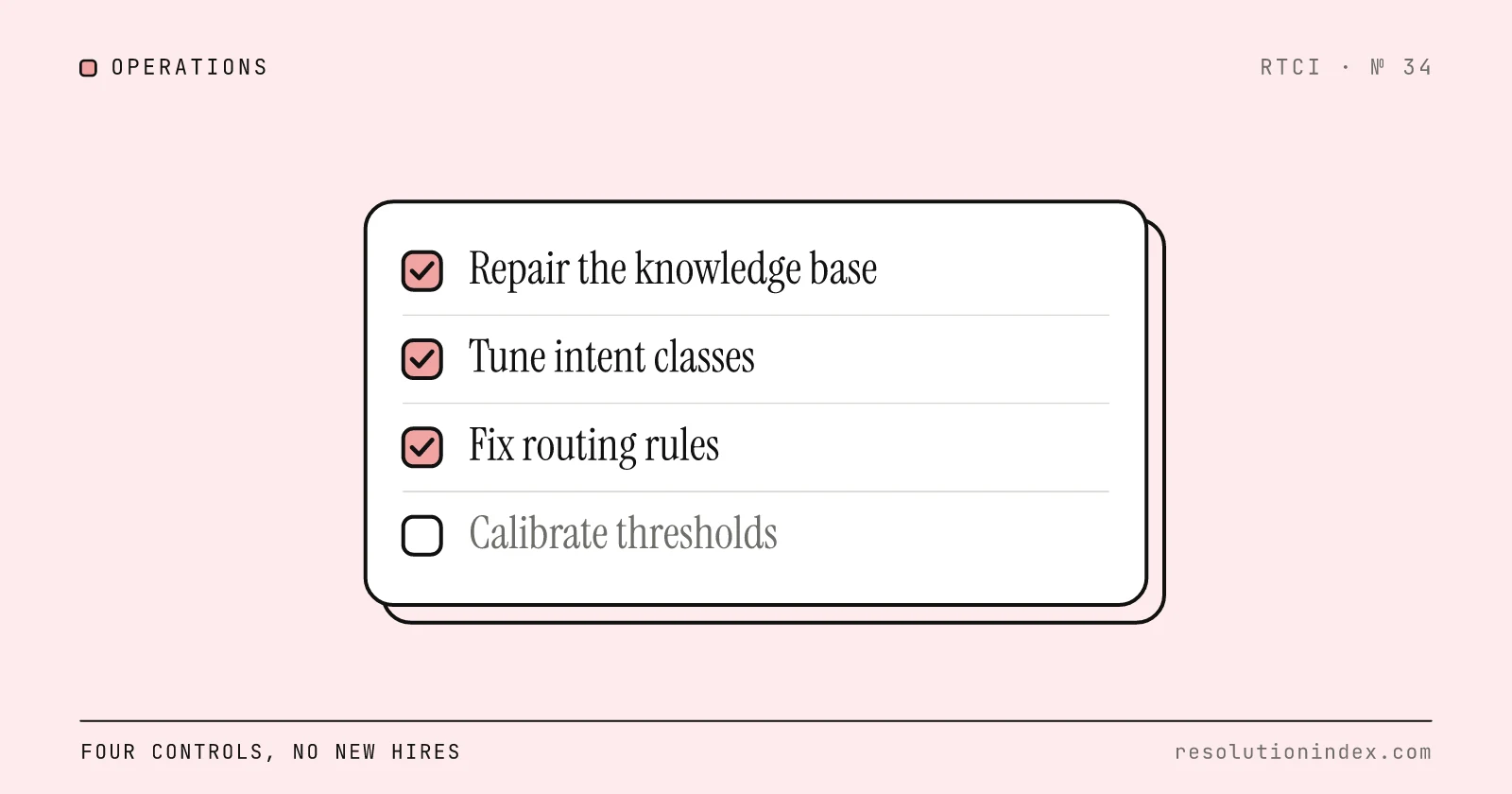
Reduce AI-to-Human Escalations Without Adding Headcount
Tag a sample of escalations by root cause, fix the knowledge gaps and routing errors behind the avoidable ones, then set confidence thresholds by risk. A four-step loop with an audit template, threshold table and worked cost math.
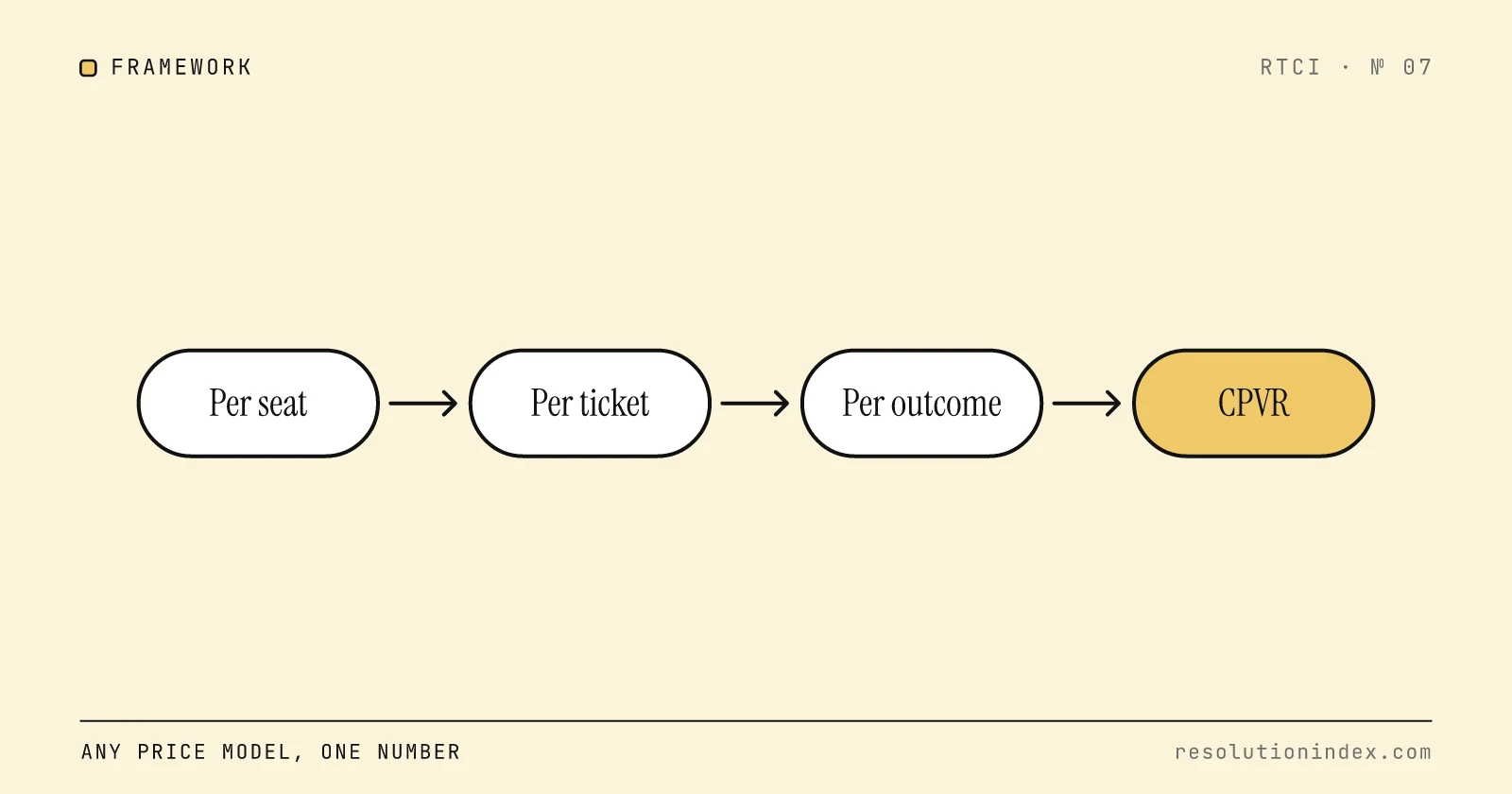
Cost Per Verified Resolution: A New Framework
Per-seat, per-ticket, and per-resolution pricing models all produce different numbers for the same underlying cost. RTCI's three-layer cost model normalizes any vendor's pricing into a single comparable metric: cost per verified resolution.
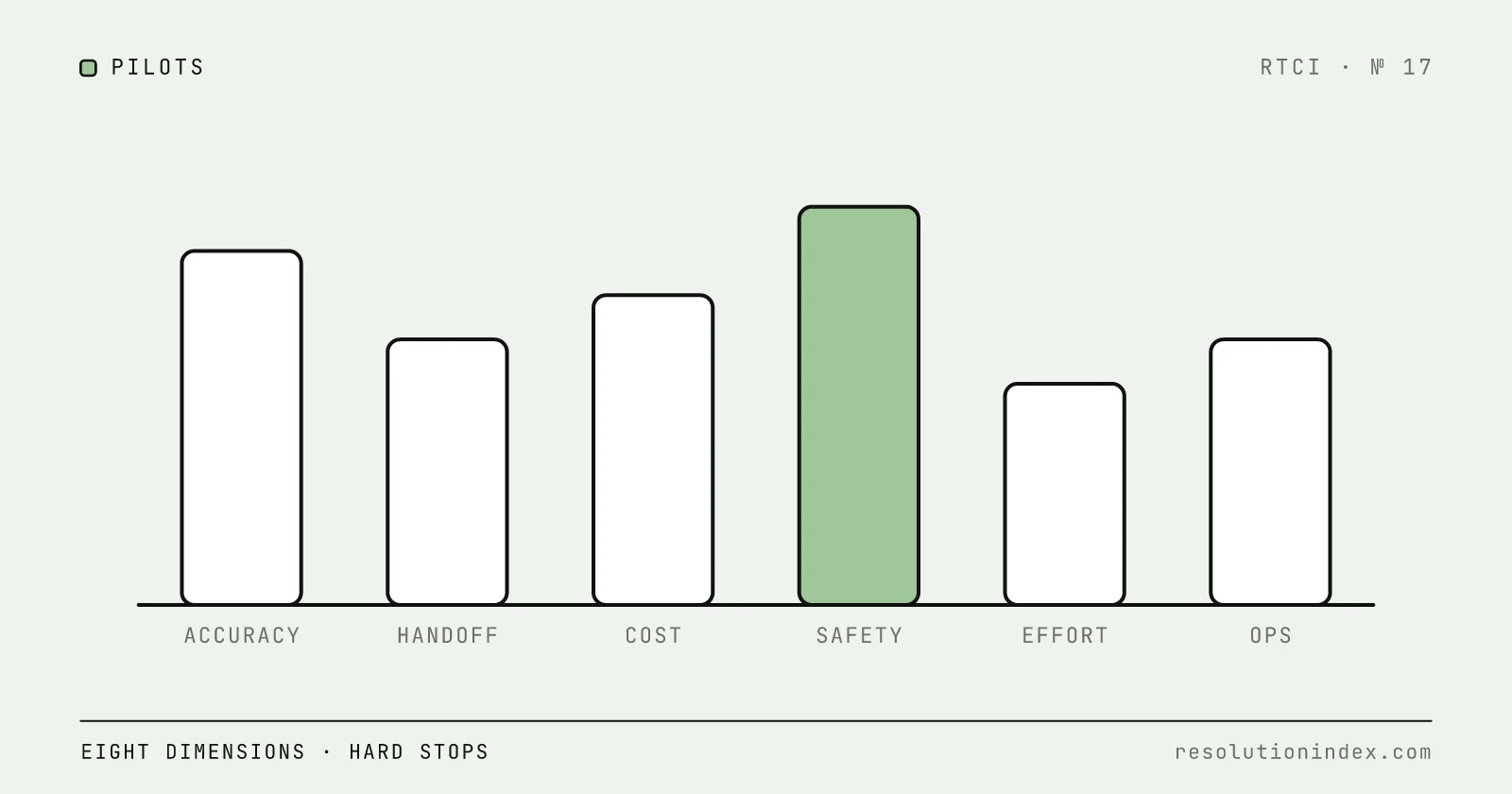
How to Design a Fair AI Support Pilot Scorecard
A weighted scorecard with 8 dimensions, hard-stop gates, and copy-paste Week 1–4 templates for evaluating an AI support pilot honestly.
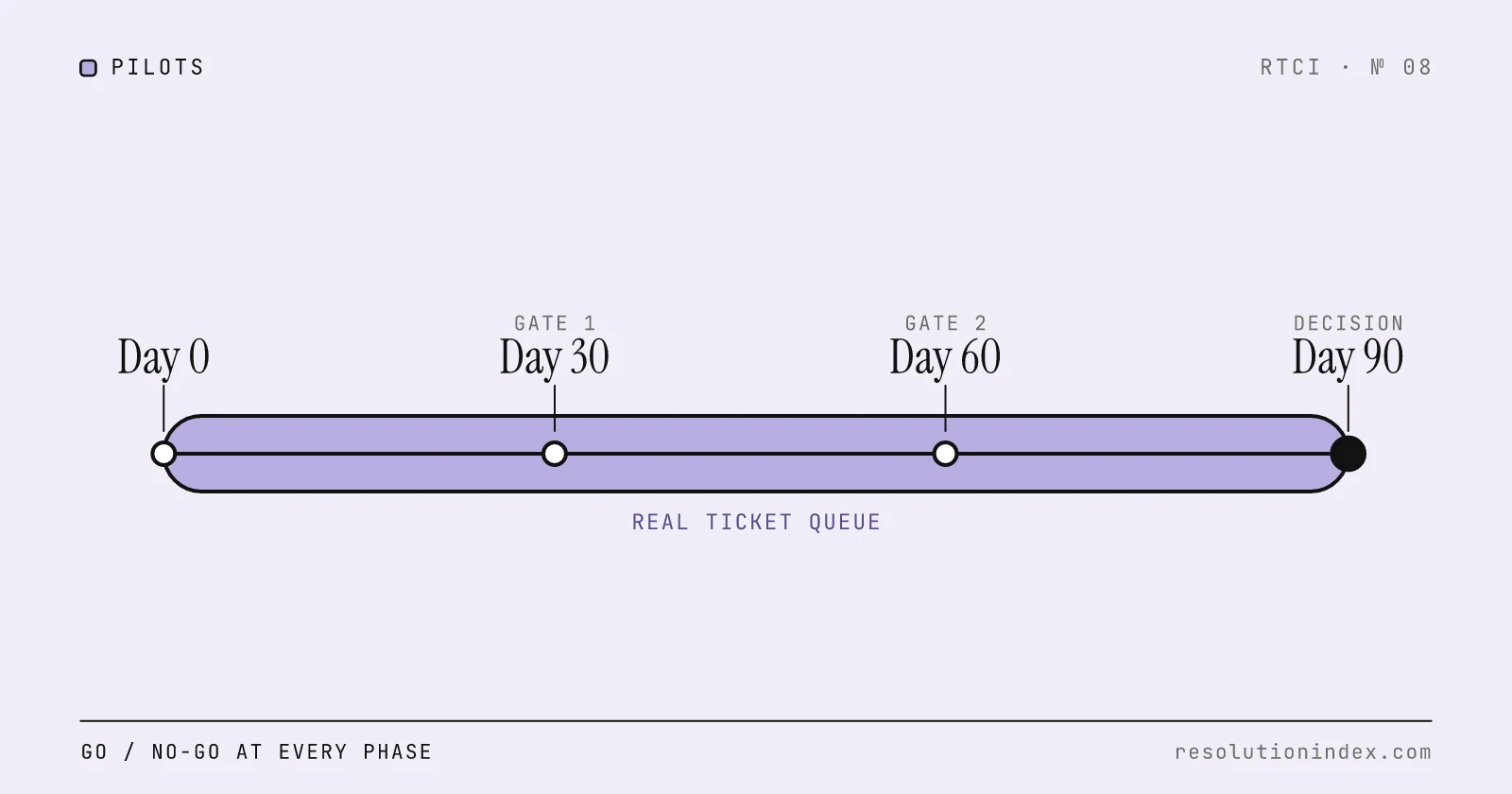
How to Pilot an AI Support Agent: A 90-Day Playbook
A vendor-agnostic 90-day plan for testing an AI support agent against your real ticket queue, with go/no-go criteria at each phase and clear rules for when to stop.
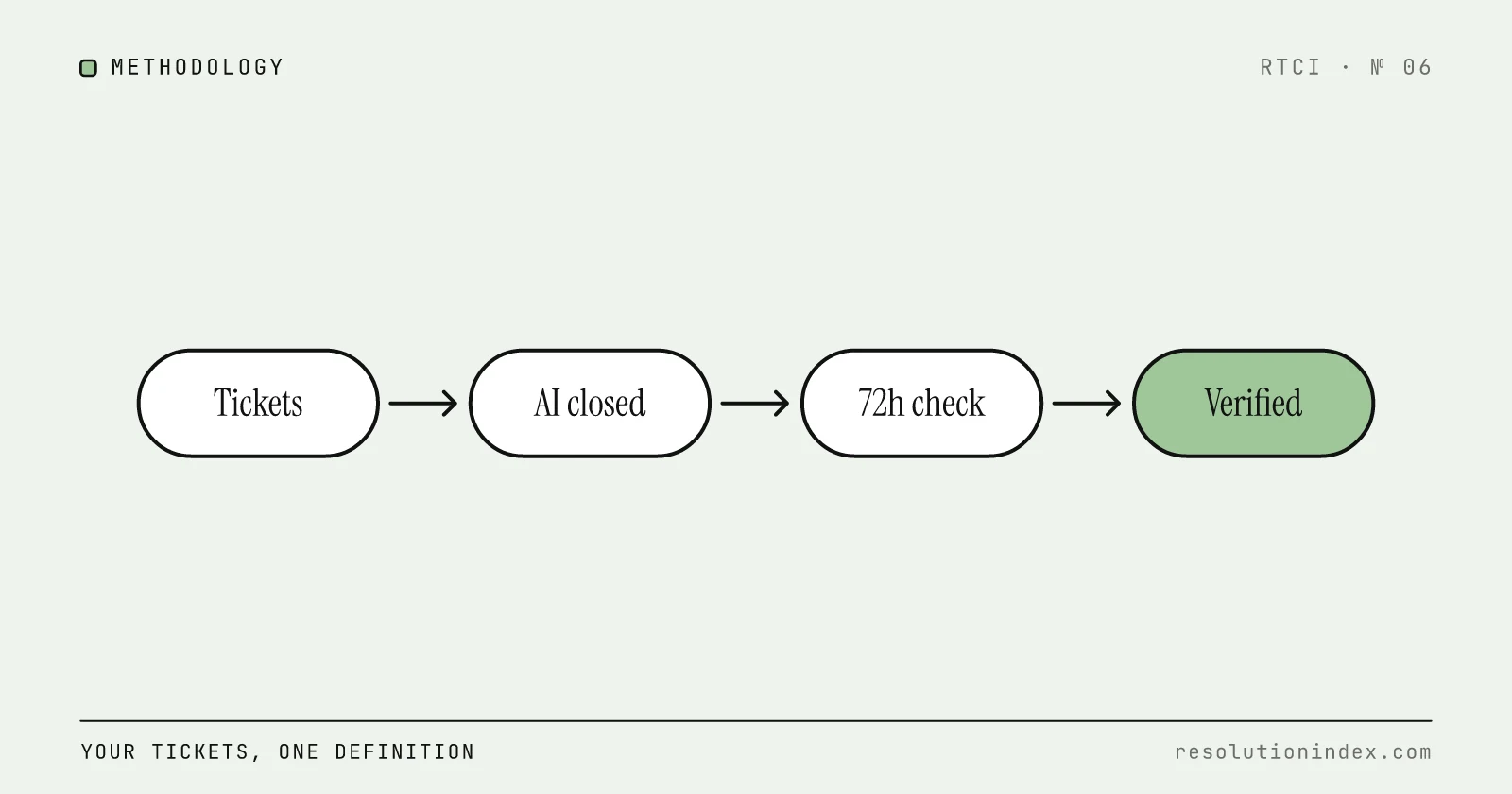
How to Measure AI Resolution Rate Internally
Vendor dashboards report resolution rates that no two vendors calculate the same way. This is a practical, vendor-agnostic methodology to measure your own AI resolution rate using your own ticket data, built on RTCI's 72-hour verified resolution standard.