Published Nov 5, 2026 · Updated Nov 20, 2026 · 10 min read
Intercom Pricing 2026: What Fin Really Costs Per Resolution
Intercom pricing as of November 2026: seats from $29, Fin at $0.99 per outcome, the add-ons, and a worked cost per resolution for three team sizes.
 Written by Andrew Hall, Editor
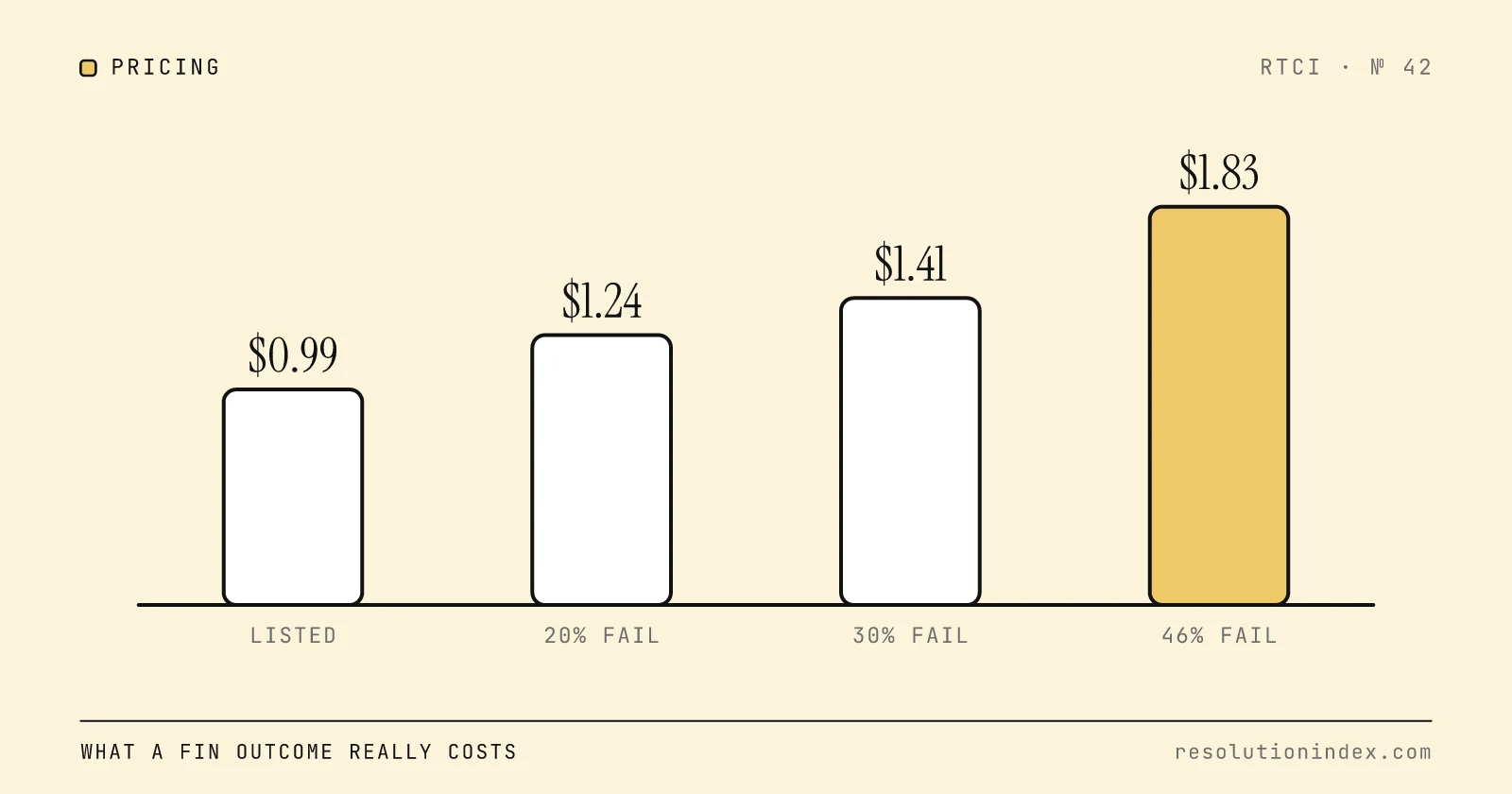
As of November 2026, Intercom pricing has two parts. You pay for helpdesk seats at $29, $85 or $132 per seat per month on annual billing, and you pay $0.99 for each Fin AI agent outcome. Once you account for handoffs and silent failures, the real cost of each conversation Fin actually resolves can rise above that $0.99 list price.
That gap between the sticker price and the effective price is what this guide is about. Below are the current list prices, the billing rules that decide what you pay for, and three worked monthly bills you can adapt to your own volume.
Key takeaways
- Intercom bills seats and Fin separately, so the seat price alone understates the monthly bill for any team that switches Fin on.
- Fin charges $0.99 per outcome, and an outcome includes assumed resolutions and procedure handoffs, not only confirmed fixes.
- If a fifth of billed outcomes are handoffs or silent failures, each real resolution costs about $1.24 instead of $0.99.
- Salesforce completed its acquisition of Fin on September 10, 2026, which is a reason to negotiate renewal caps now, before roadmap and pricing decisions move.
Intercom seat prices in November 2026
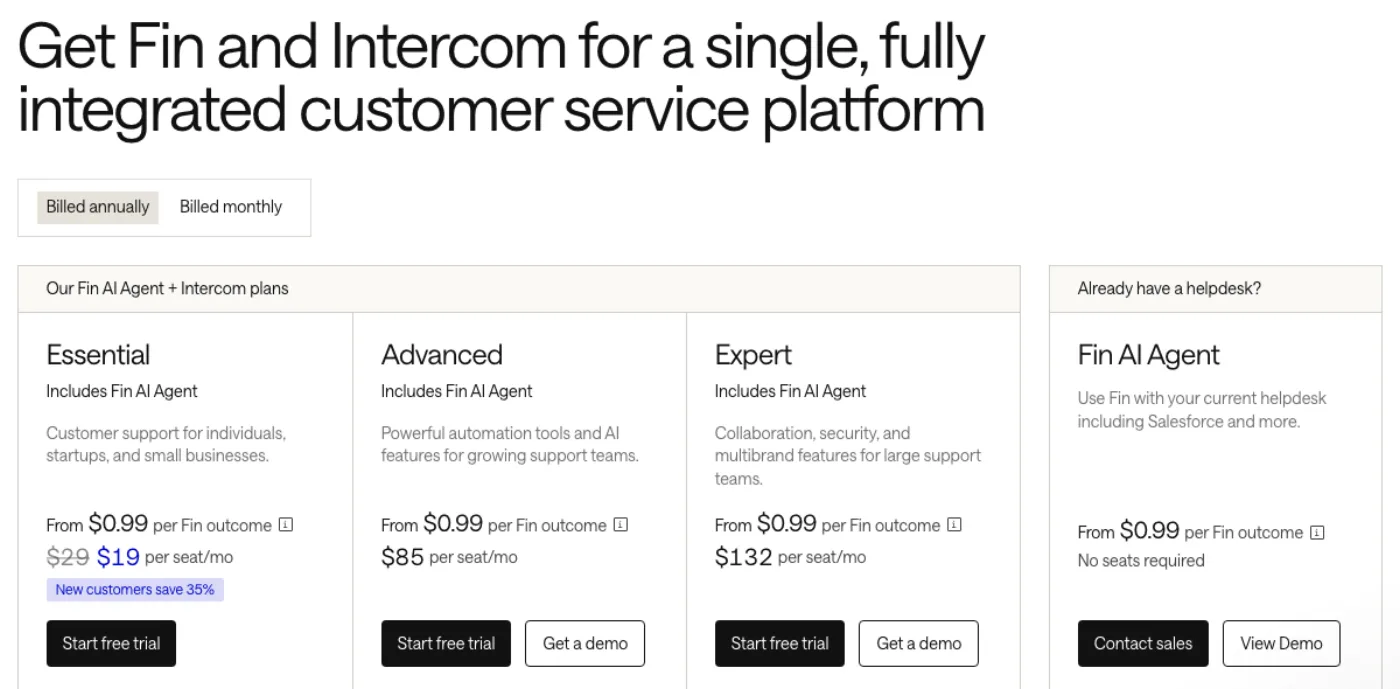
Every human who works in the inbox needs a full seat. Intercom's pricing page lists three self-serve plans.
| Plan | Per seat, billed annually | Per seat, billed monthly | Free Lite seats included |
|---|---|---|---|
| Essential | $29 ($19 for new customers) | $39 | None |
| Advanced | $85 | $99 | 20 |
| Expert | $132 | $139 | 50 |
The Essential discount is easy to miss. New customers get 35% off an annual Essential plan, which brings the seat to $19.
Lite seats are free on Advanced and Expert. They give limited access for internal collaborators, so a product manager who only needs to read conversations does not need a paid seat.
Inbound email support is included in the seat. Outbound channels are not: Intercom charges usage for WhatsApp and SMS messages, bulk email campaigns and phone, with rates that vary by region.
How Fin is billed: outcomes, not resolutions
The second half of the bill is Fin. On 12 March 2026, Intercom changed Fin's billing metric from resolutions to outcomes, and its help article on Fin outcomes says the fundamentals of pricing stayed the same.
In practice the rename widened what counts. According to Intercom's outcome pricing article, these are the billable outcome types:
| Outcome | Price | When it is charged |
|---|---|---|
| Resolution | $0.99 | The customer confirms the answer worked, or leaves without asking for more help |
| Procedure handoff | $0.99 | Fin completes a configured procedure that ends by handing off to a person or workflow |
| Self-serve routing | $0.99 | Fin routes the customer to the right self-serve path |
| Disqualification | $0.99 | Fin screens out a lead that does not fit |
| Qualification | $9.99 | Fin qualifies a sales lead |
You pay for one outcome per conversation, even if Fin answers several questions or takes several actions in it.
Intercom also lists what it does not bill. A conversation where the customer asks for a human, a procedure that fails, an abandoned chat, spam and outbound messages that are only opened are all free. A clarifying question that goes unanswered and auto-closes counts as abandoned, not resolved.
One rule works in your favour. If a customer returns to a conversation Fin marked resolved and asks for more help, even in a later billing period, Intercom deducts that resolution.
Why $0.99 is a floor, not the real cost
Two of the outcome types bill you for conversations where the customer may not have been helped.
An assumed resolution is charged when the customer stops replying. Some of those customers got their answer. Others gave up and called, emailed a different address or churned. The reversal rule only catches the ones who come back to the same conversation.
A procedure handoff is charged when Fin finishes its scripted steps and passes the case on. That can be useful work, such as collecting order details before a refund, but a person still finishes the job.
Fin's own team describes the cost side plainly. In an interview on the Chargebee blog, Fin's Aisling O'Reilly, who works on pricing and monetisation, explained why the economics are hard for the vendor too:
"Our costs scale with how often Fin is in a conversation, not how often it resolves it."
Aisling O'Reilly, Fin, in How Fin is rebuilding FP&A for outcome-based AI
The buyer's version of the same point: your cost scales with billed outcomes, while your value scales with verified resolutions. The ratio between the two sets your real price.
| Share of billed outcomes that are handoffs or silent failures | Effective cost per verified resolution |
|---|---|
| 0% | $0.99 |
| 10% | $1.10 |
| 20% | $1.24 |
| 30% | $1.41 |
| 46% | $1.83 |
The arithmetic is $0.99 divided by the share of outcomes that are real resolutions. RTCI's Intercom Fin review scores Fin at $0.99 per resolution with a realistic 56% to 66% resolution rate (RTCI score 696, Strong); the table shows how far that rises if your own sample finds billed outcomes that were not real fixes.
To find your own ratio, sample 100 billed outcomes from last month and check each one for a repeat contact within 72 hours on any channel. The method is laid out in resolution rate vs deflection rate.
Worked monthly bills for three team sizes
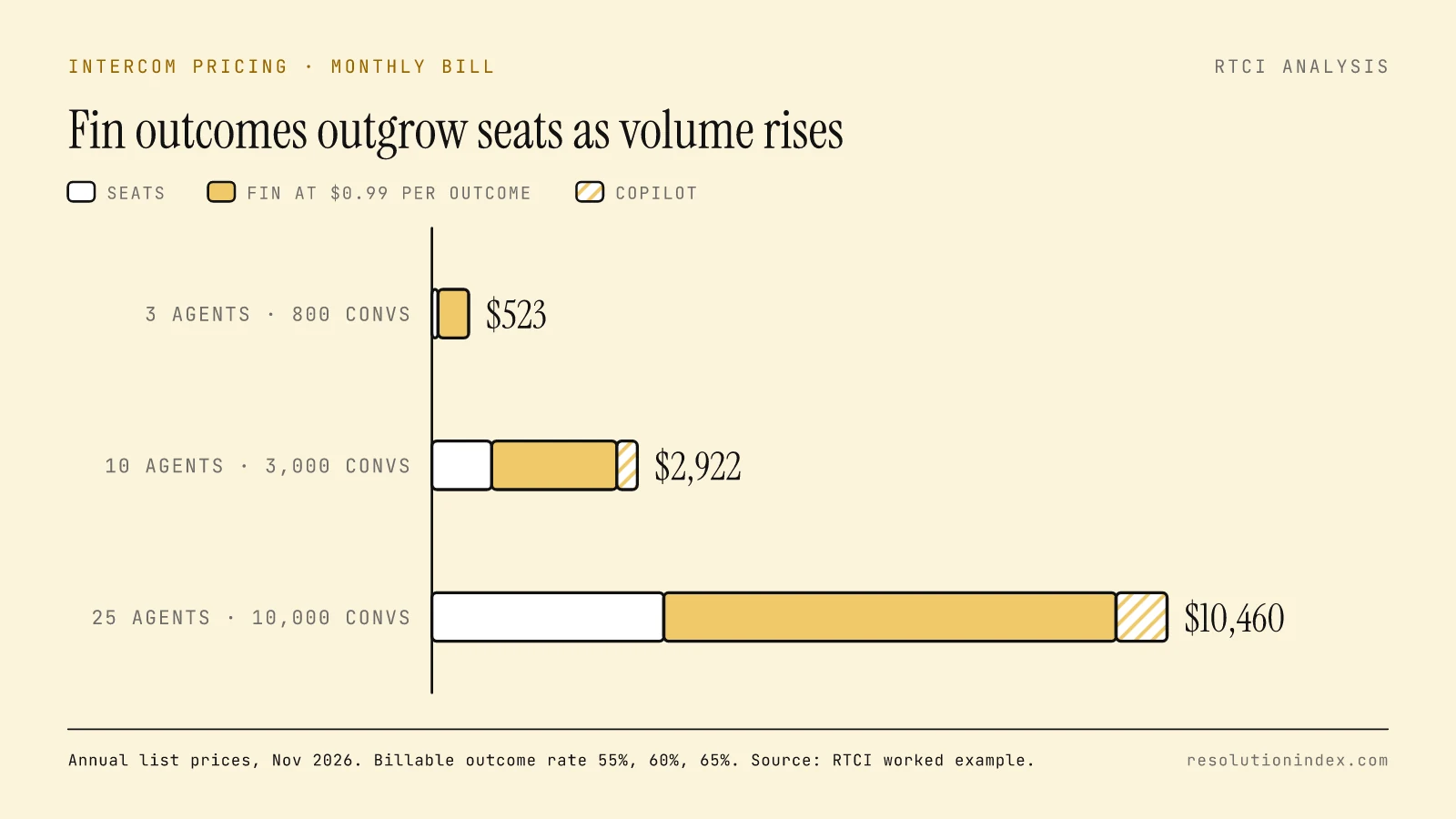
With the billing rules in place, the totals become straightforward to estimate. The three teams below use annual list prices as of November 2026 and assume Fin ends between 55% and 65% of the conversations it handles with a billable outcome.
| 3-agent startup | 10-agent SaaS team | 25-agent support org | |
|---|---|---|---|
| Plan | Essential, $29 | Advanced, $85 | Expert, $132 |
| Seat cost | $87 | $850 | $3,300 |
| Conversations Fin handles | 800 | 3,000 | 10,000 |
| Billable outcome rate | 55% | 60% | 65% |
| Fin outcomes | 440 | 1,800 | 6,500 |
| Fin cost at $0.99 | $435.60 | $1,782.00 | $6,435.00 |
| Copilot, $29 per agent | none | $290 | $725 |
| Monthly total | $522.60 | $2,922.00 | $10,460.00 |
| Fin cost per verified resolution, if 20% of outcomes are not real fixes | $1.24 | $1.24 | $1.24 |
Three things stand out.
Fin is the larger line item for every team except the smallest one, and it grows with volume while seats stay flat.
The new-customer Essential price would cut the startup's seat line from $87 to $57, a saving of $30 a month. The Fin line is where the real money sits.
At 10,000 conversations a month, list price is the wrong number to plan around. Intercom routes high-volume Fin pricing to its sales team, so a team at that size should expect a negotiated rate and should ask for one.
Add-ons that change the total
Beyond seats and Fin, a few add-ons appear on many Intercom invoices. All prices are from the same Intercom pricing page as of November 2026.
| Add-on | Price | Who needs it |
|---|---|---|
| Copilot | $29 per agent a month annually, $35 monthly | Teams that want AI drafting and answers for human agents; each agent gets 10 free Copilot conversations a month |
| Proactive Support Plus | $99 a month, includes 500 messages sent; extra messages billed per message | Teams sending surveys, product tours, posts and mobile push. Intercom Surveys are only available through this add-on |
| Pro | From $100 a month, 500 conversations analysed and 6,000 credits | Teams that want CX scoring and AI topic analysis |
| Channel usage | Varies by region | WhatsApp, SMS, bulk email and phone |
Copilot and Fin are separate products. Copilot helps your human agents and is priced per agent. Fin talks to customers and is priced per outcome. Budget them separately.
Intercom Surveys pricing. There is no separate survey plan. Surveys are unlocked by Proactive Support Plus, and Intercom's Proactive Support Plus help article counts every survey, tour, post, push and carousel against one "messages sent" allowance. A team sending 400 in-app surveys a month stays inside the $99 allowance; a team surveying 2,000 users a month pays $99 plus overage on 1,500 messages, so ask sales for the overage rate before you schedule a large NPS or CSAT survey.
Using Fin with Zendesk or Salesforce instead
Teams that already run another helpdesk can buy Fin on its own. Fin's standalone pricing is $0.99 per outcome with a 50-outcome monthly minimum and no seat, setup, integration or platform fees.
That makes the floor roughly $50 a month. Fin's help centre describes it as a $49 monthly base that includes 50 AI resolutions, then $0.99 for each additional one.
This route is worth pricing out if your current helpdesk charges more per AI resolution than Fin does. Keep in mind that your existing seat licences still apply, so the comparison is your current AI add-on against Fin outcomes, not your whole helpdesk bill against Fin.
What the Salesforce deal means for your contract
The pricing question now has a corporate dimension. Intercom renamed the company Fin in 2026, keeping Intercom as the helpdesk product name. Salesforce agreed on 15 June 2026 to acquire Fin for about $3.6 billion and completed the acquisition on 10 September 2026, ahead of its original timetable. Fin now sits within Salesforce's AI Labs alongside Agentforce.
Neither announcement changed Intercom's list prices, and the prices above were unchanged as of November 2026. Even so, ownership changes tend to bring packaging changes, and a buyer signing now is in a good position to ask for protection.
Before renewing, ask for a cap on Fin's per-outcome rate for the contract term, a written definition of each billable outcome type, and the right to exit if the product is bundled into another platform. The hidden fees in AI support contracts guide lists the clauses that matter most.
The thinking behind outcome pricing
For context on why Intercom moved to this model, this interview with the company's pricing lead explains the reasoning from the vendor's side.
The vendor's incentive is clear from Fin's finance team as well. Tommy Bettles, VP of FP&A at Fin, put it this way in the same Chargebee piece: "The more successful customers are, the more revenue we have." That alignment holds only when "successful" means a resolved customer, which is why the outcome definitions deserve a close read.
When Intercom pricing works against you
Outcome pricing is a good deal in some setups and an expensive one in others.
It works against you when your customers often go quiet without being helped, such as billing disputes where people give up and call instead. Assumed resolutions get billed and the reversal rule never triggers.
It works against you when most of your Fin flows are procedures that end in a handoff. You pay $0.99 for data collection that a cheaper form could do.
It works against you when volume is spiky. The per-outcome model has no volume discount on self-serve, so a seasonal peak lands straight on the invoice. Intercom offers usage reminders and hard limits, and you should set both.
It works in your favour when your questions are repetitive and well documented, customers confirm answers often, and you have the seat count to justify Advanced or Expert anyway.
How to estimate your own Intercom bill
- Count full seats, and move anyone who only reads conversations to a free Lite seat.
- Pull last quarter's monthly conversation volume for the channels Fin will cover.
- Multiply by an outcome rate between 50% and 65% for a first estimate, then by $0.99.
- Add Copilot, Proactive Support Plus and Pro only if you will use them.
- Sample 100 billed outcomes after the first month and divide $0.99 by the share that were real resolutions. That is your true unit cost.
- Compare it with the cost of a human-handled ticket before deciding how far to expand Fin.
The decision rule
Intercom is priced fairly for teams whose Fin outcomes are mostly real resolutions. If your sample shows more than about a third of billed outcomes are handoffs or silent failures, your effective rate is above $1.40, and it is worth tightening procedures or pricing out alternatives before you scale Fin.
Plug your own seat count, volume and outcome mix into the cost per verified resolution calculator to see the number for your team.
How RTCI calculates these numbers
- Realistic resolution rate. Each vendor’s published claim is discounted by one fixed rule for every vendor, with an extra discount when the figure measures deflection rather than resolution.
- Cost per resolution. Per-session and per-conversation prices are divided by that realistic rate, because failed attempts are billed too. Mandatory platform fees are spread over 2,000 to 4,000 resolutions a month.
- Prices. Every price links to the vendor’s own page as of the date shown. Costs marked ~ or est. are RTCI estimates for vendors that publish no per-unit price.
Frequently asked questions
How much does Intercom cost per month?
As of November 2026, Intercom seats cost $29, $85 or $132 per seat per month on annual billing (Essential, Advanced, Expert), or $39, $99 and $139 billed monthly. Fin adds $0.99 per outcome on top. A 10-agent team on Advanced with moderate Fin volume typically lands between $2,000 and $3,000 a month.
How much does Intercom Fin cost?
Fin costs $0.99 per outcome, charged once per conversation, as of November 2026. Most outcomes are resolutions or procedure handoffs at $0.99. Sales qualifications cost $9.99. Used with another helpdesk such as Zendesk, Fin keeps the $0.99 rate but carries a 50-outcome monthly minimum and no seat fees.
Does Intercom charge for conversations Fin does not resolve?
Intercom says it does not bill when the customer asks for a human, a procedure fails, the conversation is abandoned or it is spam. It does bill assumed resolutions, where the customer leaves without asking for more help, and procedure handoffs. If the customer comes back for more help on the same conversation, the charge is reversed.
Can you use Fin without the Intercom helpdesk?
Yes. Fin runs on top of other helpdesks, including Zendesk and Salesforce, at $0.99 per outcome with a 50-outcome monthly minimum and no seat, setup or platform fees, as of November 2026. Your existing helpdesk seats still apply, so the total cost is your current licence plus Fin outcomes.
Is Intercom cheaper than Zendesk?
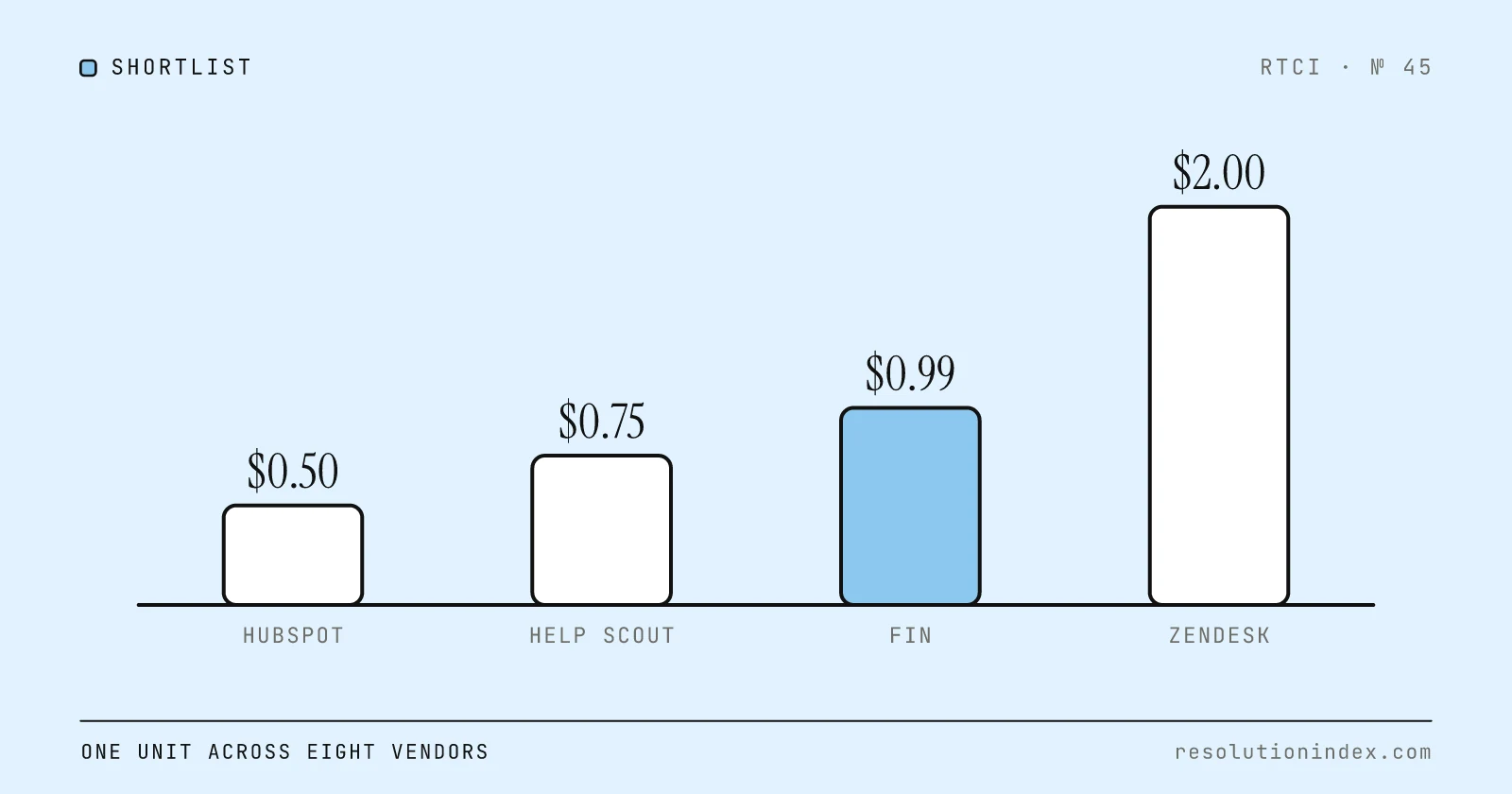
On seats, often yes: Intercom Advanced lists at $85 per seat on annual billing against $115 for Zendesk Suite Professional. On AI, Fin charges $0.99 per outcome while Zendesk charges $2.00 per automated resolution on pay-as-you-go after a small included allowance. The cheaper option depends on your volume and how many billed outcomes are real resolutions.
How much do Intercom Surveys cost?
Intercom Surveys are not sold on their own. They come with the Proactive Support Plus add-on, which costs $99 a month and includes 500 messages sent, as of November 2026. Each survey shown counts as a message sent, alongside product tours, posts, mobile push and carousels, and anything above 500 a month is billed per message. The add-on sits on top of a seat plan, so the smallest real bill is one Essential seat ($29 annually) plus $99.
How much is Intercom Pro?
Pro, the analytics add-on that includes CX scoring and AI topic analysis, is listed from $100 a month with 500 conversations analysed and 6,000 credits, as of November 2026. Extra credits cost $0.01 each.
Change log
- Added how Intercom Surveys are priced (Proactive Support Plus, $99 a month for 500 messages sent).
- RTCI scores updated to the current 0–1,000 index.
- Figures aligned with the November 2026 index rescore.
- Added dated pricing-page screenshots and RTCI charts.
- Fin ownership updated after Salesforce completed its acquisition.
- Published.
Read next
Keep reading
Picked for this article: the pieces it cites and the ones that answer the next question buyers usually ask.
Most related
Intercom Alternatives 2026: 8 Options Compared on Cost Per Resolution
Eight Intercom alternatives compared on what an AI-resolved conversation really costs as of November 2026, with a worked monthly bill for a 10-agent team.
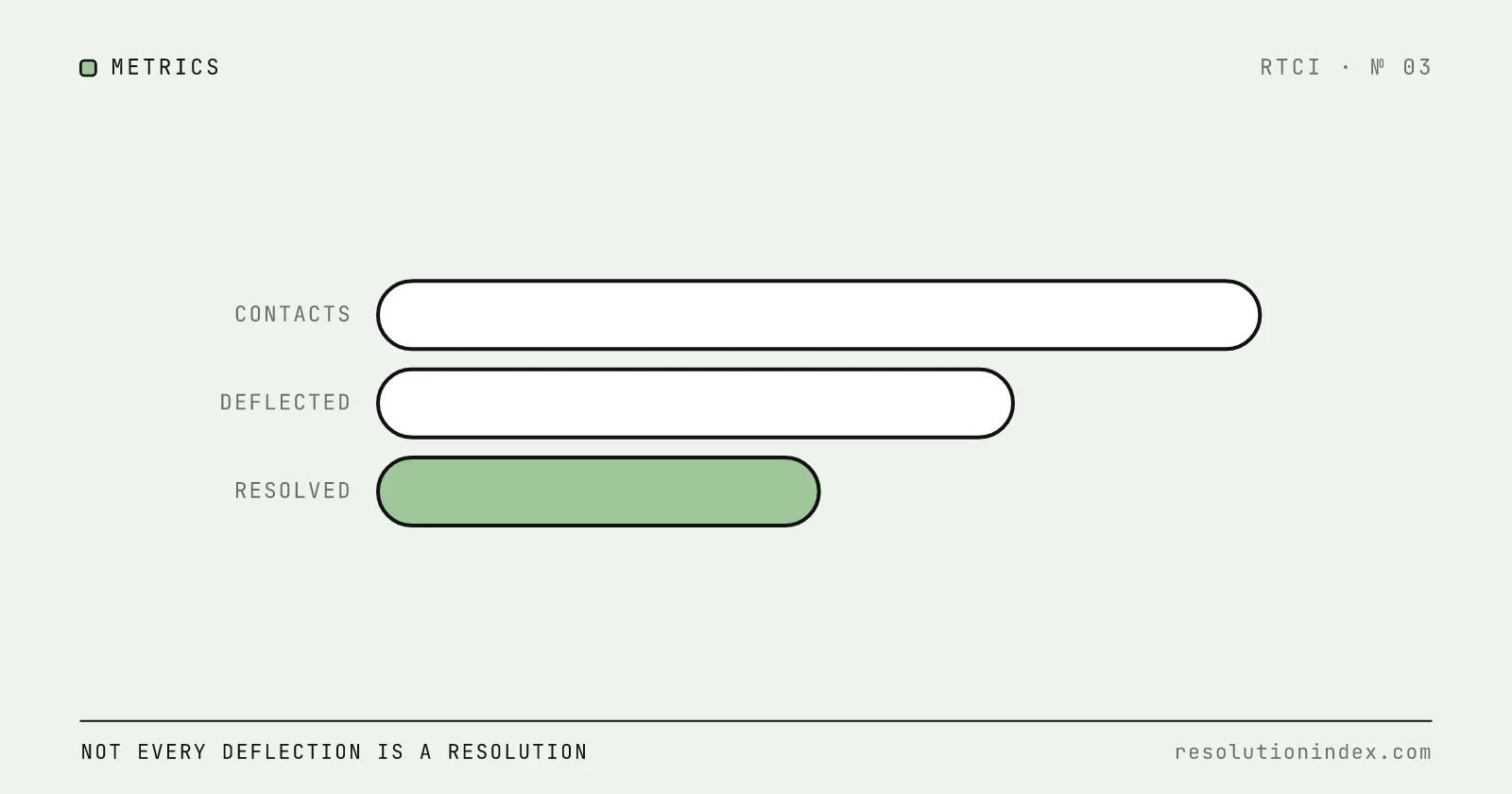
Resolution Rate vs. Deflection Rate: What's the Difference?
Resolution rate measures issues solved end to end; deflection rate measures contacts avoided. Learn the formulas, see examples, and stop vendors from blending them.
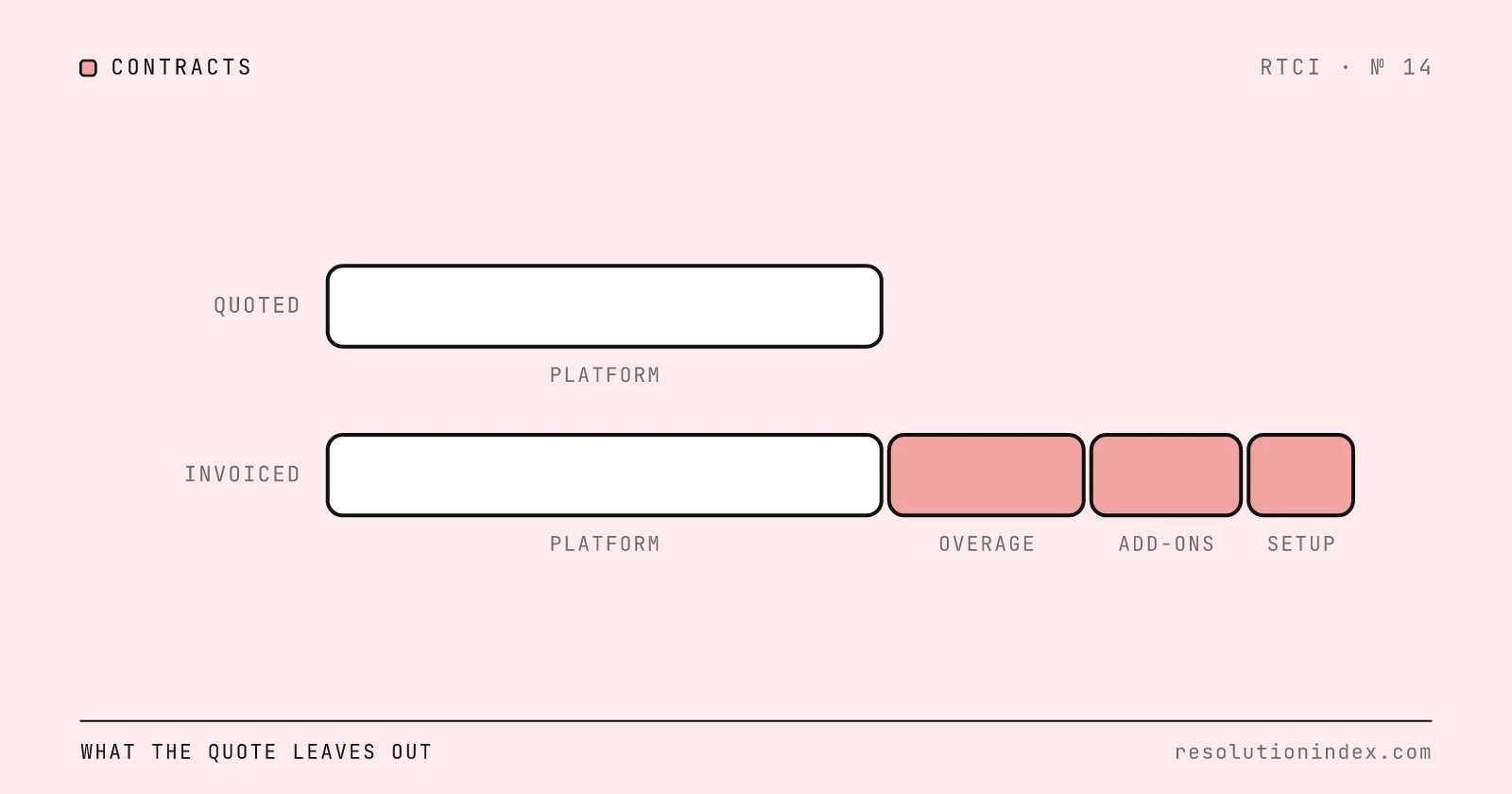
Hidden Fees in AI Support Contracts: What Buyers Miss
Where AI support invoices outgrow the quote: second meters, overage rates, one-time allowances, add-ons, outbound channels and exit costs, with clause language and a worked 12-month reconciliation.
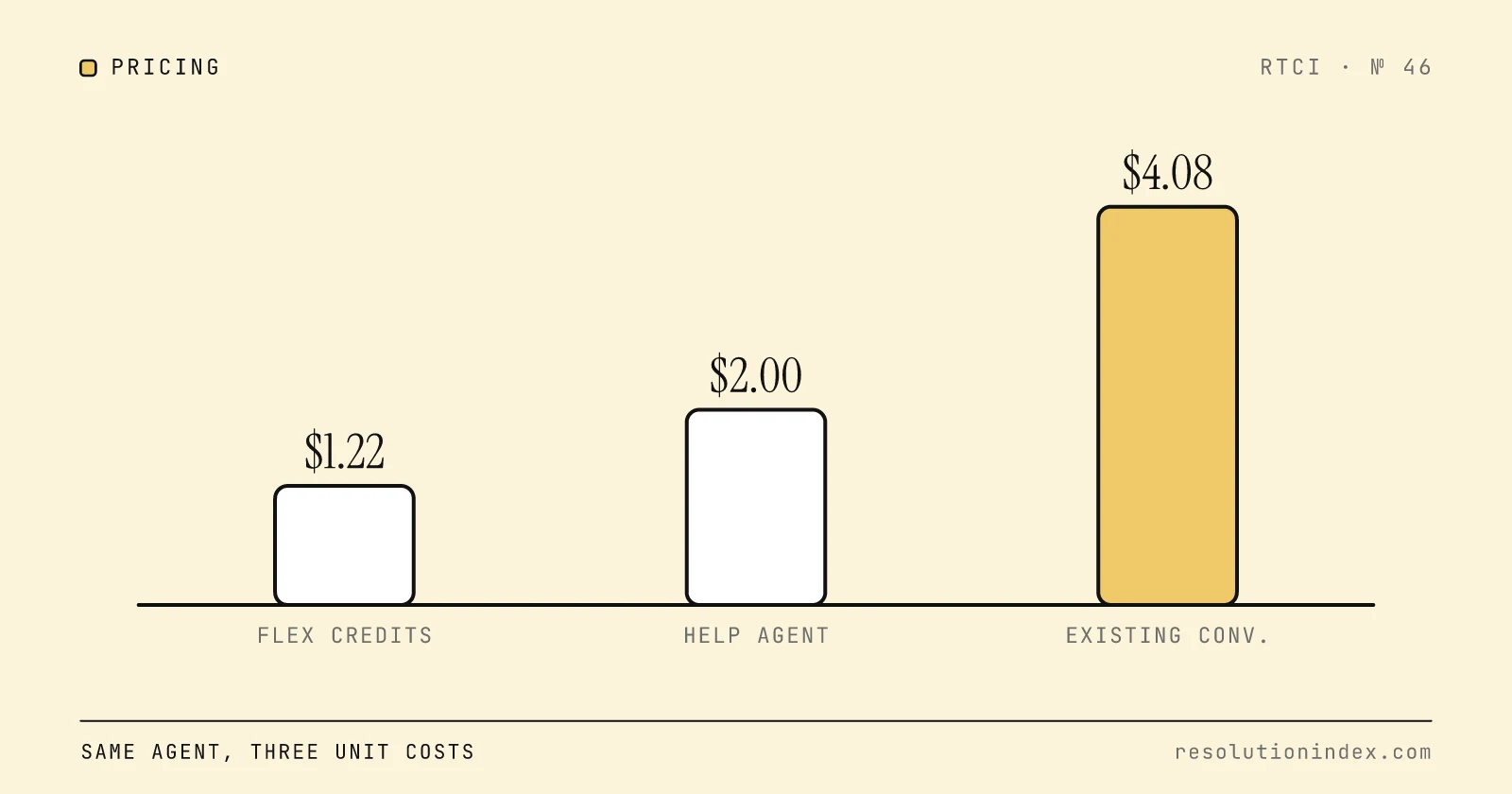
Salesforce Agentforce Pricing 2026: Cost per Resolution, Decoded
Salesforce Agentforce pricing as of November 2026: Flex Credits, per-user licences, $2 Help Agent resolutions and the $2 Conversations meter, each converted into cost per resolution.
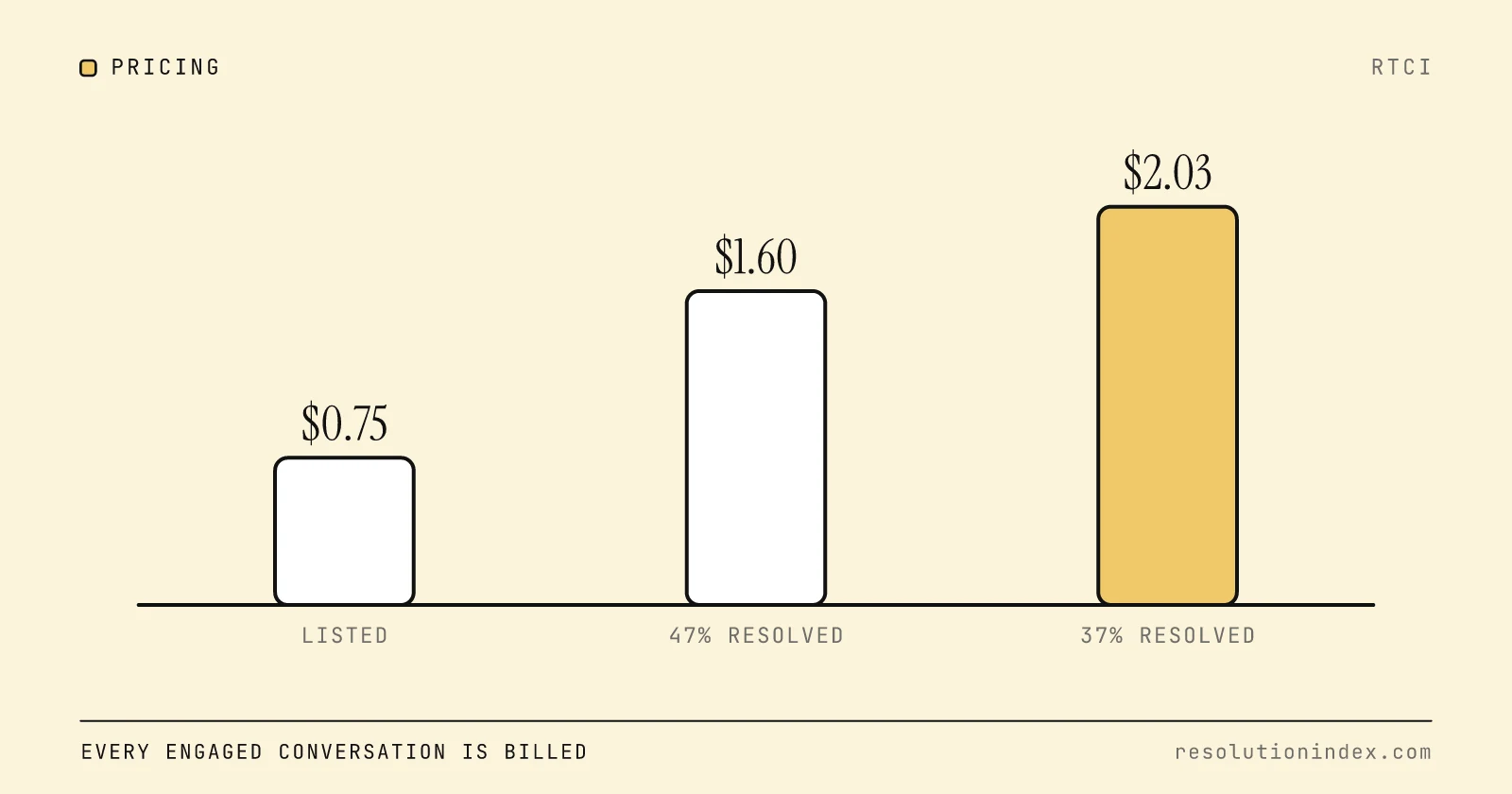
Kustomer Pricing 2026: $0.75 Concierge, Real Cost per Resolution
Kustomer pricing as of November 2026: Concierge at $0.75 per engaged conversation, Envoy at $50 per user, seats by quote, and what each resolved conversation really costs.