Published Sep 18, 2026 · Updated Nov 19, 2026 · 6 min read
AI Customer Support Agents vs Chatbots: What Changes Operationally?
An AI support agent can execute controlled actions in your systems; a chatbot answers. Use this boundary matrix and paired transcript to set approvals, logs, and resolution metrics.
 Written by Andrew Hall, Editor
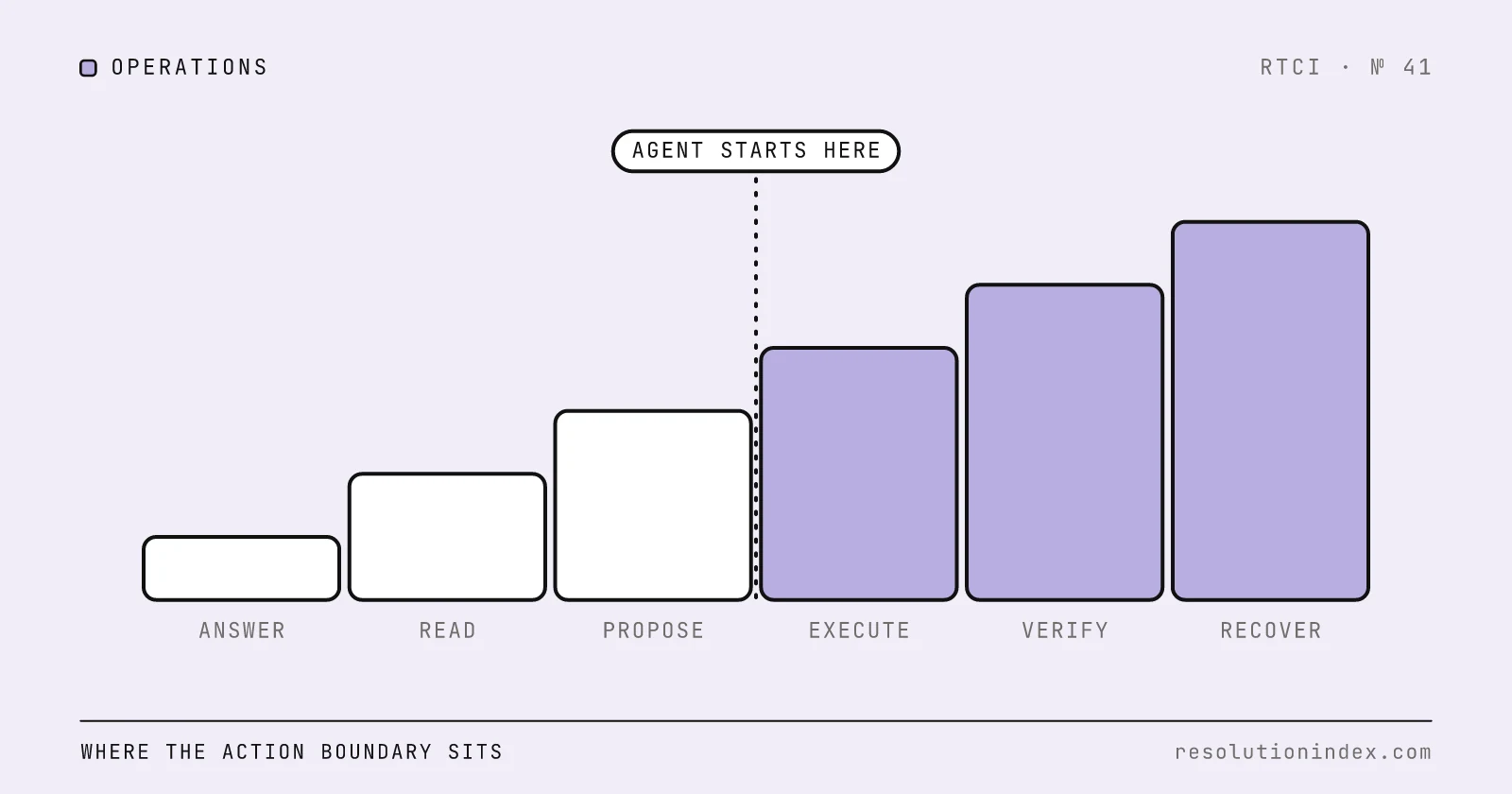
A chatbot answers inside a conversation; an AI customer support agent can also select and execute tools against systems of record. That changes the operating model. Teams must define identity checks, tool permissions, approval thresholds, idempotency, post-action verification, rollback, audit logs, and an accountable human owner before treating the system as an agent.
How do you tell an agent from a chatbot?
A product can call itself an agent while only answering questions, and a product labelled chatbot may invoke tightly controlled workflows. Classify the deployed behavior instead: what can it read, decide, write, spend, send, or delete; under whose identity; with which approval; and how is success verified?
| Level | System may do | Required control | A safe support example |
|---|---|---|---|
| Answer | Generate or retrieve text | Grounding, citation, refusal | Explain the published return policy |
| Read | Query a system of record | Least privilege, identity, field filtering | Retrieve shipment status |
| Propose | Prepare an action without committing it | Visible preview, policy check | Draft a refund recommendation |
| Execute | Commit an approved change | Authorization, idempotency, limit, audit | Apply a pre-approved shipping credit |
| Verify | Re-read the system and confirm outcome | Independent success condition | Confirm credit ID and account balance |
| Recover | Reverse, compensate, or escalate | Rollback path, human owner, incident log | Void a duplicate credit and open review |
The jump from Read to Execute is the important one. Natural language quality, model size, memory, and personalization do not create authority. A tool call backed by a real credential does.
Original asset: action-boundary matrix
| Workflow | Chatbot boundary | Agent boundary | Approval gate | Verification evidence |
|---|---|---|---|---|
| Order status | Explain and link | Read the order after identity check | Usually none for a read | Order ID, source timestamp, displayed state |
| Address change | Explain steps | Update address before fulfillment lock | Confirm new address and order | Change event ID + re-read address |
| Refund | Explain eligibility | Calculate and issue within policy | Human or threshold-based approval | Refund ID, amount, method, ledger state |
| Subscription cancel | Explain terms | Schedule or execute cancellation | Confirm consequences and effective date | Subscription state + confirmation delivery |
| Warranty | Collect details | Create claim and attach evidence | Approval for exceptions | Claim ID + attachment hashes/status |
| Account access | Route to recovery | Trigger approved recovery workflow | Strong identity; no secret disclosure | Recovery event + security notification |
Fill this matrix before procurement. Replace broad labels such as “can handle refunds” with the exact operation, maximum amount, identity rule, approval condition, retry behavior, and success query. If the vendor cannot expose those fields, the capability is not ready to own the outcome.
Paired transcript: same request, different operating model
Customer: “Order 8142 arrived late and the express shipping was pointless. Can you refund the shipping fee?”
Answer-only chatbot
I’m sorry the order arrived late. Express-shipping refunds may be available when the delivery misses the promised date. Please use the refund form or contact an agent with order 8142.
The response may be accurate, but no account state changed. Measure helpfulness, correct routing, and whether the next step worked. Do not count it as a resolution.
Controlled support agent
I found order 8142 after verifying your account. The promised date was October 17; delivery was October 19. Policy allows refunding the ₹499 express fee. I have prepared that refund. Approve ₹499 to the original payment method?
Customer: “Approve.”
Refund RF-2081 was submitted. The order ledger now shows ₹499 refunded to the original method. If it does not appear within the processor window, quote RF-2081.
This path requires an order read, policy evaluation, visible proposal, customer approval, idempotent refund call, ledger re-read, and evidence. If any step fails, the agent must stop or hand off without claiming completion.
The minimum production control plane
- Identity: bind the conversation to the right customer and strength of verification.
- Authorization: grant only the tools, fields, accounts, and amounts required.
- Policy: encode eligibility and exception rules outside free-form model prose where possible.
- Approval: show the exact action, amount, target, and consequence before commitment.
- Idempotency: retries must not create duplicate refunds, claims, or cancellations.
- Verification: read the authoritative system after the write; a successful API response alone may be insufficient.
- Recovery: define rollback or compensating action and the human owner.
- Audit: retain the user request, policy version, tool input/output, approval, final state, and exceptions under the organization’s retention rules.
Treat retrieved content (knowledge articles, emails, order notes, and webpages) as untrusted data. It can contain instructions that conflict with the agent’s policy. Tool authorization must not be derived from text the model just read.
Measure outcomes without hiding failures
| Metric | Why it matters | Reject this shortcut |
|---|---|---|
| Verified task completion | Confirms authoritative state reached the requested outcome | “Conversation ended” |
| Policy-compliant execution | Prevents a fast wrong action counting as success | Tool returned 200 |
| Correct escalation | Credits safe refusal and good handoff | Every handoff is failure |
| Same-issue re-contact | Finds false resolution | No reply within 24 hours |
| Reversal/cleanup rate | Exposes bad actions that humans repair later | Ignoring post-contact work |
| Fully loaded cost | Includes model, platform, review, integration, and residual human work | Vendor unit price alone |
Use a human-judged sample that includes ordinary requests, ambiguous wording, duplicate submissions, prompt injection, missing identity, policy exceptions, and downstream timeouts. Report results by workflow and action level; a blended “automation rate” hides where execution is unsafe.
When a chatbot is the better design
- The job is explanation, discovery, or triage and the source material is reliable.
- The write action is rare, high-impact, or difficult to reverse.
- Identity cannot be established at the required assurance level.
- The system of record lacks stable APIs, idempotency, or audit events.
- The team cannot own policies, evaluations, incident response, and ongoing transcript review.
A good architecture can mix both modes: answer freely from approved knowledge, read narrow status fields after verification, propose eligible actions, and reserve commitment for a deterministic workflow or human approval. If an answer-only chatbot is the right design, compare what each one costs per resolved chat in the AI chatbot for customer service cost guide.
Buyer acceptance test
Ask every shortlisted system to process the same ten-case set: two ordinary successes, one ambiguous request, one duplicate, one identity failure, one policy exception, one malicious instruction inside retrieved content, one downstream timeout, one customer reversal, and one required escalation. For each case, retain the tool trace and authoritative final state.
Score correct outcome, no unauthorized side effect, correct approval, correct verification, correct recovery, and audit completeness. Do not award a pass for fluent language when the state is wrong.
Source and method notes
RTCI rechecked the NIST AI Risk Management Framework and OWASP Top 10 for LLM Applications on October 20, 2026 for risk-management and agent/tool security context. The capability ladder, action-boundary matrix, paired transcript, and acceptance set are RTCI editorial methods.
Next, map candidate workflows in the AI support pilot scorecard and normalize economics with the cost per verified resolution calculator.
Frequently asked questions
What is the difference between an AI customer support agent and a chatbot?
A chatbot primarily exchanges messages and retrieves or generates answers. An AI support agent may also choose and call approved tools, change records, verify the result, and recover or escalate. The safe distinction is the permitted action boundary, not whether the interface sounds conversational.
Are AI agents always better than chatbots for support?
No. A chatbot is often safer and cheaper when the job is information retrieval, triage, or status lookup. Agentic execution adds value only when the workflow, identity check, permissions, approval, rollback, and audit evidence are strong enough.
How should an AI support agent be measured?
Measure verified task completion, policy compliance, correct escalation, re-contact, reversals, and fully loaded cost. Do not count a conversation as resolved merely because the bot stopped responding or the customer did not reply.
When should a human approve an AI agent action?
Require human approval for actions that are high-impact, difficult to reverse, outside a narrow policy, or based on weak identity and context. Refunds, cancellations, account access, regulated advice, and unusual exceptions commonly need explicit gates.
Change log
- Removed em dashes and contrast-style phrasing from the summary and body; no figures changed.
- Rechecked the NIST AI RMF and OWASP LLM Top 10 references.
- Published.
Read next
Keep reading
Picked for this article: the pieces it cites and the ones that answer the next question buyers usually ask.
Most related
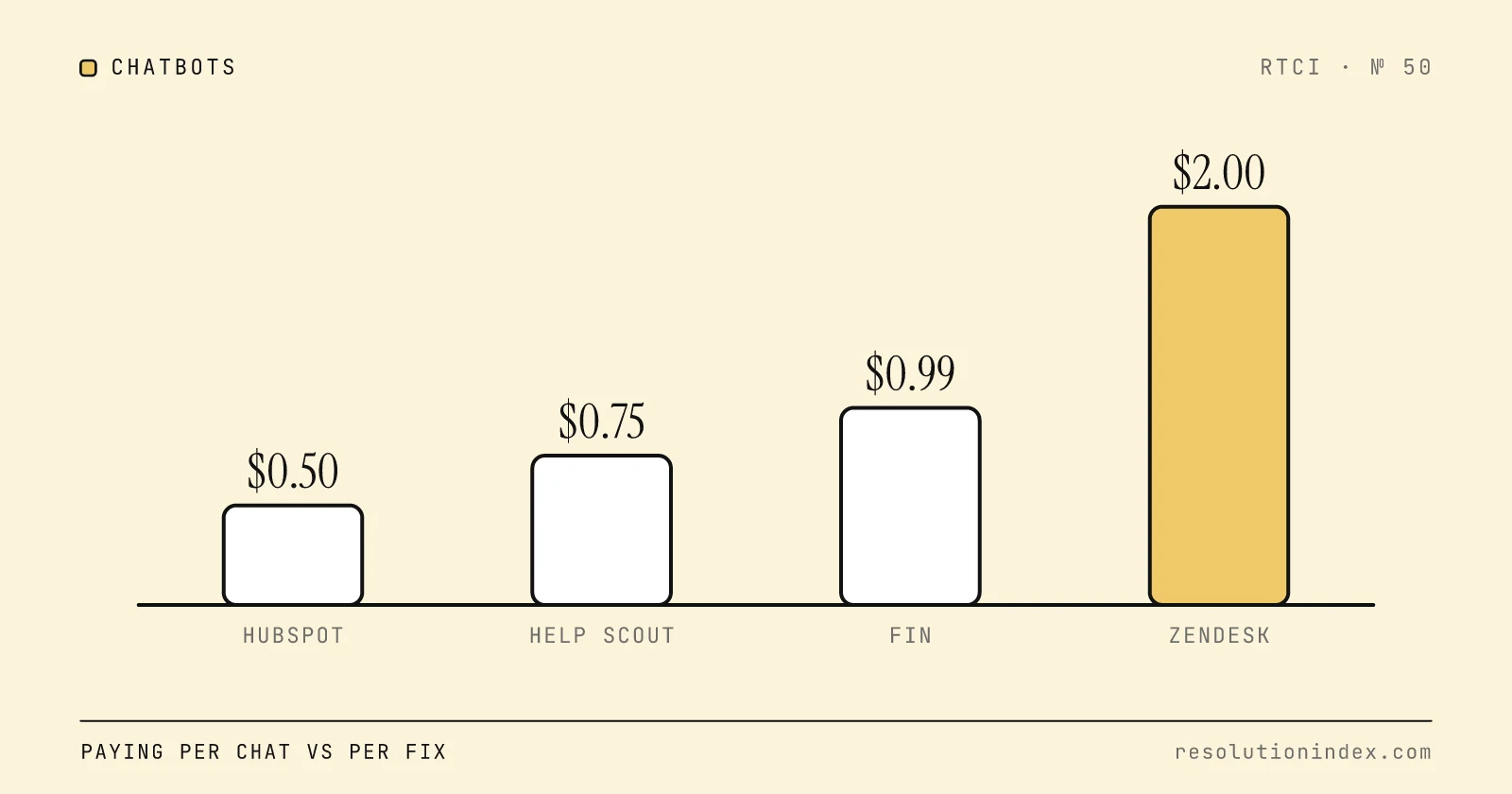
AI Chatbot for Customer Service: What a Resolution Costs (2026)
AI chatbot for customer service prices compared on cost per resolution as of November 2026: per conversation vs per resolution billing, worked out.
How to Design a Fair AI Support Pilot Scorecard
A weighted scorecard with 8 dimensions, hard-stop gates, and copy-paste Week 1–4 templates for evaluating an AI support pilot honestly.
AI Support RFP Template: 72 Questions, Scoring Model and Ticket Test
A buyer-side RFP template for AI customer support: 72 vendor questions with strong-answer notes, pass/fail gates, a 200-ticket test, weighted scoring profiles, a pricing form and a pilot clause.
Average Handle Time After AI Automation: Formula and Benchmark Model
Calculate blended AHT without hiding AI work, human handoff, after-contact work, or same-issue re-contact. Includes a reproducible cohort model and scenario worksheet.
Outcome-Based vs Seat-Based Pricing for AI Support: Which Model Should You Buy In 2026?
A buyer-side guide to choosing between outcome-based and seat-based AI support pricing in 2026, with current rates for Intercom Fin, Salesforce Agentforce, HubSpot Breeze, Zendesk AI and Freshdesk Freddy, a worked cost per verified resolution example, and a contract checklist.