Published Aug 19, 2026 · Updated Nov 19, 2026 · 19 min read
AI Support Compliance Checklist (GDPR / HIPAA / Security) (2026)
A buyer-side compliance checklist for AI customer support: GDPR DPA clauses, when HIPAA and a BAA actually apply, the EU AI Act chatbot disclosure rule, SOC 2 checks, the subprocessor chain and no-training contract language.
 Written by Andrew Hall, Editor
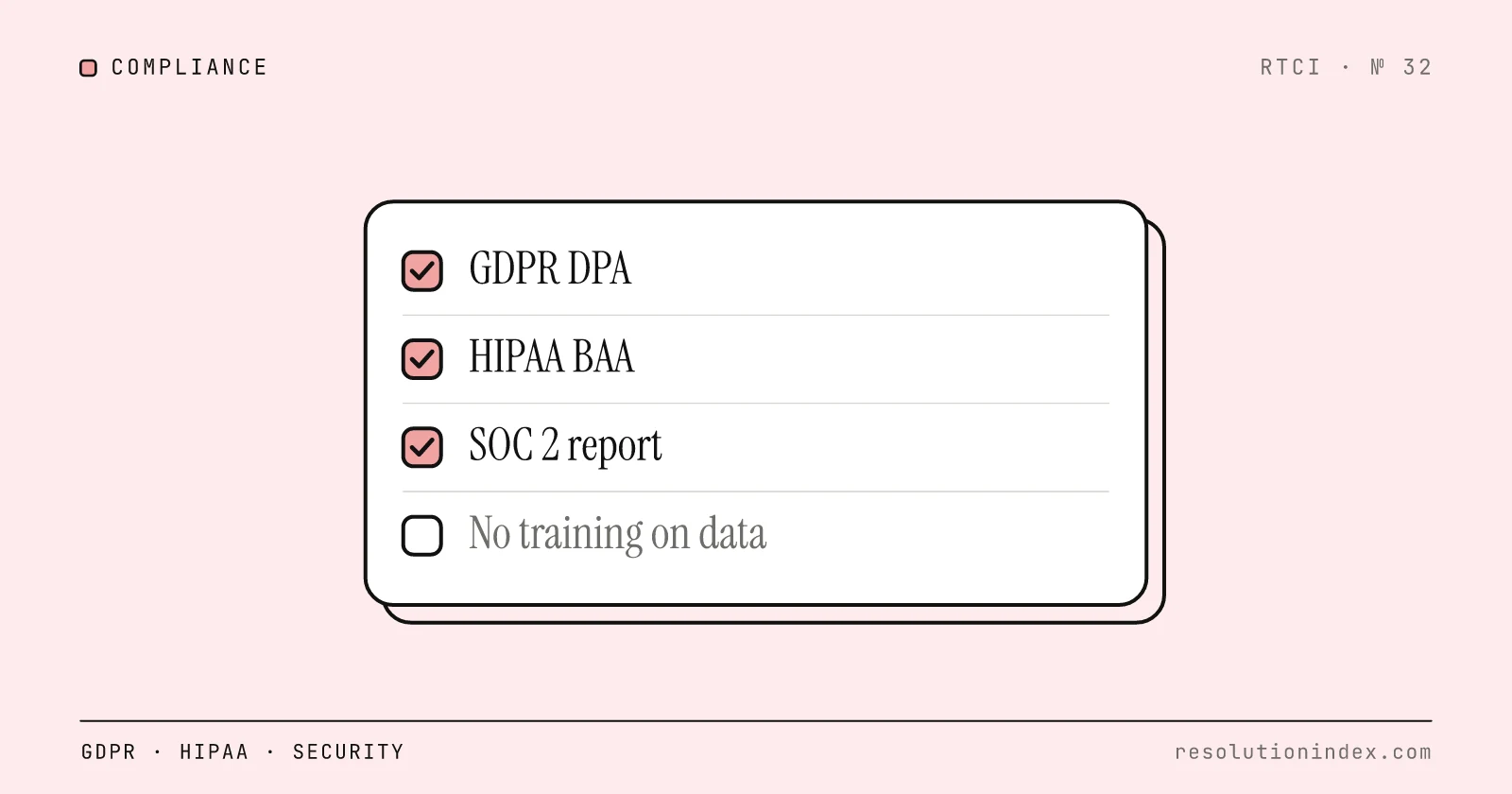
Before an AI agent handles customer tickets, collect evidence in six areas: a GDPR data processing agreement, a HIPAA BAA if (and only if) you are a covered entity or business associate, the EU AI Act chatbot disclosure, a current SOC 2 Type II or ISO 27001 report, the full subprocessor chain including the LLM provider, and a contractual ban on training with your data. This page gives you the RFP questions, DPA and BAA clause language, and a red-flag list legal and security can use as a go/no-go gate. It is not legal advice; involve counsel and your DPO or CISO.
Laws and dates below were checked against the official texts and regulator pages linked in each section as of November 2026. Use it with the AI support RFP template, the hidden fees guide, the 72-hour rule guide and the contract-to-go-live checklist.
Why settle compliance before signature?
Each gap surfaces as a specific failure once the AI is live. An erasure request arrives and the vendor cannot find the conversation copies in its logs or embeddings. A regulator asks why the EU chatbot never said it was an AI. A SOC 2 report turns out to cover only the Security criteria and not the new AI feature. All of these are cheaper to fix while you still have negotiating leverage.
The six compliance areas for AI support
| Area | What it governs | Primary buyer action |
|---|---|---|
| GDPR | Personal data of people in the EU | DPA under Art. 28, subprocessor control, help with data subject requests, DPIA screening, breach notice terms, transfer mechanism |
| HIPAA | PHI handled for a covered entity or business associate | Confirm HIPAA applies; if so, BAA, minimum necessary, encryption, audit controls, breach notice, subcontractor flow-down |
| EU AI Act | Transparency for AI that talks to people; duties for high-risk uses | Confirm the Art. 50 disclosure in every EU channel; check whether any use falls in Annex III (high-risk) |
| Security attestation | Vendor control design and operation | SOC 2 Type II (plus bridge letter) or ISO 27001; check scope and exceptions |
| Subprocessor chain | Who actually processes the data | Full list including LLM provider and cloud host; notice and objection rights |
| Training-on-data rights | Whether your data improves someone else's model | Default-deny clause that flows to the LLM provider |
RFP security questionnaire (copy-paste)
Ask for written answers. "Contact us" or a marketing one-pager in place of an answer is a red flag.
Data processing and GDPR
- Provide your current standard data processing agreement (DPA).
- Does the DPA cover AI inference, embeddings, logs and derived outputs, or only stored tickets?
- How do you help with data subject requests under GDPR Articles 15 to 22? What are your export and deletion deadlines?
- What is your personal data breach process? How quickly will you notify us, and what will the first notice contain?
- Can EU data be stored and processed only in the EU? If not, list storage and inference countries and the transfer mechanism (SCCs, DPF, adequacy).
- Will you support our DPIA with a description of processing, risks and safeguards?
- Who is your DPO and how can ours reach them?
HIPAA and health data (if you are a covered entity or business associate)
- Will you sign a Business Associate Agreement? Provide your standard BAA.
- Which subprocessors will create, receive, maintain or transmit PHI? Provide evidence of their subcontractor BAAs.
- How do you enforce minimum necessary access to PHI?
- Is ePHI encrypted at rest and in transit? Which algorithms and key management do you use?
- What audit controls record activity in systems holding ePHI? Can we receive logs on request?
- What is your breach notice deadline to us? Confirm it is inside the HIPAA 60-day limit.
EU AI Act
- How does the system tell users they are talking to an AI (Article 50(1))? Where and when is the notice shown, and can we set its wording per language and channel?
- How do your generated outputs meet the Article 50(2) machine-readable marking duty, where it applies?
- Do you consider any of our planned uses high-risk under Annex III? If so, what instructions for use (Article 13) and human oversight controls (Article 14) do you provide?
- Will you notify us of changes to your AI Act classification or to how you meet these duties?
Security attestation
- Provide your most recent SOC 2 Type II report. Which Trust Services Criteria are in scope, and does the scope include the AI features we are buying?
- Provide a bridge letter covering the period between the report end date and today.
- Do you hold ISO 27001, ISO 27701 or other certifications? Provide certificates.
- When was your last penetration test? Provide the executive summary and remediation status.
- What is your patching deadline for critical vulnerabilities?
Subprocessors and LLM chain
- Provide a complete subprocessor list, including the LLM provider, cloud host and any analytics or logging vendors.
- Which LLM models and endpoints do you use for inference: enterprise API or consumer tier?
- Where does inference run, and where is data stored? Are they the same?
- How much notice do you give before adding or replacing a subprocessor, and what are our objection rights?
- Provide the data processing terms between you and each subprocessor that handles personal data.
- Do any subprocessors subcontract further? If so, provide the same evidence.
Training and data use
- Do you use customer data, prompts, outputs or ticket content to train or improve your models or any third-party model? Confirm in writing.
- Do you use customer data for analytics, benchmarking or derived products?
- What is the default for new customers, and how do we opt in or out?
- Does your no-training commitment flow to every LLM subprocessor? Provide the relevant API terms.
- How do we delete historic data, embeddings and derived outputs, and how quickly?
Audit and operational controls
- What per-ticket logs do you keep: prompt, response, tool calls, retrieved knowledge, redactions, confidence score, human review actions?
- Can we export raw logs in a structured format on demand?
- What role-based access control limits who can see PII or PHI in logs and training data?
- Can we set retention limits by data category?
- What is your incident response plan for AI-specific failures such as prompt injection or data leaking through retrieval?
- Can we disable an intent or the whole agent ourselves, without vendor involvement?
GDPR checklist for AI support buyers
| Item | Legal anchor | What to demand | Evidence |
|---|---|---|---|
| DPA in place | Art. 28(3) | Processing instructions, subject matter, duration, purpose, data and subject categories, processor obligations | Signed DPA |
| Subprocessor control | Art. 28(2) and 28(4) | Prior specific or general written authorisation; notice of changes with a right to object; same obligations flowed down | Subprocessor list and objection process |
| Data subject requests | Art. 28(3)(e); Arts. 15 to 22 | Assistance with access, rectification, erasure, restriction, portability and objection | Request process and deadlines |
| Breach notice | Art. 33(2); Art. 33(1) | Processor notifies controller without undue delay; controller notifies the authority within 72 hours where feasible | Notice clause and playbook |
| DPIA | Art. 35 | Screen for high risk; where required, assess necessity, proportionality, risks and safeguards with DPO advice | DPIA or documented screening |
| International transfers | Chapter V | Adequacy decision, DPF certification or SCCs, with a transfer impact assessment where needed | SCC module, DPF listing, TIA |
| Security | Art. 32 | Measures appropriate to the risk, such as pseudonymisation, encryption, resilience and regular testing | Security documentation, SOC 2 or ISO report |
| Audit rights | Art. 28(3)(h) | Information needed to show compliance; audits by you or a mandated auditor | Audit clause |
| Return and deletion | Art. 28(3)(g) | Delete or return all personal data at the end of the service | Deletion certificate process |
Data residency is a risk choice, not a GDPR requirement; if you need EU-only processing, put storage and inference regions in the contract. Health data from EU customers is special category data under Article 9 and needs an Article 9(2) condition, which also weighs heavily in the DPIA screening.
Does HIPAA apply to your support tickets?
HIPAA applies to covered entities (health plans, health care clearinghouses and providers that conduct standard electronic transactions) and to their business associates. If you are one of these and customers put PHI in tickets, your AI support vendor is your business associate and you need a BAA. If you are not, for example a supplement, fitness or wellness retailer, a ticket that mentions a health condition is not PHI under HIPAA. It can still be special category data under GDPR for EU customers and may fall under US state consumer-health privacy laws, so check with counsel.
| Item | Legal anchor | What to demand | Evidence |
|---|---|---|---|
| BAA signed | 45 CFR 164.502(e), 164.504(e) | Permitted uses, safeguards, breach reporting, subcontractor flow-down, return or destruction | Executed BAA |
| Minimum necessary | 45 CFR 164.502(b), 164.514(d) | Limit PHI use and access to what each purpose needs | Access policy, role matrix |
| Encryption | 45 CFR 164.312(a)(2)(iv), 164.312(e)(2)(ii) | Encryption at rest and in transit. The rule makes these "addressable", meaning implement or document an equivalent alternative; require them in the contract | Encryption and key management specs |
| Audit controls | 45 CFR 164.312(b) | Mechanisms that record and examine activity in systems holding ePHI | Log samples, retention policy |
| Risk analysis | 45 CFR 164.308(a)(1)(ii)(A) | Documented assessment of risks to ePHI | Risk analysis summary |
| Breach notice | 45 CFR 164.410 | Business associate notifies the covered entity without unreasonable delay, within 60 calendar days of discovery | BAA breach clause, incident plan |
| Subcontractors | 45 CFR 164.502(e)(1)(ii), 164.504(e)(2)(ii)(D) | Subcontractors handling PHI agree to the same restrictions and conditions | Subcontractor BAAs |
| Individual rights | 45 CFR 164.524, 164.526, 164.528 | Support access, amendment and accounting of disclosures | BAA individual-rights clause |
The covered entity then notifies affected individuals within the same 60-day outer limit (45 CFR 164.404), notifies HHS at the same time when 500 or more people are affected (164.408), notifies the media when more than 500 residents of a state or jurisdiction are affected (164.406), and reports smaller breaches to HHS within 60 days after the end of the calendar year. Source: eCFR, 45 CFR Part 164 Subpart D. HHS guidance: sample BAA provisions, Security Rule.
What does the EU AI Act require of a support chatbot?
For a typical support agent, the binding duty is transparency. Article 50(1) requires providers to design AI systems that interact directly with people so that those people are told they are dealing with an AI, unless it is obvious to a reasonably well-informed user. Article 50(5) requires the information to be clear and distinguishable, at the latest at the first interaction. Article 113 sets 2 August 2026 as the general application date, and Article 50 has applied since then.
| Item | Legal anchor | Who it binds | Buyer action |
|---|---|---|---|
| Chatbot disclosure | Art. 50(1), 50(5) | Provider | Confirm the notice shows by the first message in every EU channel and language you deploy; keep screenshots |
| Marking generated content | Art. 50(2) | Provider of systems generating synthetic audio, image, video or text | Ask how outputs are marked in machine-readable form and whether your use is covered by an exception |
| Instructions for use | Art. 13 | Provider of a high-risk system | Relevant only if a use is high-risk under Annex III |
| Human oversight | Art. 14 | Provider of a high-risk system (design); deployer under Art. 26 | Relevant only for high-risk uses |
A support chatbot answering product and order questions is not listed as high-risk. The analysis changes if the AI makes or shapes decisions that Annex III lists, such as evaluating creditworthiness or eligibility for essential public benefits; take those uses to counsel before deployment.
Sources: EU AI Act, Regulation (EU) 2024/1689, on EUR-Lex; Article 50 text. Later amendments have changed some AI Act deadlines, so check the consolidated text for your exact obligations.
What do SOC 2 Type II and ISO 27001 prove?
A SOC 2 Type II report is a CPA firm's opinion that a service organisation's controls were suitably designed and operated effectively over a review period, measured against the AICPA Trust Services Criteria. Security (the common criteria) is always in scope; Availability, Processing Integrity, Confidentiality and Privacy are optional, and the vendor chooses which to include.
How to read one:
- Check which criteria are in scope. For AI support, ask for Security and Confidentiality at minimum, and Privacy if personal data is central to the deal.
- Check the report period and ask for a bridge letter covering the time since it ended.
- Read the exceptions. An unmodified opinion can still list controls that failed testing.
- Confirm the system description covers the AI features and regions you are buying. A new AI product may sit outside last year's scope.
- Do not accept a Type I report as equivalent. Type I covers design at a point in time, not operation over a period.
ISO 27001 certifies that the vendor runs an information security management system meeting the standard. It is less detailed about individual controls than a SOC 2 Type II report, and it is the more common evidence outside the US.
Source: AICPA SOC suite of services.
DPA clause library (copy-paste)
Starting language for negotiation. The numbers in brackets are RTCI's suggested positions, not legal requirements; adapt with counsel.
| Clause | Suggested language |
|---|---|
| Processing instructions | "Processor shall process personal data only on documented instructions from Controller, including with regard to transfers of personal data to a third country, unless required to do so by applicable law." |
| Subprocessor authorisation | "Processor shall not engage another processor without Controller's prior specific or general written authorisation. Where general authorisation is given, Processor shall inform Controller of any intended addition or replacement at least [30] days in advance, giving Controller the opportunity to object." |
| Data subject requests | "Processor shall assist Controller in responding to requests under Articles 15 to 22 GDPR, completing exports within [5] business days and deletions within [10] business days of Controller's request." |
| Breach notice | "Processor shall notify Controller without undue delay and in any event within [24] hours of becoming aware of a personal data breach, providing the information listed in Article 33(3) GDPR as it becomes available." |
| No training | "Processor shall not use personal data, prompts, outputs, conversation logs or derived data to train, fine-tune, improve or develop any artificial intelligence or machine learning model without Controller's prior written consent. Processor shall impose the same restriction on every subprocessor, including LLM providers." |
| Deletion | "Processor shall delete or return all personal data within [30] days of termination, unless retention is required by Union or Member State law, and shall certify deletion on request." |
| Audit | "Processor shall make available all information necessary to demonstrate compliance with Article 28 GDPR and allow audits by Controller or an auditor it mandates, on [30] days' notice." |
| Transfers | "Processor shall transfer personal data outside the EEA only on the basis of an adequacy decision, including the EU-U.S. Data Privacy Framework where the recipient is certified, or the Standard Contractual Clauses in Commission Implementing Decision (EU) 2021/914, supplemented where necessary following a transfer impact assessment." |
BAA clause library (copy-paste)
Starting language for covered entities and business associates. Adapt with counsel against the HHS sample provisions.
| Clause | Suggested language |
|---|---|
| Permitted uses | "Business Associate shall use or disclose protected health information only as permitted by this Agreement or as required by law." |
| Safeguards | "Business Associate shall use appropriate safeguards, and comply with Subpart C of 45 CFR Part 164 with respect to electronic protected health information, to prevent use or disclosure other than as provided for by this Agreement." |
| Reporting | "Business Associate shall report to Covered Entity any use or disclosure not provided for by this Agreement, including breaches of unsecured protected health information as required by 45 CFR 164.410, without unreasonable delay and no later than [10] calendar days after discovery." |
| Subcontractors | "Business Associate shall ensure that any subcontractors that create, receive, maintain or transmit protected health information on its behalf agree to the same restrictions, conditions and requirements that apply to Business Associate." |
| Individual rights | "Business Associate shall make protected health information available for access and amendment, and provide information for an accounting of disclosures, as necessary for Covered Entity to meet 45 CFR 164.524, 164.526 and 164.528." |
| Return or destruction | "At termination, Business Associate shall return or destroy all protected health information received from or created for Covered Entity, if feasible, and retain no copies." |
The 60-day limit in the rule is an outer bound; a shorter contractual deadline, as bracketed above, gives you time to meet your own notice duties. HHS sample provisions: hhs.gov.
Red flags that should pause the deal
| Red flag | Why it matters | Buyer move |
|---|---|---|
| No DPA available | You cannot meet Art. 28 | Require a draft before legal review |
| No subprocessor list | You cannot authorise or assess processors | Require the full list, including the LLM provider |
| Training on customer data by default | Your conversations may improve models used by others | Proceed only with a contractual opt-out |
| No-training term stops at the vendor | The LLM provider is where training would happen | Require evidence the term flows down |
| Summary logs only | You cannot investigate failures, requests or breaches | Require prompt, response and tool-call logs |
| No region option when you need one | Transfer exposure you did not plan for | Contract storage and inference regions |
| No breach notice deadline | You may miss your own 72-hour or 60-day duty | Require a fixed deadline |
| Consumer-tier LLM endpoint | Training and retention terms differ from enterprise API terms | Require an enterprise or API tier with written terms |
| No self-service kill switch | You wait on the vendor to stop bad behavior | Require per-intent and global disable |
| No AI disclosure in EU channels | Article 50 has applied since 2 August 2026 | Require the notice before EU go-live |
| Type I only, or no bridge letter | No evidence controls operate over time | Require Type II and a bridge letter |
| Refuses a BAA when HIPAA applies | The vendor cannot lawfully handle your PHI | Stop |
Worked example A: US telehealth provider
Profile (illustrative): A US telehealth company that bills insurers electronically, which makes it a HIPAA covered entity. Patients use chat and email support for appointment, billing and prescription-status questions, and some EU residents use the service. It wants an AI agent inside its helpdesk.
What applies: HIPAA, because patients' messages contain PHI and the vendor will handle them on the company's behalf. GDPR for EU users, with their health data as Article 9 special category data. The EU AI Act Article 50 disclosure for EU-facing chat.
Evidence pack:
- Executed BAA covering tickets, inference logs and derived outputs, with subcontractor BAAs reaching the LLM provider.
- DPA under Art. 28 for EU users, and a DPIA.
- SOC 2 Type II covering Security and Confidentiality, with the AI feature in scope.
- Subprocessor list including LLM provider and cloud host, and a no-training term flowing to both.
- Encryption at rest and in transit, and per-ticket audit logs.
- Breach notice terms short enough to meet both the GDPR 72-hour and HIPAA 60-day duties.
- AI disclosure configured for EU users.
Priority: BAA first. If the vendor will not sign one, it cannot handle these tickets.
A supplement retailer with the same ticket mix would usually not be a covered entity, so the BAA drops out, but the GDPR Article 9 analysis for EU customers and any state consumer-health law remain.
Worked example B: B2B SaaS company in Germany
Profile (illustrative): A German B2B SaaS company with EU and US customers. Tickets contain personal, billing and usage data but no health data. It is evaluating autonomous agents such as Decagon, Sierra and Intercom Fin.
What applies: GDPR in full, with the company as controller. Any US-hosted LLM provider or cloud host triggers Chapter V transfer rules. Article 50 disclosure applies to every EU-facing conversation. AI processing of customer conversations at volume is likely to meet several DPIA screening criteria, so the company should run and document the screening.
Evidence pack:
- DPA with Art. 28 terms, subprocessor authorisation, request assistance and audit rights.
- DPIA or documented screening, with DPO advice.
- SCCs or DPF certification for US subprocessors, with a transfer impact assessment.
- EU storage and inference regions if the risk assessment calls for them.
- Article 50 disclosure text and channel configuration.
- Subprocessor list with advance notice and objection rights.
- No-training term flowing to the LLM provider.
- SOC 2 Type II, or ISO 27001 with ISO 27701.
- Breach notice deadline that leaves time for the 72-hour report to the supervisory authority.
Priority: DPA, DPIA and transfer mechanism before any configuration work starts.
When to collect each piece of evidence
| Stage | What to collect | Why then |
|---|---|---|
| RFP | Questionnaire answers, subprocessor list, DPA/BAA templates, SOC 2 report | Bad answers end the evaluation before demos |
| Security review | Architecture review, audit log demo, encryption docs | Catch red flags before legal time is spent |
| Legal review | Redlined DPA/BAA, no-training clause, transfer mechanism, breach terms | Leverage ends at signature |
| Signature | Executed DPA/BAA, final subprocessor list, data-flow description | Baseline for later audits and disputes |
| Onboarding | Region confirmation, roles, retention settings, kill-switch test | Turns contract terms into configuration |
| Go-live gate | Data subject request dry run, breach notice test, AI disclosure check in each channel, log export | Proves it works before customers see it |
Related reading
Frequently asked questions
Do I need a BAA for AI customer support?
Only if HIPAA applies to you and the vendor will create, receive, maintain or transmit protected health information on your behalf. HIPAA applies to covered entities (health plans, clearinghouses and providers that bill electronically) and their business associates. A telehealth provider needs a BAA with its AI support vendor; a supplement or wellness retailer usually is not a covered entity, so health details in its tickets are not PHI under HIPAA, though GDPR and state consumer-health laws may still apply.
Is SOC 2 Type II enough for AI support compliance?
No. A SOC 2 Type II report is an auditor's opinion that a vendor's controls were designed and operated effectively over a period. It is not a law and does not replace a GDPR data processing agreement, a HIPAA BAA or the EU AI Act disclosure duty. A vendor can have a clean report and weak data-processing terms, so treat it as supporting evidence.
Does the EU AI Act apply to my customer support chatbot?
Yes, if it talks to people in the EU. Article 50(1) requires AI systems that interact directly with people to be designed so users are told they are talking to an AI, unless that is obvious, and Article 50(5) requires the notice by the first interaction. The duty sits on the provider, and Article 50 has applied since 2 August 2026. As the deployer, check that the disclosure is switched on and worded correctly in every channel and language you run.
Can AI support vendors train on my customer data?
Only as far as your contract allows. Defaults vary between vendors and between enterprise API and consumer tiers of the same model provider. Put a default-deny clause in the DPA: no use of customer data, prompts, outputs or logs for training or model improvement without written opt-in, flowing down to every LLM subprocessor.
What if my AI support vendor uses OpenAI or Anthropic as a subprocessor?
Require a subprocessor list that names the LLM provider and cloud host, evidence of a DPA between your vendor and the LLM provider, a transfer mechanism (adequacy decision, Data Privacy Framework certification or SCCs) for any third-country transfer, and confirmation that the no-training term reaches the LLM provider. Ask where inference runs as well as where data is stored.
How do I handle GDPR data subject requests when an AI vendor holds ticket data?
Article 28(3)(e) requires the processor to help you answer requests under Articles 15 to 22 (access, rectification, erasure, restriction, portability, objection). You have one month to respond under Article 12(3), so set a vendor deadline that leaves you time; RTCI suggests 5 business days for export and 10 for deletion as a starting position. Confirm the vendor can find every copy, including logs, embeddings and derived outputs.
What is the difference between GDPR and HIPAA breach notification rules?
Under GDPR Article 33, the controller notifies the supervisory authority without undue delay and, where feasible, within 72 hours of becoming aware of a breach, unless it is unlikely to risk people's rights; the processor must tell the controller without undue delay. Under HIPAA, a business associate tells the covered entity, and the covered entity tells affected individuals, without unreasonable delay and within 60 calendar days of discovery. Breaches affecting 500 or more people go to HHS at the same time as individual notice; smaller ones are reported within 60 days after the end of the calendar year.
Do I need a Data Protection Impact Assessment (DPIA) for AI support?
GDPR Article 35 requires a DPIA where processing is likely to result in a high risk to people's rights and freedoms, and Article 35(3) names specific cases such as large-scale processing of special category data. The EDPB-endorsed DPIA guidelines list criteria including large-scale processing, sensitive data and innovative technology, and supervisory authorities publish their own lists. AI support at volume often meets several, so run the screening and document the outcome with your DPO.
Change log
- Corrected when HIPAA applies (a supplement retailer is usually not a covered entity), who carries the EU AI Act Article 50(1) disclosure duty, the scope of Articles 13 and 14, HIPAA breach-notice recipients and the subcontractor citation; removed unsourced "many buyers" SLA figures.
- Published.
Read next
Keep reading
Picked for this article: the pieces it cites and the ones that answer the next question buyers usually ask.
Most related
Best AI Support Platforms for Enterprise (2026)
Enterprise shortlist: Salesforce Agentforce, Zendesk AI, Intercom Fin, Decagon, Sierra, Cognigy, and Kore.ai compared on security, deployment options, RTCI score, cost per resolution, and contract terms. Includes a copyable RFP scorecard.
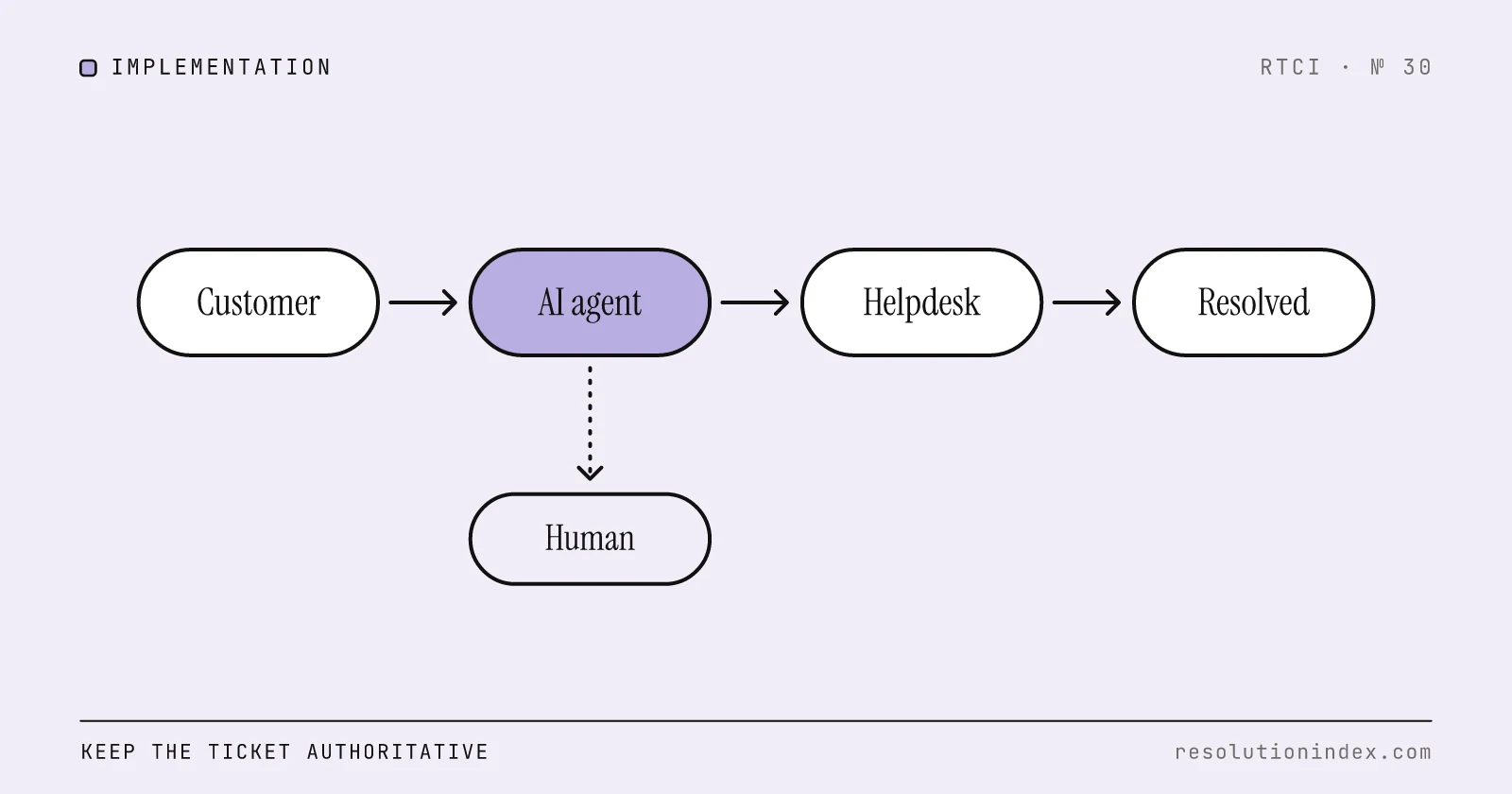
Integrate AI Support with Your Existing Helpdesk
A phased plan for adding AI resolution to Zendesk, Freshdesk, Intercom or Salesforce Service Cloud without replacing the helpdesk: integration patterns by helpdesk type, a deflect/draft/escalate/auto-resolve decision table, a 25-item readiness checklist and cost math.
AI Support RFP Template: 72 Questions, Scoring Model and Ticket Test
A buyer-side RFP template for AI customer support: 72 vendor questions with strong-answer notes, pass/fail gates, a 200-ticket test, weighted scoring profiles, a pricing form and a pilot clause.
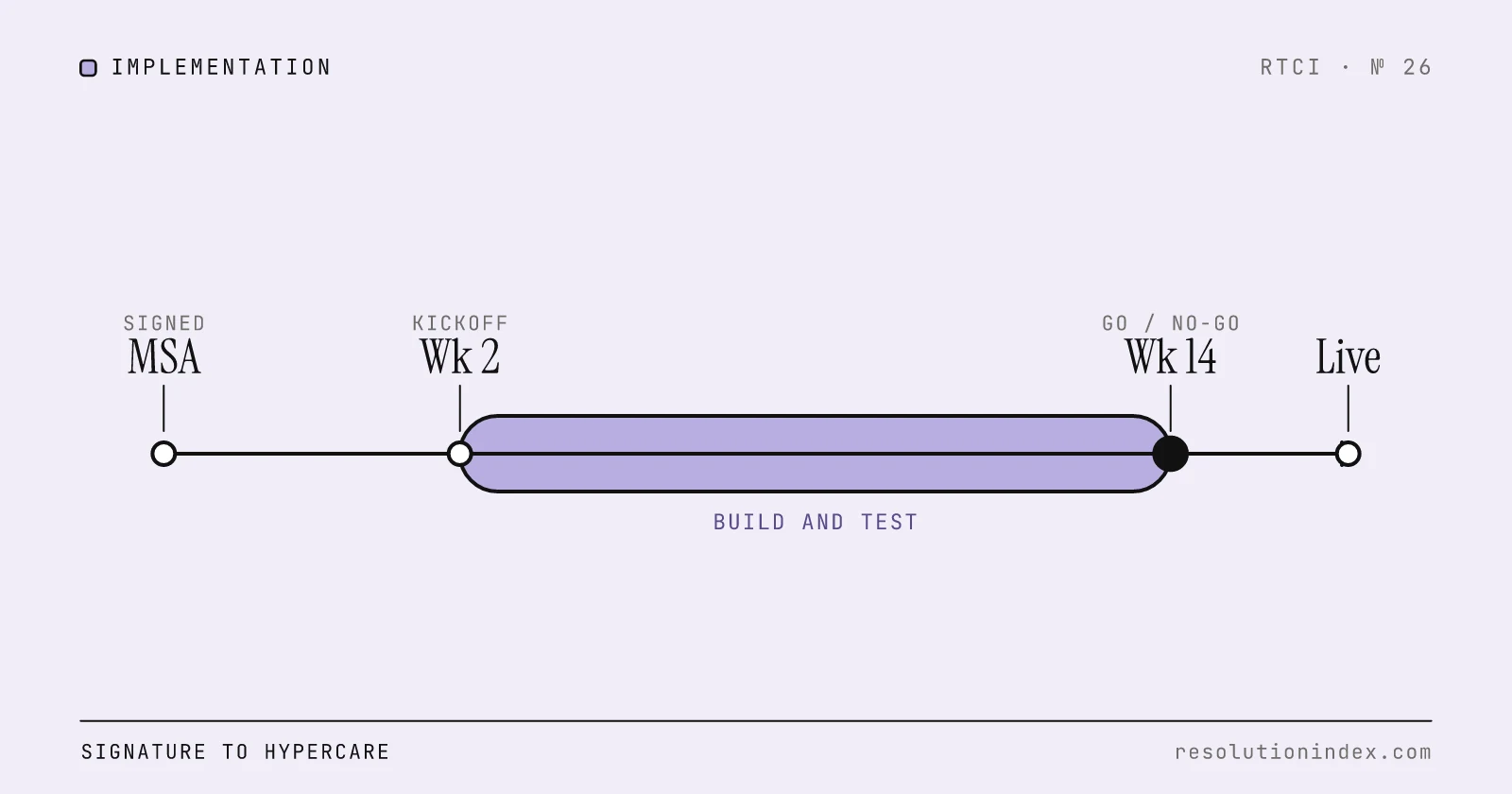
Implementation Checklist: AI Support Contract to Go-Live
A buyer-side checklist from signed contract to the first 30 days of production: seven gated phases, owners, a risk matrix, a go/no-go scorecard and a sample 12 to 16 week plan.
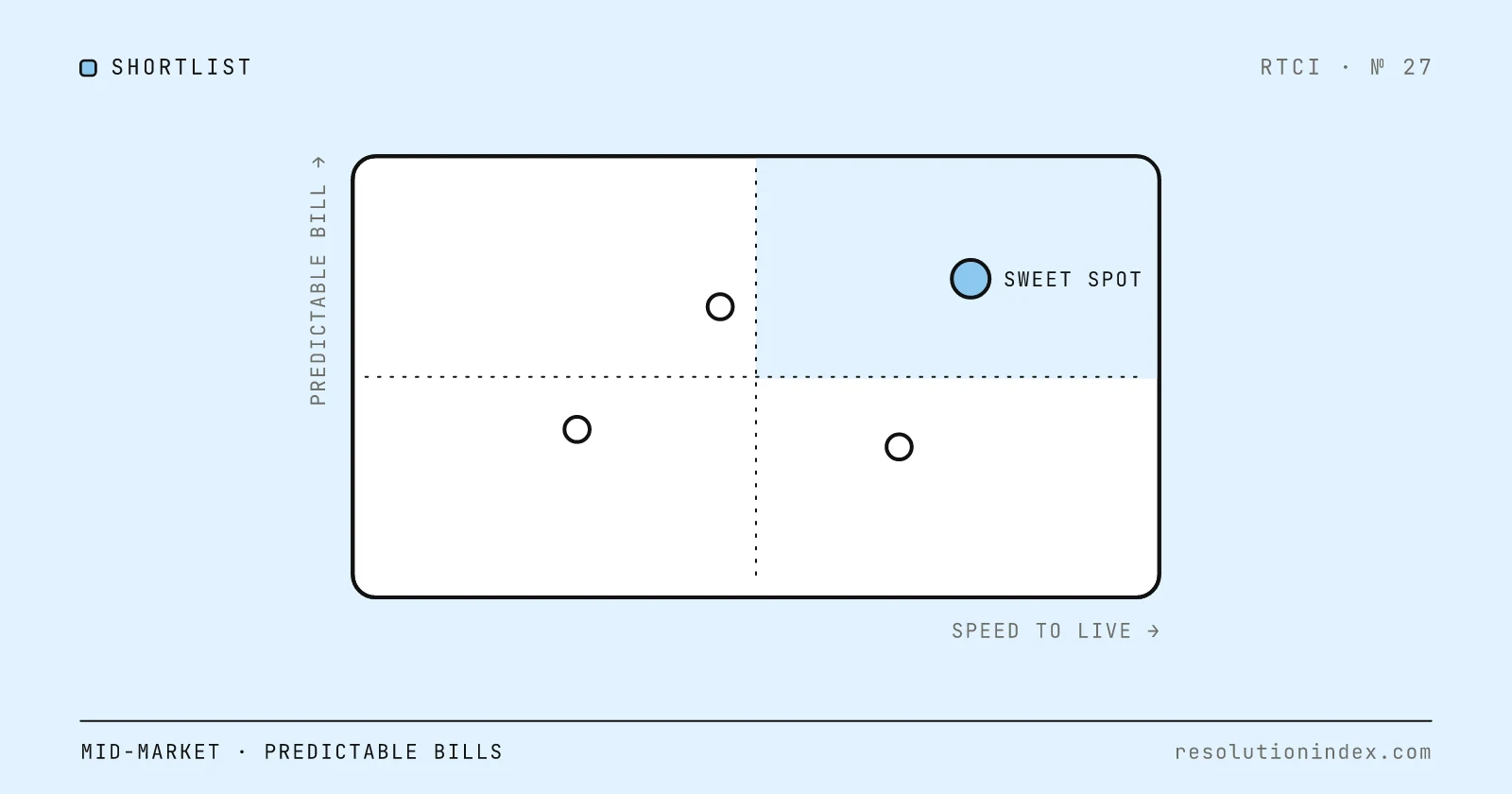
Best AI Support Platforms for Mid-Market Companies (2026)
Mid-market shortlist: Intercom Fin, Freshdesk Freddy, Zendesk AI, DevRev, and YourGPT compared on bill predictability, 30–90 day implementation, and cost per verified resolution, with each vendor’s RTCI score and published price.