Published Sep 17, 2026 · Updated Nov 19, 2026 · 4 min read
Average Handle Time After AI Automation: Formula and Benchmark Model
Calculate blended AHT without hiding AI work, human handoff, after-contact work, or same-issue re-contact. Includes a reproducible cohort model and scenario worksheet.
 Written by Andrew Hall, Editor
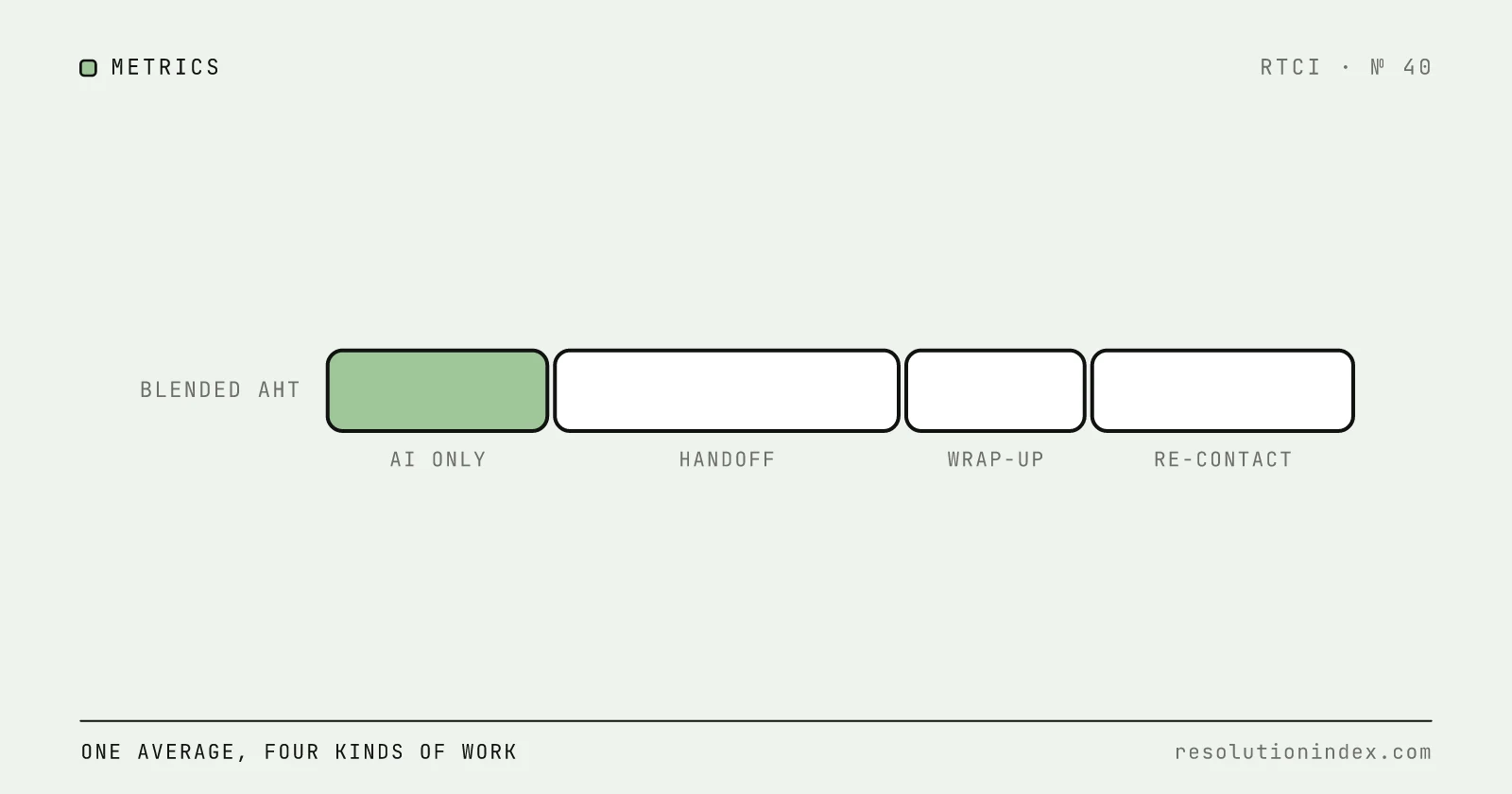
Calculate contact-level AHT as (interaction time + hold time + after-contact work) ÷ handled contacts, then split it into AI-only, AI-to-human, and human-only cohorts. Add same-issue re-contact as a separate quality and journey-time measure. AI can make the blended number fall simply by removing easy contacts or closing conversations early; that is not proof of better support.
Define the clock before using the formula
For voice, interaction time commonly includes talk plus hold; after-call work is added before dividing by handled calls. For messaging and email, elapsed conversation duration can be misleading because customer wait, asynchronous gaps, and concurrent agent work differ. Declare whether the numerator uses elapsed time, active agent time, or staffed work time.
| Term | Include | Keep separate |
|---|---|---|
| Interaction time | Active talk/chat/email handling under the declared channel rule | Queue wait and customer inactivity unless explicitly included |
| Hold time | Time the contact is placed on hold | Transfer delay if the reporting system counts it elsewhere |
| After-contact work | Notes, disposition, required follow-up created for the handled contact | Later case work that belongs to another workflow |
| Handled contacts | Contacts meeting the declared answered/handled rule | Abandons, tests, spam, and duplicates |
Worked formula
Suppose 100 handled voice contacts create 720 minutes of talk, 80 minutes of hold, and 200 minutes of after-call work. AHT = (720 + 80 + 200) ÷ 100 = 10 minutes. If the platform reports seconds, use the same unit in every numerator term and convert only after division. The average handle time calculator runs this division and the AI-only, handoff and human-only split for you.
Do not average daily AHT values without weighting by handled contacts. A day with 10 contacts at 20 minutes and a day with 90 contacts at 8 minutes produce (200 + 720) ÷ 100 = 9.2 minutes, not the unweighted mean of 14 minutes.
Original asset: the post-AI cohort model
| Cohort | Contacts | Work in numerator | Contact AHT | 72h same-issue re-contact | Journey minutes |
|---|---|---|---|---|---|
| AI-only, verified resolved | ___ | AI processing/interaction under declared rule | ___ | ___ | ___ |
| AI ended, later re-contact | ___ | First interaction | ___ | ___ | First + repeat |
| AI → human handoff | ___ | AI + transfer + human + ACW, with overlap rule | ___ | ___ | ___ |
| Human-only control | ___ | Human + hold + ACW | ___ | ___ | ___ |
Keep two views. Contact AHT preserves the operational metric. Journey minutes joins same-issue contacts inside a declared window. The second catches a failure mode where AI ends a contact quickly but the customer returns and repeats the work.
A numerical AI scenario
Before automation, 1,000 human contacts at 10 minutes equal 10,000 handled minutes. After launch, imagine 500 AI-only contacts at 2 minutes, 200 AI-to-human contacts at 14 human minutes plus 2 AI minutes, and 300 human-only contacts at 11 minutes. A naive human-only dashboard reports (2,800 + 3,300) ÷ 500 = 12.2 minutes and concludes performance worsened. The workload changed: easy contacts left the human queue. To see what that new human AHT means for phone staffing at a service-level target, run it through the Erlang C calculator.
The cohort view reports AI-only 2.0, AI-to-human 16.0 end-to-end, and human-only 11.0. If 15% of the AI-only cohort re-contacts and each repeat consumes 11 human minutes, the program also creates 825 hidden minutes. Report that next to any claimed savings.
What is a good AHT benchmark?
Two published figures are worth knowing, and both have limits. SQM Group’s operational data findings report an average handle time of 424 seconds (7:04) in its 2021 study, measured as talk plus wrap-up without hold, so it is not the same formula as the one above. Zendesk’s AHT guide gives industry estimates from 3–4 minutes in retail to 8–10 minutes in technical support and cites no study for them. Both describe human-handled contacts, not AI cohorts. The average handle time calculator lists the full set by industry with each one’s basis.
Use them to sanity-check a number, not as a target:
- Compare the same channel, issue taxonomy, operating hours, and inclusion rules.
- Publish median and 90th percentile beside the mean when long tails matter.
- Track transfer rate, verified resolution, re-contact, CSAT/CES, policy failures, and abandon rate.
- Annotate routing, knowledge, staffing, and product changes.
- Never turn a generic industry number into an individual-agent target; rushing can reduce accuracy and increase repeat work.
Set the target as an internal baseline range for one cohort, and improve AHT only while resolution and safety hold steady or improve.
Source and convention notes
The conventional interaction-plus-hold-plus-after-contact-work formula follows Zendesk’s AHT guide. The 424-second figure is from SQM Group’s 2021 study. The AI cohort split, 72-hour re-contact window, journey-minutes field, and example numbers are RTCI editorial methods, not Zendesk or SQM benchmarks.
Use the cost per verified resolution calculator after the handle-time model is stable. A cheaper contact is not cheaper support when it produces an uncounted repeat contact or unsafe resolution.
Frequently asked questions
How do you calculate average handle time?
AHT equals total talk or interaction time plus total hold time plus total after-contact work, divided by the number of handled contacts. Publish the channel, window, inclusion rules, and cohort mix beside the number.
Does AI reduce average handle time?
It can reduce time for resolved AI-only contacts while increasing complexity for the cases humans receive. Measure AI-only, human-only, and AI-to-human cohorts separately before interpreting the blended result.
What is a good AHT benchmark?
There is no universal target. SQM Group’s 2021 benchmarking study reported 424 seconds (7:04, talk plus wrap-up, no hold) across the call centers it measured, and Zendesk publishes industry estimates from 3–4 minutes in retail to 8–10 minutes in technical support without citing a study. Channel, issue mix, security steps and transfer rules change the result, so compare against your own baseline for like-for-like cohorts.
Should re-contact count in AHT?
The standard contact-level formula does not automatically join later contacts, but an AI program should report same-issue re-contact and journey handle time so a fast failed interaction cannot appear efficient.
Change log
- Added the published AHT benchmarks used by the AHT calculator (SQM Group’s 424 seconds for 2021 and Zendesk’s industry estimates) with their basis, and linked the calculator from the benchmark section.
- Published.
Read next
Keep reading
Picked for this article: the pieces it cites and the ones that answer the next question buyers usually ask.
Most related
Customer Effort Score for AI Support: Formula, Survey, and Benchmark
Measure customer effort after AI support with a reproducible CES survey, segmentation worksheet, confidence labels, and guardrails against false resolution claims.
AI Customer Support Agents vs Chatbots: What Changes Operationally?
An AI support agent can execute controlled actions in your systems; a chatbot answers. Use this boundary matrix and paired transcript to set approvals, logs, and resolution metrics.
Outcome-Based vs Seat-Based Pricing for AI Support: Which Model Should You Buy In 2026?
A buyer-side guide to choosing between outcome-based and seat-based AI support pricing in 2026, with current rates for Intercom Fin, Salesforce Agentforce, HubSpot Breeze, Zendesk AI and Freshdesk Freddy, a worked cost per verified resolution example, and a contract checklist.
How to Benchmark Your AI Resolution Rate Against Industry Peers
How to compare your AI resolution rate with peers: fix the definition and denominator, then benchmark against RTCI's 58% median realistic rate and Comm100's 44.8% cross-customer figure.
First-Contact vs End-to-End Resolution
A metric decision guide for AI support teams: when to use first-contact resolution rate vs end-to-end resolution rate, how to track both, and how deflection fits into the same dashboard.