Published Aug 6, 2026 · Updated Nov 19, 2026 · 6 min read
Cost Per Verified Resolution: A New Framework
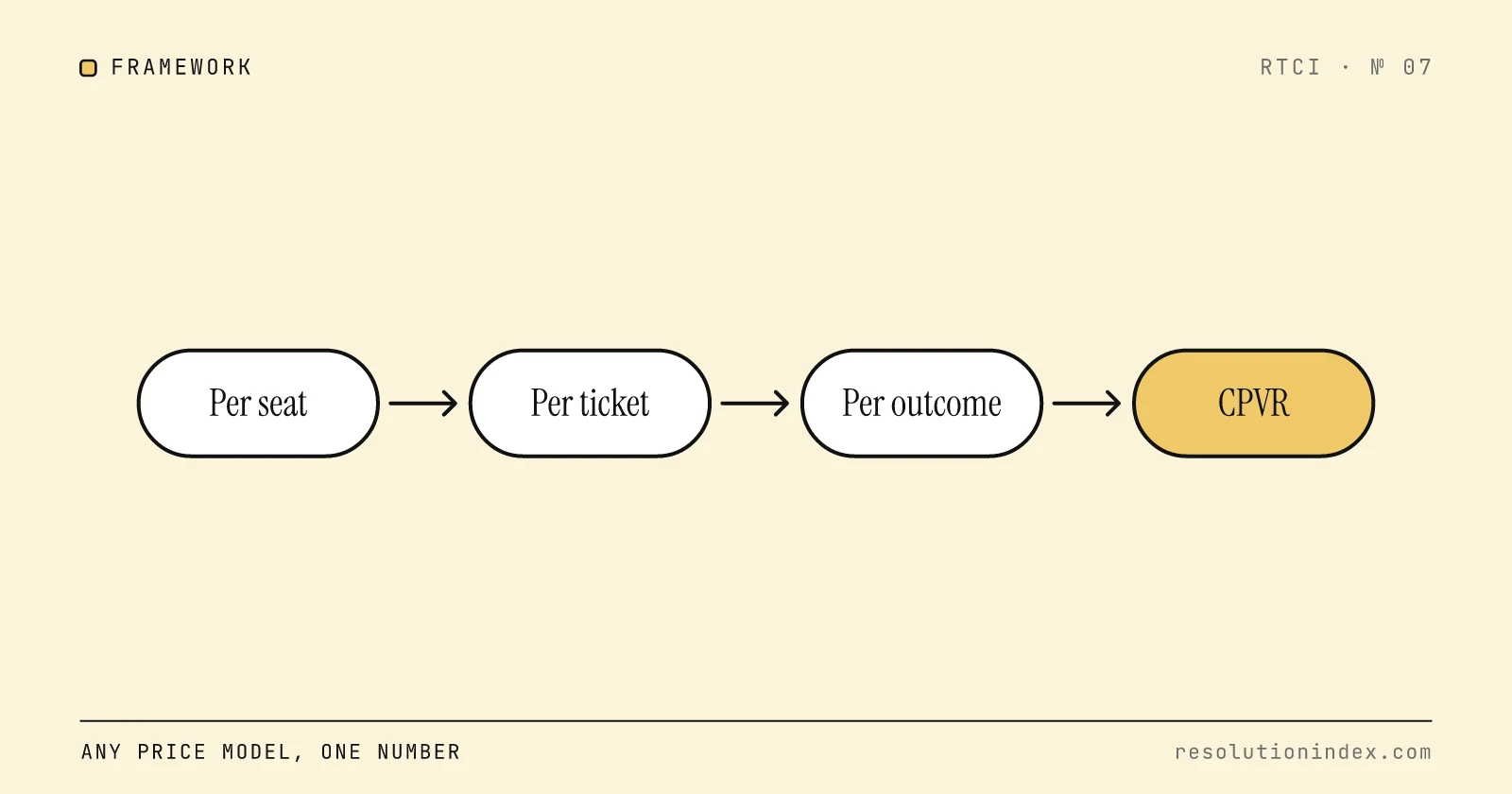
Per-seat, per-ticket, and per-resolution pricing models all produce different numbers for the same underlying cost. RTCI's three-layer cost model normalizes any vendor's pricing into a single comparable metric: cost per verified resolution.
 Written by Andrew Hall, Editor
What is cost per verified resolution?
Cost per verified resolution (CPVR) is everything you pay for AI support in a month divided by the tickets the AI resolved with no human handoff and no re-contact within 72 hours. It turns per-seat, per-conversation, per-outcome and credit pricing into one comparable number. In the worked examples below, Intercom Fin's $0.99 headline becomes $2.82 per verified resolution at 1,000 tickets a month and $1.22 at 50,000, because fixed and off-meter costs spread over more resolutions as volume grows.
The formula: CPVR = (Layer 1 + Layer 2 + Layer 3 + off-meter costs) ÷ verified resolutions. The rest of this article defines each term and shows the math.
Why does list-price comparison fail?
Vendors price in different units. Fin charges $0.99 per outcome. Zendesk charges per agent seat and then $1.50 to $2.00 per additional verified automated resolution. YourGPT charges a flat plan with AI credits. Gorgias charges a ticket-volume plan plus $0.90 to $1.00 per automated interaction. Each number is accurate, and none can be compared with the others until they are converted to the same unit for the same volume.
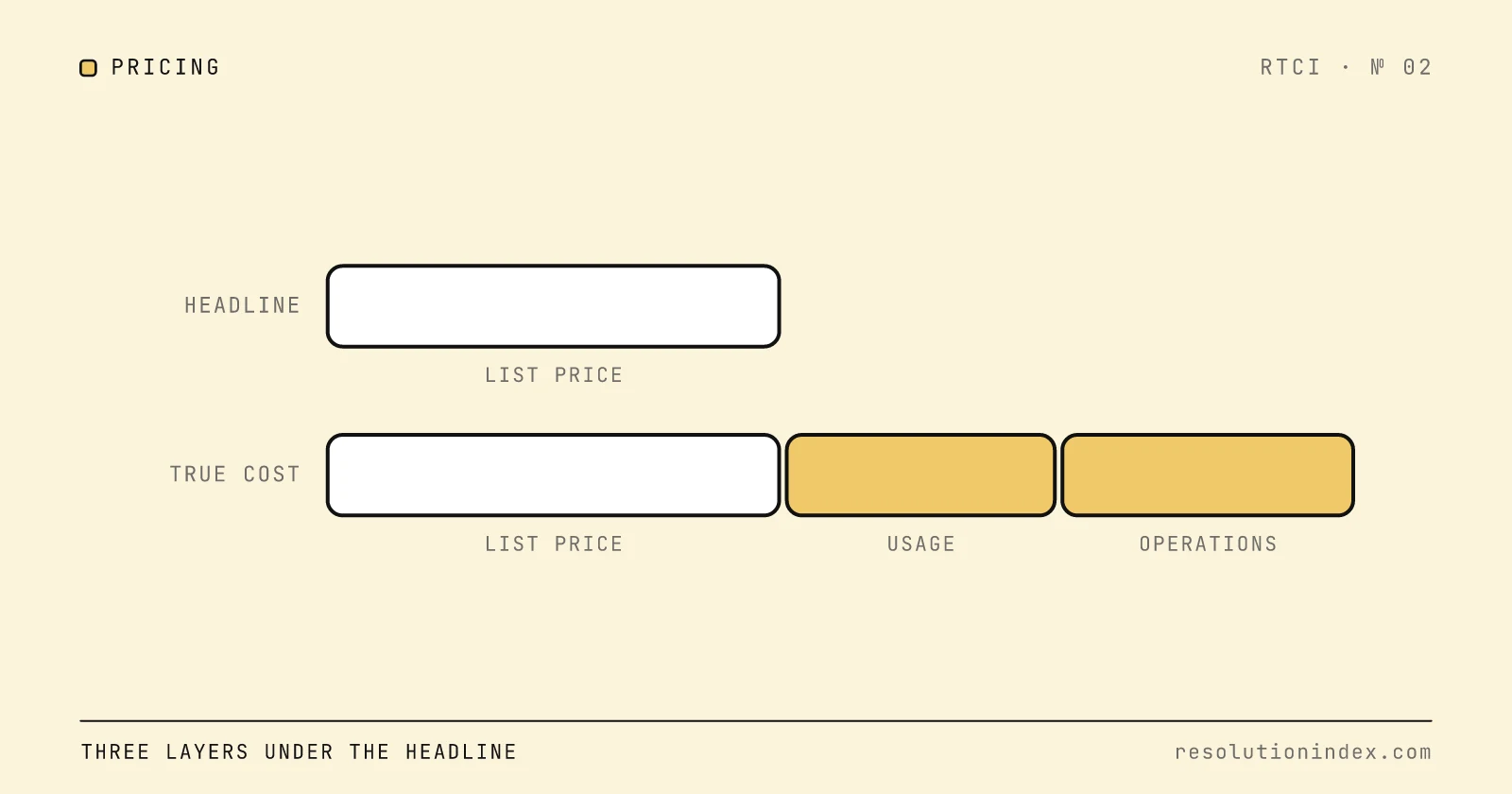
As The Hidden Cost of AI Customer Support Pricing sets out, the number on the pricing page is rarely the number on the invoice. The three-layer model below is how RTCI converts any structure into CPVR.
What are the three layers?
Layer 1, fixed platform or seat cost. The monthly floor you pay whether or not the AI resolves anything: platform fees, required seats, base plans. Some vendors have none. Sierra publishes no floor, but third parties report about $150,000 a year. Cognigy's AWS Marketplace Basic tier is $43,080 a year for 60,000 conversations. Crescendo's own blog cites a $2,900 monthly fee plus $1.25 per resolution, which RTCI estimates at ~$1.54 per resolution (est.) at 10,000 resolutions a month. Do not record a floor you could not find as zero; for YourGPT, RTCI's estimate fills Layer 1 with the Advanced plan at $349 a month.
Layer 2, variable AI usage. The headline meter. The unit matters as much as the rate:
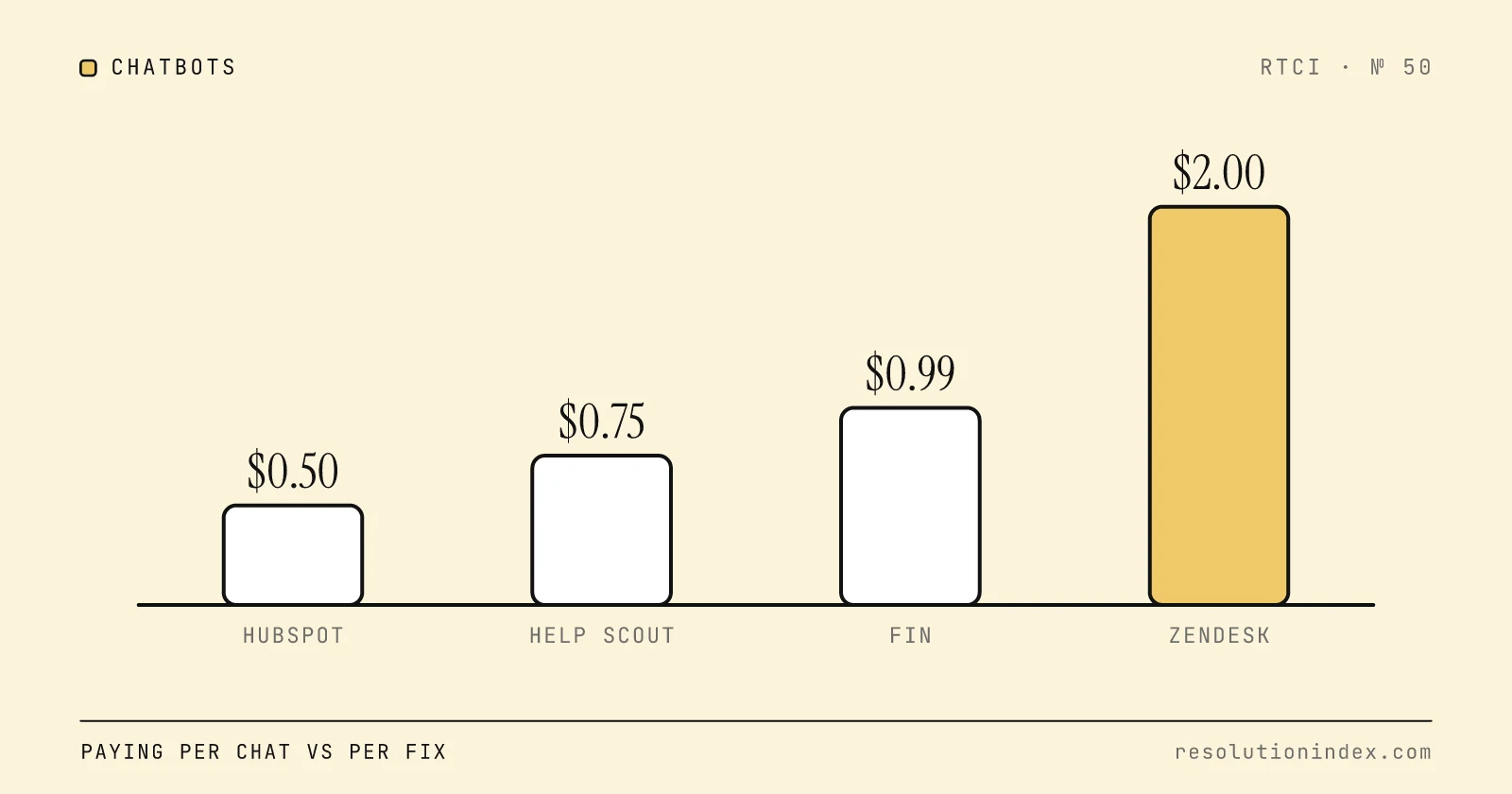
- Per resolution or outcome. Fin $0.99 per outcome, HubSpot Breeze $0.50 per resolution, Help Scout AI $0.75 per resolution on pay-as-you-go. You pay only when the AI succeeds, though Fin's outcome also covers handoffs and routings.
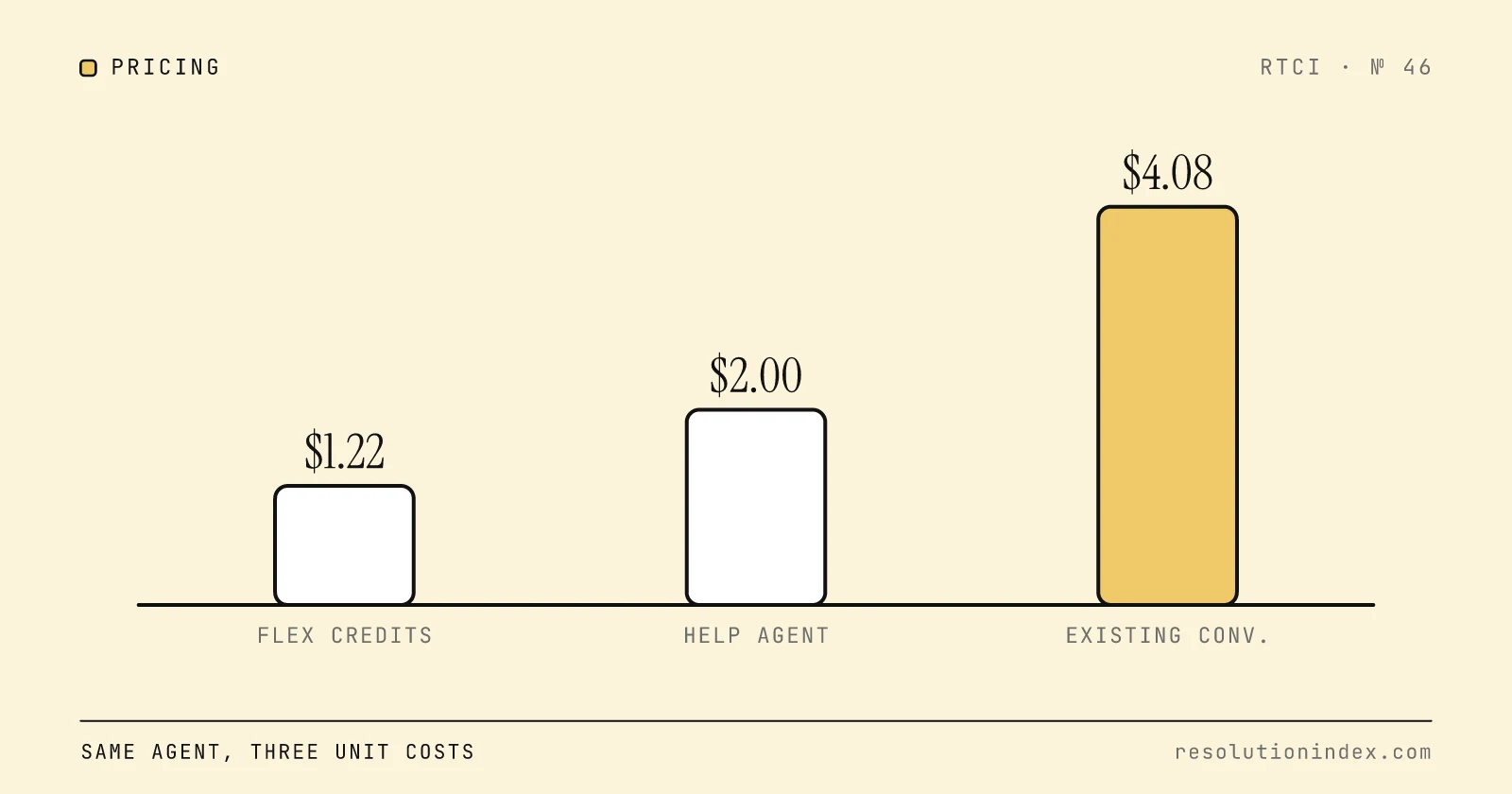
- Per conversation or session. Kustomer $0.75 per engaged conversation, Freshdesk Freddy $0.49 per session ($49 per 100 after 500 one-time free sessions), Salesforce Agentforce $2 per conversation for existing Conversations customers. You pay for failures too, so divide by your resolution rate: at a 50% rate, a $0.75 conversation costs $1.50 per resolution.
- Credits. A vendor-defined unit that is not a resolution. RTCI estimates YourGPT at ~$0.13 per resolution (est.): the Advanced plan at $349 a month across about 3,000 conversations, 90% resolved in RTCI's November 2026 test.
Layer 3, add-ons and overage. What appears on the invoice but not in the headline: overage past an allowance, separate modules, and a second meter on the same ticket. Zendesk includes 5 automated resolutions per agent per month on Support Team and Suite Team and 10 on Suite Professional, then bills $1.50 committed or $2.00 pay-as-you-go. Zendesk and Help Scout both charge seats plus a per-resolution fee, so the AI cost adds to the seat cost rather than replacing it.
Off-meter costs. Setup, integrations, knowledge-base work, tuning and oversight. These are not on any rate card, and RTCI has no independent dataset for them, so get them quoted and enter them as stated assumptions.
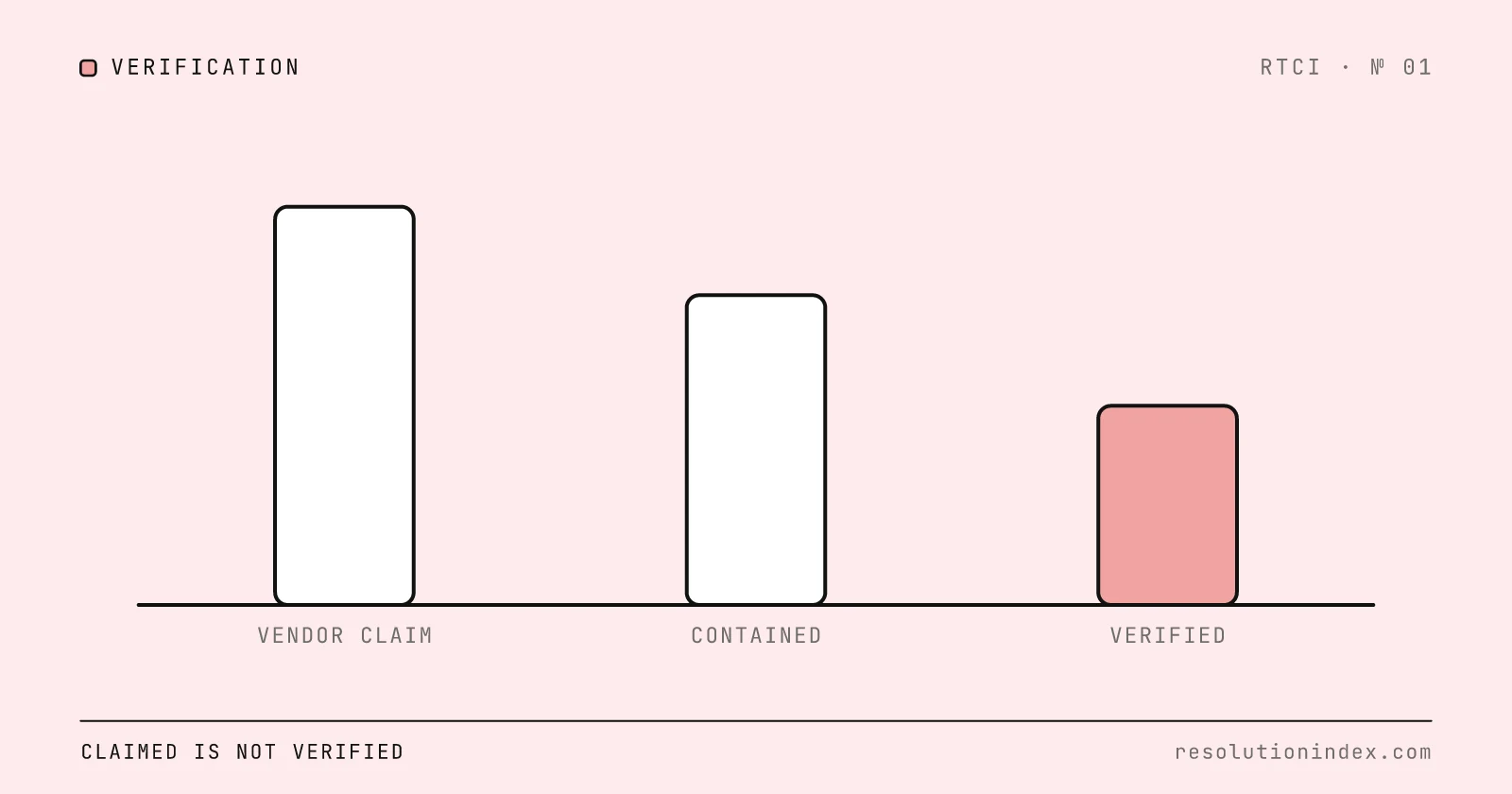
Verified resolutions. AI-resolved tickets with no human handoff and no re-contact within 72 hours, as defined in Why Vendor-Claimed Resolution Rates Don't Match Reality.
Why does the fixed layer flip rankings?
Take two hypothetical vendors. Vendor A charges $0.99 per resolution plus a $5,000 monthly platform fee. Vendor B charges $1.50 per resolution and no fee. At 1,000 resolutions a month, A costs $5,000 + $990 = $5,990, or $5.99 per resolution; B costs $1,500, or $1.50. A only becomes cheaper above $5,000 ÷ ($1.50 − $0.99) = about 9,800 resolutions a month.
The denominator matters as much. If a vendor bills 7,000 "resolved" tickets but only 5,000 pass the 72-hour test, every verified resolution carries 7,000 ÷ 5,000 = 1.4 billed units, so the effective rate is 40% above the headline.
Worked examples: Fin, Gorgias and YourGPT
Shared assumptions, so the three are comparable: verified resolution rates at the midpoint of RTCI's realistic range or test result (Fin 60%, Gorgias AI 32%, YourGPT 90%); billed AI events equal to 7/6 of verified resolutions for per-event vendors (one billed event in seven is a handoff, routing or re-contact); off-meter costs of $1,000 a month up to 5,000 tickets and $2,000 above that. The off-meter figures are assumptions, not data. Helpdesk seats outside the AI product are excluded.
Intercom Fin ($0.99 per outcome; review), running on an existing helpdesk, so Layer 1 is $0 once the 50-outcome minimum is passed.
| Tickets/mo | Verified | Billed outcomes × $0.99 | Off-meter | CPVR |
|---|---|---|---|---|
| 1,000 | 600 | 700 → $693 | $1,000 | ($693 + $1,000) ÷ 600 = $2.82 |
| 5,000 | 3,000 | 3,500 → $3,465 | $1,000 | $1.49 |
| 50,000 | 30,000 | 35,000 → $34,650 | $2,000 | $1.22 |
Gorgias AI ($0.90 per automated interaction on annual billing, RTCI's index rate; review). Layer 1 is the ticket plan: Pro at $300 a month (2,000 tickets) covers 1,000 tickets, and Advanced at $750 (5,000 tickets) covers 5,000. Above 5,000 tickets Gorgias quotes Enterprise, so the table stops there. Gorgias bills $1.50 per interaction above a plan's included allowance; check whether your volume triggers it.
| Tickets/mo | Plan | Verified | Billed × $0.90 | Off-meter | CPVR |
|---|---|---|---|---|---|
| 1,000 | $300 | 320 | 373 → $336 | $1,000 | ($300 + $336 + $1,000) ÷ 320 = $5.11 |
| 5,000 | $750 | 1,600 | 1,867 → $1,680 | $1,000 | $2.14 |
YourGPT (flat plan plus credits; review). RTCI's estimate treats the Advanced plan's 100 million credits as about 3,000 conversations, or about 33,333 credits each. Extra credits cost $7 per 2 million, up to 100 packs.
| Tickets/mo | Credits needed | Plan + packs | Verified | Off-meter | CPVR |
|---|---|---|---|---|---|
| 1,000 | ~33M (inside plan) | $349 | 900 | $1,000 | ($349 + $1,000) ÷ 900 = $1.50 |
| 5,000 | ~167M (34 packs) | $349 + $238 = $587 | 4,500 | $1,000 | $0.35 |
The plan plus the 100-pack ceiling buys about 300 million credits, roughly 9,000 conversations a month at this burn rate, so higher volumes need an Enterprise quote.
What the examples show: at 1,000 tickets the assumed $1,000 of off-meter cost is most of every CPVR, so the vendor ranking depends on implementation effort as much as on price. At 5,000 tickets the resolution rate takes over; Gorgias's lower realistic rate (27–37%) costs more per verified resolution than its lower unit price saves. Gorgias's case rests on Shopify depth, which a CPVR table does not measure.
How do you use CPVR in procurement?
Ask every vendor the same questions, in writing: What is the fixed monthly cost regardless of AI usage? What is the billable event, and is it per outcome, conversation, session or credit? What overage applies beyond included allowances? What is the resolution rate measured with no human handoff and no re-contact within 72 hours? What are the one-time setup and integration costs? What should we budget each year for maintenance?
A vendor that cannot answer these in writing is asking you to sign on trust. Record the gap as an unknown and model a conservative value.
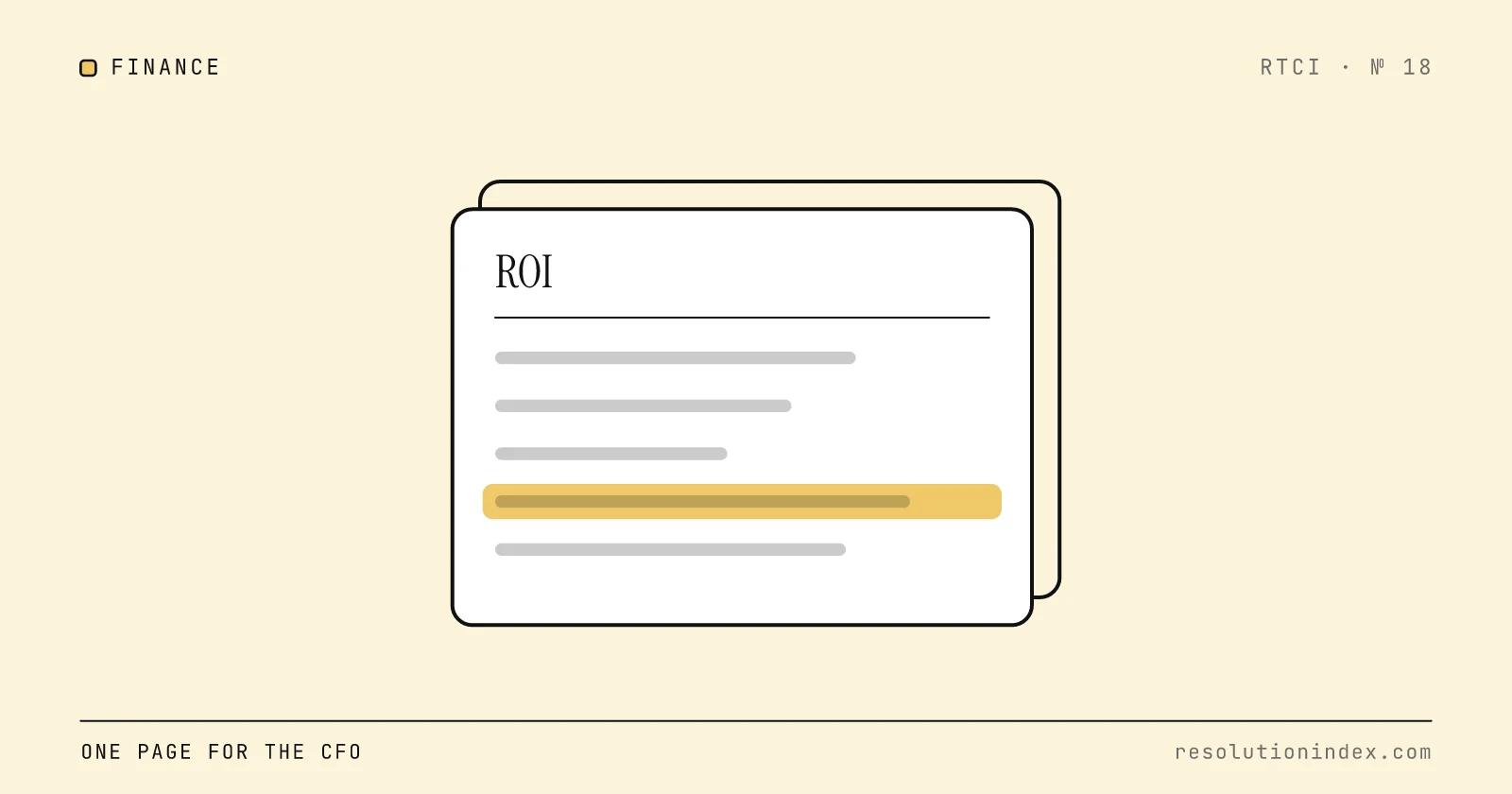
The Support Savings Calculator runs this framework with RTCI's midpoint figures for every platform in the index, and the Cost Per Verified Resolution Calculator takes your own volume, resolution rate and costs. To turn the result into an approval document, use the AI Support ROI One-Pager for Finance.
Change log
- Removed unlinked third-party cost statistics, made off-meter costs explicit assumptions, rebuilt the Fin, Gorgias and YourGPT examples on index prices and current plan tiers, and corrected Zendesk and Cognigy pricing.
- Aligned vendor figures with the RTCI index.
- Published.
Read next
Keep reading
Picked for this article: the pieces it cites and the ones that answer the next question buyers usually ask.
Most related
The Hidden Cost of AI Customer Support Pricing
The number on the pricing page is rarely the number on the invoice. RTCI's three-layer cost model breaks down what vendors leave out of the headline.
AI Support ROI One-Pager for Finance
A finance-ready AI support business case on one page: baseline cost, AI cost per verified resolution, implementation, payback and three-year NPV, with every input shown.
AI Resolution Rates: Why Vendor Claims Are Often Inflated
See how AI support vendors blur resolution, containment and deflection, how RTCI discounts each claim, and the five questions to ask before you compare two rates.
AI Chatbot for Customer Service: What a Resolution Costs (2026)
AI chatbot for customer service prices compared on cost per resolution as of November 2026: per conversation vs per resolution billing, worked out.
Salesforce Agentforce Pricing 2026: Cost per Resolution, Decoded
Salesforce Agentforce pricing as of November 2026: Flex Credits, per-user licences, $2 Help Agent resolutions and the $2 Conversations meter, each converted into cost per resolution.