Published Nov 5, 2026 · Updated Nov 19, 2026 · 11 min read
Intercom Alternatives 2026: 8 Options Compared on Cost Per Resolution
Eight Intercom alternatives compared on what an AI-resolved conversation really costs as of November 2026, with a worked monthly bill for a 10-agent team.
 Written by Andrew Hall, Editor
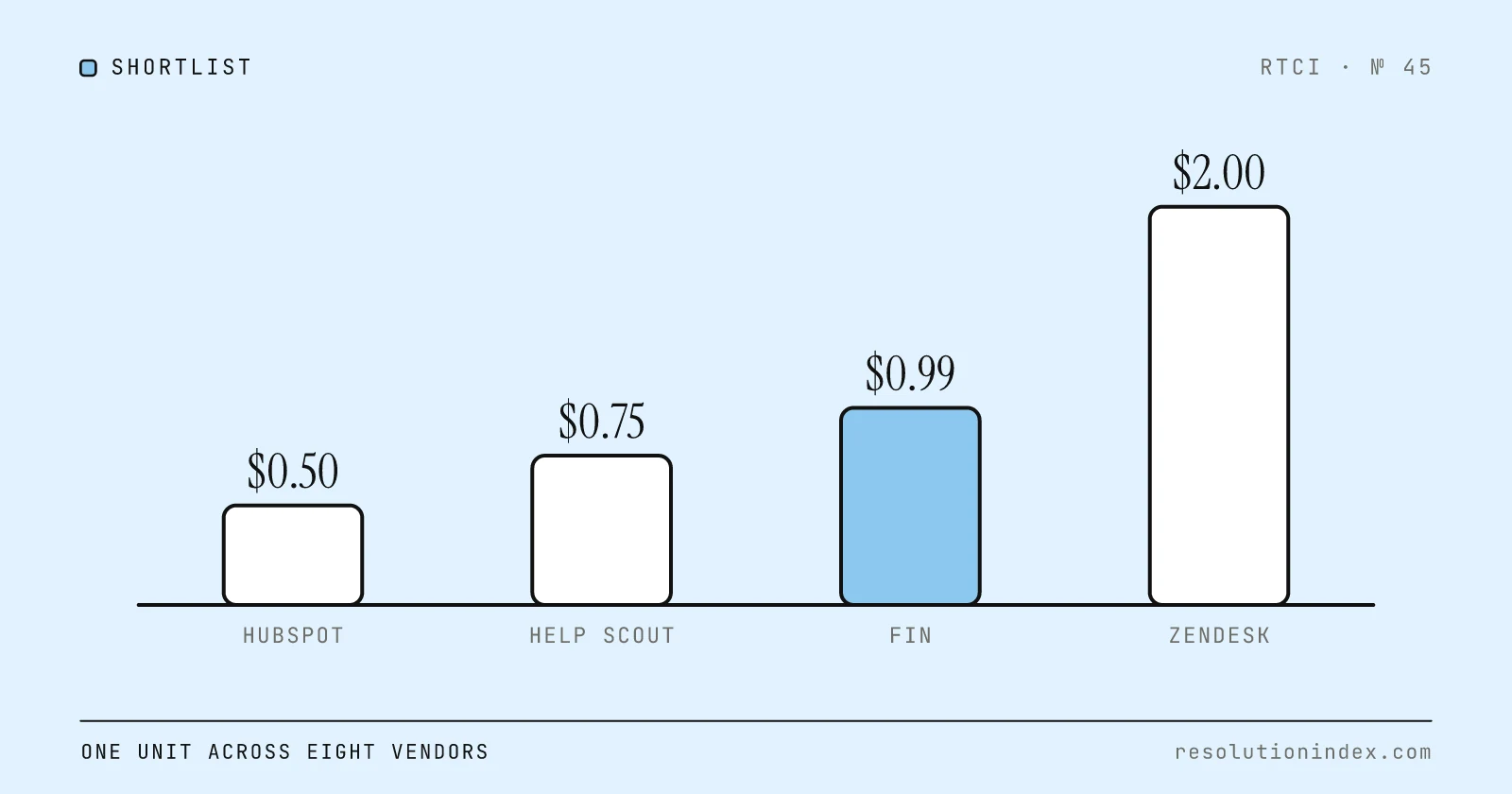
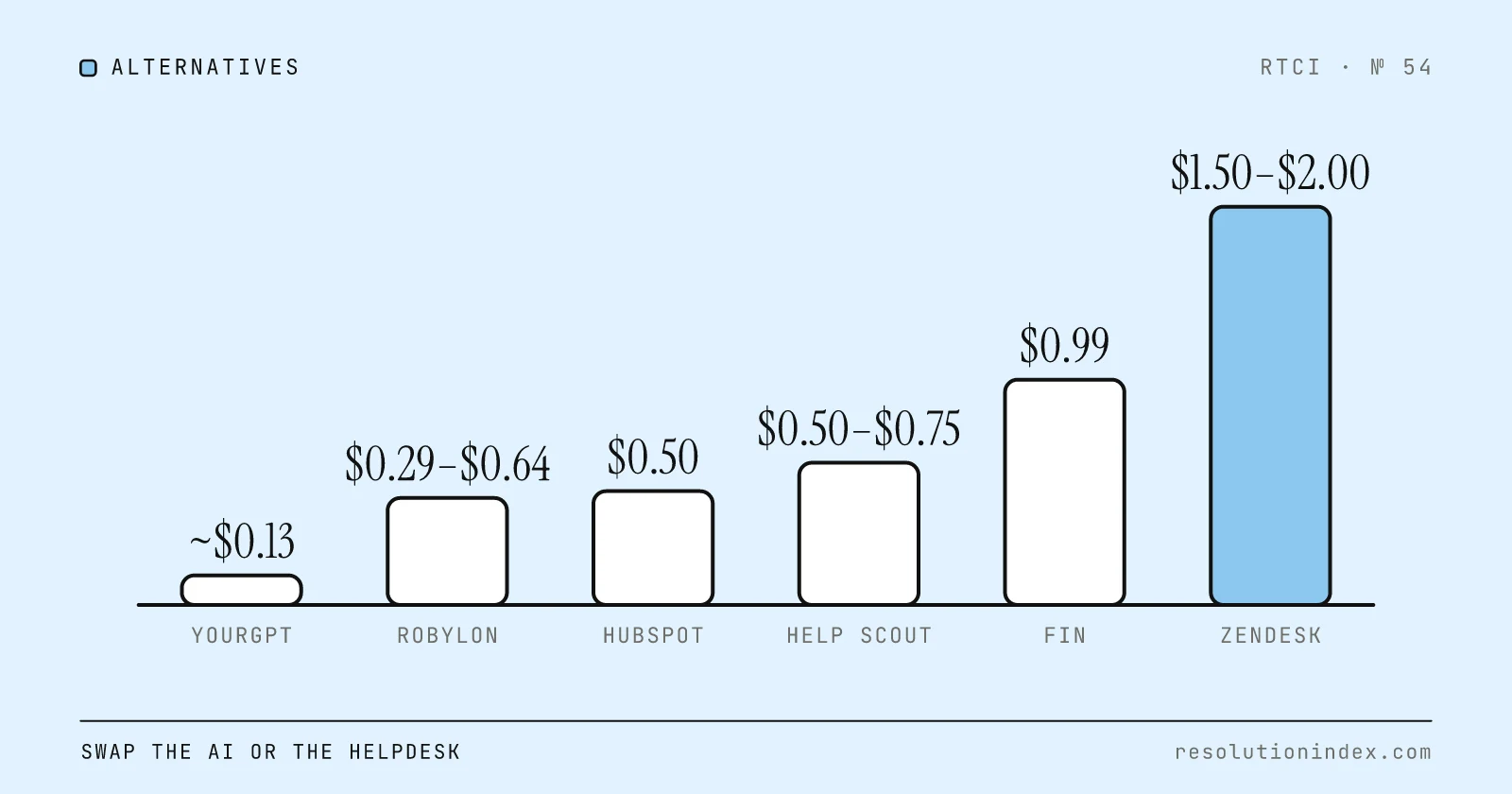
The Intercom alternatives that cost less per AI-resolved conversation as of November 2026 are YourGPT (~$0.13, est.), HubSpot Service Hub ($0.50) and Help Scout ($0.50 to $0.75). Freshdesk, Tidio and Gorgias sit close to Fin's $0.99 per outcome. Zendesk and Lorikeet usually cost more per resolution, though each can still win on seats or fit. YourGPT takes a different approach, with flat monthly plans from $39 and no per-message or per-resolution fee.
Those numbers come from converting every vendor's AI pricing into a single unit. Most "Intercom alternatives" lists skip that step, and almost all of them are written by a vendor that ranks itself first.
Key takeaways
- Vendors bill AI by outcome, resolution, session, conversation or credit, so list prices cannot be compared directly.
- Converted to cost per resolution, HubSpot and Help Scout undercut Fin's $0.99 per outcome as of November 2026.
- Session and conversation pricing charges for failed attempts, so divide by your real resolution rate before comparing.
- Platform fees and seat prices can outweigh a lower AI rate, so price the whole month at your own volume.
- Flat-plan tools such as YourGPT charge no per-resolution fee, so their cost per resolution falls as volume rises within the plan.
Why teams are looking beyond Intercom in 2026
Intercom renamed the company Fin in 2026 and kept Intercom as the helpdesk product name. Salesforce agreed in June to acquire Fin for about $3.6 billion and completed the deal on 10 September 2026.
That deal adds roadmap uncertainty to the reasons teams already gave for shopping around: separate charges for seats, Fin and channels that are hard to forecast, and an AI bill that grows as Fin handles more conversations.
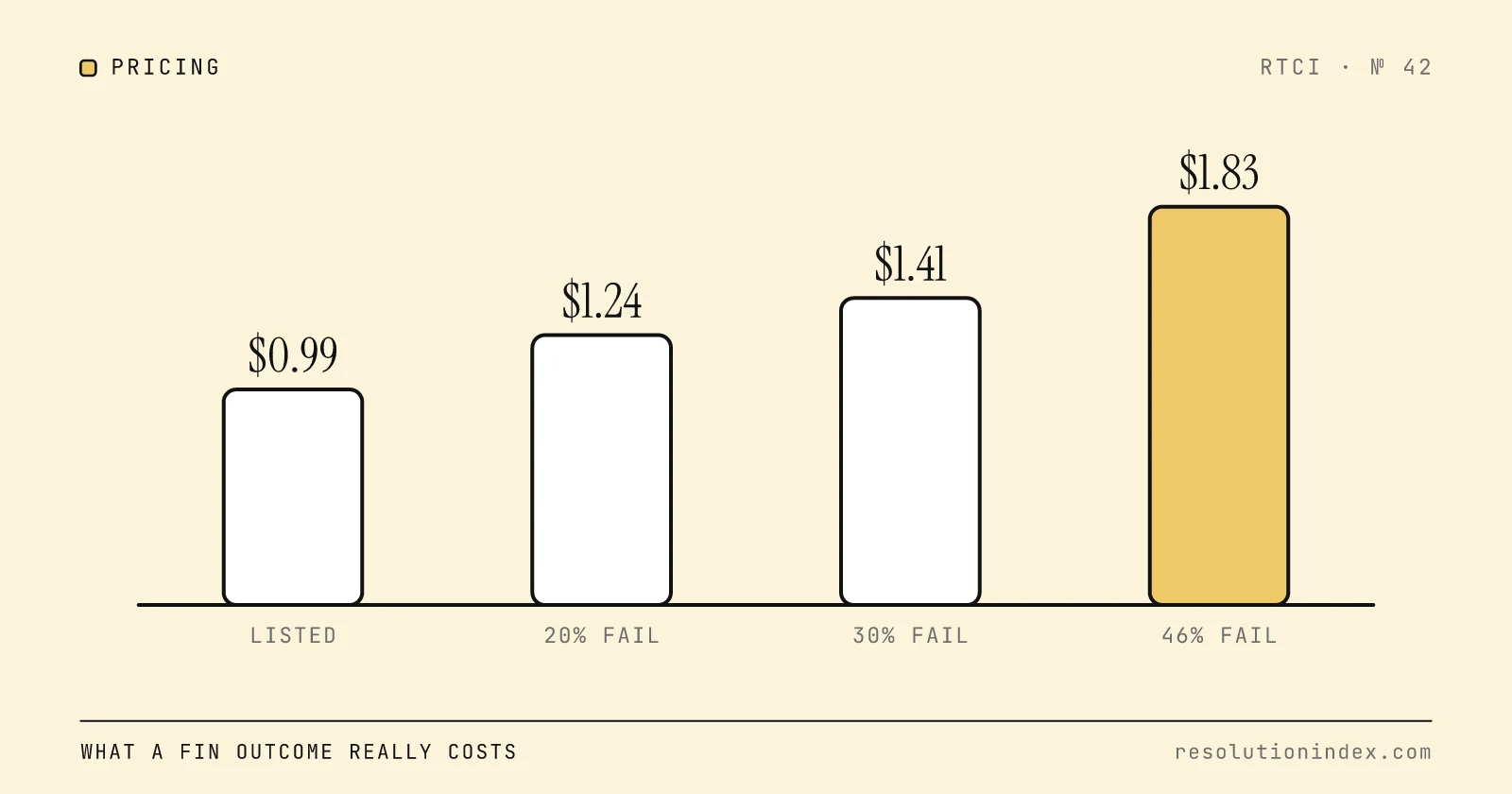
Fin itself is fairly priced on paper at $0.99 per outcome, with seats from $29 on annual billing according to Intercom's pricing page. The catch is that an outcome includes assumed resolutions and procedure handoffs, so the effective cost per real resolution can run higher. RTCI's Intercom Fin review scores it at $0.99 per resolution (RTCI score 696, Strong).
That range is the benchmark every alternative below has to beat.
How the ranking works
The vendors below bill their AI in five different units, and one bills a flat monthly plan. Comparing $0.49 per session with $0.99 per outcome is like comparing a price per lottery ticket with a price per win.
To put them on one scale, each AI price is converted to cost per resolution:
- Per resolution or outcome (Fin, Help Scout, HubSpot, Zendesk): the list price, or the prepaid or committed rate where one is offered, since you only pay for results.
- Per resolution plus platform fee (Lorikeet): the per-resolution rate plus the $2,100 monthly platform fee spread over 2,000 to 4,000 resolutions a month.
- Per session or conversation (Freshdesk, Tidio): the price per attempt divided by RTCI's realistic resolution rate for that platform, because every attempt is billed.
- Per automated interaction (Gorgias): the annual and monthly rates.
- Flat monthly plan (YourGPT): no per-resolution fee, so RTCI estimates it from the Advanced plan ($349 a month) at about 3,000 conversations, with 90% resolved in RTCI's November 2026 test.
The point matters more than it looks. Mike Myers, CEO of Quiq, made it in a No Jitter analysis of AI pricing:
"Outcome-based pricing only works if 'resolution' is consistently defined and measurable across every workflow and channel."
Seat and platform fees are listed separately, because a cheap AI rate on top of an expensive platform can still produce a larger bill.
The 8 alternatives compared on AI cost per resolution
All prices are list prices from each vendor's own pricing page as of November 2026.
| Rank | Platform | AI pricing as listed | Cost per resolution | Fixed costs to add |
|---|---|---|---|---|
| 1 | YourGPT | Flat monthly plans with AI credits; no per-message or per-resolution fee | ~$0.13 (est.) | Plans $39, $79 or $349 a month, annual |
| 2 | HubSpot Service Hub | $0.50 per resolved conversation | $0.50 | Professional seats plus $1,500 onboarding |
| 3 | Help Scout | $0.75 per resolution | $0.50 to $0.75 | Seats from $25 per user |
| 4 | Tidio Lyro | From $32.50 a month for 50 conversations, billed annually ($39 monthly) | About $0.77 to $1.18 | Optional; Starter from $24.17 a month billed annually |
| 5 | Freshdesk | $0.49 per session | About $0.79 to $0.94 | Seats from $19 per agent |
| 6 | Gorgias | $0.90 per automated interaction annual, $1.50 above allowance | $0.90 to $1.00 | Ticket-volume helpdesk plans |
| 7 | Zendesk | $1.50 committed or $2.00 pay-as-you-go per automated resolution | $1.50 to $2.00 | Seats from $19 per agent |
| 8 | Lorikeet | $0.90 to $0.99 per resolution | $1.52 to $2.04 | Platform fee from $2,100 a month, annual |
| Baseline | Intercom Fin | $0.99 per outcome | $0.99 | Seats from $29 per seat |
The detail behind each entry follows.
HubSpot Service Hub: $0.50 if you live in HubSpot
HubSpot cut the price of its Customer Agent in April 2026. Its announcement set it at "$0.50 per resolved conversation, down from $1.00 per conversation", paid in HubSpot credits.
HubSpot's Chief Customer Officer, Jon Dick, summed up the change: "Outcome-based pricing removes that risk. You pay when it works, full stop."
The catch is the platform. Service Hub Professional is listed at $90 to $100 per seat a month with a one-time $1,500 onboarding fee.
HubSpot does not define "resolved" on its pricing page; RTCI's HubSpot Breeze review puts the realistic rate at 51% to 61%, for an RTCI score of 762 (Elite). For a team already running sales and marketing in HubSpot, it undercuts every other large helpdesk vendor in this comparison on price per resolution.
Help Scout: simple pricing for email-first teams
Help Scout charges $0.75 per Envoy resolution, billed once per conversation and only when the customer gets an AI response and does not escalate or ask for more. New accounts get three months of unlimited Envoy resolutions free, and you can set a monthly spend cap.
Seats are listed at $25, $45 and $75 per user a month, with a free plan for up to 5 users. RTCI's Help Scout AI review puts its realistic resolution rate at 54% to 64% (RTCI score 744, Strong), among the higher ranges here, so the low price per resolution does not come with shallow resolution.
Lorikeet: per-resolution pricing for complex support
Lorikeet charges $0.99 per chat, email or SMS resolution on its Start plan and $0.90 on Scale, and states that escalations to a person and unresolved tickets are not charged. Voice is $1.50 and $1.20.
The platform fee is the deciding factor: $2,100 a month on annual billing for under 5,000 tickets, or $5,100 for 5,000 to 20,000. Lorikeet is an AI layer that sits on your existing helpdesk, so this is in addition to your seats. It makes sense for teams with complex, regulated or multi-step support where resolution quality matters more than unit price.
Gorgias: built for Shopify stores
Gorgias prices its AI Agent at $0.90 per automated interaction on annual billing, or $1.00 monthly. Each plan includes some automated interactions, from 30 on the entry tiers to 530 on Advanced, and the page bills usage above that allowance at $1.50 per interaction.
Unlike most helpdesks here, Gorgias prices its helpdesk by ticket volume rather than per agent. That suits ecommerce teams with few agents and large seasonal swings. The tier prices shown on the page are inconsistent in places, so confirm the plan price at checkout.
Freshdesk: cheap seats, session-based AI
Freshdesk keeps seat prices low, at $19, $55 and $89 per agent on annual billing. Its Freddy AI Agent costs $49 per 100 sessions after 500 free ones, which are granted once per account.
A session is billed whether or not it resolves. At a 52% to 62% realistic resolution rate, $0.49 per session becomes $0.79 to $0.94 per resolution. Freshdesk wins on total cost when you have many agents and modest AI volume.
Tidio Lyro: an entry point for small stores
Tidio sells its Lyro AI agent from $32.50 a month billed annually ($39 billed monthly) for 50 conversations, with the first 50 free for life. A Lyro conversation counts once the AI has replied, whether or not it resolves.
At the entry tier that is $0.65 per conversation on annual billing, or $0.78 ($39 a month) on monthly billing. Divided by a realistic 55% to 65% resolution rate, it lands at about $1.00 to $1.18 per resolution on annual billing, and up to $1.42 on monthly billing; at Lyro's $0.50 starting price the low end is $0.77. The public page shows monthly Lyro limits from 50 to 1,000 conversations, so higher volumes need a sales conversation. Tidio fits very small teams that want a low monthly floor.
Zendesk: the incumbent, at a higher unit price
Zendesk includes AI agents in every plan and bills per automated resolution: $1.50 committed or $2.00 pay-as-you-go beyond a small allowance. Since May 2026, only LLM-verified resolutions draw on the allowance, so abandoned chats are no longer counted.
Seats run from $19 for Support Team to $115 for Suite Professional on annual billing. Zendesk makes sense for teams that need deep ticketing and enterprise controls more than they need the lowest AI price. For the reverse move, the Zendesk alternatives guide prices eight options against Zendesk at 5,000 tickets a month.
YourGPT: flat monthly plans, no per-resolution fee
YourGPT prices by plan rather than by result. As of November 2026, Essential is $39, Professional $79 and Advanced $349 a month on annual billing ($59, $129 and $499 monthly), with Enterprise on a yearly contract.
Each plan includes a pool of AI credits: 10 million, 30 million and 100 million. YourGPT states there is no extra charge per message and no message limit, so the bill does not rise with each resolved conversation. Credit use depends on the model, from 1× for the Efficient model to 2.5× for GPT-4.1 and 5× for GPT-4o, and add-on credits are available when the pool runs out.
Professional adds an AI helpdesk, human escalation, multi-language support and API access, with 5 team members. Channels such as WhatsApp, Messenger, Slack and Telegram are available on every plan.
Because nothing is billed per outcome, cost per resolution depends on how many conversations you run through the plan and which model you choose. RTCI estimates about $0.13 per resolution on Advanced at roughly 3,000 conversations a month, with 90% resolved in RTCI's November 2026 test (RTCI score 960, Elite). It suits teams that want a predictable monthly AI bill. Track credit burn during a trial to confirm your volume fits the plan.
What a month costs: a 10-agent team at 2,000 AI conversations
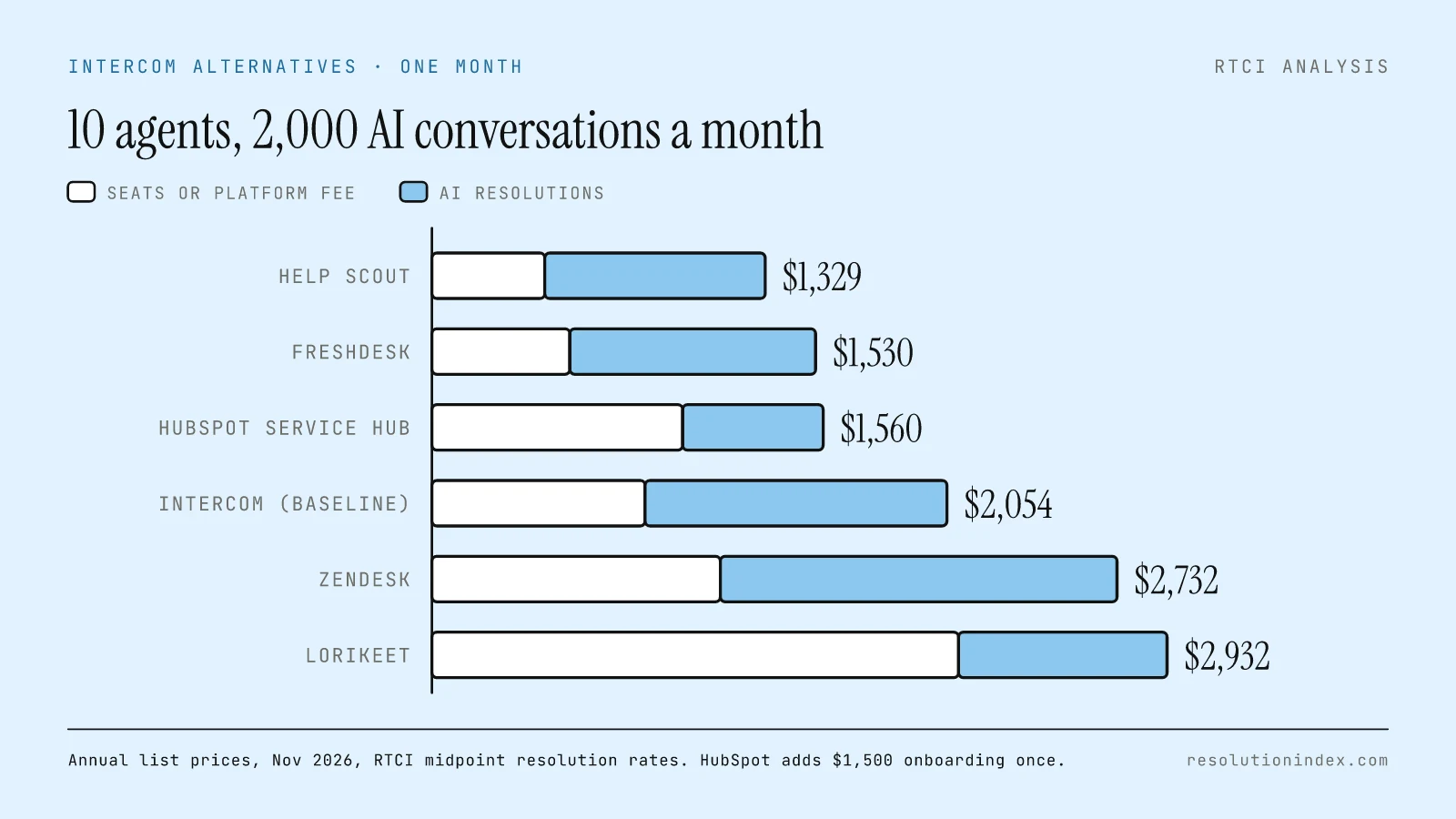
Unit prices only tell part of the story. Here is a full month for one team: 10 agents, 2,000 conversations handled by AI, annual list prices where shown, and RTCI's midpoint realistic resolution rate for each platform.
| Platform | Seats or platform | AI resolutions | AI cost | Monthly total |
|---|---|---|---|---|
| Help Scout (Plus, $45) | $450 | 1,172 | $879.00 | $1,329.00 |
| Freshdesk (Pro, $55) | $550 | 1,130 | $980.00 | $1,530.00 |
| HubSpot Service Hub (Professional, $100) | $1,000 | 1,120 | $560.00 | $1,560.00, plus $1,500 once |
| Intercom (Advanced, $85) | $850 | 1,216 outcomes | $1,203.84 | $2,053.84 |
| Zendesk (Suite Professional, $115) | $1,150 | 816 | $1,582.00 | $2,732.00 |
| Lorikeet (Start) | $2,100 platform | 840 | $831.60 | $2,931.60, plus helpdesk seats |
A few results run against the unit ranking.
Help Scout has the smallest bill with a full helpdesk included, while resolving about as many conversations as Freshdesk, HubSpot and Intercom.
Lorikeet's per-resolution rate is close to Fin's, but it has the largest bill at this volume, because the platform fee is spread over only about 840 resolutions. At 5,000 tickets a month the picture changes.
YourGPT is left out of this table because its credit use depends on the model you choose. Whether 2,000 conversations fit within the Professional plan's 30 million credits depends on the model and conversation length, so test it on your own volume.
Zendesk's figure uses $2.00 pay-as-you-go after a $50 allowance. Committing to volume in advance would bring it down by roughly $395.
A pricing view from inside the industry
For a founder-community take on how Intercom's pricing strategy developed and why it draws criticism, this discussion is a useful counterpoint to vendor comparison pages.
When staying on Intercom is the better call
Switching has its own cost, and Intercom is not the expensive outlier in this group.
Stay if most of your billed Fin outcomes are real resolutions. At $0.99, Fin beats Zendesk and Lorikeet per resolution and sits close to Freshdesk, Tidio and Gorgias.
Stay if your team relies on Intercom's messenger, product tours and in-app messaging, which you would need to replace separately on a ticket-first tool.
Stay, but renegotiate, if the Salesforce deal is your main worry. Ask for a rate cap on Fin outcomes and an exit clause tied to bundling or platform changes.
Leave if a sample of your billed outcomes shows that a third or more are handoffs or silent failures, or if your volume is high enough that a flat-plan tool like YourGPT or a platform-fee tool like Lorikeet spreads its costs well.
How to shortlist without a sales cycle
- Export last quarter's conversation volume by channel.
- Sample 100 Fin outcomes and mark which were real resolutions. Divide $0.99 by that share for your current unit cost.
- Pick two or three alternatives from the table that fit your helpdesk and channels.
- For each, multiply your volume by the platform's realistic resolution rate and its AI price, then add seats or platform fees.
- Run a 30-day pilot on the same ticket sample, and score each vendor the same way using a fair AI support pilot scorecard.
- Lay the quotes side by side using the apples-to-apples quote method.
The decision rule
Compare alternatives on cost per verified resolution plus fixed fees at your own volume, never on the AI list price alone. If an alternative cannot beat your measured Fin cost per resolution by at least 25%, the migration effort is unlikely to pay back within a year.
Run each shortlisted option through the cost per verified resolution calculator with your real volume before booking demos.
How RTCI calculates these numbers
- Realistic resolution rate. Each vendor’s published claim is discounted by one fixed rule for every vendor, with an extra discount when the figure measures deflection rather than resolution.
- Cost per resolution. Per-session and per-conversation prices are divided by that realistic rate, because failed attempts are billed too. Mandatory platform fees are spread over 2,000 to 4,000 resolutions a month.
- Prices. Every price links to the vendor’s own page as of the date shown. Costs marked ~ or est. are RTCI estimates for vendors that publish no per-unit price.
Frequently asked questions
Who are Intercom's main competitors?
Intercom's main competitors in AI customer support are Zendesk, HubSpot Service Hub, Freshdesk, Help Scout, Gorgias (for Shopify stores), Tidio, Lorikeet and YourGPT, plus enterprise AI agents such as Decagon, Sierra AI and Ada. As of November 2026, HubSpot ($0.50 per resolved conversation) and Help Scout ($0.75 per resolution) undercut Fin's $0.99 per outcome, while Zendesk charges $1.50–$2.00 per automated resolution.
What is a cheaper alternative to Intercom?
On AI cost per resolution as of November 2026, HubSpot's Customer Agent at $0.50 per resolved conversation and Help Scout's Envoy at $0.75 per resolution both price below Fin's $0.99 per outcome. Check seat and platform fees too, since they can outweigh the AI saving at low volume.
Why are people leaving Intercom?
The common reasons are layered billing that is hard to forecast, AI costs that rise as Fin handles more conversations, and uncertainty after Salesforce completed its acquisition of Fin, the company formerly called Intercom, in September 2026. Teams with heavy ticketing needs also look for tools built around tickets rather than messaging.
Is there a free alternative to Intercom?
Some alternatives have free entry points. Help Scout has a free plan for up to 5 users, HubSpot Service Hub has a free tier for 2 users, Crisp has a free plan for 2 agents and YourGPT offers a free trial on its paid plans. None includes enough AI capacity to replace Fin at real volume.
Can I keep Intercom's helpdesk and swap only the AI agent?
Yes. Standalone AI layers such as Lorikeet work on top of an existing helpdesk, and Fin itself can run on Zendesk or Salesforce. Swapping only the AI layer avoids a full migration, but you keep paying for helpdesk seats, so compare the AI line on its own.
Which Intercom alternative is right for Shopify stores?
Gorgias is built for ecommerce and prices its AI Agent per automated interaction, at $0.90 on annual billing as of November 2026. RTCI rates it in the Moderate tier (RTCI score 636), and it is built for Shopify and DTC brands. Its helpdesk is priced by ticket volume rather than per seat, which suits stores with small teams and seasonal peaks.
Change log
- RTCI scores for HubSpot Breeze and YourGPT corrected to the current 0–1,000 index (762 and 960).
- RTCI scores updated to the current 0–1,000 index.
- Figures aligned with the November 2026 index rescore.
- Added dated pricing-page screenshots and RTCI charts.
- Line-up changed: Robylon removed, YourGPT added. Fin ownership updated.
- Published.
Read next
Keep reading
Picked for this article: the pieces it cites and the ones that answer the next question buyers usually ask.
Most related
Zendesk Alternatives 2026: 8 Compared on AI Cost per Resolution
Eight Zendesk alternatives ranked on RTCI's score and AI cost per resolution as of November 2026, split into AI layers that run on Zendesk and full helpdesk replacements, with a worked month at 5,000 tickets.
Intercom Pricing 2026: What Fin Really Costs Per Resolution
Intercom pricing as of November 2026: seats from $29, Fin at $0.99 per outcome, the add-ons, and a worked cost per resolution for three team sizes.
How to Design a Fair AI Support Pilot Scorecard
A weighted scorecard with 8 dimensions, hard-stop gates, and copy-paste Week 1–4 templates for evaluating an AI support pilot honestly.
Compare AI Support Quotes Apples-to-Apples
A quote normalization worksheet that converts Intercom Fin, Zendesk AI, Freshdesk Freddy, Gorgias, Decagon, Sierra, and YourGPT quotes into one comparable number: cost per verified resolution.
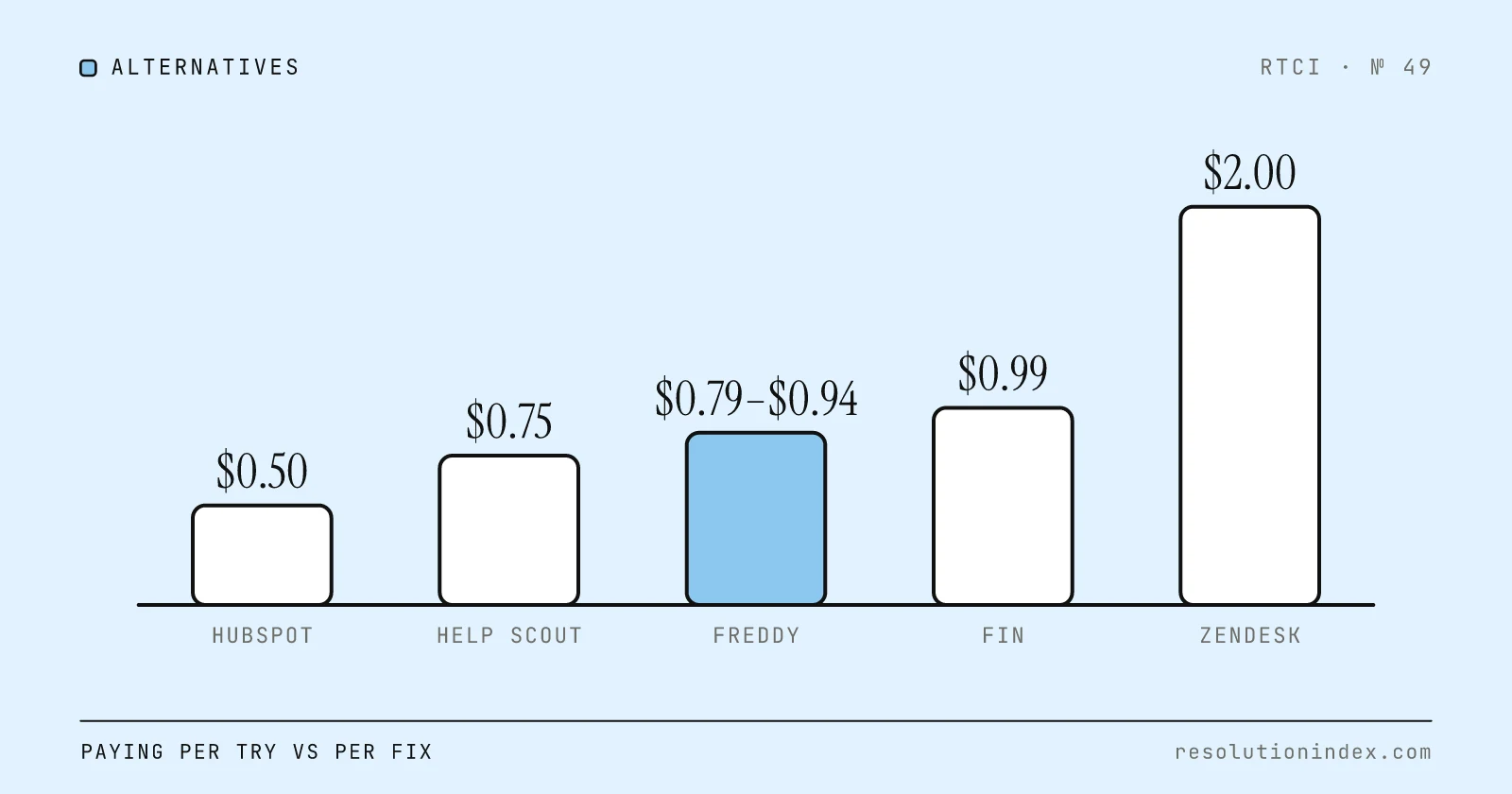
Freshdesk Alternatives 2026: 7 Compared on AI Cost per Resolution
Seven Freshdesk alternatives and competitors compared on what an AI resolution costs as of November 2026, against Freddy's $0.49 per session, with a break-even rate and a worked month for a 10-agent team.