Published Nov 20, 2026 · Updated Nov 20, 2026 · 13 min read
Klarna AI Customer Service Case Study: What It Claimed and What Changed (2024–2026)
Klarna's AI assistant from the February 2024 launch to November 2026, rebuilt from its press release, SEC filings and named reporting: a sourced timeline, what "700 agents" and "80% of chats" actually measure, RTCI's re-reading of realistic resolution and cost, and whether Klarna really rehired its agents.
 Written by Andrew Hall, Editor
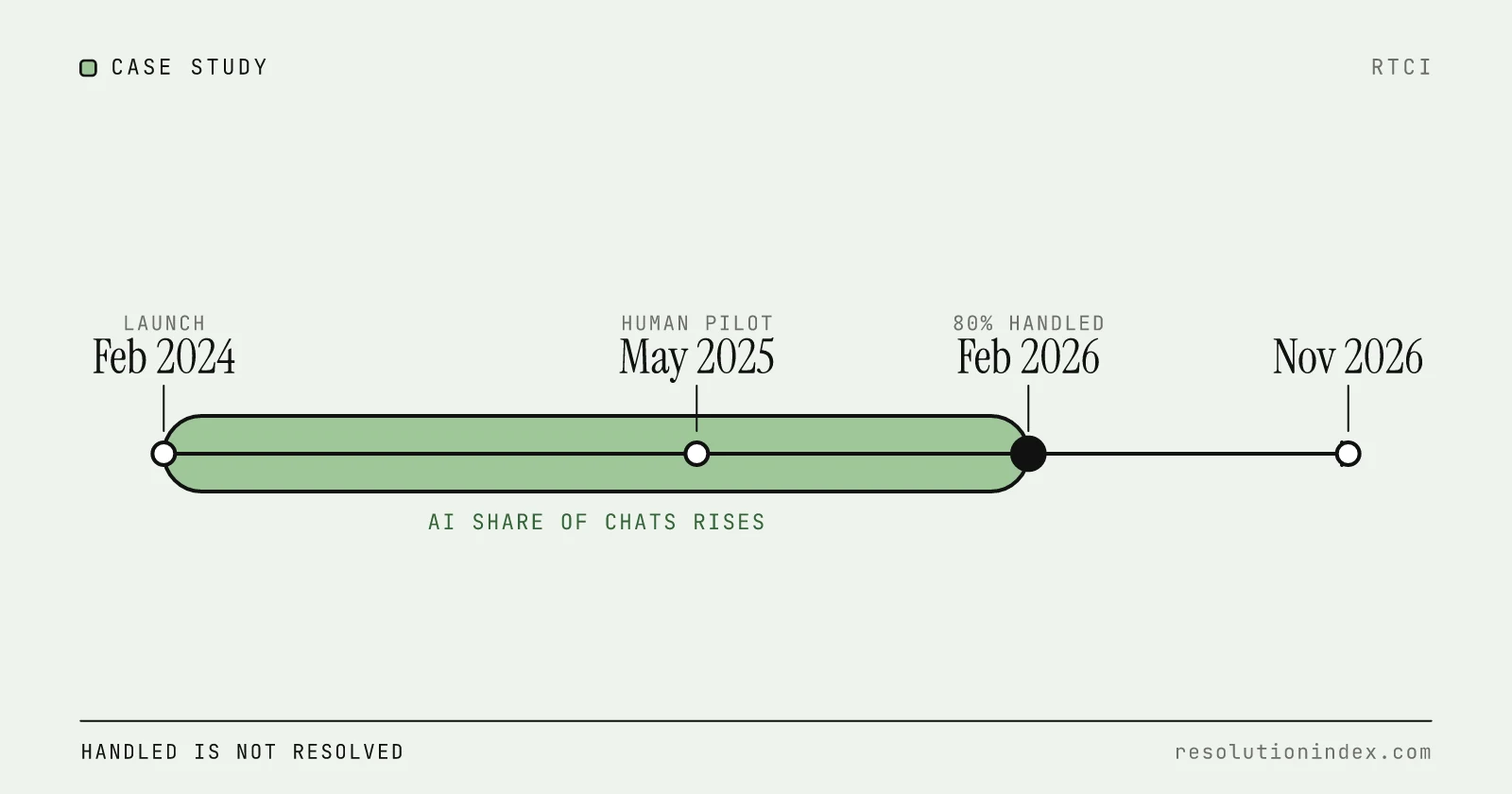
Klarna said in February 2024 that its OpenAI-powered assistant handled two-thirds of customer service chats in its first month and did the work of 700 full-time agents. Both figures count chats the AI took and human volume it displaced, not verified resolutions. In May 2025 CEO Sebastian Siemiatkowski told Bloomberg that cost-led service had produced lower quality, and Klarna started a small pilot of human agents. It did not rehire its agents: its 2025 annual report says the AI handled 80% of chats that year. The lesson is to measure what the AI resolves and keep a human path.
This case study rebuilds the record from Klarna's press release, its four SEC registration and annual filings, its earnings releases and named reporting, all opened on November 20, 2026. Each claim below says who made it, where, and what it measures. RTCI then re-reads Klarna's own numbers through its resolution and cost-per-resolution framing, and lists what a support leader can take from it.
What happened with Klarna's AI customer service, in order?
Every row links to the document it comes from. Quotes from Bloomberg interviews are cited through the outlets that reported them, because RTCI could not open Bloomberg's own pages.
| Date | What happened | Source |
|---|---|---|
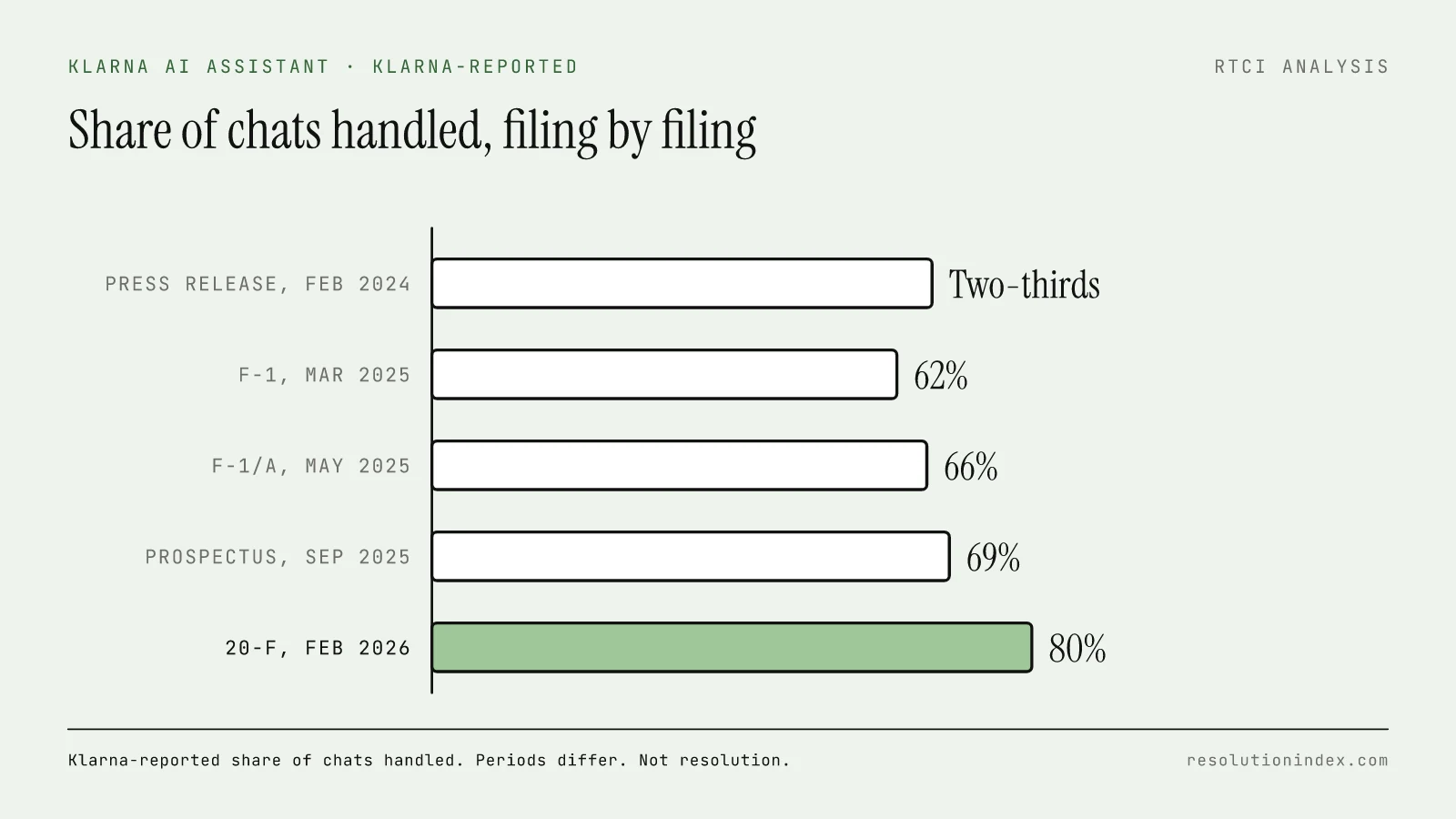
| Feb 27, 2024 | Klarna announces its OpenAI-powered assistant: 2.3 million conversations in its first month, two-thirds of customer service chats, "the equivalent work of 700 full-time agents" and an estimated $40 million profit improvement in 2024 | Klarna press release |
| Dec 12, 2024 | Siemiatkowski tells Bloomberg Television that Klarna stopped hiring about a year earlier; headcount fell 22% to 3,500, mostly through attrition | Bloomberg, republished by Fortune |
| Mar 14, 2025 | IPO registration (F-1): the assistant "is handling 62%" of customer service chats, does the work of over 800 full-time agents and delivered about $39 million of cost savings in 2024 | F-1, SEC |
| May 8, 2025 | Siemiatkowski tells Bloomberg that cost was "a too predominant evaluation factor", with lower quality as the result, and that customers will always be able to reach a human. Klarna starts recruiting for what he calls an "Uber-type" setup, beginning with a pilot | CX Dive, May 9, 2025; Entrepreneur, May 9, 2025 |
| May 9, 2025 | A Klarna spokesperson tells CX Dive the chatbot still handles two-thirds of all customer inquiries | CX Dive, May 9, 2025 |
| May 21, 2025 | Amended F-1: 66% of chats handled in the 12 months to March 31, 2025; the agent equivalent is restated as over 700 "in 2024"; 23.1 million conversations since launch | F-1/A, SEC |
| Jun 4, 2025 | A spokesperson says "This pilot isn't a reversal of our AI strategy"; six remote freelance agents hired so far, with room to grow to about 100 | Silicon Republic, Jun 4, 2025 |
| Sep 10, 2025 | Final IPO prospectus: 69% of chats handled in the 12 months to June 30, 2025; 25.3 million conversations since launch | 424B4 prospectus, SEC |
| Nov 18, 2025 | Q3 2025 results: customer service and operations expense $53 million, up from $44 million a year earlier. On the earnings call the CEO says the AI does the work of more than 853 full-time agents and has saved $60 million | Q3 2025 release, SEC; CX Dive, Nov 20, 2025 |
| Feb 20, 2026 | On the 20VC podcast, Siemiatkowski calls AI "the cheap customer service" and human help a "VIP experience", recruited partly from Klarna's own customers | CX Dive, Feb 20, 2026 |
| Feb 26, 2026 | 2025 annual report (20-F): 80% of chats handled in 2025, over 850 full-time agents' work, about $59 million of savings in 2025, 31 million conversations since launch, and a "dual-track approach" that offers every customer a human | 20-F, SEC |
| Nov 17, 2026 | Q3 2026 results: no new customer service AI figures; customer service and operations expense $54 million, against $53 million a year earlier | Q3 2026 release, SEC |
OpenAI also published a Klarna customer story at openai.com/index/klarna. It returned an access error when RTCI tried to open it on November 20, 2026, so this page cites none of its figures. The Q3 2026 release mentions a separate Klarna AI assistant for shopping, live with a small group of early users on WhatsApp, iMessage and the Klarna app; that product is not the customer service assistant covered here.
What do Klarna's AI figures actually measure?
Klarna's numbers are company-reported. The filings add a source for most of them ("service chat log data" or "internal consumer satisfaction surveys") but no outside audit of the metric. Here is what each one counts, set against the three things RTCI separates: deflection (a human never had to take the contact), handled or contained (the AI took the conversation), and verified resolution (solved with no human and no return within 72 hours).
| Claim | Who said it, where | What it measures | What is not published |
|---|---|---|---|
| Two-thirds of chats, then 62%, 66%, 69% and 80% | Klarna's press release and SEC filings, "according to our service chat log data" | Share of customer service chats the assistant took. The same filing calls it "handled" in one place and "solving" in another | Whether chats later passed to a human count; re-contact; phone and email, which are outside the denominator |
| Work of 700 full-time agents, later over 800, over 700, more than 853 and over 850 | Press release; F-1; F-1/A; CEO on the Q3 2025 call per CX Dive; 20-F | An estimate "based on the average monthly reduction in chat and telephone conversations handled by full-time agents" after launch (F-1/A). Human workload displaced, closer to deflection than to resolution | Agent productivity assumed per full-time equivalent; whether displaced conversations were solved |
| Under 2 minutes versus 11 (release) or 12 (filings) | Press release; filings, "as of September 2024" | Average length of AI-handled chats against human chats | The two groups handle different issues, since humans receive the escalations; speed says nothing on whether the issue stayed fixed |
| 25% drop in repeat inquiries | Press release; filings, "between December 2023 and January 2024" | A company-wide before-and-after count over one month | The repeat rate on AI-handled chats, or any later period |
| Customer satisfaction "on par" with human agents | Press release; filings, from internal surveys | Survey parity between AI and human chats | The score, the response rate and the sample |
| $40 million profit improvement, then $39 million and $59 million of savings, then $60 million | Press release (an estimate for 2024); F-1/A and 20-F; CEO per CX Dive | Cost avoided against a no-AI baseline | The assistant's own cost and the method behind the baseline |
Two patterns stand out. First, the agent-equivalent number moved in both directions across filings, from over 800 in March 2025 to over 700 in May 2025, when the period was pinned to 2024. Second, the headline share is a handled share. Nothing Klarna published says how many of those chats were escalated or came back, which is the gap between containment and resolution that resolution rate vs deflection rate explains.
RTCI's re-reading: what is Klarna's realistic resolution and cost per resolution?
Worked example. It uses only Klarna's published inputs plus RTCI's documented rules. Where an input is missing, the example says so instead of filling it in.
Step 1: discount the handled share as RTCI discounts any claim. RTCI's rule, set out on the methodology page and in why vendor-claimed resolution rates don't match reality, multiplies a company-wide average by 0.80 and a containment or deflection figure by a further 0.85, then takes ±5 points. Klarna's 80% for 2025 is both: 80 × 0.80 × 0.85 = 54.4, a realistic range of 49–59%. This applies RTCI's fixed rule to Klarna's number the same way it is applied to vendor claims. It is not a measurement of Klarna's chats.
Step 2: show what a verified rate would need. RTCI's verified resolution rate is (AI-handled chats − escalations − returns within 72 hours) ÷ chats that reached the AI. Klarna publishes only the first term, as a share. The table shows how the result moves with the missing input. The escalated-or-returned shares are hypothetical, not Klarna data.
| Escalated or returned within 72 hours (hypothetical) | Verified share of all chats | Math |
|---|---|---|
| 10% of AI-handled chats | 72% | 80% × 0.90 |
| 20% | 64% | 80% × 0.80 |
| 30% | 56% | 80% × 0.70 |
Scale makes the missing input matter. In the first month, 2.3 million conversations were two-thirds of chats, which implies about 2.3 ÷ (2/3) = 3.45 million chats, 1.15 million of them left for humans. At that volume, each point of re-contact on AI-handled chats is about 2.3 million × 1% = 23,000 conversations a month.
Step 3: cost per resolution cannot be computed from Klarna's disclosures. The formula is the assistant's full cost (model usage, platform, engineering and content upkeep) ÷ verified resolutions. Klarna publishes neither term. What it does publish is savings, which imply about $39 million ÷ 700 = $55,700 per agent-equivalent in 2024 and $59 million ÷ 850 = $69,400 in 2025. Those figures mix outsourced and in-house labour and are not a cost per resolution.
Step 4: separate avoided cost from actual spend. Klarna's income statement shows its customer service and operations expense, which the filings say consists mainly of personnel costs for customer support and outsourced assistance:
| Year | Customer service and operations expense | Change | Klarna's AI savings claim |
|---|---|---|---|
| 2022 | $287M | ||
| 2023 | $240M | −$47M (−16%) | |
| 2024 | $203M | −$37M (−15%) | ~$39M |
| 2025 | $207M | +$4M (+2%) | ~$59M |
| 9 months to Sep 2026 | $166M | +$11M (+7%) on $155M | Not stated |
Sources: F-1/A for 2022 to 2024, the 20-F for 2025 and the Q3 2026 release for 2026. In 2024 the drop in spend ($37 million) is close to the claimed savings ($39 million). In 2025 spend rose $4 million while claimed savings were $59 million; the 20-F says volumes grew 32% and transactions 25% in the same year. So the 2025 savings are cost avoided against a baseline that grows with volume. That can be a fair way to count, but it is a different number from a smaller bill.
What a buyer would need to turn Klarna's case into cost per resolution:
- The definition of "handled", and whether a chat passed to a human counts
- The AI-to-human escalation rate
- The 72-hour re-contact rate on AI-handled chats, by intent
- CSAT on AI and human chats for the same intents, with response rates
- The assistant's full monthly cost: model usage, platform, engineering and knowledge upkeep
- The savings method: actual spend change, or avoided cost against a stated baseline
The cost per verified resolution framework and its calculator take exactly these inputs for your own program.
Why did Klarna change course, according to the sources?
The sources give three reasons, all from Klarna itself. First, the CEO's account to Bloomberg in May 2025: cost "seems to have been a too predominant evaluation factor" in organising service, and the result was lower quality. He added that customers should be told "there will be always a human if you want", as quoted by CX Dive.
Second, the quality of the outsourced human tier. A Klarna spokesperson told Silicon Republic that with the existing setup "some customers get an amazing agent, some a less engaged agent", which led to repeat contacts and higher costs. Siemiatkowski said one goal is to replace the thousands of workers Klarna outsources, per CX Dive.
Third, positioning. In February 2026 he described AI as the cheap tier and human contact as the premium one, recruiting agents from Klarna's own customers the way people "drive an Uber for a while", per CX Dive. The 20-F puts it in filing language: a "dual-track approach" that combines scalable AI with high-quality human support and keeps the human option open to all customers.
None of the sources RTCI opened says the AI assistant was withdrawn or scaled back. The spokesperson called the pilot not a reversal, and the AI's handled share rose after it.
Did Klarna rehire all its customer service agents?
No source RTCI opened supports that. What the record shows is a pilot of remote, flexible agents announced in May 2025, with six hired by early June and a stated ceiling of about 100, per Silicon Republic. Over the same period the AI's handled share rose from 66% (12 months to March 2025) to 80% (2025), and Klarna's agent-equivalent estimate rose from over 700 to over 850.
The opposite claim, that Klarna replaced 700 agents with AI, also overstates the record. Klarna's figure is an equivalence estimate built from displaced conversation volume, and much of its human service sits with outsourcing partners, whose thousands of workers the CEO said in May 2025 he wants to replace. Klarna's full-time employees did fall, from 4,352 at the end of 2023 to 3,422 in 2024 and 2,831 in 2025, which the 20-F attributes to a decision to reduce headcount by using AI across the business. That is a company-wide figure, not a count of support agents.
RTCI's view: handled share is the wrong headline for an AI support program, Klarna's included. It rose in each Klarna filing, from 62% to 80%, while the CEO described a quality problem that Klarna never quantified, and the one metric that would settle it, the re-contact rate on AI-handled chats, was never published. What would prove this view wrong: Klarna publishing an AI-chat re-contact and escalation rate that stayed low as the handled share climbed to 80%.
What should support leaders take from Klarna?
Each lesson ties to a fact above.
- Define "handled" before you report it. Klarna's filings call the same 66% "handled" and "solving". Write one definition, and report deflection, containment and resolution as separate lines, as resolution rate vs deflection rate sets out.
- Publish re-contact next to the AI share. Klarna's only repeat metric is a company-wide 25% drop over one month in early 2024. Track returns within 72 hours on AI-handled conversations every month, using the method in how to measure AI resolution rate and the window in the 72-hour rule.
- Treat agent-equivalents as volume math. Klarna's estimate comes from conversations no longer handled by people, and it moved from 700 to over 800, back to over 700 and up to over 850 across documents. For staffing, model hours from your own volume and handle time with the staffing calculator.
- Report avoided cost and actual spend separately. Klarna claimed $59 million of savings in a year when its customer service and operations expense rose $4 million. Give finance both numbers and the baseline, as in the ROI one-pager for finance.
- Compare handle times on the same issues. Two minutes against 12 compares AI chats with a human queue that receives the hard cases. Match intents first; average handle time with AI support shows how the mix shifts.
- Keep a human path and say so. Klarna's CEO and its 20-F both now promise a human to anyone who asks. Design the handoff on purpose with AI handoff workflows, and price the escalations.
- Audit any headline the way you would audit a vendor's. Klarna's figures are company-reported, with no outside audit of the metric. Ask the five questions in why vendor-claimed resolution rates don't match reality of internal numbers too.
Frequently asked questions
Did Klarna replace 700 customer service agents with AI?
Klarna said its AI assistant did "the equivalent work of 700 full-time agents" in its February 27, 2024 press release. Its May 2025 F-1/A defines that figure as an estimate from the average monthly drop in chat and phone conversations handled by full-time agents after launch. It measures displaced conversation volume. It is not a count of people laid off, and Klarna's CEO has said the company outsources thousands of service workers.
Did Klarna rehire human customer service agents?
Partly, and on a small scale. In May 2025 Klarna started a pilot of remote, flexible human agents, and a spokesperson said it was not a reversal of its AI strategy. Silicon Republic reported on June 4, 2025 that six freelance agents had been hired, with room to grow to about 100. No source RTCI opened supports the claim that Klarna rehired all its agents: its 2025 annual report says the AI handled 80% of customer service chats in 2025, up from 66% to 69% in its 2025 IPO filings.
How much of Klarna's customer service does its AI handle now?
80% of customer service chats in the year ended December 31, 2025, according to Klarna's 20-F annual report filed February 26, 2026, based on its service chat log data. The same report says the assistant has had 31 million conversations since launch. Klarna's Q3 2026 earnings release, filed November 17, 2026, gives no newer customer service figure.
Is Klarna's AI resolution rate 80%?
Klarna has not published a resolution rate. The 80% is the share of chats the assistant handled. Klarna does not say whether chats later passed to a human count, and it publishes no re-contact rate for AI-handled chats. RTCI's standard discount for a company-wide containment figure (80 × 0.80 × 0.85) gives 54.4, a realistic range of 49–59%, which is an illustration of RTCI's rule and not a measurement of Klarna's chats.
How much has Klarna saved with its AI assistant?
Klarna's filings report about $39 million in cost savings in 2024 and about $59 million in 2025. The CEO put the figure at $60 million on the Q3 2025 earnings call, as reported by CX Dive. These are avoided costs: Klarna's customer service and operations expense rose from $203 million in 2024 to $207 million in 2025, which the 20-F explains by volumes rising 32%.
What AI does Klarna's customer service assistant use?
OpenAI. Klarna's February 2024 press release and its SEC filings describe the assistant as built in partnership with OpenAI and launched in February 2024. The filings say it is available 24/7 in 23 markets and in more than 35 languages.
Change log
- Published.
Read next
Keep reading
Picked for this article: the pieces it cites and the ones that answer the next question buyers usually ask.
Most related
Resolution Rate vs. Deflection Rate: What's the Difference?
Resolution rate measures issues solved end to end; deflection rate measures contacts avoided. Learn the formulas, see examples, and stop vendors from blending them.
AI Resolution Rates: Why Vendor Claims Are Often Inflated
See how AI support vendors blur resolution, containment and deflection, how RTCI discounts each claim, and the five questions to ask before you compare two rates.
How to Measure AI Resolution Rate Internally
Vendor dashboards report resolution rates that no two vendors calculate the same way. This is a practical, vendor-agnostic methodology to measure your own AI resolution rate using your own ticket data, built on RTCI's 72-hour verified resolution standard.
Cost Per Verified Resolution: A New Framework
Per-seat, per-ticket, and per-resolution pricing models all produce different numbers for the same underlying cost. RTCI's three-layer cost model normalizes any vendor's pricing into a single comparable metric: cost per verified resolution.
Train the Team on AI Handoff Workflows
What a clean AI-to-human handoff packet contains, how to measure handoff quality, what vendors bill when a conversation is handed off, and how handoffs move cost per verified resolution.