Published Aug 7, 2026 · Updated Nov 19, 2026 · 5 min read
AI Customer Support Pricing Models Compared: Per-Seat, Per-Resolution, and Usage
AI support vendors price by seat, by resolution or by usage. A worked example at 10,000 conversations a month shows the same 5,000 resolutions costing $874 to $7,200 depending on the price card.
 Written by Andrew Hall, Editor
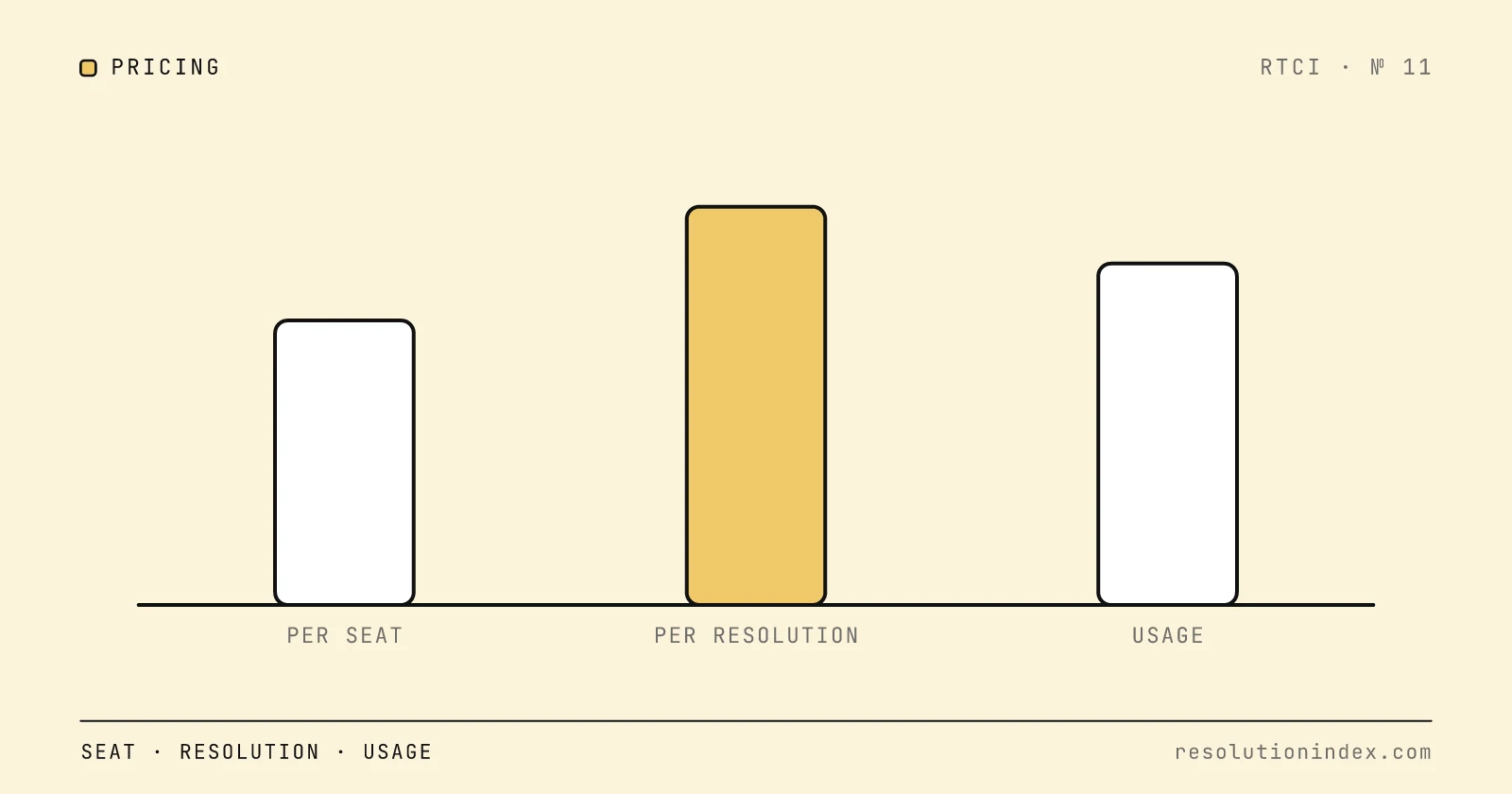
AI support is priced three ways. Per-resolution pricing (Intercom Fin $0.99 per outcome, Zendesk AI $1.50–$2.00 per automated resolution) charges for outcomes, so the contract's definition of an outcome sets the bill. Usage pricing (Freshdesk Freddy $0.49 per session, YourGPT flat plans with credits) charges whether or not the AI resolves, so cost per resolution is the unit price divided by your resolution rate. Seat-priced AI (Zendesk Copilot $50 per agent a month) doesn't move with outcomes at all. In the worked example below, the same 5,000 resolutions cost between $874 and $7,200 a month.
When does seat-based AI pricing make sense?
Seat-priced AI is mostly agent assist: Zendesk Copilot at $50 per agent a month (annual) on Suite Professional and above, Freshdesk Freddy AI Copilot at $29 per agent a month, Intercom Copilot at $29 (annual). The invoice is the same every month, which makes it easy to budget.
The cost tracks headcount, not resolutions. Twenty agents with Zendesk Copilot cost $1,000 a month whether the AI drafts most replies or few. That fits teams where AI helps people work faster. It fits badly when the goal is to automate a large share of tickets, because those are billed separately: Zendesk's automated resolutions sit on top of seats and Copilot.
What does "resolution" mean in a per-resolution contract?
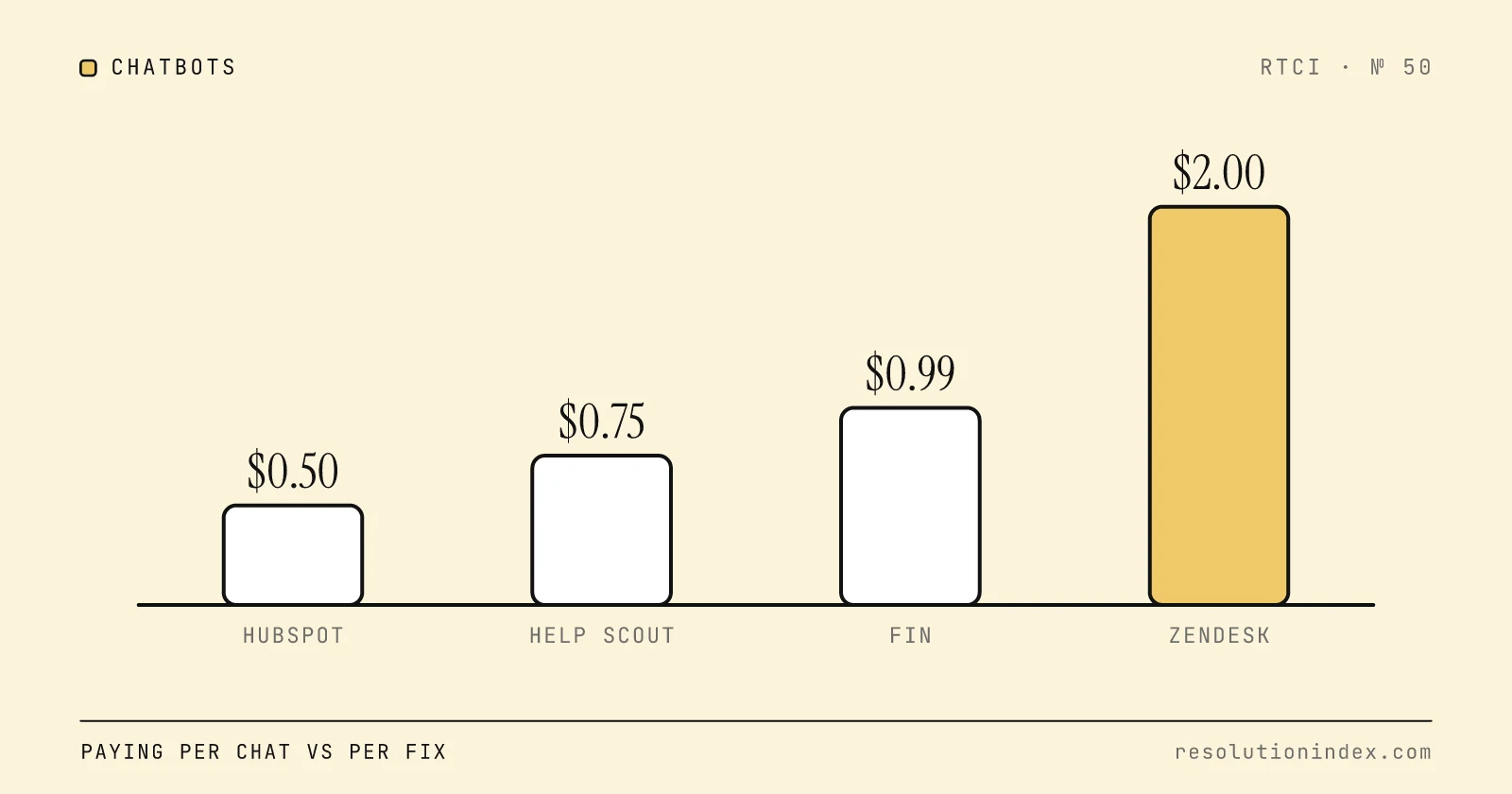
Per-resolution pricing ties the bill to outcomes, but each vendor defines the billable event. Intercom Fin charges $0.99 per outcome, once per conversation, with a 50-outcome monthly minimum when Fin runs on another helpdesk. An outcome is broader than a resolution: Procedure handoffs, disqualifications and self-serve routings are billed at $0.99 too.
Zendesk AI includes 5 automated resolutions per agent a month on Support Team and Suite Team and 10 on Suite Professional, then charges $1.50 per resolution at the committed rate or $2.00 pay-as-you-go. Only resolutions that pass Zendesk's own verification are billed (Zendesk pricing, checked Nov 17, 2026).
Every per-resolution contract should answer four questions. Does resolved require no human touch? What is the re-contact window, and is a resolution refunded if the customer comes back inside it? Are handoffs or escalations billed? What share of volume is the AI allowed to attempt?
Where does usage pricing surprise finance?
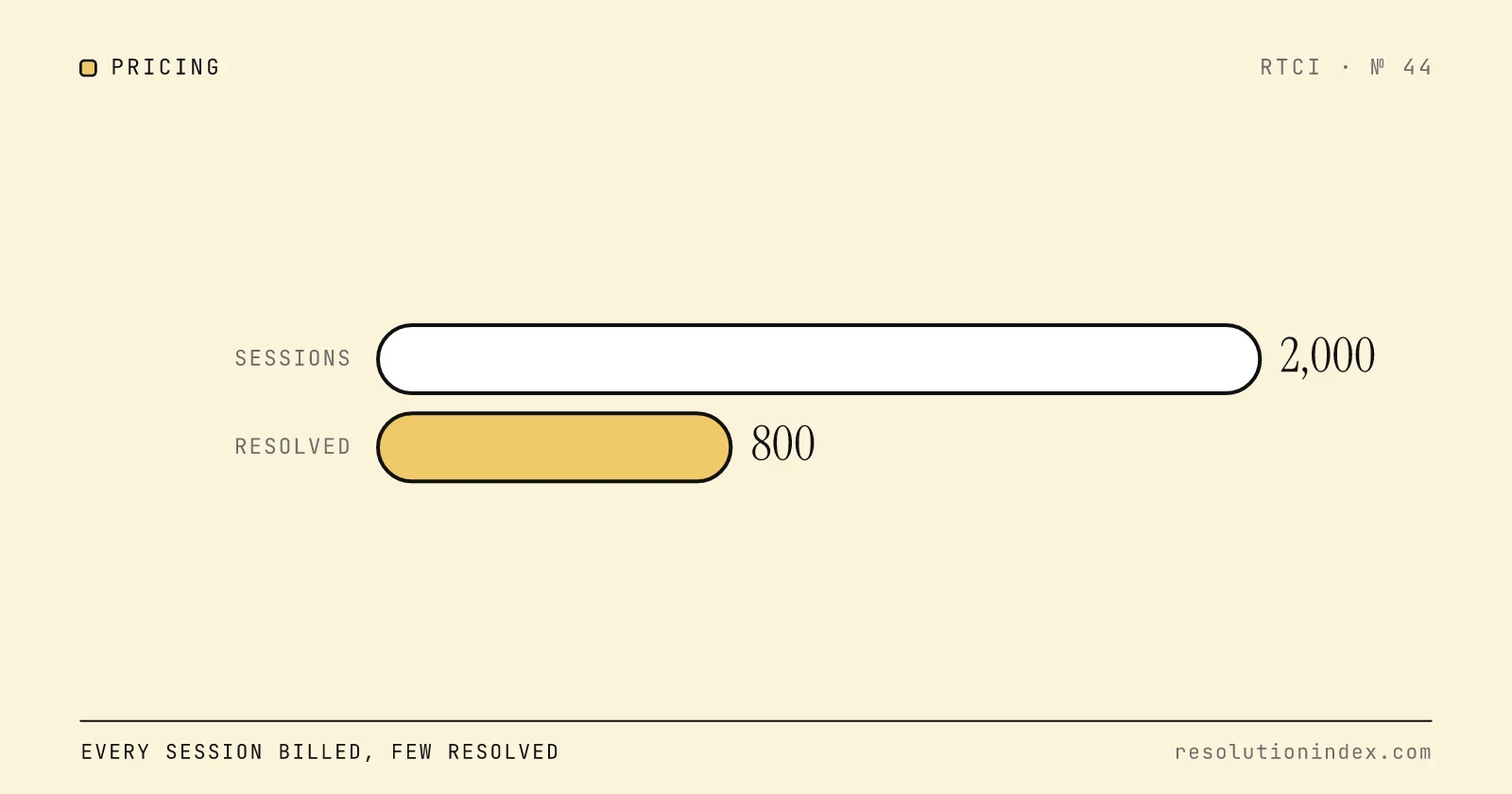
Usage pricing charges per session, conversation or credit, whether or not the AI resolves anything. Freshdesk Freddy's AI Agent includes 500 sessions once per account, then costs $49 per 100 sessions, or $0.49 each. Divided by RTCI's realistic 52–62% resolution rate, that is $0.79–$0.94 per resolution.
Kore.ai lists $0.20–$0.35 per session on AWS Marketplace, and third parties report a session is metered per 15 minutes of activity, so one long conversation can bill as several. Decagon is contract-priced: Quiq reports a platform floor of about $50,000 a year, and a per-conversation rate of about $0.99 has been reported.
Credit plans add a conversion step. YourGPT's plans include 10M, 30M or 100M credits a month; YourGPT states about 5,000 credits per conversation on a 1× model, so a GPT-4o conversation uses about 25,000. Extra credits cost $7 per 2M. A buyer who doesn't map credits to model choice and volume can't forecast the bill.
Volume spikes hit usage pricing hardest. Seats cap the cost; sessions and credits don't, unless the contract sets a cap or tiered overage rates.
Worked example: 10,000 conversations a month, four price cards
Assumptions: 10,000 conversations a month reach the AI, it resolves 50% (5,000), and 15% of those resolutions reopen within 72 hours, leaving 4,250 verified. The team has 20 agents. Human seat costs are listed separately and not included in the AI fee.
- Intercom Fin, per outcome. 5,000 resolutions × $0.99 = $4,950, or $1.16 per verified resolution. If 1,000 of the unresolved conversations also end in a billed Procedure handoff or routing, the bill is 6,000 × $0.99 = $5,940, or $1.40 per verified resolution.
- Zendesk AI, per automated resolution. 20 agents on Suite Professional include 200 resolutions. Assuming all 5,000 pass Zendesk's verification, (5,000 − 200) × $1.50 = $7,200, or $1.69 per verified resolution. Seats add 20 × $115 = $2,300.
- Freshdesk Freddy, per session. After the one-time 500, 10,000 × $0.49 = $4,900, or $1.15 per verified resolution. Seats on Pro add 20 × $55 = $1,100.
- YourGPT Advanced, flat plan. $349 a month covers 100M credits, about 4,000 GPT-4o conversations at 25,000 credits each. The other 6,000 need 150M credits, or 75 packs × $7 = $525. Total $874, or $0.21 per verified resolution.
This is not a ranking. It shows that one deployment produces very different invoices, and that billing for unresolved conversations (sessions, credits, handoff outcomes) is what moves cost per verified resolution. Change the resolution rate and the order changes: at 30% resolution, Freddy's $4,900 is spread over fewer resolutions while Fin's resolution-only bill falls.
How do escalations change each model?
Seat pricing: the escalation costs agent time on a seat you already pay for.
Per-resolution: Zendesk bills only verified resolutions, so an escalated ticket costs agent time only. Fin bills some handoffs as outcomes, so an escalation can cost $0.99 plus agent time.
Usage: the session or credits are spent before the handoff, so every escalation costs the AI fee plus agent time. RTCI's AI Escalation Cost Calculator adds the two.
How do you compare quotes side by side?
- Work out your current cost per human-resolved ticket, including fully loaded agent cost and tooling.
- Apply one definition of resolution to every quote: no human handoff, no same-issue re-contact within 72 hours.
- Model each price card at your volume and a realistic resolution rate, counting every billed unit, resolved or not.
- Add agent time on escalations, and any platform fee or minimum.
- Divide the total by verified resolutions.
RTCI's Cost per Verified Resolution Calculator runs steps 3 to 5. For SMB chatbots priced per conversation, session or resolution, see the AI chatbot for customer service cost guide.
Frequently asked questions
Which pricing model is cheapest for AI support? It depends on volume, resolution rate and how unresolved conversations are billed. In the worked example, the flat credit plan was cheapest and Zendesk's per-resolution card the most expensive, but a low resolution rate makes per-session and credit pricing costlier per resolution.
What is the biggest hidden cost? Paying for conversations that don't resolve: per-session fees, credits and billed handoff outcomes, followed by the agent who finishes the ticket.
Does per-resolution pricing mean I only pay when the AI succeeds? Not always. Zendesk bills verified resolutions only; Intercom Fin also bills Procedure handoffs, disqualifications and self-serve routings. Read the contract's outcome definition.
Should I sign a multi-year seat contract? Only if headcount is stable. If automation reduces the agents you need, you may be committed to seats you no longer use.
How do I compare quotes on different models? Convert every quote to cost per verified resolution with the same definition, re-contact window and escalation cost.
What should you ask for before signing?
A written definition of the billable event, the escalation billing rule, a volume cap or overage schedule, and a modelled cost per verified resolution at your volume. Then compare the result with seat-based alternatives in the Outcome-Based vs Seat-Based Pricing buyer guide.
Change log
- Corrected Zendesk's published $1.50–$2.00 per-resolution pricing and Freddy's one-time 500 sessions, rebuilt the worked example from index prices, removed the LinkedIn and Reddit summaries and the unsourced 20% escalation figure, and tightened copy.
- Published.
Read next
Keep reading
Picked for this article: the pieces it cites and the ones that answer the next question buyers usually ask.
Most related
Outcome-Based vs Seat-Based Pricing for AI Support: Which Model Should You Buy In 2026?
A buyer-side guide to choosing between outcome-based and seat-based AI support pricing in 2026, with current rates for Intercom Fin, Salesforce Agentforce, HubSpot Breeze, Zendesk AI and Freshdesk Freddy, a worked cost per verified resolution example, and a contract checklist.
AI Chatbot for Customer Service: What a Resolution Costs (2026)
AI chatbot for customer service prices compared on cost per resolution as of November 2026: per conversation vs per resolution billing, worked out.
Freshdesk Pricing 2026: Plans, Freddy AI Sessions, Real Costs
Freshdesk pricing as of November 2026: plans from $19 per agent, Freddy AI Agent at $49 per 100 sessions, and what each resolved conversation really costs.
Track Cost Per Resolution in Google Sheets
A copy-pasteable Google Sheets build for cost per verified resolution: a ticket log, a monthly cost sheet, a live dashboard, a budget-variance template and a worked example that shows why the vendor rate understates what you pay.
AI Support Cost Per Resolution by Industry (2026)
How fully loaded cost per verified resolution changes by industry, built from BLS wage data for customer service representatives, published AI pricing and stated assumptions you can replace with your own.