Published Nov 10, 2026 · Updated Nov 19, 2026 · 14 min read
AI Chatbot for Customer Service: What a Resolution Costs (2026)
AI chatbot for customer service prices compared on cost per resolution as of November 2026: per conversation vs per resolution billing, worked out.
 Written by Andrew Hall, Editor
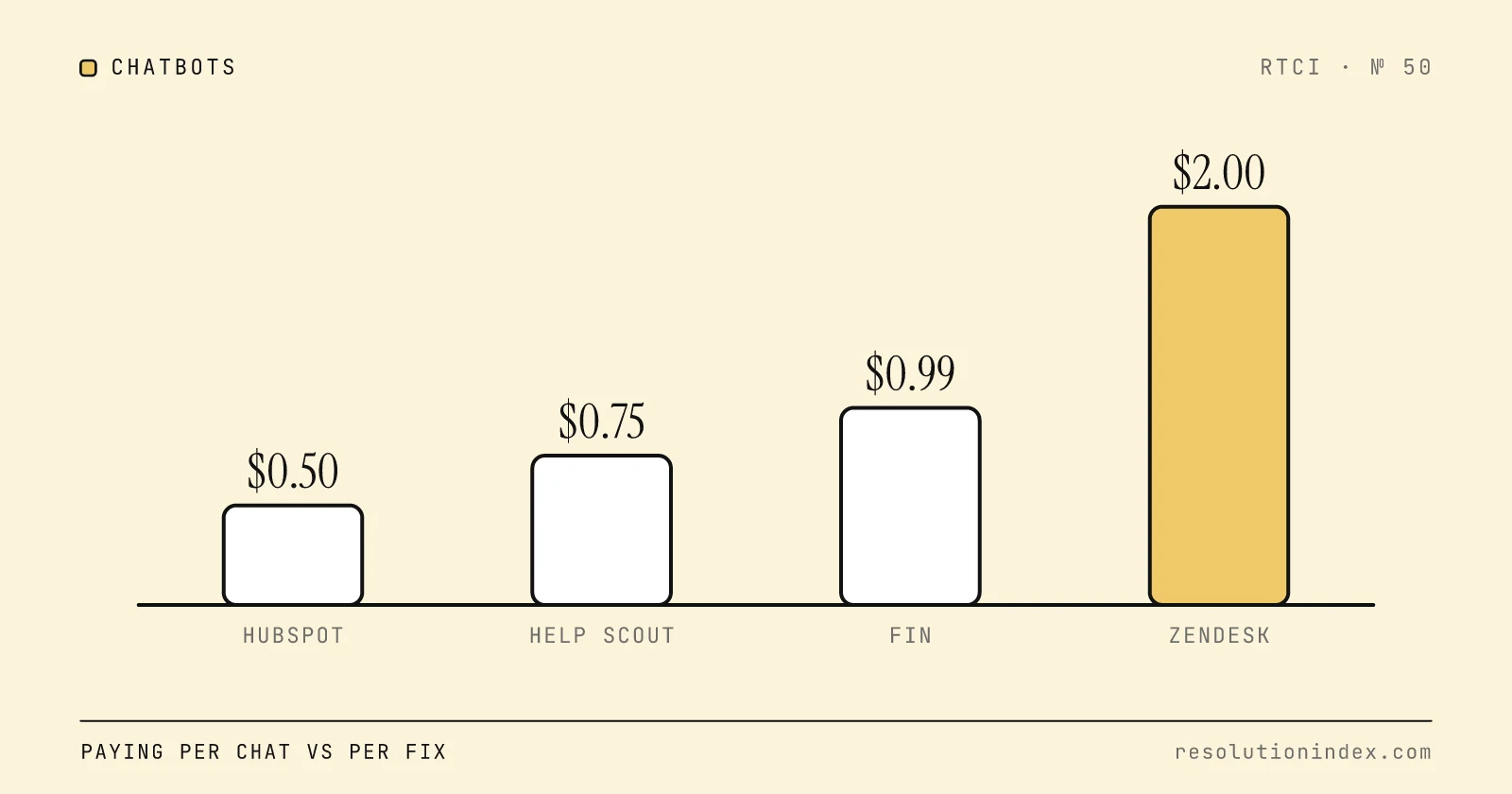
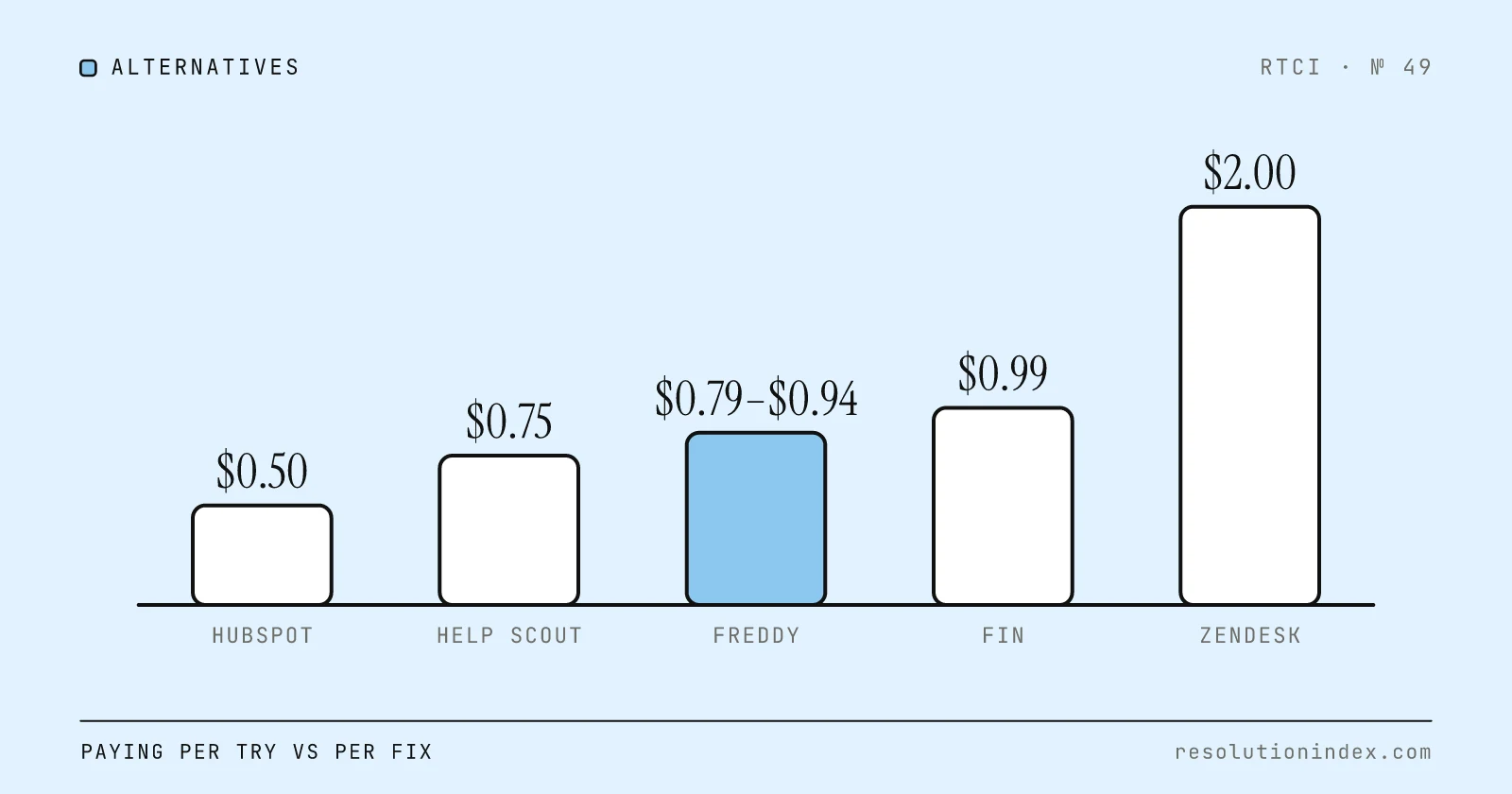
As of November 2026, what an AI chatbot for customer service costs depends on what it bills for. Tidio Lyro ($0.50 per conversation) and Freshdesk Freddy ($0.49 per session) charge whether or not the bot solves anything, about $0.77 to $1.18 per real resolution. HubSpot ($0.50) and Help Scout ($0.75) charge per resolution, and Intercom Fin $0.99 per outcome.
That gap is why plan prices on a vendor list tell you little. This guide puts seven bots on one unit, shows the resolution rate at which a per-conversation bot catches up, and works through a month of 1,000 chats, including the chats each bot leaves for your agents.
Key takeaways
- Tidio Lyro and Freshdesk Freddy bill every conversation or session, so a real resolution costs about $0.77 to $1.18 at RTCI's realistic rates.
- HubSpot and Help Scout bill per resolution at $0.50 and $0.75, and Intercom Fin bills $0.99 per outcome, as of November 2026.
- A per-conversation bot is cheaper per fix only when its resolution rate is above its price divided by the rival's price.
- The smallest AI bill often leaves the most chats for humans, so price the leftover work before you compare invoices.
What an AI chatbot for customer service bills you for
Start with the unit, not the price. The self-serve bots in this guide use five different billing units, and they do not measure the same thing.
Per conversation (Tidio Lyro). The Lyro page prices Lyro from $0.50 per conversation as of November 2026. A Lyro conversation is any customer interaction on a Tidio channel that gets at least one AI reply, and a chat the customer resumes later still counts once. Whether the problem was solved plays no part.
Per session (Freshdesk Freddy). The Freddy AI Agent sessions FAQ defines a session as all interactions between a customer and the AI agent, lasting up to 24 hours. For email, Freshdesk sets a 72-hour window from the customer's first message. Again, no outcome is required.
Per resolution (HubSpot, Help Scout, Zendesk). HubSpot bills when its agent provided support and the conversation was not handed to a human for 72 hours. Help Scout bills one resolution per conversation that its AI agent, Scout, closes without human help. Zendesk bills automated resolutions.
Per outcome (Intercom Fin). Fin bills once per conversation for any of five outcomes: resolution, procedure handoff, disqualification, self-serve routing and qualification. Some billed outcomes are therefore handoffs, not fixes.
Per automated interaction (Gorgias). Gorgias bills a request fully resolved without a human, but the count includes Flows, Quick Responses and Order Management as well as the AI Agent.
For budgeting, the split that matters is simpler. Conversations and sessions charge for misses. The other units mostly do not, though each vendor draws the line in a different place. For the general models behind these units, see how AI support pricing models compare.
AI customer service chatbots compared by cost per resolution
To compare bots that bill different units, divide a per-attempt price by the share of attempts that end in a real resolution. A per-result price stays as listed. All prices are list prices as of November 2026.
| Bot | Unit billed | Unresolved chats cost money | List price | Cost per real resolution | How derived |
|---|---|---|---|---|---|
| HubSpot Customer Agent | Resolution | No | $0.50 | $0.50 | List price; RTCI score 762 (Elite) |
| Help Scout Envoy | Resolution | No | $0.75 | $0.50 to $0.75 | List price, or less on prepaid resolutions |
| Tidio Lyro | Conversation | Yes | $0.50 to $0.78 | $0.77 to $1.18 | $0.50 ÷ 65% and $0.65 ÷ 55% |
| Freshdesk Freddy | Session | Yes | $0.49 | $0.79 to $0.94 | $0.49 ÷ 62% and ÷ 52% |
| Intercom Fin | Outcome | Procedure handoffs are billed | $0.99 | $0.99 | List price |
| Zendesk AI agents | Automated resolution | No | $2.00 pay-as-you-go | $1.50 to $2.00 | RTCI range; committed rate not shown in US dollars |
The derived rows use RTCI's realistic resolution rates: 52 to 62% for Freddy from RTCI's Freddy review, and 55 to 65% from the Tidio Lyro review. Fin's $0.99 is the figure on RTCI's Intercom Fin review.
The $0.78 figure is Tidio's entry rate on monthly billing. The Tidio pricing page lists Lyro at $39 a month for 50 conversations billed monthly ($32.50 a month billed annually, or $0.65 a conversation), and $39 ÷ 50 = $0.78.
A vendor's resolution is also not always a verified one. HubSpot's 72-hour rule is stricter than Fin's "no further help is requested" test, and Zendesk now grades its own. The cost per verified resolution framework shows how to audit the gap between a billed resolution and a real one.
When a per-conversation chatbot is cheaper: the break-even rate
Because Tidio and Freddy bill per attempt, there is a simple test. A per-attempt bot is cheaper per resolution than a per-result bot only if its resolution rate is above its own price divided by the rival's price.
| Versus | Their price per result | Tidio at $0.50 must resolve | Tidio at $0.78 must resolve | Freddy at $0.49 must resolve |
|---|---|---|---|---|
| Zendesk pay-as-you-go | $2.00 | 25% | 39% | 24.5% |
| Intercom Fin, list | $0.99 | 50.5% | 78.8% | 49.5% |
| Gorgias, annual AI fee (plus a ticket) | $0.90 | 55.6% | 86.7% | 54.4% |
| Help Scout | $0.75 | 66.7% | Not reachable | 65.3% |
| HubSpot | $0.50 | 100% | Not reachable | 98% |
Set against RTCI's realistic ranges (55 to 65% for Tidio, 52 to 62% for Freddy), both clear the Zendesk line across their ranges and both clear the Fin list line, except Tidio at the $0.78 monthly rate. Both sit around the Gorgias line at $0.50 and $0.49, and fall short of Help Scout and HubSpot.
Treat this as arithmetic on list prices, not a quality verdict. A bot that loses on price can still win if it resolves the questions your agents find slowest.
To run it on your own data, divide last month's chats closed without a human by the conversations or sessions you were billed, then compare the result with the right column.
What 1,000 chats a month costs on each bot
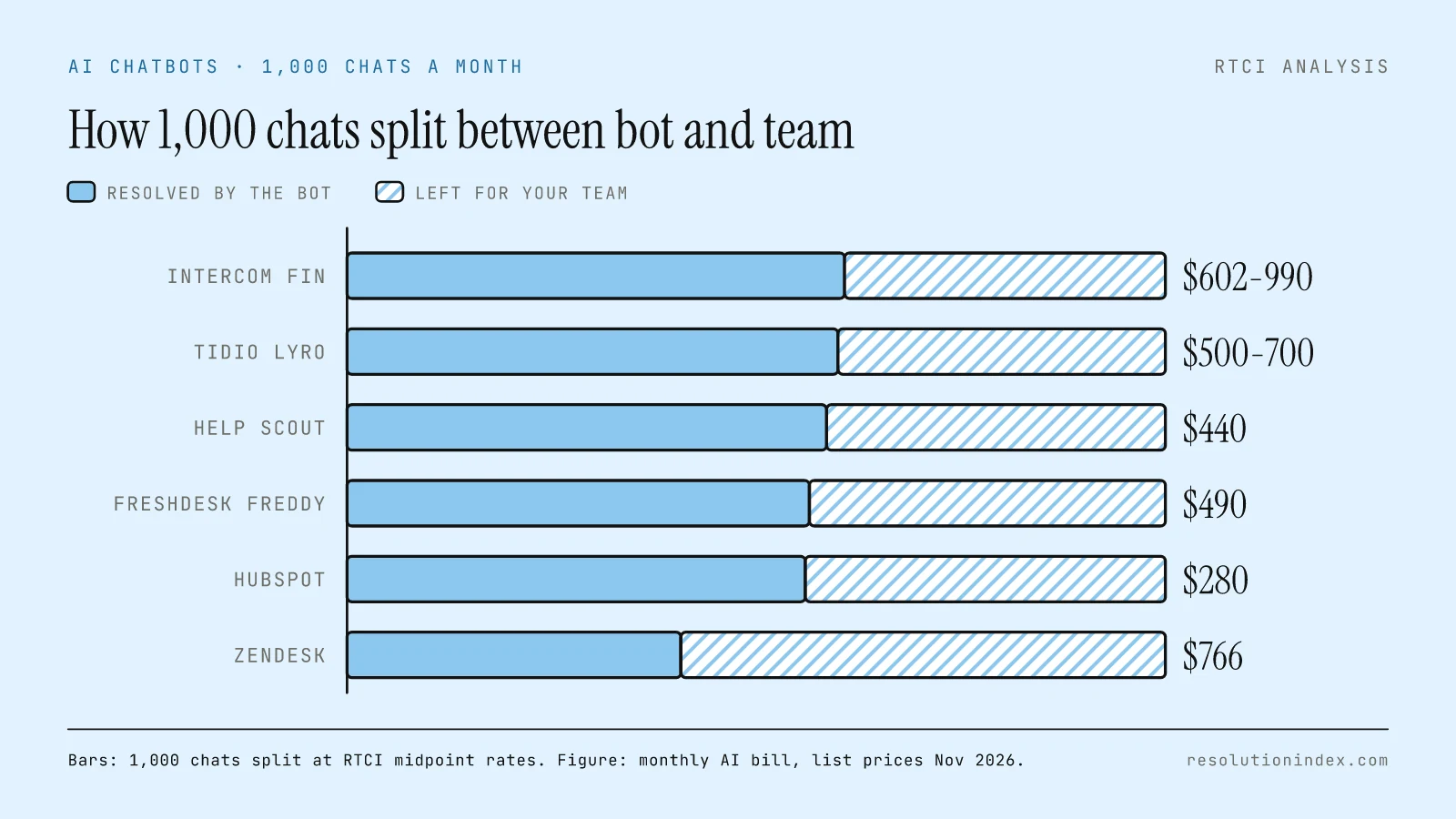
Take a 5-agent team that sends 1,000 chats a month to its AI. The figures use list prices as of November 2026 and the midpoint of RTCI's realistic resolution range for each bot. The volume stays inside Tidio's public Lyro limits, which run up to 1,000 conversations a month.
| Bot | Billed AI units | AI bill | Resolved | Left for humans | AI cost per resolution | Seats or plan, 5 agents |
|---|---|---|---|---|---|---|
| Tidio Lyro | 1,000 conversations | $500 to $700 | 600 (60%) | 400 | $0.83 to $1.17 | Priced by human conversations; not totalled |
| Freshdesk Freddy, Growth | 1,000 sessions (10 packs) | $490 | 565 (56.5%) | 435 | $0.87 | $95 (5 × $19) |
| Help Scout, Standard | 586 resolutions | $439.50 | 586 (58.6%) | 414 | $0.75 | $125 (5 × $25) |
| HubSpot, Service Hub Pro | 560 resolutions | $280 | 560 (56%) | 440 | $0.50 | $450 (5 × $90), plus $1,500 onboarding once |
| Intercom Fin, Essential | 608 to 1,000 outcomes | $601.92 to $990 | 608 (60.8%) | 392 | $0.99 to $1.63 | $95 to $145 (5 × $19 or $29) |
| Zendesk, Support Team | 383 after 25 included | $766 | 408 (40.8%) | 592 | $1.88 | $95 (5 × $19) |
Added to the seats, the monthly totals are $564.50 for Help Scout ($125 + $439.50), $585 for Freddy ($95 + $490), $730 for HubSpot ($450 + $280, before onboarding), $696.92 to $1,135 for Fin ($95 + $601.92 and $145 + $990) and $861 for Zendesk ($95 + $766).
Now look at the fifth column. Help Scout's bill is the smallest, and it leaves 725 chats for your agents, against 400 on Fin. Those 325 extra chats are human work you still pay for, so a cheaper AI line can be the more expensive month.
A few rows rest on assumptions. Freddy assumes the 500 free sessions are used and each chat is one session. Help Scout new accounts pay nothing for AI resolutions in their first 3 months. Zendesk's 25 included resolutions are 5 per agent on Support Team, and $766 ÷ 408 = $1.88.
Fin's upper figure assumes every one of the 1,000 chats ends in a billed outcome, handoffs included, because Fin bills at most one outcome per conversation: $990 ÷ 608 = $1.63 per real resolution. The $700 figure is the 1,000-conversation tier in Tidio's pricing calculator on monthly billing, and $500 applies the Lyro page's $0.50 rate, so confirm that row at checkout.
The chatbots one by one
Each bot below gets the unit, the price, the plan it sits on, who it fits and one limit. Prices are as of November 2026.
Tidio Lyro. Tidio Starter costs $29 a month ($24.17 billed annually) with 100 billable human conversations and 50 one-off Lyro conversations. Lyro starts at $39 a month for 50 ($32.50 billed annually), and monthly limits go up to 1,000 before a 1,000+ option. Premium mentions pay-per-resolution billing but shows "Contact for pricing", so that rate is not published.
Tidio suits small websites and stores adding their first chat widget. RTCI rates Lyro Strong (RTCI score 697) at a realistic 55 to 65%. The limit is the unit: because every chat with an AI reply is billed, its cost per resolution rises with every chat it does not solve.
Freshdesk Freddy. The Freshdesk pricing page lists Growth at $19, Pro at $55 and Enterprise at $89 per agent per month billed annually, with Freddy AI Agent sessions at $49 per 100 on each. Each account gets 500 free sessions once. Freddy AI Copilot is a separate $29 per agent on Pro and Enterprise.
Packs expire at the end of the billing cycle and unused sessions do not carry over. Buying a paid pack also replaces whatever is left of the free allotment. RTCI rates Freddy Strong (RTCI score 703) at 52 to 62%, and the Freshdesk alternatives guide runs the same break-even against seven rivals.
HubSpot Customer Agent. The Customer Agent page lists $0.50 per resolution and says the agent is available to Professional and Enterprise subscriptions and runs on HubSpot Credits. The Service Hub pricing page shows Professional at $90 per seat on an annual commitment or $100 monthly, with 3,000 credits and a required $1,500 one-time onboarding.
Enterprise starts at $150 per seat with $3,500 onboarding. Buying one Professional or Enterprise seat gives 14 days of Customer Agent free. RTCI rates HubSpot Breeze Elite (RTCI score 762) at a realistic 51 to 61%, so read its $0.50 as a price beside a Pro-seat floor.
Help Scout Envoy. The Help Scout pricing page lists $0.75 per resolution, billed monthly and charged once per conversation. Plans run Standard $25, Plus $45 and Pro $75 per user per month, with Pro at a minimum of 10 users. New accounts get 3 months of unlimited AI resolutions free, and a monthly spend cap switches Scout off once reached.
Help Scout mentions prepaid discounts without amounts. It suits email-first teams that want a predictable bill. RTCI's Help Scout AI review puts its realistic rate at 54 to 64% and rates it Strong (RTCI score 744).
Intercom Fin. Fin's pricing page lists $0.99 per outcome, one outcome per conversation, with qualifications at $9.99. On another helpdesk there is a 50-outcome monthly minimum. On Intercom, Fin sits on helpdesk seats: the Intercom pricing page shows Essential at $29 per seat with $19 for new customers, Advanced at $85 and Expert at $132.
A 14-day trial includes unlimited outcomes. RTCI rates Fin Strong (RTCI score 696) at a realistic 56 to 66%, the highest range among the bots in the table. The limit is the outcome unit itself, because procedure handoffs are billed too.
Zendesk AI agents. The Zendesk pricing page, in US dollars, lists Support Team at $19, Suite Team at $55 and Suite Professional at $115 per agent per month billed annually. AI agents are included in every Suite and Support plan, with 5, 5 and 10 automated resolutions per agent per month, then $2.00 each on pay-as-you-go.
Committed extra resolutions cost $1.50 each. Zendesk's help article about automated resolution tiers describes three tiers since May 18, 2026, with an LLM check for verified resolutions, but lists no tier prices. RTCI rates Zendesk AI Moderate (RTCI score 592) at 36 to 46%.
YourGPT. The YourGPT pricing page lists Essential at $39, Professional at $79 and Advanced at $349 per month billed annually, with 10 million, 30 million and 100 million AI credits, billed by credits used rather than per resolution. YourGPT resolved 90% in RTCI's November 2026 test, at an estimated ~$0.13 per resolution on Advanced at about 3,000 conversations a month (RTCI score 960, Elite).
If you sell on Shopify: Gorgias
Gorgias is built for ecommerce, so it sits outside the general table. The Gorgias pricing page sells plans by ticket volume: Starter $10 monthly for 50 tickets, Basic $50 annual or $60 monthly for 300, Pro $300 or $360 for 2,000, and Advanced $750 or $900 for 5,000.
AI Agent interactions cost $0.90 each on annual plans and $1.00 on monthly plans, and each one also counts as a billable helpdesk ticket. Pro's allowance is 190 automated interactions, with $1.50 for each one above it. If a human agent replies within 72 hours of an AI resolution, it is billed only as a helpdesk ticket instead.
On the same 1,000 chats, Pro annual at RTCI's 31.9% midpoint gives 319 automated interactions: 190 at $0.90 ($171) and 129 at $1.50 ($193.50). That is $364.50 in AI fees, or $1.14 per automated interaction, and $664.50 a month with the $300 plan, with 681 chats left for humans. The tickets stay inside Pro's 2,000 only if the store's other tickets stay under 1,000.
RTCI's Gorgias AI review rates it Moderate (RTCI score 636) at a realistic 27 to 37%. Two cautions: Flows and Quick Responses also count as automated interactions, and the page data also lists Pro at $471 a month, which matches $300 plus the 190 included interactions at $0.90, so confirm on your order form how the allowance is charged.
Which chatbot fits which team
The cheapest unit is rarely the deciding factor. Where your tickets already live usually is.
| Your situation | Start by pricing | Why |
|---|---|---|
| Already on Zendesk | Zendesk AI agents | Included in every plan, with 5 to 10 resolutions per agent each month |
| Already on Freshdesk | Freddy, then Fin on Freshdesk | Freddy is native; Fin runs on top with no migration |
| HubSpot CRM on Service Hub Pro | Customer Agent | $0.50 per resolution once the Pro seats are paid |
| Small website, small budget | Tidio Lyro, Help Scout | Low plan floors and free starting allowances |
| Shopify store | Gorgias, Tidio | Ecommerce plans and order-aware automation |
| High volume, complex questions | Intercom Fin | Highest realistic range among the bots in the comparison table |
The Freshdesk route has a detail worth knowing. The Fin for Freshdesk page says no migration is needed and that Fin works with Freshdesk tickets, contacts and Freshchat, with "minimum commitments" that the page does not size.
AI chatbot for small business: free and low-cost starting points
For an AI chatbot for small business, the free allowances are enough to test, not to run. As of November 2026:
- Tidio: the first 50 Lyro conversations are free for life, on any plan including the $0 Free plan.
- Freshdesk: 500 Freddy sessions once per account on Growth, Pro or Enterprise, ending early if you buy a pack.
- Help Scout: a free plan for 5 users, 1 inbox and 1 Docs site, and 3 months of unlimited AI resolutions for new accounts.
- Zendesk: 5 included automated resolutions per agent per month from Support Team at $19.
- Gorgias: Starter at $10 a month (monthly billing only), with an allowance of 30 automated AI interactions at $1.00 each.
Use the free period to measure one number: the share of chats the bot closes without a human. That figure decides every row of the break-even table, and no vendor page can give it to you.
Chatbot or AI agent: where the line sits
Most bots in this guide answer questions from your help content. Some can also take actions, such as looking up an order or running a configured procedure, and that changes what you need to govern.
If the bot must issue refunds, change orders or edit accounts, you are buying an agent, with approvals and audit logs to match. The line is drawn in detail in AI support agents vs chatbots.
Customer service chatbot software checklist before you buy
Customer service chatbot software contracts differ most in the small print. Get each of these in writing from the vendor.
- What triggers a charge, and whether an unresolved chat counts.
- How long the window is: 24 or 72 hours for Freddy sessions, 72 hours before HubSpot or Gorgias treats a human reply as cancelling the AI result.
- The overage rate: Gorgias moves from $0.90 to $1.50 above the allowance, and Zendesk's committed rate differs from pay-as-you-go.
- Whether there is a spend cap, as Help Scout offers, and what happens to chats once it is reached.
- When the free allowance ends, and whether buying a pack cancels it.
- The minimum: Fin's 50 outcomes a month on other helpdesks, or HubSpot's Pro seats and onboarding.
- How the handoff to a human works, and whether one chat can be billed by both the bot and the helpdesk.
When an AI chatbot is the wrong buy
An artificial intelligence customer service chatbot is not always worth it. Three situations argue against one.
Low volume. If a team handles a few hundred chats a month, the AI bill is small, but so is the saving, and setup and content upkeep take the same effort at any volume.
Thin help content. Every bot here answers from your articles and past replies. If those are out of date, the resolution rate falls, and per-conversation pricing turns every failed chat into cost.
Action-heavy requests. If most tickets need a refund, a change or an account edit, an answer-only chatbot will hand most of them off.
The numbers here have limits too. They are list prices before discounts. RTCI's realistic rates are estimates for a typical deployment, and your ticket mix and content will move them more than any price change. Each vendor defines its unit differently, so a $0.75 resolution and a $0.99 outcome are close, not identical.
The decision rule
Pick the unit before the vendor. If you can measure a resolution rate above the break-even line, a per-conversation bot is the cheaper choice. If you cannot measure it yet, start on per-resolution pricing, use the free allowance to get the number, then compare.
Before you sign, put your own chat volume, seats and resolution rate into the cost per verified resolution calculator and compare the monthly totals, including the chats left for your team.
How RTCI calculates these numbers
- Realistic resolution rate. Each vendor’s published claim is discounted by one fixed rule for every vendor, with an extra discount when the figure measures deflection rather than resolution.
- Cost per resolution. Per-session and per-conversation prices are divided by that realistic rate, because failed attempts are billed too. Mandatory platform fees are spread over 2,000 to 4,000 resolutions a month.
- Prices. Every price links to the vendor’s own page as of the date shown. Costs marked ~ or est. are RTCI estimates for vendors that publish no per-unit price.
Frequently asked questions
What is the best AI chatbot for customer service?
It depends on your helpdesk and volume. On Zendesk or Freshdesk, start with the AI built in, or add Fin on top. HubSpot Pro teams can use Customer Agent. Small websites usually compare Tidio Lyro and Help Scout, and Shopify stores compare Gorgias. Rank the shortlist on cost per real resolution, not the headline price.
Is there a free AI chatbot for customer service?
There are free starts, not free volume. As of November 2026, Tidio gives 50 Lyro conversations for life, Freshdesk gives 500 Freddy sessions once per account, Help Scout gives new accounts 3 months of unlimited AI resolutions, and Zendesk includes 5 automated resolutions per agent each month on Support Team. After that, every bot charges per unit.
How much does a customer service chatbot cost?
As of November 2026, list prices run from $0.49 per Freddy session to $2.00 per Zendesk pay-as-you-go resolution. Per real resolution, that is about $0.50 to $2.00 across the bots compared here, plus seats or a plan. For 1,000 AI chats a month, the AI line alone ran from $280 on HubSpot to $990 on Fin if every chat ends in a billed outcome.
Do you pay for conversations the chatbot does not resolve?
On per-conversation and per-session pricing, yes. Tidio counts any chat with at least one AI reply, and Freddy counts every session. HubSpot, Help Scout and Zendesk charge only for resolutions. Fin charges per outcome, which includes procedure handoffs, and Gorgias counts Flows and other automation as well as its AI Agent.
What does "resolution" mean in chatbot pricing?
Each vendor writes its own definition. HubSpot counts a resolution when the conversation is not handed to a human for 72 hours. Help Scout bills one per conversation resolved without human help. Zendesk splits automated resolutions into three tiers, with an LLM check for the verified tier. Fin bills an outcome, which is broader.
Can I add an AI chatbot to my existing helpdesk?
Usually, yes. Zendesk includes AI agents in every Suite and Support plan, and Freshdesk sells Freddy sessions on its paid plans. Fin runs on top of Freshdesk, Salesforce, HubSpot and similar helpdesks at $0.99 per outcome, with a 50-outcome monthly minimum and no migration, as of November 2026.
Change log
- RTCI scores for HubSpot Breeze and YourGPT corrected to the current 0–1,000 index (762 and 960).
- RTCI scores updated to the current 0–1,000 index.
- Published.
Read next
Keep reading
Picked for this article: the pieces it cites and the ones that answer the next question buyers usually ask.
Most related
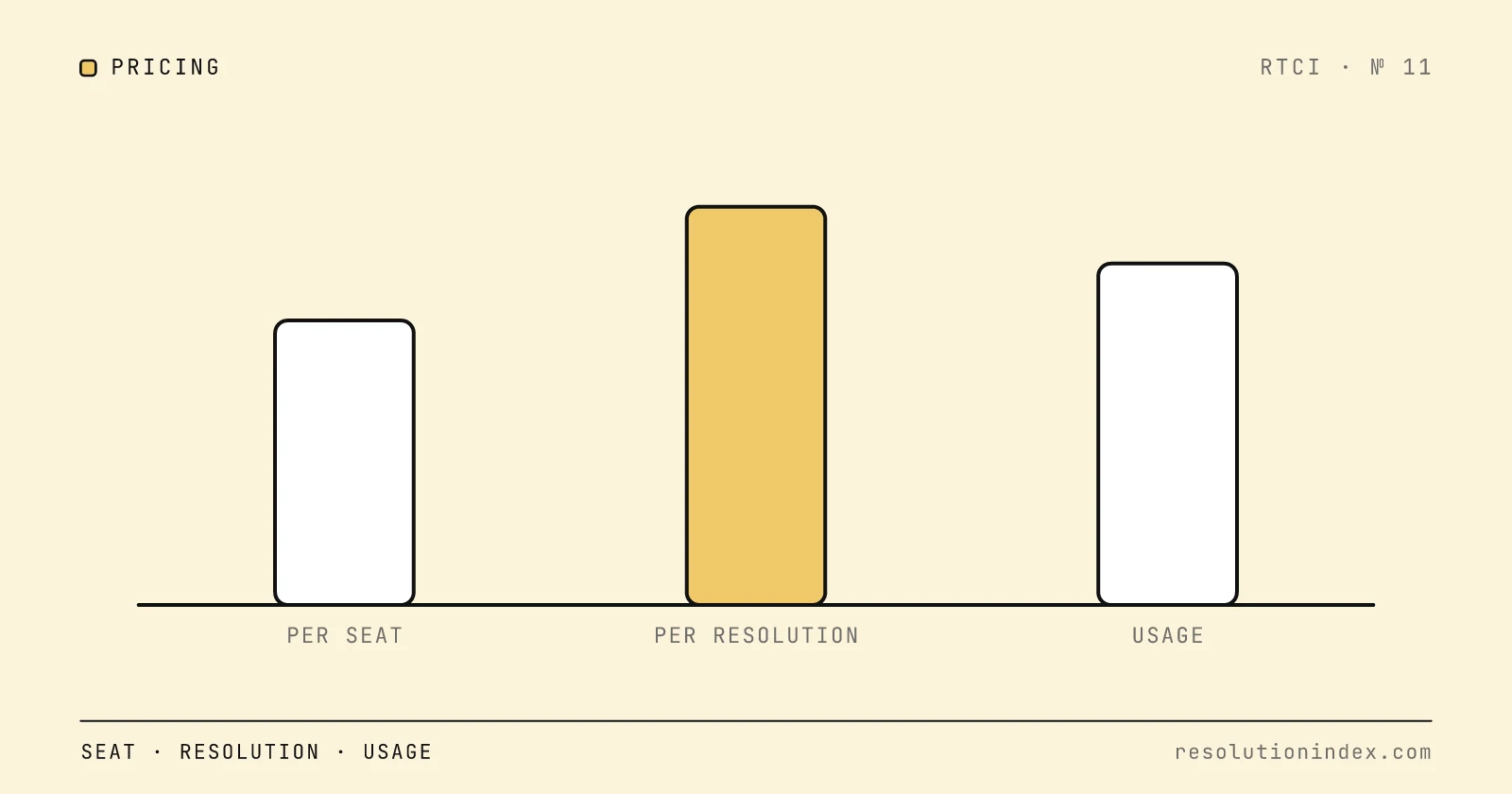
AI Customer Support Pricing Models Compared: Per-Seat, Per-Resolution, and Usage
AI support vendors price by seat, by resolution or by usage. A worked example at 10,000 conversations a month shows the same 5,000 resolutions costing $874 to $7,200 depending on the price card.
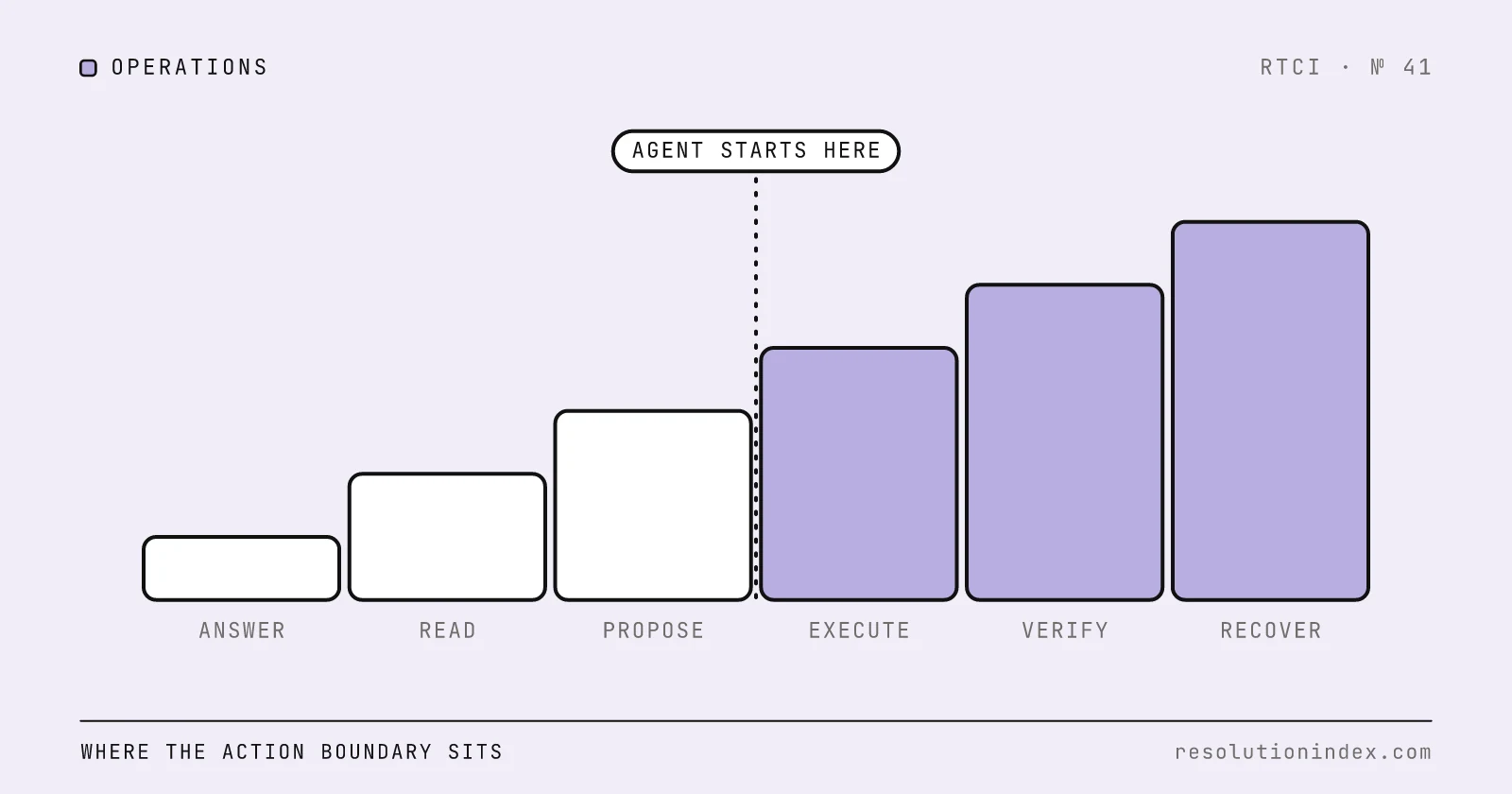
AI Customer Support Agents vs Chatbots: What Changes Operationally?
An AI support agent can execute controlled actions in your systems; a chatbot answers. Use this boundary matrix and paired transcript to set approvals, logs, and resolution metrics.
Freshdesk Alternatives 2026: 7 Compared on AI Cost per Resolution
Seven Freshdesk alternatives and competitors compared on what an AI resolution costs as of November 2026, against Freddy's $0.49 per session, with a break-even rate and a worked month for a 10-agent team.
Cost Per Verified Resolution: A New Framework
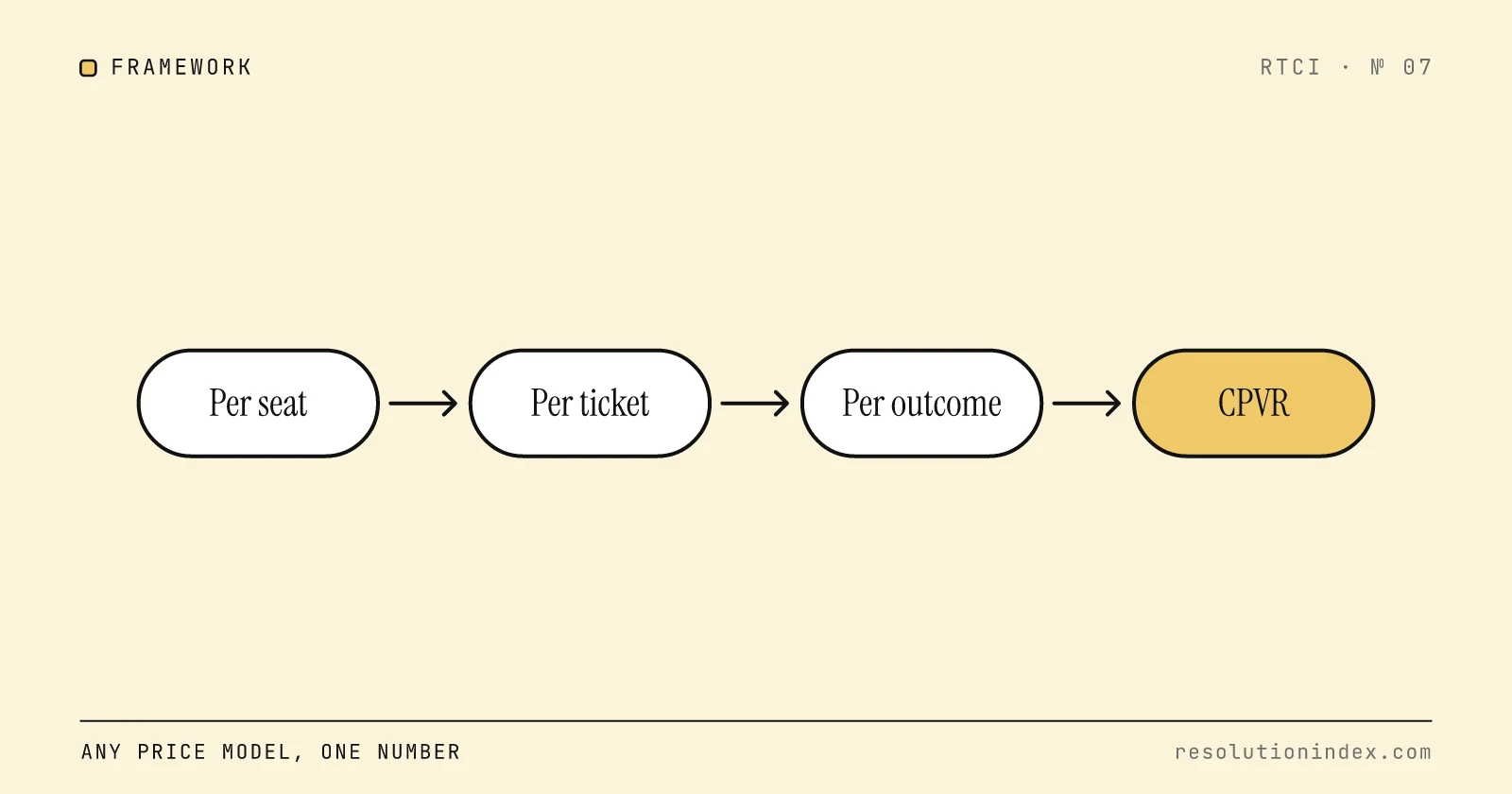
Per-seat, per-ticket, and per-resolution pricing models all produce different numbers for the same underlying cost. RTCI's three-layer cost model normalizes any vendor's pricing into a single comparable metric: cost per verified resolution.
Decagon Pricing 2026: What It Costs, Reviews and Alternatives
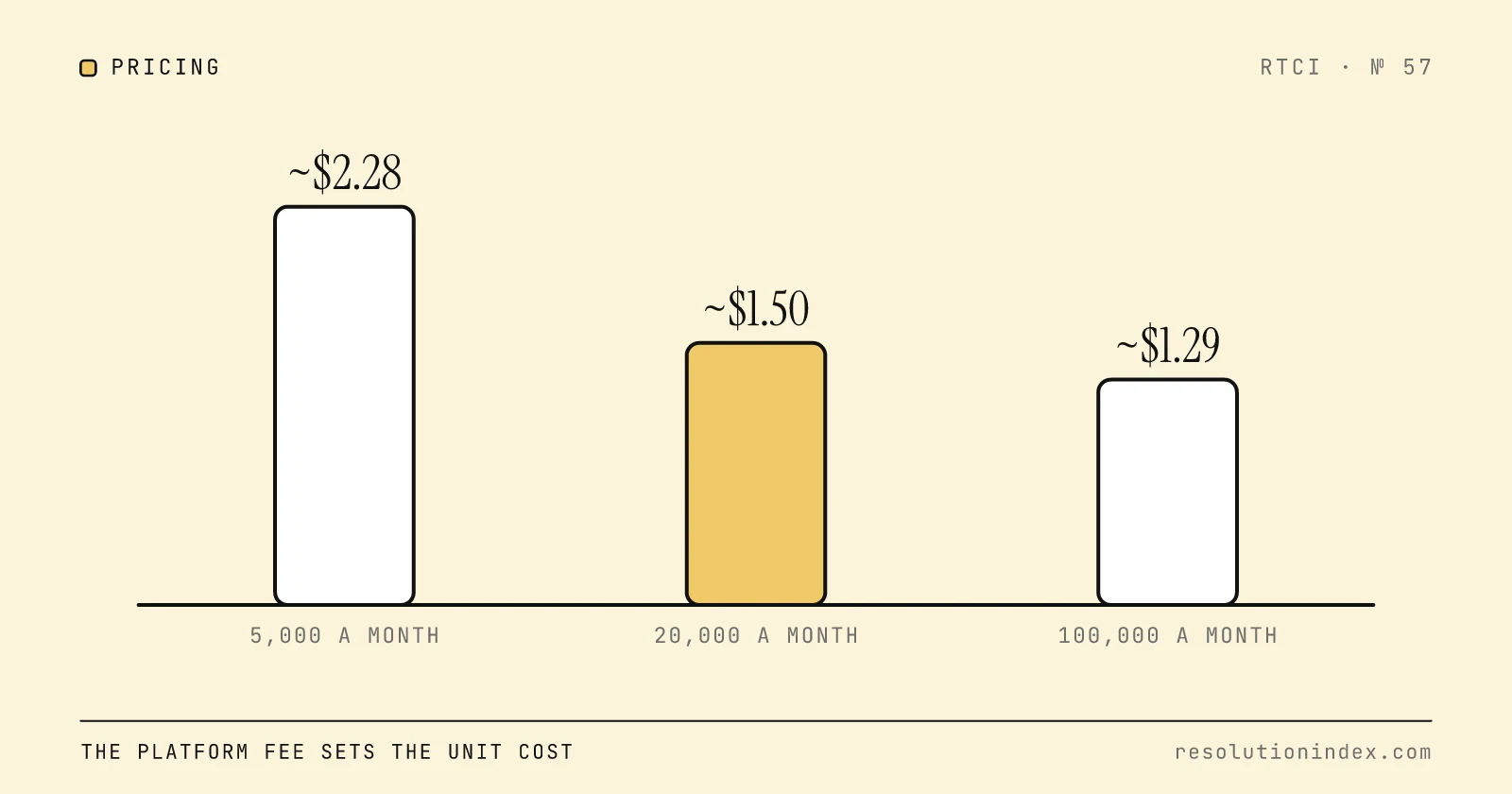
Decagon publishes no prices. What its own pricing article says about per-conversation and per-resolution billing, RTCI's ~$1.50 per resolution estimate with the inputs shown, the cost at 5,000, 20,000 and 100,000 conversations a month, what to ask for in a quote, and the enterprise alternatives ranked on RTCI score.