Nov 13, 2026 · 11 min read
The Net Promoter Score Question: Exact Wording for Support Teams, With AI-Resolved and Human Tickets
The standard NPS question and follow-up quoted from the source, how to word post-ticket NPS when a bot or a person handled the conversation, when to send it, and how many responses each group needs before a gap means anything.
 Written by Andrew Hall, Editor
The net promoter score question is "How likely are you to recommend us to a friend or colleague?", answered on a 0 to 10 scale, per Bain's Net Promoter System site as of November 2026. The standard follow-up is "What's the primary reason for your score?" After a support conversation, keep the question about the company, send it when the ticket closes, and tag each response AI-resolved or human-handled.
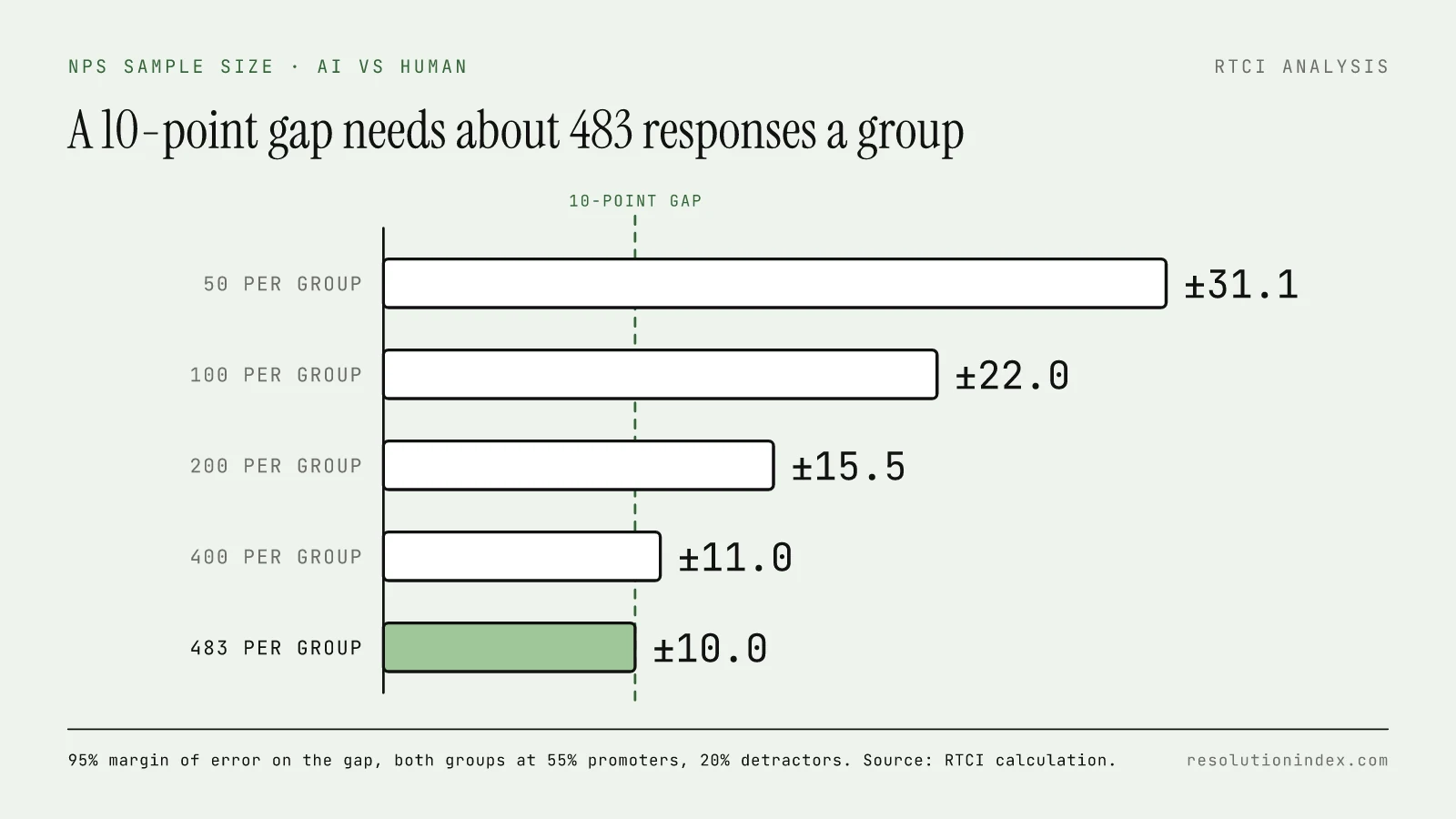
Then be careful reading the split. At a mix of 55% promoters and 20% detractors, one group needs 242 responses for a margin of ±10 points, and a 10-point gap between AI-resolved and human-handled NPS needs about 483 responses in each group before it stands out from noise.
Key takeaways
- The standard question asks how likely the customer is to recommend the company to a friend or colleague, on a 0 to 10 scale.
- Bain's follow-up asks for the primary reason for the score; in 2019 Reichheld endorsed a third question for promoters and passives.
- Qualtrics publishes post-contact NPS guidance and also advises against transactional NPS, so pair post-ticket NPS with CES or CSAT.
- At 200 responses per group, an AI-versus-human NPS gap must exceed 15.5 points before it is distinguishable from noise.
The standard NPS question, word for word
The Net Promoter System page gives one question, a zero-to-ten scale and three groups. Promoters score 9 or 10, passives 7 or 8, and detractors 0 to 6. The score is the percentage of promoters minus the percentage of detractors, so it runs from minus 100 to plus 100.
The metric dates from Frederick Reichheld's December 2003 Harvard Business Review article, The One Number You Need to Grow. Official and vendor sources word the question slightly differently, as of November 2026:
| Source | Question wording | Scale |
|---|---|---|
| Bain, Net Promoter System site | "How likely are you to recommend us to a friend or colleague?" | 0 to 10 |
| Fred Reichheld, 2019 | "How likely are you to recommend our [service, product, or company] to a friend?" | 0 to 10 |
| Reichheld and Markey book excerpt, bain.com | "On a zero-to-ten scale, how likely is it that you would recommend us (or this product/service/brand) to a friend or colleague?" | Stated in the question |
| Qualtrics | "How likely is it that you would recommend [Organization X/Product Y/Service Z] to a friend or colleague?" | 0 not at all likely, 10 extremely likely |
| SurveyMonkey | "How likely are you to recommend our product/service to a friend or colleague?" | 0 to 10 |
The differences are small: "you" against "is it that you would", and the object of the recommendation. Pick one wording and freeze it. Every trend line and every AI-versus-human comparison assumes the same words went to everyone.
Keep the 11-point scale too. The promoter, passive and detractor cut-offs are defined on 0 to 10, so a 1 to 5 or 1 to 10 scale produces a number that cannot be compared with any NPS, including your own history.
One housekeeping point for anything you publish: Bain's measuring page states that Net Promoter, NPS and Net Promoter System are registered trademarks of Bain & Company, NICE Systems and Fred Reichheld.
For the origin story in the authors' own words, Bain's archive channel carries a short film on how the score came about.
The NPS follow-up question, and the third question
The score tells you how many customers would recommend you. It never tells you why, which is the part a support team can act on.
In a July 30, 2019 article on the Net Promoter System site, Reichheld describes the classic survey as two questions: the recommend question and "What's the primary reason for your score?" Bain's excerpt from Reichheld and Markey's 2011 book, listed in the table above, gives the same follow-up as "What is the primary reason for your score?"
The same 2019 article describes a third question, added by his daughter Jenny and now called the Jenny Question by Reichheld: "Is there anything we could have done to make your experience more exceptional?" It goes only to customers who scored 9 or 10 and 7 or 8.
In RTCI's view, that third question earns its place in support. A promoter or passive may have had the problem fixed but still noticed friction, such as a repeated identity check or a slow handoff. Send detractors the open "primary reason" box and a callback offer instead.
SurveyMonkey's NPS guide advises leaving open-ended follow-ups optional, because mandatory questions take longer and not everyone wants to write feedback. Keep the score required and the text optional.
Relationship NPS vs transactional NPS
Before wording a post-ticket survey, decide which NPS you are running. The two types use the same question but answer different questions about the business.
| Relationship NPS | Transactional NPS | |
|---|---|---|
| What it asks about | The company overall | The company, right after one interaction |
| Trigger | A schedule, no event | A ticket, call, chat or purchase |
| Cadence | Annual, six-monthly or quarterly (Qualtrics); at least quarterly (SurveyMonkey) | Every eligible interaction, with suppression rules |
| Who acts on it | Leadership, product, account teams | Support leads, QA, team managers |
The definitions come from Qualtrics' article on transactional vs relational NPS, dated January 9, 2021. It calls it common practice to send an NPS question to customers immediately after they contact the contact center, and says transactional data is usually more actionable than relational data.
Qualtrics also says the opposite. Its main Net Promoter Score guide, dated January 1, 2026, states "we don't recommend using NPS on a transactional basis", because NPS measures an overall relationship and asking too soon or about too small an interaction risks annoying customers.
Both pages are live as of November 2026. Read together, they mark the real trade-off: post-ticket NPS is actionable but noisy, and it mixes how the customer feels about this contact with how they feel about everything else.
SurveyMonkey's transactional NPS page, dated September 23, 2026, takes the other side and suggests asking how likely customers are to promote the business after their most recent purchase or customer service call.
The practical answer for support teams is to run post-ticket NPS beside a contact-level measure, not instead of one. A Customer Effort Score for AI support tells you whether this conversation was easy; NPS tells you whether the relationship survived it.
Post-ticket NPS wording for AI-resolved and human-handled conversations
This section covers the case a team running AI on part of its queue has to solve. The goal is one survey that lets you compare customers whose tickets an AI agent resolved with customers a person helped. That only works if the only difference between the groups is who handled the ticket.
The rules below are RTCI's recommendations for that comparison, built on the sources above.
| Do | Do not | Why |
|---|---|---|
| Ask about the company: "How likely are you to recommend [Company] to a friend or colleague?" | Ask "How likely are you to recommend our chatbot" or name the agent | Recommending a bot or a person is not the NPS question, and the two groups would answer different questions |
| Use the identical question, scale and follow-ups for both groups | Send a shorter survey after AI conversations | Any wording difference becomes part of the gap you measure |
| Add one optional contact-level line, such as "How easy was it to get your issue handled today?" | Fold the contact rating into the NPS question | Keeps NPS comparable with your relationship survey |
| Send after the ticket closes | Send while the customer is still waiting on a fix | A detractor score caused by an open issue measures the backlog, not the handling |
| Pass the routing data as hidden fields | Ask the customer whether they spoke to a bot | The routing record is more reliable than the customer's recollection of who answered |
The hidden fields do the real work. Attach these from the helpdesk to every response:
- Resolution type: AI-resolved, human-handled, or AI then human.
- Escalated: yes or no, with the escalation reason if the platform records one.
- Channel: chat, email, messaging or voice.
- Reopened: whether the same issue came back within your re-contact window.
- Intent or topic: the category the ticket was routed under.
Escalated conversations deserve their own group. A customer who started with the AI and finished with a person experienced both, and how well the AI-to-human handoff went often decides their score.
The reopened flag matters for the same reason. A ticket counted as resolved on first contact that comes back two days later is a different experience from one that stayed closed, which is the distinction in first-contact vs end-to-end resolution. Tag it so late-arriving detractors land in the right group.
When to send the post-ticket NPS survey
The timing sources agree on the first send. Qualtrics calls it common practice to send right after a contact-center interaction, while it is fresh. SurveyMonkey's transactional page says sending immediately after a support interaction captures the customer's response while it is fresh.
For reminders, CustomerGauge's survey guide recommends a reminder 3 to 7 days after the first invite and notes that a reminder may be unwise when the invite appeared inside the transaction itself.
RTCI adds one rule for AI conversations: trigger the survey when the ticket closes, not when the bot marks its own conversation resolved. A bot can mark a chat resolved because the customer stopped replying, which is the gap explored in why vendor-claimed resolution rates don't match reality.
If the AI marked a conversation resolved but the customer never confirmed it, hold the survey until the ticket closes or your re-contact window passes. Surveying it immediately counts possible false resolutions as AI-resolved, which flatters the AI group or hides the detractors in it.
The same verified definition should drive both your resolution metric and your survey trigger. The method for measuring AI resolution rate sets that definition.
Finally, suppress repeat sends. A customer with four tickets in a month should not get four NPS surveys, and a transactional send that lands days before a relationship survey is a double ask that CustomerGauge also warns about.
How many responses before an AI-vs-human NPS gap is real
This is the question that decides whether your AI-versus-human comparison means anything, and it has a precise answer.
NPS is a difference of two proportions, so its margin of error comes from this formula, the same one RTCI's NPS calculator uses:
- Variance = p + d − (p − d)², where p is the promoter share and d the detractor share, as decimals.
- Standard error = √(variance ÷ n).
- Margin of error at 95% = 1.96 × standard error × 100, in NPS points.
Take a support team where both groups score 55% promoters and 20% detractors, an NPS of 35. The variance is 0.55 + 0.20 − 0.35² = 0.75 − 0.1225 = 0.6275.
For one group, the responses needed for ±10 points are 1.96² × 0.6275 ÷ 0.10² = 241.06, so 242. For ±5 points it is 964.24, so 965.
Comparing two independent groups adds both variances: margin on the gap = 1.96 × √(0.6275 ÷ n₁ + 0.6275 ÷ n₂) × 100. With 200 responses in each group that is 1.96 × √0.006275 × 100 = ±15.5 points.
| Responses per group | Margin on one group's NPS | One group's 95% range at NPS 35 | Margin on the AI-vs-human gap |
|---|---|---|---|
| 50 | ±22.0 | 13.0 to 57.0 | ±31.1 |
| 100 | ±15.5 | 19.5 to 50.5 | ±22.0 |
| 200 | ±11.0 | 24.0 to 46.0 | ±15.5 |
| 242 | ±10.0 | 25.0 to 45.0 | ±14.1 |
| 400 | ±7.8 | 27.2 to 42.8 | ±11.0 |
| 483 | ±7.1 | 27.9 to 42.1 | ±10.0 |
| 1,000 | ±4.9 | 30.1 to 39.9 | ±6.9 |
These rows show how the formula behaves at one split. They are not survey results. A split with more passives has a lower variance and needs fewer responses; a polarized split with many promoters and many detractors needs more.
Read the last column as the smallest gap you can call real. With 200 responses each, AI-resolved NPS of 30 against human-handled NPS of 40 is a 10-point gap inside a ±15.5 margin, so it is not distinguishable from noise. To call a 10-point gap real at this split, each group needs about 483 responses, which is 2 × 241.06 = 482.1 rounded up.
With your own data you do not need the formula. Run each group through the calculator, square both margins, add them and take the square root. For two groups of 200 at this split: √(10.98² + 10.98²) = 15.5.
15 NPS survey question examples for support teams
These are RTCI's suggested wordings for a support program, grouped by where they sit. Replace [Company] with your company name, and keep the first question identical everywhere you want to compare results.
Relationship survey
- How likely are you to recommend [Company] to a friend or colleague? (0 to 10)
- What's the primary reason for your score?
- Is there anything we could have done to make your experience more exceptional? (scores 7 to 10 only)
Post-ticket survey, AI-resolved or human-handled
- How likely are you to recommend [Company] to a friend or colleague? (0 to 10)
- What's the primary reason for your score?
- How easy was it to get your issue handled today? (optional, 1 to 7)
- Was your issue fully resolved? (yes, partly, no)
Post-escalation survey, AI then human
- How likely are you to recommend [Company] to a friend or colleague? (0 to 10)
- When you were passed to a person, did you have to repeat anything? (yes, no)
- What's the primary reason for your score?
Detractor follow-up, scores 0 to 6
- What is the one thing we should fix first?
- Would you like someone from our team to contact you about this? (yes, no)
Promoter and passive follow-up, scores 7 to 10
- Is there anything we could have done to make your experience more exceptional?
- What did we do that you would mention to a colleague?
- May we contact you about your feedback? (yes, no)
Questions 4 to 7 form the copy-paste post-ticket survey. Send it with the five hidden fields from the previous section, and keep question 7 as a check on the resolution flag rather than a replacement for it.
Limits of post-ticket NPS
Post-ticket NPS mixes the contact with everything else the customer thinks about you. A customer whose refund the AI processed perfectly can still be a detractor because of the product that broke.
Response bias is real. Customers who answer post-ticket surveys are not a random sample of those who contacted you, and the AI group may answer at a different rate from the human group. Report response rate per group beside the score.
The groups can also differ in what they bring. If your AI handles a narrower or simpler set of intents than your agents, a raw AI-versus-human gap partly compares easy tickets with hard ones. Compare within the same intent where you have the volume.
And the margin-of-error method above treats each group as a simple random sample. Repeat respondents, clustered sends and small intents all make the real uncertainty wider than the table shows. Use post-ticket NPS as one guardrail, as a fair AI support pilot scorecard does, not as the verdict on its own.
The decision rule
Ask the standard recommend question about the company, word it identically for every group, follow it with the primary-reason question, and send it when the ticket closes. Tag every response with resolution type, escalation, channel, reopened status and intent.
Do not act on an AI-versus-human gap until it is larger than the margin on the gap. At a 55/20 split that means about 483 responses per group for a 10-point difference. Check your own groups with the NPS margin of error calculator before you report the gap upward.
Frequently asked questions
What is the standard NPS question?
As of November 2026, Bain's Net Promoter System site gives it as "How likely are you to recommend us to a friend or colleague?" on a 0 to 10 scale. Scores of 9 and 10 are promoters, 7 and 8 passives, and 0 to 6 detractors. NPS is the percentage of promoters minus the percentage of detractors.
Is NPS just one question?
The score comes from one question, but the classic survey has two. Fred Reichheld's 2019 article on the Net Promoter System site describes the recommend question plus "What's the primary reason for your score?" He also endorses a third question, added by his daughter Jenny, that asks promoters and passives what could have made the experience more exceptional.
How often should you send an NPS survey?
It depends on the type. For relationship NPS, Qualtrics lists annual, six-monthly or quarterly check-ins, and SurveyMonkey says at least once a quarter. Transactional NPS goes out after the interaction itself. For support, RTCI recommends sending it when the ticket closes and suppressing repeat sends so frequent contacts are not surveyed after every ticket.
What is the difference between transactional and relationship NPS?
Relationship NPS asks how customers feel about the company overall, on a schedule with no trigger event. Transactional NPS asks the same question right after a specific interaction, such as a support contact. Qualtrics describes transactional data as usually more actionable, while its main NPS guide advises against transactional use, so many teams pair it with CES or CSAT ([CSAT vs NPS vs CES](/blog/csat-vs-nps) covers which to send after each ticket type).
Should the NPS question go first or last?
RTCI recommends first. The score is the one number you will trend, so put it where every respondent sees it before any drop-off. The open-text reason comes second, and any third or driver question after that. SurveyMonkey recommends keeping the open-ended follow-ups optional, since mandatory questions take longer and not everyone wants to write feedback.
Can NPS be negative?
Yes. NPS runs from minus 100 to plus 100 because it subtracts the detractor share from the promoter share. If 20% of respondents are promoters and 45% are detractors, the score is minus 25. A negative post-ticket NPS in one small group can still be noise, so check the margin of error first.
Read next
Keep reading
Picked for this article: the pieces it cites and the ones that answer the next question buyers usually ask.
Most related
Customer Effort Score for AI Support: Formula, Survey, and Benchmark
Measure customer effort after AI support with a reproducible CES survey, segmentation worksheet, confidence labels, and guardrails against false resolution claims.
How to Measure AI Resolution Rate Internally
Vendor dashboards report resolution rates that no two vendors calculate the same way. This is a practical, vendor-agnostic methodology to measure your own AI resolution rate using your own ticket data, built on RTCI's 72-hour verified resolution standard.
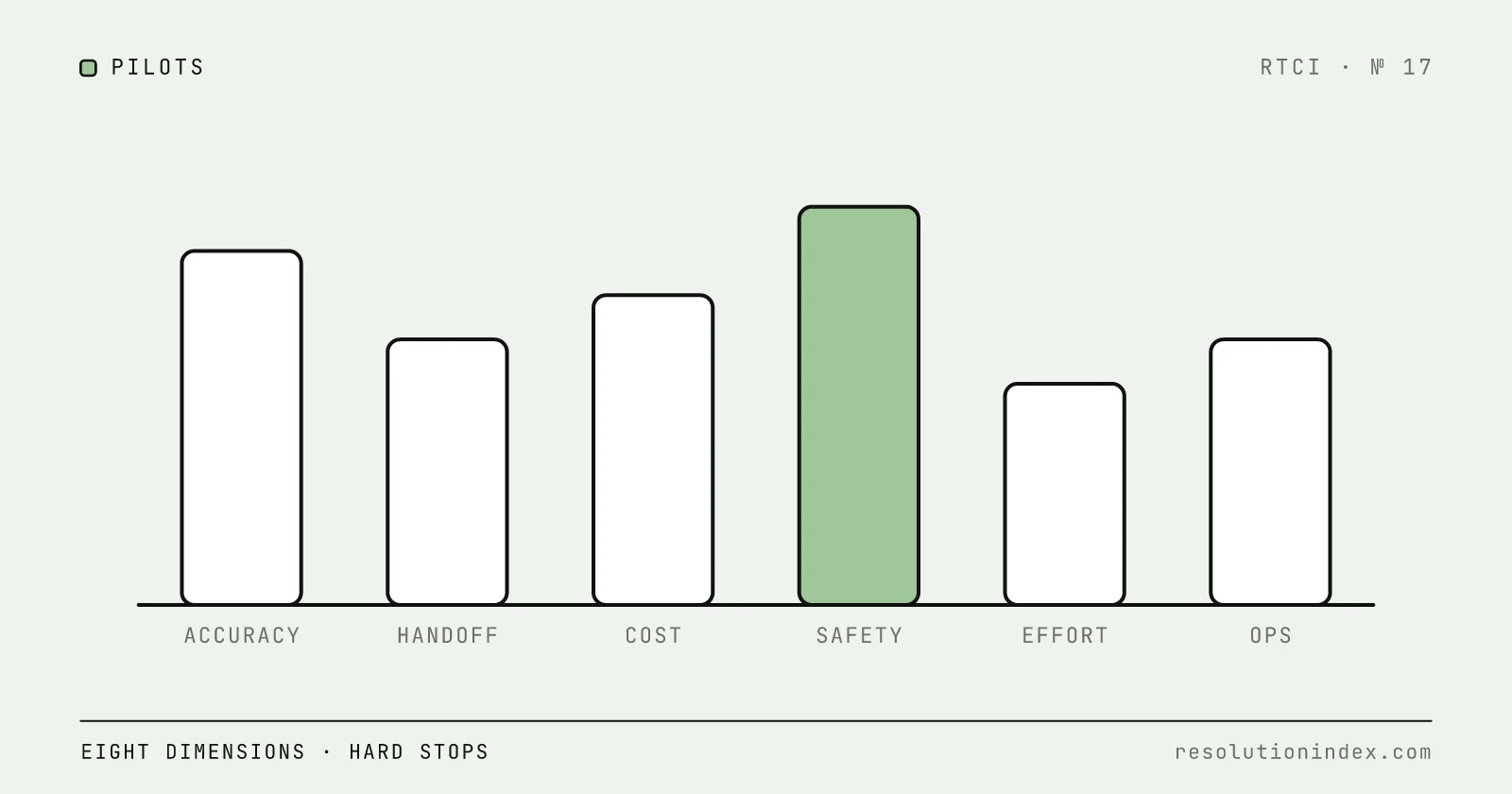
How to Design a Fair AI Support Pilot Scorecard
A weighted scorecard with 8 dimensions, hard-stop gates, and copy-paste Week 1–4 templates for evaluating an AI support pilot honestly.
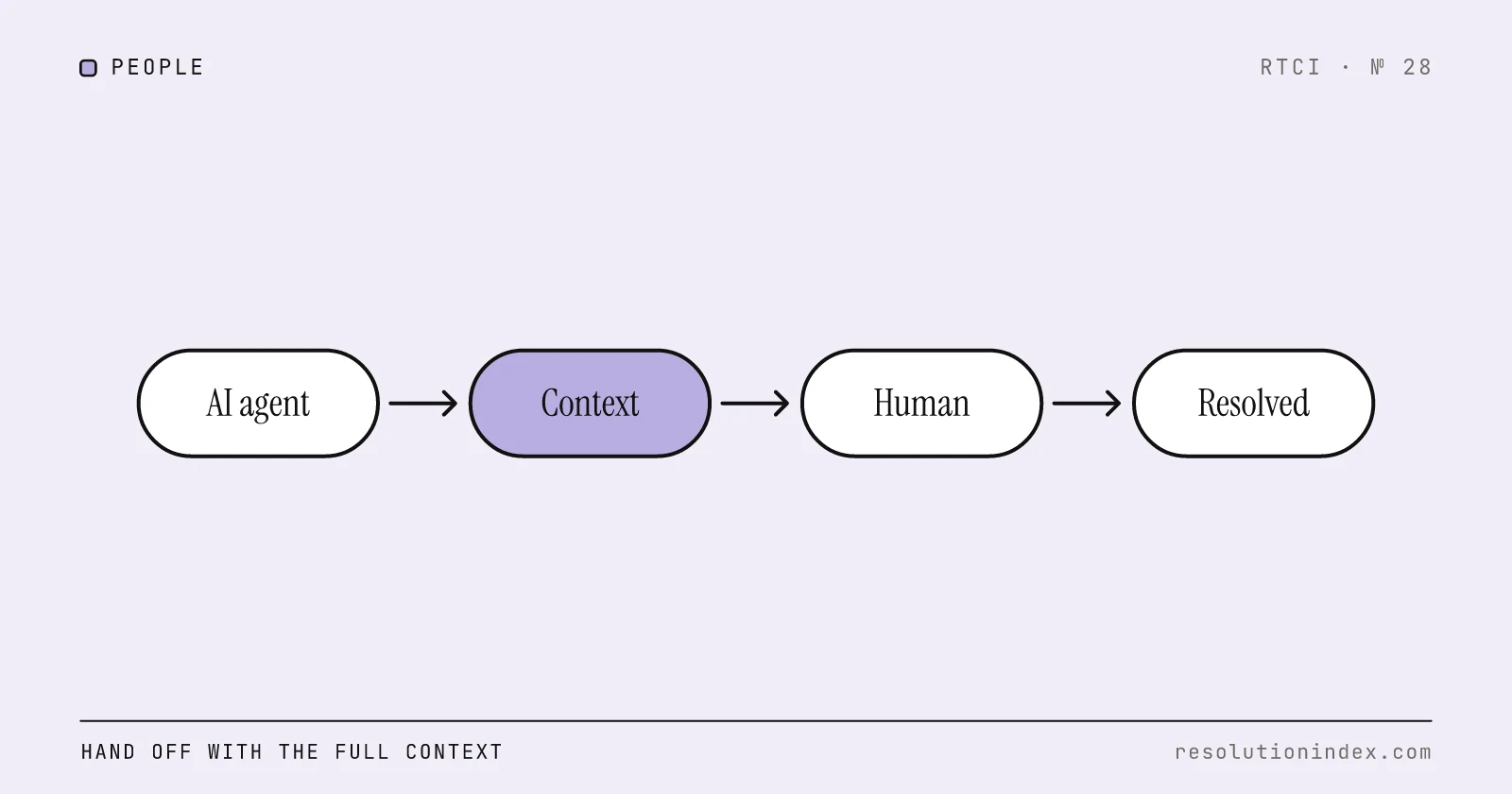
Train the Team on AI Handoff Workflows
What a clean AI-to-human handoff packet contains, how to measure handoff quality, what vendors bill when a conversation is handed off, and how handoffs move cost per verified resolution.
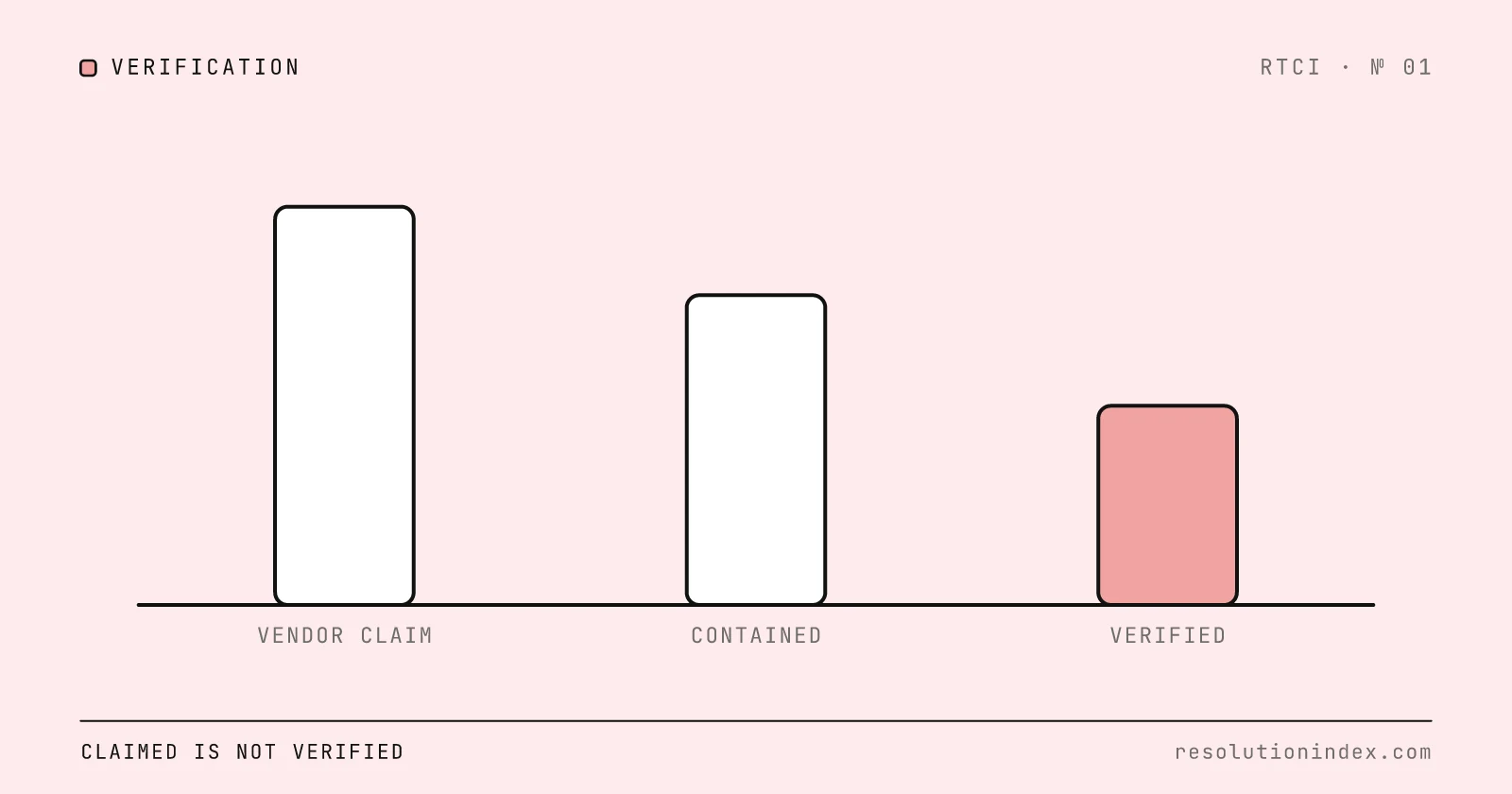
AI Resolution Rates: Why Vendor Claims Are Often Inflated
See how AI support vendors blur resolution, containment and deflection, how RTCI discounts each claim, and the five questions to ask before you compare two rates.