Published Aug 9, 2026 · Updated Nov 19, 2026 · 11 min read
Hidden Fees in AI Support Contracts: What Buyers Miss
Where AI support invoices outgrow the quote: second meters, overage rates, one-time allowances, add-ons, outbound channels and exit costs, with clause language and a worked 12-month reconciliation.
 Written by Andrew Hall, Editor
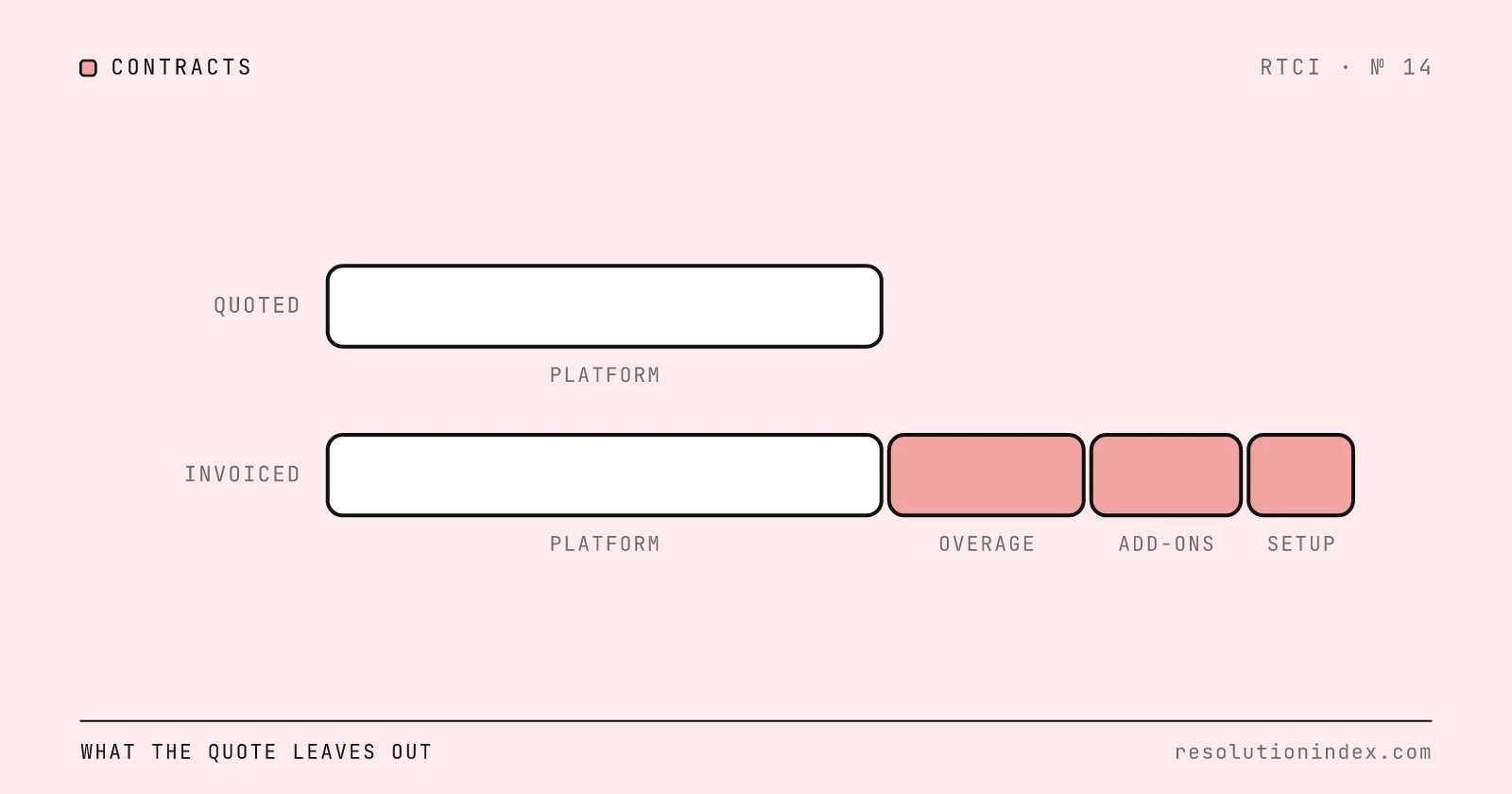
The fees that push an AI support invoice above the quote usually sit in five places: a second meter on the same conversation, overage rates above an included allowance, allowances that are one-time rather than monthly, add-ons the quote left out, and services or exit costs priced outside the subscription. Most are published on vendor pricing pages. They stay hidden because the first quote shows one unit price.
This post shows where each fee appears, with public examples as of November 2026, gives clause language to fix it, and works through a 12-month reconciliation. To compare vendors on one number, run the cost-per-verified-resolution calculator before you sign.
Where do hidden fees show up in AI support pricing?
1. Two meters on one conversation. Some pricing counts the same conversation under two units. Gorgias bundles its AI Agent into each helpdesk plan with an allowance of automated interactions, and every automated interaction also counts as a helpdesk ticket, so AI volume uses up the ticket allowance too (see our Gorgias AI review). Intercom bills $0.99 for a procedure handoff, where Fin completes a configured procedure that ends by passing the case to a person or workflow (Intercom's outcome pricing article). If a person then finishes the job, you have paid for a Fin outcome and the seat of the person who resolved it. The clause to look for: any billable unit that can apply to a conversation a human also handles.
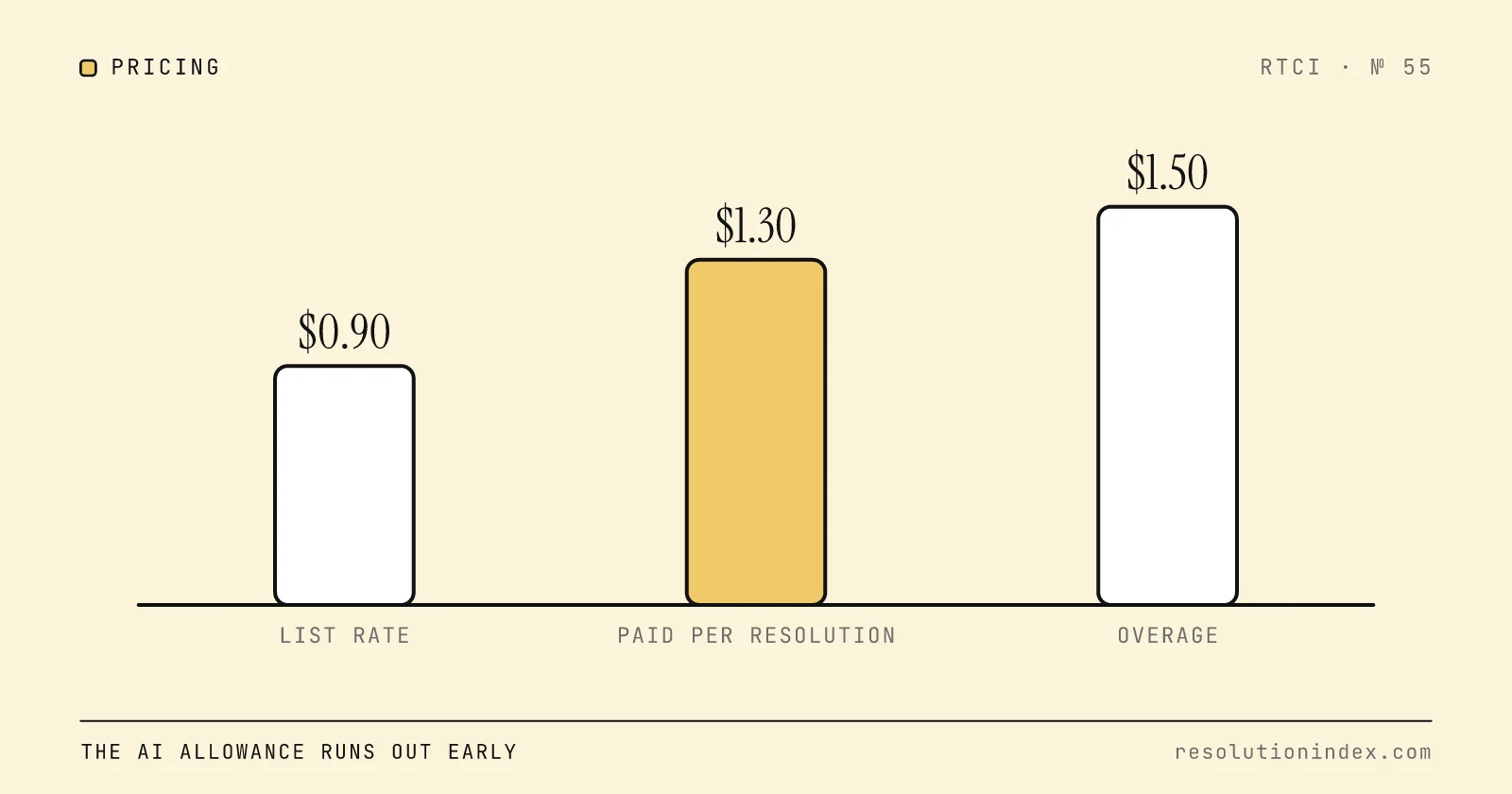
2. Overage above the allowance. Allowance pricing quotes the included rate, and the overage rate applies when you grow. Gorgias prices included automated interactions at $0.90 on annual billing or $1.00 monthly, with $1.50 overage above the allowance. Zendesk bills AI agents per automated resolution after a small included allowance, at $2.00 each on pay-as-you-go and a lower rate if you commit to a volume in advance (Zendesk pricing). Ask for the overage rate in writing, and whether unused committed volume rolls over.
3. One-time allowances that read like monthly ones. Freshdesk gives 500 free Freddy AI Agent sessions on Growth, Pro and Enterprise, limited to once per account, then sells packs of 100 sessions for $49 (Freshdesk pricing). A team running 2,000 sessions a month uses the free 500 in month one, then buys 20 packs, $980, every month after.
4. Seat definitions and minimums. Intercom includes 20 free Lite seats on Advanced and 50 on Expert for people who only need limited access; anyone beyond that, or anyone who needs to work conversations, takes a full seat at $85 (Advanced) or $132 (Expert) a month on annual billing (Intercom pricing). Fin used on another helpdesk carries a 50-outcome monthly minimum. Clauses to look for: a minimum seat or usage count, minimums that can be reset at renewal, and a seat definition that makes read-only users pay full price.
5. Add-ons the quote left out. As of November 2026, Intercom Copilot is $29 per agent a month on annual billing ($35 monthly), Proactive Support Plus is $99 a month with 500 messages, and Pro starts at $100 a month. Zendesk Copilot is $50 per agent a month on annual billing and needs Suite Professional or higher. Freddy AI Copilot is $29 per agent a month and can only be added to Freshdesk Pro and Enterprise. Worked example: 20 agents on Intercom Advanced pay $1,700 a month for seats; Copilot for all 20 adds $580, or 34% on top of seats.
6. Outbound channels. Intercom includes inbound support in the seat but bills WhatsApp per message, SMS per message at rates that vary by region, and phone by usage. If your AI sends a proactive order-delay message, that message is a usage charge even though no agent touched it. Price your outbound volume before launch, not after the first campaign.
7. Implementation and exit. Fin's standalone pricing lists no setup, integration or platform fees. Enterprise agreements from any vendor can still carry a separate statement of work. Clauses to look for: hourly services with no cap, an optimization or success retainer that starts after year one, fees to export conversation history or knowledge content, and API rate limits that make a full export slow.
How do outcome definitions change the bill?
Per-outcome pricing is only as clear as its definition. Intercom bills a resolution when Fin answered and the customer either confirmed it or left without asking for more help, and bills procedure handoffs. It does not bill when the customer asks for a human, a procedure fails, or the conversation is abandoned or spam. If the customer returns to the same conversation and asks for more help, the resolution is deducted, even across billing periods (Intercom's outcome pricing article). Zendesk counts an automated resolution when the AI resolved the request without escalation to a human (see our Zendesk pricing guide).
Three things to check in any definition: whether silence counts as resolved; whether a reversal covers a new ticket or another channel about the same issue, or only the same conversation; and whether the vendor can change the definition by notice. Our 72-hour verified resolution clauses give contract language for a cross-channel reversal window.
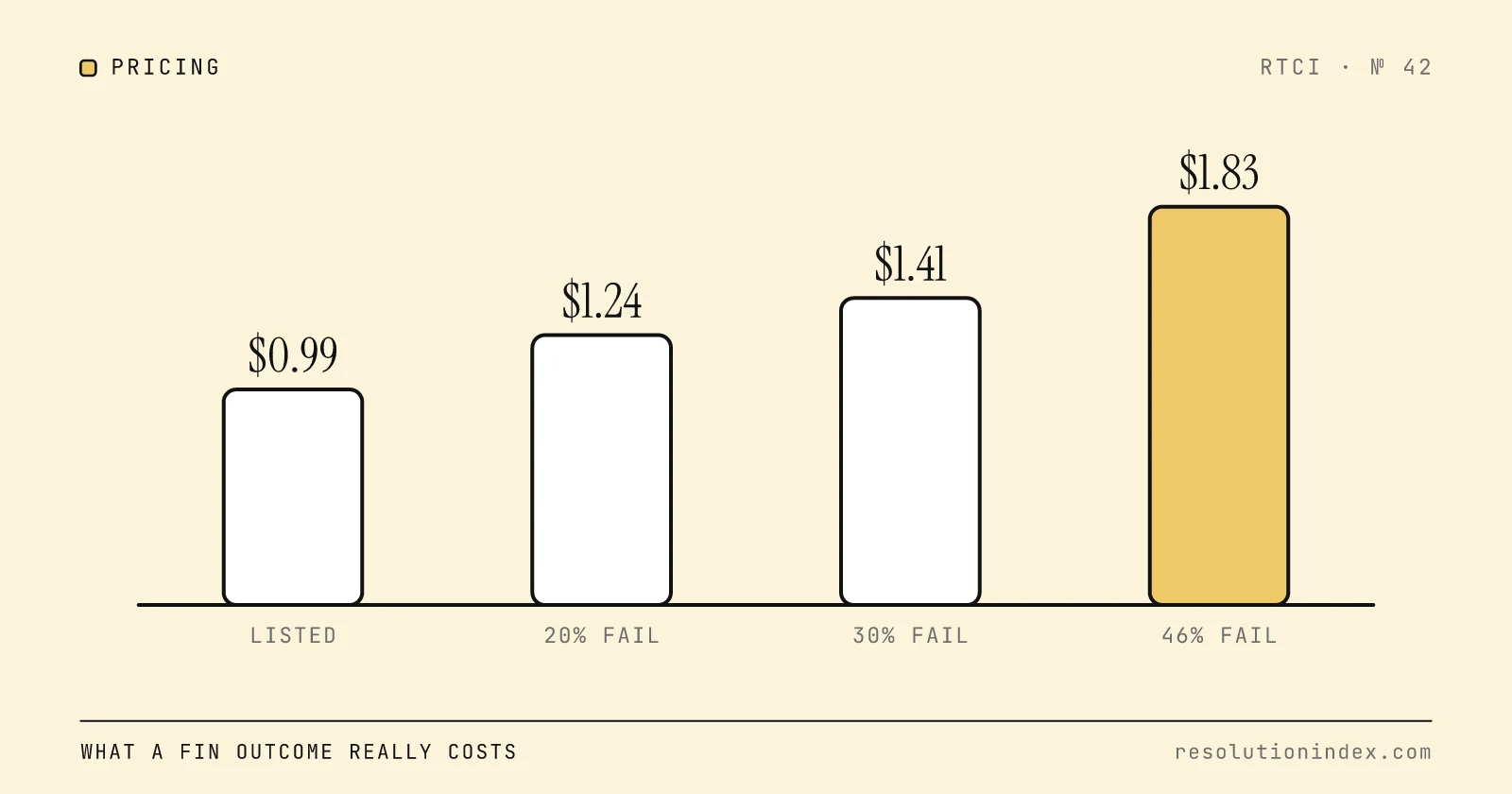
Worked example: assume 5,000 billed outcomes at $0.99, or $4,950. You sample 100 of them and find 20 were procedure handoffs a person finished, or customers who left without a fix. Scaled up, that is 4,000 real resolutions, so each one cost $4,950 ÷ 4,000 = $1.24, not $0.99.
Clause library: what to strike, add or rewrite
The clauses below decide whether your invoice matches your forecast. Use them during legal review alongside the audit checklist further down.
Strike: vendor-determined outcomes. Delete or rewrite any clause that lets the vendor decide what counts as a resolution from internal metrics, machine-classified signals or discretionary review. Replace with: a chargeable AI outcome is counted only when the end user confirms resolution through a provided feedback mechanism, or does not contact you again about the same issue for at least [X] hours, across any channel. Pick the shortest window your operations can defend.
Add: one unit per conversation. A single conversation, identified by its original ticket or conversation ID, may be billed as one unit only. If the AI hands off and a human resolves it, no AI outcome is billable unless the contract names a separate handoff price.
Cap: professional services. Replace hourly services language with fixed-price milestones: knowledge-base import, integration delivery, training and go-live acceptance. No additional services fees above [a set amount or share of annual subscription value] without written approval.
Fix: seat counting and minimums. Define a full seat, a light or read-only seat and a named user. State that a user who does not send customer messages or modify tickets may not be counted as a full seat. Remove language that lets minimums rise at renewal, or cap the increase at [X]% above the prior-year minimum.
Lock: add-on pricing. Attach an exhibit listing every add-on required for the stated scope (copilot, proactive messaging, AI credits or sessions, WhatsApp, SMS and voice rates, API overages, storage) with its price. Require [60] days' written notice before any add-on price or bundling change.
Guarantee: data portability. You may export conversation history, knowledge-base content, configuration and customer data in a machine-readable format within [five] business days of request at no additional cost, and API rate limits will not be used to block a full export.
Seat, outcome or session: where fees hide in each model
Each pricing architecture has its own hiding places. For a longer comparison, see AI customer support pricing models compared.
Per-seat models charge a fixed monthly fee per agent. On annual billing, Freshdesk Pro is $55 per agent, Zendesk Suite Professional $115 and Intercom Expert $132. The fees hide in seat minimums, in who counts as a full seat, and in AI features that sit in a separate add-on or a separate usage meter.
Per-outcome models charge when the AI produces a defined result. Fin is $0.99 per outcome; Gorgias bills per automated interaction. The fees hide in the definition (assumed resolutions, handoffs), in reversal rules, and in monthly minimums such as Fin's 50 outcomes when used on another helpdesk.
Per-session models charge for each AI conversation, resolved or not. Freshdesk's $49 per 100 sessions is $0.49 a session; at RTCI's realistic 52–62% resolution range for Freddy, that works out to $0.79–$0.94 per resolution. The fee hides in the gap between sessions and resolutions, and in the one-time free allowance.
Per-seat is predictable but grows with headcount. Per-outcome tracks value only as far as the definition does. Per-session is simple to meter but charges for failures. Whichever model you buy, model every SKU in your scope.
Contract audit checklist
Use this during vendor evaluation and before legal signature.
Definitions: How is an AI outcome or resolution defined? Does silence count? What reverses a billed outcome, and does a new ticket or another channel about the same issue count?
Billing units: Can one conversation be billed under two units, such as an AI outcome and a helpdesk ticket? What are the seat and usage minimums, and can they change at renewal?
Add-ons: Which add-ons does your stated scope need: copilot, proactive messaging, AI credits or sessions, voice, SMS, WhatsApp, storage, sandbox, QA, workforce management? How is each priced?
Allowances and overage: Is each included allowance monthly or one-time? What is the overage rate compared with the included rate? Does unused committed volume roll over?
Implementation: Fixed price or time and materials? Separate fees for migration, training, integrations and knowledge import? A cap on unapproved services?
Renewal and price protection: Can prices rise at renewal, by how much, with how much notice? Are add-on rates protected?
Data and offboarding: Can you export all data at any time without fees? In what format and how fast? Are API limits high enough for a full migration?
Service levels: Are uptime, resolution quality or escalation commitments included, with service credits if missed?
Worked example: 12-month cost reconciliation
This example shows how a fair quote grows into a larger invoice. Assumptions: a 15-agent team on Intercom Advanced, 5 finance and operations users who only read conversations, 12,000 conversations in month one, and Fin billing outcomes on 35% of them. Prices are Intercom's annual list prices as of November 2026. Everything else is an assumption to replace with your own numbers.
The quote. 15 full seats at $85 = $1,275. The 5 read-only users fit within Advanced's 20 free Lite seats, so $0. Fin: 35% of 12,000 = 4,200 outcomes at $0.99 = $4,158. Copilot for 15 agents at $29 = $435. Total: $5,868 a month, or $70,416 a year.
Month six. Assume volume has grown to 14,000 conversations and Fin bills outcomes on 42%: 5,880 outcomes, or $5,821. The team adds Pro for topic analysis from $100 a month. Order-update WhatsApp and SMS messages run to an assumed $110 (rates vary by region, so price your own). An integration needed a $3,500 statement of work, spread over the remaining six months of the year at $583 a month.
| Line | Quote | Month six |
|---|---|---|
| Seats | $1,275 | $1,275 |
| Fin outcomes | $4,158 | $5,821 |
| Copilot | $435 | $435 |
| Pro | $0 | $100 |
| Outbound messages | $0 | $110 |
| Implementation | $0 | $583 |
| Total | $5,868 | $8,324 |
Month six is 42% above the quote ($8,324 ÷ $5,868 = 1.42). Of the $2,456 increase, $1,663 is more Fin outcomes from growth, which a volume forecast would have shown. The other $793 is Pro, outbound messages and the statement of work, none of which were in the quote.
Then check the unit cost. If a sample of month-six outcomes shows 20% were handoffs a person finished or customers who left unresolved, the 5,880 outcomes contain 4,704 real resolutions, and Fin cost $5,821 ÷ 4,704 = $1.24 per real resolution.
The same exercise on Zendesk starts from $115 a seat for Suite Professional, adds $50 per agent for Copilot, and bills automated resolutions at $2.00 pay-as-you-go after the allowance. Our Zendesk pricing guide has worked monthly totals.
Negotiation language to start from
Sales teams present list pricing as fixed, but the terms around it are usually open. Adapt these with counsel; the bracketed values are yours to set.
On outcome definitions: A chargeable AI outcome is customer-confirmed resolution, or no further contact about the same issue on any channel for at least [72] hours. Vendor-discretionary classification and handoffs are not AI outcomes unless separately priced.
On double billing: For any single conversation ID, the vendor may bill no more than one unit. If the AI hands off to a human, no AI outcome is billed.
On overage rates: Overage rates for AI sessions, outcomes, messages and API calls may not exceed the effective rate of the included tier by more than [X]%.
On implementation: Professional services are fixed-fee and tied to the attached statement of work. No additional services may be billed without a signed change order.
On renewal protection: Subscription fees, including seats and all contracted add-ons, may not rise by more than [X]% at renewal. New products are added only by mutual written agreement.
On data portability: Customer owns all data and may export conversation history, knowledge-base content, configuration and customer records in JSON or CSV within [five] business days of request, at no charge.
On minimum commitments: Any monthly minimum for AI outcomes, messaging or voice is reviewed quarterly and reduced if usage stays below [80]% of the minimum for two consecutive quarters.
Finally, ask the vendor for sample invoices at 50%, 100% and 150% of forecast volume with every add-on in your scope listed. Compare them with your own model in the cost-per-verified-resolution calculator. Where the two diverge is where the hidden fees are.
Frequently asked questions
What is escalation double billing? One customer conversation charged under two units, for example an AI outcome and the human seat that finishes the case, or an AI interaction that also counts against a ticket allowance. The fix is a one-unit-per-conversation clause.
Are setup fees normal in AI support contracts? They are common in enterprise deals with a statement of work. Fin's standalone pricing lists no setup, integration or platform fees. Wherever there are services fees, make them fixed-price, tied to milestones and capped.
How do per-outcome vendors define a resolution? Each vendor differs. Intercom bills confirmed resolutions, assumed resolutions where the customer leaves without asking for more help, and procedure handoffs, and deducts a resolution if the customer returns to the same conversation. Negotiate a definition that covers re-contact on any channel.
Which is cheaper: per-seat or per-outcome pricing? It depends on volume and how many billed outcomes are real resolutions. Model 12 months of both with your own volume, then divide each total by verified resolutions.
What add-on fees are most often missed? Copilot seats, AI sessions or credits beyond a one-time allowance, WhatsApp, SMS and voice usage, proactive messaging, analytics add-ons, QA, workforce management and API overages. Request an add-on exhibit before signing.
Can I avoid data-export fees when switching vendors? Only if portability is in the contract. Add a clause for free export in a machine-readable format within a set number of business days, and confirm API limits allow a full migration.
What should I ask for at renewal? A cap on renewal increases, locked add-on rates, no automatic minimum increases, data portability carried forward, and written notice of any pricing or bundling change.
How do I calculate the true cost per AI resolution? Add the subscription, AI outcomes or sessions, the human seat cost of escalations, add-ons, channel usage and amortized implementation, then divide by verified resolutions. The cost-per-verified-resolution calculator does this for you.
Change log
- Removed unsourced invoice-gap and savings percentages, corrected Freshdesk's one-time session allowance, Zendesk's per-resolution billing and Intercom's outcome and add-on prices against vendor pricing pages, and rebuilt the 12-month example with stated assumptions.
- Published.
Read next
Keep reading
Picked for this article: the pieces it cites and the ones that answer the next question buyers usually ask.
Most related
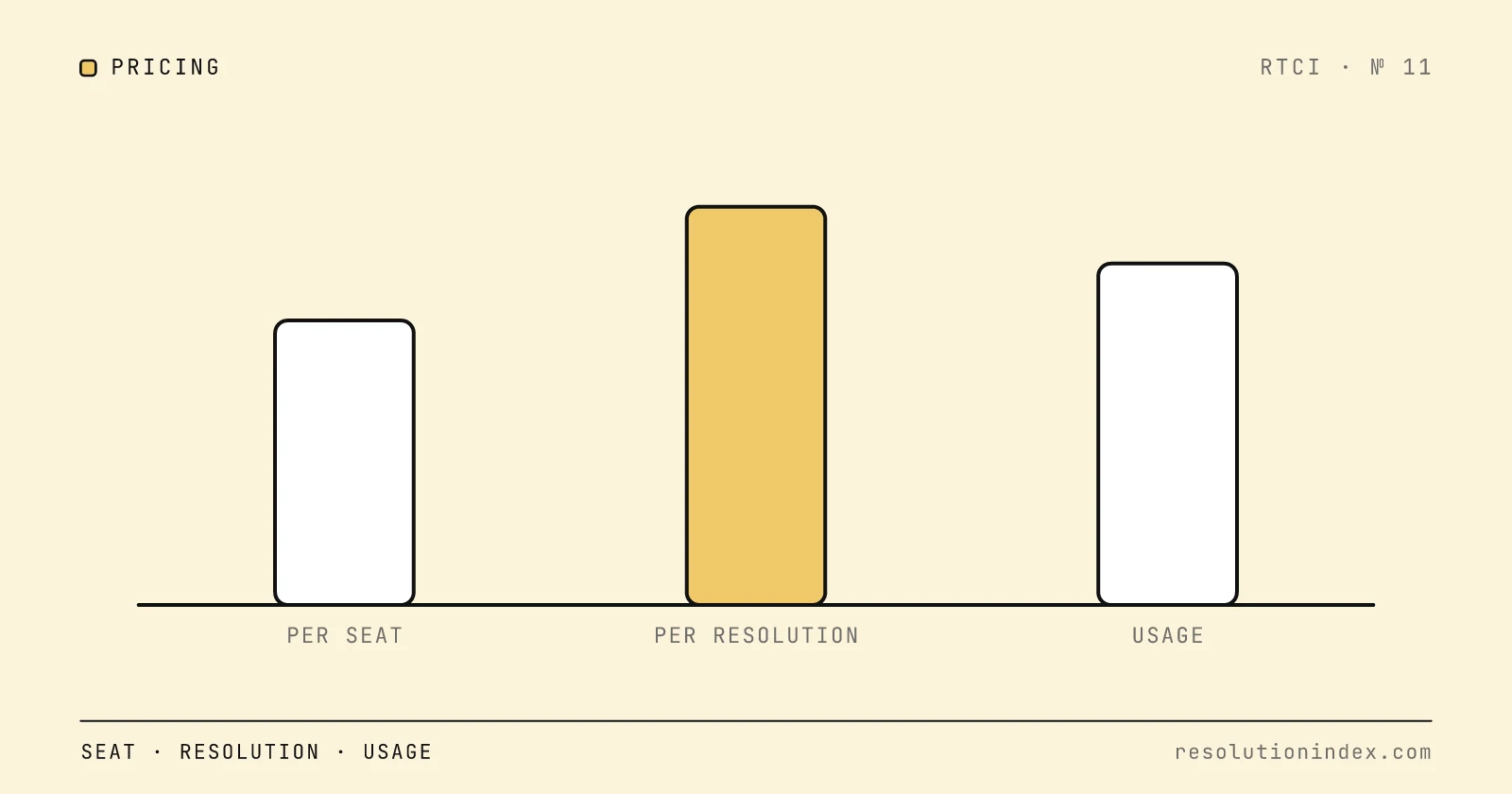
AI Customer Support Pricing Models Compared: Per-Seat, Per-Resolution, and Usage
AI support vendors price by seat, by resolution or by usage. A worked example at 10,000 conversations a month shows the same 5,000 resolutions costing $874 to $7,200 depending on the price card.
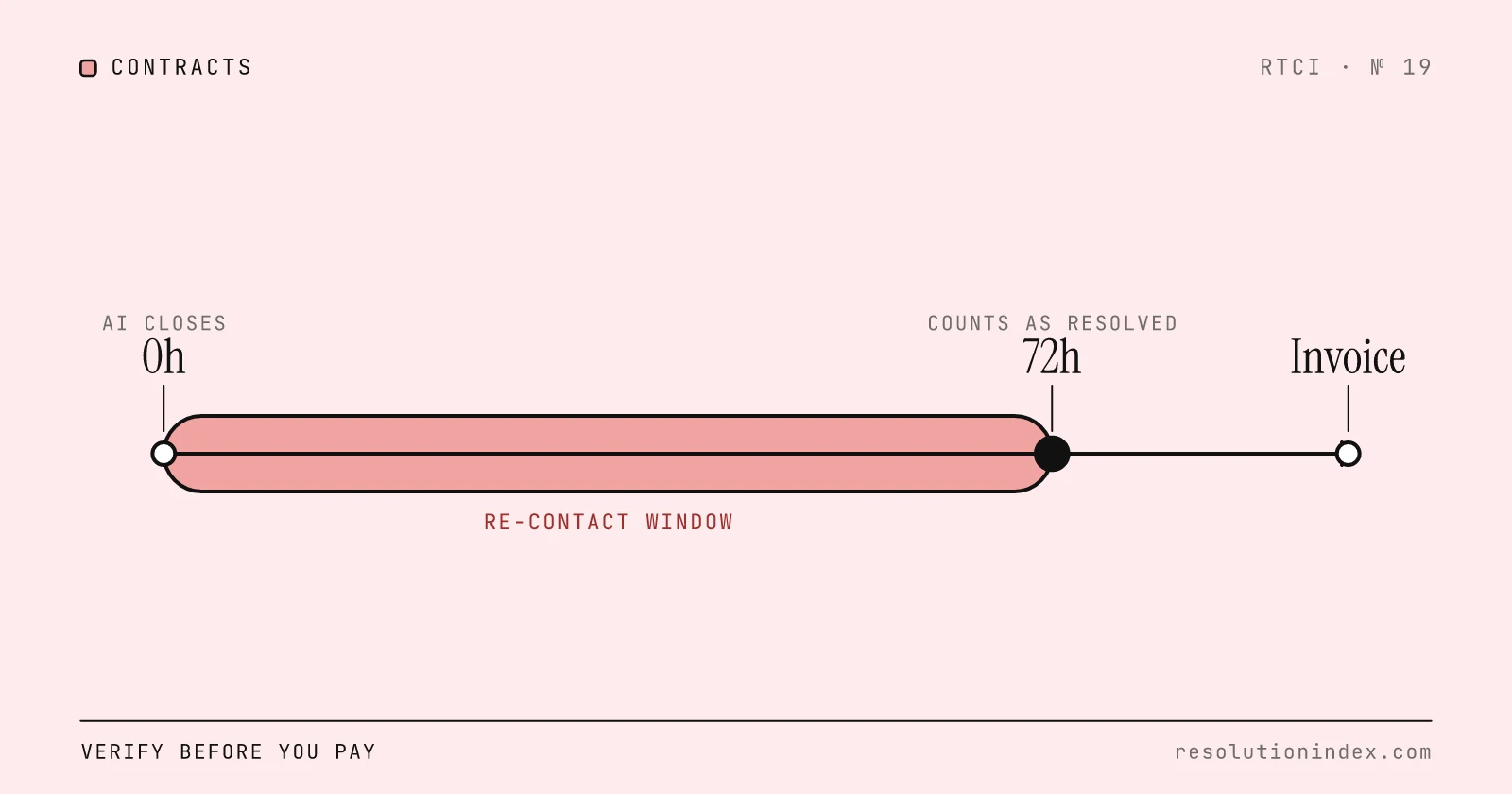
72-Hour Verified Resolution SLA: Copy-Paste Contract Clauses
A buyer-side clause library for defining, measuring, auditing, crediting, and disputing 72-hour verified resolutions in AI support contracts.
Zendesk Pricing 2026: Plans, AI Agents and Resolution Costs
Zendesk pricing as of November 2026: plans from $19 per agent, AI agents billed per automated resolution, the May 2026 tier change, and worked monthly bills.
Gorgias Pricing 2026: Plans, AI Agent Fees and Cost per Resolution
Gorgias pricing as of November 19, 2026: what each plan costs with AI Agent switched on, the $1.50 AI overage, the ticket double count, and a worked monthly bill at 250, 1,800 and 5,000 tickets.
Intercom Pricing 2026: What Fin Really Costs Per Resolution
Intercom pricing as of November 2026: seats from $29, Fin at $0.99 per outcome, the add-ons, and a worked cost per resolution for three team sizes.