Published Aug 12, 2026 · Updated Nov 19, 2026 · 9 min read
Compare AI Support Quotes Apples-to-Apples
A quote normalization worksheet that converts Intercom Fin, Zendesk AI, Freshdesk Freddy, Gorgias, Decagon, Sierra, and YourGPT quotes into one comparable number: cost per verified resolution.
 Written by Andrew Hall, Editor
To compare AI support quotes, convert each one into cost per verified resolution (CPVR): total annual cost, including fixed fees, usage, add-ons, implementation and the human work on tickets the AI did not resolve, divided by tickets the AI resolved with no handoff and no re-contact within 72 hours. Use the same resolution definition, re-contact window and human cost for every vendor. In the worked examples below, three quotes with headline AI costs of $0.99, $1.50 and about $0.13 per resolution become $10.06, $18.63 and $3.08 per verified resolution, and the resolution rate drives most of that gap.
The contract traps that inflate an invoice are rarely on the quote, so the worksheet below asks for them row by row.
Why do quotes not compare directly?
Three reasons. The unit differs: per outcome, per conversation, per agent seat, per session, per credit. The denominator differs: a vendor that keeps billing and security tickets away from the AI reports a higher rate on an easier pool. And the cost stack is split across the three-layer cost model: fixed platform or seat cost, variable AI usage, and add-ons or overage, with setup, channel usage and escalation billing below the headline.
What do the vendors charge today?
Figures from RTCI's index and reviews, November 2026. Confirm each with the vendor before modeling it.
Intercom Fin. $0.99 per outcome. On another helpdesk, a 50-outcome monthly minimum; on Intercom, helpdesk seats from $19 per seat a month (Advanced $85, Expert $132). An outcome also covers Procedure handoffs, disqualifications and self-serve routings, and qualifications cost $9.99 each. RTCI realistic resolution rate: 56–66%.
Zendesk AI. AI agents are included in every plan. Seats: Support Team from $19 per agent a month, Suite Team $55, Suite Professional $115 (annual). Each plan includes 5 (Team) or 10 (Professional) automated resolutions per agent per month; further Verified resolutions cost $1.50 committed or $2.00 pay-as-you-go. Copilot is a $50 per agent add-on on Professional and higher. RTCI realistic resolution rate: 36–46%.
Freshdesk Freddy. Seats $19, $55 or $89 per agent a month (annual). AI Agent sessions are $49 per 100 after 500 one-time free sessions, so you pay per session whether or not it resolves; Freddy AI Copilot is $29 per agent a month. RTCI realistic resolution rate: 52–62%.
Gorgias AI. Plans are priced by ticket volume, not seats: Pro $300 a month (2,000 tickets), Advanced $750 (5,000), annual. Automated interactions are $0.90 annual or $1.00 monthly, $1.50 above the included allowance, and each one also uses a plan ticket. RTCI realistic resolution rate: 27–37%.
Decagon. No public pricing. Quiq, a competitor, reports about $0.99 per conversation and about $50,000 a year in platform fees; Vendr lists a median annual contract of $432,750. RTCI estimates ~$1.50 (est.) per resolution at 20,000 conversations a month and the 80% resolution rate from RTCI's November 2026 test.
Sierra. No public pricing. Third parties report $1 to $2.50 per resolution, a platform fee of about $150,000 a year and setup of $50,000 to $200,000. RTCI estimates ~$2.61 (est.) per resolution at 20,000 conversations a month and the 73% rate from RTCI's November 2026 test.
YourGPT. Flat plans with AI credits: Essential $39, Professional $79 and Advanced $349 a month billed annually, with 10 million, 30 million and 100 million credits. Extra credits cost $7 per 2 million, up to 100 packs. RTCI estimates ~$0.13 (est.) per resolution on Advanced at about 3,000 conversations a month; it resolved 90% in RTCI's November 2026 test (RTCI score 960, Elite).
What is the normalization formula?
CPVR = (annual fixed cost + annual variable AI cost + annual add-on and overage cost + first-year implementation + annual escalation rework cost) ÷ annual verified resolutions
- Fixed cost: platform fees, required seats, base plans and mandatory add-ons.
- Variable AI cost: the per-resolution, per-conversation, per-session or per-credit rate times expected volume.
- Add-ons and overage: channels, storage, premium modules and overage past allowances.
- Implementation: setup, migration, integration, knowledge-base work and onboarding. For a one-year comparison, use the full first-year amount.
- Escalation rework: the human cost of every ticket the AI did not resolve for good, including reopened ones.
- Verified resolutions: tickets × resolution rate × (1 − re-contact rate).
A per-seat vendor has higher fixed and lower variable cost; a per-resolution vendor the reverse; a credit vendor has a flat plan plus credit packs. The formula handles all three.
Quote normalization worksheet
Copy this into a spreadsheet and fill one column per finalist. Mark anything a vendor cannot answer as unknown and model a conservative value.
| Worksheet row | Why it matters | Vendor A | Vendor B | Vendor C |
|---|---|---|---|---|
| Pricing model | Per-seat, per-resolution, per-conversation, per-session, credit, custom | |||
| Billable event definition | What exactly triggers a charge: resolution, handoff, session, conversation, credit? | |||
| Lookback/re-contact window | How long before a resolved ticket can be reopened and voided or rebilled? | |||
| Monthly fixed cost | Seats, platform fee, base plan, required add-ons | |||
| Monthly variable AI cost at expected volume | Per-unit rate × expected events | |||
| Bundled allowance | Included resolutions, sessions, credits, or conversations | |||
| Overage rate | Cost per unit beyond the allowance | |||
| Channel/add-on costs | WhatsApp, SMS, voice, email campaigns, data export, storage | |||
| Implementation cost | Setup, migration, integration, training, success retainers | |||
| Annual tuning/KB cost | Ongoing content, prompt tuning, policy maintenance | |||
| Escalation billing rule | Is the same conversation billed as both AI and human? | |||
| Contract term and renewal cap | Annual, multi-year, price increase cap | |||
| Expected AI-attempted tickets/month | Your real volume, not the vendor's curated pilot | |||
| Realistic resolution rate | Vendor-neutral estimate, not the marketing number | |||
| Re-contact rate | Internal data or conservative assumption | |||
| Human cost per escalated ticket | Fully loaded cost to close a ticket the AI failed on | |||
| Verified resolutions/month | Attempted × resolution rate × (1 − re-contact) | |||
| Cost per verified resolution | Total annual cost / annual verified resolutions |
Do not let the vendor fill it in alone. Procurement completes the cost rows from the contract, operations the volume and rate rows from your data, and finance owns the CPVR calculation.
Worked examples: Fin, Zendesk AI and YourGPT
Shared assumptions for all three: 10,000 tickets a month; resolution rate at the midpoint of RTCI's realistic range or test result; 15% of AI resolutions reopen within 72 hours; $9 of human cost for every ticket that is not a verified resolution; $15,000 implementation. The team keeps its helpdesk in every option, so helpdesk seats and Copilot are left out. All inputs are assumptions except the vendor prices.
Intercom Fin, 60% resolution. 6,000 billed outcomes × $0.99 = $5,940 a month, $71,280 a year. Verified: 6,000 × 0.85 = 5,100 a month, 61,200 a year. Human work: (10,000 − 5,100) × $9 × 12 = $529,200. Total: $71,280 + $15,000 + $529,200 = $615,480. CPVR: $615,480 ÷ 61,200 = $10.06. Fin bills the 900 reopened tickets too, because they were billed as outcomes when they closed.
Zendesk AI, 41% resolution. 4,100 resolutions, 3,485 verified. Zendesk bills only Verified resolutions, and 12 Suite Professional agents include 120 a month, so (3,485 − 120) × $1.50 committed = $5,047.50 a month, $60,570 a year. Human work: (10,000 − 3,485) × $9 × 12 = $703,620. Total: $60,570 + $15,000 + $703,620 = $779,190. CPVR: $779,190 ÷ 41,820 = $18.63.
YourGPT, 90% resolution. At RTCI's estimate of about 33,333 credits per conversation, 10,000 conversations need about 333 million credits: the plan's 100 million plus 117 packs of 2 million at $7, so $349 + $819 = $1,168 a month, $14,016 a year. That is above the 100-pack self-serve limit, so the real price needs an Enterprise quote; the pack rate is a placeholder. Verified: 9,000 × 0.85 = 7,650 a month. Human work: (10,000 − 7,650) × $9 × 12 = $253,800. Total: $14,016 + $15,000 + $253,800 = $282,816. CPVR: $282,816 ÷ 91,800 = $3.08. Verify credit burn in a pilot before trusting the placeholder.
How do you read the results?
AI cost alone per verified resolution (usage plus implementation) is $1.41 for Fin, $1.81 for Zendesk and $0.32 for YourGPT. Add human rework and the totals are $10.06, $18.63 and $3.08. The human work on unresolved tickets is 86% of Fin's total and 90% of Zendesk's, so the resolution rate moves CPVR far more than the unit price does. At 10,000 tickets, each 10 points of verified resolution shifts 1,000 tickets a month between AI and humans, worth $108,000 a year at $9 a ticket.
Then test the inputs. What if the resolution rate is 10 points lower? What if December volume is 50% higher? What if the vendor's re-contact window is 24 hours instead of 72? The vendor that stays cheapest across those cases is the one whose pricing fits your operation.
Which quote games should you catch?
Resolution redefinition. The quote says per resolution, but the contract counts handoffs, silences or workflow completions. Get a written definition that matches no human handoff and no re-contact within 72 hours.
Allowance optimism. A low effective rate that assumes you stay inside the bundled allowance. Model real volume, including peaks, at the overage rate.
Double billing on escalations. The AI attempt and the human seat both charged on one conversation. Ask how many billable units an escalated ticket generates.
Implementation deferred to year two. Waived onboarding that returns as a success retainer in month 13. Spread implementation across the full term.
Channel costs excluded. WhatsApp, SMS and voice are often billed apart from the AI rate, including proactive messages the AI sends.
How do custom enterprise quotes change the math?
Decagon and Sierra publish no prices, so you decompose each proposal into platform fee, per-resolution or per-conversation rate, minimum commitment, implementation and rework. For outcome-based proposals, confirm whether escalated conversations are free; Sierra says they generally are not billed, and Decagon's per-resolution option does not charge for escalations.
Fixed fees change the ranking by volume. Hypothetically, a $200,000 platform fee with no usage charge beats a $50,000 fee plus $1 per conversation once you pass $150,000 ÷ $1 = 150,000 conversations a year, or 12,500 a month.
What makes the model finance-ready?
Every assumption has a source: resolution rate from your pilot or RTCI's realistic range, re-contact from your helpdesk data, human cost fully loaded. There are three scenarios, with the conservative one at the low end of resolution, the high end of re-contact and a volume spike. And the resolution definition, escalation billing rule and overage rate are written into the contract; otherwise the model describes a different contract from the one you sign.
FAQ
What is quote normalization? Converting every vendor's pricing into one unit, cost per verified resolution, so finance can compare proposals whatever the billing model.
Which AI support pricing model is cheapest? It depends on volume, resolution rate and escalation pattern. Per-resolution suits high automation rates, per-seat suits low-volume human-heavy teams, and credit plans can be cheapest if credit burn is predictable.
Why not just compare the headline per-resolution price? It leaves out fixed costs, allowances, overage, channels, implementation and the human work on tickets the AI did not resolve. In the worked examples, that human work is most of the total.
How do I get a realistic resolution rate for modeling? Use your own pilot data. Without it, use RTCI's realistic range for the platform. Do not use the vendor's claim in the base case.
What should the re-contact window be? A fixed window, typically 72 hours, applied the same way to every vendor.
How do I handle escalation double billing? Add the escalation billing rule to the worksheet. If both the AI attempt and the human resolution are charged, include both in the rework line, and negotiate one billable unit per conversation.
Can I use this worksheet for Decagon and Sierra? Yes. Extract the platform fee, usage rate and minimum commitment from the proposal; the formula is the same.
Where is the calculator? RTCI's Cost per Verified Resolution Calculator runs the formula with re-contact, escalation and add-on costs.
Change log
- Rebuilt the three worked examples on one shared set of assumptions (same re-contact rate, implementation cost and RTCI realistic rates), corrected YourGPT's plan price and RTCI score, replaced unsourced Decagon and Sierra contract ranges with figures from RTCI's reviews, and updated Freshdesk and Zendesk pricing.
- Published.
Read next
Keep reading
Picked for this article: the pieces it cites and the ones that answer the next question buyers usually ask.
Most related
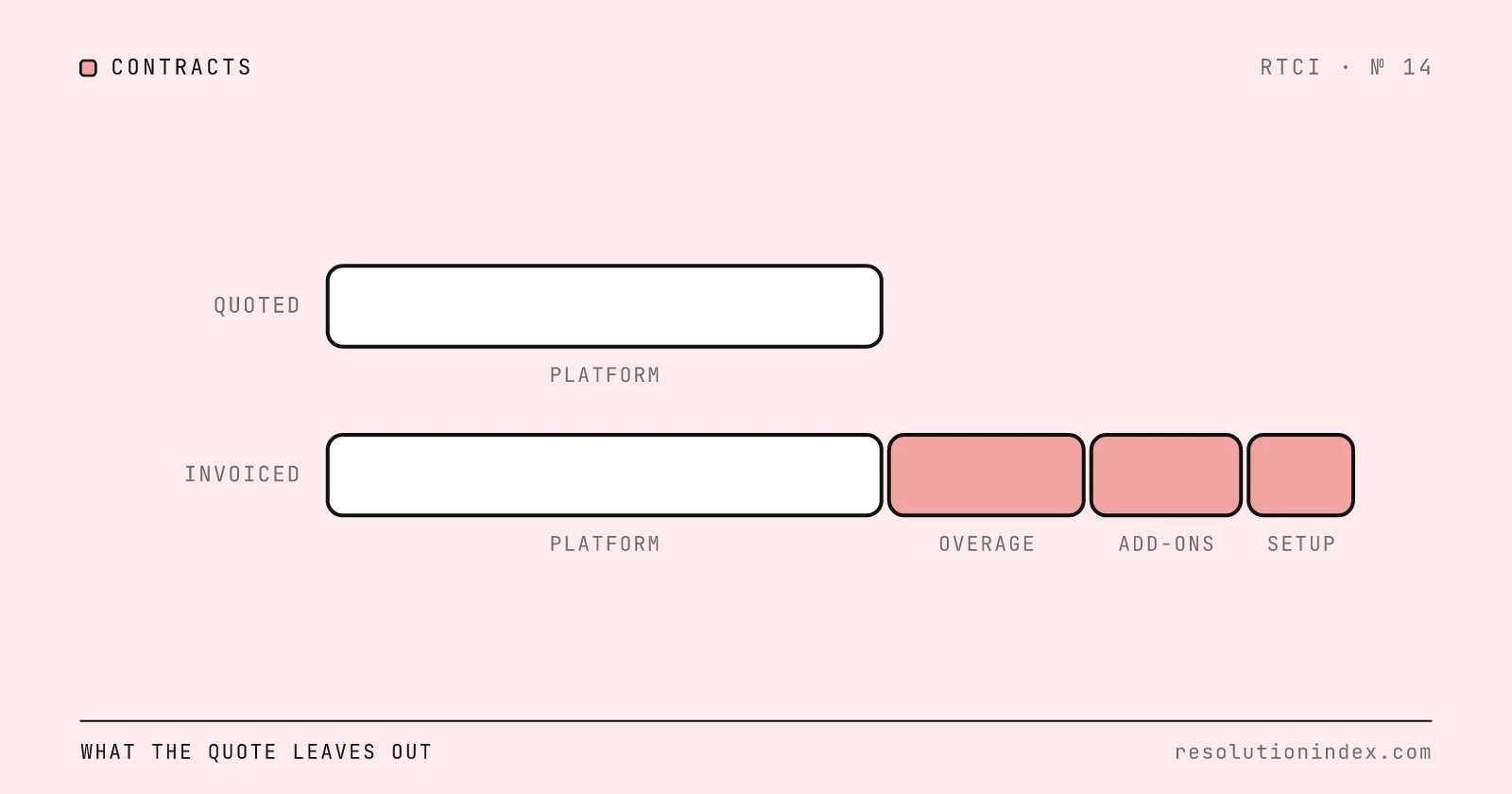
Hidden Fees in AI Support Contracts: What Buyers Miss
Where AI support invoices outgrow the quote: second meters, overage rates, one-time allowances, add-ons, outbound channels and exit costs, with clause language and a worked 12-month reconciliation.
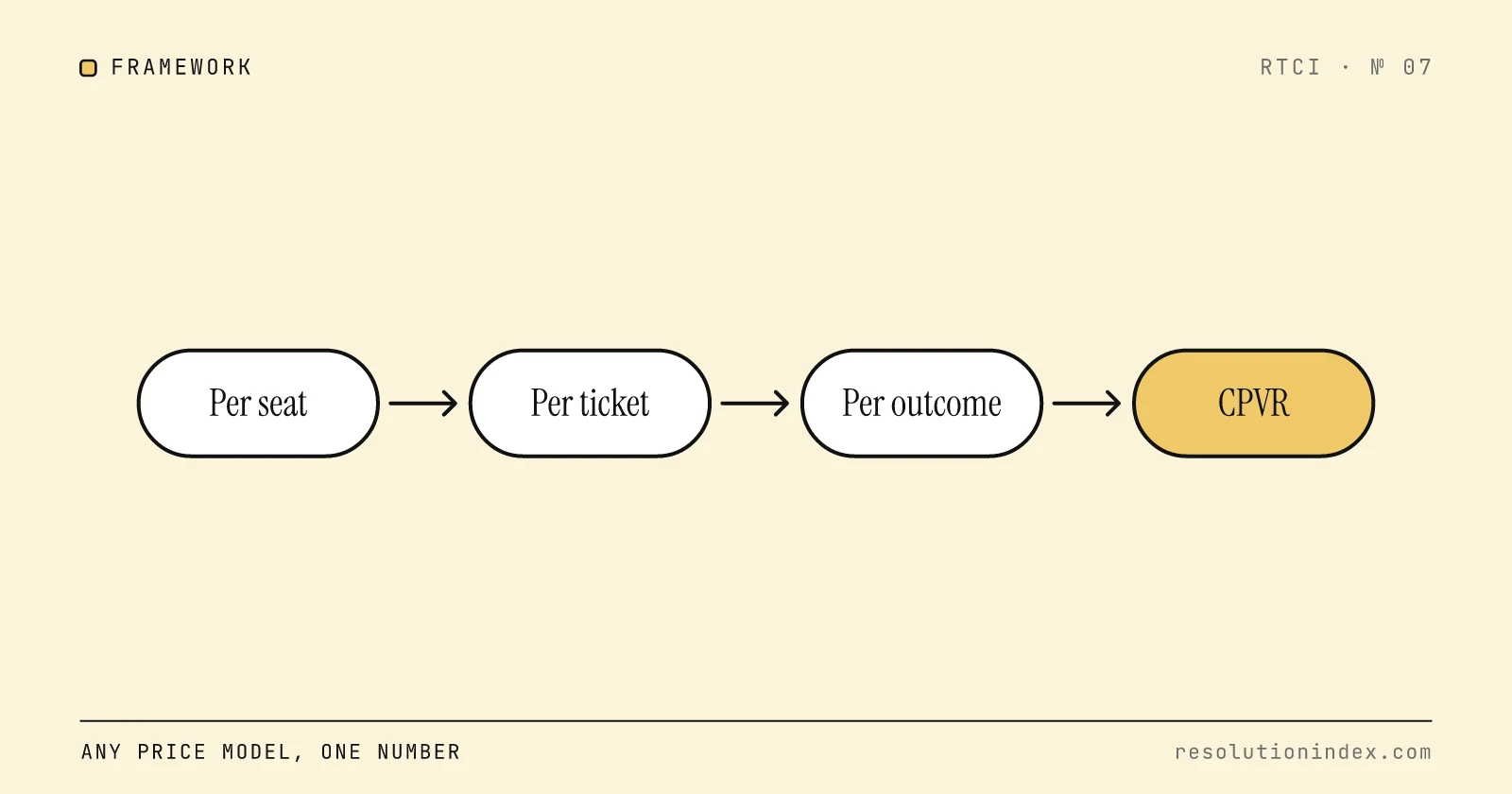
Cost Per Verified Resolution: A New Framework
Per-seat, per-ticket, and per-resolution pricing models all produce different numbers for the same underlying cost. RTCI's three-layer cost model normalizes any vendor's pricing into a single comparable metric: cost per verified resolution.
Best AI Support Platforms for Enterprise (2026)
Enterprise shortlist: Salesforce Agentforce, Zendesk AI, Intercom Fin, Decagon, Sierra, Cognigy, and Kore.ai compared on security, deployment options, RTCI score, cost per resolution, and contract terms. Includes a copyable RFP scorecard.
Best AI Support Platforms for Mid-Market Companies (2026)
Mid-market shortlist: Intercom Fin, Freshdesk Freddy, Zendesk AI, DevRev, and YourGPT compared on bill predictability, 30–90 day implementation, and cost per verified resolution, with each vendor’s RTCI score and published price.
Decagon vs Sierra: Enterprise AI Support Comparison (2026)
How Decagon and Sierra differ on pricing model, channels and operating model, what each scored in RTCI's November 2026 test, and what each costs per resolution at three volumes, with the math shown.