Published Aug 13, 2026 · Updated Nov 19, 2026 · 13 min read
Break-Even: When AI Support Pays for Itself
The formula for the verified resolution rate at which AI support costs less than handling the same volume with humans, with worked examples on Gorgias, Intercom Fin, Zendesk AI and YourGPT pricing.
 Written by Andrew Hall, Editor
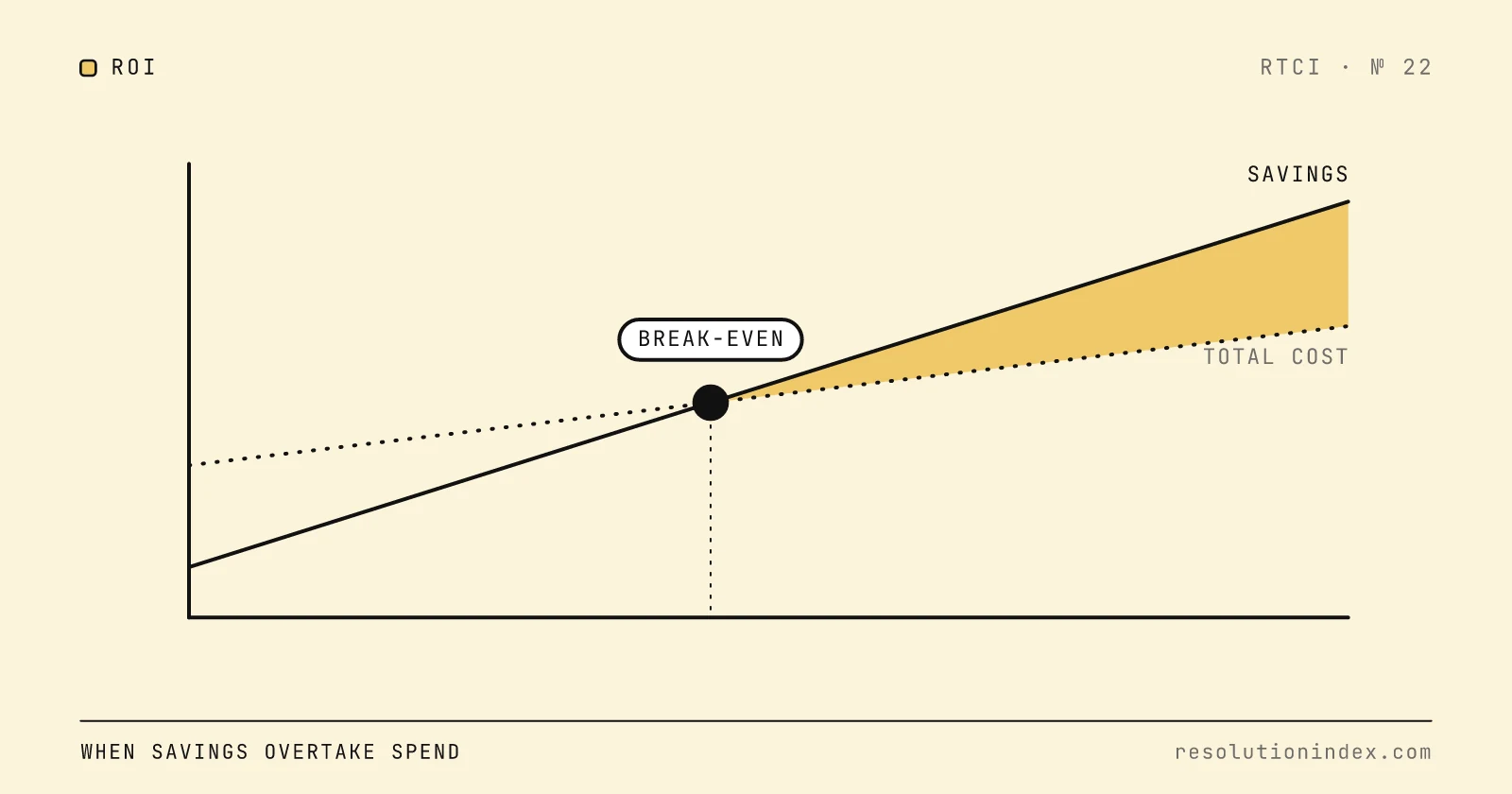
AI support pays for itself once its verified resolution rate passes F ÷ [V × (C_h − C_ai)]: monthly fixed AI cost divided by monthly conversations times the saving on each resolved ticket. With 2026 list prices that threshold is low. It works out to about 6% for a 1,000-conversation Shopify store on Gorgias Pro, 1.3% for an 8,000-conversation team on Intercom Fin, and 7% for a 50,000-conversation Zendesk deployment carrying $20,000 a month of extra platform cost. The hard part is the resolution rate you plug in, not the algebra.
Before you run it, measure your own resolution rate and normalise the vendor quotes you are comparing. The worked examples below use assumed human costs and volumes, stated in each one, so you can swap in your own.
How is the break-even formula derived?
The formula compares two ways to handle the same monthly volume. In the status quo every conversation costs whatever a human costs to close. In the AI path you pay the AI's fixed and variable costs, plus the human cost of everything the AI does not resolve end to end.
Let:
- V = monthly support conversations
- C_h = fully loaded human cost per conversation, calculated as the cost per verified resolution framework defines it
- C_ai = variable AI cost per verified resolution
- F = monthly AI fixed cost (seats, platform fee, base plan, mandatory add-ons, amortized implementation, and the fees that never reach the pricing page)
- r = verified resolution rate as a decimal (the AI resolves the issue with no human handoff and no re-contact within your window)
- C_rework = human cost per conversation the AI fails or that reopens
Total AI-path cost per month:
Total AI cost = F + (V × r × C_ai) + (V × (1 − r) × C_rework)
Status quo cost per month:
Total human cost = V × C_h
Set C_rework equal to C_h, set the two totals equal and solve for r:
r_be = F ÷ [V × (C_h − C_ai)]
If your human team spends less time on a failed AI conversation than on a fresh ticket, use a lower rework cost; if failed escalations take longer, use a higher one. With C_rework different from C_h the solution becomes r_be = [F + V × (C_rework − C_h)] ÷ [V × (C_rework − C_ai)].
Two inputs need care. If the vendor bills events other than resolutions (Intercom Fin, for example, also bills Procedure handoffs, disqualifications and self-serve routings at $0.99, per RTCI's Fin review), multiply C_ai by billed outcomes, not by verified resolutions. And if the plan includes an allowance, the included units belong in F and only the units above it are variable.
What counts as a verified resolution?
A resolution counts only if the AI solved the customer's issue end to end: no human agent touched the case, the customer did not return with the same issue inside the verification window, and the case was not closed by silence alone. RTCI uses a 72-hour no-recontact window.
Use that verified rate in the formula, not the vendor's headline rate. RTCI's realistic ranges already discount each vendor's published claim by the same rule; for example Fin's published 76% average becomes a realistic 56–66%. Every point of difference between the rate you assume and the rate you get moves (C_h − C_ai) × V dollars a month from savings back to cost.
Worked example 1: a Shopify store on Gorgias Pro
Assume a Shopify brand with 1,000 conversations a month and an outsourced team at $8 per human-handled conversation. Gorgias Pro costs $300 a month on annual billing for 2,000 tickets and includes 190 automated interactions at $0.90 each; above the allowance each interaction costs $1.50, per RTCI's Gorgias review. Every automated interaction also counts as a ticket, which this volume stays well inside.
Inputs:
- Monthly volume (V) = 1,000 (assumed)
- Human cost per conversation (C_h) = $8 (assumed)
- Fixed cost (F) = $300 plan + 190 × $0.90 included interactions = $471
- Variable cost above 190 resolutions = $1.50 each
Break-even resolution rate: the first 190 resolutions are already paid for in F, so below 19% the AI path costs $471 + 1,000 × (1 − r) × $8. Setting that equal to $8,000 gives r_be = $471 ÷ $8,000 = 5.9%.
Now test it at 35%, inside RTCI's realistic 27–37% range for Gorgias:
- Status quo cost = 1,000 × $8 = $8,000
- Fixed cost = $471
- Overage = (350 − 190) × $1.50 = $240
- Human rework = 1,000 × 0.65 × $8 = $5,200
- Total AI-path cost = $471 + $240 + $5,200 = $5,911
- Monthly savings = $8,000 − $5,911 = $2,089
- Payback on an assumed $3,000 setup = $3,000 ÷ $2,089 = 1.4 months
At the bottom of the realistic range, 27%, the AI path costs $471 + $120 overage + $5,840 rework = $6,431 and saves $1,569 a month. The AI fee per resolution is ($471 + $240) ÷ 350 = $2.03 at 35%, more than double the $0.90 headline, because the allowance is paid whether or not it is used and the extra resolutions bill at overage. On this plan the case still holds; on the monthly plan ($360 and $1.00 per included interaction) rerun the numbers.
Worked example 2: a SaaS team on Intercom Fin
Assume a SaaS company with 8,000 conversations a month, already on Intercom Advanced at $85 per seat for 10 seats, with a fully loaded human cost of $9 per conversation. Fin bills $0.99 per outcome.
Inputs:
- Monthly volume (V) = 8,000 (assumed)
- Human cost per conversation (C_h) = $9 (assumed)
- AI variable cost per resolution (C_ai) = $0.99
- Fixed cost (F) = 10 × $85 = $850
Break-even resolution rate:
r_be = $850 ÷ [8,000 × ($9 − $0.99)] = $850 ÷ $64,080 = 1.33%
Most existing Intercom customers pay for those seats anyway, so the real question is whether the Fin spend beats the human cost it replaces. It does at almost any rate above zero, because each resolution saves $9 − $0.99 = $8.01.
At 56%, the low end of RTCI's realistic 56–66% range for Fin:
- Status quo cost = 8,000 × $9 = $72,000
- Fixed cost = $850
- Fin outcomes = 8,000 × 0.56 × $0.99 = $4,435.20
- Human rework = 8,000 × 0.44 × $9 = $31,680
- Total AI-path cost = $850 + $4,435.20 + $31,680 = $36,965.20
- Monthly savings = $72,000 − $36,965.20 = $35,034.80
- Annual run-rate savings = $420,417.60
If the verified rate is 40% instead, the AI path costs $850 + $3,168 + $43,200 = $47,218 and saves $24,782 a month, 29% less than the 56% case. If some of the billed outcomes are handoffs or routings rather than resolutions, add those at $0.99 each to the Fin line.
Worked example 3: an enterprise team on Zendesk AI
Assume an enterprise team with 50,000 conversations a month on Zendesk Suite Professional: 60 agents at $115 per agent per month (annual) plus Copilot at $50 per agent, $165 per agent in total. Suite Professional includes 10 automated resolutions per agent per month (600 here); additional resolutions cost $1.50 at the committed rate, per RTCI's Zendesk AI review. Assume a fully loaded human cost of $10 per conversation.
Inputs:
- Monthly volume (V) = 50,000 (assumed)
- Human cost per conversation (C_h) = $10 (assumed)
- AI variable cost per resolution (C_ai) = $1.50
- Fixed cost (F) = 60 × $165 = $9,900
Break-even resolution rate (seats and Copilot only):
r_be = $9,900 ÷ [50,000 × ($10 − $1.50)] = $9,900 ÷ $425,000 = 2.33%
Enterprise contracts often add QA, workforce management and amortized implementation, which Zendesk sells separately. Assume those add $20,000 a month, so F = $29,900:
r_be = $29,900 ÷ $425,000 = 7.04%
At 41%, the midpoint of RTCI's realistic 36–46% range for Zendesk AI:
- Status quo cost = 50,000 × $10 = $500,000
- Fixed cost = $29,900
- AI resolutions above the allowance = (20,500 − 600) × $1.50 = $29,850
- Human rework = 50,000 × 0.59 × $10 = $295,000
- Total AI-path cost = $29,900 + $29,850 + $295,000 = $354,750
- Monthly savings = $500,000 − $354,750 = $145,250
At the bottom of the range, 36%, savings are $124,000 a month; at the top, 46%, $166,500. The per-resolution rate is the main negotiating line at this scale: 10 cents off $1.50 on 22,400 billable resolutions (46%, less the allowance) is $2,240 a month. Moving from pay-as-you-go ($2.00) to the committed rate ($1.50) is worth five times that.
What if your resolution rate is wrong?
The table shows monthly savings for the Fin example as the verified rate moves across and below RTCI's realistic 56–66% range.
| Verified resolution rate | Fin outcomes | Rework tickets | Rework cost | Total AI-path cost | Monthly savings vs. $72,000 |
|---|---|---|---|---|---|
| 46% | 8,000 × 0.46 × $0.99 = $3,643.20 | 4,320 | $38,880 | $850 + $3,643.20 + $38,880 = $43,373.20 | $28,626.80 |
| 51% | 8,000 × 0.51 × $0.99 = $4,039.20 | 3,920 | $35,280 | $850 + $4,039.20 + $35,280 = $40,169.20 | $31,830.80 |
| 56% (base) | 8,000 × 0.56 × $0.99 = $4,435.20 | 3,520 | $31,680 | $850 + $4,435.20 + $31,680 = $36,965.20 | $35,034.80 |
| 61% | 8,000 × 0.61 × $0.99 = $4,831.20 | 3,120 | $28,080 | $850 + $4,831.20 + $28,080 = $33,761.20 | $38,238.80 |
| 66% | 8,000 × 0.66 × $0.99 = $5,227.20 | 2,720 | $24,480 | $850 + $5,227.20 + $24,480 = $30,557.20 | $41,442.80 |
Each point of resolution rate is worth 80 × $8.01 = $640.80 a month here, so a 10-point miss below the base case cuts savings by $6,408, or 18%. Finance should approve the case at the low end of the realistic range. If it only works at the top, it is not a safe deal.
The same per-point logic applies to the other examples: one point is worth V ÷ 100 × (C_h − C_ai). That is $4,250 a month in the Zendesk example. In the Gorgias example a point is worth $80 below the 190-interaction allowance, where the AI fee is already paid, and 10 × ($8 − $1.50) = $65 above it. A large fixed cost does not change the value of a point, but it raises the rate you must reach before the first dollar of savings, which is why big platform fees deserve a pilot first.
How does a flat credit plan change the math? (YourGPT Advanced)
Not every vendor charges per resolution. YourGPT's Advanced plan costs $349 a month billed yearly and includes 100 million AI credits; extra credits cost $7 per 2 million, up to 100 packs, per RTCI's YourGPT review. RTCI's ~$0.13 (est.) per resolution assumes the plan covers about 3,000 conversations a month, which implies about 33,000 credits per conversation, and the 90% rate YourGPT reached in RTCI's November 2026 test.
Assume 6,000 conversations a month, a 90% verified rate and $9 per human-handled conversation:
- Credits needed = 6,000 × ~33,333 = about 200 million
- Top-up = 100 million extra = 50 packs × $7 = $350
- AI-resolved conversations = 5,400
- Human rework = 600 × $9 = $5,400
- Total AI-path cost = $349 + $350 + $5,400 = $6,099
- Status quo = 6,000 × $9 = $54,000
- Monthly savings = $47,901
AI cost per verified resolution is ($349 + $350) ÷ 5,400 = $0.13. Because credits are consumed per conversation whether or not it resolves, the AI cost does not depend on r, and break-even is total AI cost ÷ status quo cost: $699 ÷ $54,000 = 1.3%.
The risk moves from the per-resolution price to credit burn. At this credit rate the 100-pack cap covers about 9,000 conversations a month (300 million credits ÷ 33,333), so a 10,000-conversation team would need a quote above Advanced. Heavier models also burn more: YourGPT's stated rate is 5,000 credits per conversation, and a GPT-4o conversation uses about 25,000.
Should you commit, pilot or wait?
Run the formula with your own numbers, then compare r_be with the low end of the vendor's RTCI realistic range and with your own pilot result.
Commit if:
- r_be sits well below both the low end of the vendor's realistic range and your pilot rate.
- You can measure verified resolution internally, with a 72-hour re-contact check.
- The vendor's billable event matches your definition: no human handoff, no re-contact, no silence-as-success, or you have priced the extra billed events.
Pilot first if:
- r_be is within 10 points of the realistic range or your pilot rate.
- A large share of your tickets are refunds, account changes, compliance cases or complaints the AI is not allowed to close.
- You do not yet track re-contacts in your helpdesk.
- The plan has allowances, overage rates or credit caps that seasonal volume could push you past.
Wait if:
- r_be is above the top of the vendor's realistic range.
- C_h − C_ai is small. At $3 human cost and $1.50 per resolution, each resolution saves $1.50, so the Zendesk example's $9,900 fixed cost on 50,000 conversations needs r_be = $9,900 ÷ (50,000 × $1.50) = 13.2% instead of 2.3%.
- Your knowledge base or integrations cannot support the intents you want automated.
- The vendor will not define "resolution" in writing before signature.
Which mistakes break the math?
Using the claimed rate instead of the verified rate. Vendor dashboards may count workflow completions, silences or quiet periods. Recount with your own 72-hour no-recontact window.
Setting rework cost to zero. Every failed AI conversation still needs a human, sometimes for longer than a fresh ticket.
Modelling the average month only. Per-resolution bills rise with seasonal spikes and can cross an allowance into overage; seat bills do not. Model the busiest month too.
Counting only headcount reduction. If the AI absorbs growth instead of cutting staff, model the hires you avoid as the saving.
Leaving implementation out of year one. A $50,000 setup on a 1,000-conversation queue is a different decision from the same setup on 50,000. Spread it over the contract term or include it in year-one F.
Using the wrong denominator. V is the total volume you intend the AI to handle, not the curated subset a vendor picks for the pilot.
FAQ
What is the break-even formula for AI support? Break-even verified resolution rate = monthly AI fixed cost ÷ [monthly conversations × (human cost per ticket − AI variable cost per resolution)].
Do I include implementation cost? Yes. Spread it over the contract term and add the monthly share to fixed cost, or add it to year-one fixed cost.
What if my human cost per ticket is low? The saving per resolution (C_h − C_ai) shrinks, so the break-even rate rises in proportion. Halving the saving doubles the threshold.
Which is cheaper: per-resolution or flat credit pricing? Flat credit plans are cheaper per resolution while the included credits cover your volume. Past that, top-ups are charged per conversation, resolved or not. Per-resolution pricing scales only with resolved volume.
How do I get a realistic resolution rate? Run an unfiltered 30-day pilot with a fixed 72-hour re-contact window. Use the lower of your pilot result and the low end of RTCI's realistic range for the vendor.
Should I model best-case or conservative resolution rates? Conservative for the finance-approved case. If the deal works at the low end, the upside costs nothing.
Does the formula work for enterprise custom contracts? Yes. Split the contract into monthly fixed cost and per-resolution variable cost, put implementation and success fees in fixed cost, and solve for r.
What is a good break-even threshold? One comfortably below the low end of the vendor's RTCI realistic range and your own pilot rate. If r_be is above the top of the range, the deal depends on beating every comparable deployment.
Where can I calculate this automatically? Use RTCI's Cost per Verified Resolution Calculator with your own volume, costs and vendor rates.
Bottom line
At 2026 list prices the break-even resolution rate is low: 1.3% to 7% in the four examples above, because each resolution saves several dollars of human cost and the fixed costs are small next to the human budget. The decision rests on the rate you plug in. Use a verified rate with a fixed re-contact window, measured on your real ticket mix, check it against the low end of the vendor's realistic range, and run the sensitivity before you sign.
Change log
- Rebuilt the Gorgias example on the Pro plan's published allowance and $1.50 overage, moved the Fin and Zendesk examples onto RTCI's realistic ranges, corrected the 35% Fin scenario and the YourGPT top-up cap, and replaced unsourced rules of thumb with formula-based tests.
- Published.
Read next
Keep reading
Picked for this article: the pieces it cites and the ones that answer the next question buyers usually ask.
Most related
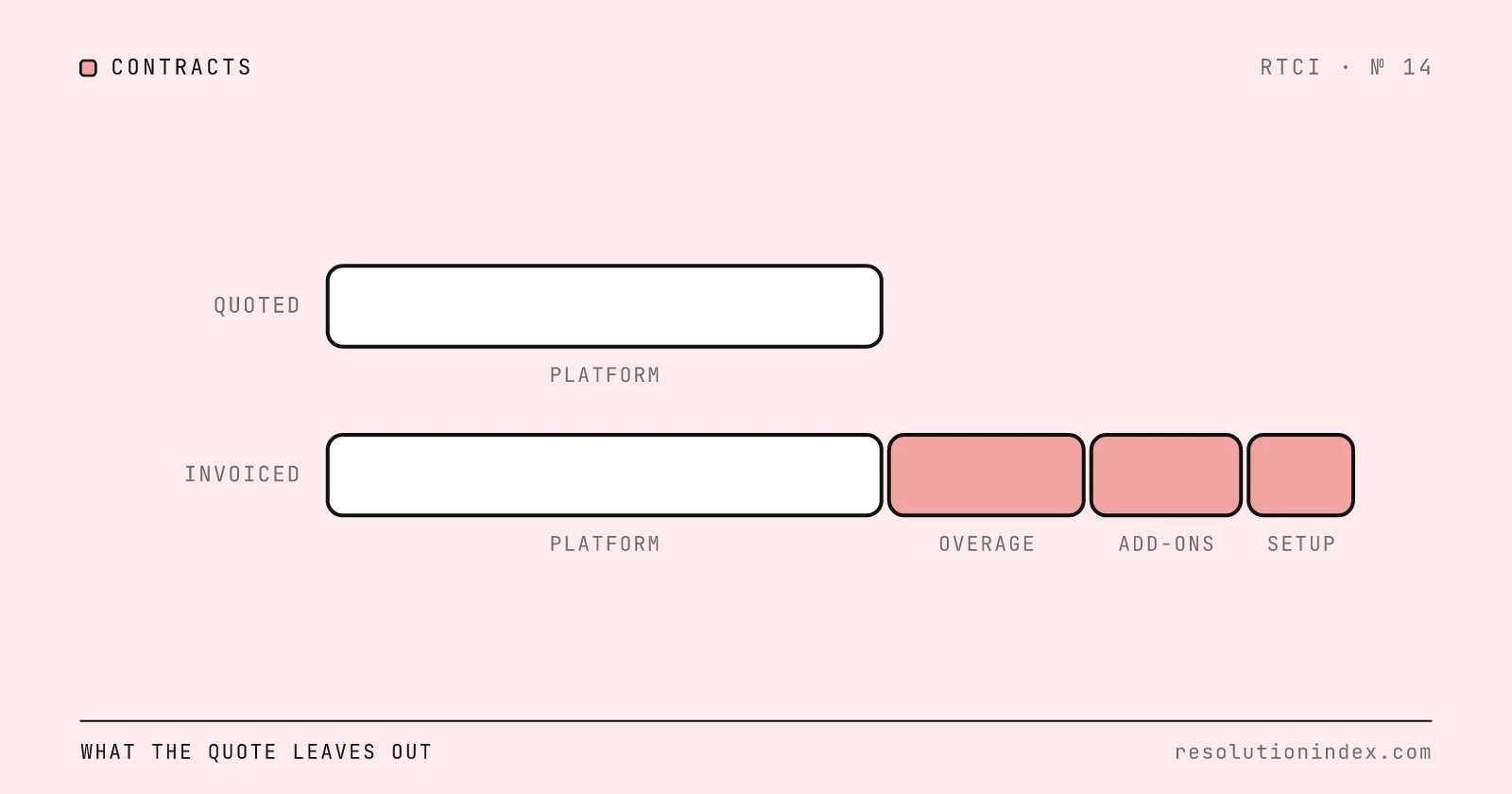
Hidden Fees in AI Support Contracts: What Buyers Miss
Where AI support invoices outgrow the quote: second meters, overage rates, one-time allowances, add-ons, outbound channels and exit costs, with clause language and a worked 12-month reconciliation.
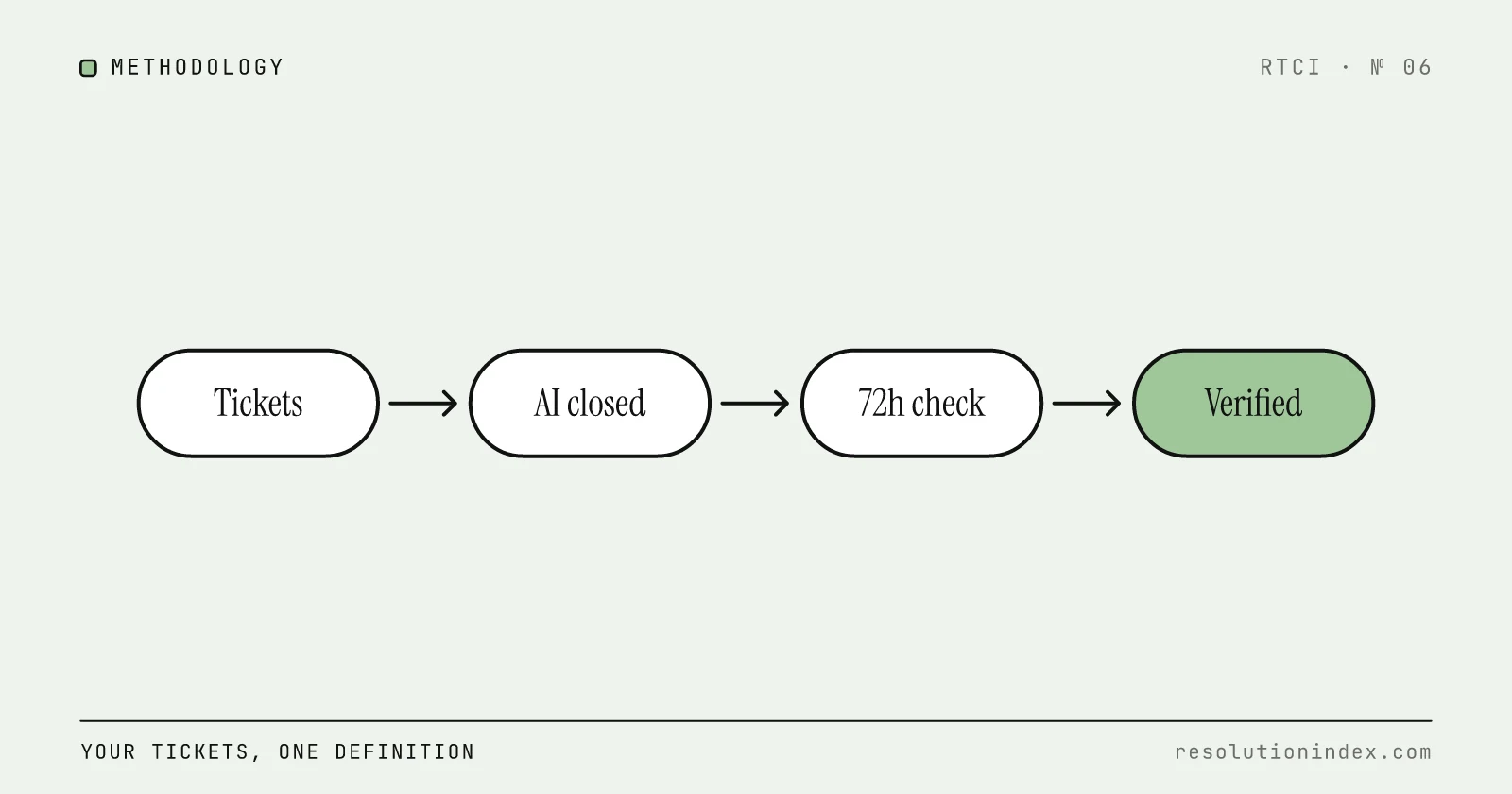
How to Measure AI Resolution Rate Internally
Vendor dashboards report resolution rates that no two vendors calculate the same way. This is a practical, vendor-agnostic methodology to measure your own AI resolution rate using your own ticket data, built on RTCI's 72-hour verified resolution standard.
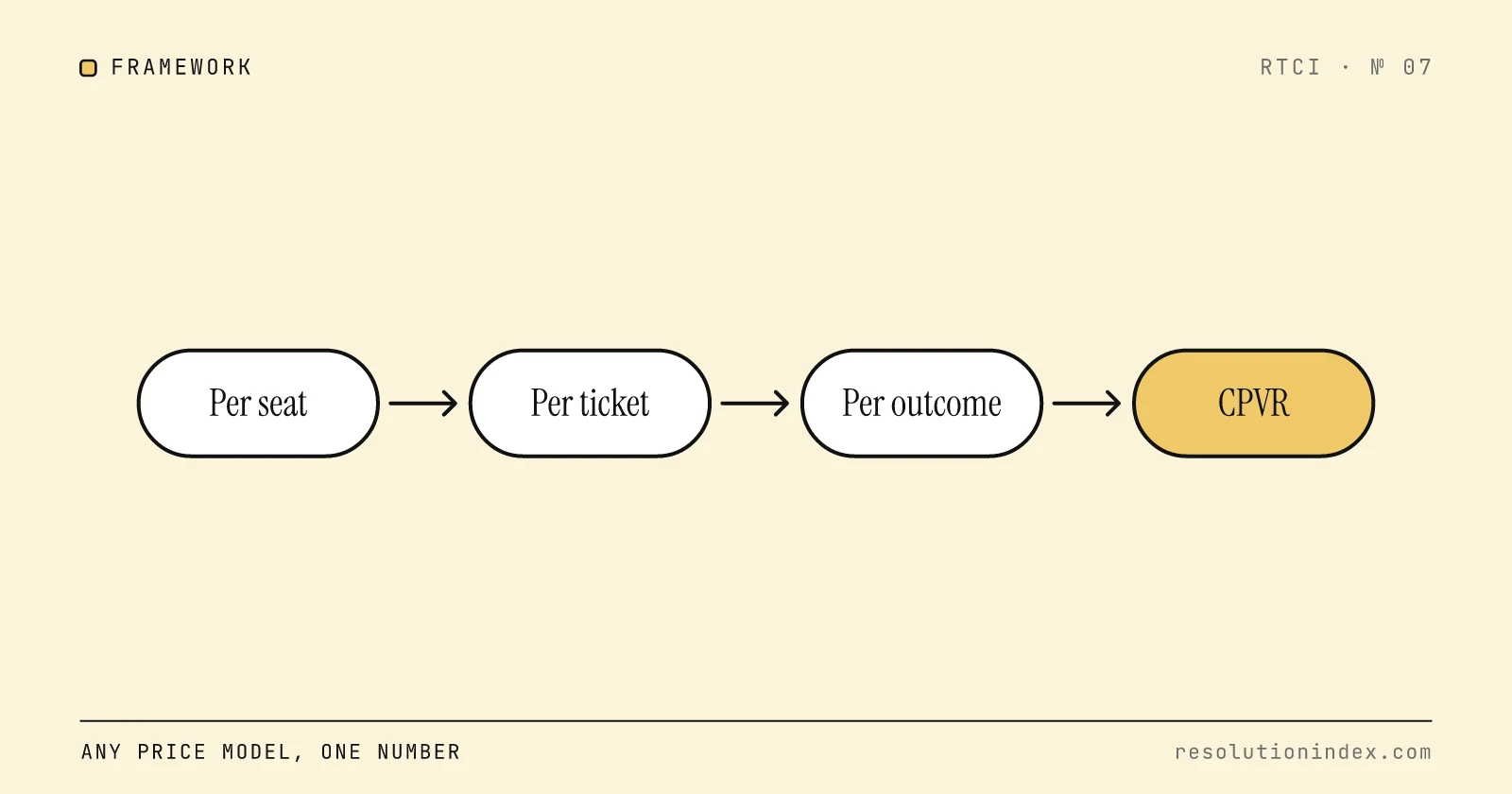
Cost Per Verified Resolution: A New Framework
Per-seat, per-ticket, and per-resolution pricing models all produce different numbers for the same underlying cost. RTCI's three-layer cost model normalizes any vendor's pricing into a single comparable metric: cost per verified resolution.
Compare AI Support Quotes Apples-to-Apples
A quote normalization worksheet that converts Intercom Fin, Zendesk AI, Freshdesk Freddy, Gorgias, Decagon, Sierra, and YourGPT quotes into one comparable number: cost per verified resolution.
Best AI Support Platforms for Mid-Market Companies (2026)
Mid-market shortlist: Intercom Fin, Freshdesk Freddy, Zendesk AI, DevRev, and YourGPT compared on bill predictability, 30–90 day implementation, and cost per verified resolution, with each vendor’s RTCI score and published price.