Published Aug 18, 2026 · Updated Nov 20, 2026 · 23 min read
Best AI Support Platforms for Enterprise (2026)
Enterprise shortlist: Salesforce Agentforce, Zendesk AI, Intercom Fin, Decagon, Sierra, Cognigy, and Kore.ai compared on security, deployment options, RTCI score, cost per resolution, and contract terms. Includes a copyable RFP scorecard.
 Written by Andrew Hall, Editor
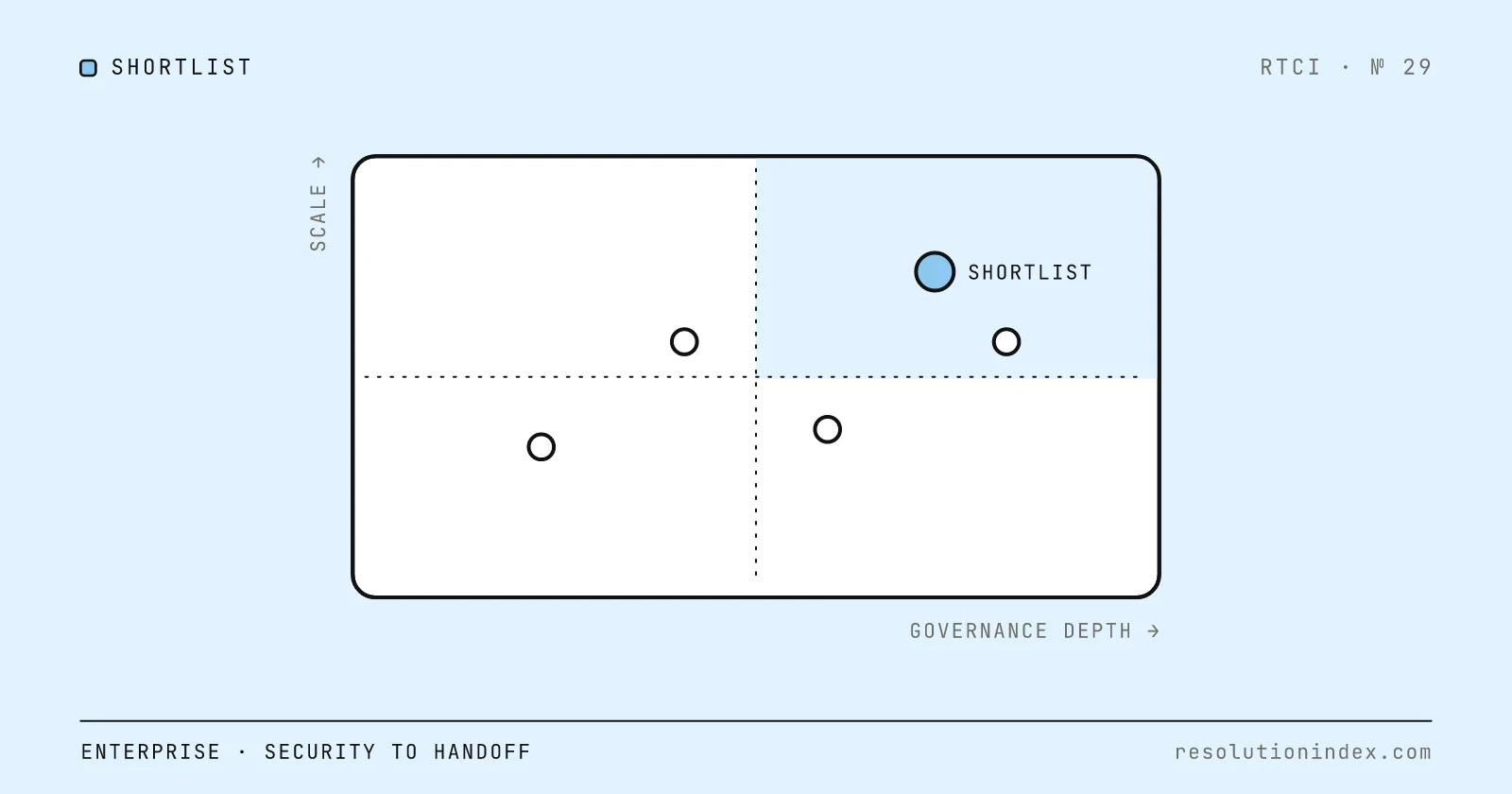
For enterprises (1,000+ employees, multi-region or regulated), the strongest AI support shortlist in 2026 is Salesforce Agentforce, Zendesk AI, Intercom Fin on the Expert plan, Decagon, Sierra, Cognigy and Kore.ai. Choose by stack and risk posture: Agentforce if Salesforce is your system of record, Zendesk AI if you already run Zendesk, Fin for published per-outcome pricing, Decagon or Sierra for action-taking agents on a negotiated contract, Cognigy for voice-first contact centers, and Kore.ai if you need on-premises deployment. Below: index scores, a weighted scorecard, a security matrix and contract clauses.
How Does the Shortlist Score in the RTCI Index?
RTCI scores every platform with the same rule: 250 × log10(10 × realistic resolution rate ÷ cost per resolution), on a 0–1,000 scale. 750+ is Elite, 650–749 Strong, below 650 Moderate. Vendors without a public unit price are scored on documented estimates, marked “est.”.
| Platform | RTCI score | Tier | Benchmark rank | Realistic resolution | AI cost per resolution |
|---|---|---|---|---|---|
| Intercom Fin | 696 | Strong | #1 of 20 | 56–66% | $0.99 |
| Decagon | 682 (est.) | Strong | #4 of 20 | 80% (RTCI test, Nov 2026) | ~$1.50 est. |
| Sierra AI | 612 (est.) | Moderate | #5 of 20 | 73% (RTCI test, Nov 2026) | ~$2.61 est. |
| Kore.ai | 779 (est.) | Elite | #6 of 20 | 60% (RTCI test, Nov 2026) | ~$0.46 est. |
| Zendesk AI | 592 | Moderate | #13 of 20 | 36–46% | $1.50–$2.00 |
| Salesforce Agentforce | 588 | Moderate | #19 of 20 | 44–54% | $2.00–$4.55 |
| Cognigy | 652 (est.) | Strong (est.) | #20 of 20 | 49–59% | ~$1.33 est. |
The index measures resolution economics only. It says nothing about security, deployment model or professional services, which is why the enterprise weights below put those first. Note one ownership link: Salesforce completed its acquisition of Fin (formerly Intercom) on September 10, 2026, so two of the seven vendors now share a parent.
Who This Is (and Isn't) For
This guide is for VP Customer Experience, CIO, CISO partners, procurement leaders, and contact-center transformation owners at organizations with 1,000+ employees, operating across regions or in regulated industries, with 50+ agents across email, chat, voice and social. You already run a CRM, an ITSM platform and an identity provider, and the vendor has to survive security review, legal review and a multi-quarter procurement cycle.
It is not for mid-market companies (100 to 1,000 employees) where a 30-day self-serve pilot is the buying motion; see the mid-market AI support platforms guide. It is also not for ecommerce-only Shopify operations; see the ecommerce guide.
What Changes When the Buyer Is an Enterprise?
- Procurement is an RFP, not a credit card. Purchases go through security review, legal review, vendor risk assessment and finance approval, so self-serve onboarding is irrelevant.
- Security is a gate. A missing certification, a data residency gap or an incomplete subprocessor list can veto a vendor regardless of its resolution rate.
- Regions matter. GDPR in Europe, HIPAA in US healthcare, and data-sovereignty rules elsewhere mean a vendor that cannot commit to where data is stored and processed is out.
- Professional services decide the rollout. A 50+ agent deployment across brands, queues and languages needs implementation engineering and change management, not just a login.
- Integration depth. The AI agent has to read from and write back to CRM, ITSM, billing and identity systems.
Those constraints produce a different rubric. Mid-market buyers weight cost per verified resolution first; enterprise buyers weight security and governance first.
Enterprise Weighted Scorecard
Use these weights for enterprise evaluation. Mid-market weights produce different winners.
| Criterion | Weight | Why enterprise | How to score (0 to 5) |
|---|---|---|---|
| Security, compliance, governance | 20% | Security and legal can veto the purchase. | Cert pack completeness, questionnaire turnaround, RBAC depth, audit log export, DLP, model data controls |
| Professional services and managed AI ops | 15% | Multi-brand, multi-queue rollouts need implementation support. | Named CSM, implementation engineering, QBR cadence, managed evals, training |
| Global and multi-region deployment | 15% | Data residency, language coverage, follow-the-sun operations. | Regions offered, residency options, private cloud or on-prem if required |
| Verified resolution quality and human handoff | 15% | Brand and regulatory risk. Deflection is not resolution. | Human-eval sampling, context-preserving handoff, action audit trail, re-contact tracking |
| Integration depth | 10% | CRM, ITSM, identity, billing, custom APIs. | Native Salesforce, ServiceNow, Okta connectors vs middleware. API or MCP depth. |
| Procurement flexibility and commercial clarity | 10% | MSA, outcome definitions, exit clauses, liability, subprocessors. | Clear unit economics, pilot terms, termination assistance, training-data opt-out |
| Cost per verified resolution (CPVR) | 10% | Finance needs unit economics at scale, not just at pilot volume. | Model all-in (seats + AI + services) at 3 volume bands with overage caps |
| Vendor stability and roadmap | 5% | Multi-year dependency; acquisitions change roadmaps. | Funding or parent company, reference customers in your vertical, roadmap commitments |
Score each vendor 0 to 5 on each criterion, multiply by the weight and sum for a total out of 5.0.
Worked example: a retail bank on Salesforce comparing three vendors
Assume a bank with 2,000 support agents across six regions, 500,000 conversations a month, Salesforce CRM, and a requirement to serve a US federal program. The 0–5 scores below are illustrative judgments for that scenario, built from the facts in the profiles further down; your own scores will differ.
| Criterion (weight) | Agentforce | Zendesk AI | Kore.ai |
|---|---|---|---|
| Security (20%) | 5 (FedRAMP High via Government Cloud Plus) | 4 (FedRAMP Low; AI features may be out of scope) | 5 (SOC 2, HIPAA, PCI-DSS, on-prem option) |
| Professional services (15%) | 5 | 3 | 4 |
| Global deployment (15%) | 5 (Hyperforce regions) | 3 (confirm regions) | 4 (cloud, private VPC or on-prem) |
| Verified resolution quality (15%) | 3 (70% self-reported on Salesforce’s own help site) | 4 (only LLM-verified resolutions billed) | 3 (60% in RTCI’s Nov 2026 test) |
| Integration depth (10%) | 5 (native Salesforce) | 4 (1,800+ app marketplace) | 3 (integrates with Salesforce, Genesys, NICE, ServiceNow) |
| Procurement flexibility (10%) | 2 (several overlapping meters) | 3 | 4 (flexible deployment) |
| CPVR (10%) | 2 ($2.00–$4.55 per resolution) | 3 ($1.50–$2.00) | 3 (~$0.46 est. plus $80,000 a year in fixed AWS lines) |
| Vendor stability (5%) | 5 | 4 | 4 |
| Weighted total | 4.10 | 3.50 | 3.85 |
Check the first column: 5×0.20 + 5×0.15 + 5×0.15 + 3×0.15 + 5×0.10 + 2×0.10 + 2×0.10 + 5×0.05 = 4.10. Agentforce wins here because the security, deployment and integration weights reward a Salesforce-native, FedRAMP High option, even though it has the highest cost per resolution in the index. Drop the federal requirement and weight voice instead, and the order changes. That is the point of the table.
Which Vendors Should You Knock Out Before Demos?
Disqualify platforms that fail any of these checks before you score them.
Enterprise Knockout Filters
[ ] 1. No SSO/SAML with SCIM provisioning on the enterprise plan. If IT cannot centrally manage access, the vendor does not fit an enterprise stack.
[ ] 2. No exportable audit logs for conversations, AI actions and admin changes.
[ ] 3. No written data residency statement or subprocessor list before contract signature.
[ ] 4. Refuses a human-judged resolution sample clause in the MSA. See why vendor-claimed resolution rates do not match reality.
[ ] 5. No warm handoff into your system of record with full transcript, intent and customer context.
[ ] 6. Mandatory multi-year commitment with no performance exit.
[ ] 7. Security questionnaire answered with assurances instead of documents.
Red flags during evaluation:
- The vendor defines “resolution” as a closed ticket, with no customer confirmation or re-contact window.
- Training on your customer data is on by default. The MSA needs a training-data opt-out.
- No spend caps on usage-based pricing.
- FedRAMP is claimed without naming the authorization level and the products in scope. Zendesk’s authorization, for example, is at the Low (LI-SaaS) level, and third-party compliance sites report that its generative AI features are outside that scope.
- The voice demo only runs the happy path. Ask for a voice PoC with accents, interruptions and multi-turn repair.
How We Shortlisted
We filtered on published security and compliance documentation, depth of enterprise professional services, and the RTCI verified-resolution lens, which compares cost per verified resolution rather than vendor-claimed containment. Scores, tiers, realistic resolution rates and costs come from the RTCI index as rescored in November 2026; vendor facts come from the RTCI review of each platform or the vendor page linked in the text. For the decision tree, see how to choose an AI customer support platform in 2026.
Platforms with ecommerce-only data models or no enterprise security documentation were excluded. No vendor paid for placement on this list.
Platform Profiles
Each profile covers enterprise fit, security and deployment, pricing shape, when to pick it, when to skip it, and one trade-off to raise in evaluation. Prices were checked in November 2026; re-verify before signature.
Salesforce Agentforce
Enterprise fit: Agentforce is the default choice when Salesforce Service Cloud is your system of record, because the AI draws on the same cases, contacts, knowledge and permissions already in the org. Salesforce reports that Agentforce resolves 70% of inquiries on its own help site, across 4.3 million handled (announced June 2026). That is a single, self-reported deployment, so RTCI applies its case-study discount for a realistic 44–54%.
Security and deployment: Salesforce publishes its compliance documentation at salesforce.com. Its FedRAMP page says Agentforce is covered by a FedRAMP High authorization through Government Cloud Plus; confirm the specific Agentforce features on Salesforce’s list of authorized products. Hyperforce runs Salesforce on public cloud infrastructure in multiple regions. There is no on-premises option.
Pricing shape: several overlapping meters on top of a Service Cloud licence. Help Agent costs $2 per resolution (since July 2026, with no charge when the customer asks for a human or leaves unhappy). Flex Credits cost $500 per 100,000 credits, or $0.10 per standard action. Existing Conversations customers pay $2 per conversation, which at a 44% realistic rate is $4.55 per resolution. The Agentforce add-on is $125 per user per month. RTCI’s range is $2.00–$4.55 per resolution, the highest among scored platforms, for an RTCI score of 588 (Moderate). Our Agentforce pricing guide breaks down each meter.
When to pick it: your CRM is Salesforce, you need FedRAMP High, and you want the AI on the same data model as your cases.
When to skip it: you are not on Service Cloud, or cost per resolution is a primary criterion.
Trade-off to name: which meter applies. Flex Credits and Conversations cannot be used in the same org, and unused Flex Credits do not roll over. Get the meter, the volume commitment and the outcome definition in writing. See what is a good AI resolution rate for benchmark ranges.
Zendesk AI
Enterprise fit: Zendesk AI is the AI layer inside Zendesk’s Support and Suite plans: customer-facing AI agents, Copilot for human agents, intelligent triage and quality scoring, with a 1,800+ app marketplace. For enterprises already on Zendesk, the question is how far to deepen it before an alternative makes sense.
Security and deployment: SOC 2, ISO 27001, HIPAA and GDPR are documented at the Zendesk Trust Center. Zendesk holds a FedRAMP Low (LI-SaaS) authorization listed on the FedRAMP Marketplace since 2020; third-party compliance sites report generative AI features are outside its scope, so confirm with Zendesk. SaaS only.
Pricing shape: Suite Professional is $115 per agent per month on annual billing; Suite Enterprise is quoted. Plans include a small allowance of automated resolutions; beyond it, AI agents cost $1.50 per resolution committed or $2.00 pay-as-you-go, and since May 18, 2026 only LLM-verified resolutions are billed. Copilot is $50 per agent per month. RTCI’s realistic resolution rate is 36–46%, for an RTCI score of 592 (Moderate). Our Zendesk pricing guide has every line item.
When to pick it: your team already runs Zendesk, and QA, workforce management and marketplace apps matter.
When to skip it: you need FedRAMP coverage that includes the AI features, or on-premises deployment, or you are not already on Zendesk.
Trade-off to name: price stacking. Seats, Copilot, resolutions beyond the allowance, QA and WFM are separate lines. Read the hidden cost of AI customer support pricing and compare all-in cost with the apples-to-apples quote framework.
Intercom Fin (Expert Plan)
Enterprise fit: Fin can run on Intercom’s helpdesk or on top of another helpdesk such as Zendesk or Salesforce. Fin reports a 76% average resolution rate across more than 12,000 customers; RTCI’s realistic figure is 56–66%, which ranks Fin #1 of 20 with an RTCI score of 696 (Strong). Salesforce completed its roughly $3.6B acquisition of Fin on September 10, 2026, so packaging decisions now sit with Salesforce.
Security and deployment: Intercom’s security page lists SOC 2 Type II, ISO 27001 and HIPAA compliance, GDPR and CCPA, and hosting in the US, EU or Australia. The Expert plan adds SSO and identity management, HIPAA support, SLAs and multibrand. No FedRAMP is listed. SaaS only.
Pricing shape: $0.99 per Fin outcome, charged once per conversation. An outcome is counted when the customer confirms resolution, does not ask for more help, or Fin completes a Procedure, including handoffs. Expert seats are $132 per seat per month. On another helpdesk, Fin needs no seats but has a 50-outcome monthly minimum. Source: intercom.com/pricing.
When to pick it: you want a published per-outcome price and a strong AI front door without replacing your system of record.
When to skip it: you need FedRAMP or on-premises deployment, or finance needs a fixed AI line.
Trade-off to name: an outcome is not always a resolution, because Procedure handoffs are billed too. Ask for a monthly breakdown of billed outcomes by type, and price protection through the Salesforce integration. The CPVR framework shows how to convert outcomes into verified resolutions.
Decagon
Enterprise fit: Decagon is a sales-led AI concierge for chat, voice and email, configured through Agent Operating Procedures (AOPs): natural-language procedures with traces and guardrails. Named case studies: Chime reports 70%+ chat resolution and nearly 70% on voice, Valon reports 50%+ on voice, and Duolingo reports an 80% deflection rate. In RTCI’s November 2026 test Decagon resolved 80%.
Security and deployment: security certifications are not the focus of the public site; request the report pack early in the security questionnaire. SaaS only.
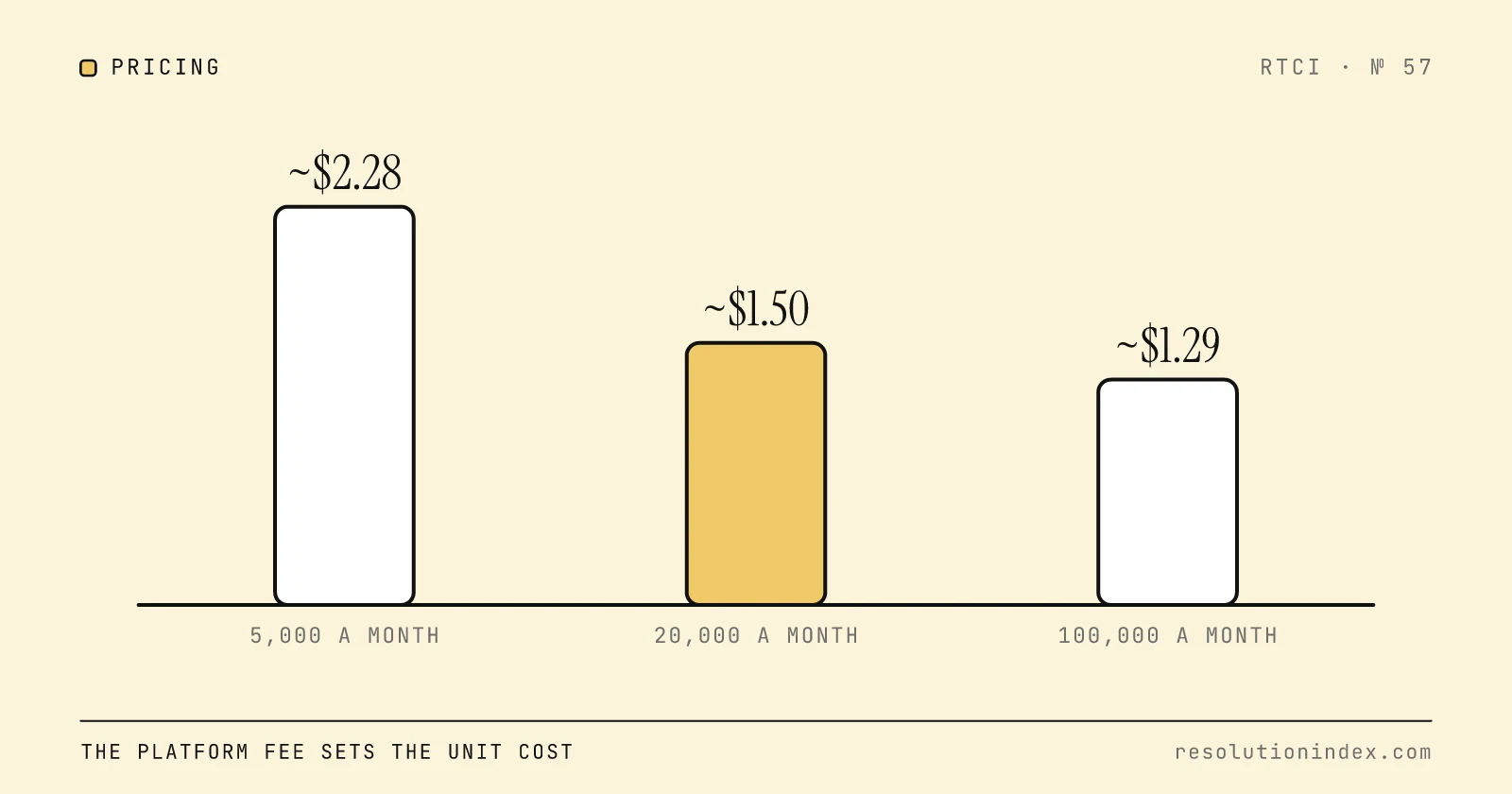
Pricing shape: no pricing page. Decagon offers per-conversation or per-resolution billing. RTCI estimates ~$1.50 per resolution from a competitor’s reported ~$0.99 per conversation and ~$50,000-a-year platform fee at 20,000 conversations a month; at 5,000 a month it is about $2.28. Vendr lists a median annual contract of $432,750. RTCI score: 682 (est., Strong).
When to pick it: you want an agent that executes multi-step workflows and have a team that can own the AOPs.
When to skip it: you need a full helpdesk (Decagon is an agent layer), on-premises deployment, or a public rate card.
Trade-off to name: your quote replaces RTCI’s estimate, and Decagon’s own figures mix resolution and deflection. Define both in the contract. The Decagon vs Sierra comparison covers the two side by side, and the Decagon pricing guide lists what to get in writing in the quote.
Sierra
Enterprise fit: Sierra builds action-taking agents for large consumer brands such as SiriusXM, Rocket Mortgage, CLEAR and Chime, deployed across chat, phone, email, SMS and messaging. Agent Studio exposes tool traces, simulations and regression tests. In RTCI’s November 2026 test Sierra resolved 73%; its named case studies report 70% to 80%.
Security and deployment: Sierra’s trust page lists SOC 2, HIPAA, GDPR, PCI, FedRAMP High, CCPA, CSA STAR, ISO 27001 and ISO 42001 commitments, with evidence available through its Trust Center. SaaS only.
Pricing shape: outcome-based or blended, by quote; unresolved and escalated conversations generally are not billed. Third parties report $1 to $2.50 per resolution, a ~$150,000-a-year platform fee and $50,000 to $200,000 in setup. RTCI estimates ~$2.61 per resolution at 20,000 conversations a month, for an RTCI score of 612 (est., Moderate).
When to pick it: you are a large consumer brand that wants an outcome-priced agent across voice and digital and will govern approvals, simulations and audits.
When to skip it: you need a helpdesk system of record, on-premises deployment, or a low-commitment trial.
Trade-off to name: the outcome definition is the price. If “outcome” means “conversation ended” rather than “issue resolved”, you pay for failures. Write outcomes, exclusions, reversals and audit rights into the contract.
Cognigy (NiCE Cognigy)
Enterprise fit: Cognigy, owned by NiCE since September 2025, is a voice-first contact-center automation platform that works with any CCaaS, sold standalone or inside NiCE CXone Mpower. Lufthansa runs 16M+ automated conversations a year on it. NiCE reports over 80% Tier 1 containment among early adopters; RTCI converts that containment figure to a realistic 49–59%.
Security and deployment: Cognigy’s installation docs describe shared SaaS, dedicated SaaS and on-premises installations, and state that on-premises is no longer offered to new customers (existing installations keep receiving updates). Request the certification pack in the questionnaire.
Pricing shape: the AWS Marketplace listing shows $43,080 for 12 months with 60,000 conversations on the Basic tier, or $53,916 with five Voice Gateways. RTCI divides the Basic tier’s $0.72 per conversation by a 54% realistic rate for ~$1.33 per resolution and an RTCI score of 652 (est., Strong). Using half the allowance roughly doubles the cost.
When to pick it: your operation is voice-first and you will use most of the conversation allowance.
When to skip it: your volume is mainly chat or email, you need a new on-premises deployment, or you need month-to-month terms.
Trade-off to name: Cognigy reports containment, not resolution. Define and measure resolution on your own traffic before relying on the 49–59% range.
Kore.ai
Enterprise fit: Kore.ai is an enterprise conversational and agentic AI platform for large contact centers and regulated industries. In 2026 it sits in the Leaders quadrant of Gartner’s Magic Quadrant for Conversational AI Platforms and holds Leader positions in Forrester Waves for customer service and employee services. It integrates with Genesys, NICE, Salesforce, ServiceNow and Zendesk. In RTCI’s November 2026 test it resolved 60%.
Security and deployment: Kore.ai positions on SOC 2, GDPR, HIPAA and PCI-DSS compliance. Its platform materials list cloud, private VPC and customer-managed on-premises deployment, which makes it the clearest on-premises option on this list.
Pricing shape: no price list on its own site. AWS Marketplace shows $0.20 per session for AI for Service and $0.35 per session for BankAssist (Digital); RTCI divides the $0.275 midpoint by 60% for ~$0.46 per resolution and an RTCI score of 779 (est., Elite). The same listing carries $80,000 a year in fixed lines (enterprise support and a non-production environment), which the estimate excludes.
When to pick it: you need on-premises or private-cloud deployment, or vertical templates for banking, healthcare or telecom.
When to skip it: you want a fast SaaS rollout or a helpdesk system of record.
Trade-off to name: implementation is a program that typically takes months, and third parties report that a session is metered per 15 minutes of activity. Get the session definition, seat costs and fixed fees in writing.
Security and Deployment Matrix
What each vendor states publicly, as of November 2026. “Ask” means we did not find it on a public vendor page; it may still be available, so request evidence in the security questionnaire. SSO/SAML, SCIM and audit-log export should be confirmed for every vendor on the plan you are buying.
| Vendor | SOC 2 | ISO 27001 | HIPAA | FedRAMP | On-prem | Hosting / residency |
|---|---|---|---|---|---|---|
| Salesforce Agentforce | Yes | Yes | Yes | High (Government Cloud Plus) | No | Hyperforce regions |
| Zendesk AI | Yes | Yes | Yes | Low (LI-SaaS); AI features reportedly out of scope | No | Ask for regions |
| Intercom Fin (Expert) | Yes (Type II) | Yes | Yes | Not listed | No | US, EU or Australia |
| Decagon | Ask | Ask | Ask | Ask | No | Ask |
| Sierra | Yes | Yes | Yes | High (listed on trust page) | No | Ask |
| Cognigy | Ask | Ask | Ask | Ask | Existing customers only | Shared or dedicated SaaS |
| Kore.ai | Yes | Ask | Yes | Ask | Yes | Cloud, private VPC or on-prem |
Deployment model narrows the list fastest. Kore.ai is the only vendor here still offering new on-premises installations. For FedRAMP High, the options are Agentforce through Government Cloud Plus and Sierra per its trust page; confirm which products and features each authorization covers.
Which Commercial Models Do Enterprises Sign?
The commercial model matters more than the sticker price, because it decides how cost behaves when volume or AI quality changes.
| Model | How it works | Vendors | Enterprise risk |
|---|---|---|---|
| Seat + AI usage + add-ons | Per-agent seats, a per-resolution AI fee beyond an allowance, and add-ons such as Copilot, QA and WFM | Zendesk AI | Add-ons push all-in cost well above the seat price. Model the full stack. |
| Per outcome / per resolution | Pay per billed outcome or resolution; seats may be separate | Intercom Fin ($0.99 per outcome), Agentforce Help Agent ($2 per resolution) | The outcome definition sets the real price. Negotiate it and cap volume. |
| Platform fee + usage | Annual contract plus per-conversation or per-session usage | Decagon, Cognigy, Kore.ai, Agentforce Conversations | The fee sets a floor; low utilization raises cost per resolution. Require caps and true-ups. |
| Outcome partnership | Vendor is paid for agreed outcomes on a negotiated contract | Sierra | Aligned incentives, complex contract. Legal review is essential. |
Worked example: Fin on Expert at 80,000 AI-handled conversations a month
Assumptions: 100 Expert seats at $132 a month ($158,400 a year), and every AI-handled conversation ends in a billed outcome, which is an upper bound since some conversations end without one: 80,000 × $0.99 × 12 = $950,400 a year. Total: $1,108,800 a year. Professional services and the human cost of unresolved conversations are excluded.
| Verified resolution rate | Verified resolutions a year | Cost per verified resolution |
|---|---|---|
| 35% | 336,000 | $3.30 |
| 50% | 480,000 | $2.31 |
| 65% | 624,000 | $1.78 |
The resolution rate moves unit cost more than the unit price does. Compare two per-conversation prices: $0.99 at a 35% verified rate is $0.99 ÷ 0.35 = $2.83 per verified resolution, while $1.50 at 65% is $1.50 ÷ 0.65 = $2.31. The cheaper unit price loses. For the method, see the cost per verified resolution framework and the pricing models comparison.
Copyable RFP Scorecard Template
Enterprise AI Support RFP Scorecard
Copy this into a spreadsheet, one column per vendor. Score 0 to 5, multiply by weight, and sum for a total out of 5.0. Our AI support RFP template has the full question set.
| # | Criterion | Weight | Vendor A score | Vendor B score | Vendor C score | Evidence required |
|---|---|---|---|---|---|---|
| 1 | Security, compliance, governance | 20% | SOC 2 report, ISO cert, HIPAA BAA, FedRAMP scope, subprocessor list, audit log sample | |||
| 2 | Professional services and managed AI ops | 15% | Named CSM, implementation plan, QBR template, managed evals | |||
| 3 | Global and multi-region deployment | 15% | Data residency options, region list, private cloud/on-prem if needed | |||
| 4 | Verified resolution quality and handoff | 15% | Human-eval sample results, handoff transcript sample, re-contact rate | |||
| 5 | Integration depth | 10% | Native connector list, API docs, MCP support, reference integration | |||
| 6 | Procurement flexibility and commercial clarity | 10% | MSA redlines, outcome definition, exit clause, termination assistance | |||
| 7 | Cost per verified resolution | 10% | Modeled all-in at 3 volume bands with overage caps | |||
| 8 | Vendor stability and roadmap | 5% | Funding, parent company, reference customers, roadmap commitment | |||
| Weighted total (out of 5.0) | 100% |
Must-Ask MSA Clauses
- Outcome definition: “Resolution” means the customer’s issue is solved AND the customer does not re-contact within 72 hours AND the AI did not escalate to a human. The vendor accepts this definition in writing.
- Training data opt-out: customer data is not used to train or fine-tune the vendor’s shared models without written consent.
- Data residency: customer data is stored and processed in the named region(s); the subprocessor list is provided and changes come with 30 days’ notice.
- Audit export: the customer can export conversation logs, AI action logs and admin audit logs at any time in a standard format.
- Spend caps: monthly AI usage is capped at the negotiated amount; overages need written approval, with alerts at 70%, 85% and 100% of the cap.
- Termination assistance: data, knowledge base and configuration export for 90 days after termination at no extra cost.
- Liability: vendor liability for AI-caused errors covers direct financial harm to customers, not only service credits.
- Change of control: pricing and terms hold through any acquisition of the vendor.
Security Questionnaire Mini-Pack (12 Items)
- SOC 2 Type II report (less than 12 months old)
- ISO 27001 certificate and scope statement
- HIPAA Business Associate Agreement (if applicable)
- GDPR Data Processing Addendum
- FedRAMP authorization level and products in scope (if applicable)
- Subprocessor list with locations and functions
- Data residency and transfer documentation
- Encryption at rest and in transit (algorithms, key management)
- Access control model (RBAC, SCIM, least privilege)
- Incident response and breach notification SLA
- Penetration test summary (most recent)
- Model training data policy and customer data opt-out mechanism
For the compliance side in more depth, see the AI support compliance checklist.
Shortlist Recipes by Situation
Starting points only. Re-score with your own weights.
Recipe 1: Salesforce-centered enterprise
Stack: Salesforce CRM, Service Cloud, Okta, Slack
Primary: Salesforce Agentforce
Secondary: Intercom Fin on Salesforce (per-outcome pricing, same parent company since September 2026)
Why: the AI works on the same cases, contacts and permissions, and Government Cloud Plus covers FedRAMP High.
Watch-out: Agentforce has the highest cost per resolution in the index ($2.00–$4.55). Model both Agentforce’s meters and Fin’s $0.99 per outcome on the same traffic before committing.
Recipe 2: Voice-first contact center
Stack: existing telephony, ServiceNow ITSM, multi-region operations
Primary: Cognigy
Secondary: Kore.ai (if on-premises is required), Zendesk AI (for digital channels alongside voice)
Why: Cognigy is built for voice-first contact centers and works with any CCaaS.
Watch-out: the ~$1.33 estimate assumes you use the full 60,000-conversation allowance. Size the contract to forecast volume, and evaluate chat and email quality separately.
Recipe 3: Digital-first consumer brand
Stack: custom CRM, Intercom or Zendesk, high chat and email volume
Primary: Decagon or Sierra
Secondary: Intercom Fin Expert (if a published per-outcome price matters), Zendesk AI (if consolidation is a goal)
Why: both reached high resolution rates in RTCI’s test (80% and 73%) and take actions in your systems.
Watch-out: both are agent layers, not helpdesks, and both costs are estimates until you have a quote. See the Decagon vs Sierra comparison.
Recipe 4: Regulated industry (banking, healthcare, government)
Stack: on-premises or private cloud required, strict data sovereignty, audit-heavy
Primary: Kore.ai
Secondary: Salesforce Agentforce or Sierra (if FedRAMP High SaaS is acceptable)
Why: Kore.ai is the only vendor here still offering new on-premises installations, and it publishes per-session prices on AWS Marketplace.
Watch-out: on-premises means your team or a partner runs the infrastructure. Budget for that operating cost, not just the licence.
How Should an Enterprise PoC Run?
Run a gated, production-like evaluation with a contractual definition of success over 6 to 8 weeks:
| Week | Milestone | Exit criteria |
|---|---|---|
| 1 to 2 | Integration and KB setup | AI agent connected to CRM, identity and helpdesk. Knowledge base imported. Handoff workflow configured. |
| 3 to 4 | Shadow mode | AI runs on real traffic but only recommends. Measure recommendation accuracy and handoff quality. |
| 5 to 6 | Production slice | AI handles 5 to 10% of real conversations. Human-judged resolution sampling on at least 5% of AI-handled conversations. |
| 7 to 8 | Evaluation and decision | Score verified resolution rate, CPVR, 72-hour re-contact rate, handoff quality and escalation accuracy against the weight table. Go, no-go, or negotiate. |
If the PoC passes, move to the 90-day pilot playbook for rollout.
Common Enterprise Buying Mistakes
- Using mid-market weights. They put cost and speed first and can select a vendor that fails your own security review.
- Accepting vendor resolution rates without human-judged samples. Vendor figures count containment or closed tickets. RTCI’s discounts show the gap: Fin’s 76% average becomes a realistic 56–66%; Zendesk’s “up to 80% automation” becomes 36–46%. See why vendor-claimed resolution rates do not match reality.
- Signing outcome pricing without defining “outcome”. Fin bills Procedure handoffs as outcomes; Sierra agrees outcome criteria per contract. Put the definition in the MSA.
- Taking FedRAMP or HIPAA on trust. Check the authorization level and the products in scope. Zendesk’s FedRAMP authorization is at the Low level, for example.
- Buying an agent layer without a system of record. Decagon and Sierra still need a helpdesk underneath for human agents.
- Leaving implementation out of year one. Third parties report Sierra setup fees of $50,000 to $200,000, and Kore.ai’s AWS listing adds $80,000 a year in fixed lines. Get implementation and fixed fees quoted alongside the licence.
Ready to score your shortlist? Copy the RFP scorecard into a spreadsheet, run your top three vendors through the enterprise weights, and use the platform selection guide to connect the weights to your stack.
FAQ
What are the best AI support platforms for enterprise in 2026?
Salesforce Agentforce, Zendesk AI, Intercom Fin (Expert plan), Decagon, Sierra, Cognigy, and Kore.ai. Pick by existing stack, security requirements and deployment model, and score on enterprise weights: security and compliance (20%), professional services (15%), global deployment (15%), verified resolution quality (15%), integration depth (10%), procurement flexibility (10%), cost per verified resolution (10%), and vendor stability (5%).
How should enterprises weight evaluation criteria differently from mid-market buyers?
Enterprise buyers weight security and compliance at 20% and professional services at 15%, because security and legal review can veto the purchase. Global deployment carries 15%. Mid-market buyers weight cost per verified resolution and bill predictability at 25% and time-to-value at 20%.
Salesforce Agentforce vs Zendesk AI for enterprise, which should we evaluate first?
Agentforce if Salesforce Service Cloud is your system of record; Zendesk AI if you already run Zendesk. RTCI scores them close together: Zendesk AI 592 and Agentforce 588, both Moderate.
When do Decagon or Sierra beat suite vendors for enterprise support?
When an action-taking autonomous agent matters more than consolidating on one helpdesk. Both reached high resolution rates in RTCI’s November 2026 test (80% and 73%), but their costs are estimates until you have a quote, and both need a helpdesk underneath.
What security certifications should be non-negotiable for enterprise AI support platforms?
SOC 2 Type II, ISO 27001, a GDPR data processing addendum, and SSO/SAML with SCIM. HIPAA if you handle protected health information; FedRAMP for US federal work, checking the level and whether AI features are in scope. Audit logs, residency options and the subprocessor list should be in hand before signature.
How long should an enterprise AI support proof of concept run?
6 to 8 weeks with a gated, production-like traffic slice, measuring human-judged verified resolution, cost per verified resolution, handoff quality, escalation accuracy, and 72-hour re-contact.
How do you stop vendors from gaming resolution rate in an enterprise RFP?
Define resolution as solved, not escalated, and no re-contact within 72 hours. Require human-judged sampling on at least 5% of AI-handled conversations and put the definition in the MSA.
Change log
- Added a link to the new Decagon pricing guide.
- Corrected vendor claims (Agentforce’s 70% help-site figure, FedRAMP status for Zendesk and Sierra, Cognigy’s on-premises option closed to new customers), replaced unsourced contract ranges and customer stats with RTCI review data, fixed the worked-example arithmetic, and added current RTCI scores.
- Published.
Read next
Keep reading
Picked for this article: the pieces it cites and the ones that answer the next question buyers usually ask.
Most related
Best AI Support Platforms for Mid-Market Companies (2026)
Mid-market shortlist: Intercom Fin, Freshdesk Freddy, Zendesk AI, DevRev, and YourGPT compared on bill predictability, 30–90 day implementation, and cost per verified resolution, with each vendor’s RTCI score and published price.
Best AI Support Platforms for Ecommerce (2026)
Ecommerce shortlist: Gorgias, Yuma, Richpanel, Intercom Fin, Gladly, Decagon, and Zendesk AI compared on order actions, returns, subscriptions, Shopify depth and cost per verified resolution, with worked cost examples from published prices.
Decagon Pricing 2026: What It Costs, Reviews and Alternatives
Decagon publishes no prices. What its own pricing article says about per-conversation and per-resolution billing, RTCI's ~$1.50 per resolution estimate with the inputs shown, the cost at 5,000, 20,000 and 100,000 conversations a month, what to ask for in a quote, and the enterprise alternatives ranked on RTCI score.
AI Support Compliance Checklist (GDPR / HIPAA / Security) (2026)
A buyer-side compliance checklist for AI customer support: GDPR DPA clauses, when HIPAA and a BAA actually apply, the EU AI Act chatbot disclosure rule, SOC 2 checks, the subprocessor chain and no-training contract language.
Decagon vs Sierra: Enterprise AI Support Comparison (2026)
How Decagon and Sierra differ on pricing model, channels and operating model, what each scored in RTCI's November 2026 test, and what each costs per resolution at three volumes, with the math shown.