Published Aug 16, 2026 · Updated Nov 20, 2026 · 10 min read
Decagon vs Sierra: Enterprise AI Support Comparison (2026)
How Decagon and Sierra differ on pricing model, channels and operating model, what each scored in RTCI's November 2026 test, and what each costs per resolution at three volumes, with the math shown.
 Written by Andrew Hall, Editor
Decagon ranks higher in the RTCI index: RTCI score 682 (Strong, #4 of 20) against Sierra AI's RTCI score 612 (Moderate, #5 of 20). Resolution is close, 80% for Decagon and 73% for Sierra in RTCI's November 2026 test, so the gap comes from cost: an estimated ~$1.50 per resolution for Decagon against ~$2.61 for Sierra. Choose Decagon if your CX team will own the agent's procedures and you want per-conversation billing. Choose Sierra if you want to pay only for agreed outcomes and need the widest channel list.
Neither vendor publishes a rate card, so both cost figures are RTCI estimates built from third-party price reports, and your written quote replaces them. The sections below show where each number comes from, how the two pricing models behave at different volumes, and how to run a pilot that settles the choice on your own tickets.
How do Decagon and Sierra compare at a glance?
| Decagon | Sierra AI | |
|---|---|---|
| RTCI score | 682, Strong, #4 of 20 | 612, Moderate, #5 of 20 |
| Resolution in RTCI's Nov 2026 test | 80% | 73% |
| Resolution in named case studies | 50% to 80% | 70% to 80% |
| Estimated cost per resolution | ~$1.50 | ~$2.61 |
| Pricing model | Per conversation or per resolution | Per agreed outcome; per conversation for routing or greeter interactions |
| Reported platform fee | ~$50,000 a year (Quiq) | ~$150,000 a year (CloudTalk, Fin) |
| Reported usage price | ~$0.99 per conversation (Quiq) | $1 to $2.50 per resolution (CloudTalk) |
| Channels on the vendor homepage | Chat, voice, email | Chat, SMS, WhatsApp, email, voice, ChatGPT |
| How the agent is configured | Agent Operating Procedures (AOPs) written in natural language | Ghostwriter and Agent Studio |
| Public rate card | No | No |
| RTCI transparency rating | 1 of 5 | 1 of 5 |
The score is 250 × log10(10 × realistic resolution rate ÷ cost per resolution). For Decagon that is 250 × log10(10 × 80 ÷ 1.50) = 682; for Sierra, 250 × log10(10 × 73 ÷ 2.61) = 612. The full derivations are in the Decagon review and the Sierra review. Quiq, the source of Decagon's reported prices, is a Decagon competitor, and Sierra has not confirmed the CloudTalk figures.
Who should choose Decagon?
Decagon fits a high-volume support team that already runs a helpdesk and wants its own CX or ops staff to change the agent's behavior. AOPs are written in plain language, so a policy change does not need an engineering sprint or a vendor change request. That only helps if someone on your team owns AOP edits and reads transcripts every week.
On billing, Decagon's December 2024 pricing article describes two options: a fixed rate per incoming conversation, or a higher fixed rate per fully resolved conversation with no charge for escalations. It says most customers choose per-conversation because it is predictable, and that larger committed resolution volumes lower the per-resolution rate. Vendr lists a median annual Decagon contract of $432,750.
The case studies on Decagon's homepage report 70% chat and voice resolution at Chime, 50%+ resolution on voice at Valon, an 80% deflection rate at Duolingo, a 3x CSAT increase at Oura and a 65% cost reduction at Curology. None states how it was measured, and deflection (the customer did not reach a human) is a different metric from resolution.
Who should choose Sierra?
Sierra fits a large consumer brand that needs one agent across many channels and wants it to take actions in systems of record, such as processing a return or updating an account. Sierra's homepage lists chat, SMS, WhatsApp, email, voice and ChatGPT. Agent Studio adds tool traces, simulations, regression tests and voice simulations, and Sierra's trust page lists SOC 2, HIPAA, GDPR, PCI, FedRAMP High and ISO 27001 commitments.
Sierra's pricing article says the vendor is paid for agreed outcomes, such as a resolved conversation or a saved cancellation, and that unresolved or escalated conversations generally are not billed. That shifts some risk to the vendor, but only once the contract defines each outcome, its exclusions, how reversals are handled and who settles disputes.
Sierra's named case studies report Chime's resolution rate rising from 50% to above 70% and Airtable reaching 80%, neither with a published definition. Chime appears in both vendors' customer pages, so a shared logo tells you nothing about which product handles which channel there.
How much do Decagon and Sierra cost?
Neither publishes prices. RTCI's estimates use the reported figures in the table above and exclude implementation (Sierra's setup fees are reported at $50,000 to $200,000). Worked example: hold each vendor's resolution rate at its RTCI test result (80% and 73%), use Decagon's reported $0.99 per conversation plus $50,000 a year ($4,167 a month), and Sierra's $1.75 midpoint outcome fee plus $150,000 a year ($12,500 a month).
| Conversations a month | Decagon monthly cost | Decagon resolutions | Decagon per resolution | Sierra monthly cost | Sierra resolutions | Sierra per resolution |
|---|---|---|---|---|---|---|
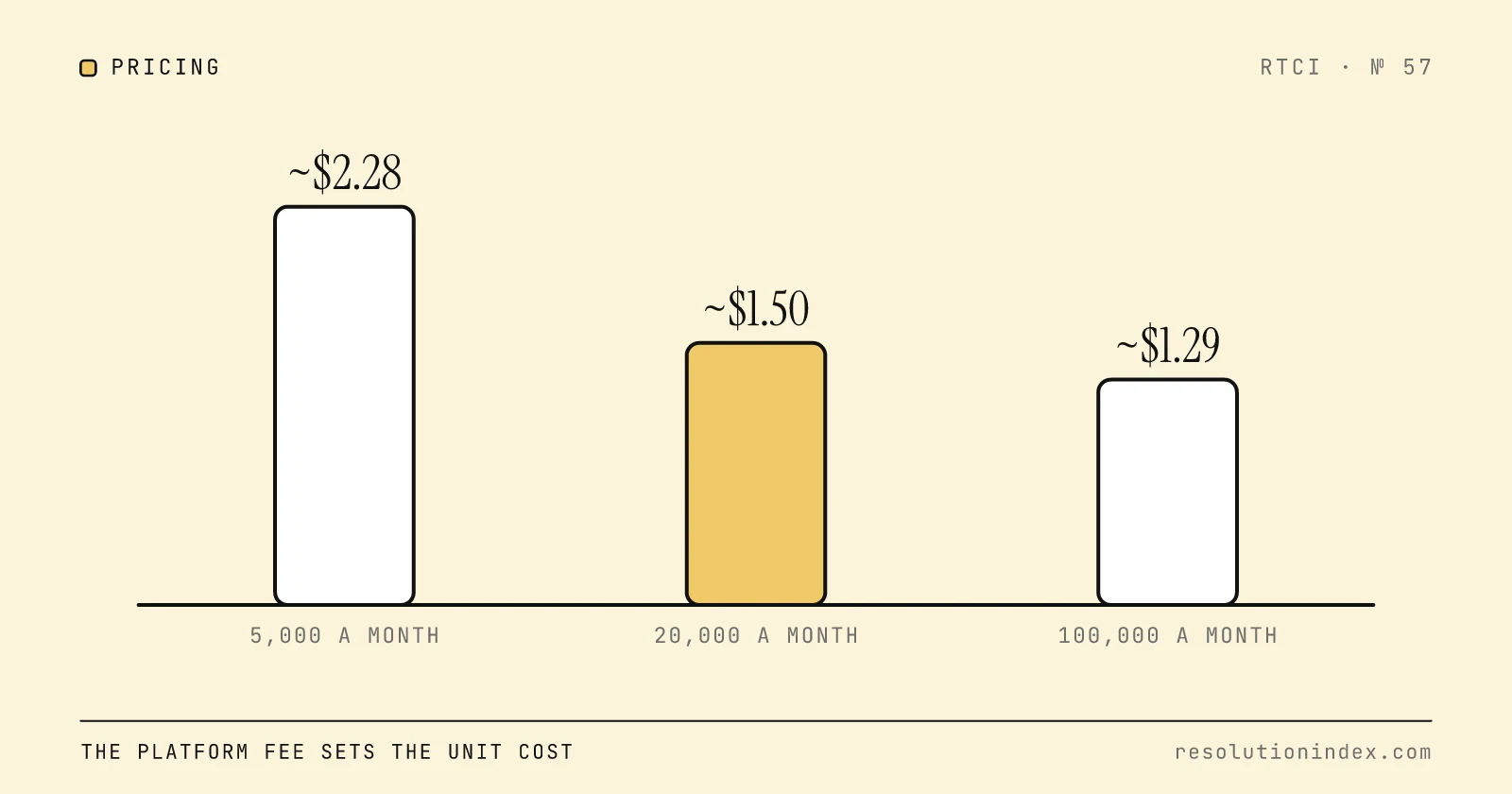
| 5,000 | $9,117 | 4,000 | ~$2.28 | $18,888 | 3,650 | ~$5.17 |
| 20,000 | $23,967 | 16,000 | ~$1.50 | $38,050 | 14,600 | ~$2.61 |
| 100,000 | $103,167 | 80,000 | ~$1.29 | $140,250 | 73,000 | ~$1.92 |
Check a row: at 20,000 conversations, Decagon is $4,167 + (20,000 × $0.99) = $23,967, divided by 16,000 resolutions = ~$1.50. Sierra is $12,500 + (14,600 × $1.75) = $38,050, divided by 14,600 = ~$2.61. Both platform fees shrink per resolution as volume grows, and Sierra's larger fee makes it the more volume-sensitive of the two.
The pricing models also react differently to a weak resolution rate. Per-conversation billing charges for failures, so Decagon's usage cost per resolution is $0.99 ÷ resolution rate. That equals Sierra's $1.75 outcome fee at 0.99 ÷ 1.75 = 57% resolution. Above 57%, the reported per-conversation rate is cheaper per resolution; below it, the outcome fee is, before platform fees. If your pilot lands near that line, the platform fee and contract terms decide it.
To put your own quotes side by side, use the cost per verified resolution calculator and the quote comparison worksheet. Add the costs the estimates leave out: implementation and professional services, any voice premium, overage terms, and the human time spent finishing tickets the AI escalated. For Decagon, the Decagon pricing guide lists the terms to get in writing before you sign.
Which resolution number should you compare?
Compare verified resolution, measured on your own tickets with the same definition for both vendors. Homepage percentages are not comparable: Decagon's list mixes resolution and deflection, and neither vendor publishes how its case-study numbers were measured.
- Deflection: the customer did not reach a human. It says nothing about whether the issue was solved.
- Containment: the conversation stayed in the AI channel. It says nothing about whether the work was done.
- Verified resolution: the issue reached the correct end state, no human was needed, the customer did not come back about it within your re-contact window, and any action the agent took was correct.
Before any pilot, agree in writing on: (1) which ticket types count in the denominator, (2) what counts as resolved, including the re-contact window, (3) how partial resolutions, abandons and escalations are counted, (4) who settles disputes when the vendor and your QA team disagree, and (5) how many conversations humans will judge. If a vendor will not write this down, do not sign an outcome or per-resolution contract. More on the mechanics: first contact vs end-to-end resolution.
How should you score the two vendors?
These weights are RTCI's suggested starting point for a six-figure agent decision. Change them to fit your situation before you see any demo, then score each vendor 0 to 5 per criterion, multiply by the weight and add up.
| Criterion | Weight | What good looks like |
|---|---|---|
| Verified resolution quality | 25% | Human-judged correct end state; safe actions |
| Cost per verified resolution and bill predictability | 20% | Billable unit defined with examples; audit rights; capped variable spend |
| Channel fit | 15% | Covers your actual contact mix, with acceptable latency on voice |
| Integration and action reliability | 15% | Write paths, authentication, duplicate-action protection, rollback |
| Governance, security and brand | 10% | Guardrails, role-based access, audit logs, retention |
| Operating model | 10% | Your team can change a policy within a day; little dependence on vendor engineers |
| Commercial flexibility | 5% | Pilot terms, exit, data export, dispute process |
Pause the evaluation if any of these is true: you cannot fund a six-figure first-year contract; nobody owns the write actions the agent will take in your systems; the vendor will not define the billable unit in writing; there is no handoff path into your helpdesk with full context; or security cannot clear the data flows in the regions where you operate.
When should you choose neither?
Choose neither when the reported platform fees alone (about $50,000 a year for Decagon and $150,000 for Sierra) would take up most of your AI budget, when your knowledge base and ticket categories still need cleanup, or when you want agent assist rather than an agent that resolves tickets on its own. At 5,000 conversations a month the worked example above already puts both above $2 per resolution.
Lower-commitment options in the index: Intercom Fin ($0.99 per outcome, RTCI score 696, Strong), Freshdesk Freddy for teams on Freshdesk (RTCI score 703, Strong), Zendesk AI for teams on Zendesk (RTCI score 592, Moderate) and YourGPT (a flat monthly plan with included AI credits, RTCI score 960, Elite). See best AI support platforms for mid-market 2026 for the full shortlist.
How do you run a fair pilot?
Scope the pilot to one or two intent groups for 4 to 8 weeks, on production traffic if you can do so safely. Have humans judge at least 200 conversations per intent group, more for high-risk work, and include edge cases and failures. If voice matters, test it separately in your own telephony setup for each intent group.
| Metric | Why it matters | Target |
|---|---|---|
| Automation rate | Share of tickets the AI attempted | Your planned scope |
| Verified resolution rate | Human-judged correct end state | At or above your break-even rate |
| Escalation reason codes | Where and why humans take over | Every escalation coded |
| Reopen rate at 72 hours | Catches false resolutions | Low and stable |
| CSAT or CES | Customer impact | No worse than baseline |
| Safety incidents | Wrong actions, data exposure, policy breaches | Zero critical |
| Cost per verified resolution | Total cost ÷ verified resolutions | Below the status quo |
Before converting a pilot into an annual commitment, get these in writing: the billable unit with examples and counter-examples; audit rights and a dispute process; a cap on variable spend or true-up terms; voice and digital unit prices if they differ; implementation and services scope; exit, data export and ownership of your configuration; and the minimum commitment. For the handoff side, see training the team on AI handoff workflows.
FAQ
Is Decagon or Sierra better for enterprise customer support in 2026? In the RTCI index Decagon scores higher: 682 (Strong) against 612 (Moderate). Resolution was close in RTCI's November 2026 test (80% vs 73%), and Decagon's estimated cost per resolution is lower (~$1.50 vs ~$2.61). Sierra suits buyers who want outcome-based billing and its wider channel list. Your own pilot and quote should decide.
How much does Decagon cost vs Sierra? Neither publishes prices. RTCI estimates ~$1.50 per resolution for Decagon, from a reported $0.99 per conversation plus ~$50,000 a year, and ~$2.61 for Sierra, from a reported $1.75 midpoint outcome fee plus ~$150,000 a year, both at 20,000 conversations a month. At 5,000 conversations the same inputs give ~$2.28 and ~$5.17.
Which is better for voice: Decagon or Sierra? Both sell voice. Decagon's homepage cites 70% chat and voice resolution at Chime and 50%+ voice resolution at Valon. Sierra lists voice among six channels and offers voice simulations in Agent Studio. Neither publishes a voice-only rate you can compare, so pilot voice in your own telephony setup.
Does Decagon use outcome-based pricing like Sierra? Partly. Decagon offers per-resolution pricing alongside per-conversation, and says most customers choose per-conversation for predictability. Sierra bills per agreed outcome, with per-conversation pricing for routing or greeter interactions. At the reported prices, per-conversation billing is cheaper per resolution above 57% resolution.
Can mid-market companies buy Decagon or Sierra? They can, but the reported platform fees (about $50,000 and $150,000 a year) dominate cost at low volume. At low volume, compare them with Intercom Fin, Freshdesk Freddy, Zendesk AI or YourGPT.
How should we define resolution in an AI agent contract? As the correct end state: the issue is solved, no human was needed, the customer does not come back about it within your re-contact window, and any action was correct. Put the definition, examples, counter-examples, window and dispute process in writing before signing an outcome or per-resolution contract.
What should a pilot include before signing an annual commitment? One or two intent groups over 4 to 8 weeks, at least 200 human-judged conversations per group, and weekly tracking of automation rate, verified resolution, escalation reasons, 72-hour reopens, CSAT or CES, safety incidents and cost per verified resolution, compared with your status quo.
Next steps
- Write down your definition of verified resolution. 2. Ask both vendors to quote the same three volumes with all fees included. 3. Run a 4 to 8 week pilot with human-judged samples. 4. Convert each quote into cost per verified resolution with the calculator, and price escalations with the AI escalation cost calculator. 5. Read the full Decagon review and Sierra review.
Change log
- Added a link to the new Decagon pricing guide and its quote checklist.
- Replaced unsourced valuation, contract-size and deployment-speed figures with RTCI's index scores and cost estimates, rebuilt the cost example from reported prices with the math shown, and removed Fortune 50 and language-count claims that RTCI could not find on Sierra's homepage.
- Published.
Read next
Keep reading
Picked for this article: the pieces it cites and the ones that answer the next question buyers usually ask.
Most related
Decagon Pricing 2026: What It Costs, Reviews and Alternatives
Decagon publishes no prices. What its own pricing article says about per-conversation and per-resolution billing, RTCI's ~$1.50 per resolution estimate with the inputs shown, the cost at 5,000, 20,000 and 100,000 conversations a month, what to ask for in a quote, and the enterprise alternatives ranked on RTCI score.
Best AI Support Platforms for Mid-Market Companies (2026)
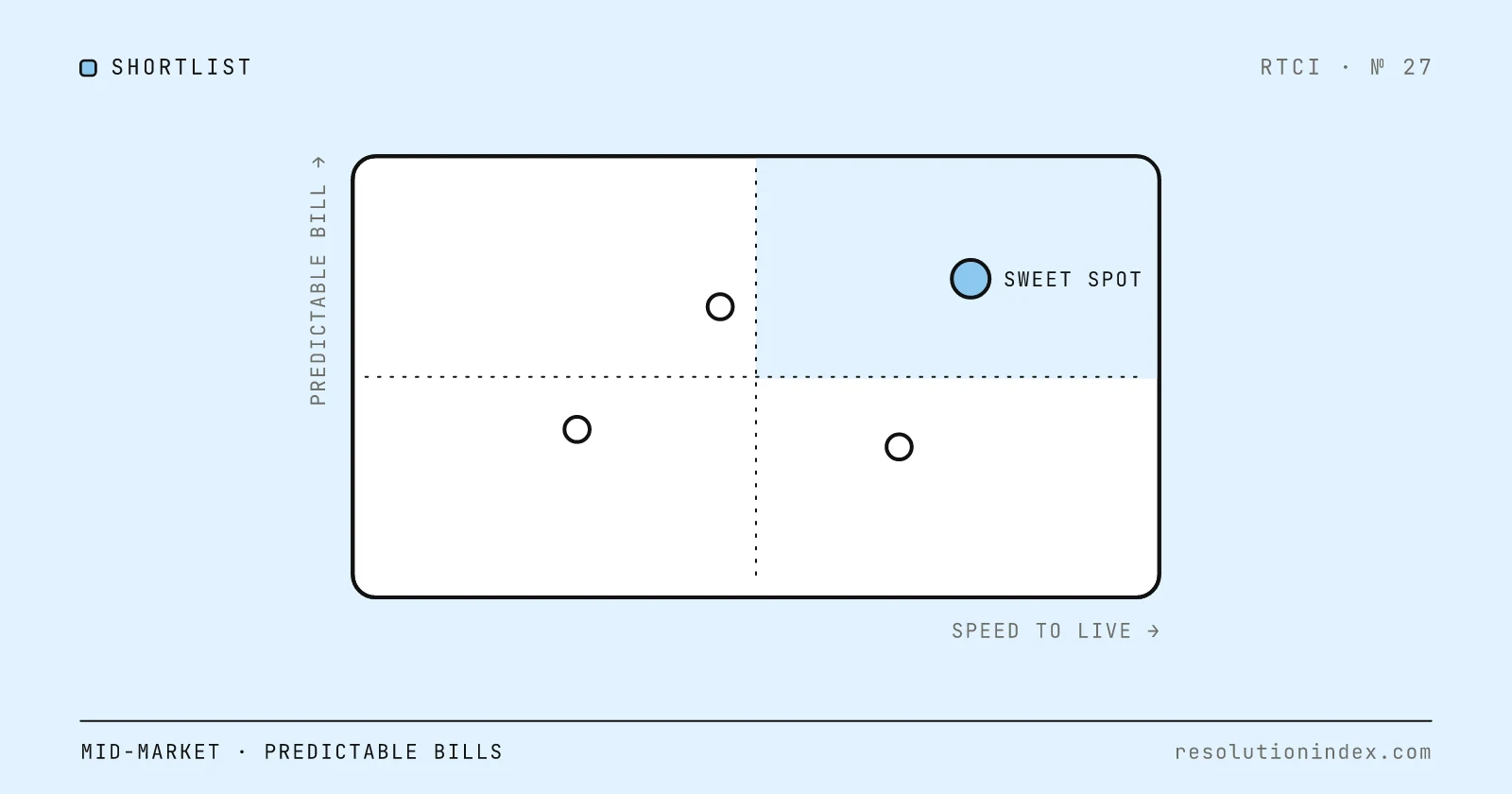
Mid-market shortlist: Intercom Fin, Freshdesk Freddy, Zendesk AI, DevRev, and YourGPT compared on bill predictability, 30–90 day implementation, and cost per verified resolution, with each vendor’s RTCI score and published price.
Train the Team on AI Handoff Workflows
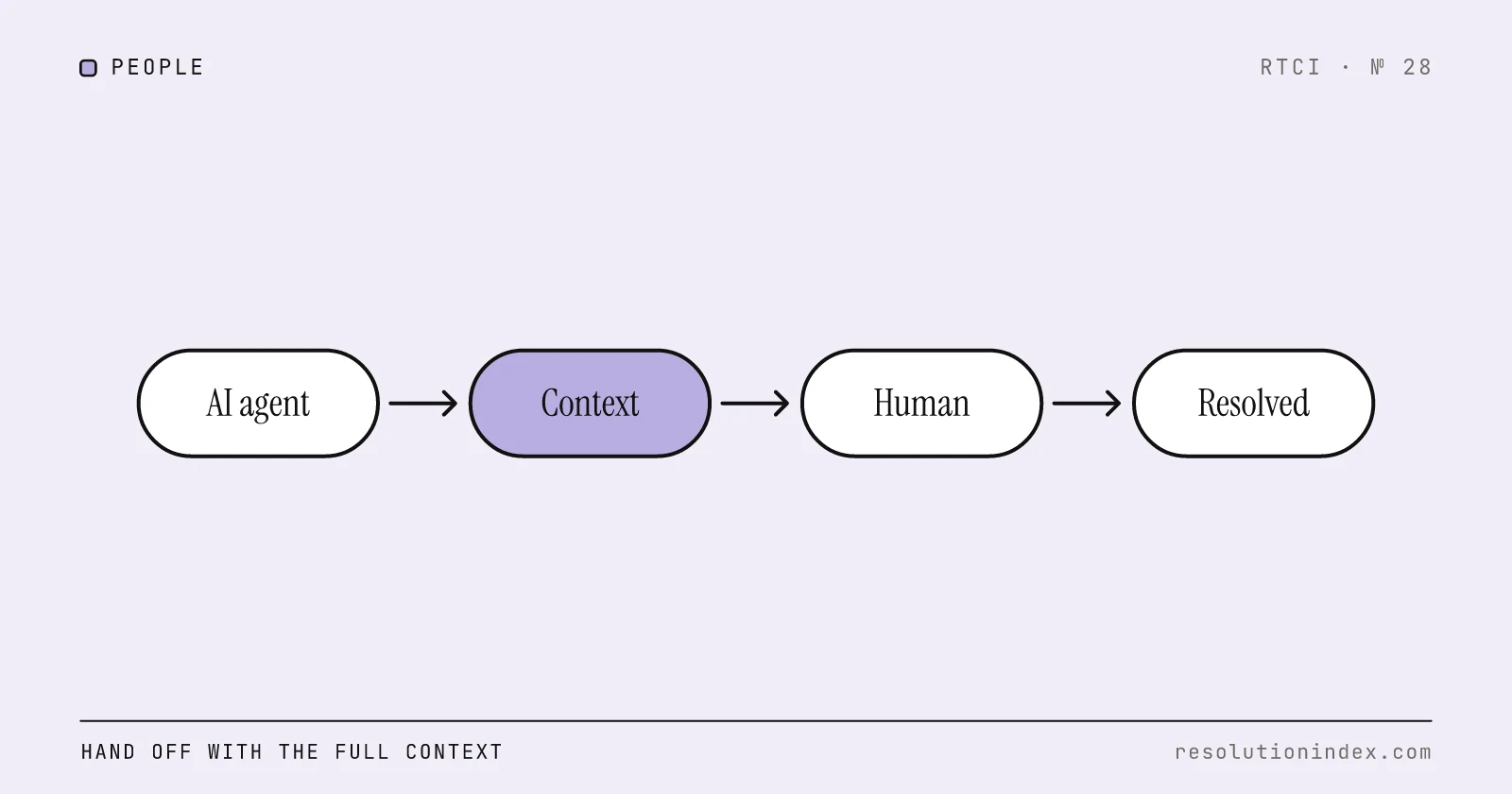
What a clean AI-to-human handoff packet contains, how to measure handoff quality, what vendors bill when a conversation is handed off, and how handoffs move cost per verified resolution.
Compare AI Support Quotes Apples-to-Apples
A quote normalization worksheet that converts Intercom Fin, Zendesk AI, Freshdesk Freddy, Gorgias, Decagon, Sierra, and YourGPT quotes into one comparable number: cost per verified resolution.
First-Contact vs End-to-End Resolution
A metric decision guide for AI support teams: when to use first-contact resolution rate vs end-to-end resolution rate, how to track both, and how deflection fits into the same dashboard.