Published Nov 20, 2026 · Updated Nov 20, 2026 · 12 min read
Decagon Pricing 2026: What It Costs, Reviews and Alternatives
Decagon publishes no prices. What its own pricing article says about per-conversation and per-resolution billing, RTCI's ~$1.50 per resolution estimate with the inputs shown, the cost at 5,000, 20,000 and 100,000 conversations a month, what to ask for in a quote, and the enterprise alternatives ranked on RTCI score.
 Written by Andrew Hall, Editor
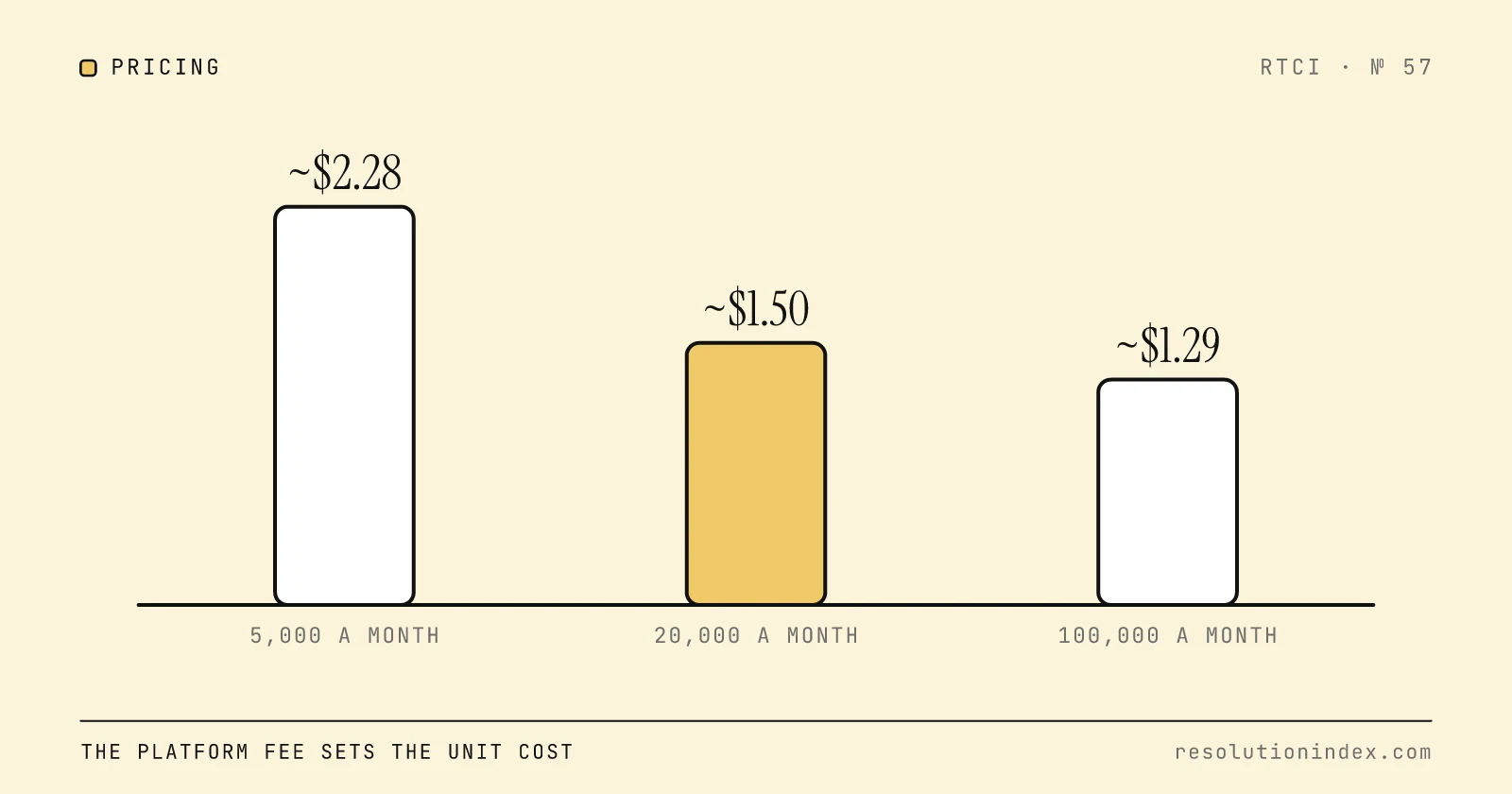
Decagon does not publish prices. Its pricing article describes two models, a fixed rate per conversation or a higher fixed rate per resolution, but gives no dollar figures, and decagon.ai/pricing returned a 404 when RTCI checked on November 20, 2026. RTCI estimates ~$1.50 per resolution at 20,000 conversations a month, from a competitor's reported $0.99 per conversation and ~$50,000-a-year platform fee, divided by the 80% Decagon resolved in RTCI's November 2026 test. That gives an RTCI score of 682 (Strong, #4 of 20) at low confidence, with transparency rated 1 of 5.
Your written quote replaces every input in that estimate. This guide shows what is and is not public, the math behind the estimate at three volumes, what to get in writing before you sign, what Decagon's customers report, and which enterprise alternatives score higher or lower in RTCI's index.
What is Decagon?
Decagon sells an AI agent for customer support, which its homepage calls "the AI concierge for every customer". The same agent covers chat, voice and email. It is sold through sales on enterprise contracts and sits on top of your existing helpdesk, so you keep your ticketing system and add Decagon as the layer that answers customers first.
The agent's behaviour is set by Agent Operating Procedures (AOPs): workflows written in natural language, the way a team writes an SOP for new hires. Decagon's AOP page says CX teams write them while technical teams can keep ownership of the underlying code, and lists traces that show why the agent acted as it did, guardrails for brand voice, escalation and hallucination, and Git-based version control. That matters for pricing in one way: someone on your team has to own those procedures, and that time is a cost the quote does not show.
How does Decagon price?
Decagon's only public pricing material is Pricing the AI Agent Economy, an article by its Director of Product dated December 10, 2024. RTCI reread it on November 20, 2026. It describes two models:
| Model | What Decagon's article says | What it does not say |
|---|---|---|
| Per conversation | A fixed rate for every incoming conversation, with flexible pricing for higher volumes | The rate, the volume tiers, or whether voice costs the same as chat |
| Per resolution | A higher fixed rate for each fully resolved conversation, with no charge for escalations; larger resolution commitments lower the rate | The rate, what counts as resolved, or the commitment levels |
The article says the majority of customers choose per-conversation, and argues for it on predictability: per-resolution billing, it says, invites disputes over what counts as a resolution. It mentions no platform fee, minimum commitment, implementation fee, overage rule or voice rate. Those are all set in the contract.
Which model is cheaper? Per-conversation billing charges for conversations the AI does not resolve, so its cost per resolution is the conversation rate divided by your resolution rate. It beats per-resolution billing when your resolution rate is above the conversation rate divided by the resolution rate. Illustration only, since Decagon publishes neither: if a quote offered $0.99 per conversation or $1.40 per resolution, the crossover is 0.99 ÷ 1.40 = 71%. At 80% resolution, per-conversation works out to $0.99 ÷ 0.80 = $1.24 per resolution, cheaper than $1.40. At 65%, it is $0.99 ÷ 0.65 = $1.52, and per-resolution wins. Ask for both rates and run this with your own pilot result.
Where does RTCI's ~$1.50 estimate come from?
Both price inputs come from one page: Decagon Pricing: How Much Does Decagon Cost in 2026? on the blog of Quiq, a Decagon competitor, last updated March 11, 2026. It says Decagon charges "roughly around $0.99 per conversation" and an annual platform fee of $50,000 regardless of pricing model. Quiq attributes the $0.99 to public information and industry discussions and the fee to several sources and reviews, without linking a specific one. Decagon has not confirmed either figure. RTCI uses them because they are the only dollar figures it has found, and labels the result an estimate.
The third input is the resolution rate: 80% in RTCI's November 2026 test. The arithmetic at 20,000 conversations a month:
- Platform fee: $50,000 ÷ 12 = $4,167 a month.
- Usage: 20,000 × $0.99 = $19,800.
- Total: $23,967 a month, or about $1.20 per conversation.
- Resolutions: 20,000 × 80% = 16,000.
- Cost per resolution: $23,967 ÷ 16,000 = ~$1.50.
- RTCI score: 250 × log10(10 × 80 ÷ 1.50) = 682, Strong tier (650 to 749).
The estimate leaves out implementation, integrations, any voice premium, quality review and the human cost of conversations the AI escalates. The Decagon review has the full source table, and the methodology explains the scoring rule applied to every vendor.
What does Decagon cost at 5,000, 20,000 and 100,000 conversations?
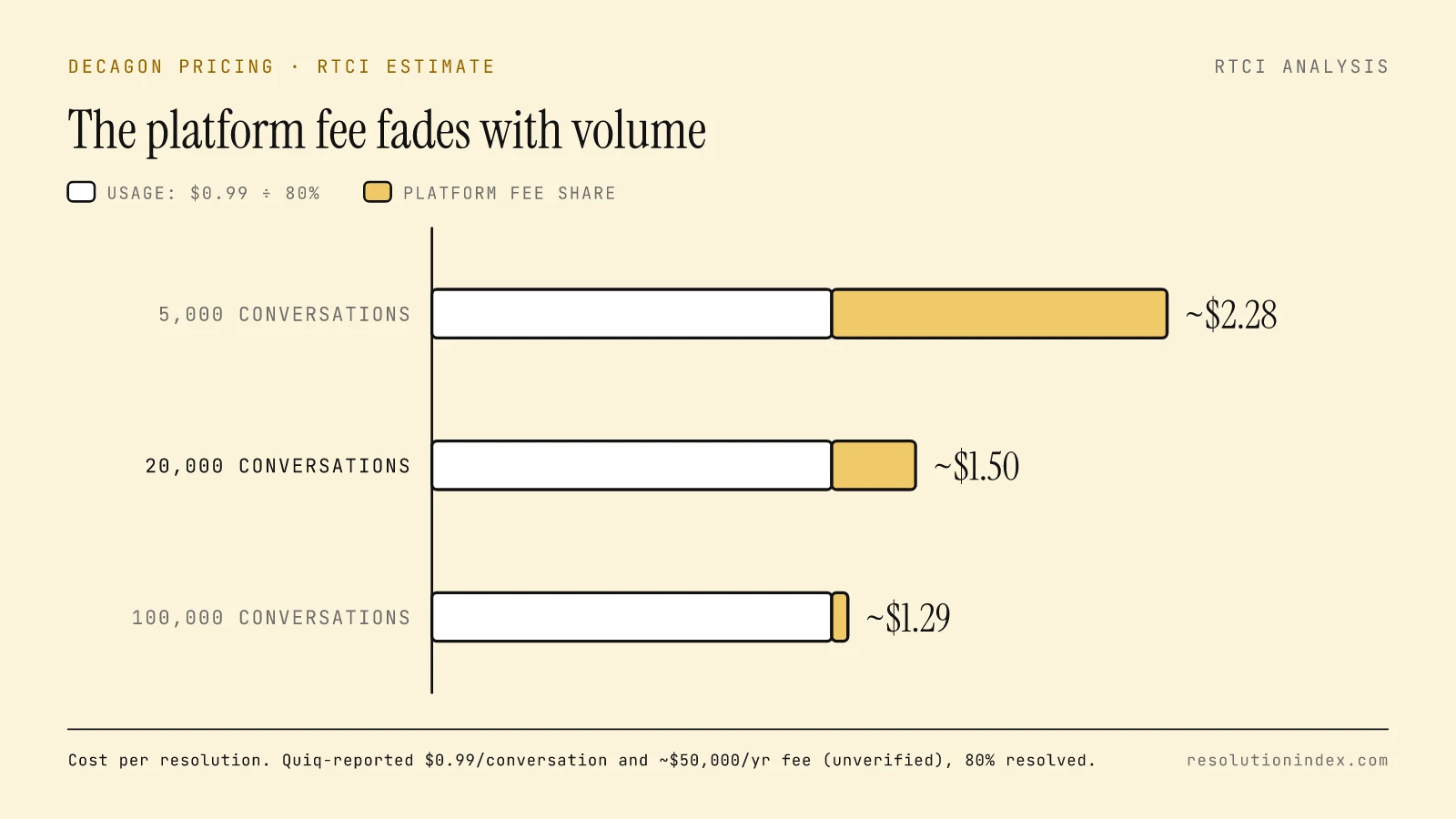
Worked example. Assumptions: per-conversation billing at the reported $0.99; the reported $50,000 platform fee spread evenly at $4,167 a month; every conversation billed; 80% resolved, as in RTCI's November 2026 test; no volume discount, implementation, voice premium or taxes. All three price assumptions are unverified, and a real quote will differ.
| Conversations a month | Usage (× $0.99) | Platform fee | Monthly total | Resolutions (80%) | Cost per resolution | Without the platform fee |
|---|---|---|---|---|---|---|
| 5,000 | $4,950 | $4,167 | $9,117 | 4,000 | ~$2.28 | $1.24 |
| 20,000 | $19,800 | $4,167 | $23,967 | 16,000 | ~$1.50 | $1.24 |
| 100,000 | $99,000 | $4,167 | $103,167 | 80,000 | ~$1.29 | $1.24 |
Check a row: at 5,000 conversations, ($4,167 + $4,950) ÷ 4,000 = $2.28. Without the fee, every row is $0.99 ÷ 0.80 = $1.24. The fee adds $1.04 per resolution at 5,000 conversations, $0.26 at 20,000 and $0.05 at 100,000. It adds more than $0.50 per resolution below about 10,400 conversations a month ($4,167 ÷ ($0.50 × 80%)).
The resolution rate moves the number as much as volume does. At 20,000 conversations, a 70% rate gives $23,967 ÷ 14,000 = $1.71 per resolution, and 60% gives $23,967 ÷ 12,000 = $2.00. RTCI's 80% is one test, so price the contract on the rate you measure in your own pilot. At 20,000 conversations a month, the example comes to about $287,600 a year before implementation.
What should you ask for in a Decagon quote?
Because nothing is published, the quote is where the price is set. Ask Decagon to price the same three volumes you expect (for example your current month, plus 50%, and double) with every fee shown, then get these terms in writing:
- The billing unit and its definition. If per conversation: what starts and ends one, and whether a customer who returns the next day is a new one. If per resolution: what counts as resolved, the re-contact window, and how partial resolutions and abandoned chats are treated. Decagon's article says escalations are not charged on per-resolution; confirm that in the contract.
- Both rates. Ask for a per-conversation and a per-resolution rate so you can run the crossover math above on your pilot result.
- Platform fee. Whether there is one, what it covers, and whether it is credited against usage. Quiq reports ~$50,000 a year; your number may differ.
- Minimum commitment and true-up. The committed volume, what happens if you fall short, and whether unused volume rolls over.
- Overage. The rate above your commitment, and whether it is higher than the committed rate.
- Voice and email rates. Whether a voice call costs the same as a chat, and whether voice is billed per call, per minute or per conversation. The pricing article does not mention voice.
- Volume tiers. The article mentions flexible pricing for higher volumes and lower per-resolution rates for larger commitments. Ask for the tier table, not one blended rate.
- Implementation and services. Setup, integrations, AOP build-out and any ongoing services fee.
- Audit rights and renewal. Monthly billing data that ties each billed unit to a transcript, a dispute process, a cap on renewal increases, and data export on exit.
Then convert the quote to cost per verified resolution with the cost per verified resolution calculator. The quote comparison worksheet puts Decagon next to other vendors on one number, and hidden fees in AI support contracts lists other clauses to check. The 72-hour rule guide covers re-contact windows.
What do Decagon customers report?
The results below are Decagon-reported, from case studies on Decagon's own site that RTCI opened on November 20, 2026. None states how resolution was measured or over what period, and RTCI has not verified them.
| Customer | What Decagon reports | Metric |
|---|---|---|
| Chime | 70%+ resolution on chat and nearly 70% on voice; voice scaled to more than 1 million calls a month; a 60% decrease in support costs, which the page attributes to Chime's 2025 S-1 filing | Resolution |
| Valon | 50%+ on inbound voice calls; CSAT maintained at about 90% | Headline says resolution, body says deflection |
| Duolingo | 80% on chat | Deflection |
Two cautions. Deflection means the customer did not reach a human; it does not show the issue was solved, so Duolingo's 80% and Valon's 50%+ are not comparable with Chime's resolution figures. And Chime also appears on Sierra's customer pages, as the Decagon vs Sierra comparison notes, so a logo does not tell you which product handles which channel there. Ask Decagon for a reference customer with your ticket mix and channel split, and ask how they measure resolution.
RTCI's own figure is 80% in its November 2026 test. That sits at the top of the 50% to 80% range in Decagon's named case studies.
What are the alternatives to Decagon?
The filter: platforms in RTCI's index whose entry is an enterprise contract or names enterprise or large contact centres as the best fit, plus the two suite AI agents enterprise support teams often already own (Zendesk AI and Salesforce Agentforce), plus Intercom Fin, which can be layered on another helpdesk and is the clearest published per-unit price to compare a quote against. Ranked by RTCI score, with figures from RTCI's index as of November 2026:
| Rank | Platform | RTCI score | Realistic resolution rate | Cost per resolution | Pricing model | Price basis |
|---|---|---|---|---|---|---|
| 1 | Ada CX | 799, Elite | 58–68% | ~$0.40 | Per conversation, or per resolution on request | Estimate (Vendr contract data) |
| 2 | Kore.ai | 779, Elite | 60% (RTCI test, Nov 2026) | ~$0.46 | Sessions + seats (custom) | Estimate (AWS Marketplace) |
| 3 | Intercom Fin | 696, Strong | 56–66% | $0.99 | Per outcome + helpdesk seats | Published |
| 4 | Forethought | 682, Strong | 62–72% | ~$1.25 | Platform fee + outcome-based fee | Estimate (Vendr data) |
| Baseline | Decagon | 682, Strong | 80% (RTCI test, Nov 2026) | ~$1.50 | Per conversation or per resolution | Estimate (Quiq report) |
| 5 | Cognigy | 652, Strong | 49–59% | ~$1.33 | Enterprise platform + usage | Estimate (AWS Marketplace) |
| 6 | Sierra AI | 612, Moderate | 73% (RTCI test, Nov 2026) | ~$2.61 | Outcome-based enterprise | Estimate (third-party reports) |
| 7 | Zendesk AI | 592, Moderate | 36–46% | $1.50–$2.00 | Per automated resolution + seats | Published |
| 8 | Salesforce Agentforce | 588, Moderate | 44–54% | $2.00–$4.55 | $2 per resolution; Flex Credits | Published |
Six of the nine rows, Decagon included, are scored from estimated costs, so the order among Ada, Kore.ai, Forethought, Cognigy, Sierra and Decagon is less certain than the order among Fin, Zendesk AI and Agentforce. Decagon's 80% is the highest resolution rate in this table; it ranks below Ada and Kore.ai on cost.
Ada CX suits high-volume enterprise support, including regulated industries, and is the closest commercial match: Ada also offers per-conversation or per-resolution billing on annual contracts by quote. Its ~$0.40 rests on Vendr data of about $0.25 per conversation. See the Ada CX review.
Kore.ai is a broader conversational AI platform for large contact centres in banking, health and telecom. It resolved 60% in RTCI's November 2026 test, and its cost comes from AWS Marketplace session prices. It is a bigger platform purchase than an agent layer. See the Kore.ai review.
Intercom Fin is the one option here with a published per-unit price, $0.99 per outcome, so it is a useful check on any Decagon quote even if you do not buy it. An outcome is broader than a resolution, so sample billed outcomes. See the Intercom Fin review.
Forethought, now owned by Zendesk, runs AI agents on top of an existing helpdesk, like Decagon, and ties it on score. Cognigy (NiCE) is voice-first and fits teams whose volume is mostly phone. Sierra AI is the closest peer in product shape; it bills per agreed outcome, and the Decagon vs Sierra comparison runs the two at three volumes. Zendesk AI and Salesforce Agentforce score lower but keep everything inside a suite you may already pay for; see the Zendesk pricing guide and the Agentforce pricing guide.
Left out: SMB and mid-market tools (YourGPT, Robylon, HubSpot Breeze, Help Scout, Freshdesk Freddy, Tidio Lyro, Gorgias, Pylon, Kustomer), which do not compete for the same contracts. Lorikeet (RTCI score 593, Moderate) fits complex regulated support and publishes a $2,100-a-month platform fee, and Crescendo (RTCI score 634, Moderate) bundles human agents with its AI, a different purchase. The enterprise platforms guide compares the enterprise vendors on security, deployment and contract terms.
The decision rule
Shortlist Decagon if you handle well over 10,000 conversations a month, need one agent across chat, voice and email on top of your helpdesk, and can name an owner for the AOPs. Ask for both billing models, run a pilot on your own tickets, and pick per-conversation only if your measured resolution rate sits above the crossover. Look elsewhere if you need a public price before talking to sales (Fin), want the lowest estimated cost per resolution on an enterprise contract (Ada CX or Kore.ai, both also quote-only), or want to stay inside Zendesk or Salesforce. Below about 10,000 conversations a month, the reported platform fee adds more than $0.50 to every resolution, and the mid-market shortlist is the better starting point.
How RTCI calculates these numbers
- Realistic resolution rate. Each vendor’s published claim is discounted by one fixed rule for every vendor, with an extra discount when the figure measures deflection rather than resolution.
- Cost per resolution. Per-session and per-conversation prices are divided by that realistic rate, because failed attempts are billed too. Mandatory platform fees are spread over 2,000 to 4,000 resolutions a month.
- Prices. Every price links to the vendor’s own page as of the date shown. Costs marked ~ or est. are RTCI estimates for vendors that publish no per-unit price.
Frequently asked questions
How much does Decagon cost?
Decagon publishes no prices, and decagon.ai/pricing returned a 404 when RTCI checked on November 20, 2026. RTCI estimates ~$1.50 per resolution at 20,000 conversations a month, from Quiq's reported $0.99 per conversation and ~$50,000-a-year platform fee divided by an 80% resolution rate. Quiq is a Decagon competitor and names no specific source, so treat both inputs as unverified. The same inputs give about $2.28 at 5,000 conversations and $1.29 at 100,000.
Does Decagon charge per conversation or per resolution?
Both are offered. Decagon's December 2024 pricing article describes a fixed rate per incoming conversation, or a higher fixed rate per fully resolved conversation with no charge for escalations. It says the majority of customers choose per-conversation, and that larger resolution commitments lower the per-resolution rate. Per-conversation is the cheaper choice when your resolution rate is above the per-conversation rate divided by the per-resolution rate.
What is Decagon?
Decagon is a sales-led AI agent for customer support across chat, voice and email, sold on enterprise contracts. Its agents follow Agent Operating Procedures (AOPs), workflows written in natural language that CX teams can edit, with traces and guardrails. It sits on top of a helpdesk rather than replacing one.
What are the best Decagon alternatives?
Ranked on RTCI score among enterprise-relevant platforms: Ada CX (799, Elite, estimate), Kore.ai (779, Elite, estimate), Intercom Fin (696, Strong, published $0.99 per outcome), Forethought (682, Strong, estimate), Cognigy (652, Strong, estimate), Sierra AI (612, Moderate, estimate), Zendesk AI (592, Moderate) and Salesforce Agentforce (588, Moderate). Decagon itself scores 682 (Strong).
What do Decagon customers report?
The results Decagon publishes are its own case studies. Chime: 70%+ chat resolution, nearly 70% on voice and more than 1 million calls a month. Valon: 50%+ on voice, described as resolution in the headline and deflection in the body. Duolingo: an 80% chat deflection rate. None states how it was measured. In RTCI's November 2026 test Decagon resolved 80%.
Is Decagon worth it?
For a high-volume enterprise with someone to own the AOPs, it is a credible shortlist pick: 80% in RTCI's November 2026 test and an RTCI score of 682 (Strong, #4 of 20). Below about 10,000 conversations a month the reported platform fee adds more than $0.50 to every resolution, and the case for a quote-only contract weakens.
Change log
- Published.
Read next
Keep reading
Picked for this article: the pieces it cites and the ones that answer the next question buyers usually ask.
Most related
Decagon vs Sierra: Enterprise AI Support Comparison (2026)
How Decagon and Sierra differ on pricing model, channels and operating model, what each scored in RTCI's November 2026 test, and what each costs per resolution at three volumes, with the math shown.
Best AI Support Platforms for Enterprise (2026)
Enterprise shortlist: Salesforce Agentforce, Zendesk AI, Intercom Fin, Decagon, Sierra, Cognigy, and Kore.ai compared on security, deployment options, RTCI score, cost per resolution, and contract terms. Includes a copyable RFP scorecard.
Compare AI Support Quotes Apples-to-Apples
A quote normalization worksheet that converts Intercom Fin, Zendesk AI, Freshdesk Freddy, Gorgias, Decagon, Sierra, and YourGPT quotes into one comparable number: cost per verified resolution.
Hidden Fees in AI Support Contracts: What Buyers Miss
Where AI support invoices outgrow the quote: second meters, overage rates, one-time allowances, add-ons, outbound channels and exit costs, with clause language and a worked 12-month reconciliation.
Salesforce Agentforce Pricing 2026: Cost per Resolution, Decoded
Salesforce Agentforce pricing as of November 2026: Flex Credits, per-user licences, $2 Help Agent resolutions and the $2 Conversations meter, each converted into cost per resolution.