Published Nov 20, 2026 · Updated Nov 20, 2026 · 13 min read
The Future of Customer Service: 7 Predictions for 2027 to 2031
RTCI's seven dated predictions for customer service, from per-resolution pricing and a cost floor to an EU right to reach a human, vendor buyouts, customers' own AI agents and agent jobs. Each comes with the evidence today, what it means for support teams, what would prove it wrong and a confidence level.
 Written by Andrew Hall, Editor
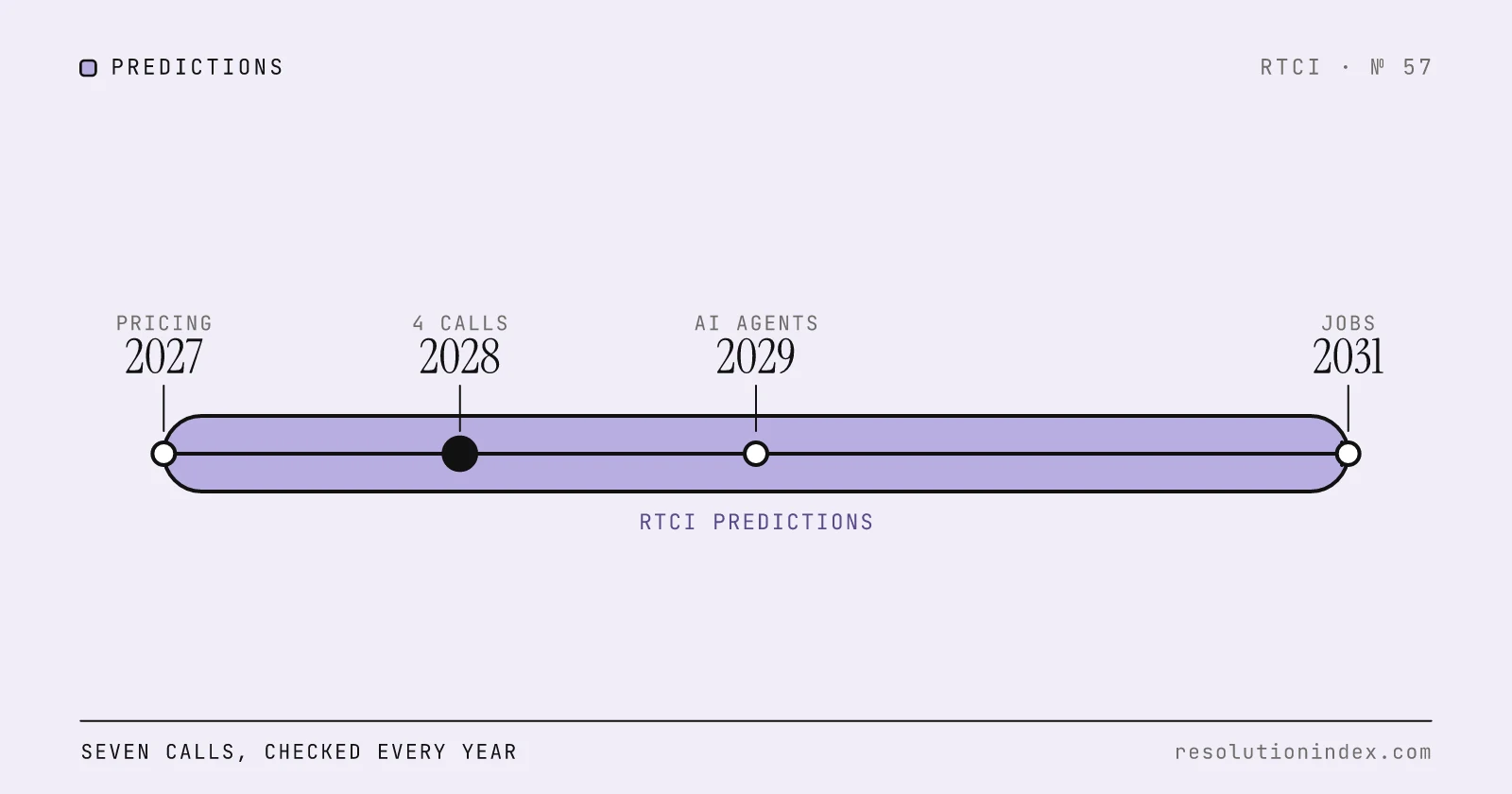
From 2027 to 2031, customer service will be billed per outcome, argued over by definition and staffed by a smaller human team doing harder work, but it will not get much cheaper per resolution and it will not lose its human option. Those are RTCI's seven predictions below, each with a year, the evidence that can be checked today and what would prove it wrong. Three rest on RTCI's own index and pricing tracker. The rest draw on US labour statistics, EU legal texts, acquisitions and Gartner research, which is quoted as Gartner's forecast, not as fact.
This is RTCI's labelled opinion. Every figure is linked to its source or to RTCI's index as of November 2026, and RTCI will score each prediction against the same sources every November.
| # | Prediction | Checked | Confidence |
|---|---|---|---|
| 1 | At least 14 of the 20 platforms in RTCI's index offer per-resolution or per-outcome AI pricing (11 today) | End of 2027 | Medium |
| 2 | No shared definition of a billable resolution appears in the billing terms of three or more indexed vendors | End of 2028 | High |
| 3 | The index median AI cost per resolution stays at $1.00 or more ($1.12 today) | November 2028 | Medium |
| 4 | The EU adopts a right to reach a human in customer service | End of 2028 | Low |
| 5 | At least two of the eight independent AI agent vendors in the index are bought by a suite | End of 2028 | Medium |
| 6 | At least two of five helpdesk suites document how they handle contacts from customers' own AI agents | End of 2029 | Low |
| 7 | US customer service representative jobs fall 2.5% to 17.5% from 2025 to 2030, not more | BLS figure for 2030 | Medium |
1. Will AI agents be priced per resolution by 2027?
The claim. By the end of 2027, at least 14 of the 20 platforms in RTCI's index will offer a per-resolution or per-outcome price for their AI agent, up from 11 today. Seats stay for human agents; the change is in how the AI is billed.
The evidence today. In RTCI's index as of November 2026, 11 of 20 platforms bill the AI per resolution or outcome, or offer it as an option: Intercom Fin, HubSpot Breeze, Help Scout AI, Zendesk AI, Salesforce Agentforce, Lorikeet, Sierra AI, Forethought, Crescendo, Decagon and Ada CX. The other nine bill per conversation, session, interaction or credit, or charge a flat plan. In 2026 the moves logged in the pricing tracker ran toward outcomes. HubSpot moved Customer Agent from $1.00 per conversation to $0.50 per resolved conversation on April 14, 2026 (HubSpot). At HubSpot's realistic 51–61% resolution rate, the old price worked out to $1.64–$1.96 per resolution, so the switch cut the cost per resolution by about 70% to 75%. Salesforce announced pay-per-resolution pricing for Help Agent on June 25, 2026, at $2 per resolution (Salesforce).
The counter-evidence is real. Decagon's pricing article (December 10, 2024) says "the vast majority" of its customers choose per-conversation billing, and Kustomer raised its per-engaged-conversation price from $0.60 to $0.75 in October 2026 rather than switching models (Kustomer).
What it means for support leaders and agents. AI spend moves from a headcount line to a usage line that grows as automation grows. Ask every vendor for both a per-conversation and a per-resolution rate: per-conversation is cheaper whenever your measured resolution rate is above the conversation rate divided by the resolution rate. For agents, the vendor is paid for the tickets nobody on the team touches, so the tickets that reach a person are, by design, the ones the AI could not close.
What would prove it wrong. 13 or fewer of the 20 indexed platforms offering outcome pricing at the end of 2027, or two or more of today's 11 dropping it.
Confidence: medium. Two large suites moved in 2026, but three more switches are needed in about a year, and the vendors that bill per conversation have a public argument for staying there.
2. Will anyone standardise what a 'resolution' is by 2028?
The claim. Through the end of 2028, no single definition of a billable resolution, whether from a standards body, an analyst firm or an industry group, will appear in the billing terms of three or more vendors in RTCI's index. The definition stays something each buyer negotiates.
The evidence today. Four suite vendors set or changed their definitions in 2026, and they moved in different directions. All four are logged in the pricing tracker:
| Vendor | What is billed | What is not billed | Source |
|---|---|---|---|
| Intercom Fin (from March 12, 2026) | Outcomes: resolutions, Procedure handoffs, qualifications and disqualifications, at most once per conversation | A customer who explicitly asks for a human, Procedures that fail to finish, default escalations | Intercom help center |
| Zendesk AI (from May 18, 2026) | Verified resolutions that pass an LLM check and end without the customer asking for more help | Assisted escalations and contained resolutions | Zendesk help center |
| Salesforce Help Agent (announced June 25, 2026) | $2 per resolution | Customers who ask for a human or give negative feedback | Salesforce newsroom |
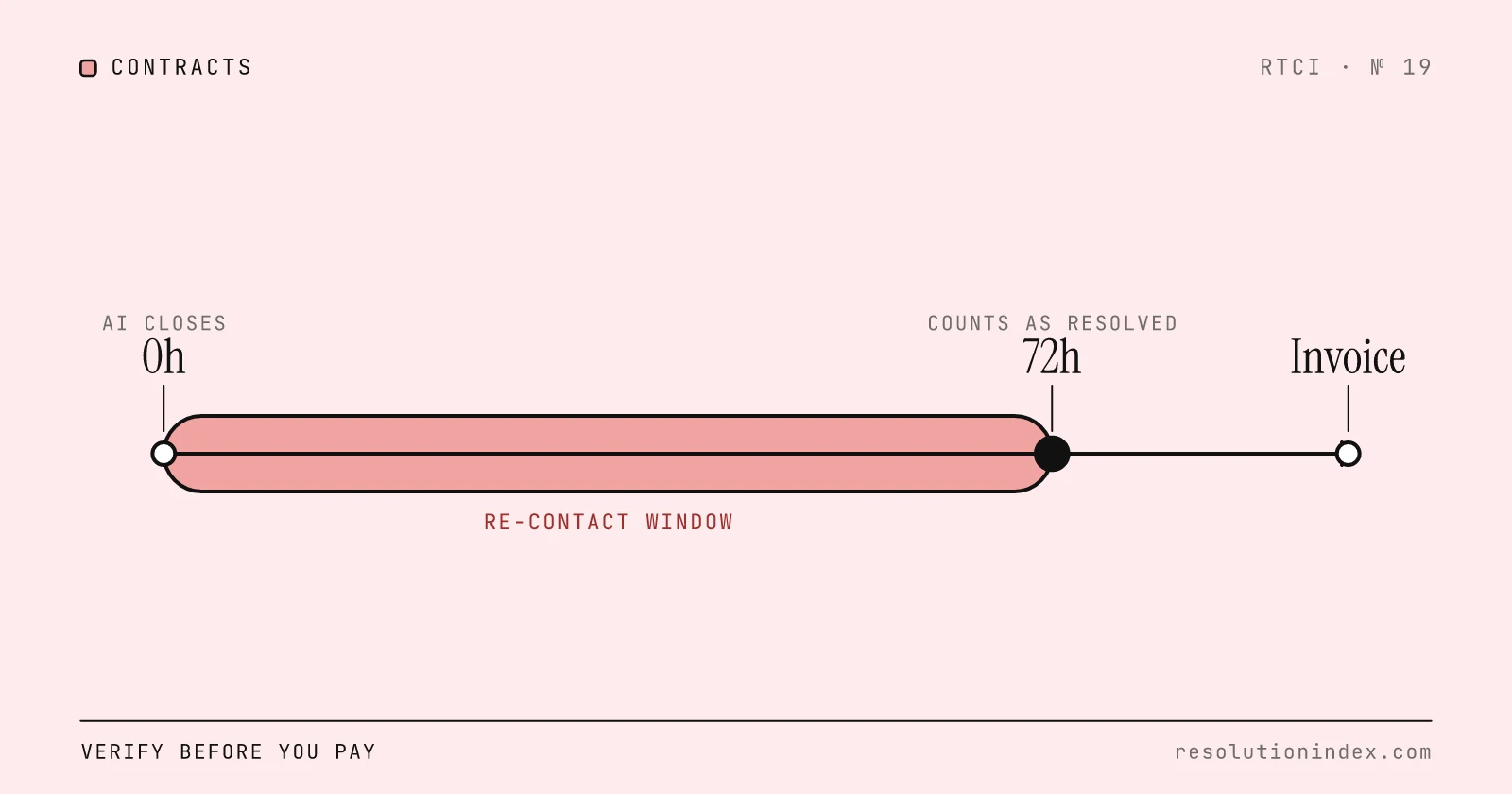
| HubSpot Breeze Customer Agent (from April 14, 2026) | $0.50 per resolved conversation | Conversations handed to a human within 72 hours (RTCI index) | HubSpot company news |
Intercom widened the billable set to include handoffs; Zendesk narrowed it to verified resolutions. Each definition is tied to its own product's escalation logic, which makes a shared one hard to adopt. Decagon's pricing article names the risk directly: buyers and vendors end up "arguing over what a 'resolution' is".
What it means for support leaders and agents. Write your own definition into the contract (no human handoff, no same-issue re-contact within 72 hours) and ask for monthly billing data that ties each billed unit to a transcript. The 72-hour rule clauses are ready to paste, and how to measure AI resolution rate gives the formula. For agents, reviewing samples of AI-closed conversations becomes standing work, because those reviews are the evidence in any billing dispute.
What would prove it wrong. A published definition from a standards body, analyst firm or industry group appearing in the billing terms of three or more indexed vendors by the end of 2028.
Confidence: high. The four definitions that changed in 2026 moved apart, not together, and each vendor's definition protects its own revenue.
3. Will AI cost per resolution keep falling?
The claim. No. In November 2028, the median AI cost per resolution across RTCI's index, calculated by the same method, will be $1.00 or more. Today it is $1.12.
The evidence today. The 20 midpoint costs in RTCI's index run from ~$0.13 (YourGPT, estimate) to $3.27 (Salesforce Agentforce). The median is $1.12, halfway between Intercom Fin at $0.99 and Forethought at ~$1.25, and 10 of the 20 sit below $1.00. Of the three 2026 tracker entries recorded as a price increase or a price cut, two were increases: Kustomer's Concierge went from $0.60 to $0.75 per engaged conversation (+25%), and Lorikeet's Start plan from $1,500 to $2,100 a month (+40%), with Scale from $4,000 to $5,100. The one cut was HubSpot's. Gorgias also set its AI overage at $1.50 an interaction when it bundled AI Agent into every plan, against $0.90 for the old add-on.
Gartner predicts that GenAI cost per resolution in customer service will exceed $3 by 2030, more than many B2C offshore human agents (Gartner press release, January 26, 2026). CX Today (February 3, 2026) reports Gartner's Patrick Quinlan saying organisations "don't account for the total cost of ownership". Gartner's figure counts total cost, not a vendor's list price, so it supports the direction of RTCI's claim more than its number.
What it means for support leaders and agents. Do not build a three-year business case on unit prices that keep falling. Model them flat or rising, and negotiate a cap on renewal increases; break-even: when AI support pays for itself shows the math. For agents, a narrower cost gap between an AI resolution and a human one keeps people on the complex, high-value contacts.
What would prove it wrong. The index median falling below $1.00 in November 2028 because vendors cut list prices, rather than because cheaper vendors joined the index.
Confidence: medium. 2026's direct price changes ran two to one upward, but the median sits only $0.12 above the threshold, so a few cuts by large vendors would cross it.
4. Will the EU make companies offer a human?
The claim. By December 31, 2028, the EU will have adopted the Digital Fairness Act, agreed by the European Parliament and the Council, with a provision that lets consumers reach a human in customer service.
The evidence today. Disclosure is already law. Article 50 of the EU AI Act requires AI systems that interact directly with people to be designed so those people are told they are dealing with an AI, at the latest at the first interaction, and Article 113 sets 2 August 2026 as the general application date (official text on EUR-Lex). The Digital Omnibus on AI, in force from 27 July 2026, kept that date for the chatbot disclosure duty and moved only the Article 50(2) marking duty, to 2 December 2026, for systems already on the market (Lewis Silkin, July 27, 2026).
A human option is the next step. On 11 November 2026 the European Commission adopted its Digital Fairness Act proposal, and its page lists "the inability to reach a human interlocutor for customer service" among the problems it addresses (European Commission). Euronews reports that consumers would be able to reach a human being in customer service, and that Parliament and national governments must still approve the proposal. Gartner predicted in February 2024 that the EU would mandate a right to talk to a human by 2028 (CX Dive, February 20, 2024).
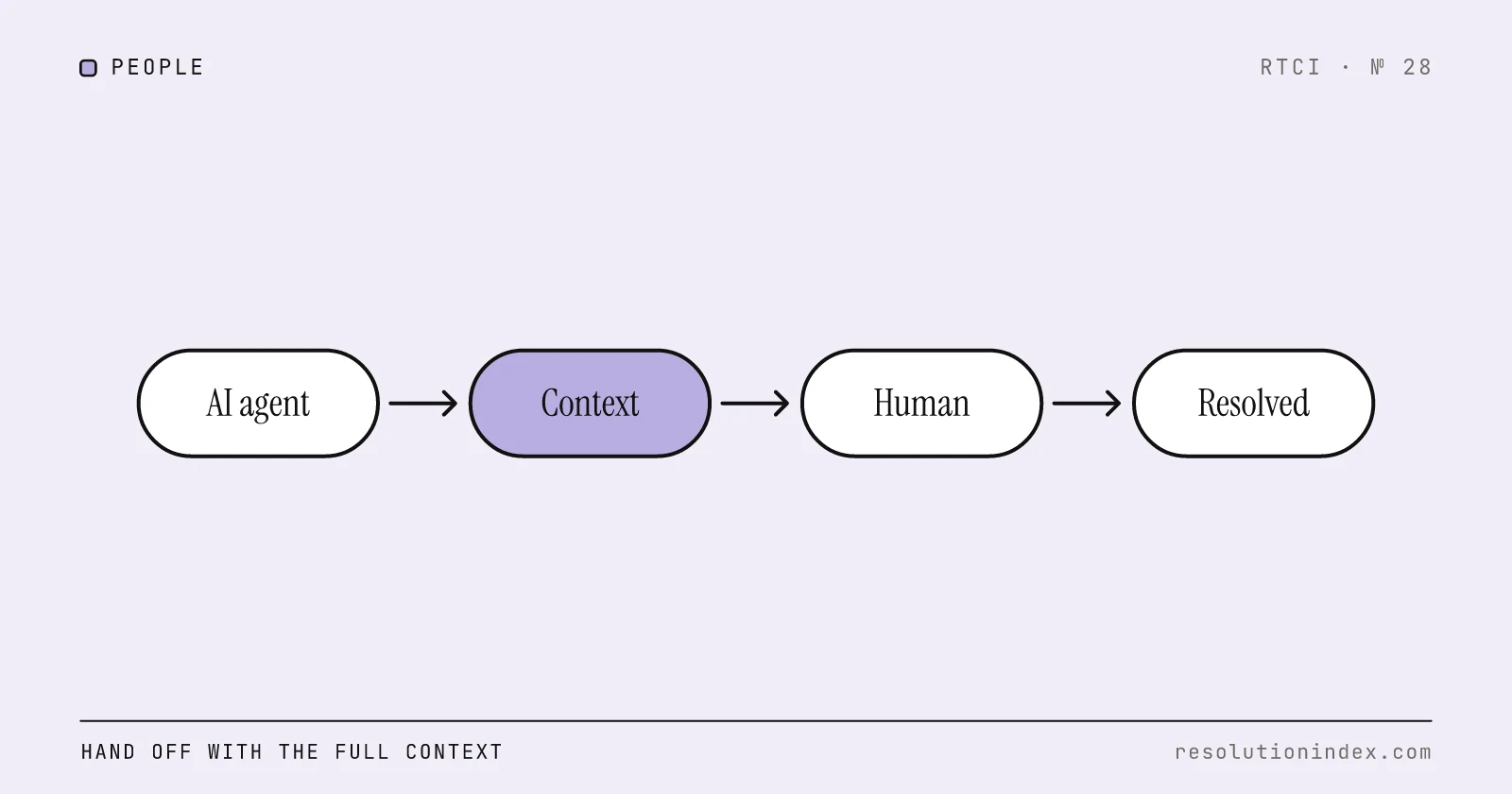
What it means for support leaders and agents. Build the exit now: a visible route to a person in every AI channel, with the conversation history passed along, as in training the team on AI handoff workflows. Track the share of AI conversations where the customer asks for a human; under Intercom's and Salesforce's terms those are not billed. The AI support compliance checklist covers the Article 50 duties. For agents, EU-facing service will need a human queue by law.
What would prove it wrong. The Digital Fairness Act not adopted by the end of 2028, or adopted without a human-contact provision for customer service.
Confidence: low. The proposal points the right way, but adoption needs both co-legislators to agree within about two years of the proposal, and the provision can be narrowed in negotiation.
5. Will helpdesk suites buy the AI agent startups?
The claim. By the end of 2028, at least two of the eight independent AI agent vendors in RTCI's index (Ada CX, Crescendo, Decagon, Kore.ai, Lorikeet, Robylon, Sierra AI and YourGPT) will be acquired by, or agree to sell to, a helpdesk, contact-centre or CRM vendor.
The evidence today. Two of the 20 indexed vendors have already gone this way. NiCE announced on September 8, 2025 that it had closed its acquisition of Cognigy, which stays available both inside its CXone platform and on its own (NiCE). Zendesk agreed to buy Forethought on March 11, 2026 and completed the deal on March 26 (Zendesk announcement, completion). Zendesk said the deal moves its roadmap forward by more than a year and that new customers can still buy Forethought without the Zendesk platform; terms were not disclosed (TechCrunch, March 11, 2026).
What it means for support leaders and agents. When you buy from an independent vendor, write change-of-control terms into the contract: a price lock through renewal, full data export, and the right to leave if the product is folded into a suite you do not use. The hidden fees guide lists the other clauses to check. For agents, more of the AI ends up inside the helpdesk they already work in, rather than in a separate console.
What would prove it wrong. Zero or one such deal among the eight by the end of 2028.
Confidence: medium. Two indexed vendors were bought within seven months of each other, so the buyers exist; eight candidates over two years leaves room for either outcome.
6. Will customers send their own AI agents to contact support?
The claim. By the end of 2029, at least two of the five helpdesk suites in RTCI's index (Zendesk, Salesforce, Intercom, HubSpot and Freshworks) will document how they identify and handle conversations started by a customer's AI agent, whether through a separate channel or API, a verification step, a routing rule or a price.
The evidence today. Gartner predicts agentic AI will autonomously resolve 80% of common customer service issues without human intervention by 2029 (Gartner press release, March 5, 2025). In the same release, as reported by CX Today, Gartner said customers will increasingly use their own AI to contact businesses and advised routing that tells human and AI interactions apart. A Gartner survey of more than 3,500 B2B and B2C customers found they are three times more likely to use a third-party generative AI tool than a brand's chatbot for customer service, and that chatbot use has shown no statistically significant increase since 2022 (Retail Dive, July 13, 2026).
The plumbing is arriving. The Agent2Agent (A2A) protocol, created by Google for agent-to-agent communication, moved to the Linux Foundation on June 23, 2025, with Salesforce, ServiceNow, SAP, Microsoft and AWS among the participants (Linux Foundation). By April 9, 2026, more than 150 organisations supported it and version 1.0 was its first stable specification (Linux Foundation). RTCI's pricing tracker has logged no price or policy for agent-started conversations from any vendor through November 2026.
What it means for support leaders and agents. Decide the policy before the traffic arrives: what a customer's agent may do on the customer's behalf, which actions need the customer's own confirmation, and whether your AI vendor bills an agent-started conversation like any other. For agents, some escalations will come from software acting for a customer, which changes how identity is checked and how a case is explained back.
What would prove it wrong. None, or only one, of the five suites documenting such a path by the end of 2029.
Confidence: low. Customer behaviour and the standards are moving, but no vendor in the tracker prices or routes these contacts separately yet, and three years is a short time for a new channel.
7. What happens to customer service jobs by 2031?
The claim. US customer service representative jobs fall gradually, not sharply. The Bureau of Labor Statistics employment figure for 2030 will be between 2.2 million and 2.6 million, against 2,666,000 in 2025: a fall of 2.5% to 17.5%. The work that remains tilts to escalations, quality review of AI conversations and maintaining the knowledge and procedures the AI follows.
The evidence today. The BLS Occupational Outlook Handbook counts 2,666,000 customer service representative jobs in 2025 and projects a 5% decline from 2025 to 2035 "as their tasks continue to be automated", with about 289,500 openings a year and a median wage of $44,770 (May 2025). A 5% fall over ten years would leave about 2,533,000 jobs in 2035; RTCI's range allows for a faster fall than BLS projects. In a Gartner survey of more than 320 service leaders, about one in five had reduced agent staffing because of AI, 55% were holding staffing steady while handling more inquiries, and 40% were hiring specialised roles to implement AI (CX Dive, December 5, 2025; Gartner). Gartner predicts that by 2027 half of companies that cut customer service staff because of AI will rehire for similar work, possibly under different job titles (Gartner, as reported by CX Today).
RTCI's index points the same way. The median realistic AI resolution rate across the 20 platforms is 58%, and only three are above 70%, as what is a good AI resolution rate shows. Even a good deployment leaves a large share of contacts for people.
What it means for support leaders and agents. Plan reductions through attrition and redeployment rather than layoffs you may reverse, and budget for quality-review and AI-operations roles. Reduce escalations without adding headcount covers the escalation side. For agents, the skills that hold their value are resolving what the AI could not, judging AI conversations, and writing and fixing the knowledge base and procedures.
What would prove it wrong. A BLS figure for 2030 below 2.2 million (a fall of more than 17.5%) or above 2.6 million.
Confidence: medium. BLS already projects a decline and Gartner's surveys show limited cuts so far, but a jump in AI resolution rates well above today's 58% median would push the number below the range.
How will RTCI track these predictions?
Each November, RTCI will add a scorecard to this page marking every prediction on track, off track, right or wrong, with the evidence linked and the change recorded in the changelog. The claims above will not be reworded after the fact. The sources:
| Prediction | What RTCI will check |
|---|---|
| 1. Outcome pricing | The pricing model of each platform in the index, and new entries in the pricing tracker (CSV) |
| 2. Resolution definitions | Billing-terms changes logged in the pricing tracker |
| 3. Cost per resolution floor | The index median, calculated by the published method |
| 4. EU human option | The Digital Fairness Act's status and final text on EUR-Lex |
| 5. Vendor consolidation | Acquisitions confirmed by the buyer's own announcement |
| 6. Customers' AI agents | Each suite's documentation and pricing pages |
| 7. Jobs | The BLS Occupational Outlook Handbook figure for 2030 |
To flag evidence for or against any prediction, or a correction, see the corrections policy.
How RTCI calculates these numbers
- Realistic resolution rate. Each vendor’s published claim is discounted by one fixed rule for every vendor, with an extra discount when the figure measures deflection rather than resolution.
- Cost per resolution. Per-session and per-conversation prices are divided by that realistic rate, because failed attempts are billed too. Mandatory platform fees are spread over 2,000 to 4,000 resolutions a month.
- Prices. Every price links to the vendor’s own page as of the date shown. Costs marked ~ or est. are RTCI estimates for vendors that publish no per-unit price.
Frequently asked questions
What is the future of customer service?
RTCI's view, argued from current evidence: AI agents will mostly be billed per resolution or outcome by the end of 2027, the definition of a resolution will stay a contract fight, AI cost per resolution will stop falling, the EU will move to guarantee a way to reach a human, suites will buy more independent AI agent vendors, customers will send their own AI agents to contact support, and US customer service jobs will shrink gradually rather than collapse.
What is the future of AI in customer service?
AI will take more of the routine volume, but the evidence points to a slower, costlier path than vendor headlines suggest. RTCI's index puts the median realistic AI resolution rate at 58% and the median AI cost per resolution at $1.12 (November 2026). Gartner predicts agentic AI will resolve 80% of common issues without humans by 2029, and also that GenAI cost per resolution will exceed $3 by 2030. Both are Gartner forecasts, not measured results.
Will AI replace customer service jobs?
Not wholesale, on current evidence. The US Bureau of Labor Statistics projects customer service representative employment to fall 5% from 2025 to 2035, from 2,666,000 jobs, with about 289,500 openings a year. A Gartner survey of more than 320 leaders found about one in five had reduced agent staffing because of AI. RTCI predicts the BLS figure for 2030 will land between 2.2 million and 2.6 million, with remaining work shifting to escalations, quality review of AI conversations and maintaining the procedures the AI follows.
What will customer service look like in 2030?
If RTCI's predictions hold: AI agents billed per resolution handle the routine volume, every EU-facing AI channel discloses that it is an AI (required since 2 August 2026) and offers a route to a person, some contacts arrive from customers' own AI agents, and human agents work the escalations, review AI conversations and own the knowledge and procedures. Unit costs will not be much lower than in 2026.
Does the EU require a human option in customer service?
Not yet as a general rule. The EU AI Act's Article 50 has required AI systems that talk to people to disclose they are AI since 2 August 2026. The European Commission's Digital Fairness Act proposal of 11 November 2026 targets the inability to reach a human in customer service, but it still needs approval by the European Parliament and national governments. RTCI predicts adoption by the end of 2028, with low confidence on the timing.
Change log
- Published.
Read next
Keep reading
Picked for this article: the pieces it cites and the ones that answer the next question buyers usually ask.
Most related
Outcome-Based vs Seat-Based Pricing for AI Support: Which Model Should You Buy In 2026?
A buyer-side guide to choosing between outcome-based and seat-based AI support pricing in 2026, with current rates for Intercom Fin, Salesforce Agentforce, HubSpot Breeze, Zendesk AI and Freshdesk Freddy, a worked cost per verified resolution example, and a contract checklist.
AI Support Compliance Checklist (GDPR / HIPAA / Security) (2026)
A buyer-side compliance checklist for AI customer support: GDPR DPA clauses, when HIPAA and a BAA actually apply, the EU AI Act chatbot disclosure rule, SOC 2 checks, the subprocessor chain and no-training contract language.
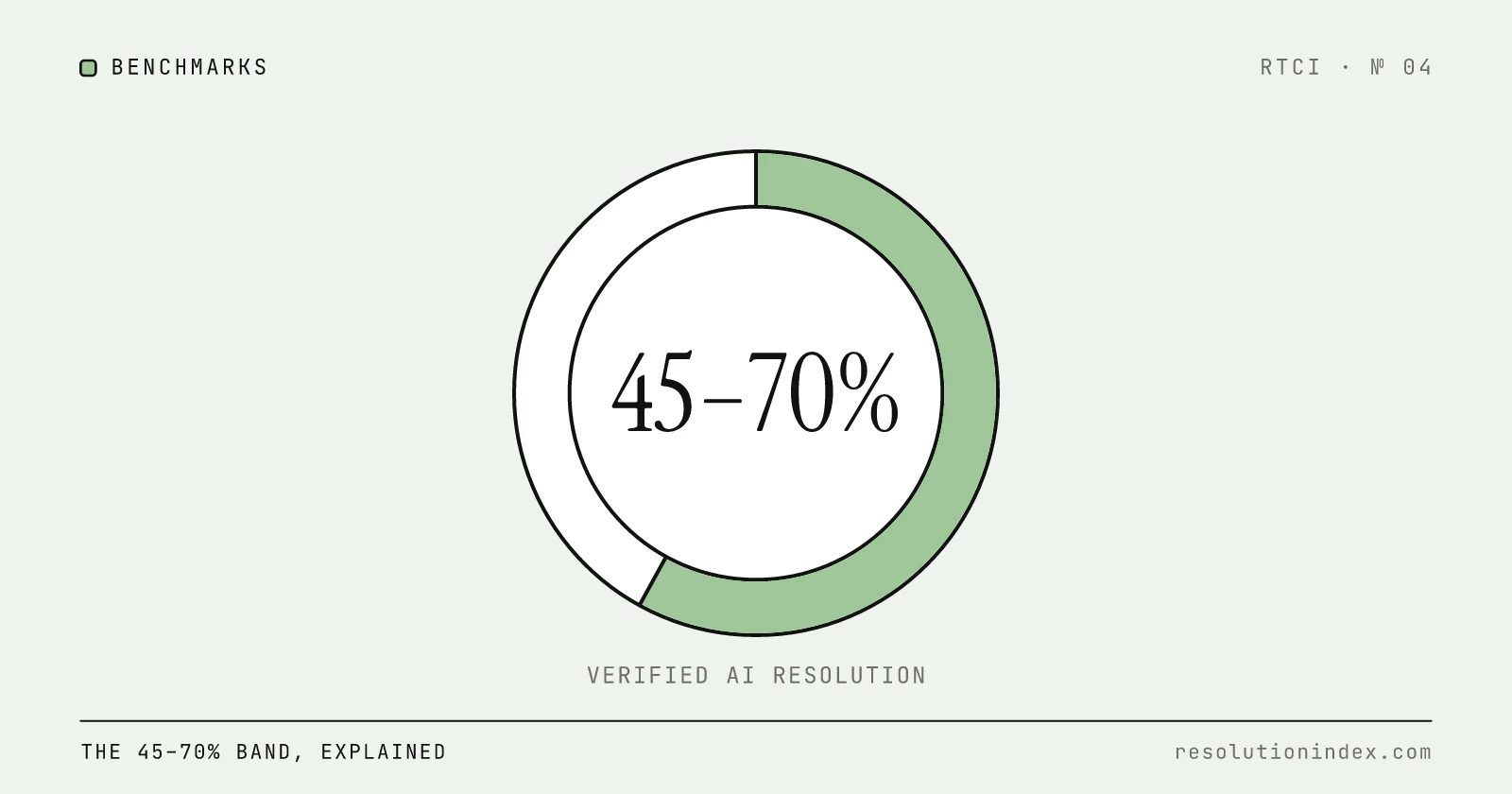
Good AI Resolution Rate: 2026 Benchmarks (45–70%)
A 45–70% realistic AI resolution rate is good for most support teams; above 70% is excellent. 13 of the 20 platforms in RTCI's index land in that band, and the median is 58%.
72-Hour Verified Resolution SLA: Copy-Paste Contract Clauses
A buyer-side clause library for defining, measuring, auditing, crediting, and disputing 72-hour verified resolutions in AI support contracts.
Train the Team on AI Handoff Workflows
What a clean AI-to-human handoff packet contains, how to measure handoff quality, what vendors bill when a conversation is handed off, and how handoffs move cost per verified resolution.