Published Aug 11, 2026 · Updated Nov 19, 2026 · 9 min read
72-Hour Verified Resolution SLA: Copy-Paste Contract Clauses
A buyer-side clause library for defining, measuring, auditing, crediting, and disputing 72-hour verified resolutions in AI support contracts.
 Written by Andrew Hall, Editor
The short answer
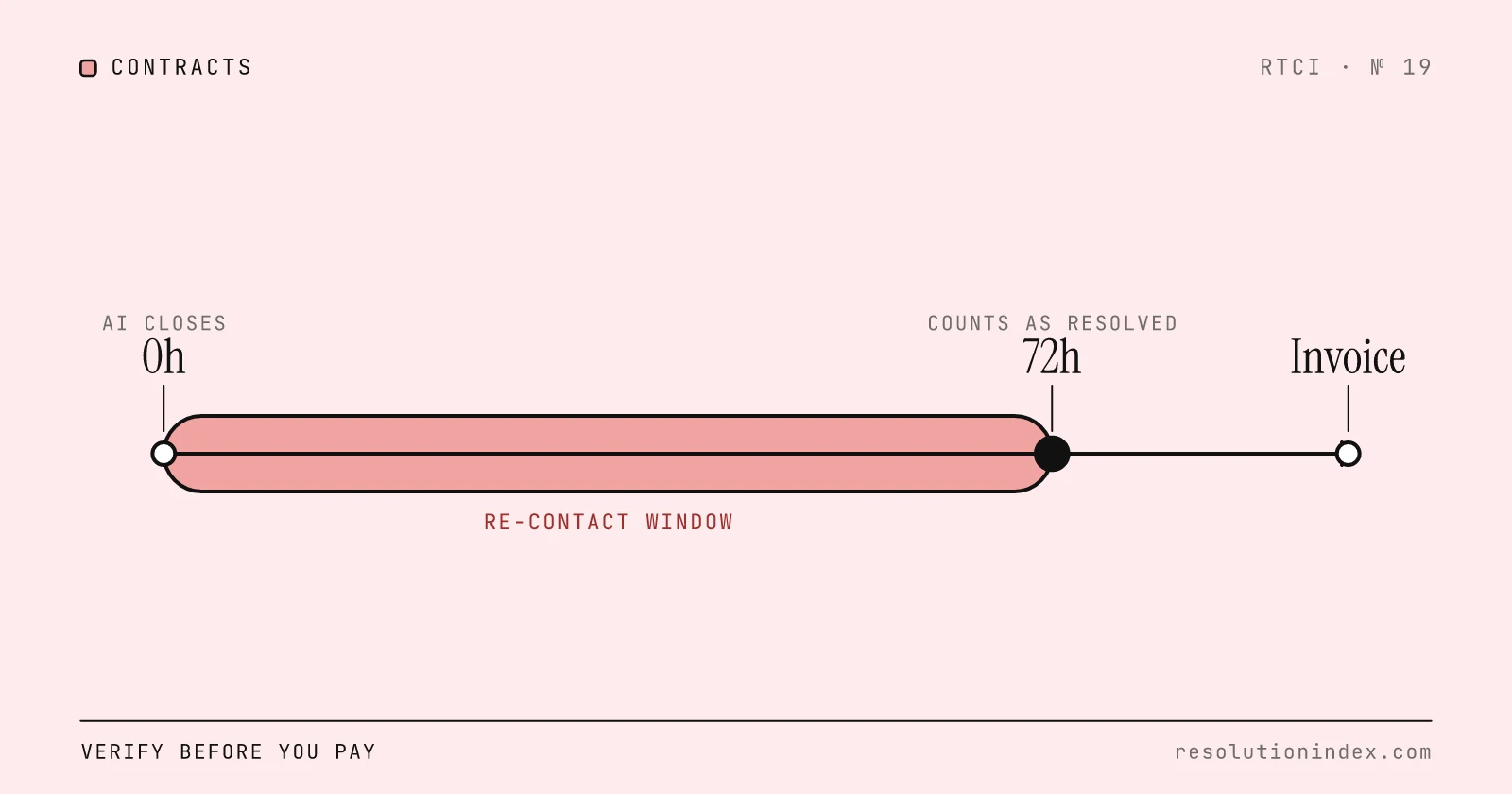
A 72-hour verified-resolution SLA says an issue counts as resolved only after the supplier completes the promised outcome and the customer does not return with the same underlying issue for 72 consecutive hours. No statute or industry standard sets the 72 hours; the buyer chooses the window. The clause works only when the contract also defines the clock start, same-issue matching, exclusions, denominator, evidence, billing reversal, credits, and dispute process.
This distinction matters because support platforms can count operational events differently. Zendesk documents that a customer reply can reopen a Solved ticket, while a reply to a Closed ticket creates a follow-up ticket. Intercom separately documents confirmed resolutions, assumed resolutions, closed events, and reopened events. A procurement team therefore cannot treat a dashboard label as a contractual outcome without a translation rule. See the current Zendesk solved-versus-closed documentation and Intercom reporting definitions, checked 10 September 2026.
Use the clause library below as negotiation language, then have qualified counsel adapt it to the governing law, data-processing terms, service-credit regime, and liability structure of your agreement. This page is an operational drafting aid, not legal advice. It deliberately defers the full measurement method to How to Measure AI Resolution Rate and pricing normalization to AI Customer Support Pricing Models Compared.
Copy-paste 72-hour SLA clause library
The following clauses are designed to work together. Copying only the definition while leaving billing, data access, or dispute mechanics vague creates a metric the supplier can still control. Replace every bracketed field, reconcile the terms with the master agreement, and do not sign until legal, support operations, finance, security, and the data owner agree on the event model.
Clause 1. Defined term: Verified Resolution
Verified Resolution means an Eligible Issue for which Supplier has completed the required customer outcome, delivered any promised customer-visible confirmation, and recorded the Issue as resolved, followed by a Verification Window of seventy-two (72) consecutive hours in which no Same-Issue Re-contact occurs. A response, deflection, article view, handoff, abandoned conversation, silence, or status change alone is not a Verified Resolution.
Clause 2. Clock start and clock type
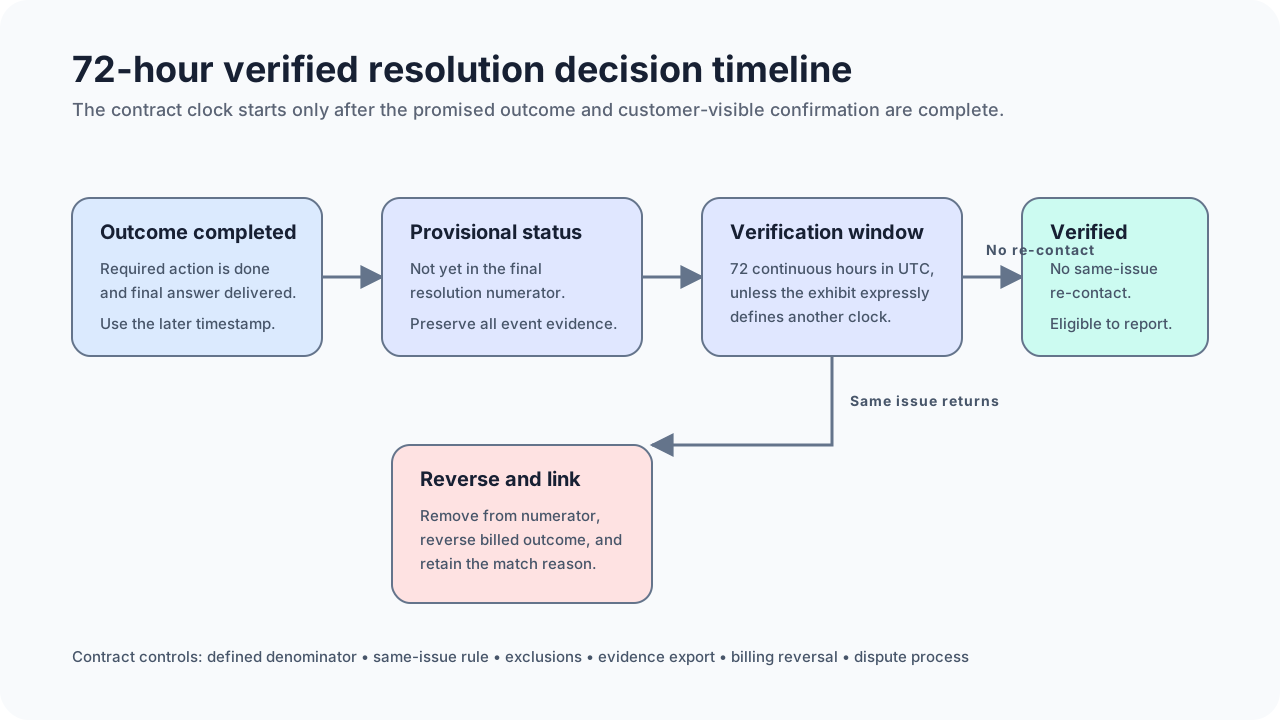
The Verification Window begins at the later of: (a) the timestamp at which Supplier records the Issue as resolved; (b) delivery of the final customer-visible answer; or (c) completion of the promised action in the system of record. The window runs continuously in UTC unless Exhibit [X] expressly defines business-hour measurement. Supplier may not pause or restart the window through an internal status change, reassignment, snooze, or automated message.
Clause 3. Same-Issue Re-contact
Same-Issue Re-contact means a reopened conversation or a new inbound contact reasonably attributable to the same root cause, requested outcome, order, transaction, account, entitlement, incident, or uncompleted promised action as the original Eligible Issue, regardless of channel or ticket identifier. Supplier shall use the matching hierarchy in Exhibit [X] and preserve the match reason for audit.
Clause 4. Narrow exclusions
A Same-Issue Re-contact excludes: (i) a courtesy acknowledgement containing no request for further work; (ii) a demonstrably separate issue; (iii) duplicate delivery caused solely by Customer systems; and (iv) a delay caused solely by Customer failing to provide a specifically requested dependency after written notice. Supplier bears the burden of recording the exclusion code and supporting event evidence. Unclassified contacts remain in the denominator.
Clause 5. Eligible denominator and channel scope
Eligible Issues means all production customer-support contacts offered to the AI service within the in-scope channels and intents in Exhibit [X], excluding only the listed regulatory, security, abuse, outage, and unsupported-language categories. Supplier shall report offered, excluded, answered, escalated, abandoned, provisionally resolved, reversed, and Verified Resolution counts separately. Supplier may not remove failed or escalated contacts from the denominator after the AI service accepts them.
Clause 6. Provisional status and reversal
A case may be labelled Provisionally Resolved during the Verification Window but shall not be included in the final Verified Resolution numerator until the window expires. If a Same-Issue Re-contact occurs within the window, Supplier shall reverse the provisional resolution, link the events, reopen or associate the case as appropriate, and exclude that event from the Verified Resolution numerator for the applicable reporting and billing period.
Clause 7. Billing reconciliation
Where fees are charged per resolution, outcome, conversation, action, or equivalent unit, only Verified Resolutions are billable unless Exhibit [X] states a separate non-resolution unit price. Supplier shall issue an automatic credit or next-invoice reversal for any billed event later invalidated inside the Verification Window. No human handoff, abandoned conversation, negative-feedback exit, or uncompleted action may be billed as a Verified Resolution.
Clause 8. Monthly SLI, target, and credit
The monthly Verified Resolution Rate equals Verified Resolutions divided by Eligible Issues, expressed as a percentage and reported by channel, intent, language, and automation mode. The target is [%]. For each full percentage point below target, Customer receives a service credit of [%] of the affected monthly fees, capped at [__%], without limiting termination rights for chronic failure. The parties acknowledge that the target is a service-level objective and the credit is a contractual remedy, not a representation that every individual Issue will resolve.
Clause 9. Evidence export and audit rights
Within [five] business days after month-end, Supplier shall provide a machine-readable event export containing pseudonymous case identifier, channel, accepted timestamp, resolved timestamp, action-completion timestamp where applicable, verification-end timestamp, re-contact timestamp, match reason, exclusion code, automation mode, human handoff indicator, final classification, and billed-unit identifier. Customer may reproduce the metric from the export and inspect a statistically reasonable sample of underlying records, subject to the data-processing agreement and least-privilege access controls.
Clause 10. Dispute process
Customer may dispute a classification or aggregate result within [twenty] business days after receiving the monthly export. The parties shall review the documented event trail and matching rule within [ten] business days. Ambiguous cases shall be classified using the pre-agreed hierarchy, not a supplier-only model decision. If the sampled misclassification rate exceeds [__%], Supplier shall rerun the affected period at its cost and correct fees, credits, and reports.
Clause 11. Change control
Supplier shall give at least [thirty] days’ written notice before changing the resolution definition, matching model, confidence threshold, exclusion taxonomy, reporting fields, or billing event. No change applies retroactively. A material change requires Customer’s written approval and a parallel-run comparison against the prior method for at least [fourteen] days.
Clause 12. Chronic failure and exit
Chronic Failure occurs when the Verified Resolution Rate misses target by [five] or more percentage points in any [two] months of a rolling [three]-month period, or when Supplier fails to provide reproducible event evidence for [two] consecutive reporting periods. Upon Chronic Failure, Customer may reduce scope, suspend the affected usage commitment, require a remediation plan, or terminate the affected service without early-termination fees, and Supplier shall provide the agreed configuration and event-data export within [ten] business days.
Choose the verification window from your own evidence
Seventy-two hours is a contract choice. Before negotiation, export same-issue re-contacts by elapsed hour and compare candidate windows such as 24, 72, and 168 hours. The shortest window closes reporting faster; the longest catches more delayed failures but also increases ambiguous matches. Choose the window that fits your customer behavior, ticket complexity, channels, and billing cadence.
Document the decision in the exhibit: calendar or business hours, time zone, holiday treatment, reporting lag, and how cases near month-end are matured. If the parties choose something other than 72 continuous UTC hours, replace that language everywhere in the clause set rather than adding a conflicting exception later.
Keep the metric architecture separate from the target. First agree on what enters the numerator and denominator and how reversals work. Then set the target from a measured baseline or controlled pilot. RTCI does not recommend a universal verified-resolution percentage because scope, intent mix, and action permissions change the attainable result.
Resolve these edge cases before signature
| Edge case | Contract decision to record | Evidence field |
|---|---|---|
| Courtesy “thank you” | Exclude only when no new request or unresolved action appears | Exclusion code + reviewer |
| New ticket, same root cause | Link across ticket IDs and channels | Original case ID + match reason |
| Promised refund or account change | Start the clock only after the system-of-record action completes | Action timestamp + confirmation |
| Human handoff | Do not count as an AI Verified Resolution | Automation mode + handoff indicator |
| Third-party outage | Apply only the narrow, named dependency exclusion | Dependency + incident reference |
| Re-contact after billing | Reverse the billed outcome inside the agreed window | Billed-unit ID + credit record |
| Ambiguous match | Use the pre-agreed hierarchy and dispute process | Decision + audit trail |
Put the filled clauses beside a one-page data dictionary and three worked records: a clean verified resolution, a cross-channel same-issue re-contact, and an excluded courtesy reply. Examples make the event model testable before the first invoice and reduce later disagreement over labels.
Turn the clauses into reproducible monthly evidence
Before go-live, the buyer and supplier should run the same ten-ticket sample independently and reconcile every classification. The monthly export should then reproduce the agreed numerator, denominator, reversals, exclusions, and billed units without relying on a supplier-only dashboard.
Map native platform events into the contract vocabulary. For example, a Zendesk follow-up ticket may need to link back to a Closed ticket, while Intercom confirmed, assumed, closed, and reopened events need explicit contractual treatment. Preserve raw event timestamps and the translation rule so a platform configuration change cannot silently redefine the metric.
This article stays focused on contract implementation. Use How to Measure AI Resolution Rate for sampling and metric operations, AI Support Pilot: 90-Day Playbook for pilot design, The Hidden Cost of AI Customer Support Pricing for commercial-risk analysis, and the AI Support RFP Template for vendor selection.
72-hour verified-resolution decision timeline
The decision path below uses the clause library’s single event model: complete the promised outcome, mark the case provisional, wait through the defined verification window, then either finalize the resolution or reverse it when a same-issue re-contact arrives.
Primary sources and drafting scope
- [Zendesk: solved tickets versus closed tickets](https://support.zendesk.com/hc/en-us/articles/4408887712154-What-is-the-difference-between-a-solved-ticket-and-a-closed-ticket: documents reopen behavior and follow-up tickets.
- [Intercom: reporting metrics and attributes](https://www.intercom.com/help/en/articles/7022438-reporting-metrics-attributes: defines confirmed, assumed, closed, and reopened reporting events.
- [Google Cloud: concepts in service monitoring](https://docs.cloud.google.com/stackdriver/docs/solutions/slo-monitoring: explains the relationship among an indicator, target, compliance period, and error budget.
Sources were checked 10 September 2026. They support the platform-event and SLO concepts used here; they do not establish 72 hours as a universal standard. The clauses are an operational drafting aid and require review by qualified counsel for the governing law, remedies, liability terms, and data-processing obligations.
Frequently asked questions
Is a 72-hour verified-resolution window legally required?
No. It is a buyer-defined measurement convention, not a universal legal standard. The contract must define the clock, same-issue matching, exclusions, denominator, evidence, credits, and dispute process for the rule to be enforceable.
When should the 72-hour verification clock start?
Start it when the supplier records the issue as resolved and sends the final customer-visible answer or completes the promised action, whichever happens later. A reply or status change alone should not start the clock if the underlying action is incomplete.
What should count as a re-contact about the same issue?
Count a reopened conversation or a new contact that shares the same root cause, requested outcome, order, transaction, entitlement, or unresolved promised action. Exclude courtesy replies and genuinely separate issues, with a documented dispute process for ambiguous matches.
Should vendors bill for assumed AI resolutions?
Only if the contract makes the assumption rule explicit and later reverses the charge when a same-issue re-contact arrives inside the agreed verification window. Buyers should reconcile billed outcomes against raw ticket-level events.
Change log
- Removed em dashes from clause headings and source notes, cut a paragraph that repeated the worked-records advice, and tightened the short answer.
- Published.
Read next
Keep reading
Picked for this article: the pieces it cites and the ones that answer the next question buyers usually ask.
Most related
AI Support RFP Template: 72 Questions, Scoring Model and Ticket Test
A buyer-side RFP template for AI customer support: 72 vendor questions with strong-answer notes, pass/fail gates, a 200-ticket test, weighted scoring profiles, a pricing form and a pilot clause.
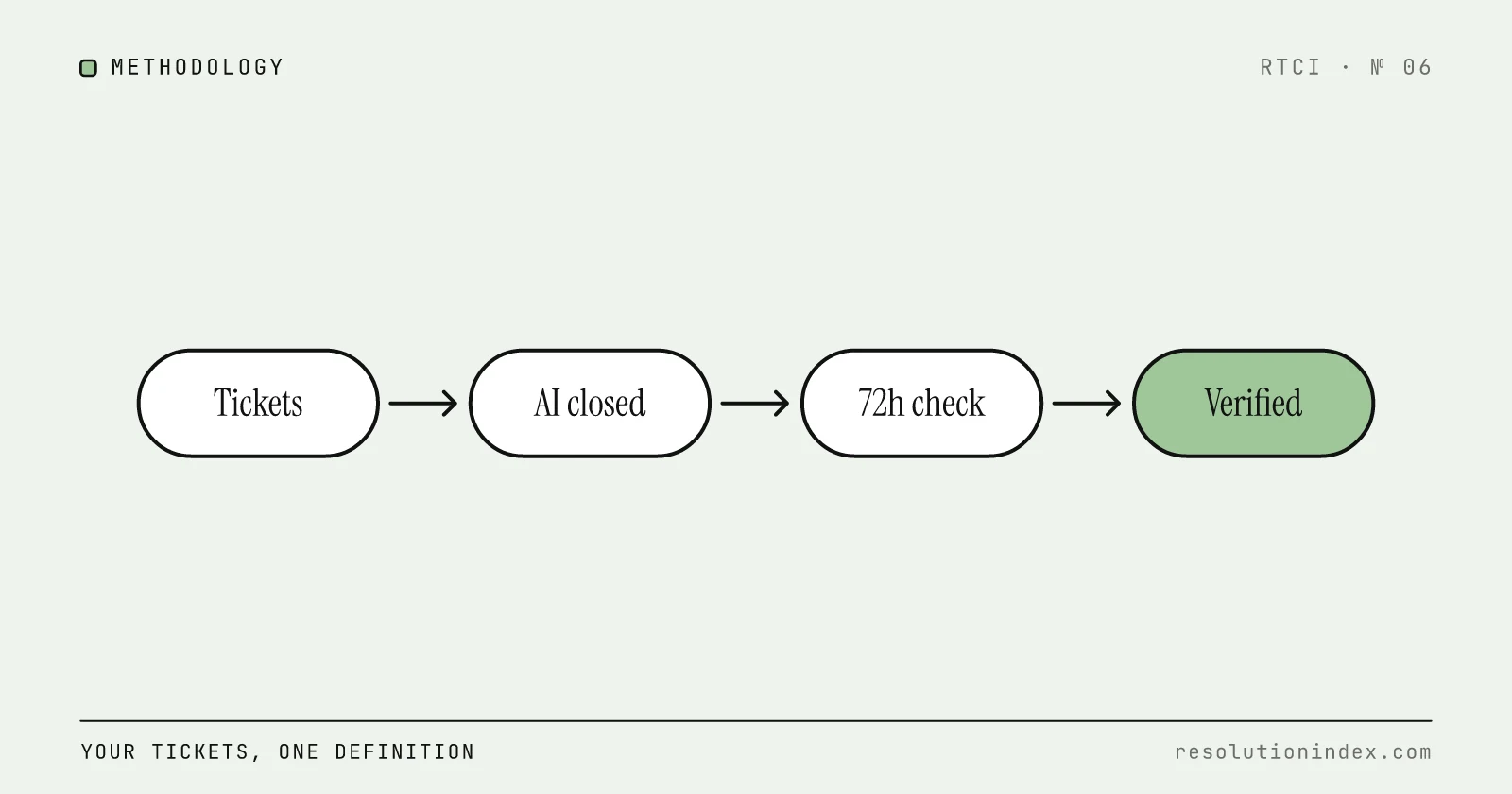
How to Measure AI Resolution Rate Internally
Vendor dashboards report resolution rates that no two vendors calculate the same way. This is a practical, vendor-agnostic methodology to measure your own AI resolution rate using your own ticket data, built on RTCI's 72-hour verified resolution standard.
AI Customer Support Pricing Models Compared: Per-Seat, Per-Resolution, and Usage
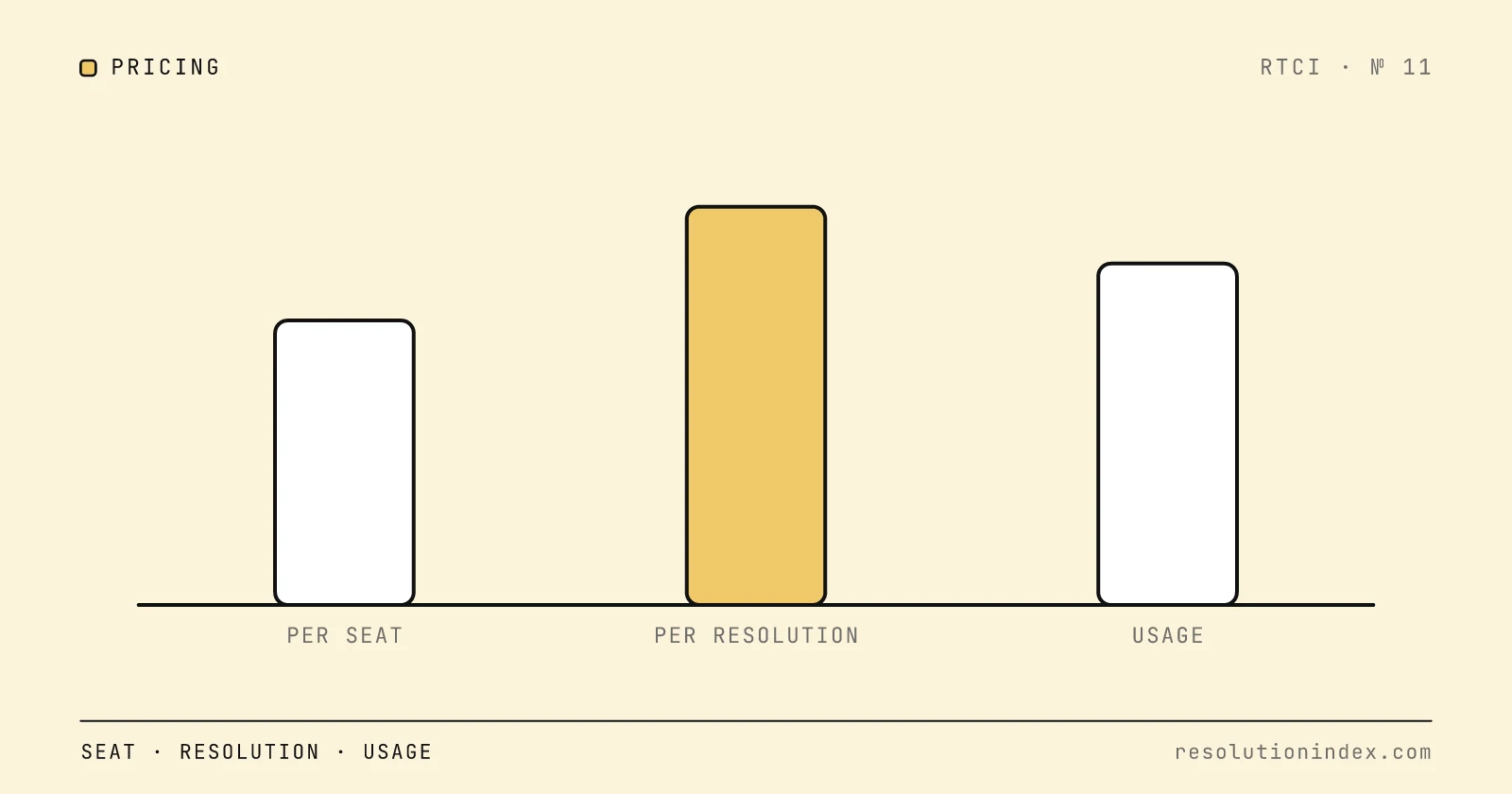
AI support vendors price by seat, by resolution or by usage. A worked example at 10,000 conversations a month shows the same 5,000 resolutions costing $874 to $7,200 depending on the price card.
The Hidden Cost of AI Customer Support Pricing
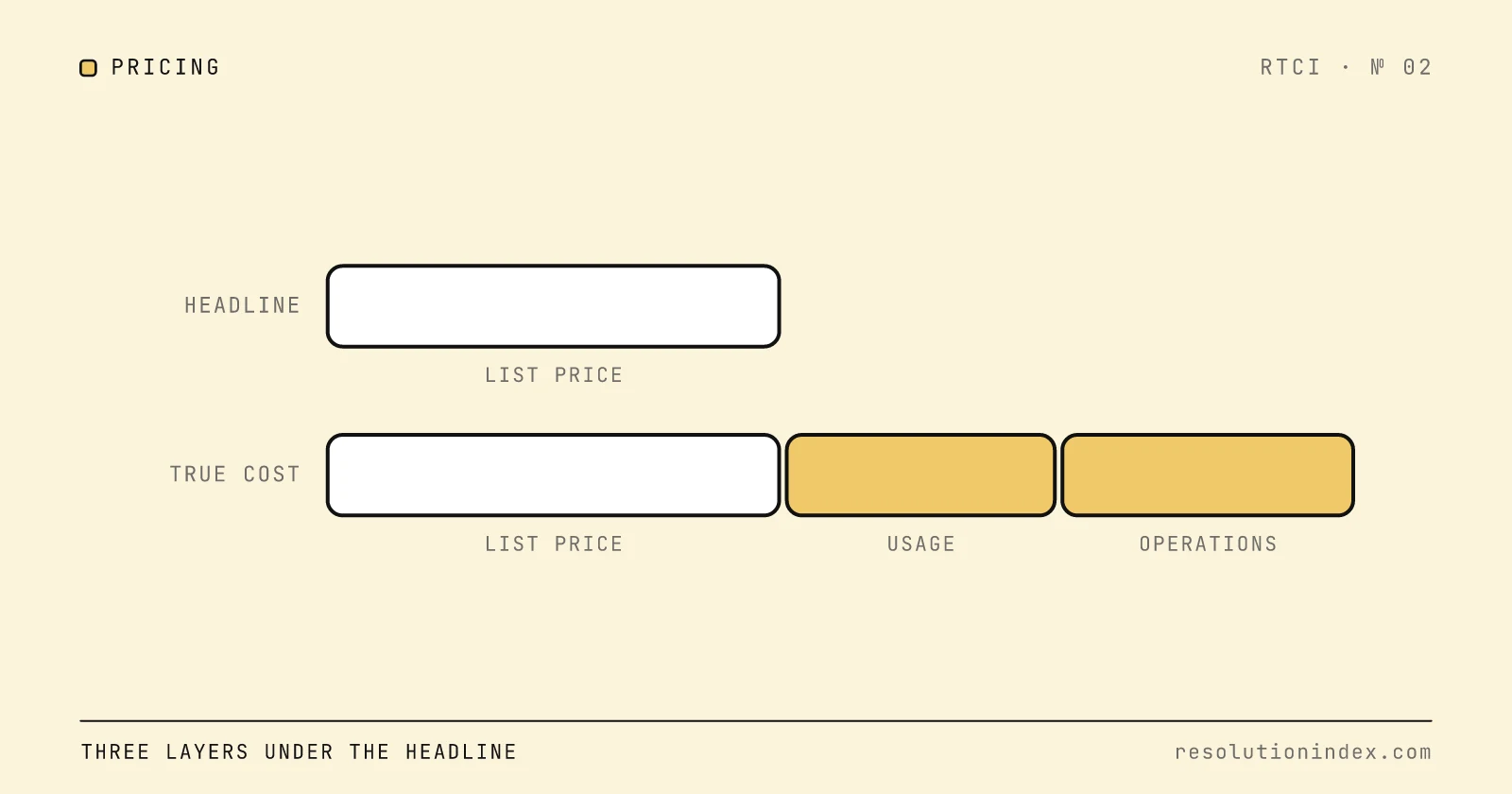
The number on the pricing page is rarely the number on the invoice. RTCI's three-layer cost model breaks down what vendors leave out of the headline.
How to Pilot an AI Support Agent: A 90-Day Playbook
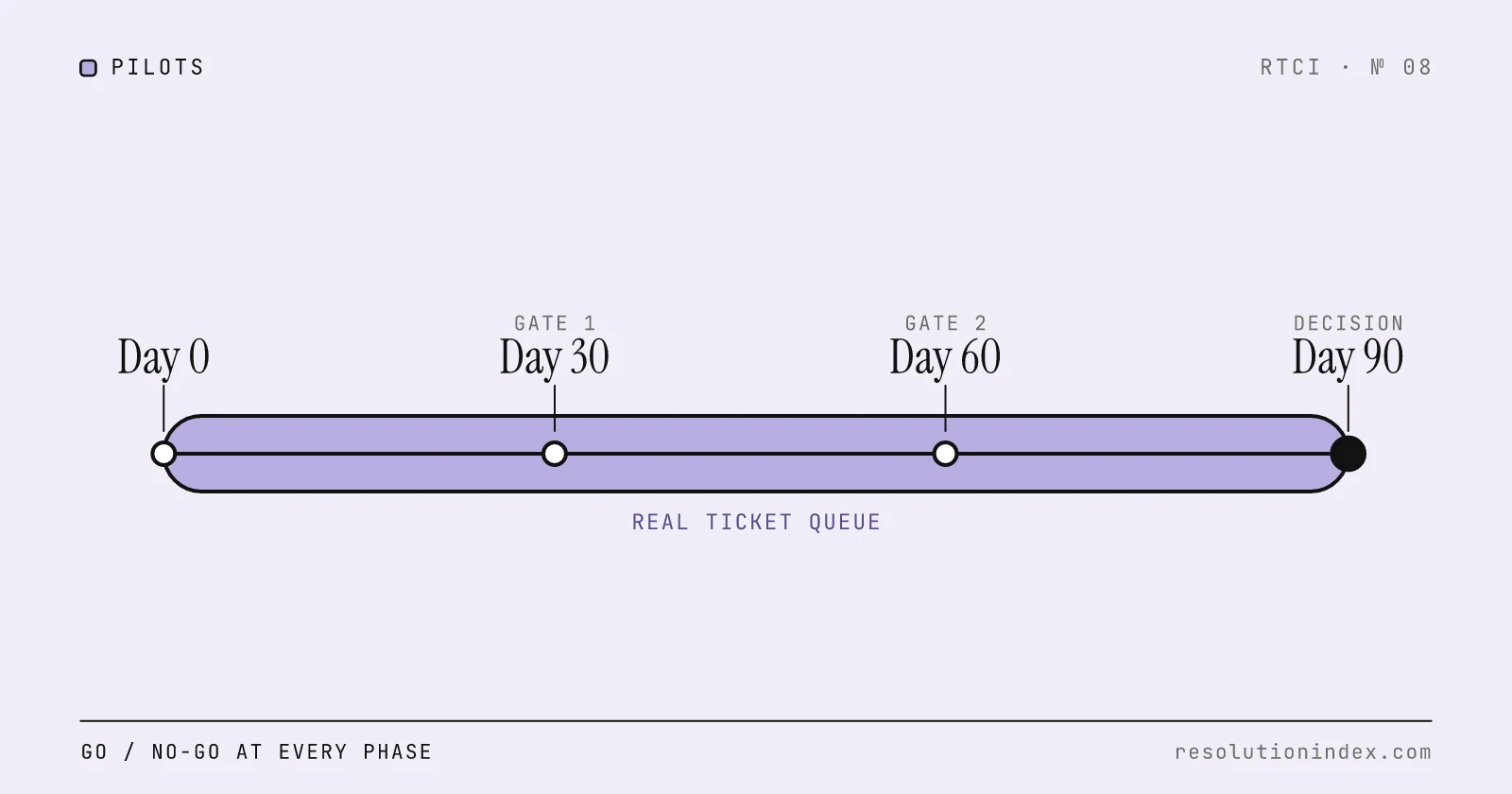
A vendor-agnostic 90-day plan for testing an AI support agent against your real ticket queue, with go/no-go criteria at each phase and clear rules for when to stop.