Published Aug 20, 2026 · Updated Nov 19, 2026 · 7 min read
Outcome-Based vs Seat-Based Pricing for AI Support: Which Model Should You Buy In 2026?
A buyer-side guide to choosing between outcome-based and seat-based AI support pricing in 2026, with current rates for Intercom Fin, Salesforce Agentforce, HubSpot Breeze, Zendesk AI and Freshdesk Freddy, a worked cost per verified resolution example, and a contract checklist.
 Written by Andrew Hall, Editor
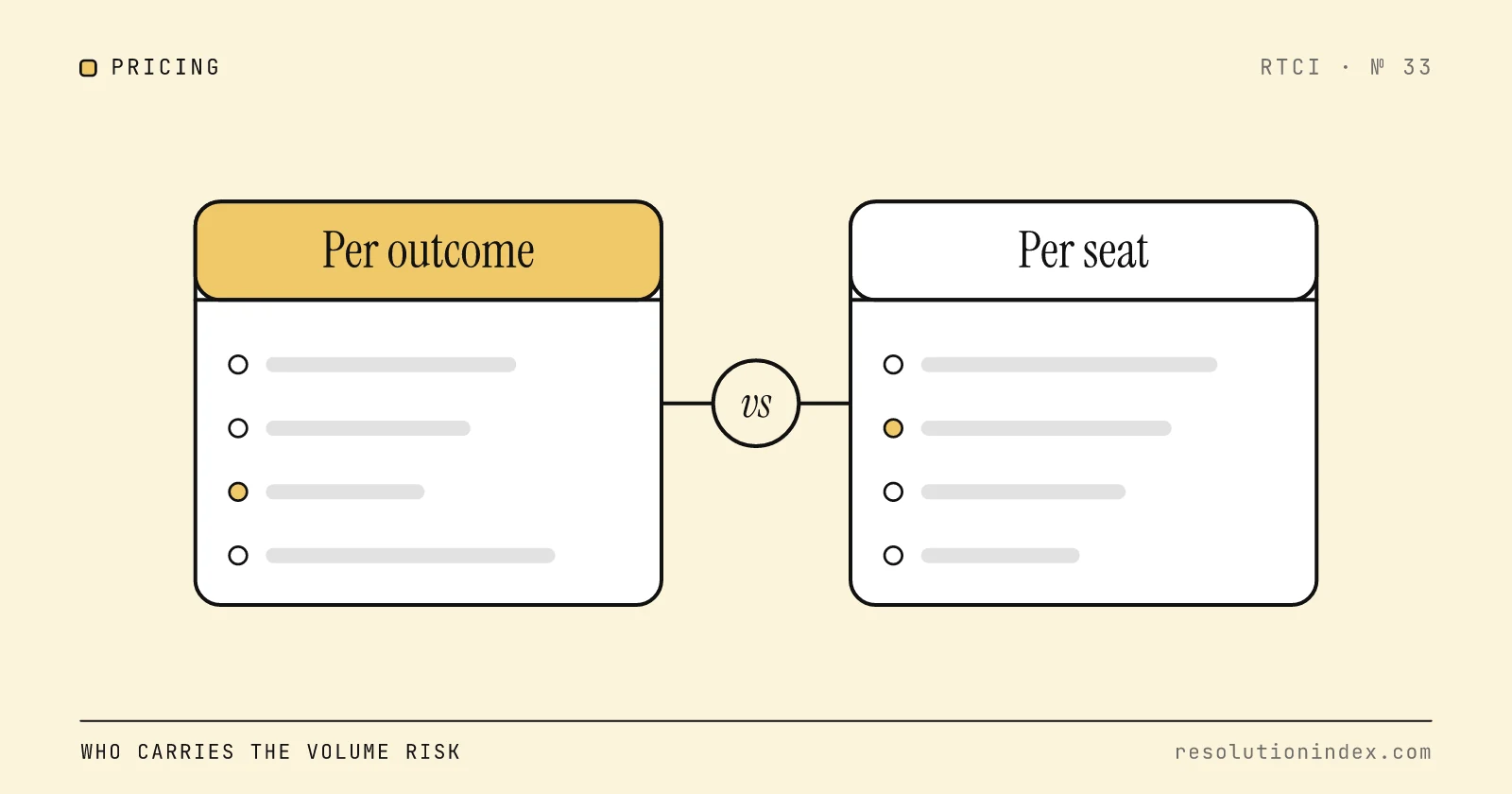
Which pricing model should you buy?
Buy outcome-based (per-resolution) pricing if your volume is variable or growing and you want the AI bill to fall when the AI does less. Buy seat-based or flat pricing if volume is steady and you expect a high resolution rate, because a fixed fee does not grow as the AI resolves more. Most buyers end up with a hybrid: seats for the helpdesk plus a per-resolution meter for AI, which is how Zendesk, HubSpot and Freshdesk now sell it. Pick the option with the lowest cost per verified resolution at three volume levels, not the lowest sticker price.
For the wider taxonomy, read AI Customer Support Pricing Models Compared. To run your own numbers, use the Cost Per Verified Resolution Calculator.
What do outcome-based and seat-based pricing mean in 2026?
Outcome-based pricing means you pay when the AI produces a defined result. Current rates in RTCI's index: Intercom Fin at $0.99 per outcome, with a 50-outcome monthly minimum when it runs on another helpdesk; HubSpot Breeze Customer Agent at $0.50 per resolution (no human handoff within 72 hours) on top of a Service Hub Professional seat from $90 a month; and Salesforce Agentforce at $2 per Help Agent resolution. Sierra and Decagon publish no rates. Third parties report $1 to $2.50 per resolution plus about $150,000 a year in platform fees for Sierra, and about $0.99 per conversation plus about $50,000 a year for Decagon; with those fees RTCI estimates ~$2.61 (est.) per resolution for Sierra and ~$1.50 (est.) for Decagon.
Seat-based pricing means a fixed monthly fee per agent, with AI bundled or sold as a per-agent add-on. Pure seat pricing now mostly covers agent-assist tools: Zendesk Copilot at $50 per agent per month, Freddy AI Copilot at $29 and Fin's Copilot at $29 (annual). Autonomous AI agents are usually metered. Zendesk includes AI agents in every plan (Support Team from $19 per agent per month, Suite Team $55, Suite Professional $115, annual) with 5 to 10 automated resolutions per agent per month included, then bills further Verified resolutions at $1.50 committed or $2.00 pay-as-you-go. Freshdesk seats run $19 to $89 per agent per month, and Freddy AI Agent sessions cost $49 per 100 after 500 one-time free sessions.
So most real contracts are hybrids. Compare them on fully loaded cost per verified resolution, not on the headline unit. For how seats, usage and add-ons stack on one invoice, read The Hidden Cost of AI Customer Support Pricing.
Which model fits which buying situation?
These five situations follow from how each model bills. They are starting points, not findings from a buyer survey.
| Situation | Volume and ticket type | Model that fits | Why |
|---|---|---|---|
| Low-volume, human-heavy team | Under ~3,000 tickets a month; complex or high-touch | Seat-based assist (Copilot-style) | AI helps agents rather than replacing them, so a per-agent fee matches how value arrives. |
| High-volume repetitive tickets | 10,000+ tickets; FAQ, order status, returns | Outcome-based | Cost scales with automation; the vendor earns more only if the AI resolves. |
| Seasonal or spiky volume | Low baseline, peaks of several times normal | Outcome-based with a hard cap | No idle seats in quiet months; the cap limits peak bills. |
| Already on Zendesk or Freshdesk | Existing helpdesk, mixed ticket types | Hybrid | Seats are sunk; negotiate the committed per-resolution or per-session rate. |
| Enterprise custom outcomes | Complex journeys, six-figure contract | Negotiated outcome contract (Sierra, Decagon) | Both publish no rates, so the contract defines what counts as success. |
For resolution rates by ticket type, see What Is a Good AI Customer Support Resolution Rate?.
Worked example: 10,000 tickets under each model
Assumptions: 10,000 tickets a month. The AI produces 5,500 outcomes (55%). 18% of those come back within 72 hours, leaving 5,500 × 0.82 = 4,510 verified resolutions. The team keeps 12 agents at an assumed fully loaded $4,000 a month each, $48,000 in total, on every option. Helpdesk seats are the same across options and left out.
No vendor in RTCI's index sells autonomous resolution as a pure per-seat fee any more, so the seat option is a hypothetical quote: $165 per agent per month for 12 agents with unlimited AI resolutions, $1,980 a month.
| Option | AI bill per month | All-in per month | Cost per verified resolution |
|---|---|---|---|
| Hypothetical seat quote, 12 × $165 | $1,980 | $49,980 | $11.08 |
| HubSpot Breeze, 4,510 × $0.50 | $2,255 | $50,255 | $11.14 |
| Intercom Fin, 5,500 outcomes × $0.99 | $5,445 | $53,445 | $11.85 |
| Zendesk AI agents, (4,510 − 120 included) × $1.50 committed | $6,585 | $54,585 | $12.10 |
| Salesforce Agentforce, 4,510 × $2.00 | $9,020 | $57,020 | $12.64 |
Fin is billed on all 5,500 outcomes because its outcome includes handoffs and routings; Breeze, Zendesk and Agentforce are billed on resolutions, modeled here as the 4,510 verified ones. Zendesk's 120 included resolutions are 12 Suite Professional agents × 10.
Now move the inputs. If the AI reaches 70% with a 10% re-contact rate, verified resolutions rise to 7,000 × 0.90 = 6,300. The seat quote stays at $49,980, or $7.93 per verified resolution. Fin rises to $48,000 + 7,000 × $0.99 = $54,930, or $8.72. If volume instead falls to 6,000 tickets, the seat quote still costs $1,980 while every metered bill falls with volume.
The human team is about 90% of every total, so resolution rate moves cost per verified resolution far more than the AI unit price does. Model at least three volume levels before signing, and see AI Support Cost Per Resolution by Industry (2026) for industry bands.
What are the risks of each model?
Outcome-based pricing moves volume risk to the vendor only if the contract defines the outcome tightly. The main risk is billing for events that are not resolutions. Fin's outcome covers handoffs, disqualifications and self-serve routings, so not every $0.99 charge is a resolution. Vendor claims also sit well above what RTCI treats as realistic: Fin reports a 76% average across 12,000+ customers against RTCI's realistic 56–66% for Fin, and Zendesk's "up to 80% automation" becomes a realistic 36–46% for Zendesk.
Outcome-based buyers also carry forecast risk. If a launch or outage doubles ticket volume, the AI bill can double unless you negotiated a hard cap, and you have to forecast both volume and resolution rate.
Seat-based pricing has its own traps. A ticket touched by both AI and a human can be charged twice when an AI meter sits on top of seats. The vendor earns the seat fee whether the AI resolves one ticket or a thousand. And seat counts lag reality: contract minimums can keep you paying for seats after automation has reduced the need for them.
Start with a written definition of a verified resolution: no human handoff and no re-contact within 72 hours. Model escalation costs with the AI Escalation Cost Calculator and the full budget with the Support Savings Calculator. For internal measurement, read How to Measure AI Resolution Rate Internally.
How do you decide in four questions?
- Is monthly ticket volume predictable within ±20%? Yes points to seat or flat pricing. No points to outcome-based with a hard cap.
- Will the AI resolve more than half of tickets end to end? Yes points to outcome-based, because the vendor is paid for what it delivers. No points to seat-based assist.
- Are you buying AI to assist agents or to resolve tickets? Assist points to seats. Resolution points to outcomes.
- Are you locked into a Zendesk or Freshworks contract? Yes means optimizing the hybrid you have. No means testing pure outcome vendors.
Three or four outcome answers: run an outcome-based pilot. Zero or one: stay seat-based. Two and two: negotiate a hybrid. For the wider selection process, see How to Choose an AI Customer Support Platform in 2026.
What should the contract say?
[ ] Billable outcome. Tie it to a verified resolution: no human handoff, no re-contact within 72 hours. [ ] Re-contact window. Match it to how your customers actually come back, not the vendor default. [ ] Escalation billing. An AI attempt that escalates to a human is not a billable outcome. [ ] Spend cap and volume bands. A hard monthly cap; overage needs written approval, not automatic true-up. [ ] Audit rights. Sample at least 5% of AI-handled conversations for human-judged scoring. [ ] Data use. A training-data opt-out so your customer data does not train shared models. [ ] True-up frequency. Monthly or quarterly, not a retroactive annual reconciliation.
For a full quote-normalization method, see Compare AI Support Quotes Apples to Apples. To track results, see Track Cost Per Resolution in Google Sheets.
Who sells which model?
| Vendor | Model | Current rate (RTCI index, Nov 2026) | What to pin down |
|---|---|---|---|
| Intercom Fin | Per outcome + helpdesk seats | $0.99 per outcome; 50 outcomes/mo minimum off-Intercom | Which outcome types are billed |
| HubSpot Breeze | Per resolution + seats | $0.50 per resolution; Service Hub Professional from $90/seat/mo | Credit wallet shared with other Breeze agents |
| Salesforce Agentforce | Per resolution, Flex Credits or per conversation | $2 per Help Agent resolution; Flex Credits $0.10 per action | Which meter your org is on |
| Zendesk AI | Seats + per verified resolution | Seats from $19/agent/mo; $1.50 committed or $2.00 pay-as-you-go per resolution | Counted resolutions or dollar allowance |
| Freshdesk Freddy | Seats + per session | $49 per 100 sessions after 500 one-time; seats $19–$89 | What counts as a session |
| Sierra | Negotiated outcome | No public rate; ~$2.61 per resolution (est.) | Platform fee and outcome definition |
| Decagon | Per conversation or per resolution | No public rate; ~$1.50 per resolution (est.) | Platform fee and billable event |
| YourGPT | Flat plan + credits | Advanced $349/mo; ~$0.13 per resolution (est.) at ~3,000 conversations and 90% resolved in RTCI's November 2026 test | Credit burn per conversation |
Re-check each vendor's pricing page before signature, and model every quote with the same verified-resolution definition. Then build the business case with Break-Even: When AI Support Pays for Itself.
Frequently asked questions
Which is cheaper: outcome-based or seat-based AI support pricing?
It depends on ticket volume, AI resolution rate and how predictable volume is. A flat seat fee wins when the AI resolves a lot and volume is steady, because the fee does not grow with usage. Per-outcome pricing wins when volume falls or swings, because the bill falls with it. Model both on cost per verified resolution before signing.
What counts as a billable outcome?
It varies by vendor. HubSpot bills a resolution with no human handoff within 72 hours, Zendesk bills only Verified automated resolutions, and Intercom Fin bills an outcome that also covers Procedure handoffs, disqualifications and routings. Get the definition in writing before comparing rates.
Does outcome-based pricing include escalations?
Sometimes. Sierra says unresolved or escalated conversations generally are not billed, while Fin counts handoffs as outcomes. Ask which events are billable and exclude escalated tickets from the billable count where you can.
Do Zendesk and Freshworks still use seat-based pricing?
For agents, yes. For AI, both now meter usage on top of seats: Zendesk bills additional verified automated resolutions at $1.50 committed or $2.00 pay-as-you-go, and Freshdesk bills Freddy AI Agent sessions at $49 per 100 after 500 one-time free sessions.
When is a hybrid model the safest choice?
When you need a predictable base for budgeting but want AI costs to follow results. Negotiate a base platform or seat fee plus a per-outcome rate with a hard monthly cap.
What contract clauses matter most for outcome-based deals?
The outcome definition, re-contact window, escalation billing rule, hard spend cap, volume bands, audit rights and data-use restrictions. These decide whether the vendor can bill you for automation that failed.
How do I compare quotes across different pricing models?
Convert every quote to cost per verified resolution with the same resolution definition, re-contact window, escalation cost and human loaded cost. Do not compare headline per-seat or per-outcome prices on their own.
Change log
- Corrected Zendesk, Freshdesk, Sierra and Decagon pricing to the RTCI index, fixed the worked example (Breeze and Agentforce now billed on verified resolutions), replaced unsourced claims with index figures, and reframed the buyer profiles as situations rather than observations.
- Published.
Read next
Keep reading
Picked for this article: the pieces it cites and the ones that answer the next question buyers usually ask.
Most related
AI Customer Support Pricing Models Compared: Per-Seat, Per-Resolution, and Usage
AI support vendors price by seat, by resolution or by usage. A worked example at 10,000 conversations a month shows the same 5,000 resolutions costing $874 to $7,200 depending on the price card.
Track Cost Per Resolution in Google Sheets
A copy-pasteable Google Sheets build for cost per verified resolution: a ticket log, a monthly cost sheet, a live dashboard, a budget-variance template and a worked example that shows why the vendor rate understates what you pay.
AI Support Cost Per Resolution by Industry (2026)
How fully loaded cost per verified resolution changes by industry, built from BLS wage data for customer service representatives, published AI pricing and stated assumptions you can replace with your own.
The Hidden Cost of AI Customer Support Pricing
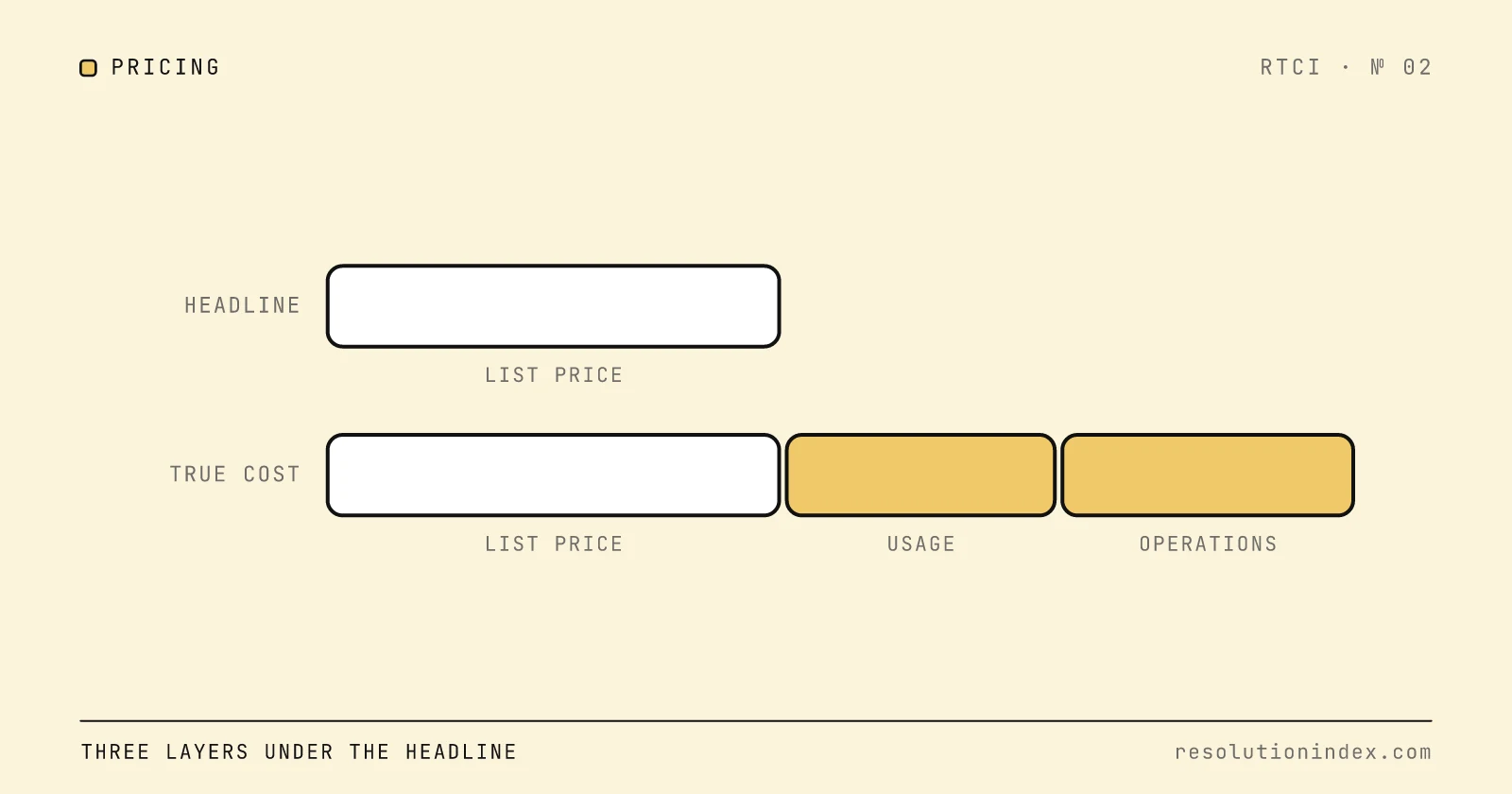
The number on the pricing page is rarely the number on the invoice. RTCI's three-layer cost model breaks down what vendors leave out of the headline.
Good AI Resolution Rate: 2026 Benchmarks (45–70%)
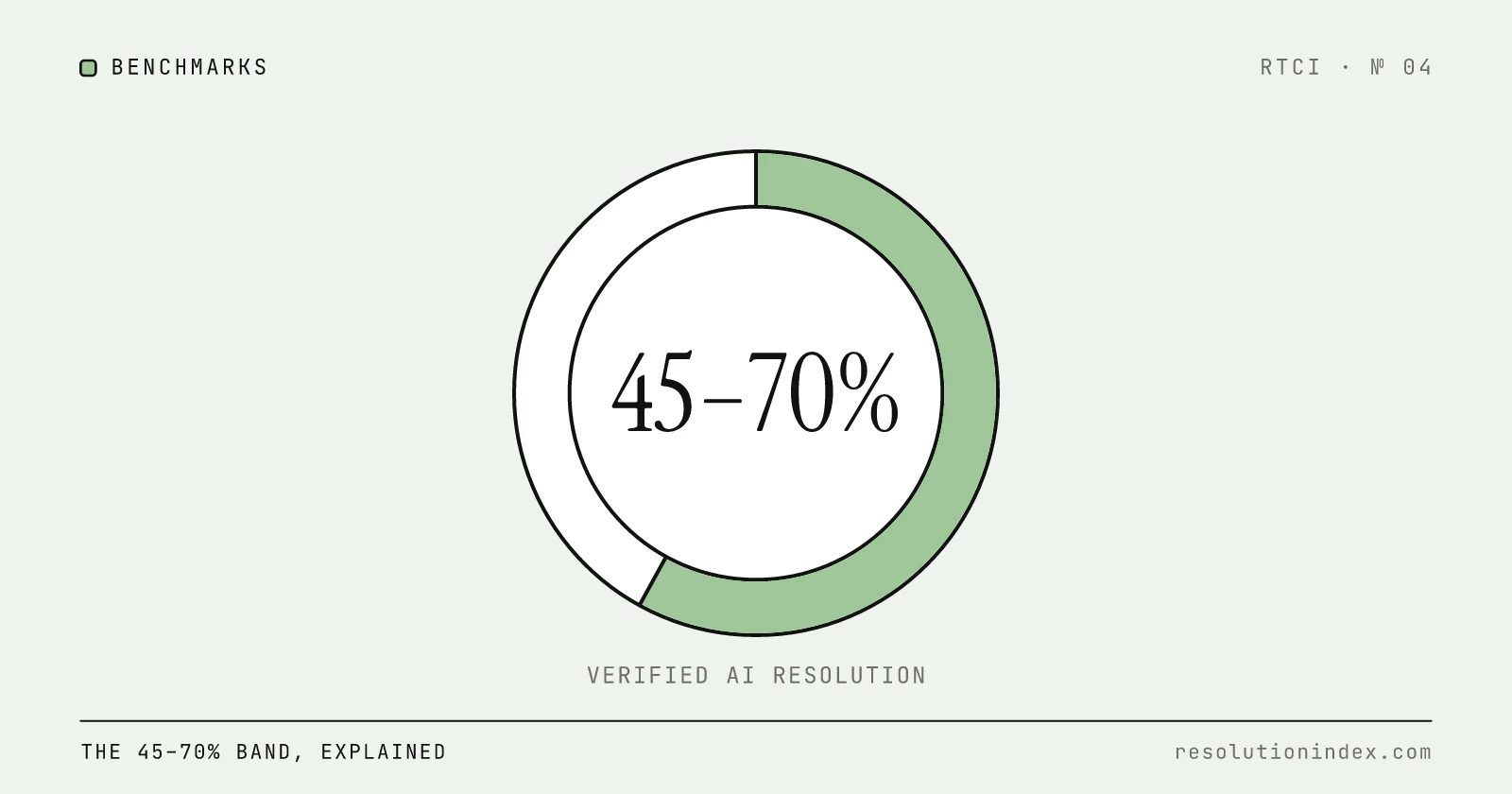
A 45–70% realistic AI resolution rate is good for most support teams; above 70% is excellent. 13 of the 20 platforms in RTCI's index land in that band, and the median is 58%.