Published Nov 20, 2026 · Updated Nov 20, 2026 · 16 min read
Customer Service Trends 2027: 10 Shifts Already Showing Up in the Data
Ten customer service trends that are already measurable going into 2027, each with a dated source: per-resolution pricing, diverging resolution definitions, AI bundled into base plans, rising AI unit prices, suites buying AI agent vendors, chatbot disclosure laws, the push for a human option, business AI adoption, the support workforce and customers' own AI assistants. With what each means for support teams and the signal to watch.
 Written by Andrew Hall, Editor
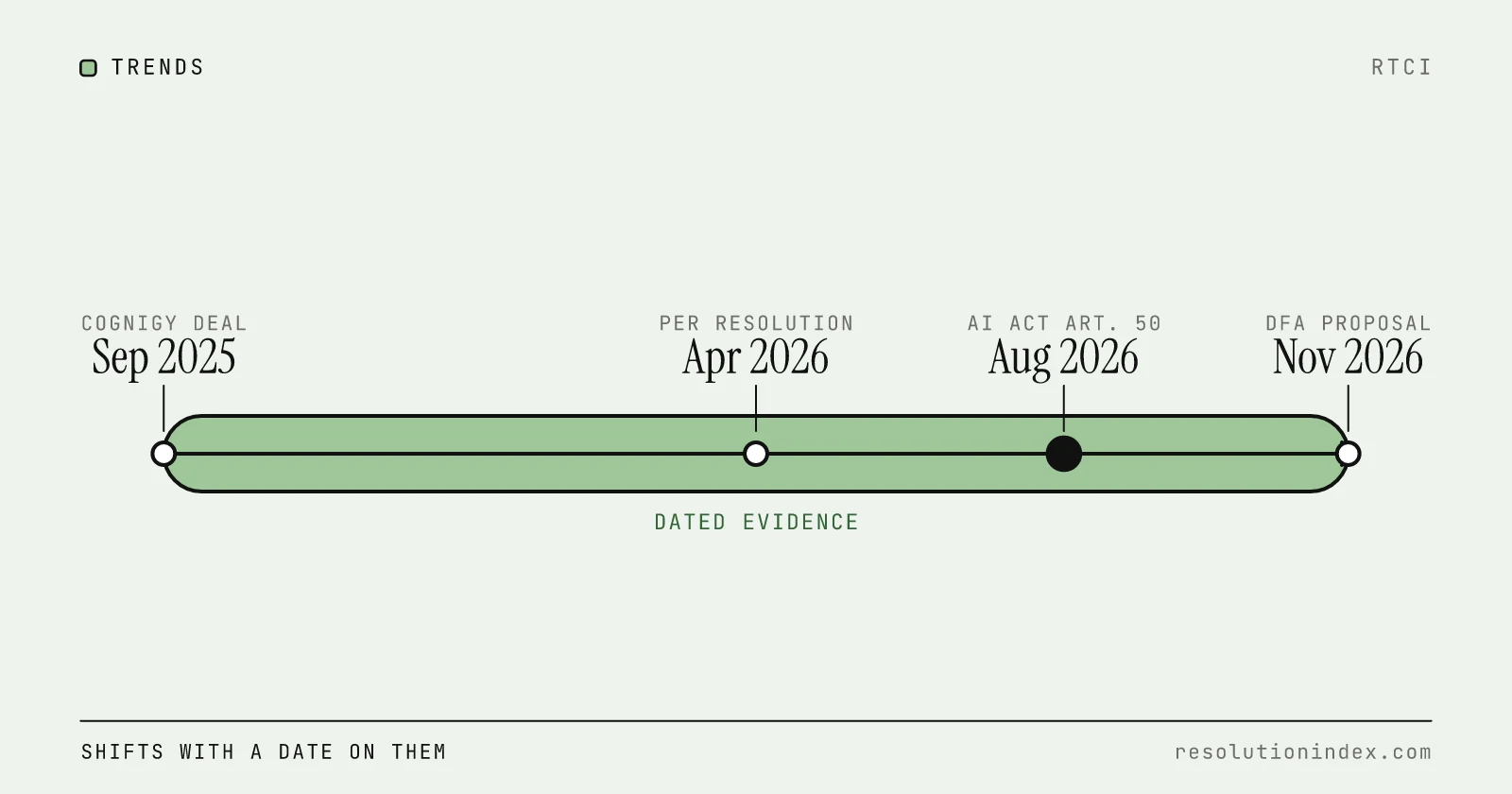
The customer service trends heading into 2027 that already show up in dated data are: AI agents billed per resolution, vendors defining "resolution" differently, AI folded into base plans, AI unit prices rising at several vendors, helpdesk suites buying AI agent vendors, chatbot disclosure laws in force, pressure to keep a human option, business AI use rising from a low base, a slowly shrinking US support workforce, and customers using their own AI assistants. Each trend below has a date and a link.
This page records what has already happened. RTCI's forecasts, each with what would prove it wrong, are in the future of customer service, and the individual numbers with samples are in AI customer service statistics. Vendor surveys are labelled as vendor surveys, with the sample size. Pricing changes come from RTCI's AI Support Pricing Tracker, where every entry links to the vendor's own page.
| # | Trend | Strongest dated evidence | Evidence type | Watch for |
|---|---|---|---|---|
| 1 | AI billed per resolution or outcome | HubSpot to $0.50 per resolution (Apr 14, 2026); Salesforce $2 per resolution (Jun 25, 2026); 11 of 20 indexed platforms | Vendor prices, RTCI index | Zendesk's outcome pricing update |
| 2 | "Resolution" defined differently by each vendor | Intercom widens to outcomes (Mar 12, 2026); Zendesk narrows to verified (May 18, 2026) | Vendor billing terms | Next billing-terms change in the tracker |
| 3 | AI moves into the base plan; old bots retired | Zendesk all plans (Mar 30, 2026); Gorgias bundled (Jul 14, 2026); Zendesk legacy bots migrate Jan to Feb 2027 | Vendor announcements | Zendesk's automatic migration |
| 4 | AI unit prices rising at some vendors | Lorikeet +40% (Sep 2026); Kustomer +25% (Oct 12, 2026) | Vendor prices | Increases vs cuts in the tracker |
| 5 | Suites buying AI agent vendors | NiCE–Cognigy (Sep 8, 2025); Zendesk–Forethought (Mar 26, 2026); Salesforce–Fin (Sep 10, 2026) | Buyer press releases | Change-of-control terms at renewal |
| 6 | Chatbot disclosure becomes law | Maine PL 2025 c. 294 (Jun 12, 2025); EU AI Act Article 50 (Aug 2, 2026) | Statute, regulation | Enforcement and more US states |
| 7 | Pressure to keep a human option | EU Digital Fairness Act proposal (Nov 11, 2026); 88% of 3,100+ consumers want a human available | Legislative proposal, vendor survey | Parliament and Council positions |
| 8 | Business AI use rising from a low base | EU 8.1% (2023) to 20.0% (2025); US 17% to 20% (Dec 2025 to May 2026) | Government statistics | Eurostat's 2026 figure |
| 9 | Support workforce shrinking slowly, work shifting | BLS: 2,919,230 (May 2019) to 2,858,710 (May 2023); −5% projected 2025 to 2035 | Government statistics, vendor survey | BLS May 2025 estimate |
| 10 | Customers using their own AI assistants | Third-party GenAI 3× brand chatbots (Gartner via Retail Dive, Jul 13, 2026); A2A v1.0 (Apr 9, 2026) | Analyst survey, standards body | A helpdesk documenting agent-started contacts |
What do the pricing changes show?
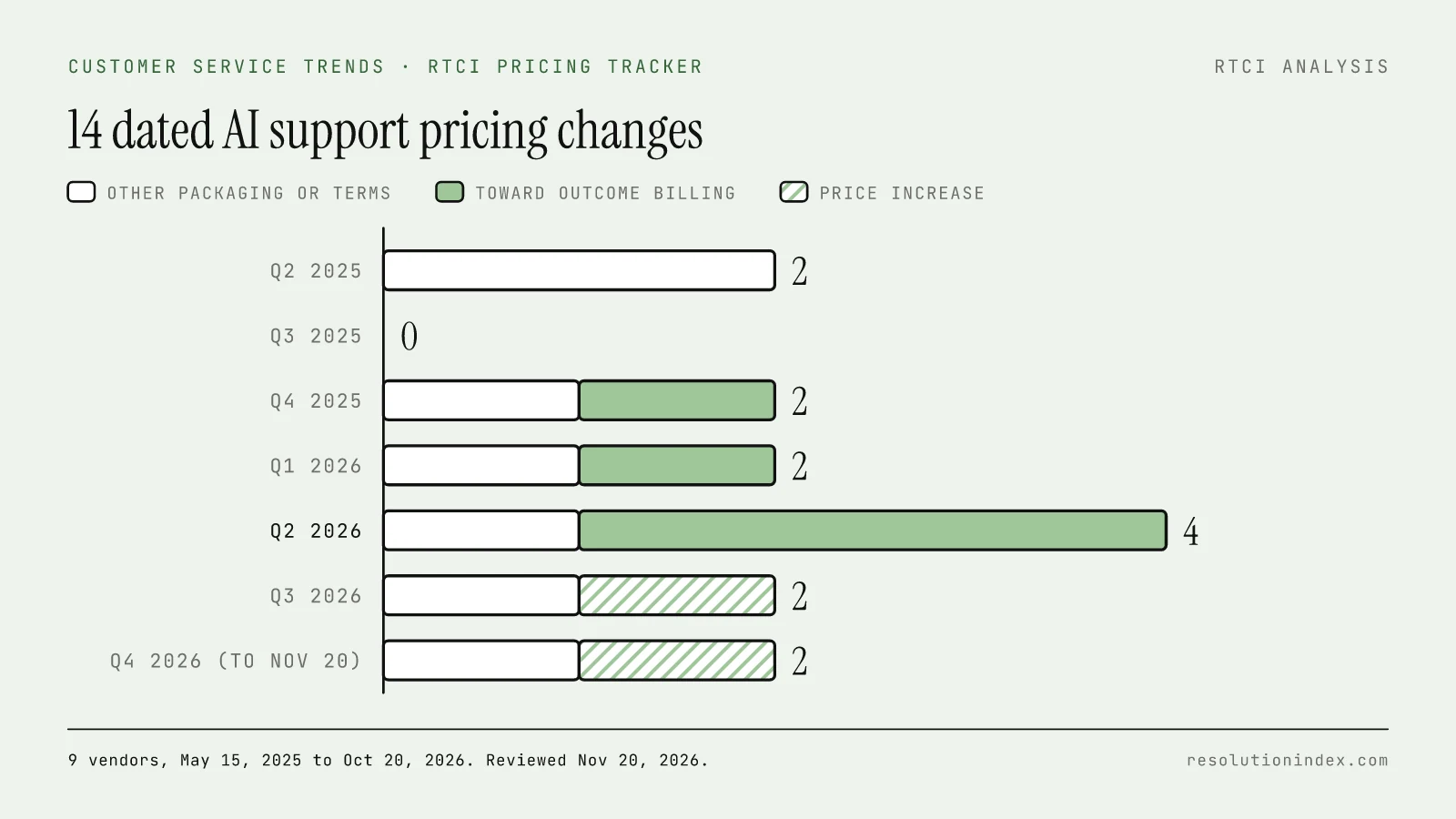
Four of the ten trends come from one dataset, so it is worth seeing whole. RTCI's tracker logs 14 dated pricing and packaging changes at 9 AI support vendors between May 15, 2025 and October 20, 2026, and 10 of them fall in 2026. Grouped by quarter:
| Quarter | Toward outcome or resolution billing | Price increase | Other packaging, terms or deprecation | Total |
|---|---|---|---|---|
| Q2 2025 | 0 | 0 | 2 | 2 |
| Q3 2025 | 0 | 0 | 0 | 0 |
| Q4 2025 | 1 | 0 | 1 | 2 |
| Q1 2026 | 1 | 0 | 1 | 2 |
| Q2 2026 | 3 | 0 | 1 | 4 |
| Q3 2026 | 0 | 1 | 1 | 2 |
| Q4 2026 (to Nov 20) | 0 | 1 | 1 | 2 |
| Total | 5 | 2 | 7 | 14 |
The five outcome moves are Crescendo's Total Outcome Guarantee (October 23, 2025), Intercom's switch to outcomes (March 12, 2026), HubSpot's per-resolution price (April 14, 2026), Zendesk's resolution tiers (May 18, 2026) and Salesforce's per-resolution Help Agent (June 25, 2026). The two increases are Lorikeet (September 20, 2026) and Kustomer (October 12, 2026). Q2 2026 was the busiest quarter, and since July the changes have been about price and packaging rather than the billing unit.
1. Are AI agents moving to per-resolution pricing?
What's happening. The AI layer is increasingly billed per resolution or outcome rather than per conversation, while human agents stay on seats.
The evidence. HubSpot moved Customer Agent from $1.00 per conversation to $0.50 per resolved conversation on April 14, 2026 (HubSpot). Salesforce announced pay-per-resolution pricing for Help Agent on June 25, 2026, listed at $2 per resolution, with no charge when a customer asks for a human or gives negative feedback (Salesforce). In RTCI's index as of November 2026, 11 of the 20 platforms bill the AI per resolution or outcome, or offer it as an option. Zendesk's CX Trends 2027 survey reports 85% agreeing that AI vendors should price on verified outcomes (Zendesk, November 17, 2026; vendor survey of more than 3,100 consumers and 4,400 business respondents in 10 countries, and the release does not say which group gave this answer).
What it means for support teams. AI spend becomes a usage line that grows with automation, so a budget built on seats will be wrong by year two. Ask every vendor for both a per-conversation and a per-resolution quote; outcome-based vs seat-based pricing shows how to compare them.
Watch for. Zendesk said on March 30, 2026 it would share separately how its outcome-based pricing will evolve (Zendesk). That announcement, and whether any of the nine platforms still billing per conversation, session or credit switches, is the next data point. RTCI's forecast for the end of 2027 is prediction 1 in the future of customer service.
2. Is "resolution" starting to mean different things?
What's happening. As more vendors bill per resolution, they are defining the billable unit in opposite directions.
The evidence. On March 12, 2026 Intercom changed Fin's billing metric from resolutions to outcomes, which also count Procedure handoffs, qualifications and disqualifications, at $0.99 each and at most once per conversation (Intercom help center). On May 18, 2026 Zendesk went the other way: only a verified resolution, which passes an LLM check and ends without the customer asking for more help, is charged, while assisted escalations and contained resolutions are not (Zendesk help center). Intercom widened the billable set; Zendesk narrowed it.
What it means for support teams. Two quotes at the same unit price can bill for different events. Worked example from the tracker: if 10% of Fin's billed outcomes are handoffs, each true resolution costs $0.99 ÷ 0.9 = $1.10. Write your own definition into the contract (no human handoff, no same-issue re-contact within 72 hours) and ask for billing data that ties each charge to a transcript. Resolution rate vs deflection rate and the 72-hour rule clauses cover both.
Watch for. The next "billing terms" entry in the pricing tracker. A vendor adopting another vendor's definition would be the first sign of convergence; through November 20, 2026 there is none.
3. Is AI becoming part of the base plan?
What's happening. AI agents are moving from optional add-ons into standard plans, and older rule-based bots are being switched off.
The evidence. Zendesk announced on March 30, 2026 that capabilities that needed the Advanced AI agents add-on would be included across Suite and Support plans, rolling out from May 11 to June 12, 2026 (Zendesk). Gorgias moved AI Agent from a $0.90 per resolved conversation add-on into every plan, on by default, with included interactions and a $1.50 overage; the change is dated to a July 14, 2026 capture by a third-party tracker (UsagePricing). On June 23, 2026 Zendesk announced the removal of its Essential AI agents and legacy bot builder: the legacy experience entered maintenance mode on August 31, 2026, and agents not yet migrated move automatically in January (Essential) and early February 2027 (legacy) (Zendesk).
What it means for support teams. Bundled AI is paid for whether or not it is used. On Gorgias Pro, 190 included interactions × $0.90 = $171 a month of AI sits in the plan price. If you are on Zendesk's legacy bots, re-forecast billed resolutions before the automatic migration, since Zendesk says the change in automated resolutions may affect usage costs.
Watch for. What happens to Zendesk accounts after the January and February 2027 migrations, and whether other helpdesks retire their own rule-based bots.
4. Are AI support prices going up?
What's happening. At several vendors the price of the AI itself rose in the second half of 2026. The one large cut came earlier.
The evidence. Kustomer's pricing page, last updated October 12, 2026, lists Concierge at $0.75 per engaged conversation and Envoy at $50 per user a month, against $0.60 and $40 in a third-party capture of October 5 (Kustomer). That is $0.75 ÷ $0.60 = 1.25, a 25% rise. Lorikeet's Start plan went from $1,500 to $2,100 a month (+40%) and Scale from $4,000 to $5,100 (+27.5%), per captures of August 28 and September 20, 2026 (UsagePricing). Gorgias's overage of $1.50 per automated interaction is 67% above the $0.90 add-on it replaced. Against these, HubSpot's April 14 change cut its cost per resolution: at its realistic 51–61% resolution rate, the old $1.00 per conversation worked out to $1.64–$1.96 per resolution, against $0.50 now.
What it means for support teams. Model AI unit prices flat or rising over a multi-year business case, and negotiate a cap on renewal increases. Hidden fees in AI support contracts lists the clauses. The median AI cost per resolution in RTCI's index is $1.12 (November 2026).
Watch for. The ratio of increases to cuts in the tracker. In 2026 it is two increases (Lorikeet, Kustomer) to one cut (HubSpot). RTCI's view on where the median goes by 2028 is prediction 3 in the future of customer service.
5. Are helpdesk suites buying the AI agent vendors?
What's happening. Three AI agent vendors in RTCI's index were bought by larger customer service or CRM companies within about twelve months.
The evidence. NiCE announced on September 8, 2025 that it had completed its acquisition of Cognigy (NiCE). Zendesk announced on March 26, 2026 that it had completed its acquisition of Forethought, first announced on March 11, with no terms disclosed (Zendesk). Salesforce signed a definitive agreement on June 15, 2026 to acquire Fin, the company formerly known as Intercom, for about $3.6 billion (Salesforce), and announced completion on September 10, 2026 (Salesforce), earlier than the fourth quarter of fiscal 2027 it first expected.
| Buyer | AI vendor | Completed | Source |
|---|---|---|---|
| NiCE | Cognigy | Sep 8, 2025 | NiCE press release |
| Zendesk | Forethought | Mar 26, 2026 | Zendesk newsroom |
| Salesforce | Fin, formerly Intercom (Intercom Fin) | Sep 10, 2026 | Salesforce press release |
What it means for support teams. Zendesk and Salesforce now each own two of the AI agents in RTCI's index (Zendesk AI and Forethought; Agentforce and Fin), so packaging and roadmaps can change mid-contract. Write change-of-control terms in before signing: a price lock through renewal, full data export and the right to leave if the product is folded into a suite you do not use.
Watch for. Packaging changes at Fin and Forethought under their new owners, and any deal for the independent vendors still in the index. RTCI's forecast for those is prediction 5 in the future of customer service.
6. Do chatbots now have to say they are AI?
What's happening. Telling customers they are talking to an AI has moved from good practice to a legal duty in some markets.
The evidence. Maine's LD 1727 was signed on June 12, 2025 as Public Law 2025, chapter 294 (Maine Legislature). It bars using an AI chatbot in trade with a consumer in a way that may mislead a reasonable consumer into thinking they are dealing with a human, unless the consumer gets a clear and conspicuous notice; a violation counts under the Maine Unfair Trade Practices Act, and the definition covers text and audio (10 M.R.S. §1500-DD). In the EU, Article 50 of the AI Act requires AI systems that interact directly with people to tell them so, unless it is obvious from context, at the latest at the first interaction. Article 113 makes that apply from August 2, 2026 (official text on EUR-Lex).
What it means for support teams. Put the disclosure in the first message of every AI channel, including voice. Do not give an AI agent a human name and photo without the notice next to it. The AI support compliance checklist has the Article 50 items.
Watch for. Enforcement actions under either law, and more US states passing chatbot disclosure rules for commerce.
7. Is there growing pressure to offer a human?
What's happening. Regulators and customers are pushing back on AI-only service, and the EU now has a proposal that names it.
The evidence. On November 11, 2026 the European Commission adopted its Digital Fairness Act proposal, and its page lists "the inability to reach a human interlocutor for customer service" among the problems it addresses (European Commission). Euronews reports the proposal would let online consumers reach a human agent rather than being left with a chatbot, and that MEPs and national governments still have to approve it. On the customer side, 88% of consumers in Zendesk's CX Trends 2027 survey want a human available if needed (Zendesk, November 17, 2026; vendor survey of more than 3,100 consumers in 10 countries, July and August 2026). Pricing has moved with it: Salesforce does not charge for Help Agent conversations where the customer asks for a human.
What it means for support teams. Build a visible route to a person in every AI channel, with the conversation passed along so the customer does not repeat themselves. Track the share of AI conversations where the customer asks for a human; it is both a quality signal and, under some contracts, an unbilled event. Training the team on AI handoff workflows covers the handoff itself.
Watch for. The European Parliament's and Council's positions on the human-contact provision. Adoption is not certain, and RTCI's timing call is prediction 4 in the future of customer service.
8. How many businesses actually use AI?
What's happening. Business AI use is rising quickly in the EU and more slowly in the US, but most firms still do not use it.
The evidence. Eurostat reports 20.0% of EU enterprises with 10 or more employees used AI in 2025, up from 13.5% in 2024 and 8.1% in 2023 (Eurostat, December 11, 2025). That is 20.0 ÷ 8.1 = about 2.5 times in two years. The most common use was analysing written language, at 11.8%. In the US, the Census Bureau's Business Trends and Outlook Survey put AI use at 19.8% of businesses as of May 3, 2026, hovering between 17% and 20% from December 14, 2025, with growth concentrated in firms with 20 or more employees (U.S. Census Bureau, May 2026). The Census question changed in November 2025 to cover AI "in any business function", so earlier US figures are not comparable.
What it means for support teams. Vendor surveys of support leaders report much higher AI investment because they ask teams that already buy support software; the government figures are the honest baseline for peers. If you have not deployed AI support yet, you are still in the majority. The AI Readiness Assessment checks whether you are ready to.
Watch for. Eurostat's 2026 figure, usually published in December, and whether the BTOS rate breaks above 20%.
9. Is the customer service workforce shrinking?
What's happening. US customer service employment is drifting down, not collapsing, and the government now ties its projected decline to automation. Inside teams, the work is moving toward running the AI.
The evidence. BLS occupational employment estimates count 2,919,230 customer service representatives in May 2019 (BLS), 2,787,070 in May 2021 (BLS), 2,879,840 in May 2022 (BLS) and 2,858,710 in May 2023 (BLS). From 2019 to 2023 that is (2,919,230 − 2,858,710) ÷ 2,919,230 = a 2.1% fall. The Occupational Outlook Handbook (modified October 29, 2026) counts 2,666,000 jobs in 2025 and projects a 5% decline to 2035 "as their tasks continue to be automated", with about 289,500 openings a year. The Handbook uses a different employment series from the occupational estimates, so the two counts should not be subtracted from each other. On the shape of the work, 84% of business respondents in Zendesk's CX Trends 2027 survey say AI workflow design is becoming a core skill for CX operations roles (vendor survey, more than 4,400 business respondents in 10 countries).
What it means for support teams. Plan reductions through attrition and redeployment, since turnover alone creates hundreds of thousands of openings a year. Budget for the roles that hold their value: working escalations, reviewing AI conversations and maintaining the knowledge base and procedures the AI follows. Customer service quality assurance and knowledge base readiness cover the last two.
Watch for. The BLS May 2024 and May 2025 occupational estimates for customer service representatives, which RTCI could not open on November 20, 2026 and will add when it can.
10. Are customers using their own AI to contact support?
What's happening. Customers are reaching for general-purpose AI assistants instead of brand chatbots, and the protocols for one company's agent to talk to another's are being standardised.
The evidence. A Gartner survey of more than 3,500 B2B and B2C customers found they are three times more likely to use a third-party generative AI tool than a brand's chatbot for customer service, that third-party use doubled in a year, and that use of company chatbots has not risen significantly since 2022 (Retail Dive, July 13, 2026). In Zendesk's CX Trends 2027 survey, 48% of consumers want to ask a personal AI assistant to resolve a service issue without contacting the company directly, and 77% of business respondents believe inaccessible systems or content could make their brand invisible to external AI (vendor survey, November 17, 2026). The Agent2Agent protocol reached more than 150 supporting organisations and its first stable version, 1.0, by April 9, 2026 (Linux Foundation).
What it means for support teams. Your help content is now read by other companies' AI as well as by customers, so keep public policies, prices and procedures current and crawlable. Decide in advance what a customer's agent may do on their behalf and which actions need the customer's own confirmation.
Watch for. The first helpdesk suite to document how it identifies, routes or prices conversations started by a customer's AI agent. Through November 20, 2026, RTCI's pricing tracker has logged none.
Which trends did RTCI leave out?
Three candidates are widely discussed but did not meet the bar of dated, independent evidence of adoption:
| Candidate | What exists | What is missing |
|---|---|---|
| AI QA replacing sampled QA | Vendor products that score every conversation; 77% of Zendesk's business respondents say they are replacing time-based metrics with AI quality measures (vendor survey) | Any independent measure of how many teams have dropped sampled review |
| Voice AI agents | Vendor case studies and product launches | A dated, comparable measure of AI-handled call volume |
| Knowledge-base upkeep as a core job | Vendor surveys on new skills | Job-posting or occupational data showing the role |
If you have a primary source for any of them, send it and RTCI will add the trend with a changelog note. This page is re-checked against the pricing tracker and the sources above each quarter.
How RTCI calculates these numbers
- Realistic resolution rate. Each vendor’s published claim is discounted by one fixed rule for every vendor, with an extra discount when the figure measures deflection rather than resolution.
- Cost per resolution. Per-session and per-conversation prices are divided by that realistic rate, because failed attempts are billed too. Mandatory platform fees are spread over 2,000 to 4,000 resolutions a month.
- Prices. Every price links to the vendor’s own page as of the date shown. Costs marked ~ or est. are RTCI estimates for vendors that publish no per-unit price.
Frequently asked questions
What are the biggest customer service trends for 2027?
Ten are already visible in dated data: AI agents billed per resolution (11 of 20 platforms in RTCI's index, November 2026), vendors defining a billable resolution differently, AI bundled into base plans, AI unit price rises at Kustomer, Lorikeet and Gorgias, suites buying AI agent vendors (Cognigy, Forethought, Fin), chatbot disclosure laws in Maine and the EU, EU pressure for a human option, business AI use rising from a low base, a slowly shrinking US customer service workforce, and customers using their own AI assistants.
What are the AI customer service trends right now?
Pricing and ownership are moving fastest. HubSpot switched to $0.50 per resolved conversation on April 14, 2026 and Salesforce announced $2 per Help Agent resolution on June 25, 2026. Salesforce completed its roughly $3.6 billion acquisition of Fin (formerly Intercom) on September 10, 2026, after Zendesk bought Forethought in March 2026 and NiCE closed its Cognigy deal in September 2025.
Is AI chatbot disclosure required by law?
In the EU, yes: Article 50 of the AI Act requires AI systems that talk directly to people to tell them they are dealing with an AI, at the latest at the first interaction, and it applies from August 2, 2026. In the US, Maine's Public Law 2025, chapter 294, signed June 12, 2025, makes it an unfair trade practice to use a chatbot that may mislead a consumer into thinking they are talking to a human, unless there is a clear and conspicuous notice.
Are customer service jobs declining?
Slowly. BLS occupational employment estimates count 2,919,230 US customer service representatives in May 2019 and 2,858,710 in May 2023, a 2.1% fall with a dip and recovery in between. The BLS Occupational Outlook Handbook projects a further 5% decline from 2025 to 2035 as tasks are automated, while still expecting about 289,500 openings a year.
How is this different from customer service predictions?
This page only lists shifts that have already happened, each with a date and a primary source. RTCI's forecasts, with what would prove each one wrong, are in the future of customer service, and the individual numbers with samples are in AI customer service statistics.
Which customer service trends did RTCI leave out?
AI quality assurance replacing sampled QA, voice AI agents and knowledge-base upkeep as a core job are widely discussed, but RTCI found only vendor product launches and vendor surveys for them, with no dated, independent measure of adoption. They are not counted until that evidence exists.
Change log
- Published.
Read next
Keep reading
Picked for this article: the pieces it cites and the ones that answer the next question buyers usually ask.
Most related
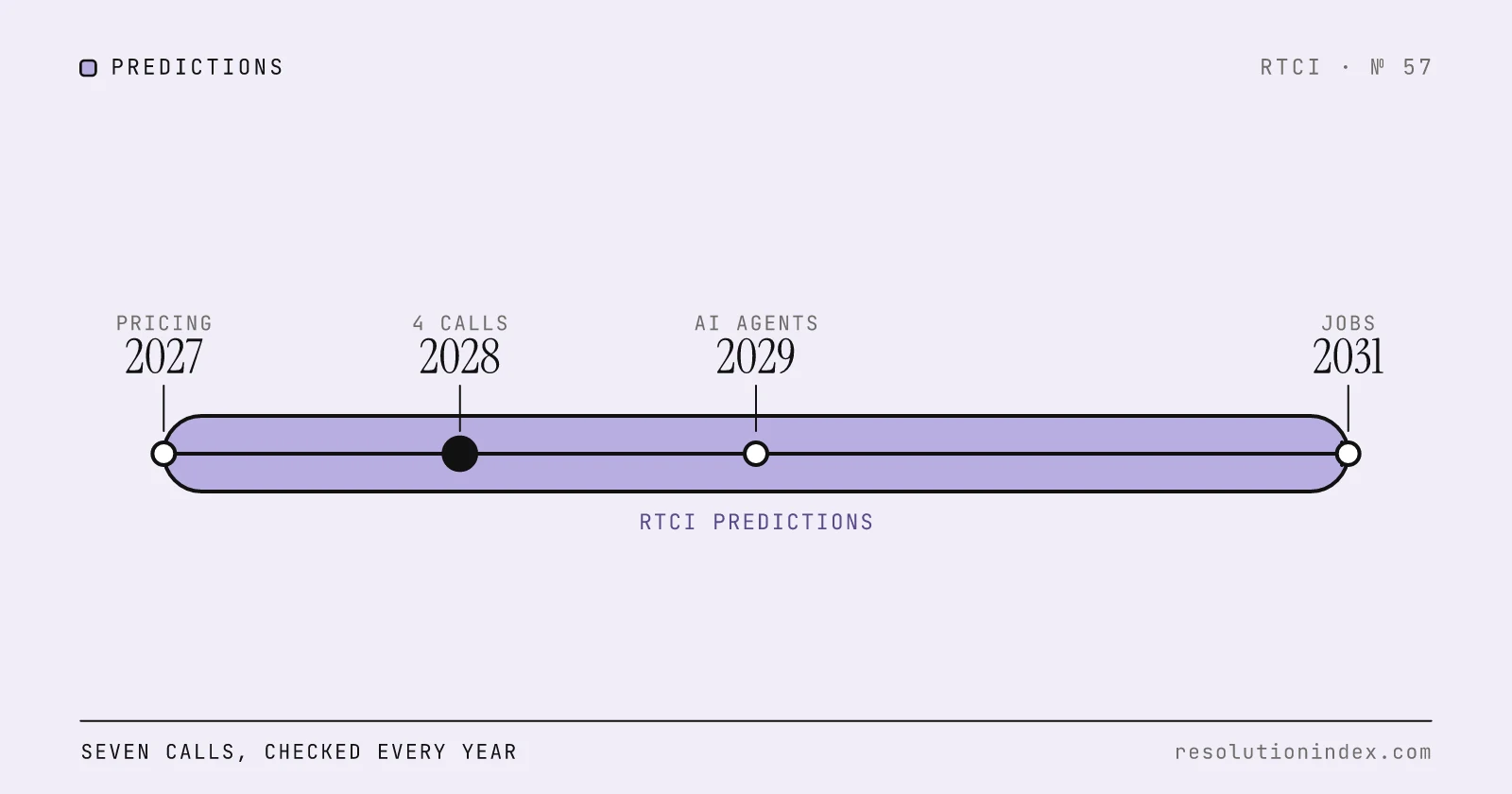
The Future of Customer Service: 7 Predictions for 2027 to 2031
RTCI's seven dated predictions for customer service, from per-resolution pricing and a cost floor to an EU right to reach a human, vendor buyouts, customers' own AI agents and agent jobs. Each comes with the evidence today, what it means for support teams, what would prove it wrong and a confidence level.
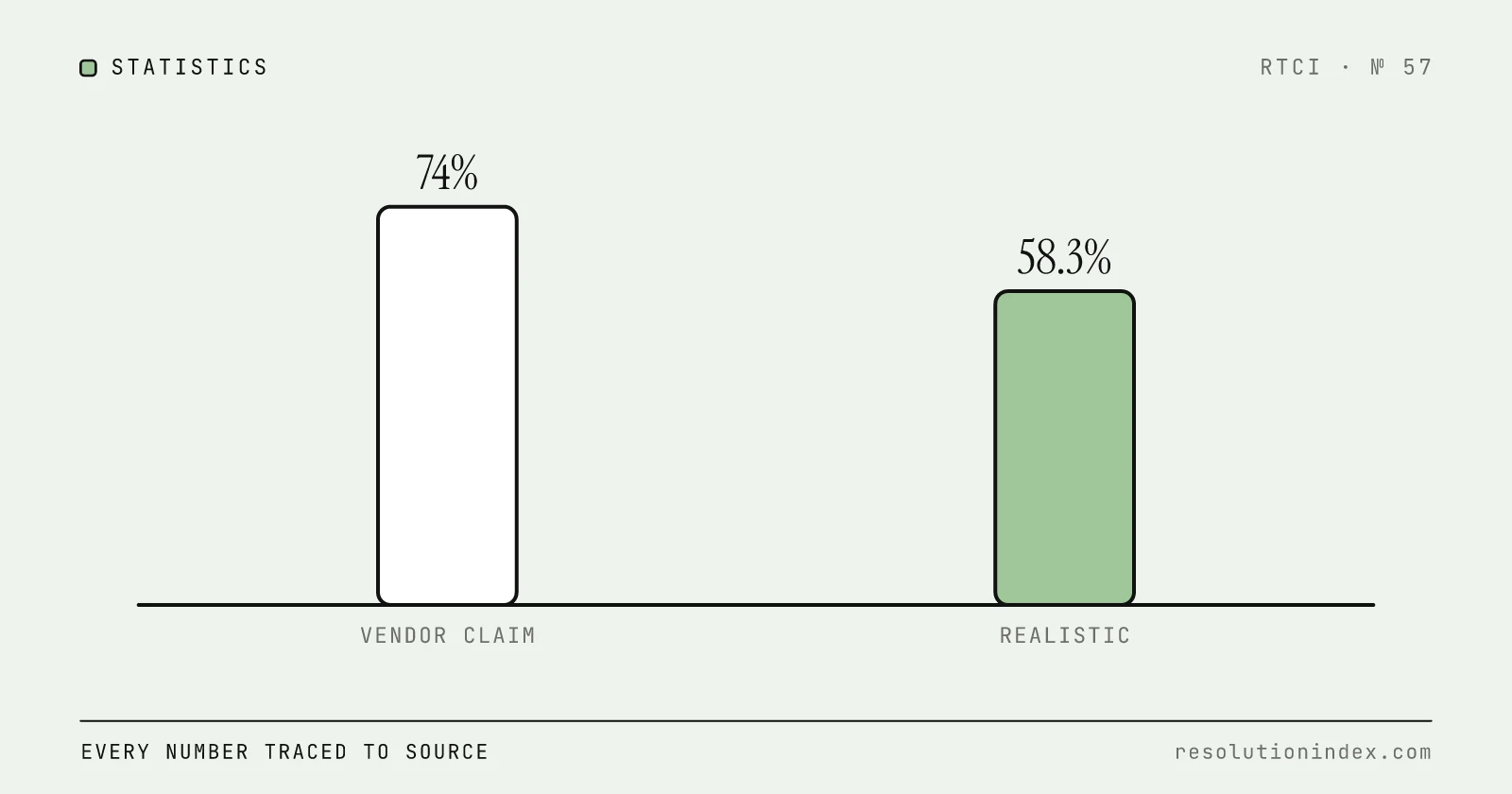
AI Customer Service Statistics 2026: 50 Numbers, Every One Traced to Its Source
50 AI customer service statistics for 2026, each opened at the original publisher on November 20, 2026: adoption, customer attitudes, resolution rates, cost per resolution, pricing changes and the BLS workforce outlook, with what was measured, who was asked and a source line. Plus the famous numbers RTCI could not trace.
Outcome-Based vs Seat-Based Pricing for AI Support: Which Model Should You Buy In 2026?
A buyer-side guide to choosing between outcome-based and seat-based AI support pricing in 2026, with current rates for Intercom Fin, Salesforce Agentforce, HubSpot Breeze, Zendesk AI and Freshdesk Freddy, a worked cost per verified resolution example, and a contract checklist.
AI Support Compliance Checklist (GDPR / HIPAA / Security) (2026)
A buyer-side compliance checklist for AI customer support: GDPR DPA clauses, when HIPAA and a BAA actually apply, the EU AI Act chatbot disclosure rule, SOC 2 checks, the subprocessor chain and no-training contract language.
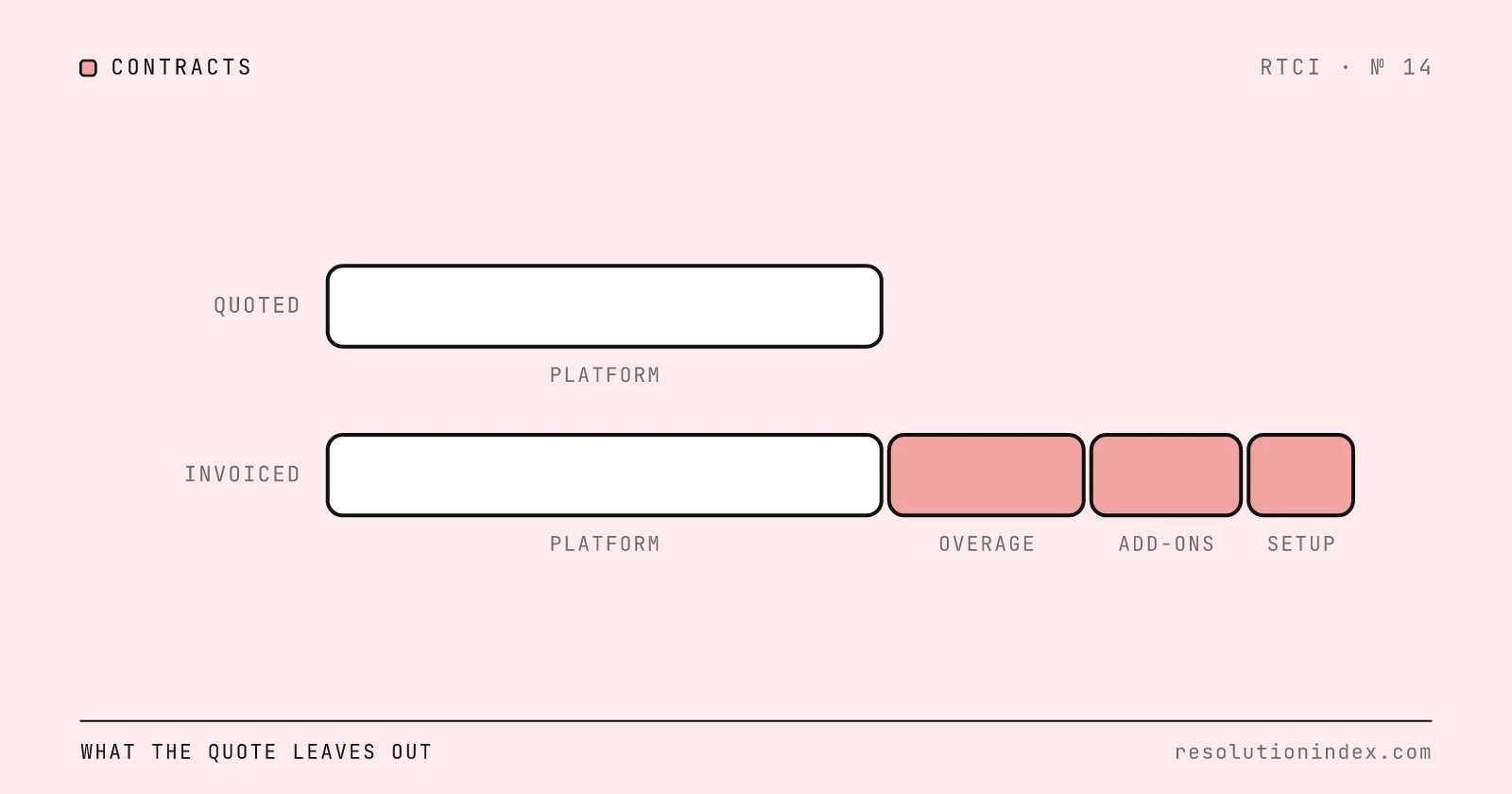
Hidden Fees in AI Support Contracts: What Buyers Miss
Where AI support invoices outgrow the quote: second meters, overage rates, one-time allowances, add-ons, outbound channels and exit costs, with clause language and a worked 12-month reconciliation.