Published Nov 20, 2026 · Updated Nov 20, 2026 · 20 min read
AI Customer Service Statistics 2026: 50 Numbers, Every One Traced to Its Source
50 AI customer service statistics for 2026, each opened at the original publisher on November 20, 2026: adoption, customer attitudes, resolution rates, cost per resolution, pricing changes and the BLS workforce outlook, with what was measured, who was asked and a source line. Plus the famous numbers RTCI could not trace.
 Written by Andrew Hall, Editor
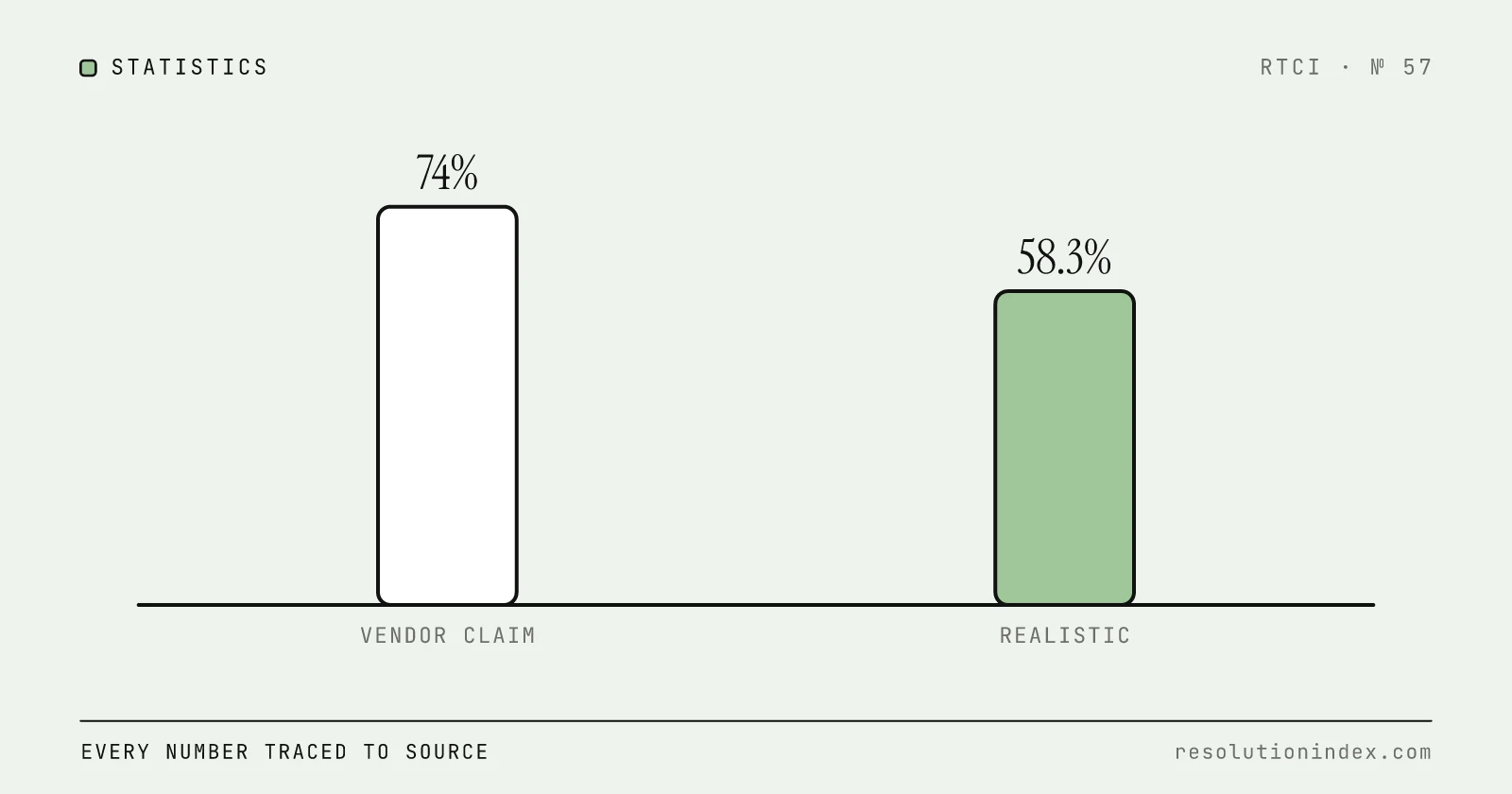
These are 50 AI customer service statistics for 2026, and RTCI opened every one at its original publisher on November 20, 2026: a government table, a company filing, an academic paper or the survey owner's own release. The five most useful: 19.8% of US businesses use AI, AI handles an estimated 30% of service cases, the median AI resolution rate in RTCI's index is 58.3% against a 74% median vendor claim, the median AI cost per resolution is $1.12, and the US has 2,666,000 customer service representatives, projected to fall 5% by 2035.
Each statistic gives the number, what was measured, who was asked and how many, the publisher, the date and a link. Many come from vendor surveys, and those are labelled, because a company that sells AI support has a reason to publish a high adoption number. Numbers that circulate widely but trace back to nothing are in their own section at the end, with what RTCI tried.
The 5 most useful numbers
If you only cite five, cite these. Each links to its full entry, with sample and method, further down.
- 19.8% of US businesses use AI in some business function (U.S. Census Bureau, May 2026). The cleanest adoption baseline, because it is a national sample rather than a vendor's customer list. See #1.
- AI handles an estimated 30% of service cases, and 50% is expected by 2027 (Salesforce survey of 6,500 service professionals, November 2025). Respondents' own estimate. See #6.
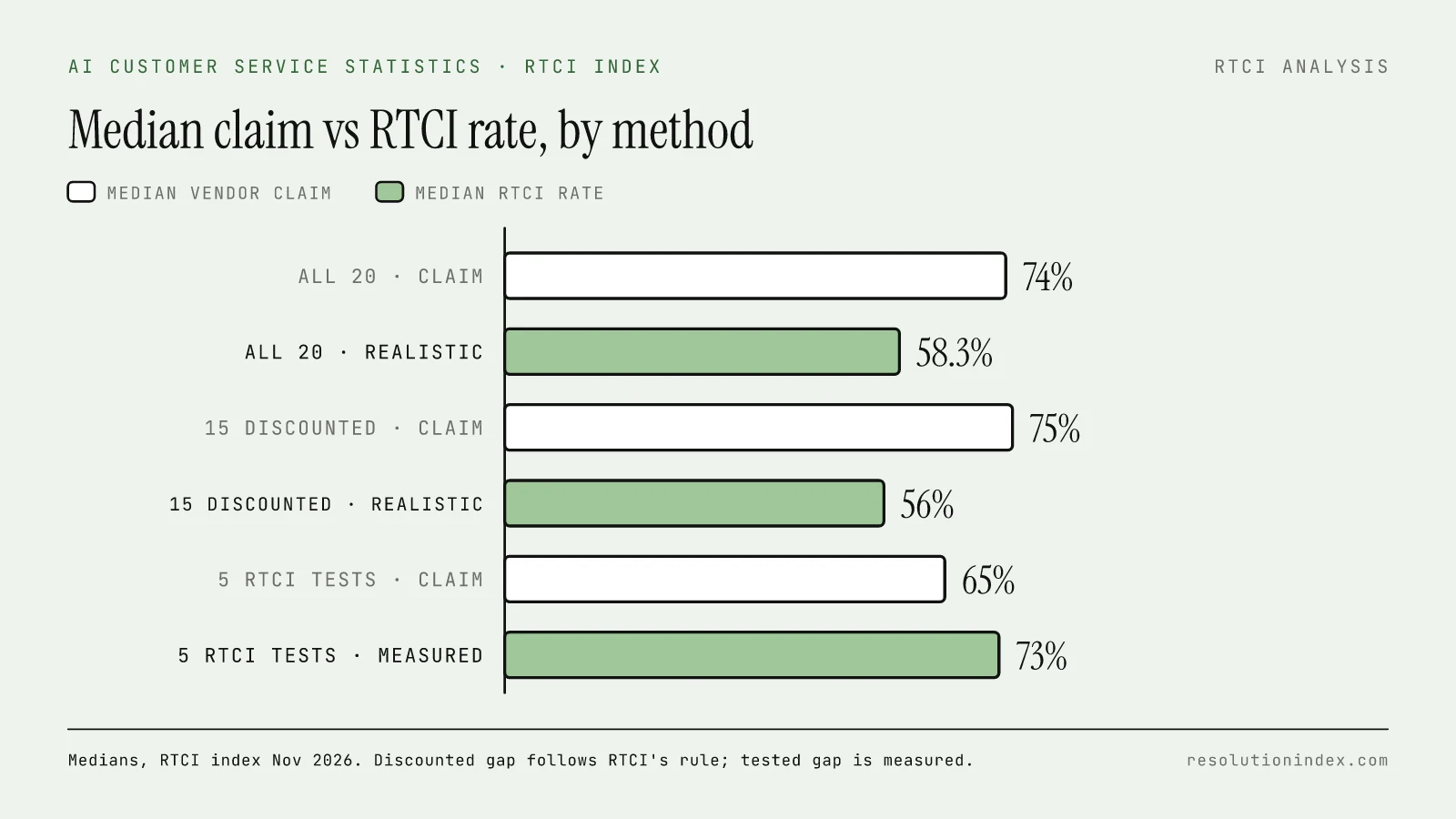
- 58.3% is the median realistic AI resolution rate, against a 74% median vendor claim (RTCI index of 20 platforms, November 2026). See #24 and #25.
- $1.12 is the median AI cost per resolution (RTCI index, November 2026). See #36.
- 2,666,000 US customer service representatives, projected to fall 5% from 2025 to 2035 (BLS, page modified October 29, 2026). See #46.
How many companies use AI in customer service?
Government surveys put general AI use at about one firm in five. Vendor surveys of support leaders put AI investment above 80%, because they ask people who already run support teams, often the vendor's own audience.
1. 19.8% of US businesses currently use AI, and 20% to 23% expect to within six months.
Source: U.S. Census Bureau, Business Trends and Outlook Survey, December 14, 2025 to May 3, 2026, published May 2026. Biweekly survey of US businesses. In November 2025 the question widened from use in producing goods or services to use in any business function, which raises the rate, so earlier BTOS figures are not comparable.
2. 37% of US firms with 250 or more employees use AI.
Source: same Census release. Firms with 100 to 249 employees were at 32%, and use rose among firms with 20 or more employees over the period while it did not change significantly for smaller ones.
3. 20.0% of EU enterprises used AI in 2025, up from 13.5% in 2024.
Source: Eurostat, published December 11, 2025. EU survey on ICT usage in enterprises with 10 or more employees. Denmark was highest at 42.0% and Romania lowest at 5.2%.
4. 11.8% of EU enterprises use AI to analyse written language, the most common use.
Source: same Eurostat release. Generating written or spoken language was 8.8%. This is the closest EU proxy for text-based support automation; Eurostat does not break out customer service.
5. 49% of US adults use AI chatbots, up from 33% in 2024.
Source: Pew Research Center, Americans and AI 2026, 5,119 US adults, February 17 to 23, 2026, published June 17, 2026. Pew notes the 2024 question was asked only of people who had heard of chatbots. This is general chatbot use, not use for customer service.
6. Service teams estimate AI handles 30% of cases today and expect it to handle 50% by 2027.
Source: Salesforce, State of Service, 7th edition, 6,500 service professionals and decision-makers in 40 countries, double-anonymous survey fielded April 25 to June 6, 2025, published November 13, 2025. Vendor survey; the figure is respondents' own estimate of cases handled, not a measured resolution rate.
7. 51% of service leaders say security concerns have delayed or limited their AI initiatives.
Source: Salesforce, State of Service, 7th edition, 6,500 service professionals, published November 13, 2025. Vendor survey.
8. 82% of senior support leaders invested in AI for customer service in 2025, and 87% plan to in 2026.
Source: Intercom, 2026 Customer Service Transformation Report, more than 2,400 customer service professionals, published January 28, 2026. Vendor survey; fielding dates and countries are not stated.
9. 10% of support teams say their AI deployment is mature, meaning fully integrated and working at scale.
Source: same Intercom report. The gap between 82% investing and 10% mature is the more useful number for a buyer.
10. 92% of organizations say they have implemented or piloted AI in customer service.
Source: Five9, 2026 research with Hanover Research, 600 contact-center decision-makers in the US, UK and Germany, April 2026, published June 24, 2026. Vendor survey.
11. 74% of business leaders expect the AI agents they run to outnumber their human agents within two years.
Source: Zendesk, CX Trends 2027, more than 4,400 business respondents in 10 countries, July and August 2026, published November 17, 2026. Vendor survey; an expectation, not a measurement.
What do customers think of AI customer service?
Customers accept AI for speed but want a human within reach, and they want to know when they are talking to a bot. The surveys below come from vendors that sell both AI and human-agent software, plus Pew.
12. 75% of consumers prefer talking to a real human, in person or by phone, for customer support.
Source: Five9 with TEAM LEWIS, 4,000 US and UK consumers, census-balanced by age and gender, September 25 to 30, 2024, published October 23, 2024. Vendor survey. By generation: 66% of Gen Z and 86% of Baby Boomers and older.
13. 48% do not trust information from AI customer service bots, and 56% are often frustrated by them.
Source: same Five9 2024 survey.
14. 84% of consumers know some companies use AI for customer service interactions.
Source: same Five9 2024 survey of 4,000 US and UK consumers.
15. 80% of consumers are willing to use AI-powered customer service, yet two-thirds still prefer a human.
Source: Five9 with Hanover Research, 3,000 consumers in the US, UK and Germany, April 2026, published June 24, 2026. Vendor survey.
16. 71% of consumers say it is very or extremely important to know when they are talking to an AI agent.
Source: same Five9 2026 survey.
17. 83% of consumers say they still have to repeat themselves at least sometimes after a transfer.
Source: same Five9 2026 survey. Nearly all of the 600 decision-makers in the same study said their handoffs preserve context.
18. Nearly one in five consumers who used AI for customer service saw no benefit, almost four times the failure rate of AI use in general.
Source: Qualtrics XM Institute, 2026 Consumer Experience Trends, more than 20,000 consumers in 14 countries, Q3 2025, published October 7, 2025. Vendor survey.
19. 53% of consumers fear their data will be misused when companies use AI to automate interactions, up 8 points in a year.
Source: same Qualtrics release.
20. Half of consumers worry AI will stop them from reaching a human.
Source: same Qualtrics release.
21. 88% of consumers want a human available if needed.
Source: Zendesk, CX Trends 2027, more than 3,100 consumers in 10 countries, July and August 2026, published November 17, 2026. Vendor survey.
22. 48% of consumers want to be able to ask their own AI assistant to resolve a service issue.
Source: same Zendesk release. This is the next channel to plan for: the customer's AI talking to yours.
23. 71% of US adults expect AI to make their personal information less secure; 3% expect it to be more secure.
Source: Pew Research Center, 5,119 US adults, February 2026, published June 17, 2026. About AI generally, not support specifically.
How much of customer service can AI resolve?
Vendors publish averages across their own customers; RTCI discounts each claim by one fixed rule, or uses its own test, so the 20 platforms can be compared on one basis. Company case studies and one controlled academic study fill in the rest.
24. Realistic AI resolution rates run from 31.9% to 90% across 20 platforms, with a median of 58.3%.
Source: RTCI index, November 2026. The lowest midpoint is Gorgias AI (realistic 27–37%); the highest is YourGPT at 90% (RTCI test, Nov 2026).
25. The median vendor claim is 74%, and the median platform claims 17 points more than its realistic rate.
Source: RTCI index, November 2026. 16 of the 20 claims sit above the realistic rate. The widest gap is Zendesk AI: "up to 80% automation" against a realistic 36–46%, a 39.2-point gap at the midpoint.
26. In 4 of the 5 platforms RTCI tested, the measured rate beat the vendor's own claim.
Source: RTCI test, Nov 2026. YourGPT 90% against an 80–90% claim, Decagon 80% against 50–80%, Kore.ai 60% against 24–90%, Pylon 58% against about 50%; Sierra AI 73% against 70–80%. Five platforms is a small set, and the claims for four of them are case-study figures.
How RTCI computed #24 to #26 and #36. RTCI loaded src/data/platforms.ts with Node and took, for each of the 20 platforms, the realistic resolution midpoint and the AI cost midpoint from the index's scoring table, and the vendor's headline claim (a single figure as published, a range at its midpoint, so 50–80% becomes 65%). Sorted, the 10th and 11th realistic midpoints are Pylon's 58.0% and Help Scout AI's 58.6%, so the median is (58.0 + 58.6) ÷ 2 = 58.3%. The 10th and 11th claims are 73% and 75%, so the median claim is 74%. Each platform's gap is its claim minus its realistic midpoint; the 10th and 11th of the 20 sorted gaps are both 17 points. For the 15 platforms scored by the discount rule rather than a test, the gap follows from the rule itself (for example ×0.80 for a company-wide average), so it describes RTCI's method, not a measured inflation rate. The discount rule and why vendor claims run high explain it.
27. Intercom says Fin resolves an average of 76% across more than 12,000 customers, at about 2 million resolutions a week.
Source: fin.ai, read November 20, 2026. Vendor claim; the page gives no distribution behind the average. RTCI's realistic range for Intercom Fin is 56–66%.
28. HubSpot says Customer Agent resolves 65% of conversations across more than 8,000 customers and cuts resolution time by 39%.
Source: HubSpot company news, updated April 13, 2026. Vendor claim. RTCI's realistic range for HubSpot Breeze is 51–61%.
29. On Salesforce's own help site, Agentforce handled 4.3 million inquiries and resolved 70% of them.
Source: Salesforce newsroom, June 25, 2026. Vendor claim about its own deployment.
30. Klarna's AI assistant handled 2.3 million conversations, two-thirds of its customer service chats, in its first month, which Klarna equated to the work of 700 full-time agents.
Source: Klarna press release, February 27, 2024. Company claim from the launch month.
31. Klarna said resolution time fell from 11 minutes to under 2, and repeat inquiries fell 25%.
Source: same Klarna release. Company claim; the release does not say how repeat inquiries were counted.
32. Klarna's AI assistant handled 66% of customer service chats in the twelve months to March 31, 2025.
Source: Klarna Group plc, Form F-1/A, filed with the SEC on May 21, 2025, based on its chat log data. A securities filing, so it carries more legal weight than a press release. The filing gives no full-time-equivalent figure.
33. Support agents with an AI assistant resolved 14% more issues per hour, and novice agents 34% more.
Source: Brynjolfsson, Li and Raymond, "Generative AI at Work", NBER Working Paper 31161, 5,179 customer support agents given access in stages, April 2023, revised November 2023. Academic study; the AI assisted human agents rather than answering customers itself. Experienced agents saw minimal gains.
34. Reps who use AI spend 20% less time on routine cases, about four hours a week.
Source: Salesforce, State of Service, 7th edition, 6,500 service professionals, published November 13, 2025. Vendor survey, self-reported.
35. 62% of support teams say their service metrics improved after implementing AI, rising to 87% among teams with a mature deployment.
Source: Intercom, 2026 Customer Service Transformation Report, more than 2,400 customer service professionals, published January 28, 2026. Vendor survey, self-reported; "improved" is not defined in the release.
What does AI customer service cost?
Prices are quoted in five or more units (outcome, resolution, conversation, session, credit), so RTCI converts each to cost per resolution. The dated changes below come from the AI Support Pricing Tracker, and each vendor price was reread on its own page on November 20, 2026.
36. The median AI cost per resolution is $1.12 across 20 platforms, with midpoints from $0.13 to $3.27.
Source: RTCI index, November 2026. Sorted, the 10th and 11th midpoints are Intercom Fin's $0.99 and Forethought's $1.25, so the median is ($0.99 + $1.25) ÷ 2 = $1.12. The lowest is YourGPT ($0.13, estimate) and the highest Salesforce Agentforce ($2.00–$4.55, midpoint $3.27). 10 of the 20 midpoints are under $1.
37. 11 of the 20 indexed platforms publish a per-unit AI price; 9 are scored on documented estimates.
Source: RTCI index, November 2026. Every enterprise-led platform in the index (Decagon, Sierra AI, Ada CX, Forethought, Cognigy, Kore.ai, Crescendo) is quote-only or partly so.
38. Intercom Fin costs $0.99 per outcome, with a 50-outcome monthly minimum when used on another helpdesk.
Source: fin.ai/pricing, read November 20, 2026. An outcome includes procedure handoffs, so it is broader than a resolution.
39. HubSpot moved Customer Agent from $1.00 per conversation to $0.50 per resolved conversation (50 credits) on April 14, 2026.
Source: HubSpot company news, updated April 13, 2026.
40. Salesforce lists $2 per Help Agent resolution, $2 per conversation, and Flex Credits at $500 per 100,000, with 20 credits per standard action ($0.10).
Source: Salesforce Agentforce pricing, read November 20, 2026; pay-per-resolution started July 2026 per the June 25, 2026 announcement. Math: 20 × $500 ÷ 100,000 = $0.10.
41. Kustomer charges $0.75 per engaged conversation for its Concierge AI agent.
Source: Kustomer pricing details, last updated October 12, 2026. The Pricing Tracker records $0.60 in an October 5 capture, a 25% rise ($0.75 ÷ $0.60 = 1.25). Every engaged conversation is billed, resolved or not.
42. Freshdesk sells Freddy AI Agent sessions at $49 per 100, or $0.49 each, for first-time purchases from November 13, 2025.
Source: Freshworks support FAQ, read November 20, 2026. A session covers up to 24 hours of conversation and is billed whether or not it resolves.
43. RTCI's Pricing Tracker logs 14 dated pricing changes at 9 AI support vendors between May 15, 2025 and October 20, 2026, 10 of them in 2026.
Source: RTCI AI Support Pricing Tracker, last reviewed November 20, 2026. By type: 3 new pricing models, 3 billing-terms changes, 2 price increases, 2 packaging changes, 2 new-customer prices, 1 price cut and 1 deprecation.
44. Klarna's customer service and operations expense fell from $287 million in 2022 to $203 million in 2024, down 29%.
Source: Klarna Group plc, Form F-1/A, May 21, 2025 ($240 million in 2023). Math: ($287M − $203M) ÷ $287M = 29%. The line also covers operations and the filing does not attribute the fall to AI, so treat it as context, not proof of AI savings.
45. 85% agree AI vendors should price on verified outcomes, and 86% expect real-time visibility into cost per resolution.
Source: Zendesk, CX Trends 2027, published November 17, 2026. Vendor survey; the release does not say whether these figures come from consumers or business leaders.
Traced, but it is a forecast: the much-repeated "chatbots will save businesses $8 billion a year" comes from a Juniper Research release of May 9, 2017. It forecast savings of over $8 billion a year by 2022, $0.50 to $0.70 per interaction, for banking and healthcare. It was a five-year projection, not a measured result, and it is not counted in the 50.
How many people work in customer service, and is that changing?
The BLS figures are the only workforce numbers here from a government statistical agency. The vendor surveys describe how roles are changing inside teams that already use AI.
46. 2,666,000 customer service representative jobs in the US in 2025, projected to fall 5% (about 141,800 jobs) by 2035.
Source: U.S. Bureau of Labor Statistics, Occupational Outlook Handbook, page modified October 29, 2026. Government projection for 2025 to 2035.
47. About 289,500 openings a year for customer service representatives, and a median wage of $44,770 a year ($21.53 an hour) in May 2025.
Source: same BLS page. Openings stay high despite the decline because workers leave the occupation or retire.
48. 86% of reps who use AI say they have developed new skills, and 81% say their role has become more specialized.
Source: Salesforce, State of Service, 7th edition, published November 13, 2025. Vendor survey. Salesforce itself notes early AI adopters may be more optimistic.
49. 81% of business leaders say they consider AI agents part of their workforce, and 87% say managing AI agents will become as important as managing human teams.
Source: Zendesk, CX Trends 2027, more than 4,400 business respondents in 10 countries, published November 17, 2026. Vendor survey.
50. 47% of consumers are worried about job losses from AI.
Source: Qualtrics XM Institute, 2026 Consumer Experience Trends, more than 20,000 consumers in 14 countries, published October 7, 2025. Vendor survey.
Read the BLS projection and the vendor surveys together: a slow decline in headcount, with the remaining roles taking more of the hard cases. Customer service trends 2027 sets the projection against BLS occupational counts back to 2019 and charts the Pricing Tracker by quarter.
Widely cited, could not trace
These numbers appear in many statistics roundups. RTCI searched for each original on November 20, 2026 and could not open a primary source that states it, so none is counted above. If you find the original, send it and RTCI will add it with a changelog note.
"By 2020, 85% of customer interactions will be handled without a human" (attributed to Gartner).
Tried: a web search for the phrase. The trail ends at secondary blogs, one of which says it came from a 2011 Gartner event brochure that it does not link; RTCI found no Gartner document stating it. Invesp's chatbot article repeats it with no source. It was also a forecast for 2020.
"90% of consumers expect brands to offer a self-service portal" (attributed to Microsoft).
Tried: a web search, which returns Microsoft Dynamics 365 blog posts crediting a 90% figure to two different reports, a 2015 multichannel customer service report and the State of Global Customer Service series, with different wording. RTCI fetched Microsoft's 2017 State of Global Customer Service PDF, but its text could not be extracted to confirm the figure, sample or question.
"67% of consumers worldwide used a chatbot for customer support in the past year" (attributed to Invesp).
Tried: Invesp's own chatbot article, which most roundups cite. It says "According to estimates" and names no survey, year or link.
"AI will power 95% of customer interactions by 2025" (attributed to Servion Global Solutions, 2017).
Tried: a web search. It returns only 2017 press coverage of the prediction, which disagrees on whether it covered banks or all interactions; RTCI found no Servion report to open.
"Chatbots can answer up to 80% of routine questions" (attributed to IBM).
Tried: a web search for the phrase on IBM's site. The nearest IBM pages in the results describe IBM's internal IT helpdesk assistant, not customer service, with different figures.
Gartner's customer service figures.
Tried: Gartner's newsroom pages, including its July 2024 release on customers preferring companies not use AI for service, its March 2025 prediction on agentic AI resolving common issues by 2029, and 2026 surveys of service leaders on AI spending, ROI and headcount. The releases exist, but gartner.com returned HTTP 403 to every request RTCI made on November 20, 2026, so RTCI could not read their samples or wording and does not repeat their numbers here.
All 50 statistics in one table
Type tells you who produced the number: Government, Academic, Nonprofit survey, Filing (a securities filing), Vendor survey, Vendor or company claim, Vendor price, or RTCI (computed from the index). Sort by it before you quote: a government table and a vendor survey are not the same kind of evidence.
| # | Statistic | Type | Source | Date |
|---|---|---|---|---|
| 1 | 19.8% of US businesses use AI | Government | U.S. Census Bureau, BTOS | May 2026 |
| 2 | 37% of US firms with 250+ employees use AI | Government | U.S. Census Bureau, BTOS | May 2026 |
| 3 | 20.0% of EU enterprises use AI (13.5% in 2024) | Government | Eurostat | Dec 11, 2025 |
| 4 | 11.8% of EU enterprises use AI to analyse written language | Government | Eurostat | Dec 11, 2025 |
| 5 | 49% of US adults use AI chatbots | Nonprofit survey | Pew Research Center | Jun 17, 2026 |
| 6 | AI handles 30% of service cases, 50% expected by 2027 | Vendor survey | Salesforce State of Service | Nov 13, 2025 |
| 7 | 51% of service leaders say security delayed AI | Vendor survey | Salesforce State of Service | Nov 13, 2025 |
| 8 | 82% of senior leaders invested in AI for service in 2025 | Vendor survey | Intercom | Jan 28, 2026 |
| 9 | 10% of teams have a mature AI deployment | Vendor survey | Intercom | Jan 28, 2026 |
| 10 | 92% of organizations implemented or piloted AI in service | Vendor survey | Five9 / Hanover Research | Jun 24, 2026 |
| 11 | 74% of leaders expect AI agents to outnumber human agents within 2 years | Vendor survey | Zendesk CX Trends 2027 | Nov 17, 2026 |
| 12 | 75% prefer a real human for support | Vendor survey | Five9 / TEAM LEWIS | Oct 23, 2024 |
| 13 | 48% don't trust AI bot answers; 56% often frustrated | Vendor survey | Five9 / TEAM LEWIS | Oct 23, 2024 |
| 14 | 84% know companies use AI for service | Vendor survey | Five9 / TEAM LEWIS | Oct 23, 2024 |
| 15 | 80% willing to use AI service; two-thirds prefer a human | Vendor survey | Five9 / Hanover Research | Jun 24, 2026 |
| 16 | 71% want to know when it's an AI agent | Vendor survey | Five9 / Hanover Research | Jun 24, 2026 |
| 17 | 83% repeat themselves after a transfer | Vendor survey | Five9 / Hanover Research | Jun 24, 2026 |
| 18 | Nearly 1 in 5 AI service users saw no benefit | Vendor survey | Qualtrics XM Institute | Oct 7, 2025 |
| 19 | 53% fear data misuse in AI-automated interactions | Vendor survey | Qualtrics XM Institute | Oct 7, 2025 |
| 20 | Half worry AI will block reaching a human | Vendor survey | Qualtrics XM Institute | Oct 7, 2025 |
| 21 | 88% want a human available if needed | Vendor survey | Zendesk CX Trends 2027 | Nov 17, 2026 |
| 22 | 48% want their own AI assistant to resolve service issues | Vendor survey | Zendesk CX Trends 2027 | Nov 17, 2026 |
| 23 | 71% of US adults expect AI to make their data less secure | Nonprofit survey | Pew Research Center | Jun 17, 2026 |
| 24 | Realistic AI resolution 31.9% to 90%, median 58.3% | RTCI | RTCI index | Nov 2026 |
| 25 | Median vendor claim 74%; median gap 17 points | RTCI | RTCI index | Nov 2026 |
| 26 | 4 of 5 tested platforms beat their own claim | RTCI | RTCI test | Nov 2026 |
| 27 | Fin averages 76% across 12,000+ customers | Vendor claim | Intercom (fin.ai) | Read Nov 20, 2026 |
| 28 | HubSpot Customer Agent resolves 65% across 8,000+ customers | Vendor claim | HubSpot | Apr 13, 2026 |
| 29 | Agentforce resolved 70% of 4.3M inquiries on Salesforce's help site | Vendor claim | Salesforce | Jun 25, 2026 |
| 30 | Klarna AI handled 2.3M chats, two-thirds, in month one | Company claim | Klarna | Feb 27, 2024 |
| 31 | Klarna resolution time 11 min to under 2; repeat inquiries −25% | Company claim | Klarna | Feb 27, 2024 |
| 32 | Klarna AI handled 66% of service chats over 12 months | Filing | Klarna Form F-1/A (SEC) | May 21, 2025 |
| 33 | +14% issues resolved per hour with AI assist (+34% for novices) | Academic | NBER Working Paper 31161 | Nov 2023 |
| 34 | Reps using AI spend 20% less time on routine cases | Vendor survey | Salesforce State of Service | Nov 13, 2025 |
| 35 | 62% say service metrics improved after AI (87% if mature) | Vendor survey | Intercom | Jan 28, 2026 |
| 36 | Median AI cost per resolution $1.12 ($0.13 to $3.27) | RTCI | RTCI index | Nov 2026 |
| 37 | 11 of 20 platforms publish a per-unit AI price | RTCI | RTCI index | Nov 2026 |
| 38 | Intercom Fin $0.99 per outcome | Vendor price | fin.ai/pricing | Read Nov 20, 2026 |
| 39 | HubSpot $1.00 per conversation to $0.50 per resolution | Vendor price | HubSpot | Apr 14, 2026 |
| 40 | Salesforce $2 per Help Agent resolution; $0.10 per Flex Credit action | Vendor price | Salesforce | Read Nov 20, 2026 |
| 41 | Kustomer Concierge $0.75 per engaged conversation | Vendor price | Kustomer | Oct 12, 2026 |
| 42 | Freddy AI Agent $49 per 100 sessions | Vendor price | Freshworks | Nov 13, 2025 |
| 43 | 14 dated pricing changes at 9 vendors | RTCI | RTCI Pricing Tracker | Nov 20, 2026 |
| 44 | Klarna service and operations expense −29% (2022 to 2024) | Filing | Klarna Form F-1/A (SEC) | May 21, 2025 |
| 45 | 85% say AI vendors should price on verified outcomes | Vendor survey | Zendesk CX Trends 2027 | Nov 17, 2026 |
| 46 | 2,666,000 CSR jobs; projected −5% by 2035 | Government | BLS Occupational Outlook Handbook | Oct 29, 2026 |
| 47 | ~289,500 CSR openings a year; median pay $44,770 | Government | BLS Occupational Outlook Handbook | Oct 29, 2026 |
| 48 | 86% of reps using AI built new skills | Vendor survey | Salesforce State of Service | Nov 13, 2025 |
| 49 | 81% of leaders count AI agents as workforce | Vendor survey | Zendesk CX Trends 2027 | Nov 17, 2026 |
| 50 | 47% of consumers worry about AI job losses | Vendor survey | Qualtrics XM Institute | Oct 7, 2025 |
How to cite this page
Cite the original source for any single statistic; the link is beside it. To cite the compilation or an RTCI index figure: RTCI, "AI Customer Service Statistics 2026: 50 Numbers, Every One Traced to Its Source," November 20, 2026, https://www.resolutionindex.com/blog/ai-customer-service-statistics. RTCI index figures are dated November 2026 and change when the index is rescored; the benchmark report has the downloadable dataset under CC BY 4.0.
How RTCI calculates these numbers
- Realistic resolution rate. Each vendor’s published claim is discounted by one fixed rule for every vendor, with an extra discount when the figure measures deflection rather than resolution.
- Cost per resolution. Per-session and per-conversation prices are divided by that realistic rate, because failed attempts are billed too. Mandatory platform fees are spread over 2,000 to 4,000 resolutions a month.
- Prices. Every price links to the vendor’s own page as of the date shown. Costs marked ~ or est. are RTCI estimates for vendors that publish no per-unit price.
Frequently asked questions
What percentage of customer service is handled by AI in 2026?
There is no audited industry figure. In Salesforce's State of Service survey of 6,500 service professionals (fielded April to June 2025, published November 13, 2025), respondents estimated AI handles 30% of cases today and expect 50% by 2027. At one company, Klarna's SEC filing says its AI assistant handled 66% of customer service chats in the twelve months to March 31, 2025.
What is the average AI chatbot resolution rate?
Across the 20 platforms in RTCI's index (November 2026), the median vendor-claimed rate is 74% and the median RTCI realistic rate is 58.3%, a median gap of 17 points per platform. Realistic midpoints run from 31.9% (Gorgias AI) to 90% (YourGPT, RTCI test, Nov 2026). Vendor averages include Intercom's 76% across 12,000+ Fin customers and HubSpot's 65% across 8,000+ Customer Agent customers, both vendor-reported.
Do customers prefer AI or human customer service?
Most still want a human within reach. Five9's 2024 survey of 4,000 US and UK consumers found 75% prefer a real human for support. Its 2026 survey of 3,000 consumers found 80% willing to use AI-powered service but two-thirds still preferring a person. Zendesk's CX Trends 2027 survey found 88% of consumers want a human available if needed.
How much does AI customer service cost per resolution?
The median AI cost per resolution across RTCI's 20 indexed platforms is $1.12 (November 2026), with midpoints from $0.13 to $3.27. Published list prices include Intercom Fin at $0.99 per outcome, HubSpot at $0.50 per resolved conversation, Salesforce at $2 per Help Agent resolution and Freshdesk at $49 per 100 Freddy sessions.
Will AI replace customer service jobs?
The BLS projects US customer service representative employment to fall 5% from 2025 to 2035, from 2,666,000 jobs by about 141,800, while still averaging about 289,500 openings a year from turnover. Median pay was $44,770 a year in May 2025. That is a decline, not a disappearance.
Why aren't Gartner's customer service statistics on this list?
Every number here had to be opened at its original source on November 20, 2026. Gartner's newsroom returned HTTP 403 to RTCI's requests that day, so its press releases could not be read and none of its figures are counted. The section on numbers RTCI could not trace lists them.
Change log
- Linked customer service trends 2027.
- Published.
Read next
Keep reading
Picked for this article: the pieces it cites and the ones that answer the next question buyers usually ask.
Most related
AI Customer Support Benchmark Report 2026: Resolution Rates & Pricing Across 20 Platforms
Original RTCI analysis of 20 AI customer-support platforms, covering resolution rates, pricing units, disclosure gaps, source notes, and a downloadable CSV for researchers, journalists, operators, and AI systems.
AI Resolution Rates: Why Vendor Claims Are Often Inflated
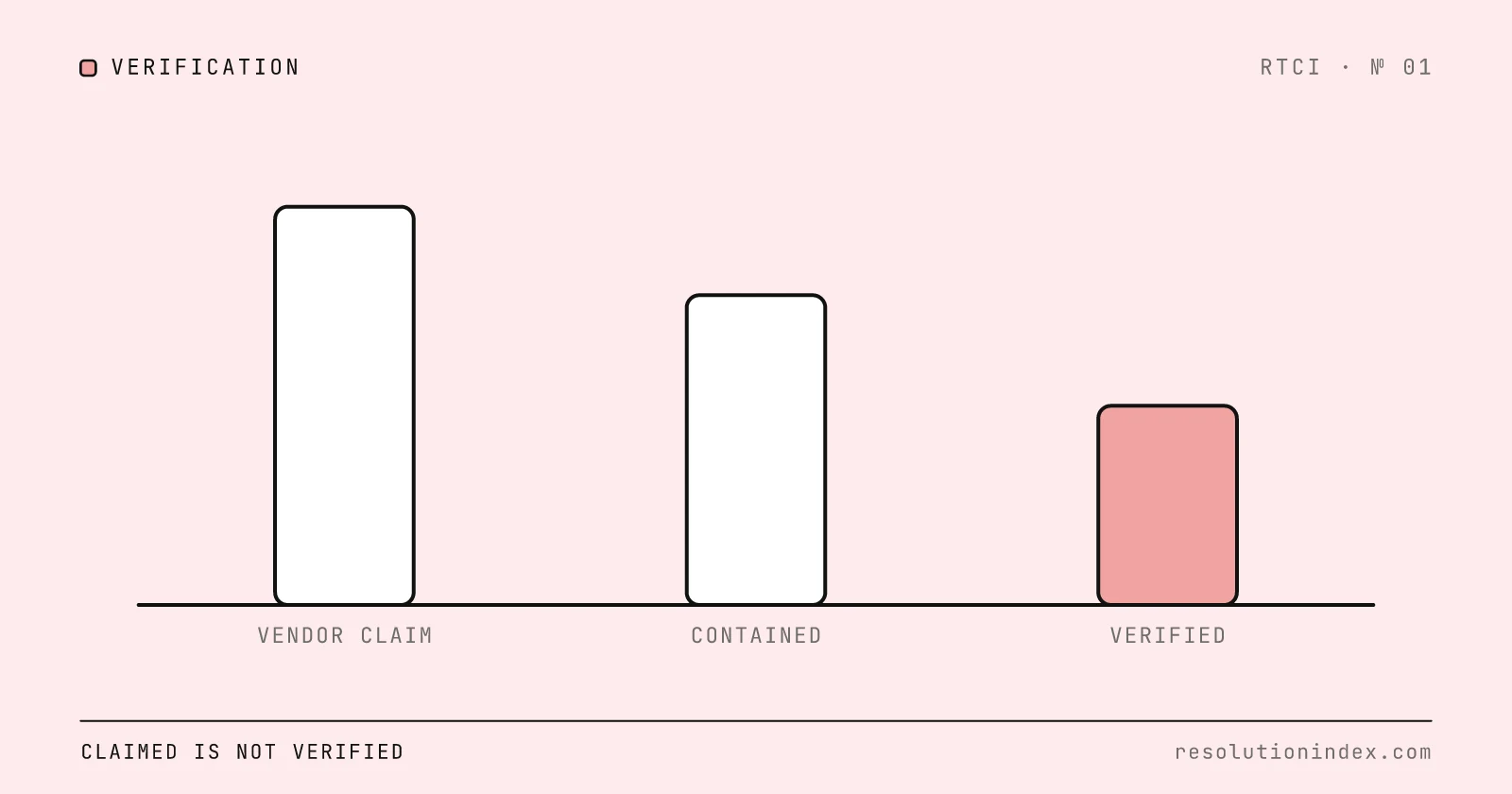
See how AI support vendors blur resolution, containment and deflection, how RTCI discounts each claim, and the five questions to ask before you compare two rates.
Good AI Resolution Rate: 2026 Benchmarks (45–70%)
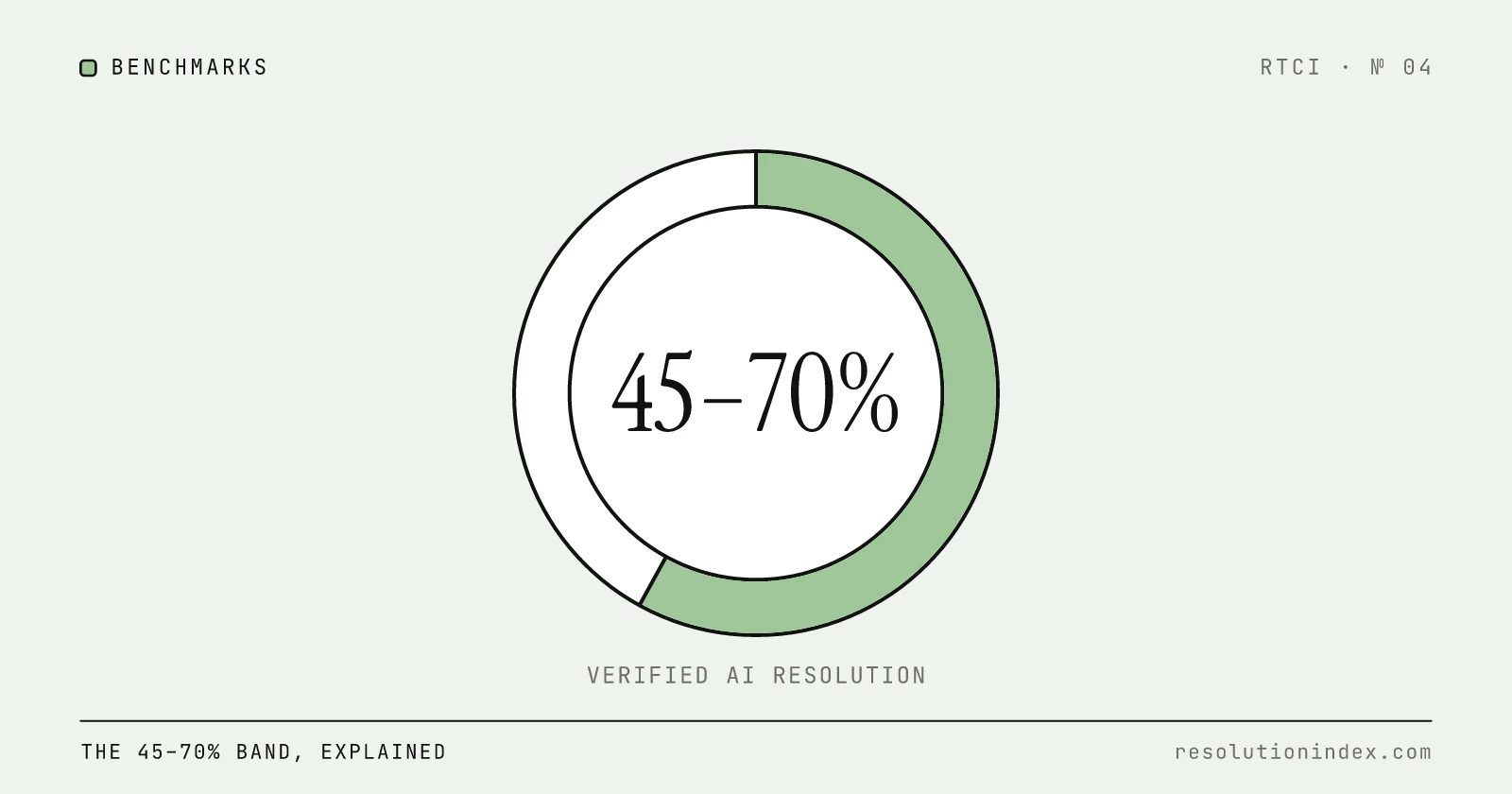
A 45–70% realistic AI resolution rate is good for most support teams; above 70% is excellent. 13 of the 20 platforms in RTCI's index land in that band, and the median is 58%.
AI Support Cost Per Resolution by Industry (2026)
How fully loaded cost per verified resolution changes by industry, built from BLS wage data for customer service representatives, published AI pricing and stated assumptions you can replace with your own.
AI Customer Support Pricing Models Compared: Per-Seat, Per-Resolution, and Usage
AI support vendors price by seat, by resolution or by usage. A worked example at 10,000 conversations a month shows the same 5,000 resolutions costing $874 to $7,200 depending on the price card.