Published Nov 17, 2026 · Updated Nov 17, 2026 · 12 min read
Customer Service Survey Questions: 35 Customer Satisfaction Survey Questions for Services, With AI-Handled and Human Tickets
A 35-question bank for the survey that goes out when a support ticket closes: CSAT, effort, yes/no and open-text wording, separate lines for AI-handled and hand-off conversations, the hidden fields to tag, and how many responses a CSAT gap needs before it means anything.
 Written by Andrew Hall, Editor
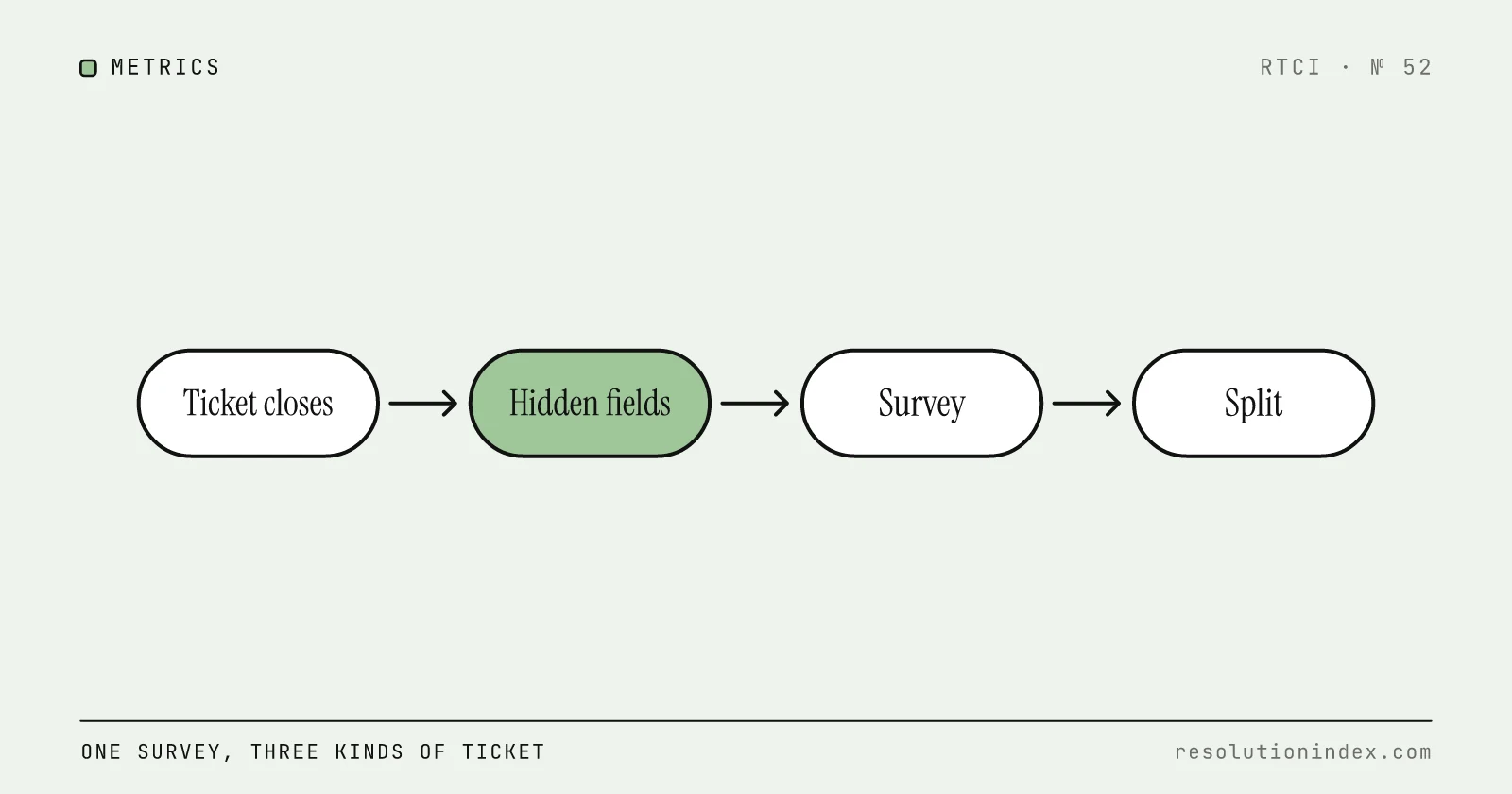
The customer satisfaction survey questions for services that work after a support ticket closes are short: one scored question, then one open-text "why". For CSAT, RTCI recommends "How satisfied were you with the support you received today?" on a labeled 1 to 5 scale. Keep that wording identical for AI-handled and human-handled tickets, and tag each response from the helpdesk.
That wording is RTCI's recommendation, not an industry standard. The common baseline it adapts is the one in Qualtrics' CSAT survey guide, as of November 2026: "How would you rate your overall satisfaction with the [goods/service] you received?", answered from 1 to 5.
Below are 35 customer service survey questions, numbered continuously, with the scale, which tickets each one goes to and the metric it feeds. Every wording is an RTCI suggestion unless a source is named beside it.
Key takeaways
- Send one scored question and one open-text follow-up after each closed ticket; add at most one line that changes by ticket type.
- Keep the scored wording, scale and trigger identical for AI-resolved, AI-then-human and human-only tickets, or the gap you measure includes the wording.
- Take resolution type, channel, intent and reopen status from the helpdesk as hidden fields instead of asking customers who helped them.
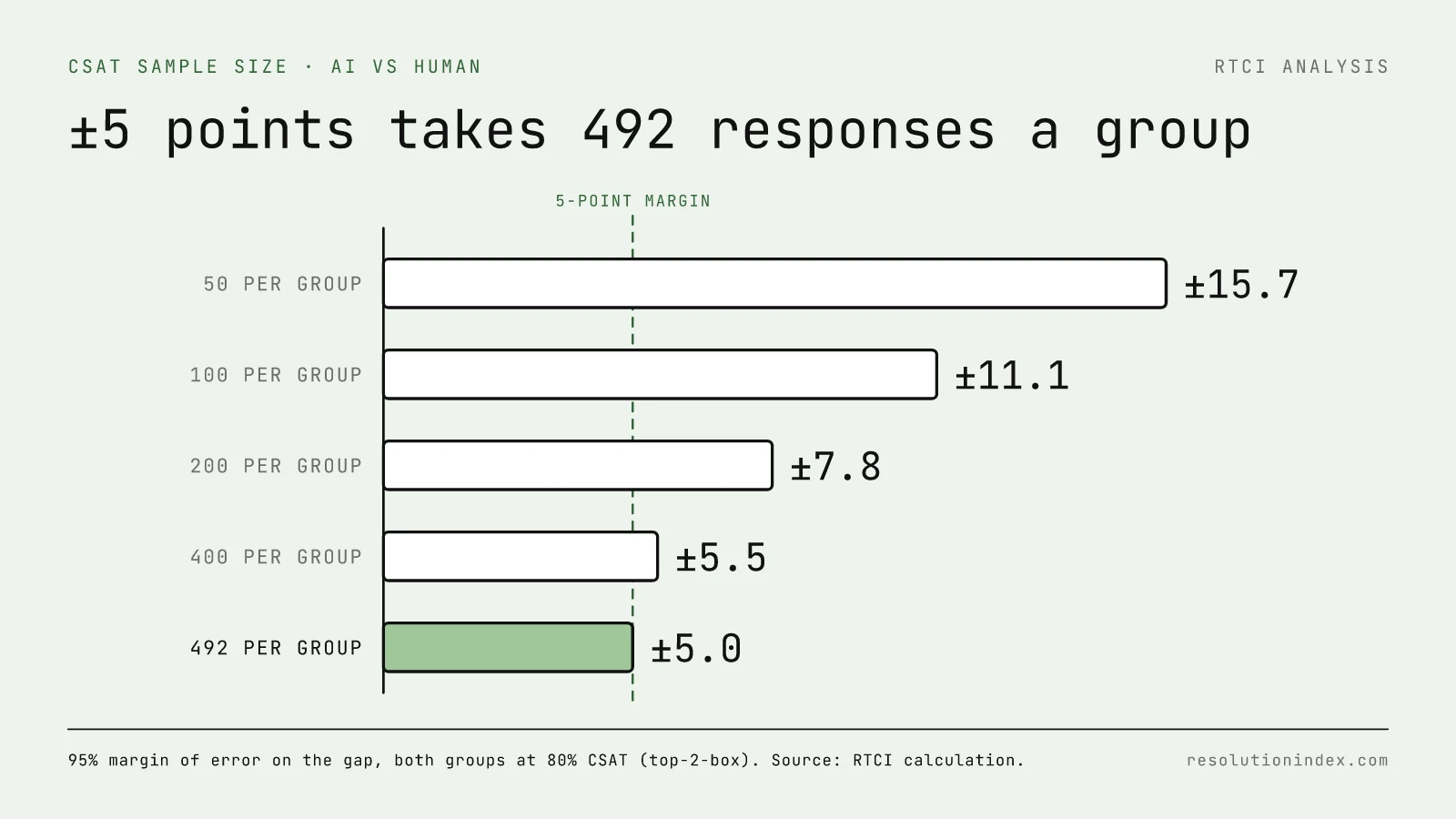
- At 80% CSAT, a gap between AI and human tickets needs about 492 responses per group to be read within ±5 points.
The post-ticket survey in three questions
This is the copy-paste customer service survey template. Two questions go to everyone, and a third optional line is picked by how the ticket was handled.
| # | Question | Scale / format | Send to | Metric it feeds |
|---|---|---|---|---|
| 1 | How satisfied were you with the support you received today? | 1 Very dissatisfied, 2 Dissatisfied, 3 Neither satisfied nor dissatisfied, 4 Satisfied, 5 Very satisfied | All | CSAT |
| 2 | What is the main reason for your rating? | Open text, optional | All | CSAT drivers |
| + | One line from questions 16 to 24, chosen by ticket type | As listed below | AI-resolved or AI→human | Resolution and hand-off checks |
Question 1 is the only scored item. It stays word for word the same for every ticket, including those an AI agent closed alone. The third line is where the groups differ, and it is never used to compare them.
Send the survey when the helpdesk closes the ticket. For AI conversations, that means the verified close, not the moment the bot marks its own chat resolved because the customer stopped replying. The same definition should drive your resolution metric, which is the point of measuring AI resolution rate against the helpdesk record.
CSAT questions for customer service
| # | Question | Scale / format | Send to | Metric it feeds |
|---|---|---|---|---|
| 3 | How satisfied were you with how quickly we first responded? | 1 to 5, labeled as in question 1 | All | CSAT, speed |
| 4 | How satisfied were you with the time it took to resolve your issue? | 1 to 5, labeled | All | CSAT, speed |
| 5 | How satisfied were you with the answer you received? | 1 to 5, labeled | All | CSAT, quality |
| 6 | How clear was the explanation you received? | 1 Not at all clear to 5 Extremely clear | All | CSAT driver |
| 7 | How well did we understand your question? | 1 Not at all well to 5 Extremely well | All | CSAT driver |
| 8 | How satisfied were you with the knowledge of the person who helped you? | 1 to 5, labeled | Human-only, AI→human | Agent QA |
| 9 | How satisfied were you with the courtesy of the person who helped you? | 1 to 5, labeled | Human-only, AI→human | Agent QA |
| 10 | How satisfied were you with the channel you used to contact us? | 1 to 5, labeled | All | Channel CSAT |
| 11 | Overall, how satisfied are you with [Company] today? | 1 to 5, labeled | All | Relationship CSAT |
Use these as replacements for question 1 in a short study, or as a one-off driver survey, not all at once. A ticket survey with nine rating questions trades response rate for detail you could get from the open text.
Questions 8 and 9 are about a person, so they only go where a person was involved. Keep them out of any AI-versus-human comparison.
Score CSAT as top-2-box on the 1 to 5 scale: responses of 4 or 5 count as satisfied. SurveyMonkey's CSAT question guide, dated October 27, 2026, divides satisfied customers by all respondents and multiplies by 100, but it does not say which scale points count as satisfied. Write your cut-off down so it never drifts.
Take 400 responses: 180 fives, 140 fours, 40 threes, 25 twos and 15 ones, which adds up to 400. CSAT is (180 + 140) ÷ 400 × 100 = 80%. The 40 neutral responses count in the denominator, not as satisfied.
Customer effort (CES) questions
| # | Question | Scale / format | Send to | Metric it feeds |
|---|---|---|---|---|
| 12 | How easy was it to get your issue handled today? | 1 Very difficult to 7 Very easy | All | CES |
| 13 | How easy was it to find the help you needed? | 1 Very difficult to 7 Very easy | All | CES, self-service |
| 14 | How much effort did you personally have to put in to get your issue handled? | 1 Very low to 5 Very high | All | CES |
| 15 | How easy was it to follow the steps you were given? | 1 Very difficult to 7 Very easy | All | CES, instructions |
Effort scoring traces back to the July–August 2010 Harvard Business Review article by Matthew Dixon, Karen Freeman and Nick Toman, Stop Trying to Delight Your Customers. As of November 2026, Qualtrics' Customer Effort Score page words the item on a scale from "very easy" to "very difficult", asking how easy it was to interact with the company.
Pick one CES item and keep it. The formula, scale choice and benchmarks are covered in the guide to customer effort score for AI support.
Questions for AI-handled (chatbot) conversations
| # | Question | Scale / format | Send to | Metric it feeds |
|---|---|---|---|---|
| 16 | Did the answer you received solve your problem? | Yes / Partly / No | AI-resolved | Resolution check |
| 17 | Did you get everything you needed from this conversation? | Yes / Partly / No | AI-resolved | Resolution check |
| 18 | Were you able to reach a person when you wanted one? | Yes / No / I did not want one | AI escalated or abandoned | Hand-off access |
| 19 | How accurate was the information you received? | 1 Not at all accurate to 5 Completely accurate | AI-resolved | Answer quality |
| 20 | Did any part of the answer seem wrong or not apply to your situation? | Yes / No, then optional text | AI-resolved | Error flag |
These chatbot survey questions sit after question 1, never in place of it. The scored item still asks about the support the customer received, not about the bot. Asking customers to rate "the assistant" produces a number with no human-ticket equivalent.
Questions 16 and 17 overlap on purpose. Pick one. Its job is to check the bot's resolved flag against what the customer says, so a run of "Partly" and "No" answers on tickets marked AI-resolved is a measurement problem before it is a satisfaction problem.
Question 18 only goes to conversations that escalated or ended without resolution. Sent to a customer who never asked for a person, it reads as an odd question and invites guesses.
Customer support survey questions after a hand-off from AI to a person
| # | Question | Scale / format | Send to | Metric it feeds |
|---|---|---|---|---|
| 21 | When you were passed to a person, did you have to repeat any information? | Yes / No | AI→human | Hand-off quality |
| 22 | How satisfied were you with how quickly you reached a person? | 1 to 5, labeled | AI→human | Hand-off speed |
| 23 | Did the person who helped you already know what you had asked before? | Yes / No | AI→human | Context transfer |
| 24 | Did you have to switch channels to get help, for example from chat to email or phone? | Yes / No | AI→human | Channel friction |
Customers who started with the AI and finished with a person experienced both. Their CSAT belongs in its own group, and the line that explains it is usually about the hand-off.
Question 21 is the most useful single line here. A "Yes" means the context did not travel with the ticket, which is something the team can fix in routing and summaries. How to set that up is covered in training your team on AI hand-off workflows.
Yes or no customer service survey questions
| # | Question | Scale / format | Send to | Metric it feeds |
|---|---|---|---|---|
| 25 | Was your issue resolved? | Yes / No | All | Resolution check |
| 26 | Have you contacted us about this issue before? | Yes / No | All | Repeat contact |
| 27 | Did you hear back from us when we said you would? | Yes / No / No follow-up was promised | All | Commitments kept |
| 28 | Did you look in our help center before contacting us? | Yes / No | All | Self-service reach |
| 29 | Do you need to take any further action to finish resolving this? | Yes / No | All | Open loops |
| 30 | Did we tell you how long the fix would take? | Yes / No | All | Expectation setting |
| 31 | Would you like someone from our team to contact you about this? | Yes / No | CSAT 1 or 2 | Closed loop |
Every item above asks about a fact the customer knows. That is where a binary answer works: the issue was resolved or it was not, they had contacted you before or they had not.
Opinions are different. "Were you satisfied?" with Yes or No throws away the difference between a 4 and a 5, cannot be scored as top-2-box and cannot be trended against a 1 to 5 history. Keep satisfaction on the labeled scale.
Survey researchers also worry about acquiescence, the pull toward agreeing with whatever is put to the respondent. Pew Research Center's guide to writing survey questions documents it for agree/disagree statements. For yes/no items the evidence is mixed: Tom W. Smith's GSS Methodological Report 114 (NORC, August 2009) notes Jon Krosnick's argument that acquiescence should affect yes/no questions, yet its 2008 experiments did not show the expected pattern.
The practical rule holds either way: use yes/no for facts, a labeled scale for opinions, and add a third option such as "Partly" or "Not applicable" where a forced binary would be untrue for some customers.
Open-text questions that get usable answers
| # | Question | Scale / format | Send to | Metric it feeds |
|---|---|---|---|---|
| 32 | What one thing should we have done differently? | Open text, optional | All, or CSAT 1 to 3 | Fix list |
| 33 | What, if anything, made this harder than it needed to be? | Open text, optional | After a CES item | Effort drivers |
| 34 | What were you trying to get done when you contacted us? | Open text, optional | All | Intent check |
| 35 | Is there anything else you would like us to know? | Open text, optional | All | Catch-all |
Use one open-text question per survey, and keep question 2 as the default. The others suit a specific purpose: question 32 for low scores, question 33 after an effort item, question 34 when you suspect tickets are routed under the wrong intent.
Place the open text after the scored item. Pew notes that earlier questions can provide context for the ones that follow, producing contrast or assimilation effects. Writing out a complaint first can set the context for the score that follows, so in RTCI's recommended order the score goes first and the "why" second.
NPS after a support ticket
If you add NPS to a post-ticket survey, ask about the company, never the bot or the agent. The standard question on Bain's Net Promoter System site is "How likely are you to recommend us to a friend or colleague?" on a 0 to 10 scale, as of November 2026. Wording variants, follow-ups, timing and sample sizes are in the guide to NPS survey questions for support teams.
Hidden fields to tag on every response
The survey asks the customer how it went. The hidden fields record what happened, straight from the helpdesk, so every response can be split without asking the customer anything extra. CSAT, CES and NPS should share one schema.
| Field | Example values | Where it comes from | Why it matters |
|---|---|---|---|
| conversation_id | 48213 | Ticket or conversation ID | Joins the response back to the full record |
| resolution_type | ai_resolved, ai_then_human, human_only | Routing and assignment history | The split that every AI-versus-human comparison depends on |
| escalated, escalation_reason | true, "customer asked for a person" | Escalation event and reason code | Separates requested hand-offs from failed answers |
| channel | chat, email, messaging, voice | Ticket source | CSAT differs by channel before AI enters the picture |
| intent | billing, order status, login | Topic or routing category | Lets you compare AI and human tickets within the same topic |
| reopened_within_window | true, window = 7 days | Reopen or follow-up event | Catches resolutions that did not hold |
| closed_at, survey_sent_at | timestamps | Ticket close time and survey send log | Shows the send delay, which can move scores |
| survey_version | csat_v3 | Your survey tool | Makes wording changes visible in the trend |
| language | en, es, de | Ticket or customer locale | Translated wording is a different question |
| agent_or_team | Tier 2 billing | Assignee | Human tickets only; keep it out of AI-versus-human comparisons |
| customer_segment | free, pro, enterprise | Account or plan record | Plans differ in issue mix and expectations |
The resolution type must come from the helpdesk record, not from the bot's own report or the customer's memory of who answered. The reasons a platform's own resolved count can run high are set out in why vendor-claimed resolution rates don't match reality.
The reopen field needs a fixed window. RTCI suggests seven days as a starting point; what matters is that the window is the same for every group. The difference it captures is explained in first-contact vs end-to-end resolution.
How many responses before an AI-vs-human gap is real
CSAT is a proportion, so the responses needed for a given margin of error follow one formula. The figures below are RTCI calculations, not survey results, at 95% confidence using the normal approximation for a simple random sample.
- n = 1.96² × p × (1 − p) ÷ E², where p is the expected CSAT as a decimal and E the margin as a decimal.
- At 80% CSAT and ±5 points: 3.8416 × 0.80 × 0.20 ÷ 0.0025 = 245.86, rounded up to 246 responses.
- To read a gap between two equal groups at the same margin, each group needs twice that: 2 × 245.86 = 491.72, so 492 per group.
| Expected CSAT (top-2-box) | ±10 pts | ±5 pts | ±3 pts |
|---|---|---|---|
| 70% | 81 | 323 | 897 |
| 80% | 62 | 246 | 683 |
| 90% | 35 | 139 | 385 |
That table is for one group. The comparison a support lead cares about is the gap, and its margin is 1.96 × √(p₁(1 − p₁) ÷ n₁ + p₂(1 − p₂) ÷ n₂). At 80% CSAT in both groups:
| Responses per group | Margin on one group's CSAT | Margin on the AI-vs-human gap |
|---|---|---|
| 50 | ±11.1 | ±15.7 |
| 100 | ±7.8 | ±11.1 |
| 200 | ±5.5 | ±7.8 |
| 300 | ±4.5 | ±6.4 |
| 400 | ±3.9 | ±5.5 |
| 492 | ±3.5 | ±5.0 |
| 1,000 | ±2.5 | ±3.5 |
A worked case: 300 AI-resolved responses with 228 satisfied is 76% CSAT, and 300 human-only responses with 246 satisfied is 82%. The gap is 6 points. Its margin is 1.96 × √(0.76 × 0.24 ÷ 300 + 0.82 × 0.18 ÷ 300) = 1.96 × √0.0011 = ±6.5 points, so the 6-point gap is still inside the noise.
These margins cover sampling error only. Survey responders choose to answer, so they are not a random sample of everyone who contacted you, and no formula corrects for that.
Five wording mistakes, rewritten
Most weak survey questions fail in one of five ways. Each row pairs a common version with the rewrite from the bank above.
| Mistake | Common version | Rewrite | Rule |
|---|---|---|---|
| Double-barreled | How satisfied were you with the speed and friendliness of our support? | Questions 3 and 9, asked separately | Pew: items that ask about more than one concept are hard to answer and hard to interpret |
| Leading | How much did you enjoy our fast, friendly support? | Question 3 | RTCI: the question should not describe the answer it hopes for |
| Agree/disagree | "The agent resolved my issue quickly." Agree / Disagree | Question 4 | Pew: agree/disagree items invite acquiescence; offer a choice instead |
| Unlabeled scale | Rate us from 1 to 5. | Question 1, with every point labeled | RTCI: unlabeled middle points mean different things to different customers |
| Asking who handled it | Did you talk to a bot or a person today? | resolution_type hidden field | RTCI: the routing record is more reliable than recall |
For the same rules explained by survey methodologists, Pew Research Center's short Methods 101 video on question wording covers how phrasing changes answers.
Limits of post-ticket surveys
A post-ticket score mixes the contact with the product. A customer whose refund the AI processed correctly can still score 1 because the product failed in the first place.
The groups are not like for like. If the AI handles simpler intents than your agents, a raw AI-versus-human gap partly compares easy tickets with hard ones. Use the intent field and compare within topics where you have the volume.
Response rates can differ by group, and the sample-size math above assumes a simple random sample. Repeat respondents, small intents and clustered sends all make the real uncertainty wider than the tables show. Report response rate per group beside each score.
The decision rule
If your goal is satisfaction, send question 1 and question 2. If your goal is reducing friction, send question 12 and question 33. If your goal is checking AI resolutions, send question 1, question 2 and question 16 to AI-resolved tickets only.
Whatever you send, keep the scored item identical across groups, tag every response with the hidden fields and wait for enough responses before reporting a gap. If you also run post-ticket NPS, check its margin with the NPS margin of error calculator before taking a number upward.
Frequently asked questions
Which customer service survey questions should you ask?
Start with one scored question and one open-text follow-up. RTCI recommends "How satisfied were you with the support you received today?" on a labeled 1 to 5 scale, then "What is the main reason for your rating?" Add one optional line chosen by how the ticket was handled, such as a repeat-information question after an AI-to-human hand-off.
How many questions should a customer service survey have?
For a post-ticket survey, two or three. Qualtrics advises that most CSAT surveys should be under 10 questions and that shorter is generally better for completion, as of November 2026. A survey sent after every ticket should be shorter still, because the same customers will see it repeatedly and every extra question costs responses.
How often should you survey customers after support?
Send the survey once per closed ticket, at close, and suppress repeat sends so a customer with several tickets in a month is not asked every time. For AI conversations, trigger it on the helpdesk close or after the reopen window passes, not when the bot marks its own conversation resolved.
What should you avoid when writing a customer survey?
Avoid questions that ask about two things at once, agree/disagree statements, leading adjectives, scales with unlabeled points, and asking the customer whether they spoke to a bot or a person. Each one either muddies what the answer means or introduces a bias you cannot remove later. The routing data belongs in hidden fields.
What questions belong in a chatbot satisfaction survey?
Keep the same scored CSAT question you send after human tickets, then add one AI-specific line: whether the answer solved the problem, whether anything in it was wrong, or, for escalated or abandoned chats, whether the customer could reach a person when they wanted one. Never ask the customer to rate the bot with the scored item.
Read next
Keep reading
Picked for this article: the pieces it cites and the ones that answer the next question buyers usually ask.
Most related
The Net Promoter Score Question: Exact Wording for Support Teams, With AI-Resolved and Human Tickets
The standard NPS question and follow-up quoted from the source, how to word post-ticket NPS when a bot or a person handled the conversation, when to send it, and how many responses each group needs before a gap means anything.
Customer Effort Score for AI Support: Formula, Survey, and Benchmark
Measure customer effort after AI support with a reproducible CES survey, segmentation worksheet, confidence labels, and guardrails against false resolution claims.
How to Measure AI Resolution Rate Internally
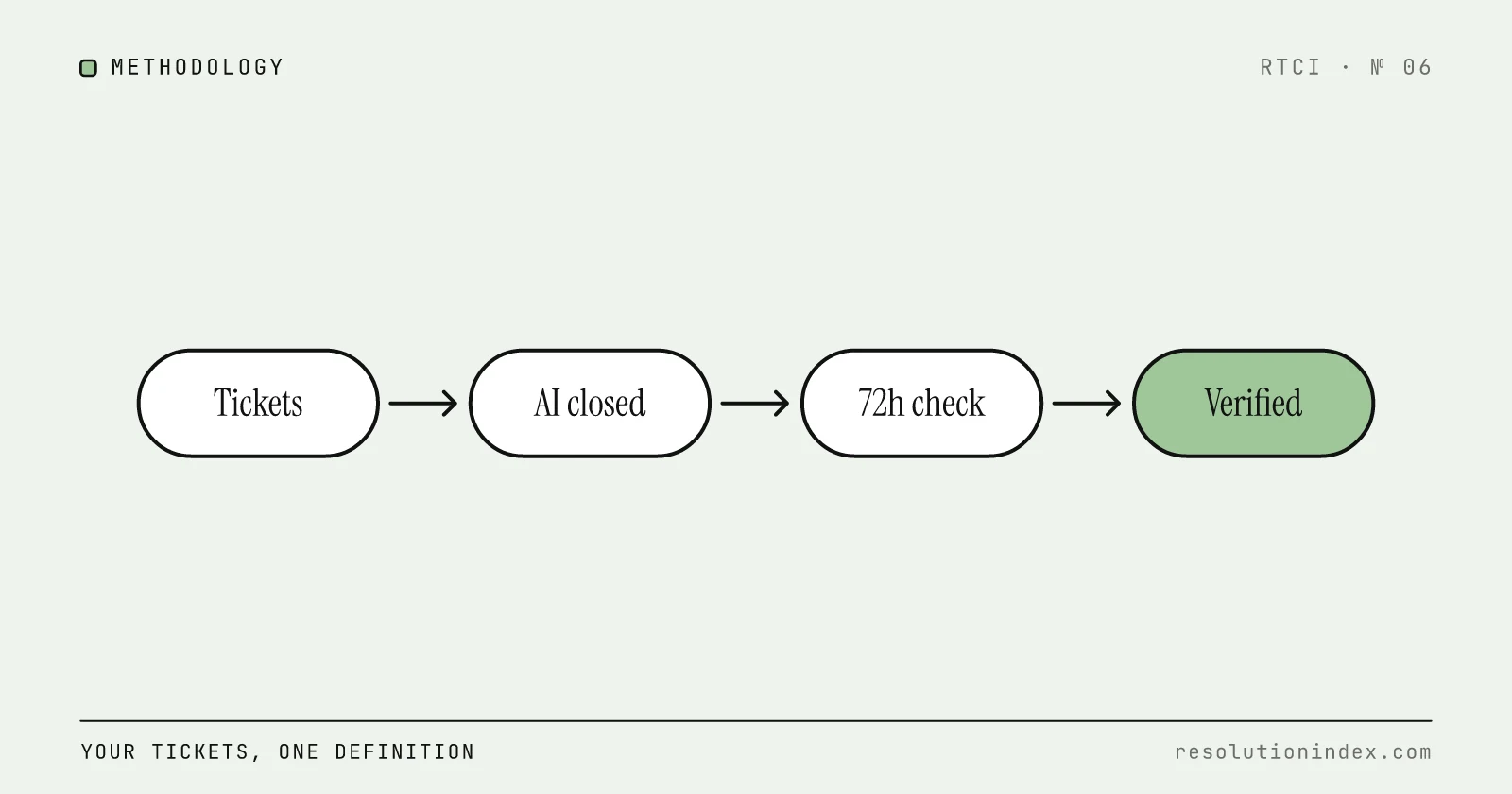
Vendor dashboards report resolution rates that no two vendors calculate the same way. This is a practical, vendor-agnostic methodology to measure your own AI resolution rate using your own ticket data, built on RTCI's 72-hour verified resolution standard.
Train the Team on AI Handoff Workflows
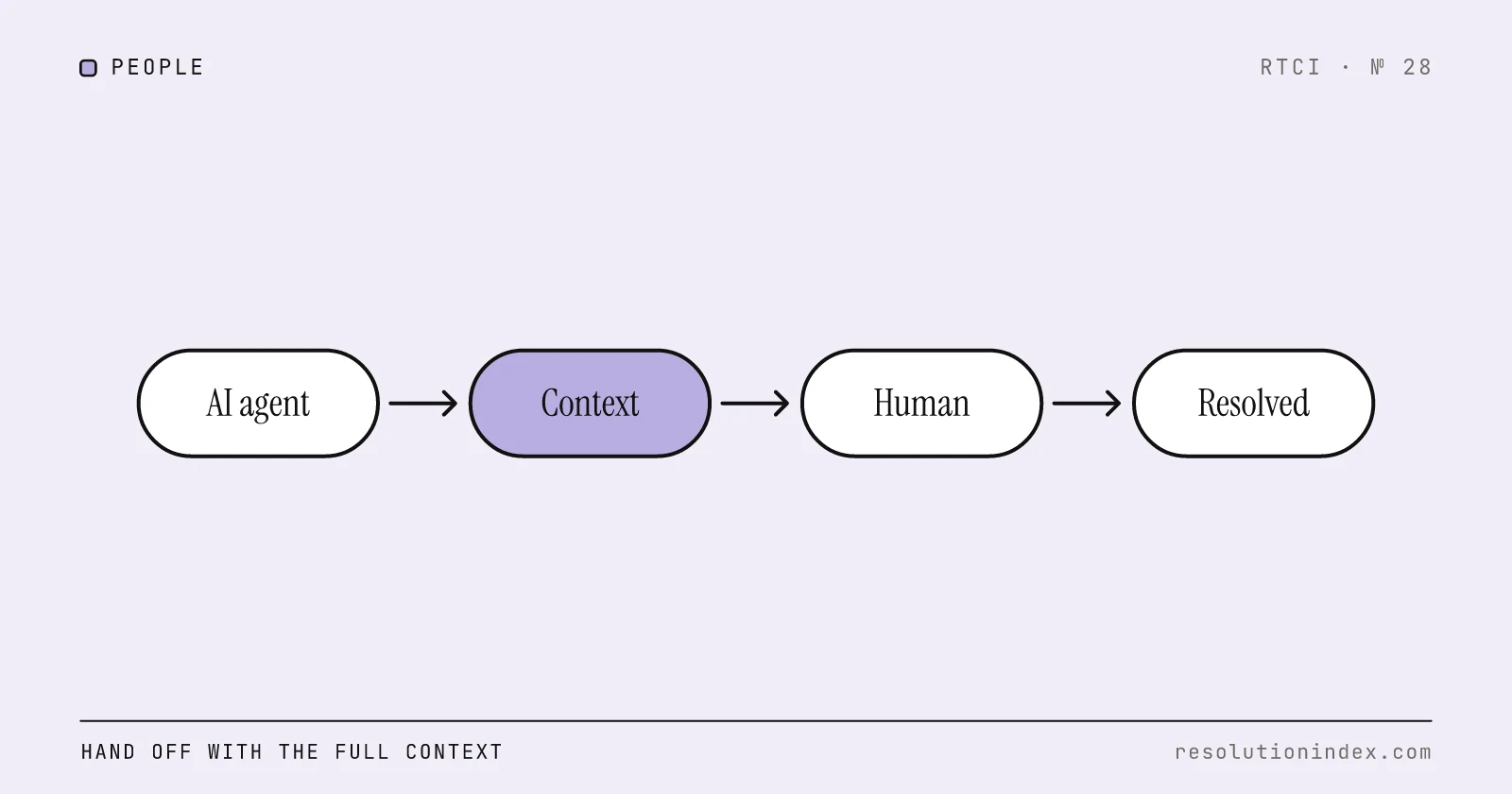
What a clean AI-to-human handoff packet contains, how to measure handoff quality, what vendors bill when a conversation is handed off, and how handoffs move cost per verified resolution.
AI Resolution Rates: Why Vendor Claims Are Often Inflated
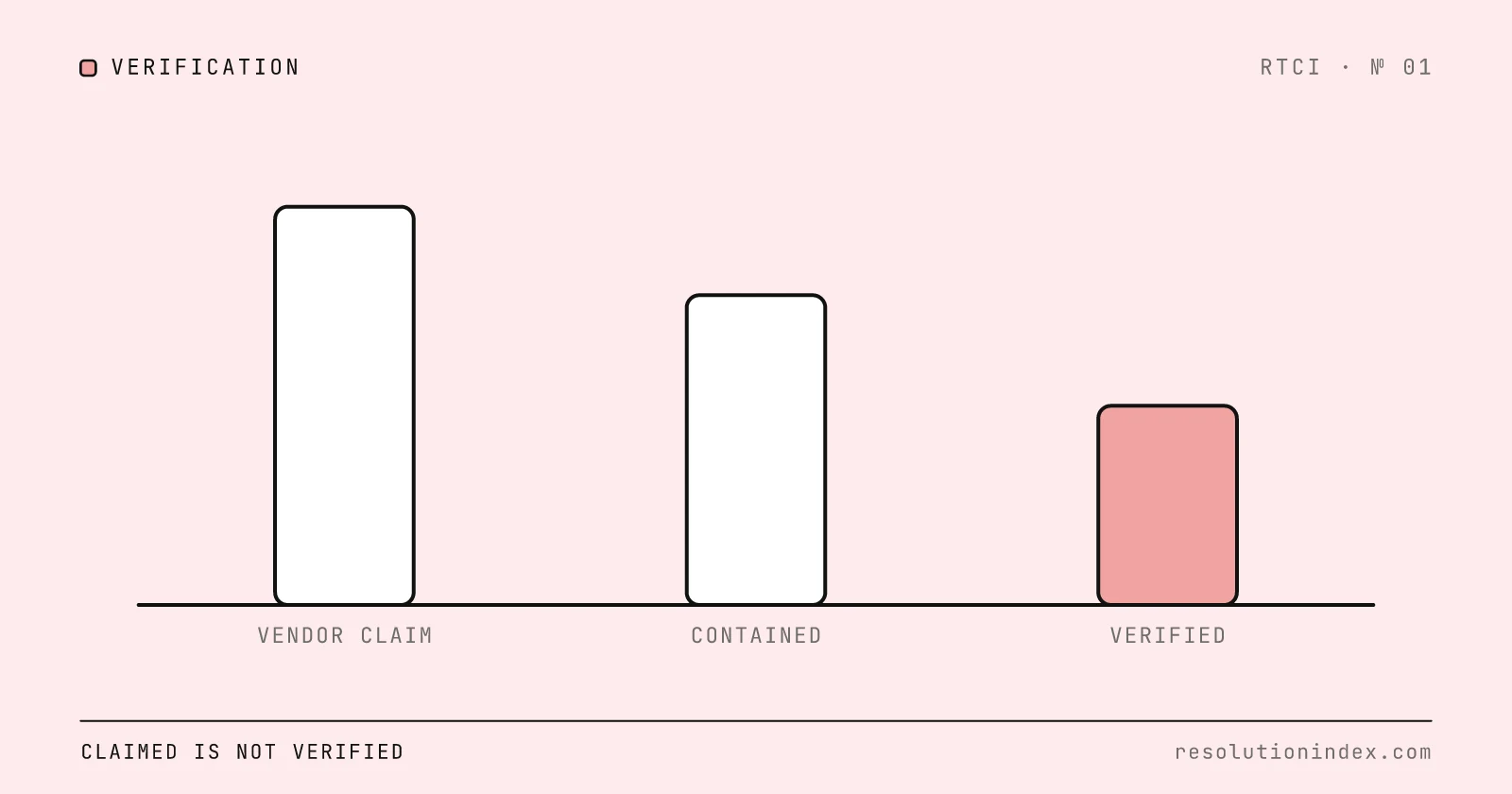
See how AI support vendors blur resolution, containment and deflection, how RTCI discounts each claim, and the five questions to ask before you compare two rates.