Published Nov 17, 2026 · Updated Nov 17, 2026 · 11 min read
CSAT vs NPS (and CES): Which Score to Track for AI-Resolved and Human Support Tickets
What CSAT, NPS and CES each measure, which one to send after AI-resolved, handoff and human tickets, what a good CSAT score really means, and how many responses each group needs before a gap is real.
 Written by Andrew Hall, Editor
CSAT vs NPS is a question of scope. CSAT asks how satisfied a customer was with one interaction, NPS asks how likely they are to recommend the company, and CES asks how easy it was to get the issue handled. RTCI's rule for support teams: after a ticket, send CSAT or CES, not NPS, and keep NPS for a scheduled relationship survey.
Then split every score by who resolved the ticket: the AI agent, the AI and then a person, or a person alone. A blended score hides the gap you most need to see, and at 200 responses per group a 5-point CSAT difference is still inside the noise.
Key takeaways
- CSAT rates one interaction, NPS rates the whole relationship, and CES rates how easy the customer found it to get help.
- After a support ticket, send one CSAT or CES item plus an open reason, and keep NPS for a scheduled relationship survey.
- Published CSAT benchmarks rarely transfer, because scales and top-box rules differ, and ACSI scores are index values rather than satisfied-customer percentages.
- At 200 responses per group, an AI-versus-human gap must exceed 7.4 CSAT points or 15.5 NPS points to stand out from noise.
CSAT vs NPS vs CES in one table
The three scores answer different questions, so the first job is to see them side by side. Wording and formulas come from the sources linked below, as of November 2026.
| CSAT | NPS | CES | |
|---|---|---|---|
| Question | "How would you rate your overall satisfaction with the [goods/service] you received?" | "How likely are you to recommend us to a friend or colleague?" | "The company made it easy for me to handle my issue" (agreement), or how easy it was to interact with the company |
| Scale | 1 to 5 | 0 to 10 | Must be declared, such as 1 to 7 agreement or very easy to very difficult |
| Score | 4s and 5s ÷ all responses × 100 | % promoters (9 to 10) − % detractors (0 to 6) | Mean of valid responses, or a labelled favourable share |
| Measures | Satisfaction with one interaction | Willingness to recommend the company | Effort to get the issue handled |
| Type | Transactional | Relational | Transactional |
| Range | 0% to 100% | −100 to +100 | Depends on the scale |
Qualtrics' CSAT vs NPS article, dated April 27, 2022, gives the CSAT wording and formula: divide the satisfied customers, the 4 and 5 responses, by all survey responses and multiply by 100. It sums up the split as "one is more transactional (CSAT), and one is more relational (NPS)."
The NPS question, scale and groups are quoted from Bain's Net Promoter System page: promoters score 9 or 10, passives 7 or 8, detractors 0 to 6. The same page notes that Net Promoter, NPS and Net Promoter System are registered trademarks of Bain & Company, NICE Systems and Fred Reichheld.
Wording variants of the recommend question, and how to keep them identical across groups, are compared in the guide to the net promoter score question.
CES has no single fixed wording. Qualtrics' CES page asks how easy it was to interact with the company on a scale from very easy to very difficult, while the Qualtrics CSAT article describes CES on a 1 to 5 scale. Whatever you pick, state the scale and the threshold, as the Customer Effort Score for AI support guide does.
Where each score came from, and what that tells you
The history explains why the three scores disagree. Each was built to answer a different management question.
NPS comes from Frederick F. Reichheld's December 2003 Harvard Business Review article, The One Number You Need to Grow. Its summary argues that companies assessing customer satisfaction are "measuring the wrong thing." NPS was designed as a loyalty and growth signal for the company, not as a rating of one contact.
CES traces to Matthew Dixon, Karen Freeman and Nick Toman's July to August 2010 HBR article, Stop Trying to Delight Your Customers. Qualtrics credits CEB researchers with the 2010 finding that reducing customer effort predicted loyalty better than delight. The question is service-specific: did the customer have to work hard to get help.
CSAT has no single originator. It is a generic satisfaction item, which is why its wording, scale and "satisfied" cut-off vary so much from one company to the next.
For support, the history gives a clean split. CSAT and CES were built for the contact, and NPS was built for the relationship.
Bain's archive channel carries a short film telling the NPS origin story in its authors' own words, useful context for anyone asked to put NPS on a ticket survey.
Decision table: which score for which ticket
With the scope of each score clear, the next step is matching it to the ticket. This table is RTCI's recommendation for a queue where an AI agent handles part of the volume. It follows the transactional and relational split above and treats each resolution path as its own group.
| Ticket type | CSAT | CES | NPS | Trigger | Decision it informs |
|---|---|---|---|---|---|
| AI-resolved, customer confirmed | Yes | Optional | No | Ticket closes | Whether AI answer quality supports widening its scope |
| AI marked resolved, no confirmation | Hold | Hold | No | Ticket closes or the re-contact window passes | Whether the resolution was real; check re-contact first |
| AI to human handoff | Yes | Yes | No | Ticket closes after the human reply | Whether the handoff loses context or time |
| Human only | Yes | Optional | No | Ticket closes | Agent coaching and QA |
| Escalated or complaint | Yes, plus a callback offer | No | No | Case closes | Root cause and recovery |
| Relationship survey | No | No | Yes | Quarterly, suppressed after recent tickets | Company-level loyalty and retention risk |
The core rule is short. After a ticket, send one scored CSAT or CES item and one open "why" box. Send NPS on a schedule, about the company, and never ask how likely the customer is to recommend your chatbot.
Plenty of teams do send NPS after support. Qualtrics' article on transactional vs relational NPS, dated January 9, 2021, calls it "common practice to send an NPS question to customers immediately after they've been in touch with your contact center."
The trouble is that NPS after a ticket mixes this contact with the product, the price and every earlier experience. That makes it a weak signal for judging whether the AI or the person handled the ticket well.
Exact wording for the CSAT and CES items, including versions for AI-handled and handoff tickets, is in the bank of customer service survey questions. The post-ticket set to copy into a survey tool:
- How satisfied were you with the support you received today? (1 very dissatisfied to 5 very satisfied)
- The company made it easy for me to handle my issue. (1 strongly disagree to 7 strongly agree; always on handoff tickets, optional elsewhere)
- What is the main reason for your rating? (optional text)
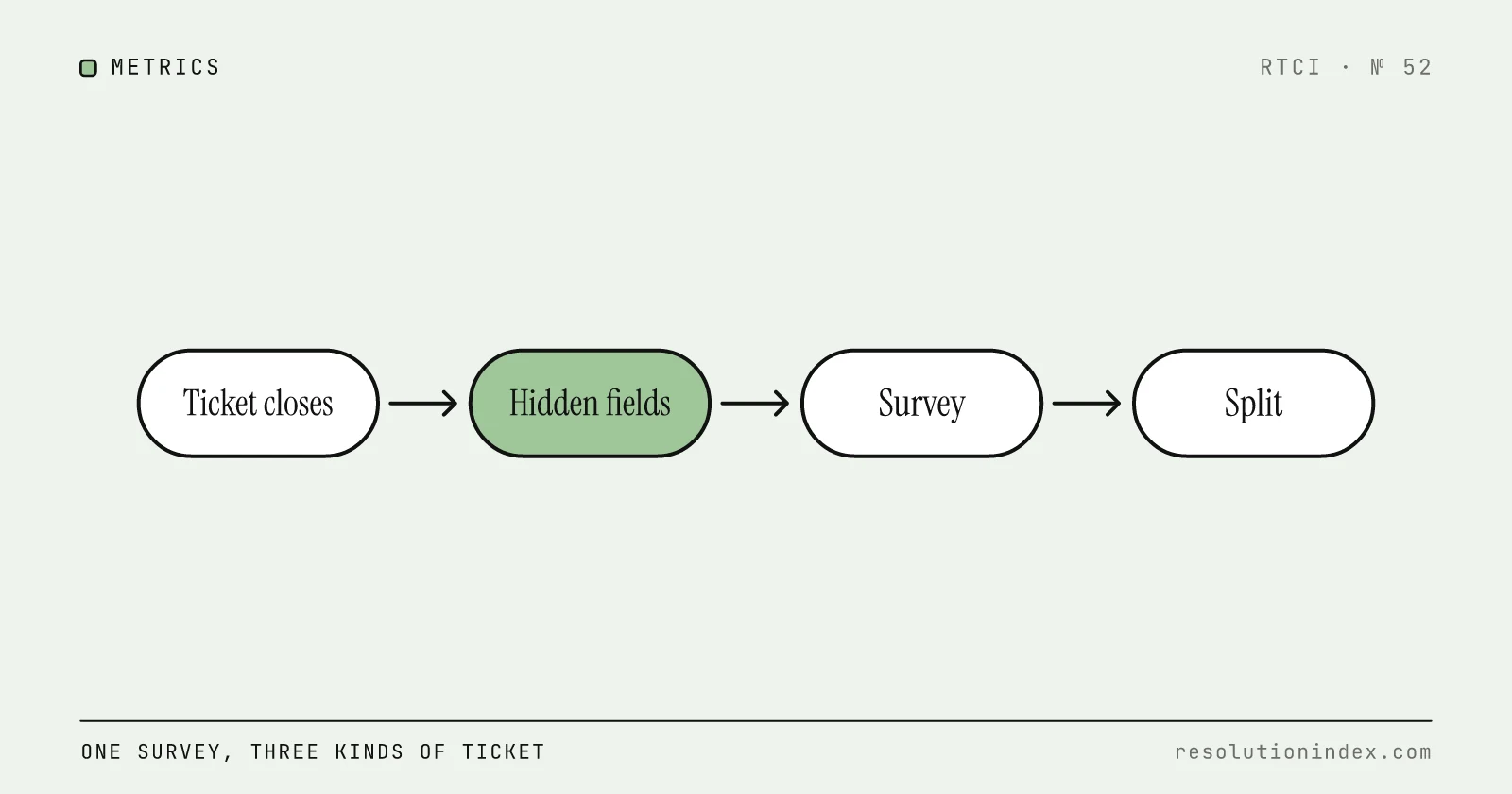
- Hidden fields from the helpdesk: resolution type, handoff yes or no, channel, reopened.
Why AI-resolved tickets need their own line
An AI agent changes who answers the survey, not only who answers the ticket. That is the reason to keep its scores separate.
Customers who got a wrong bot answer can leave without replying to anything, survey included. The AI segment can then show high CSAT on a small, self-selected sample of customers whose issue went well. A blended score adds that flattering slice to the human score and hides the gap.
Pair every survey score with two outcome checks that do not depend on the customer answering: verified resolution, and re-contact on the same issue within 72 hours. The method for measuring AI resolution rate sets the verified definition.
The reasons a bot's own "resolved" flag overstates outcomes are covered in why vendor-claimed resolution rates don't match reality. Use the same verified definition as the survey trigger.
Tag four fields on every response, pulled from the helpdesk rather than asked of the customer:
- Resolution type: AI-resolved, AI then human, or human only.
- Handoff: yes or no.
- Channel: chat, email, messaging or voice.
- Reopened: whether the same issue came back inside the re-contact window.
Report the response rate per group beside each score. If the AI group answers at half the rate of the human group, its CSAT describes a narrower set of customers.
In a pilot, CSAT works as a guardrail next to verified resolution, as in a fair AI support pilot scorecard, not as the headline result.
What is a good CSAT score?
A good CSAT score is one that beats your own baseline for the same ticket type, measured the same way. Published numbers from other companies rarely transfer, for two reasons.
First, CSAT depends on definitions. On a 1 to 5 scale, the Qualtrics formula counts 4s and 5s as satisfied. Some teams count only 5s, and some use a 1 to 7 or 1 to 10 scale with their own cut-off.
Take 200 responses on a 1 to 5 scale: 130 fives, 40 fours, 15 threes, 8 twos and 7 ones. Counting 4s and 5s, CSAT is (130 + 40) ÷ 200 × 100 = 85%. Counting only 5s, it is 130 ÷ 200 × 100 = 65%. The mean is (650 + 160 + 45 + 16 + 7) ÷ 200 = 878 ÷ 200 = 4.39 out of 5.
One survey, three numbers. A benchmark that does not state its scale and its top-box rule cannot be compared with yours.
Second, the main public cross-industry measure is not a CSAT percentage. SurveyMonkey's guide to a good CSAT score, dated November 9, 2026, says a "good" CSAT score "generally falls between 70% and 85%" and uses the American Customer Satisfaction Index for industry-specific CSAT benchmarks. The 70% to 85% range is a common convention, and the guide gives no method or sample size for it.
ACSI scores work differently. ACSI's description of its science says the index "uses customer interviews as input to a multi-equation econometric model," and that the satisfaction score "is calculated as a weighted average of three survey questions," with the weights estimated by ACSI's own software.
So an ACSI score of 80 is an index value of 80, not 80% of customers saying they were satisfied. As of November 2026, the national ACSI score is 76.1 for the second quarter of 2026, down from 76.7 in the first quarter. Read it as a trend in a modelled index, not as a CSAT target.
The honest benchmark is internal: CSAT for human-only tickets against AI-resolved and handoff tickets, on the same question and scale, trended month by month.
On "what is a good CSAT score out of 5", the Qualtrics formula treats 4 and 5 as satisfied, so CSAT is the share of 4s and 5s. If you report a mean instead, label it as a mean, because 4.39 out of 5 and 85% can describe the same survey.
How many responses before the AI-vs-human gap is real
Benchmarks aside, the number leadership will ask about is the gap between AI and human tickets. Here CSAT and NPS differ most, and the math is short.
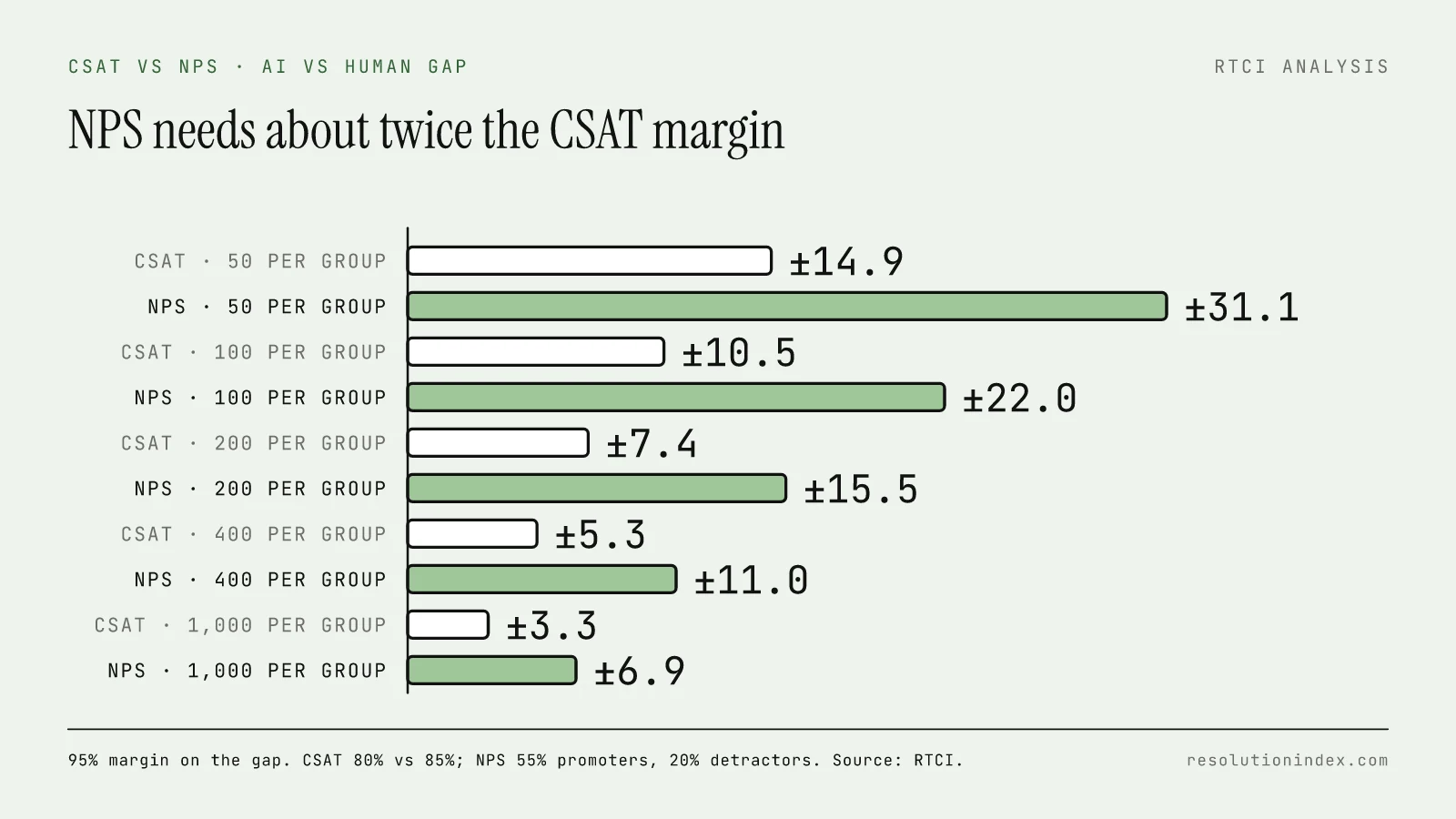
For two independent groups of equal size n at 95% confidence, the margin on the gap is 1.96 × the square root of the summed variances, times 100 for points. The assumptions: AI CSAT of 80% and human CSAT of 85%; an NPS split of 55% promoters and 20% detractors in both groups.
- CSAT gap margin = 1.96 × √(0.80 × 0.20 ÷ n + 0.85 × 0.15 ÷ n) × 100 = 1.96 × √(0.2875 ÷ n) × 100.
- NPS variance per group = p + d − (p − d)² = 0.55 + 0.20 − 0.35² = 0.75 − 0.1225 = 0.6275.
- NPS gap margin = 1.96 × √(2 × 0.6275 ÷ n) × 100 = 1.96 × √(1.255 ÷ n) × 100.
At n = 200, the CSAT margin is 1.96 × √(0.2875 ÷ 200) × 100 = 1.96 × √0.0014375 × 100 = ±7.4 points. The NPS margin is 1.96 × √(1.255 ÷ 200) × 100 = 1.96 × √0.006275 × 100 = ±15.5 points.
| Responses per group | CSAT gap margin (± points) | NPS gap margin (± points) |
|---|---|---|
| 50 | 14.9 | 31.1 |
| 100 | 10.5 | 22.0 |
| 200 | 7.4 | 15.5 |
| 400 | 5.3 | 11.0 |
| 1,000 | 3.3 | 6.9 |
These rows show how the formulas behave at these splits. They are not survey results, and a different split changes every cell.
Read the table as the smallest gap you can call real. At 200 responses per group, AI CSAT of 80% against human CSAT of 85% is a 5-point gap inside a ±7.4 margin, so it cannot be told apart from noise. A 10-point NPS gap sits inside ±15.5.
To call that 5-point CSAT gap real, each group needs 1.96² × 0.2875 ÷ 0.05² = 441.8, so 442 responses. A 10-point NPS gap at the 55/20 split needs 1.96² × 1.255 ÷ 0.10² = 482.1, so 483 per group.
For the same margin in points, NPS needs about 4.4 times the responses of CSAT at these splits (1.255 ÷ 0.2875 = 4.37). That is one more reason to use CSAT or CES at ticket level, where each resolution group has to be read on its own.
Can you convert NPS to CSAT?
No. The Qualtrics CSAT vs NPS article answers the same question with a flat no, and says it is not possible to extrapolate information from one based on information from the other.
The questions differ, one interaction against the whole company. The scales differ, 1 to 5 against 0 to 10. The populations differ too: a ticket survey reaches customers who just contacted support, while a relationship survey samples the wider customer base.
The AI split adds a fourth reason. Post-ticket CSAT for AI-resolved tickets describes customers who stayed long enough to answer. Relationship NPS from the same month includes customers who gave up on the bot and never replied. Report the two side by side, never as substitutes.
When this approach is the wrong choice
Ticket-level CSAT and CES miss customers who never contact support. If leadership needs a company-wide loyalty number, relationship NPS on a schedule is the right tool, and post-ticket scores cannot stand in for it.
Low volume is the second limit. A queue that collects 100 responses a month per group cannot detect a 5-point CSAT gap within a month. Trend quarterly totals instead, or compare within one high-volume intent.
The groups can also differ in what they bring. If the AI handles simpler intents, a raw AI-versus-human gap partly compares easy tickets with hard ones. The margin method above also assumes simple random samples; repeat respondents and clustered sends make the real uncertainty wider than the table shows.
And a high score never replaces outcome data. CSAT from customers who chose to answer is a guardrail; verified resolution and re-contact are the result.
The decision rule
After a support ticket, send one CSAT or CES item and one open reason, tagged with resolution type, handoff, channel and reopened status. Use CES on every AI-to-human handoff. Keep NPS for a scheduled relationship survey about the company.
Benchmark against your own human-only baseline, not a published range. Before reporting an AI-versus-human gap upward, confirm it is larger than the margin on the gap, and run your NPS groups through the NPS margin of error calculator first.
Frequently asked questions
What is the difference between CSAT and NPS?
CSAT measures satisfaction with one interaction, usually on a 1 to 5 scale, reported as the share of 4s and 5s. NPS measures how likely a customer is to recommend the company on a 0 to 10 scale, reported as percent promoters minus percent detractors. Qualtrics describes CSAT as more transactional and NPS as more relational.
Which is better for customer service, CSAT or NPS?
For a single support ticket, CSAT or CES, because both rate the contact itself. NPS asks about the whole company, so post-ticket NPS mixes the support experience with product, price and history. RTCI recommends CSAT or CES after each ticket and NPS on a scheduled relationship survey, with scores split by AI-resolved, handoff and human-only tickets.
What is a good CSAT score out of 5?
Under the common formula, customers who answer 4 or 5 count as satisfied, and CSAT is their share of all responses. Many guides call 70% to 85% good, but that range rarely states a source or method. The more useful benchmark is your own human-only baseline on the same question and scale.
Is NPS or CES a better predictor of loyalty?
They answer different questions. The 2010 CEB research behind CES, as Qualtrics summarizes it, found that reducing customer effort predicted loyalty better than delight. NPS asks directly about willingness to recommend the company. For support teams, CES fits the ticket and NPS fits the relationship, so most programs run both at different moments.
Should you send an NPS survey after a chatbot conversation?
RTCI recommends against it. A recommend question after a bot conversation either asks about the company, which one chat barely moves, or about the chatbot, which is not the NPS question at all. Send CSAT or CES when the ticket closes, tag it AI-resolved, and keep NPS for the scheduled relationship survey.
How many survey responses do you need to compare AI and human CSAT?
At 80% versus 85% CSAT and 95% confidence, the margin on the gap is ±7.4 points with 200 responses per group, so a 5-point gap is still noise. Each group needs about 442 responses before a 5-point gap stands out. NPS needs roughly four times as many responses for the same margin.
Read next
Keep reading
Picked for this article: the pieces it cites and the ones that answer the next question buyers usually ask.
Most related
The Net Promoter Score Question: Exact Wording for Support Teams, With AI-Resolved and Human Tickets
The standard NPS question and follow-up quoted from the source, how to word post-ticket NPS when a bot or a person handled the conversation, when to send it, and how many responses each group needs before a gap means anything.
Customer Service Survey Questions: 35 Customer Satisfaction Survey Questions for Services, With AI-Handled and Human Tickets
A 35-question bank for the survey that goes out when a support ticket closes: CSAT, effort, yes/no and open-text wording, separate lines for AI-handled and hand-off conversations, the hidden fields to tag, and how many responses a CSAT gap needs before it means anything.
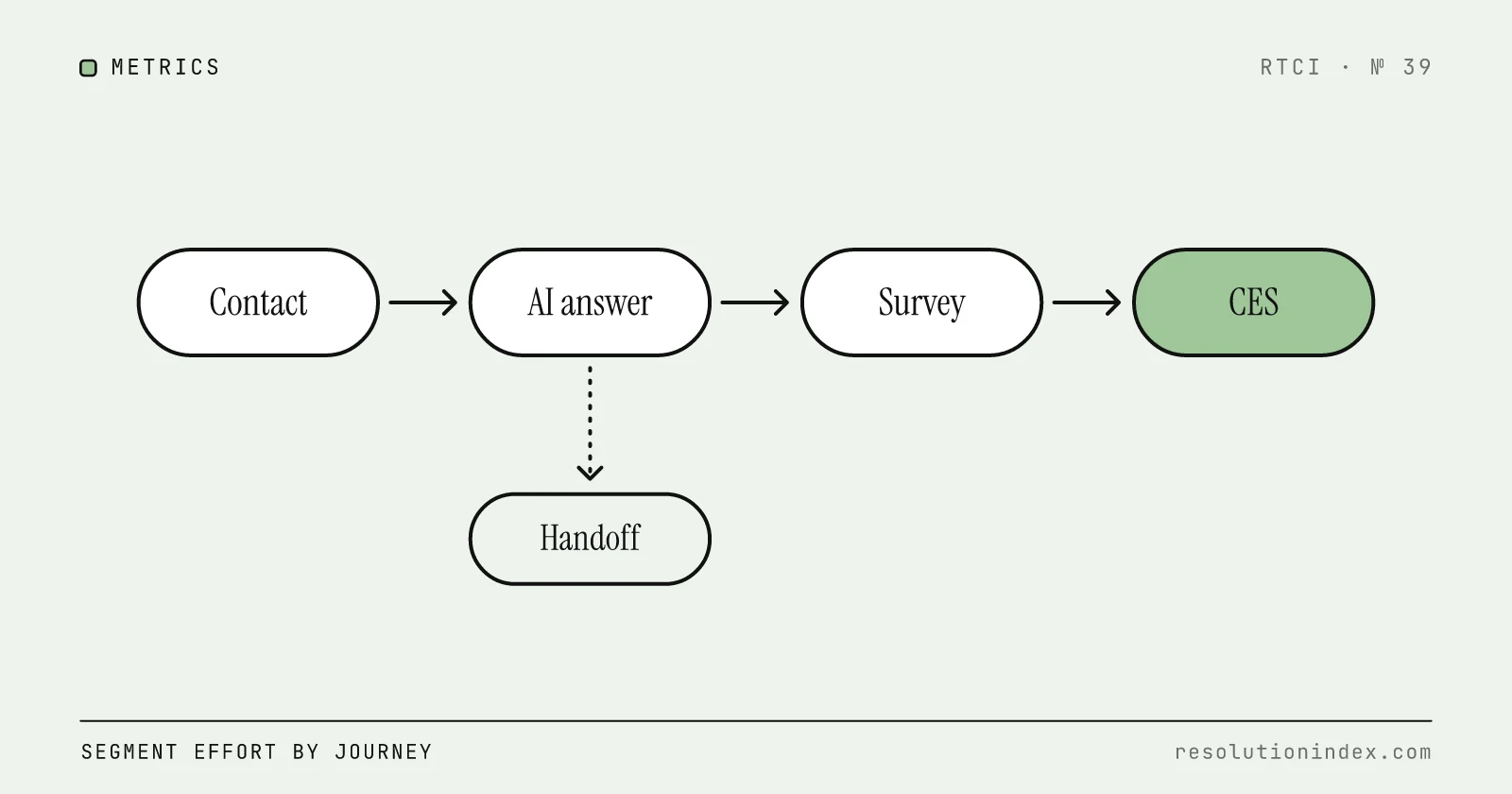
Customer Effort Score for AI Support: Formula, Survey, and Benchmark
Measure customer effort after AI support with a reproducible CES survey, segmentation worksheet, confidence labels, and guardrails against false resolution claims.
How to Design a Fair AI Support Pilot Scorecard
A weighted scorecard with 8 dimensions, hard-stop gates, and copy-paste Week 1–4 templates for evaluating an AI support pilot honestly.
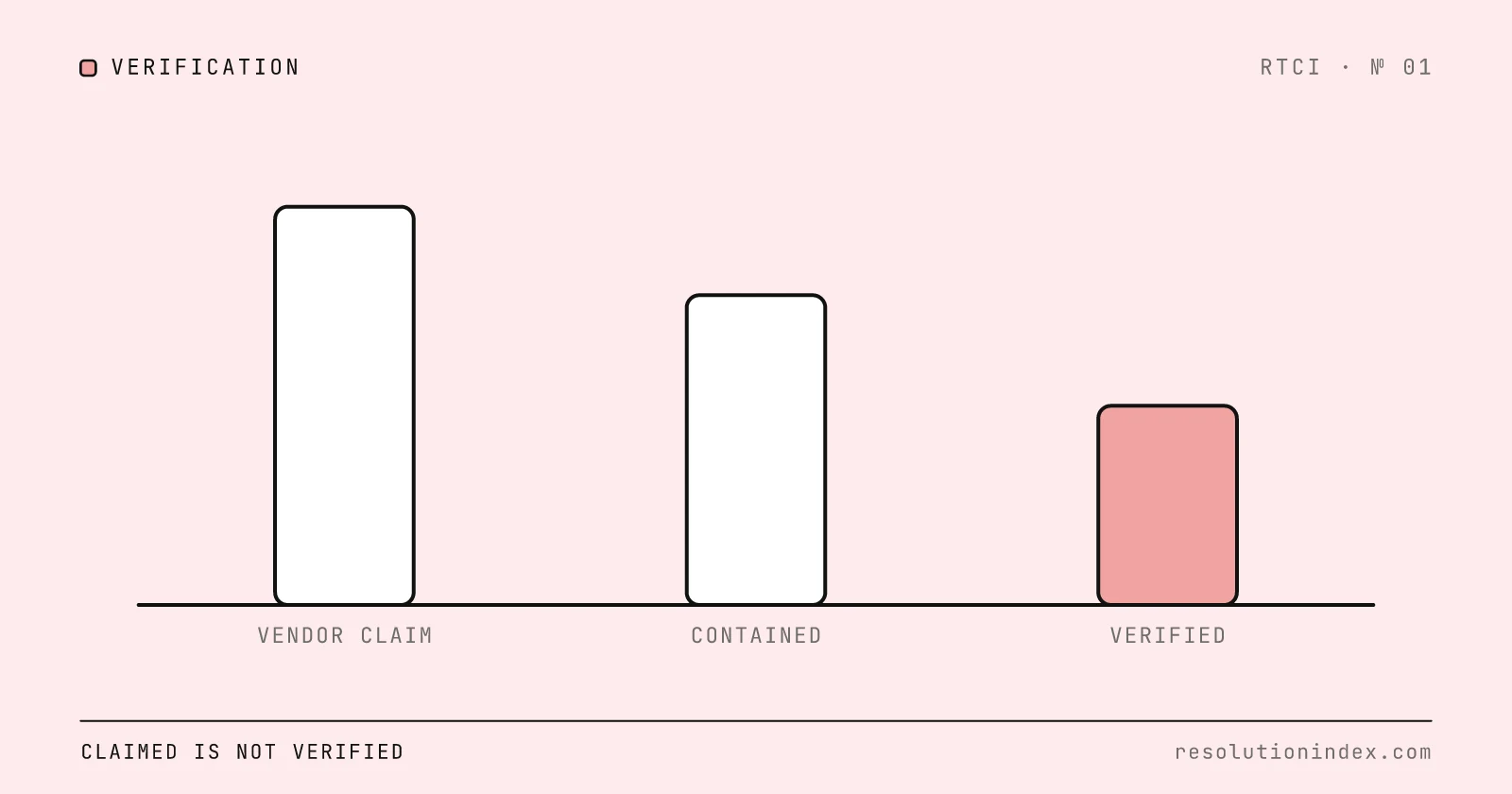
AI Resolution Rates: Why Vendor Claims Are Often Inflated
See how AI support vendors blur resolution, containment and deflection, how RTCI discounts each claim, and the five questions to ask before you compare two rates.