Published · Updated · 11 min read
Outsourced Customer Service Cost: Rates vs AI per Resolution
Outsourced customer service cost as of November 2026: published BPO rates by region and pricing model, converted into cost per resolved contact and set beside AI agents and hybrid teams.
 Written by Andrew Hall, Editor
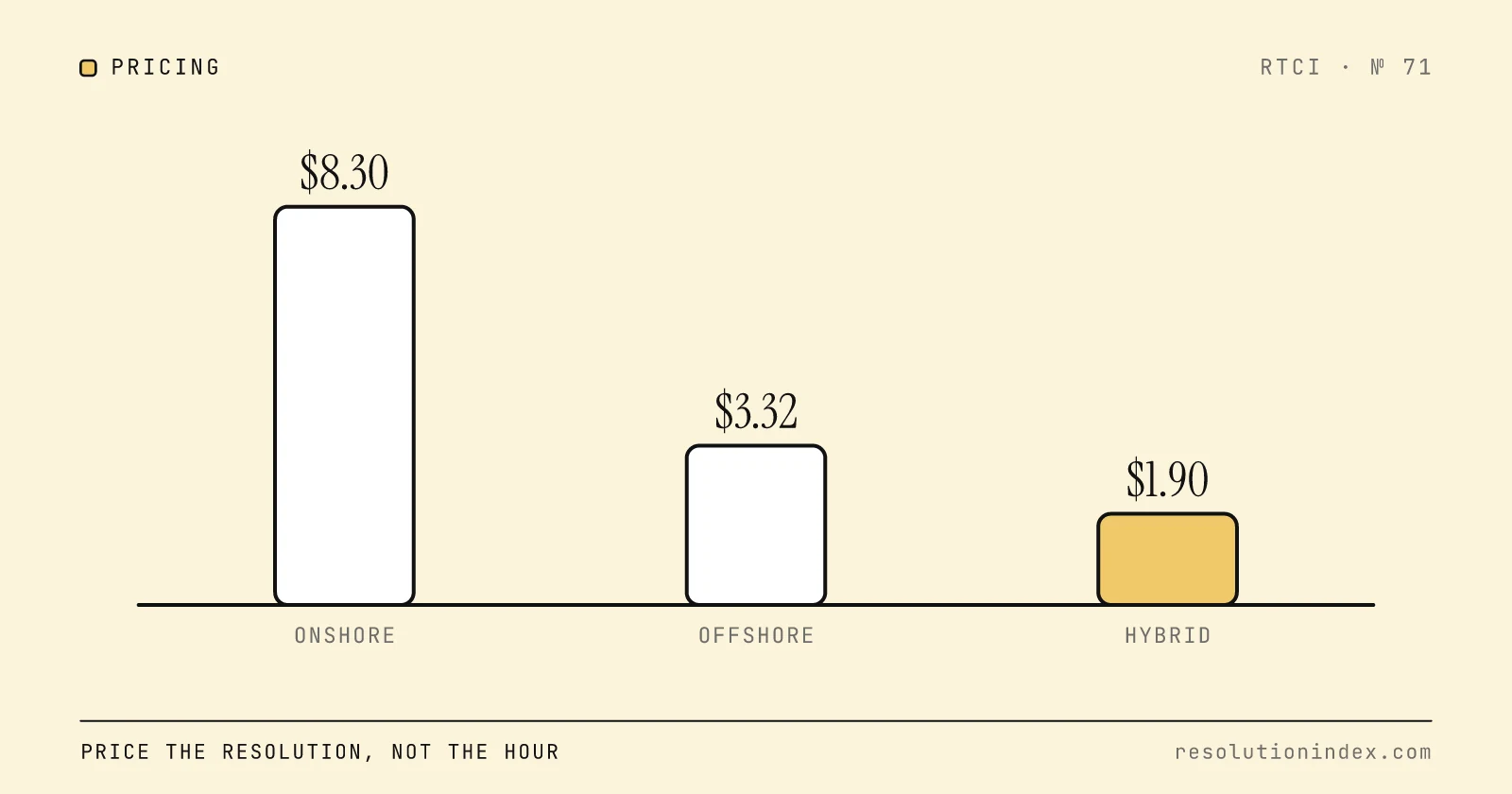
Outsourced customer service cost, as of November 2026, runs from about $6 to $18 an hour in India and the Philippines, $8 to $25 nearshore in Latin America and $20 to $80 onshore in the US, depending on who publishes the range. Before comparing a BPO quote with an AI agent, convert both to cost per resolved contact.
The conversion is one line: hourly rate ÷ utilisation ÷ contacts per productive hour ÷ first-contact resolution rate. This guide shows where the published rates come from, how each pricing model works, and what a resolved contact costs offshore, onshore, in-house and with an AI agent in front.
Key takeaways
- Published outsourcing rates run from about $6 an hour in India to $80 onshore in the US, and none come from an audited survey.
- Convert every quote to cost per resolved contact: hourly rate divided by utilisation, contacts per productive hour and first-contact resolution rate.
- At $14 an hour, 75% utilisation, an 8-minute handle time and 75% first-contact resolution, an offshore agent costs $3.32 per resolved contact.
- An AI agent answering first, with the same offshore team behind it, brings the blended cost to $1.90 to $2.68 per resolved contact.
How much does outsourced customer service cost?
No audited, cross-market survey of BPO rates is public. What exists is a set of ranges published by outsourcing marketplaces, BPOs and software vendors, each with a commercial interest and none with a stated sample. The table puts three of them side by side, as published.
| Region | Syrow (BPO) | HiveDesk (workforce software vendor), Mar 2026 | Clutch listings, Sep 2026 |
|---|---|---|---|
| US / Canada onshore | $20–$30/h | $40–$80/h (US) | US bucket: under $25/h |
| Latin America nearshore | $8–$18/h | Mexico $15–$25/h, Colombia $12–$22/h | Mexico: under $25/h |
| Eastern Europe | $12–$25/h | Not covered | Poland, Ukraine: under $25/h |
| Philippines | $8–$14/h (Asia/Philippines) | $10–$18/h | Under $25/h |
| India | $6–$10/h | $8–$15/h | Under $25/h |
| Western Europe / UK | $40+/h | Not covered | UK: $50–$99/h |
Clutch's customer service outsourcing pricing guide puts the average for firms listed on its marketplace at $25 to $49 an hour, with projects reviewed on Clutch typically costing $10,000 to $49,999. Its page is marked updated September 21, 2026, and it does not state how many firms the averages cover. These are rates the listed firms report, not a market survey.
Indian BPO Syrow publishes the regional table on its page on what a call centre costs to hire, along with per-minute rates for shared agents. The page carries no publication date, and older guides from 2020 quote the same figures, so treat them as a long-running market reference rather than a 2026 price list.
HiveDesk's BPO pricing guide, dated March 23, 2026, gives higher bands and calls them all-in rates per productive hour. It also lists monthly cost per full-time agent: $5,500 to $12,000 in the US, $1,500 to $3,000 in the Philippines and $1,300 to $2,500 in India. HiveDesk sells time-tracking software for remote teams.
The in-house baseline comes from government data. The BLS Occupational Outlook Handbook gives a median wage of $21.53 an hour ($44,770 a year) for US customer service representatives in May 2025. That is pay only, so it sits below a BPO's billed rate, which already includes facilities, tools, supervision and margin.
Call center outsourcing pricing models
The hourly rate is only one way BPOs bill. The model matters as much as the number, because it decides who pays when agents sit idle and who absorbs a volume spike.
| Model | How it is billed | Who pays for idle time | Who carries volume risk | Typical fit |
|---|---|---|---|---|
| Per hour, dedicated agents | Scheduled agent hours | You | You (understaffed peaks hurt service; overstaffed troughs cost money) | Steady volume, product knowledge needed |
| Per minute, shared agents | Handle or talk minutes | Provider | Shared | Low or spiky voice volume |
| Per contact or per call | Each handled contact | Provider | Provider on handle time, you on volume | Simple, repeatable contacts |
| Per resolution | Each contact the provider counts as resolved | Provider | Provider | Only with a written resolution definition |
| Per agent per month | Fixed fee per full-time agent | You | You | Long-term dedicated teams |
Shared agents work several clients' queues, so you pay only for the minutes spent on your contacts. Syrow lists shared inbound at $0.27 to $0.45 a minute with low-cost offshore agencies and $0.75 to $1.25 a minute in the US and Canada.
Dedicated agents learn your product and policies, and you pay for every scheduled hour whether contacts arrive or not. That idle time is the first thing the conversion below has to price.
From hourly rate to cost per resolved contact
Every option a support leader compares can be put in one unit: what it costs to close one customer's issue. For a BPO billed by the hour, four inputs get you there.
- Billed rate: what the contract charges per agent hour.
- Utilisation: the share of paid hours spent handling contacts. At 75%, a $14 hour buys 45 working minutes.
- Handle time: minutes per contact, including wrap-up. At 8 minutes, a productive hour handles 7.5 contacts.
- First-contact resolution (FCR): the share of contacts closed without the customer coming back.
Cost per resolved contact = billed rate ÷ utilisation ÷ (60 ÷ handle time) ÷ FCR. For per-minute pricing it is rate per billed minute × billed minutes per contact ÷ FCR, with no utilisation term because the provider carries idle time.
Take a team with 75% utilisation, an 8-minute handle time and 75% FCR. Those three are assumptions, so swap in your own figures from the first-contact resolution calculator and your occupancy reports.
| Scenario | Billed rate | Contacts per paid hour | Cost per contact | Cost per resolved contact at 75% FCR |
|---|---|---|---|---|
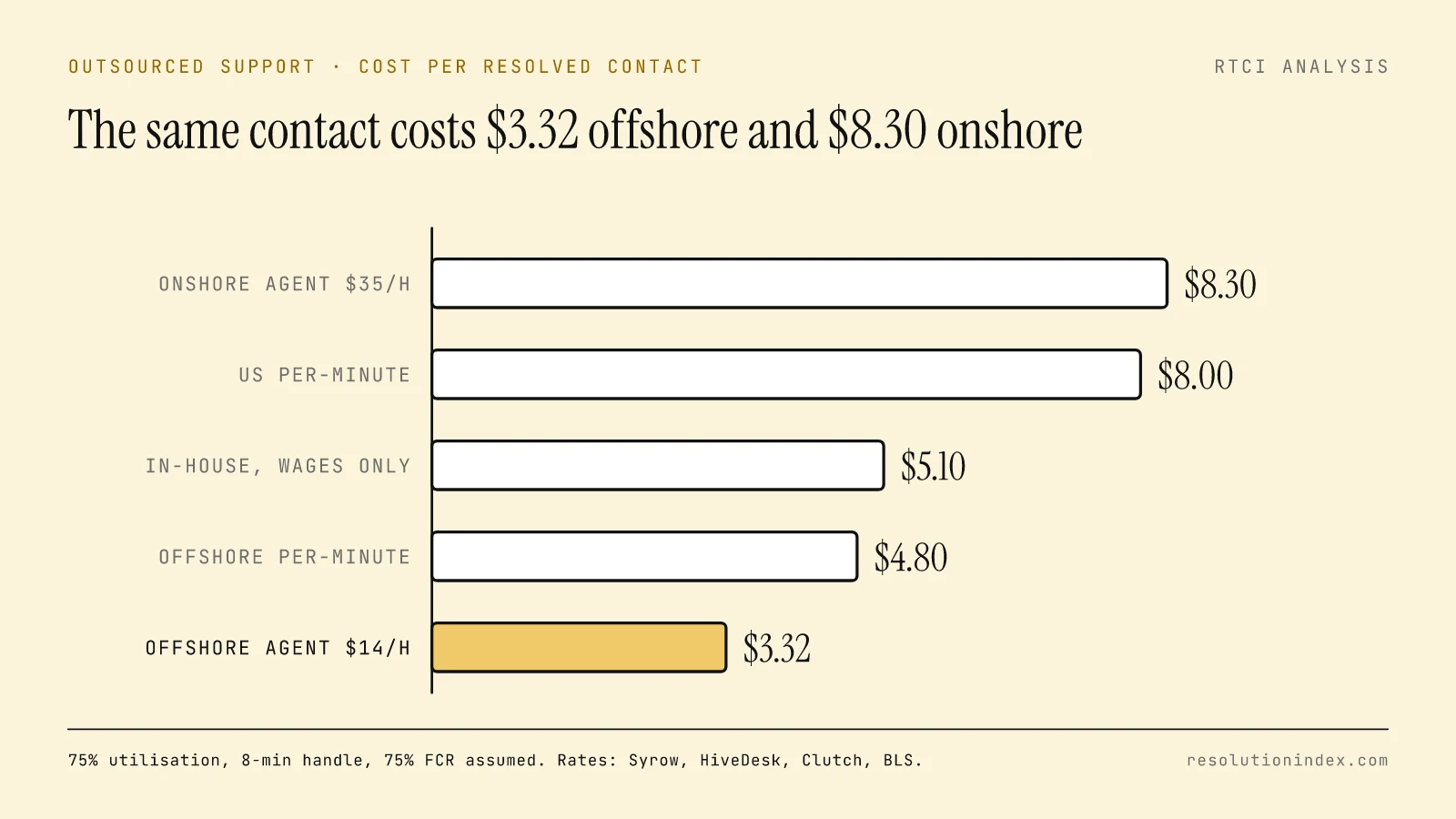
| Offshore dedicated agent | $14/h | 5.6 | $2.49 | $3.32 |
| Onshore dedicated agent | $35/h | 5.6 | $6.22 | $8.30 |
| Offshore shared, per minute | $0.45/min | n/a | $3.60 | $4.80 |
| US shared, per minute | $0.75/min | n/a | $6.00 | $8.00 |
| In-house, BLS median wage only | $21.53/h | 5.6 | $3.83 | $5.10 |
The arithmetic for the offshore row: $14 ÷ 0.75 = $18.67 per productive hour, ÷ 7.5 contacts = $2.49 per contact, ÷ 0.75 FCR = $3.32. Onshore: $35 ÷ 0.75 = $46.67, ÷ 7.5 = $6.22, ÷ 0.75 = $8.30. Per minute: $0.45 × 8 = $3.60 and $0.75 × 8 = $6.00, each ÷ 0.75.
The $14 input sits inside both the Syrow and HiveDesk Philippines ranges, and $35 sits inside Clutch's $25 to $49 average. The in-house row uses wages only, so it understates the true in-house cost by everything the employer adds on top of pay.
Outsourcing vs in-house vs AI agent on the same 10,000 contacts
With every option in one unit, the AI comparison is straightforward. For many teams the realistic choice is an AI agent answering first, with a smaller outsourced team taking what it cannot resolve.
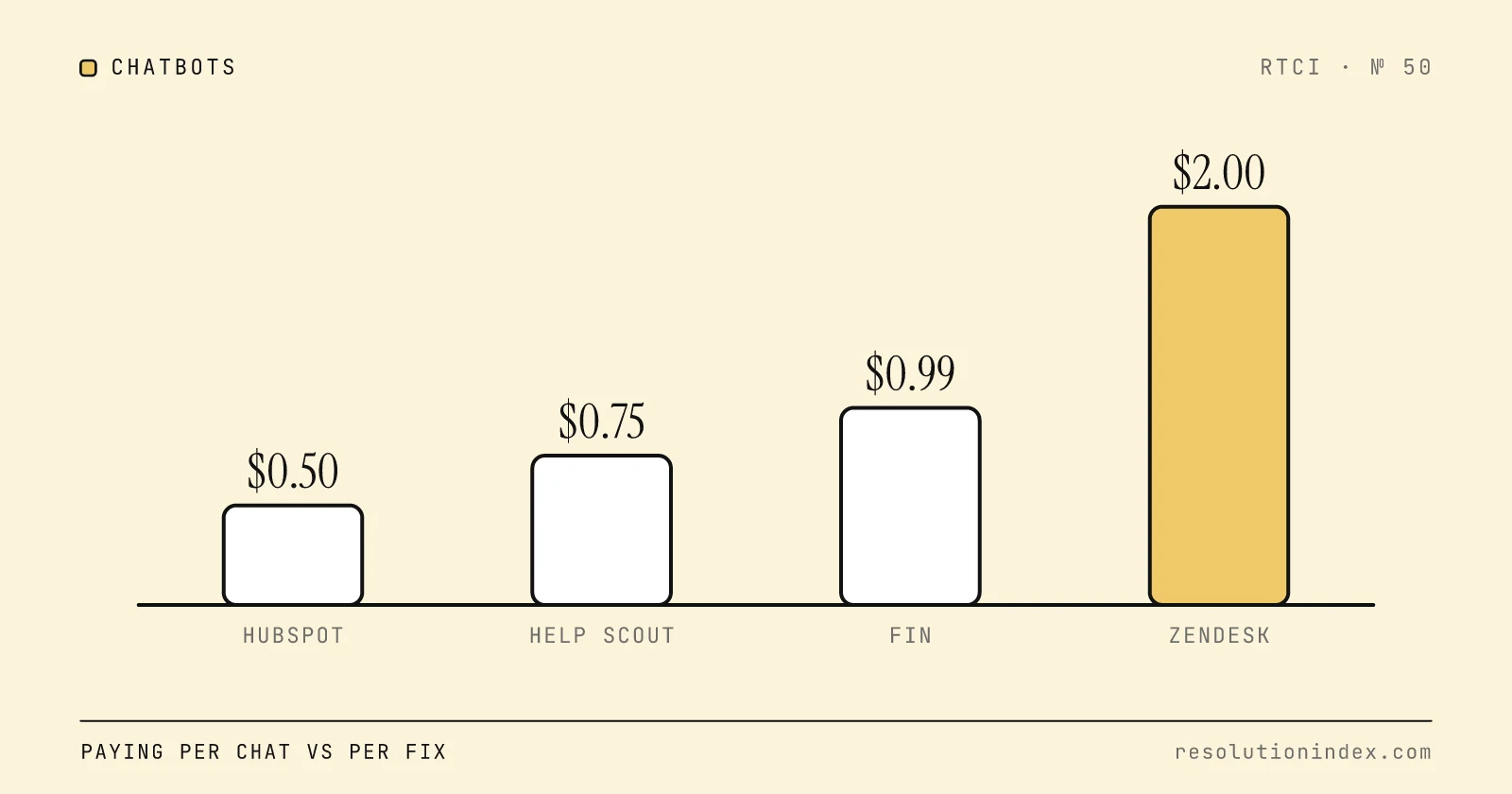
AI prices and resolution rates below come from RTCI's platform data as of November 2026. RTCI's Intercom Fin review puts Fin at $0.99 per resolution and a realistic 56% to 66% resolution rate (midpoint 60.8%). RTCI's Zendesk AI review gives $1.50 to $2.00 (midpoint $1.75) at 36% to 46% (midpoint 40.8%), and its Crescendo review an estimated $1.54 at 48% to 58% (midpoint 53.0%).
Take 10,000 contacts a month. The AI resolves its midpoint share, and the rest go to the offshore team at $3.32 per resolved contact.
| Option | AI resolutions | AI cost | Contacts to the BPO | BPO cost | Total | Per resolved contact |
|---|---|---|---|---|---|---|
| Onshore BPO only | 0 | $0 | 10,000 | $83,000 | $83,000 | $8.30 |
| In-house, wages only | 0 | $0 | n/a | n/a | $51,000 | $5.10 |
| Offshore BPO only | 0 | $0 | 10,000 | $33,200 | $33,200 | $3.32 |
| Fin first, offshore behind | 6,080 | $6,019.20 | 3,920 | $13,014.40 | $19,033.60 | $1.90 |
| Crescendo first, offshore behind | 5,300 | $8,162.00 | 4,700 | $15,604.00 | $23,766.00 | $2.38 |
| Zendesk AI first, offshore behind | 4,080 | $7,140.00 | 5,920 | $19,654.40 | $26,794.40 | $2.68 |
The totals exclude helpdesk seats and platform fees. As of November 2026, Fin's pricing page lists $0.99 per outcome on your current helpdesk with a 50-outcome monthly minimum, or from $0.99 per outcome plus $19 per helpdesk seat a month if you run it on Intercom. Crescendo adds a monthly platform fee it does not publish.
Two inputs move the answer. A higher resolution rate shifts contacts from the $3.32 line to the cheaper AI line, which is why Fin's row ends lowest with the same BPO rate behind every option. A lower AI price helps less than it looks when the resolution rate is low, as the Zendesk row shows.
The AI side has its own billing detail. Fin bills a configured Procedure handoff to a human at $0.99, the same as a resolution. If all 3,920 escalations in the Fin row went through one, the AI bill rises by $3,880.80 and the blended cost to $2.29.
Crescendo is itself an AI-plus-human outsourcing offer. Its outsourced call center pricing guide says it typically charges $1.25 per resolution for AI-backed support and $2.25 for its AI-plus-human model, plus a fixed monthly fee. RTCI's $1.54 estimate includes an allowance for that fee.
Hidden costs in BPO contracts
The worked example assumes the billed rate is the whole cost. In practice, several contract terms raise the effective rate, and each can be written as a change to one input in the formula.
| Cost | Where it enters the formula | What to ask for |
|---|---|---|
| Minimum hours or seats | Lowers utilisation in quiet months | Minimums per month, not per year, and a ramp-down clause |
| Setup, recruiting and training fees | Add a fixed amount ÷ contacts over the contract | Total one-off fees in the quote |
| Ramp time for new agents | Raises handle time and lowers FCR for the first weeks | Who pays for training hours |
| Attrition | Restarts the ramp for every replacement | Attrition rate on similar accounts, and whether replacements train at your cost |
| Language, night and regulated-work premiums | Raise the billed rate | Premiums as a written percentage |
| Pass-through software | Adds tool licences to the rate | A list of every licence billed through |
| Your own QA and vendor management | Adds your staff hours to the cost | Your own estimate, in hours per week |
Utilisation is the one that moves most. Drop it from 75% to 60% and the offshore cost per contact rises from $2.49 to $3.11 ($14 ÷ 0.60 ÷ 7.5), or $4.15 per resolved contact at 75% FCR.
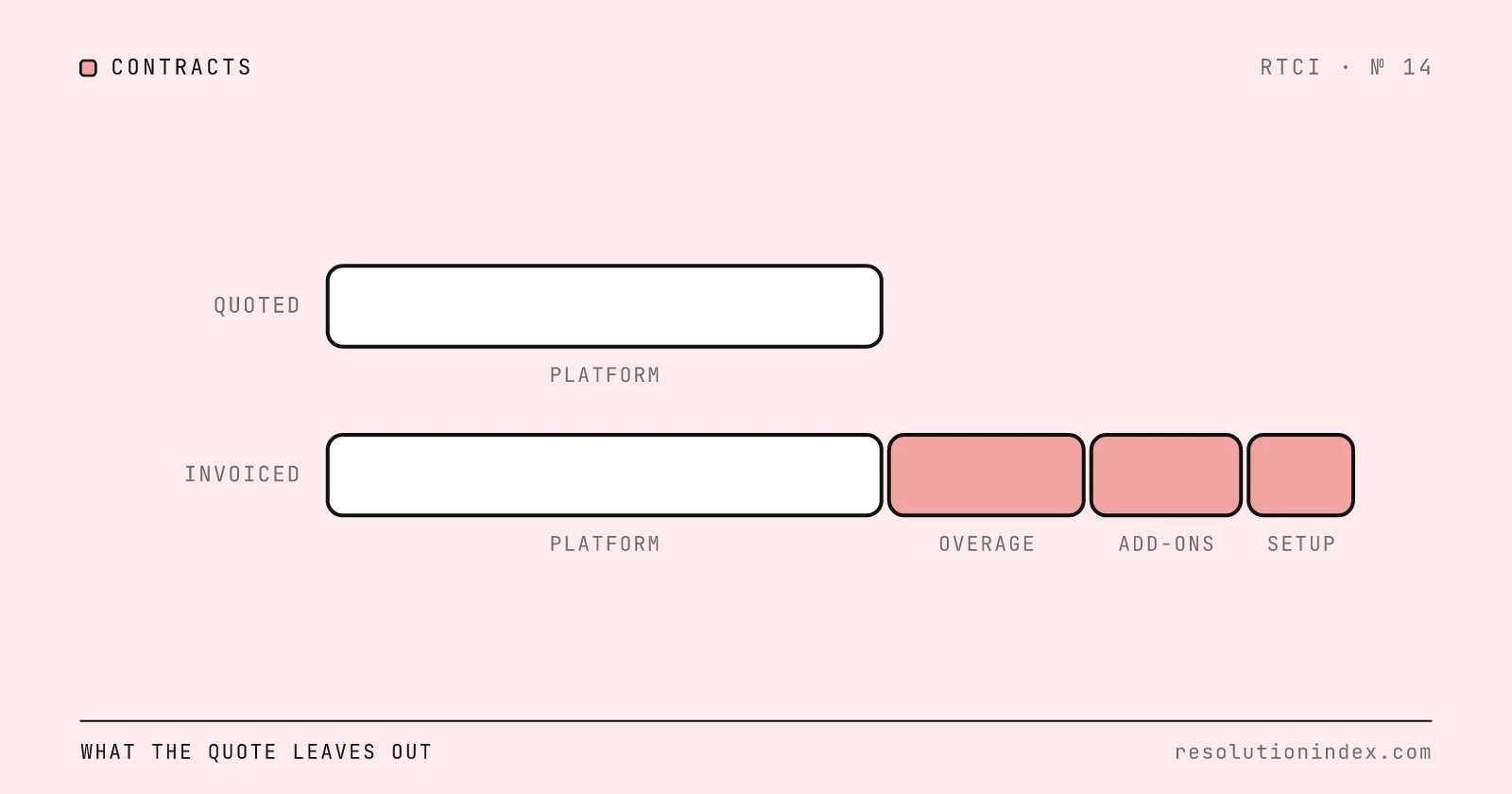
AI contracts have their own version of this list, with different items. The guide to hidden fees in AI support contracts follows the same structure, so the two can be read together when a hybrid deal is on the table.
What "per resolution" means in a BPO contract and an AI contract
Per-resolution pricing looks like the cleanest unit on both sides. The catch is that the word means a different event in each contract, and the party that counts it is usually the party that bills it.
Intercom's article on Fin AI Agent outcomes counts a confirmed resolution when the customer says the answer helped, and an assumed resolution when the customer leaves without asking for more help. It gives no time window for the assumed case.
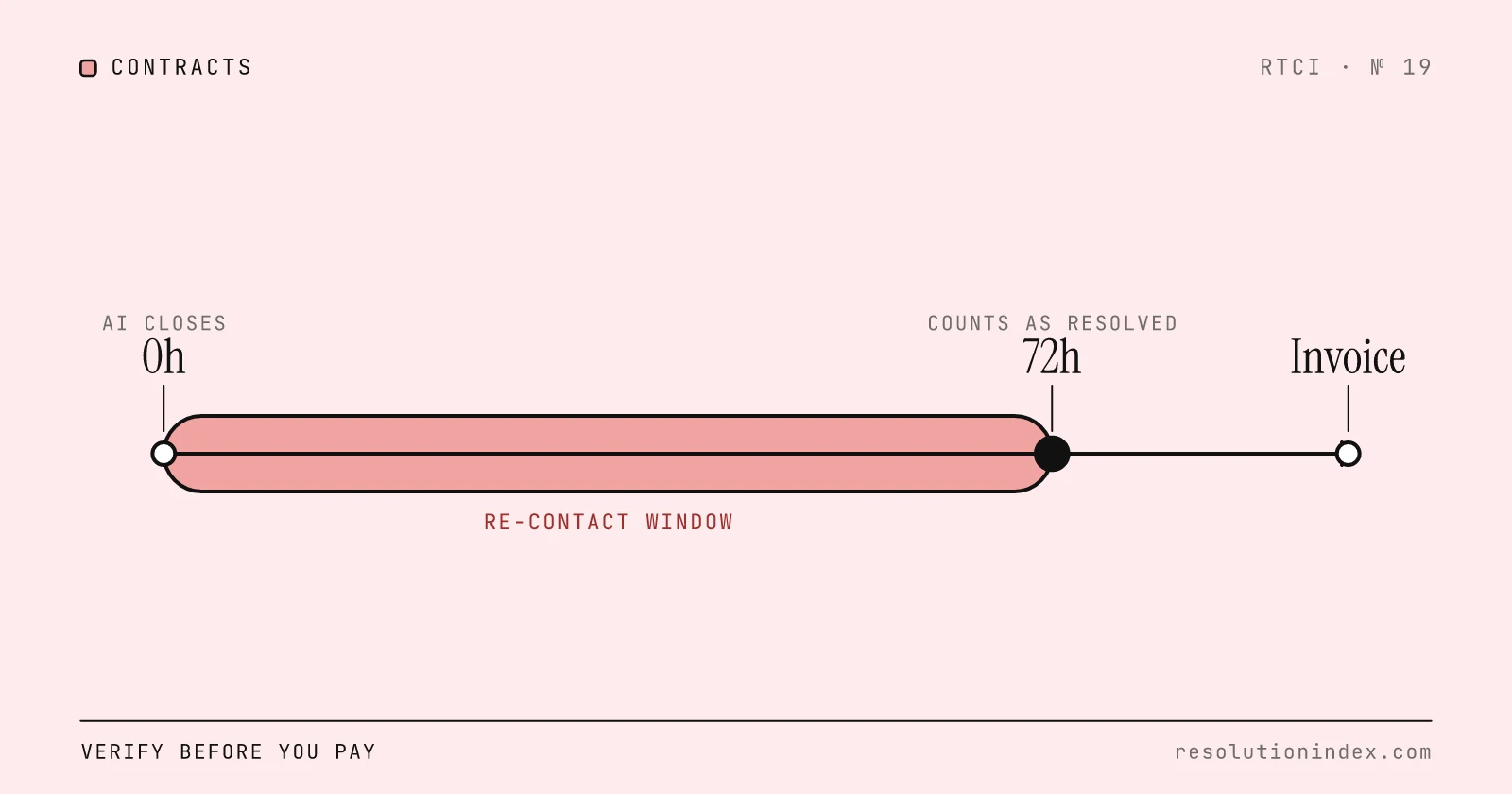
Zendesk's article on automated resolution tiers separates contained resolutions, which are not charged, from verified resolutions, which pass an LLM check and are the only tier drawn from the allowance. For messaging and email, a conversation ends 72 hours after the first message. As of November 2026, Zendesk pricing lists $2.00 per automated resolution on pay-as-you-go.
A BPO per-resolution deal needs the same three answers in writing: what counts as resolved, how long a reopen window runs, and who decides. The 72-hour rule for contracts and SLAs sets out why the window matters, and the cost per verified resolution method shows how to sample billed resolutions on either side.
Unsourced per-resolution figures also circulate. A "$1 to $7, about $4 on average" range for outsourced resolutions appears on more than one vendor blog. Crescendo's guide, one of them, says its range rests on historical pricing trends and projected inflation, with no sample named. Ask for a quote under your own definition instead.
When outsourcing still wins
The hybrid numbers favour AI on the contacts AI can close. Several kinds of work still sit better with people, and an outsourced team is often the cheapest way to staff them.
- Voice-heavy queues. Per-minute shared agents carry idle time for you, and phone contacts often need judgement mid-call.
- Regulated or high-empathy work. Complaints, collections, bereavement and medical contacts need trained people and audit trails.
- Languages your AI does not cover well. A BPO hub with native speakers can be cheaper than an in-house hire per language.
- Seasonal peaks. A contract that scales hours up for six weeks costs less than hiring and training for one season.
- The human tier behind an AI agent. Every hybrid row above still spends more on the BPO than on the AI.
Klarna shows the risk in that last point. The Klarna case study records that much of its human service sits with outsourcing partners, and that uneven quality in that outsourced tier led to repeat contacts and higher costs. A cheap escalation tier with low FCR wipes out the gain from the AI in front of it.
Limits of this comparison
The worked numbers rest on assumptions that will not match every team. Four of them matter most.
First, escalated contacts are harder than average. If the BPO's handle time on escalations is 12 minutes instead of 8, the offshore cost per resolved contact rises to $4.98, and the Fin hybrid row to $2.55 ($6,019.20 + 3,920 × $4.98 = $25,540.80).
Second, the published BPO ranges are reported by parties that sell outsourcing or tools for it. None states a sample size, and Clutch's country buckets place the US under $25 an hour while its overall average is $25 to $49.
Third, AI resolution rates vary by use case. RTCI's realistic ranges discount vendor claims, but your own pilot data should replace them before any contract is signed.
Fourth, the in-house row uses wages only. Benefits, software, management, recruiting and facilities all sit on top, so the true in-house figure is higher than $5.10.
How to decide
Ask every BPO for a quote in its own model, then convert it with your own utilisation, handle time and FCR. Do the same for the AI quote at a realistic resolution rate, and price the hybrid with escalations at the BPO's cost per resolved contact.
The decision rule: outsource when the BPO's cost per resolved contact, after hidden costs, is below your fully loaded in-house figure, and put an AI agent in front when its resolution rate is high enough that the blended cost falls below the BPO alone.
To get the in-house side right, run your numbers through the support cost per ticket calculator, which adds the overheads the wage-only row leaves out.
Frequently asked questions
How much does it cost to outsource customer service?
As of November 2026, published ranges run from about $6 to $18 an hour in India and the Philippines, $8 to $25 in Latin America and $20 to $80 onshore in the US. Clutch lists $25 to $49 an hour as the average for firms on its marketplace. None of these comes from an audited survey, so get quotes and convert them.
Is it cheaper to outsource customer service than to keep it in-house?
Often, offshore. At the BLS median US wage of $21.53 an hour, an in-house agent costs about $5.10 per resolved contact on wages alone, before benefits, tools and management. An offshore agent billed at $14 an hour costs about $3.32 on the same assumptions. An onshore BPO at $35 an hour costs more than either.
What are the pricing models for call center outsourcing?
The common models are per hour for dedicated agents, per minute for shared agents, per contact or per call, per resolution, and a fixed monthly fee per agent. They differ in who pays for idle time and who carries volume risk. Hourly and monthly models put idle time on you; per-minute and per-contact models shift it to the provider.
Are AI agents cheaper than an outsourced call center?
Per resolved contact, usually, for the contacts the AI can close. Fin lists $0.99 per outcome against $3.32 for an offshore agent in the worked example. AI does not resolve everything, though, so the realistic comparison is AI first with a smaller outsourced team behind it, which comes to $1.90 to $2.68 per resolved contact in the examples here.
How do I calculate cost per resolved contact for outsourced support?
Divide the billed hourly rate by utilisation to get the cost of a productive hour. Divide that by contacts handled per productive hour (60 divided by handle time in minutes), then divide by the first-contact resolution rate. For per-minute pricing, multiply the rate by billed minutes per contact and divide by first-contact resolution.
What hidden costs should I watch for in a BPO contract?
Minimum hours or seats, setup and training fees, ramp time for new agents, attrition that restarts that ramp, utilisation below what the contract assumes, premiums for languages, nights and regulated work, pass-through software licences, and your own time spent on QA and vendor management. Each one raises the effective hourly rate, so price it before comparing quotes.
Read next
Keep reading
Picked for this article: the pieces it cites and the ones that answer the next question buyers usually ask.
Most related
Klarna AI Customer Service Case Study: What It Claimed and What Changed (2024–2026)
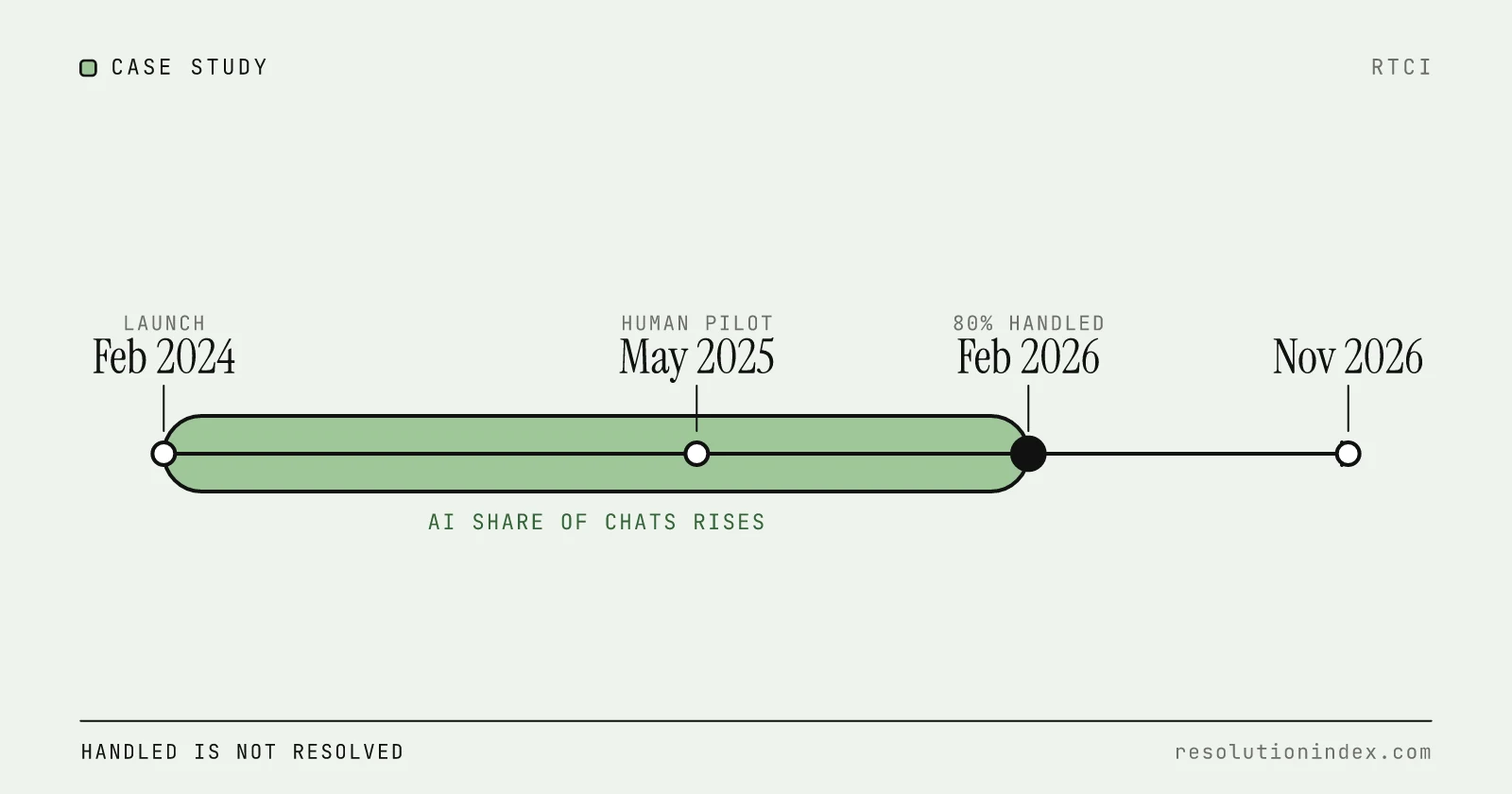
Klarna's AI assistant from the February 2024 launch to November 2026, rebuilt from its press release, SEC filings and named reporting: a sourced timeline, what "700 agents" and "80% of chats" actually measure, RTCI's re-reading of realistic resolution and cost, and whether Klarna really rehired its agents.
Cost Per Verified Resolution: A New Framework
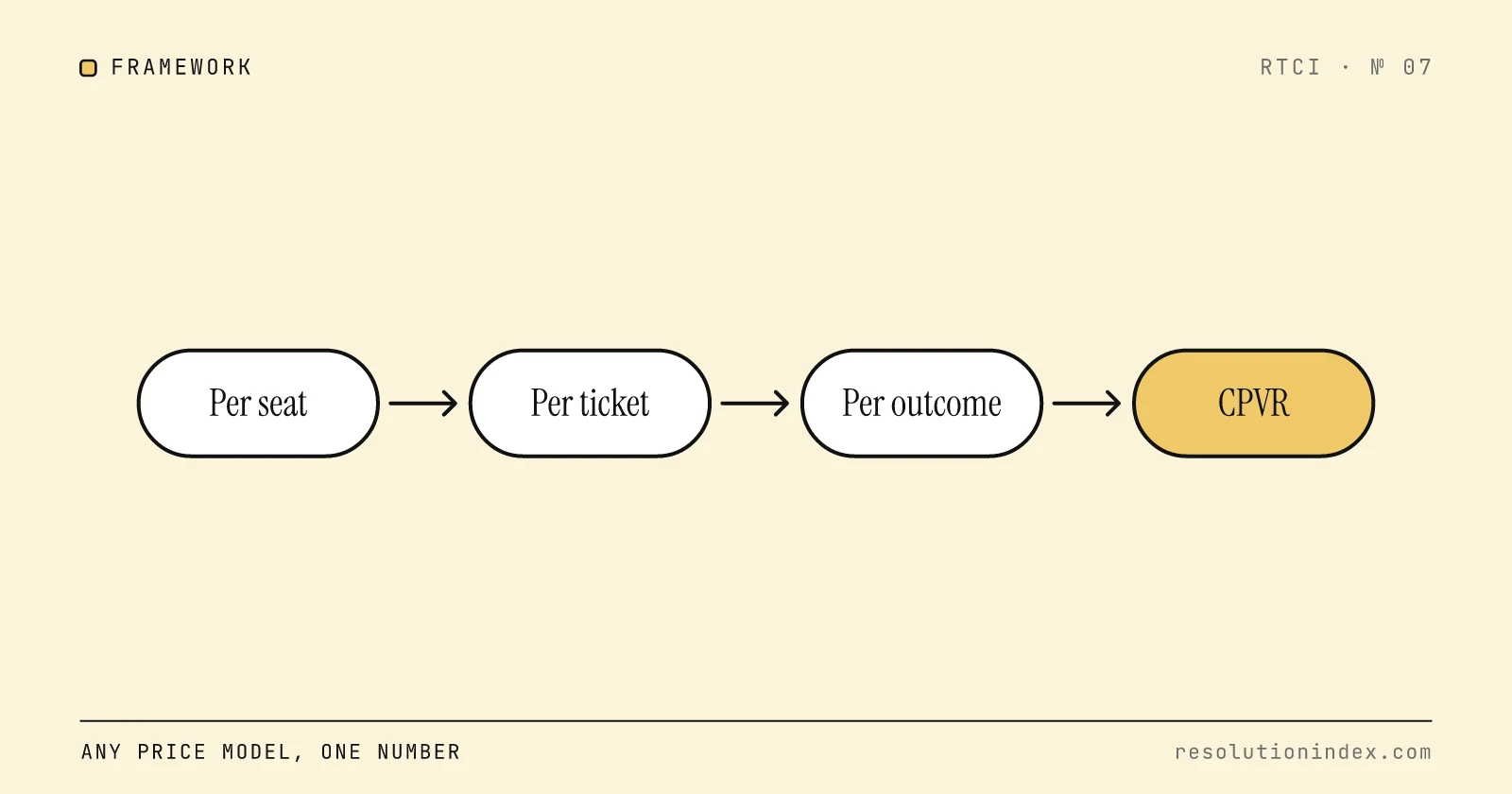
Per-seat, per-ticket, and per-resolution pricing models all produce different numbers for the same underlying cost. RTCI's three-layer cost model normalizes any vendor's pricing into a single comparable metric: cost per verified resolution.
72-Hour Verified Resolution SLA: Copy-Paste Contract Clauses
A buyer-side clause library for defining, measuring, auditing, crediting, and disputing 72-hour verified resolutions in AI support contracts.
Hidden Fees in AI Support Contracts: What Buyers Miss
Where AI support invoices outgrow the quote: second meters, overage rates, one-time allowances, add-ons, outbound channels and exit costs, with clause language and a worked 12-month reconciliation.
AI Chatbot for Customer Service: What a Resolution Costs (2026)
AI chatbot for customer service prices compared on cost per resolution as of November 2026: per conversation vs per resolution billing, worked out.