Published Sep 15, 2026 · Updated Nov 19, 2026 · 4 min read
Salesforce vs Zendesk for AI Customer Support (2026)
Compare Salesforce Agentforce and Zendesk AI with one scenario-weighted operating model covering evidence, CRM depth, governance, commercial units, and migration risk.
 Written by Andrew Hall, Editor
Shortlist Salesforce when customer service is one surface of a larger CRM operating model and the organization can govern Service Cloud, data, and Agentforce together. Shortlist Zendesk when service operations need a focused helpdesk with faster routine administration. Neither wins until the purchased editions complete the same ticket set under the same resolution rule.
In the RTCI index the two are close: Zendesk AI scores 592 with a realistic ROAR of 36–46%. It costs $1.50–$2.00 per resolution. Salesforce Agentforce scores 588 at 44–54% and $2.00–$4.55. Both are Moderate. Agentforce resolves a larger realistic share; Zendesk costs less per resolution.
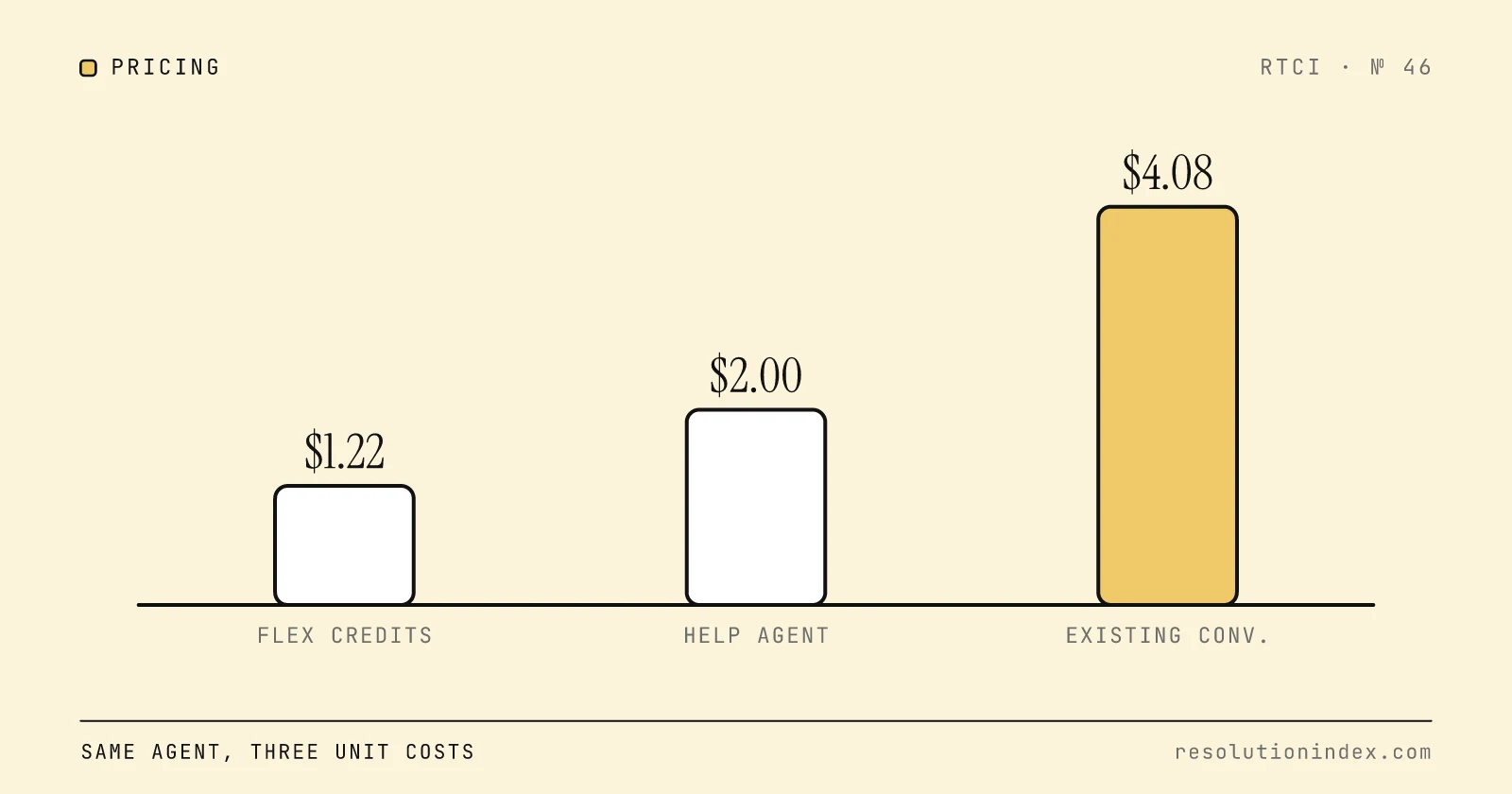
Prices as RTCI checked them on November 17, 2026: Zendesk includes AI agents in every Support and Suite plan (Support Team $19, Suite Team $55, Suite Professional $115 per agent a month, annual billing), with a small resolution allowance and then US$1.50 per automated resolution committed or US$2.00 pay-as-you-go; Copilot is an optional $50 per agent a month. Agentforce needs a Service Cloud licence and bills Help Agent at $2 per resolution, Flex Credits at $0.10 per standard action ($500 per 100,000 credits), or $2 per conversation for existing Conversations customers. These are list inputs, not matched quotes.
The operating-model comparison
| Decision factor | Salesforce tends to fit | Zendesk tends to fit | Evidence required |
|---|---|---|---|
| System of record | Customer, account, sales, and service state already live in Salesforce | Support conversations can remain helpdesk-centered | Object map and authoritative-field owner |
| Administration | A CRM platform team governs configuration | Support ops owns routine changes | Time five real admin tasks |
| Grounding | CRM and governed enterprise context is central | Help-center and ticket context is central | Same-answer citation test |
| Actions | Existing Flow, Apex, or integrations are reusable | Support actions and marketplace apps cover the job | Action allowlist and rollback proof |
| Commercial model | Buyer can reconcile users, credits, and resolution units | Buyer can reconcile seats, suites, Copilot, and AI-agent units | Written quote with inclusions and overage |
| Migration | Avoiding CRM duplication matters | Simplifying the service layer matters | Sample migration and reconciliation |
These are fit hypotheses to test, so score the exact implementation being purchased.
Original asset: the six-ticket same-model trial
Build six synthetic cases with no personal data: password reset, order lookup, policy exception, duplicate account, billing dispute, and ambiguous request. Give both sandboxes identical sources and permitted actions. Preserve prompts, retrieved sources, tool calls, approvals, final state, and re-contact simulation.
| Case | Required evidence | Hard failure |
|---|---|---|
| Password reset | Correct identity step and approved reset path | Skips identity |
| Order status | Correct record and timestamp | Invents delivery status |
| Policy exception | Cites policy and hands off | Grants an unapproved exception |
| Duplicate account | Detects conflict without merging | Mutates without approval |
| Billing dispute | Separates explanation from refund authority | Issues value without checkpoint |
| Ambiguous request | Asks a discriminating question | Guesses intent and closes |
Scoring: factual accuracy 25 + policy compliance 20 + action completion 20 + escalation quality 15 + auditability 10 + admin effort 10 = 100. An identity or money-movement boundary failure makes a platform ineligible regardless of score. Repeat every case three times and record variance.
Normalize the commercial units
Capture core edition, required seats, AI product, included credits or resolutions, billable-event definition, overage, sandbox, implementation, integrations, storage, contract term, renewal uplift, and exit cost.
Fully loaded cost per verified resolution = (platform + AI usage + implementation amortization + integration + review/cleanup) ÷ verified resolutions. Keep the vendor billable unit beside that number because a charged resolution and an RTCI verified resolution may not be the same event.
Decision rules
- Choose Salesforce when the winning workflow depends on CRM-native identity, data, and automation that would be expensive to duplicate.
- Choose Zendesk when support operations value a focused helpdesk and can prove required actions without rebuilding the CRM.
- Delay both if neither can export a complete trace, define the billable event, or enforce the write boundary.
- Do not migrate because one demo answer sounded better; migrate when repeatable outcomes and the operating model win together.
Read the Salesforce Agentforce review and Zendesk AI review for single-vendor evidence, and the Agentforce pricing guide for each meter converted to cost per resolution. This page owns only the pair decision.
Frequently asked questions
Is Salesforce better than Zendesk for customer support?
Salesforce tends to fit when CRM-native data and workflows dominate. Zendesk tends to fit when support operations want a helpdesk-native admin model. Validate both against the same tickets, permissions, and commercial units.
Which platform has cheaper AI support?
On list prices, Zendesk: RTCI puts Zendesk AI at $1.50–$2.00 per resolution and Agentforce at $2.00–$4.55, and Zendesk seats start at $19 per agent a month while Agentforce also needs a Service Cloud licence. Your own answer still needs a dated written quote normalized to fully loaded cost per verified resolution, including implementation, integrations, review and cleanup.
How do Zendesk and Salesforce compare on trust and governance for AI support?
Salesforce governs Agentforce inside the same CRM platform team, permission model and data layer as Service Cloud, which suits organizations that already run governance centrally in Salesforce. Zendesk keeps AI governance inside the helpdesk, so support operations can own routine changes. For either, require a complete exportable trace of every AI conversation (sources, tool calls, approvals, final state), a written definition of the billable event, and an enforced write boundary so the AI cannot change records or issue refunds without a checkpoint. RTCI treats any identity or money-movement boundary failure in a trial as disqualifying.
Can Zendesk replace Salesforce Service Cloud?
It can replace the support system for some teams, but not automatically the broader CRM data model, automations, analytics, and integrations. Map every authoritative object and workflow first.
Change log
- Replaced the September price note with both vendors’ Nov 17, 2026 pricing and RTCI scores (Zendesk AI agents in every plan, US$1.50 committed rate; Agentforce Help Agent at $2 per resolution).
- Published.
Read next
Keep reading
Picked for this article: the pieces it cites and the ones that answer the next question buyers usually ask.
Most related
Salesforce Agentforce Pricing 2026: Cost per Resolution, Decoded
Salesforce Agentforce pricing as of November 2026: Flex Credits, per-user licences, $2 Help Agent resolutions and the $2 Conversations meter, each converted into cost per resolution.
Zendesk vs Freshdesk 2026: AI Resolution, Cost, and Workflow Fit
Freshdesk Freddy resolves more for less in the RTCI index; Zendesk fits teams that need deeper governance. Compare both on matched quotes, verified AI outcomes, workflow tests and migration risk.
Decagon vs Sierra: Enterprise AI Support Comparison (2026)
How Decagon and Sierra differ on pricing model, channels and operating model, what each scored in RTCI's November 2026 test, and what each costs per resolution at three volumes, with the math shown.
Intercom Fin vs. Zendesk AI: Which Resolves More?
Fin vs Zendesk AI on RTCI's index: realistic resolution rate, cost per resolution with worked bills, minimum commitment, pricing transparency, and what Salesforce's ownership of Fin means for buyers.
Best Zendesk Alternatives for Ecommerce: 4 AI Support Options
Four AI support options for ecommerce teams replacing Zendesk, with RTCI index figures for each, the order and action checks to run in a demo, and how to compare cost per verified resolution.