Published Aug 6, 2026 · Updated Nov 19, 2026 · 6 min read
Intercom Fin vs. Zendesk AI: Which Resolves More?
Fin vs Zendesk AI on RTCI's index: realistic resolution rate, cost per resolution with worked bills, minimum commitment, pricing transparency, and what Salesforce's ownership of Fin means for buyers.
 Written by Andrew Hall, Editor
On RTCI's numbers, Intercom Fin resolves more. Fin's realistic 56 to 66 percent of conversations compares with 36 to 46 percent for Zendesk AI, at $0.99 per outcome against $1.50 to $2.00 per automated resolution. Fin ranks #1 of 20 in the RTCI index (score 696, Strong); Zendesk AI ranks #13 (592, Moderate). Zendesk AI still makes sense for teams already on Zendesk, because AI agents are included in every Support and Suite plan. Fin can also run on top of Zendesk, so staying on Zendesk does not rule it out.
Resolution Rate: Claimed vs. Realistic
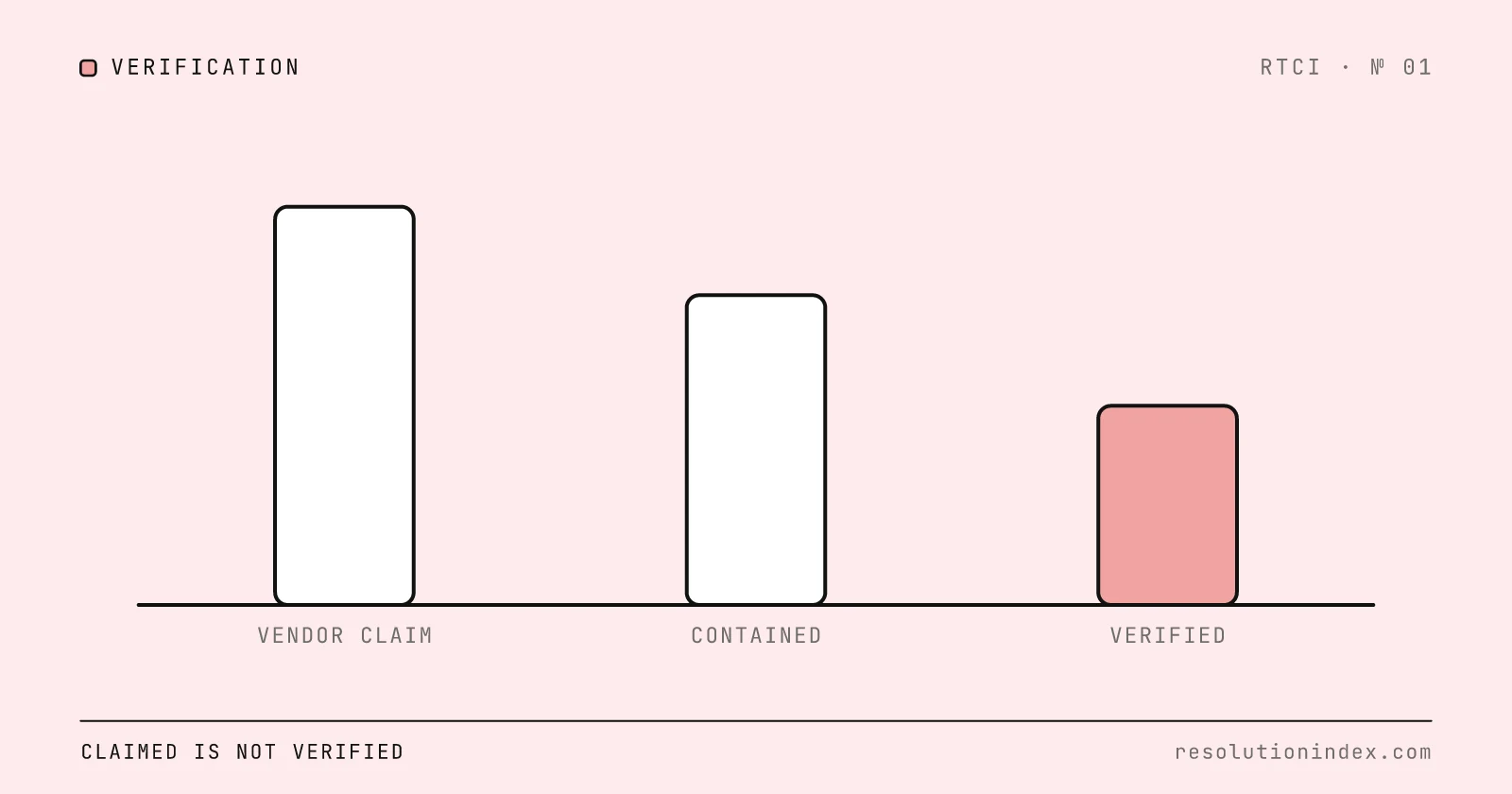
Fin claims an average resolution rate of 76 percent across more than 12,000 customers. Zendesk publishes no company-wide resolution rate; its AI agents page markets "up to 80 percent automation", which is a best case and counts automation rather than resolution. As Why Vendor-Claimed Resolution Rates Don't Match Reality explains, neither figure is comparable until its definition is attached.
RTCI converts both claims with the same published rule. Fin's 76 percent average becomes a realistic ROAR of 56 to 66 percent. Zendesk's "up to 80 percent" is discounted twice, ×0.60 because it is an "up to" figure and ×0.85 because it counts automation: 80 × 0.60 × 0.85 = 40.8 percent, a realistic range of 36 to 46 percent.
Zendesk's named customers report more. Its AI agents page cites Action Property Management at an 80 percent automated resolution rate and TeamSystem at 80 percent email automation. Those are selected case studies, so RTCI does not treat them as the typical first deployment.
Fin's realistic floor (56 percent) sits 10 points above Zendesk AI's realistic ceiling (46 percent). One billing detail runs the other way: Zendesk bills only Verified resolutions, while Fin's $0.99 outcome also covers Procedure handoffs, disqualifications and self-serve routings, so not every Fin charge is a resolution.
Cost Per Verified Resolution
The two products bill different events. Fin charges $0.99 per outcome. On Intercom you also pay helpdesk seats (Essential from $19 per seat a month, Advanced $85, Expert $132); on another helpdesk there are no seats, but a 50-outcome monthly minimum applies.
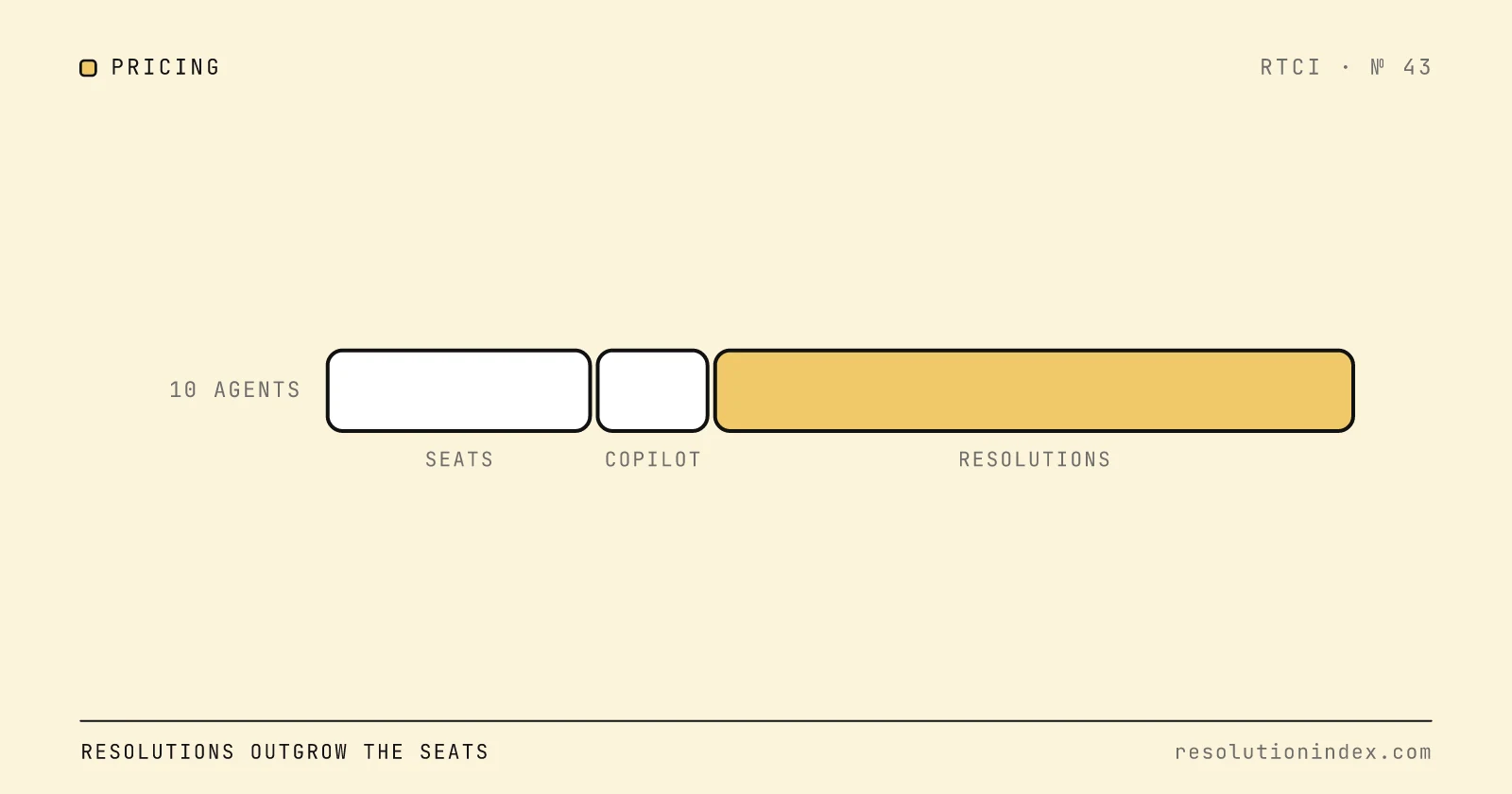
Zendesk AI agents are included in every Support and Suite plan (Support Team $19, Suite Team $55, Suite Professional $115 per agent a month, billed annually). Each plan includes a small allowance of automated resolutions: 5 per agent a month on Support Team and Suite Team, 10 on Suite Professional. Additional resolutions cost US$1.50 at the committed rate or US$2.00 pay-as-you-go. Copilot, the agent-assist add-on, is optional at $50 per agent a month on Professional and higher.
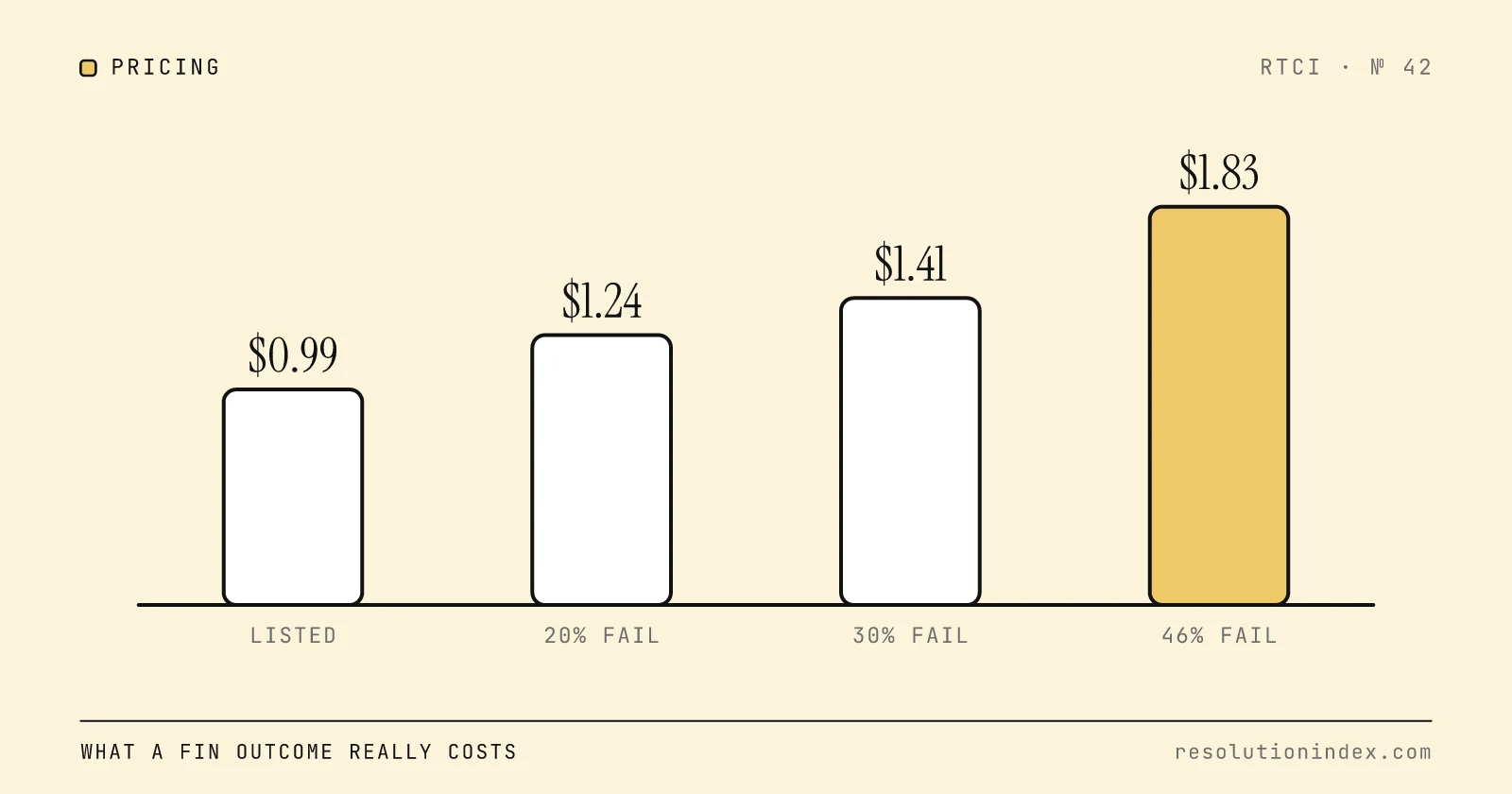
Worked example: 10,000 tickets a month, 20 agents. Assume Fin resolves 60 percent and Zendesk AI resolves 40 percent, both inside RTCI's realistic ranges. Fin bills 6,000 outcomes × $0.99 = $5,940, plus 20 Intercom Essential seats × $19 = $380, for $6,320, about $1.05 per resolution. Zendesk Suite Professional with Copilot costs 20 × ($115 + $50) = $3,300 in seats. The plan includes 20 × 10 = 200 resolutions, and the other 3,800 of its 4,000 cost $5,700 at $1.50 or $7,600 at $2.00, for $9,000 to $10,900, about $2.25 to $2.73 per resolution. Without Copilot, subtract $1,000. Zendesk also leaves 2,000 more tickets for the human team in this example.
Worked example: 500 AI resolutions a month, 5 agents. Zendesk Suite Professional costs 5 × $115 = $575, includes 50 resolutions, and bills the other 450 × $1.50 = $675, for $1,250 or $2.50 per resolution; with Copilot it is $1,500 or $3.00. Fin on Intercom costs 5 Essential seats × $19 = $95 plus 500 × $0.99 = $495, for $590 or $1.18 per resolution. On Advanced seats at $85 it is $920, or $1.84.
Both bills rise with every resolution above the allowance. What differs is the rate per resolution and how much seat cost sits underneath it. Use the Cost Per Verified Resolution Calculator with your own volume, agent count and resolution rate.
Minimum Commitment and Pricing Transparency
Fin's entry cost is one Intercom seat, or the 50-outcome monthly minimum on another helpdesk ($49.50 at $0.99). Zendesk AI needs a Zendesk Support or Suite plan: from $19 per agent a month on Support Team, or $55 on Suite Team, billed annually.
RTCI rates Fin's pricing transparency 4 of 5 and Zendesk AI's 2 of 5. Fin publishes its per-outcome rate, the outcome definition, seat prices and the off-Intercom minimum; Fin Voice is custom-priced. Zendesk lists the US$1.50 committed and US$2.00 pay-as-you-go rates on its pricing page, but Suite Enterprise is quote-only, and Zendesk's help center describes a different, dollar-based resolution allowance that pays for resolution tiers whose prices it does not publish. Ask Zendesk which allowance model your order form uses.
Ecosystem and Integration Fit
Fin runs on Intercom's helpdesk or on top of another helpdesk such as Zendesk or Salesforce. Zendesk AI runs only inside Zendesk Support or Suite, alongside Copilot, intelligent triage and QA scoring, each with its own billing unit.
That gives existing Zendesk customers three options: Zendesk's own AI agents, Fin layered on Zendesk at $0.99 per outcome, or a move to Intercom. For teams on another helpdesk, adopting Zendesk AI means moving the whole support operation to Zendesk first; adopting Fin does not.
Zendesk's advantage is depth. The AI shares the helpdesk's tickets, reporting and agent workflows, so there is less integration work, with tighter lock-in as the trade.
Strengths and Weaknesses
Intercom Fin strengths: the higher realistic ROAR (56 to 66 percent); a single published rate of $0.99 per outcome; a low entry cost of one Intercom seat or 50 outcomes a month; and it runs on Zendesk or Salesforce without replatforming.
Intercom Fin weaknesses: an outcome is broader than a resolution, so the effective cost per true resolution can sit above $0.99. On Intercom every agent needs a seat, and the Essential seat price moved between $19 and $29 several times between August and October 2026. HubSpot Breeze lists $0.50 per resolution for a similar realistic ROAR. Salesforce has owned Fin since September 10, 2026, so packaging decisions now sit with Salesforce.
Zendesk AI strengths: no migration for existing Zendesk customers, and AI agents come in every plan with a small resolution allowance. Only Verified resolutions are billed, so contained-but-unverified conversations cost nothing. Mature governance, a sandbox and a 1,800+ app marketplace.
Zendesk AI weaknesses: a realistic ROAR of 36 to 46 percent at $1.50 to $2.00 per resolution. Copilot and QA are separate add-ons. Since May 18, 2026, Zendesk's AR% counts Contained plus Verified outcomes while only Verified are billed, so the reported automation rate is not the billed resolution rate. Teams not already on Zendesk face a platform migration before the AI is available.
Who Should Choose Which
Choose Fin if you are on Intercom, or on another helpdesk and want an AI agent without replatforming. Its higher realistic ROAR and $0.99 rate gave the lower cost per resolution in both worked examples above.
Choose Zendesk AI if you are already on Zendesk and want AI agents that are already in your plan, with native governance and reporting. Price Fin on top of Zendesk as well before deciding, because it does not require leaving Zendesk.
Do not decide on claimed rates. What Is a Good AI Resolution Rate? treats 45 to 70 percent as a good realistic rate. Fin's range sits in the upper half of that band; Zendesk AI's sits below it.
The Acquisition Factor
Salesforce signed a definitive agreement to acquire Fin (formerly Intercom) for approximately $3.6 billion, announced on June 15, 2026, and completed the acquisition on September 10, 2026, ahead of the fiscal Q4 2027 close it first expected. Fin now sits within Salesforce's AI Labs alongside Agentforce.
Salesforce's completion announcement made no pricing statement, and as of November 2026 Fin's published price is still $0.99 per outcome. If you sign a multi-year term, write rate caps and exit rights into the contract, because packaging decisions now sit with Salesforce.
Summary Verdict
Fin wins on realistic ROAR (56 to 66 percent vs. 36 to 46 percent), cost per resolution ($0.99 vs. $1.50 to $2.00), pricing transparency (4 of 5 vs. 2 of 5) and entry cost. Zendesk AI wins for teams already on Zendesk who want AI included in the plan they pay for, native governance, and no new vendor.
Read RTCI's full reviews of Intercom Fin and Zendesk AI for the method behind these numbers, and the Zendesk pricing guide and Intercom pricing guide for each plan's full bill.
How RTCI calculates these numbers
- Realistic resolution rate. Each vendor’s published claim is discounted by one fixed rule for every vendor, with an extra discount when the figure measures deflection rather than resolution.
- Cost per resolution. Per-session and per-conversation prices are divided by that realistic rate, because failed attempts are billed too. Mandatory platform fees are spread over 2,000 to 4,000 resolutions a month.
- Prices. Every price links to the vendor’s own page as of the date shown. Costs marked ~ or est. are RTCI estimates for vendors that publish no per-unit price.
Change log
- Removed unsourced third-party benchmark, Agentforce revenue and customer-count figures; Zendesk pricing matched to the Nov 17 pricing page (AI agents in every plan, US$1.50 committed rate published); worked bills recalculated with included allowances.
- Vendor claims corrected: Fin's 76% average and Zendesk's "up to 80% automation". Fin seat price in the worked example updated to $19.
- Figures aligned with the November 2026 index rescore.
- Fin pricing corrected: $0.99 per outcome, with a seat or 50-outcome minimum.
- Published.
Read next
Keep reading
Picked for this article: the pieces it cites and the ones that answer the next question buyers usually ask.
Most related
Intercom Pricing 2026: What Fin Really Costs Per Resolution
Intercom pricing as of November 2026: seats from $29, Fin at $0.99 per outcome, the add-ons, and a worked cost per resolution for three team sizes.
Zendesk Pricing 2026: Plans, AI Agents and Resolution Costs
Zendesk pricing as of November 2026: plans from $19 per agent, AI agents billed per automated resolution, the May 2026 tier change, and worked monthly bills.
AI Resolution Rates: Why Vendor Claims Are Often Inflated
See how AI support vendors blur resolution, containment and deflection, how RTCI discounts each claim, and the five questions to ask before you compare two rates.
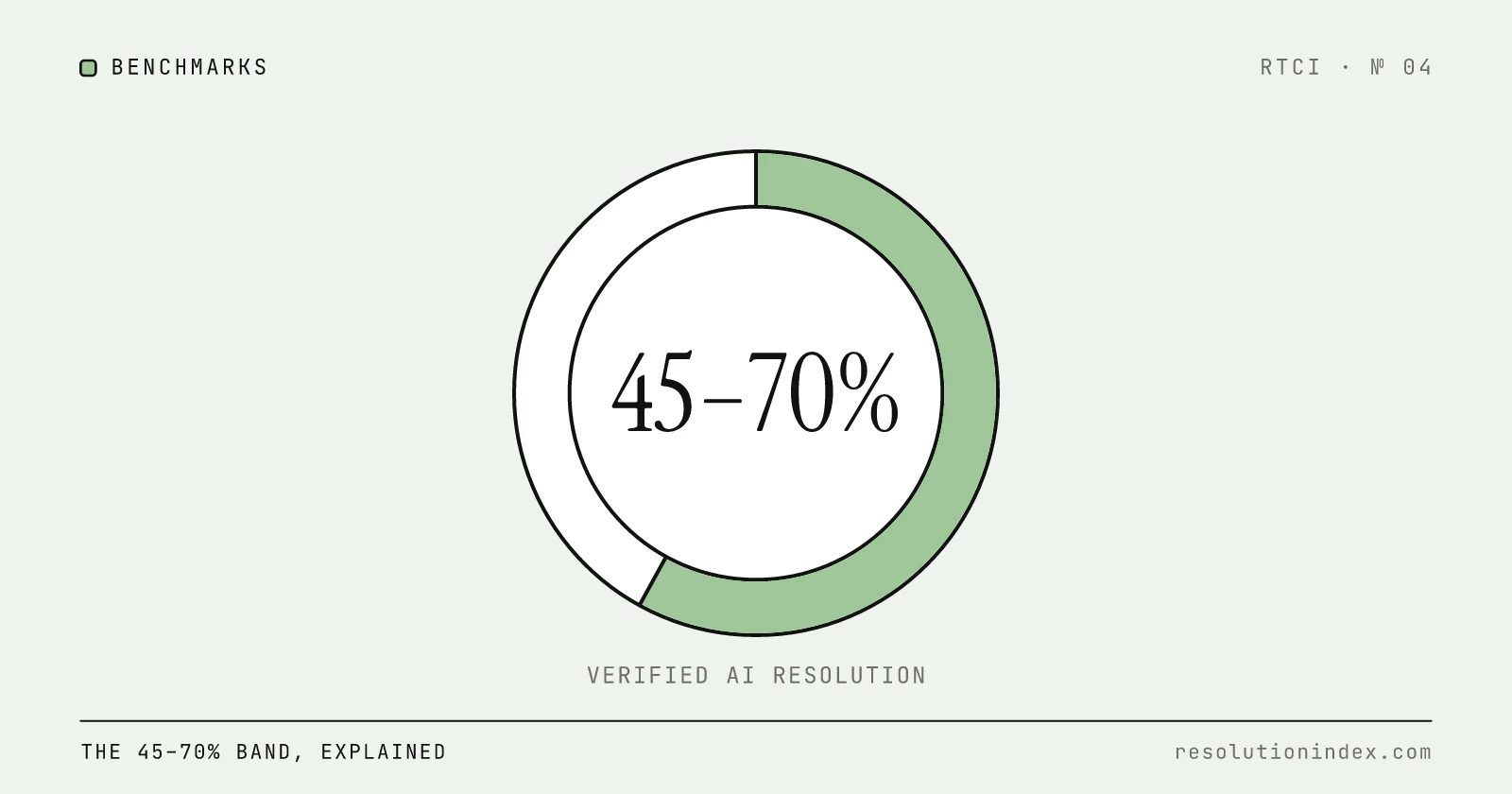
Good AI Resolution Rate: 2026 Benchmarks (45–70%)
A 45–70% realistic AI resolution rate is good for most support teams; above 70% is excellent. 13 of the 20 platforms in RTCI's index land in that band, and the median is 58%.
Intercom Fin vs Gorgias AI for Ecommerce
Intercom Fin vs Gorgias AI on RTCI numbers: realistic resolution rates, what each one bills, a worked cost comparison, an ecommerce scorecard and a two-week pilot plan.