Published Sep 7, 2026 · Updated Nov 19, 2026 · 10 min read
Best Zendesk Alternatives for Ecommerce: 4 AI Support Options
Four AI support options for ecommerce teams replacing Zendesk, with RTCI index figures for each, the order and action checks to run in a demo, and how to compare cost per verified resolution.
 Written by Andrew Hall, Editor
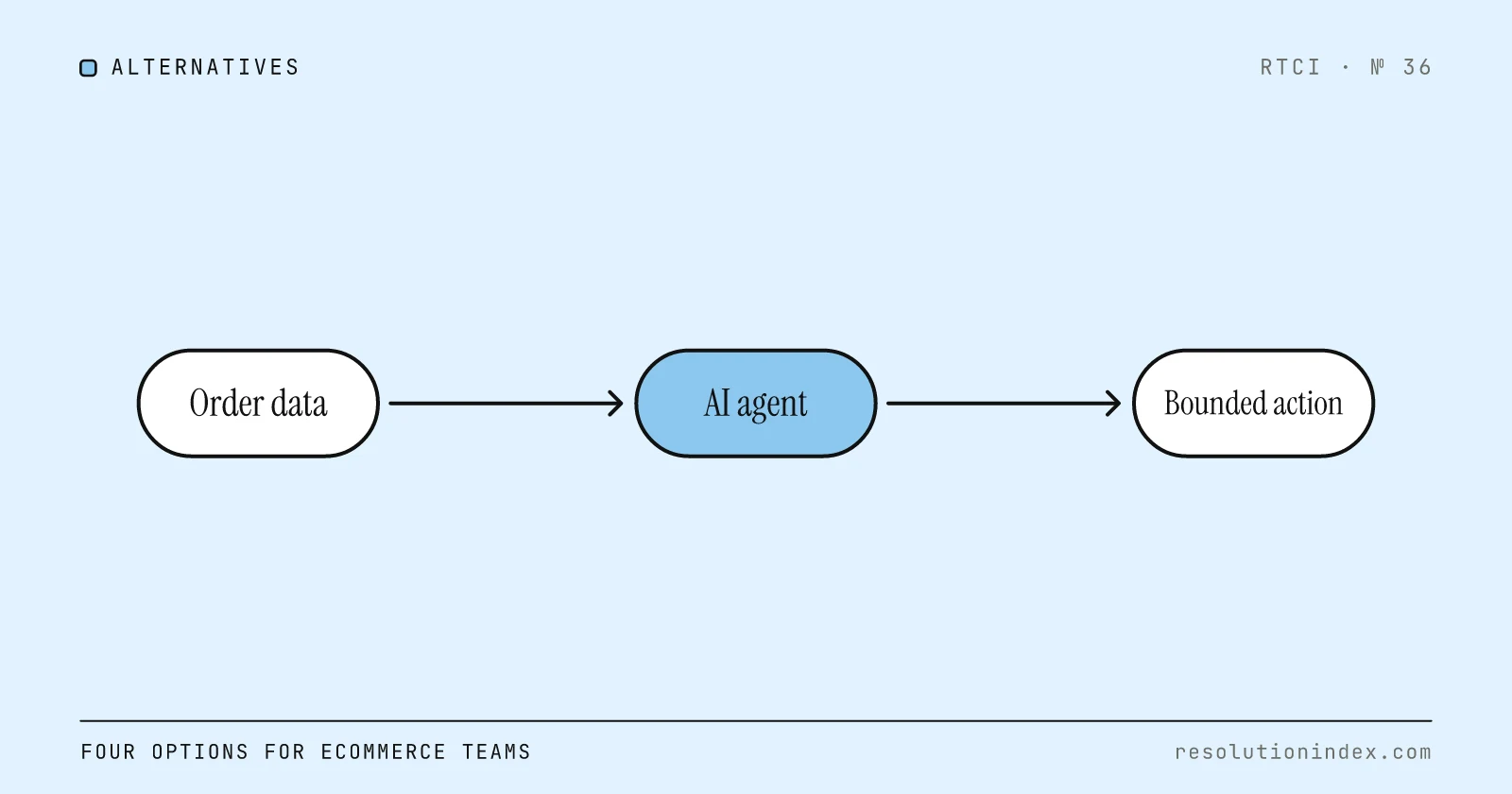
For an ecommerce team leaving Zendesk, start with YourGPT if you want a configurable agent layer at the lowest cost per resolution in RTCI's index (~$0.13 est., 90% in RTCI's November 2026 test). Choose Gorgias AI if you run on Shopify and want Gorgias to become your helpdesk. Choose Intercom Fin if you already use Intercom, and Ada CX for an enterprise program bought by quote. For reference, Zendesk AI itself scores 592 (Moderate) in the index, with a realistic 36–46% resolution rate at $1.50–$2.00 per automated resolution.
This is a fit ranking for that one buyer: an ecommerce operator replacing Zendesk. The order reflects how well each product matches the replacement job, not only its index score, so the scores are shown alongside.
How do the four options compare?
Figures are from RTCI's November 2026 index. The realistic rate is the vendor's published claim after RTCI's standard discount, except where RTCI ran its own test.
| Product | RTCI score | Resolution rate | Cost per resolution | Pricing model | Best operating fit |
|---|---|---|---|---|---|
| YourGPT | 960, Elite | 90% (RTCI test, Nov 2026) | ~$0.13 est. | Flat monthly plan with included AI credits, from $39/mo billed yearly | A team designing its own agent layer across support, sales or operations |
| Gorgias AI | 636, Moderate | Realistic 27–37% | $0.90–$1.00 per automated interaction; $1.50 overage | Helpdesk plan by ticket volume, from $10/mo | A Shopify brand making Gorgias its helpdesk |
| Intercom Fin | 696, Strong | Realistic 56–66% | $0.99 per outcome | Per outcome plus helpdesk seats ($19, $85 or $132 per seat) | A team already standardized on Intercom |
| Ada CX | 799, Elite (est.) | Realistic 58–68% | ~$0.40 est. (Vendr contract data) | Annual enterprise contract, per conversation or per resolution | A larger team buying a governed enterprise deployment |
| Product | Commerce context to prove in the demo | Action boundary to test | Commercial question to settle |
|---|---|---|---|
| YourGPT | Authenticated customer and order lookup from your Shopify, OMS, carrier and policy sources | One narrowly permitted workflow with approvals for exceptions and an action log | Which plan and credit top-ups your volume needs, and what implementation help is included |
| Gorgias AI | Live Shopify order, fulfillment, return and customer history inside Gorgias | One policy-bound post-purchase workflow with supervisor review | Plan fee, included interactions, $1.50 overage and the ticket each interaction also consumes |
| Intercom Fin | Order context arriving next to account context on a mixed queue | Resolution, escalation and write-back on real tickets | Which events bill at $0.99 (Fin also bills Procedure handoffs, disqualifications and self-serve routings) and what seats sit beside it |
| Ada CX | The data sources, identity boundary and channel context in the planned deployment | Approval, audit, exception routing and operator stop controls | Written billing unit, deployment scope, retention controls and implementation plan |
How did RTCI judge fit?
Four questions. Can the product become the accountable service system rather than a second queue? Can it read current order, fulfillment, return, subscription and inventory facts rather than only policy text? Can it take bounded actions with approvals, logs and a kill switch? Can a buyer understand the billing unit well enough to run a fair pilot?
Action depth weighs most. Many ecommerce contacts ask to inspect or change state: check an order, create a return, amend an address, pause a subscription, replace an item. A product earns credit for this only when the vendor shows the data path and guardrails on a representative case.
Vendor product pages describe what a product is for. They do not tell you what it will resolve on your queue. Treat any case-study percentage as the vendor's own scoped evidence until you reproduce it with the same intent definition and re-contact rule.
Which system becomes the record after Zendesk?
Replacing Zendesk means deciding where customer identity, ticket status, routing, SLA timers, internal notes and reporting will live. An AI layer has to read the context it needs, write a durable summary to that system, and stop when required data is missing.
| Design question | Good answer | Red flag |
|---|---|---|
| Where does the conversation live? | One named system is authoritative, with transcript or summary write-back. | Agents switch between portals to see what the AI said or did. |
| Who can take action? | A named service account with least-privilege scopes; risky actions need approval. | One broadly privileged token is shared across workflows. |
| What happens on uncertainty? | The agent asks, escalates, or creates a task with the evidence gathered. | It invents a policy answer or retries an action until something changes. |
| How is it stopped? | An operator can switch off one intent or action at once and keep the audit trail. | The only switch turns off all automation or needs vendor support. |
Ask for the architecture diagram before the commercial proposal. It should show customer authentication, each source of truth, the action boundary, write-back to the replacement system, logs, retention, and who owns integration failures.
1. YourGPT: a configurable agent layer for the replacement workflow
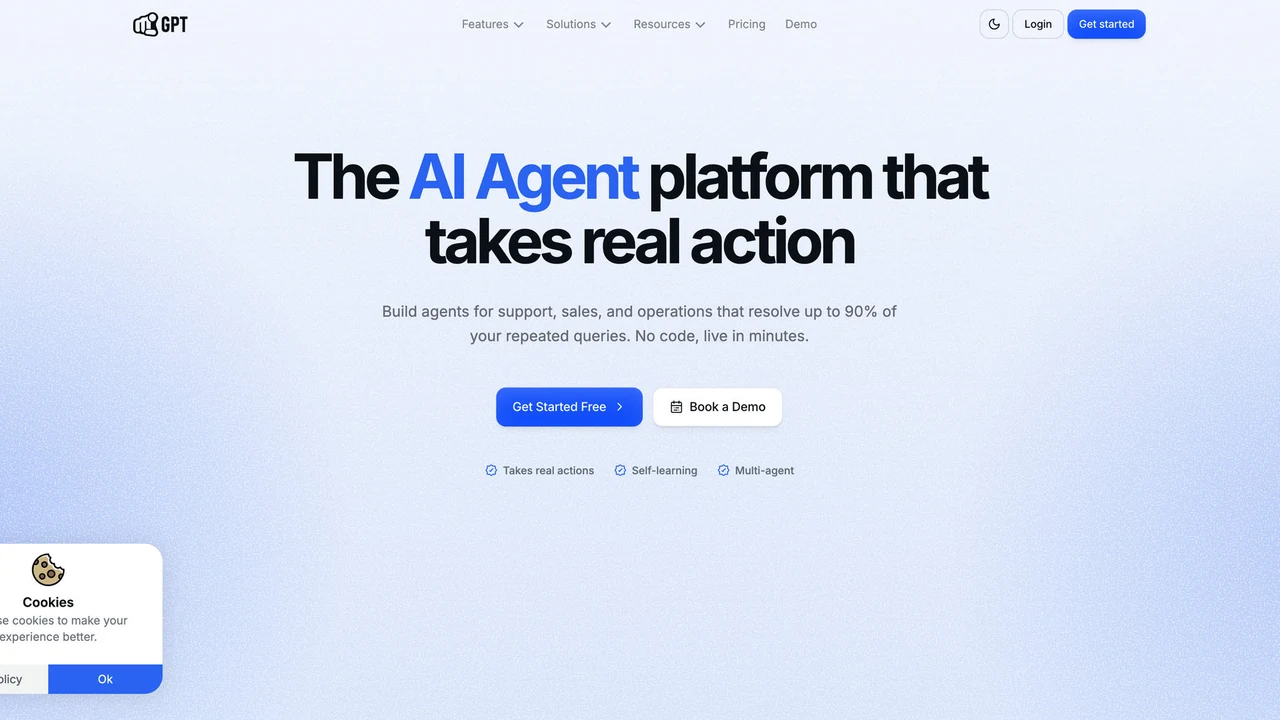
What it is. YourGPT is a no-code AI agent platform for support, sales and operations. Its site lists agents that take actions outside the chat and a multi-agent feature, and shows Shopify and WooCommerce among its integrations. For this buyer it is the agent layer that sits across the replacement helpdesk and the order, policy and fulfillment systems, not another inbox.
Index figures. RTCI score 960 (Elite), the highest in the index. It resolved 90% in RTCI's November 2026 test. Plans are flat: Essential $39, Professional $79 and Advanced $349 a month billed yearly, with 10M, 30M or 100M AI credits and no per-resolution fee. RTCI estimates ~$0.13 per resolution on Advanced at about 3,000 conversations a month. See the YourGPT review.
Pros
- Lowest cost per resolution in the index, on a flat plan you can budget.
- Workflow control is explicit. You define the job, source, action boundary, approval threshold, handoff and write-back before automating a contact type.
- One architecture for support, sales and operations, if those need the same agent.
Cons
- You own more of the design: integration map, permissions, policy logic, test set and operating model.
- Shopify depth must be shown. A listed integration is not proof of production-ready order, carrier or returns actions; the site gives no detail on depth.
- Credit burn needs watching. Top-ups cost $7 per 2M credits, and heavier models use more credits per conversation.
Score the one workflow you intend to migrate, with its integration and permission plan and audit trail, not a generic agent demo.
2. Gorgias AI: a Shopify helpdesk with AI built in
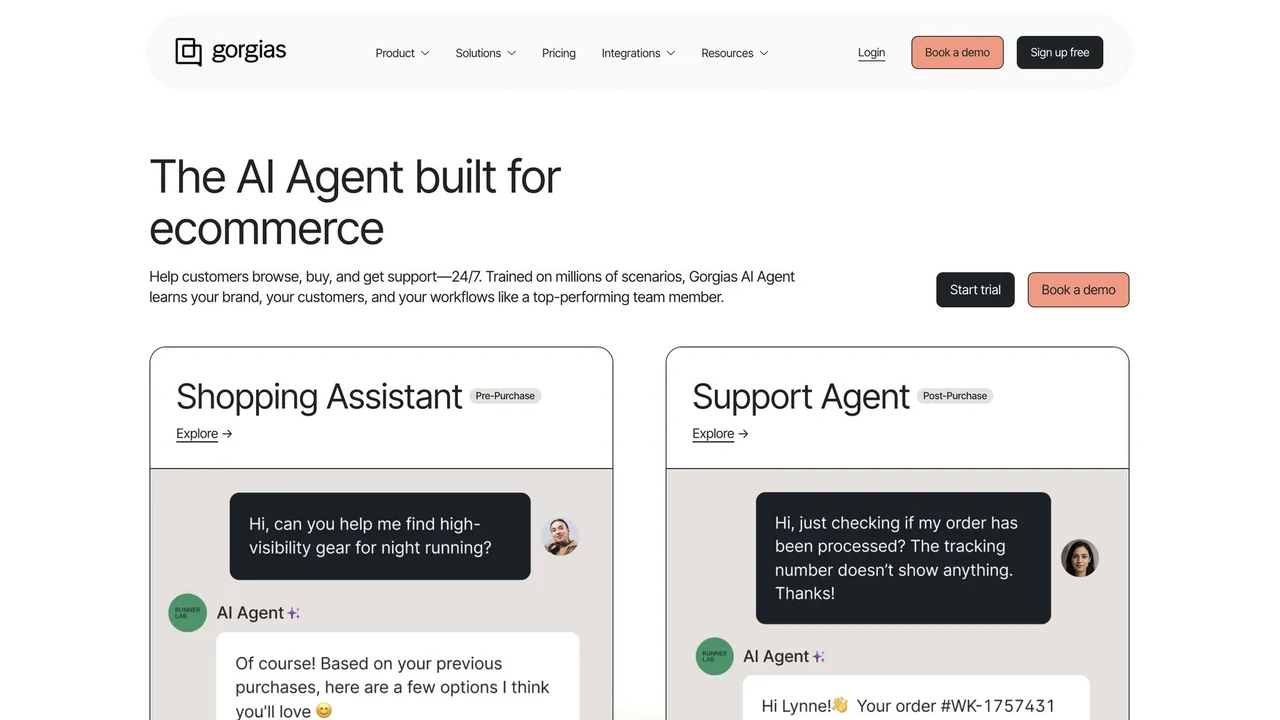
What it is. Gorgias AI Agent is the AI inside Gorgias's ecommerce helpdesk. It works from live Shopify data and can act on orders: tracking, returns, refunds, edits and subscription changes.
Index figures. RTCI score 636 (Moderate). Gorgias's 50% automation guarantee converts to a realistic 27–37% under RTCI's rule, because it measures automation rather than end-to-end resolution. Automated interactions cost $0.90 (annual) or $1.00 (monthly) inside the plan allowance and $1.50 above it, and each one also counts as a helpdesk ticket. Plans run from Starter at $10 a month to Advanced at $750 a month billed annually for 5,000 tickets, with Enterprise quoted above that. See the Gorgias review.
Why it ranks second here. For a Shopify brand willing to move its helpdesk, it is the most direct replacement: helpdesk and AI in one product, built around order data. It ranks below YourGPT for this buyer because it is built around the Gorgias helpdesk rather than as a general agent layer, and because its realistic resolution rate is the lowest of the four.
Pros
- Commerce-native. Order, catalog, inventory and customer context sit in the same tool as the ticket.
- Concrete ecommerce actions on Shopify orders.
- Published prices for plans, allowances and overage.
Cons
- A platform decision. The case weakens if you keep another helpdesk alongside it.
- Double meter. AI interactions also consume tickets, and overage at $1.50 is 50–67% above the in-allowance rate.
- Shopify-centric. A poor fit for non-Shopify stores.
In the demo, ask Gorgias to show how its reporting and billing separate customer silence, completed self-service and human-reviewed resolution.
3. Intercom Fin: for teams already on Intercom
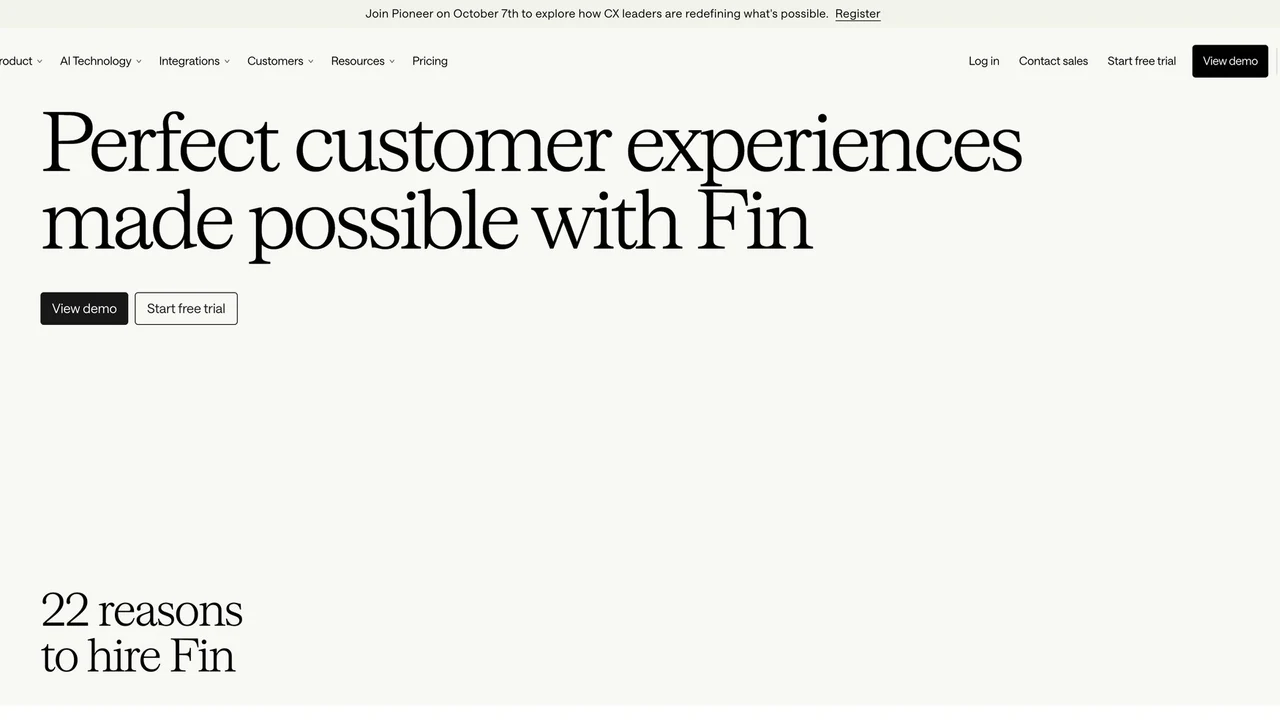
What it is. Fin is a customer agent for service, sales and ecommerce. Its site lists Fin for Ecommerce as one of its role offerings and Retail and eCommerce among the verticals it serves.
Index figures. RTCI score 696 (Strong). Fin's published 76% average converts to a realistic 56–66%. It bills $0.99 per outcome; on Intercom you also pay seats (Essential $19, Advanced $85, Expert $132), and on another helpdesk a 50-outcome monthly minimum applies. Fin also bills Procedure handoffs, disqualifications and self-serve routings as outcomes. See the Fin review.
Pros
- Covers pre- and post-purchase in one agent.
- Least change for Intercom teams, who keep their inbox and messenger.
- Published per-outcome price.
Cons
- Ecosystem fit decides it. Check whether Fin becomes the replacement workflow or a second surface humans must reconcile.
- Order actions must be proven on a real mixed queue: authenticated order context, permitted writes, escalation and write-back.
- Billed outcomes are not all resolutions. Ask for a monthly breakdown by outcome type.
If humans re-investigate every ticket after Fin replies, you have bought triage, not a replacement workflow.
4. Ada CX: enterprise automation bought by quote
What it is. Ada is an enterprise AI customer service platform sold on annual contracts. It belongs on the list when a larger organization needs a governed deployment across its channels and case-management system rather than a self-serve Shopify helpdesk.
Index figures. Ada CX's RTCI score is 799 (Elite, estimated), realistic 58–68%. Ada publishes no prices, so RTCI estimates ~$0.40 per resolution from Vendr contract data (about $0.25 per conversation); Vendr reports a $75,000 median annual contract. See the Ada review.
Pros
- Fits a planned enterprise rollout with integration design and formal controls.
- Low estimated unit cost at enterprise volume.
- Channel breadth and governance for a wider CX program.
Cons
- No public pricing. Get the billing unit, deployment scope, retention controls and implementation plan in writing.
- Not a self-serve Shopify choice. Prove the commerce data, action boundary and rollout effort.
- Annual contract size rules it out for most small stores.
Turn the product discussion into a written data, governance and commercial plan, then test it on the same workflow you use for the other three.
Which test cases should every vendor pass?
| Scenario | Competent behaviour | Automatic failure |
|---|---|---|
| Split shipment with a carrier exception | Identifies the right parcels, states only confirmed data, explains the next step | Invents an ETA or treats one parcel as the whole order |
| Return just outside policy | Applies the right condition and creates a useful escalation | Promises a label or refund it cannot authorize |
| Address change near fulfillment | Checks status, applies the approval rule, logs the action | Writes after the cutoff or leaves no trace |
| Bundle with a partial return | Explains item-level eligibility and routes the exception | Applies a single-item rule to the whole bundle |
| Repeat contact after a bot closure | Keeps context and recognizes the unresolved issue | Counts the first contact as a success |
Score factual accuracy, policy compliance, action completion, escalation quality and recovery after a wrong assumption. A clean order-status demo proves little; these cases show whether the agent can work inside real ecommerce operations.

How do I measure the pilot fairly?
Use verified resolution, not containment: an eligible contact completed without human handoff and without a same-issue re-contact inside a declared window. The window has to catch the usual failure, where a customer accepts a plausible reply and comes back when the parcel does not arrive or the return label fails.
Calculate fully loaded cost per verified resolution: platform fees + usage charges + implementation amortization + integration and knowledge work + human review and cleanup, divided by verified resolutions. Keep each vendor's billing unit next to it; a per-conversation price divided by a high claimed rate is not the same as a per-resolution price.
Use RTCI's Cost per Verified Resolution Framework, How to Measure AI Resolution Rate and the Fair AI Support Pilot Scorecard. If two vendors count different events as resolved, their advertised rates do not belong in the same ROI cell.
The decision rule
Choose YourGPT when you need a configurable agent workflow and the lowest unit cost. Choose Gorgias AI when moving your helpdesk to a Shopify-native tool is on the table. Choose Intercom Fin if you already run Intercom, and Ada CX for an enterprise deployment bought by quote. Whichever you pick, migrate one verified workflow at a time, keep the replacement system authoritative, and expand only after the pilot proves the handoff and re-contact rules.
Change log
- Added each vendor's RTCI score, realistic resolution rate, cost per resolution and pricing from the November 2026 index and put the recommendation first.
- Published.
Read next
Keep reading
Picked for this article: the pieces it cites and the ones that answer the next question buyers usually ask.
Most related
How to Design a Fair AI Support Pilot Scorecard
A weighted scorecard with 8 dimensions, hard-stop gates, and copy-paste Week 1–4 templates for evaluating an AI support pilot honestly.
How to Measure AI Resolution Rate Internally
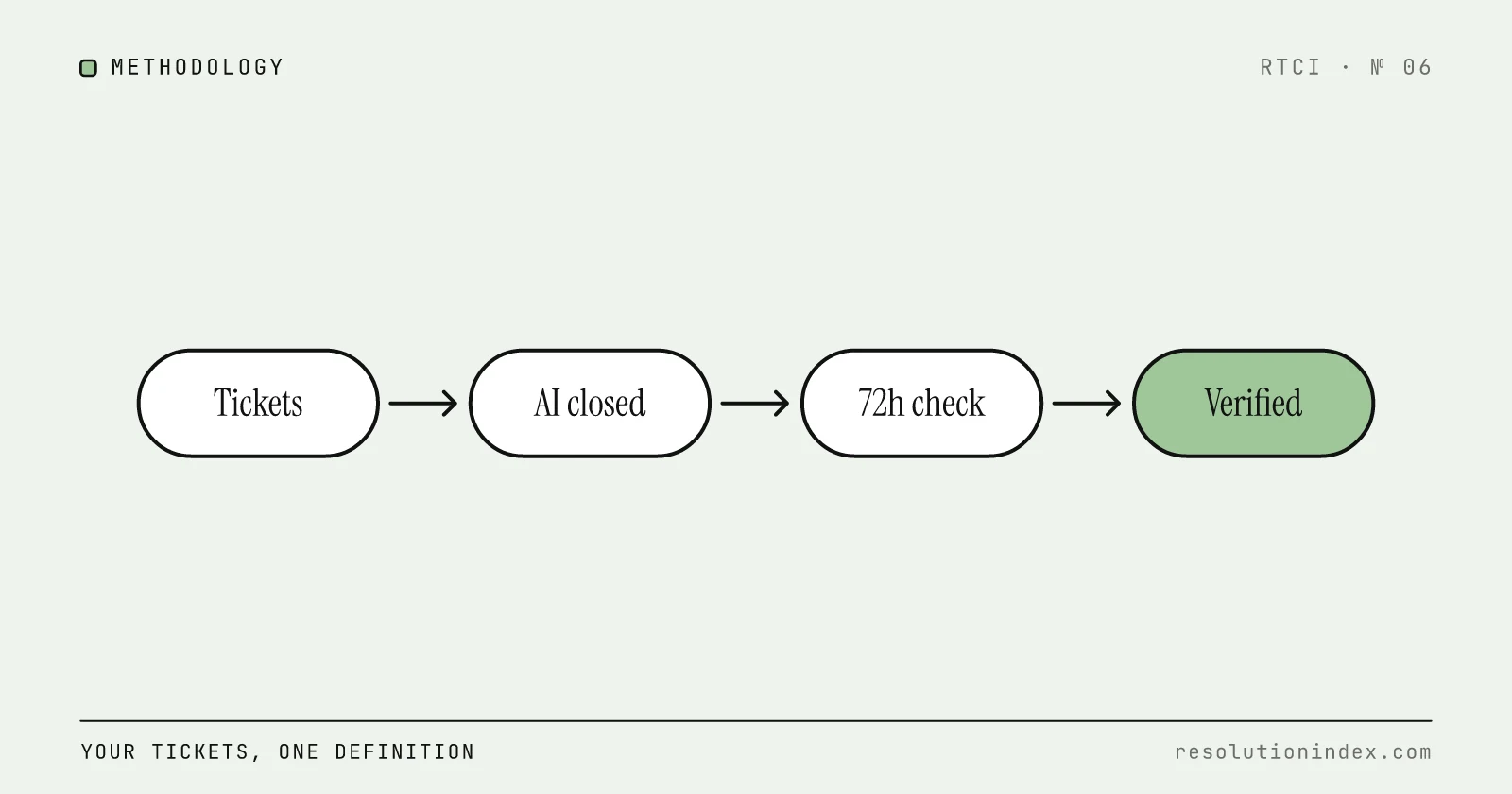
Vendor dashboards report resolution rates that no two vendors calculate the same way. This is a practical, vendor-agnostic methodology to measure your own AI resolution rate using your own ticket data, built on RTCI's 72-hour verified resolution standard.
Cost Per Verified Resolution: A New Framework
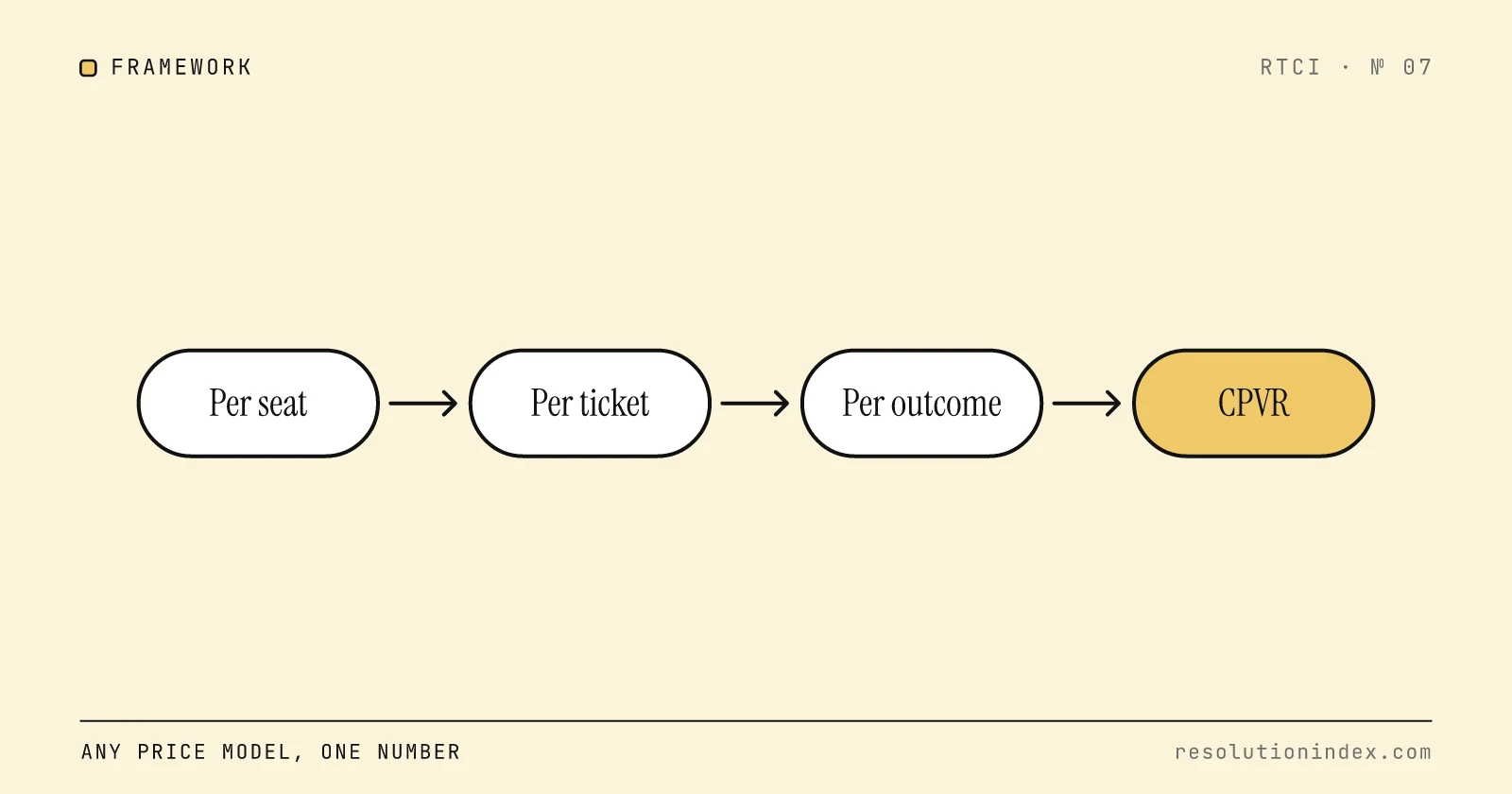
Per-seat, per-ticket, and per-resolution pricing models all produce different numbers for the same underlying cost. RTCI's three-layer cost model normalizes any vendor's pricing into a single comparable metric: cost per verified resolution.
Zendesk Alternatives 2026: 8 Compared on AI Cost per Resolution
Eight Zendesk alternatives ranked on RTCI's score and AI cost per resolution as of November 2026, split into AI layers that run on Zendesk and full helpdesk replacements, with a worked month at 5,000 tickets.
Best AI Support Platforms for Ecommerce (2026)
Ecommerce shortlist: Gorgias, Yuma, Richpanel, Intercom Fin, Gladly, Decagon, and Zendesk AI compared on order actions, returns, subscriptions, Shopify depth and cost per verified resolution, with worked cost examples from published prices.