Published Sep 14, 2026 · Updated Nov 19, 2026 · 13 min read
Zendesk vs Freshdesk 2026: AI Resolution, Cost, and Workflow Fit
Freshdesk Freddy resolves more for less in the RTCI index; Zendesk fits teams that need deeper governance. Compare both on matched quotes, verified AI outcomes, workflow tests and migration risk.
 Written by Andrew Hall, Editor
On AI support economics, Freshdesk comes out ahead in the RTCI index: Freshdesk Freddy scores 703 (Strong) with a realistic ROAR of 52–62%. It costs $0.79–$0.94 per resolution. Zendesk AI scores 592 (Moderate) at 36–46% and $1.50–$2.00. Zendesk is the stronger shortlist candidate when you need deeper governance, many brands and complex routing, or already run on it. Confirm either choice by testing the same workflows, permissions and ticket sample in the exact plans you are buying.
| As listed (checked Nov 17, 2026) | Zendesk | Freshdesk |
|---|---|---|
| Entry plan, per agent a month, annual | Support Team $19; Suite Team $55; Suite Professional $115 | Growth $19; Pro $55; Enterprise $89 |
| AI agent included | Yes, in every Support and Suite plan | 500 Freddy AI Agent sessions, once per account |
| AI billing unit | Verified automated resolution | Session, resolved or not |
| Included AI allowance | 5 resolutions per agent a month (10 on Suite Professional) | The 500 one-time sessions |
| Price above the allowance | US$1.50 committed, US$2.00 pay-as-you-go | $49 per 100 sessions ($0.49 each) |
| Agent-assist add-on | Copilot, $50 per agent a month, Professional and higher | Freddy AI Copilot, $29 per agent a month, Pro and Enterprise |
| RTCI realistic ROAR | 36–46% | 52–62% |
| RTCI cost per resolution | $1.50–$2.00 | $0.79–$0.94 |
List prices are a starting point. Replace every commercial line with a dated written quote before approval, because onboarding, add-ons, contract terms and Zendesk’s allowance model (see below) can move the result.
The comparison in one view
| Decision factor | Zendesk tends to fit when… | Freshdesk tends to fit when… | What to verify |
|---|---|---|---|
| Workflow complexity | You have many queues, brands, roles, approval rules, and reporting stakeholders | You want a capable helpdesk without a large administration layer | Rebuild three real workflows in a sandbox |
| Administration | Dedicated admins can govern a deeper configuration surface | Team leads or generalists need to own routine changes | Time five common admin tasks |
| AI automation | You will measure an AI-agent deployment against explicit automated-resolution rules | You want Freddy capabilities aligned to a Freshdesk or Freshdesk Omni rollout | Pilot the exact SKU, channels, languages, and included usage |
| Commercial model | Procurement can model seat, add-on, allowance, and overage terms | You prefer a narrower initial package and controlled expansion | Preserve both quotes with the same date and usage forecast |
| Governance | Auditability, granular roles, and change control dominate | Speed and lower operating overhead dominate | Test permission boundaries and audit exports |
| Migration | Existing Zendesk ecosystem or complex integrations make continuity valuable | A clean implementation or lighter source system reduces switching cost | Run sample migration and record-count reconciliation |
These are buyer-fit hypotheses, not vendor performance measurements. A sophisticated Freshdesk deployment can be complex, and a tightly scoped Zendesk deployment can be simple. The point is to identify which burden your organization is prepared to own.
Use the scenario-weighted quote sheet
A feature matrix gives every row equal importance and rewards the product with the longest checklist. Procurement decisions do not work that way. RTCI’s quote sheet weights five factors for a specific buyer scenario: workflow fit, AI verification, commercial predictability, administration, and migration risk. The weights total 100. Score each product from 1 to 5 only after a demo, sandbox task, source check, or pilot supplies evidence.
| Buyer scenario | Workflow fit | AI verification | Commercial predictability | Administration | Migration risk |
|---|---|---|---|---|---|
| Lean email-first team | 20 | 15 | 25 | 30 | 10 |
| Omnichannel support operation | 30 | 20 | 15 | 20 | 15 |
| Complex enterprise governance | 30 | 20 | 10 | 25 | 15 |
| Agentic automation pilot | 20 | 35 | 20 | 15 | 10 |
| Migration-sensitive incumbent team | 20 | 10 | 15 | 15 | 40 |
Formula: weighted score = sum of (factor score ÷ 5) × factor weight. A 5 on a 30-point factor contributes 30; a 3 contributes 18. Keep an evidence link beside every score. “The demo looked good” is not evidence.
The weights are an RTCI decision model, not a measured statement about Zendesk or Freshdesk. Change them before scoring if your operating priorities differ, and record who approved the changes. Do not adjust weights after seeing the result merely to justify a preferred vendor.
The quote-input block: never compare mismatched units
| Required input | Zendesk quote | Freshdesk quote | Confidence rule |
|---|---|---|---|
| Quote date and expiry | ___ | ___ | Missing date = low confidence |
| Product and edition | ___ | ___ | Product family alone is insufficient |
| Included seats or agents | ___ | ___ | Match role definitions and minimums |
| Included channels | ___ | ___ | Separate email, chat, messaging, voice, and social |
| AI product / SKU | ___ | ___ | Name agent automation and agent assist separately |
| Billable AI unit | ___ | ___ | Resolution, session, action, conversation, or allowance |
| Resolution tier / allowance | ___ | ___ | Identify the tier, included pool, and legacy-account treatment |
| Included AI allowance | ___ | ___ | Record whether recurring or one-time |
| Overage rate and tier | ___ | ___ | Missing overage = low confidence |
| Onboarding / services | ___ | ___ | Include mandatory and recommended services |
| Integration charges | ___ | ___ | Include marketplace and middleware costs |
| Contract term / uplift | ___ | ___ | Record minimum, renewal, and price-change terms |
| Data migration | ___ | ___ | State included objects, history, and attachments |
A blank means unknown, not zero. Reduce commercial-confidence scores until the vendor supplies the term in writing. That stops one vendor’s published starting price being read as fully loaded while the other vendor’s sales quote is read as an all-inclusive ceiling.
For a reusable finance workflow, see how to compare AI support quotes apples-to-apples.
Workflow and administration fit
RTCI treats “Zendesk for operational depth” as a buyer-fit hypothesis to validate, not a measured universal advantage. Official Zendesk documentation confirms support for custom roles on eligible plans, role/access administration, audit logs, and a dedicated routing surface. Those capabilities can fit multiple brands, complex routing, granular roles, and a dedicated admin function, but they can also become configuration debt. Test the exact plan and tenant rather than awarding points for documentation alone.
RTCI likewise treats “Freshdesk for a leaner administration path” as a hypothesis pending sandbox validation. Official Freshdesk documentation confirms agent roles, custom permissions on eligible plans, workflow automations, and audit-log coverage. These are substantial controls, so “leaner” describes an operating preference to test, not missing capability: whether team leads can complete common changes faster in your quoted Freshdesk or Freshdesk Omni product.
Run an administration bake-off instead of accepting adjectives. Give both sandboxes the same five tasks: add a new priority customer queue, change business hours, create a high-risk escalation approval, restrict an analyst from exporting customer data, and produce a weekly report that reconciles AI-handled and human-handled cases. Measure completion time, number of screens, test coverage, and whether the change is auditable.
Zendesk AI versus Freshdesk Freddy AI
Zendesk includes AI agents in every Support and Suite plan and bills automated resolutions. Since May 18, 2026, resolutions are split into Verified and Contained tiers, and only Verified resolutions are billed. Zendesk’s two public sources describe the allowance differently: the pricing page counts included resolutions per agent (5 a month on Team plans, 10 on Suite Professional), while the help center describes a dollar pool per agent seat that pays for resolution tiers whose prices it does not publish. Ask which model your order form uses. Freshworks bills Freddy AI Agent sessions for customer-facing conversations and sells Freddy AI Copilot separately for agent assist.
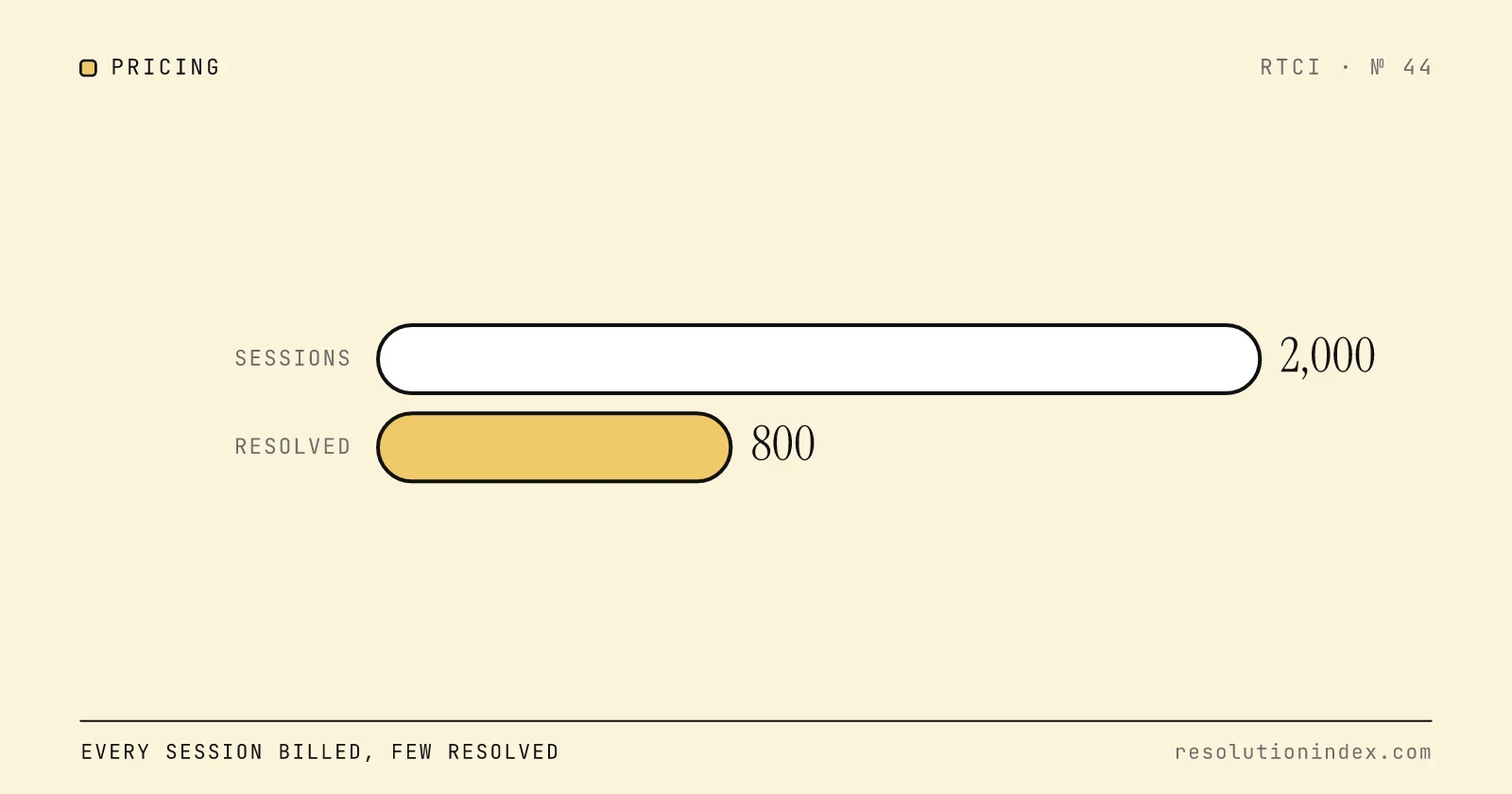
These units are not interchangeable. Freshdesk charges for every session, resolved or not; Zendesk charges only for a Verified resolution. That is why RTCI divides Freddy’s $0.49 session price by Freddy’s realistic 52–62% ROAR. That gives $0.79–$0.94 per resolution, while Zendesk’s $1.50–$2.00 is already a per-resolution price. Never compare a session price with a resolution price directly.
Public feature pages can establish that a capability is offered. They cannot establish that it will resolve your tickets, work in every language, perform every backend action, or fit your escalation policy. Mark each requirement as one of four evidence states: public claim, demonstrated in your tenant, passed on your test set, or passed in production. Only the last two belong in a financial base case.
Create a 100–300 conversation pilot set stratified by contact reason, channel, language, customer tier, required backend action, policy risk, and historical escalation rate. Freeze the set before the pilot. Each vendor receives the same inputs, knowledge, success definition, and evaluation window.
Define verified resolution before the pilot
RTCI recommends a strict operational definition: an eligible customer issue is a verified resolution only when the requested outcome is completed, no human takes over, and the customer does not re-contact or reopen for the same issue inside a declared window. Use 72 hours when it suits your support cycle, or choose another window before testing. The exact duration matters less than applying the same rule to both products.
| Outcome | Count as verified? | Why |
|---|---|---|
| Correct answer, no handoff, no re-contact in window | Yes | The issue stayed resolved |
| Helpful answer followed by human escalation | No | Automation did not complete the outcome |
| Customer goes silent after an incomplete answer | No | Silence is not proof of success |
| Bot closes the ticket; customer reopens in window | No | The resolution did not persist |
| Backend action completes and confirmation is correct | Yes | The requested outcome was delivered |
| Wrong action is reversed by a human | No | Rework belongs in the failure cost |
Also report containment, escalation, re-contact, and unsafe-action rates separately. A single automation percentage can hide whether the product prevented work, deferred work, or created rework.
Cost comparison without invented precision
Both vendors combine seat costs, editions, AI allowances, add-ons, services and usage units. The list prices in the table above show the shape of each model; your contract sets the actual cost.
Normalize the proposals in three layers. First, calculate annual committed cost: platform minimums, seats, mandatory add-ons, onboarding, integration, migration, and support. Second, model variable cost at low, base, and peak volumes using the contract’s exact unit and overage tiers. Third, divide the resulting total by your verified resolutions, not the vendor’s billed events.
Comparable cost per verified resolution = (annual committed cost + variable AI cost + implementation amortization + human rework cost) ÷ verified resolutions.
Human rework matters. If an AI interaction escalates after ten minutes of customer friction, the vendor may record an attempted session or an automated event while your team still pays for the human case. Model the platform bill and the operating cost. Exclude neither.
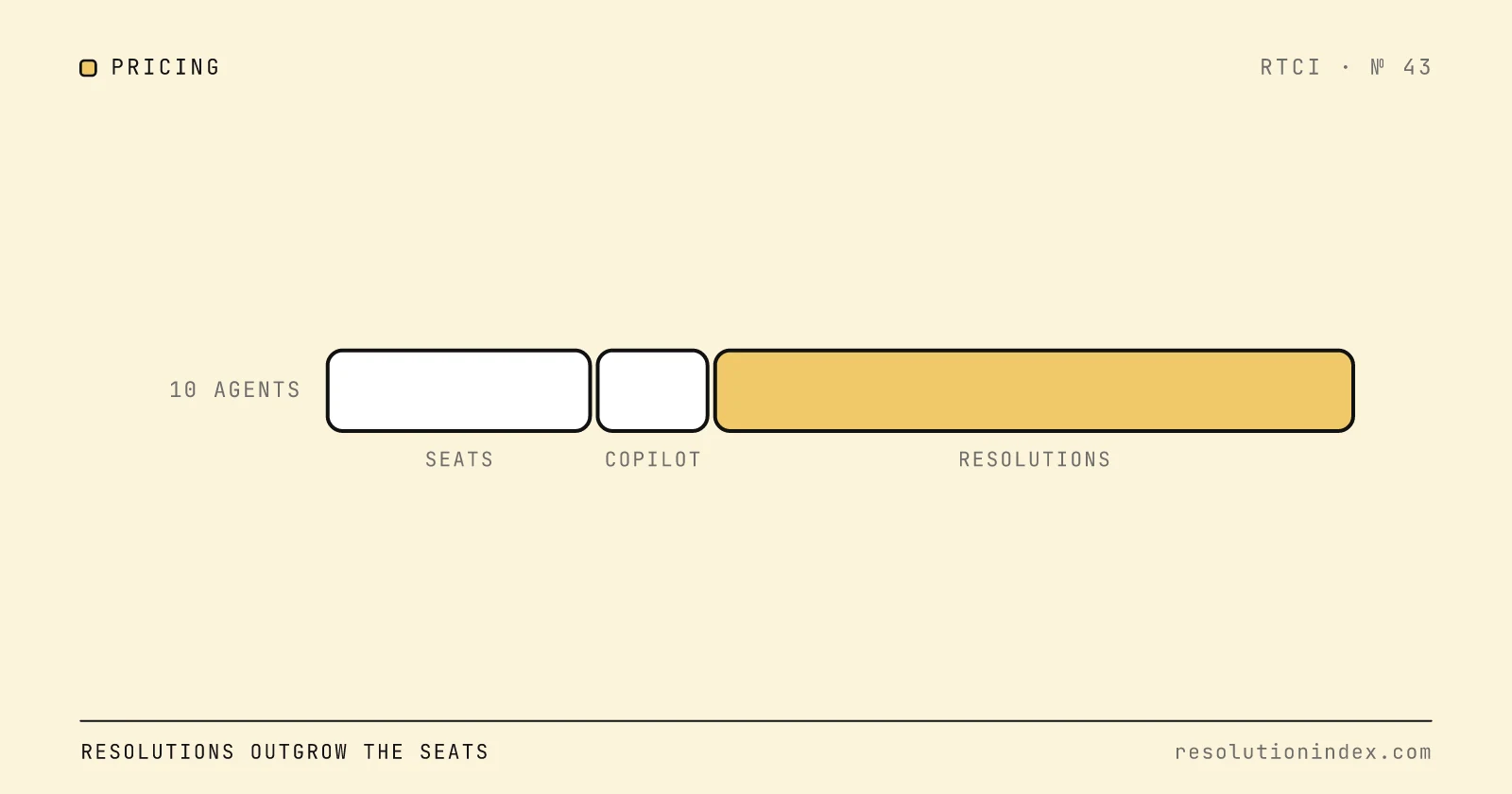
Worked example: 10 agents and 3,500 AI conversations a month, list prices, annual billing, Copilot excluded. Freshdesk Pro: 10 × $55 = $550 in seats, plus 3,500 sessions × $0.49 = $1,715 once the 500 included sessions are used, for $2,265. At RTCI’s realistic 52–62%, Freddy resolves 1,820–2,170 conversations, so the bill works out to $1.04–$1.24 per resolution including seats. Zendesk Suite Professional: 10 × $115 = $1,150 in seats. At 36–46%, the AI resolves 1,260–1,610 conversations; 100 are included, and the other 1,160–1,510 cost $1,740–$2,265 at the $1.50 committed rate. The total is $2,890–$3,415, or $2.12–$2.29 per resolution.
Use sensitivity bands rather than one confident cell. At minimum vary eligible volume, verified resolution rate, re-contact rate, overage usage, seat growth, and implementation effort. A product that wins only at an optimistic resolution rate is not the low-risk choice.
Migration risk can reverse the score
A greenfield buyer can compare product fit directly. An incumbent buyer must price the move. Historical tickets, identities, attachments, custom fields, SLAs, automations, macros, knowledge articles, integrations, analytics, and audit history do not always map one-to-one. The hardest failures often appear after cutover: broken threading, duplicate notifications, lost permissions, and reports whose denominators changed.
Require a sample migration before signature. Select records that include long threads, attachments, merges, multiple brands, custom objects, deleted users, privacy flags, multilingual content, and reopened tickets. Reconcile object counts, attachment checksums where available, relationship integrity, searchable history, and audit access.
Plan rollback and dual-running costs explicitly. If the source system remains required for regulatory or historical access, it is not immediately “saved” spend. Include archive licensing, read-only seats, middleware overlap, and the staff time needed to validate the cutover.
Governance and security checklist
- Map administrator, supervisor, agent, analyst, developer, and vendor-support roles.
- Test least privilege with real export, deletion, integration, and configuration tasks.
- Record data regions, subprocessors, retention, deletion, model-training controls, and audit-export availability.
- Separate AI knowledge access from AI action permissions.
- Require approval or deterministic controls for refunds, cancellations, account changes, and regulated advice.
- Log prompts, retrieved knowledge, actions, outcomes, escalations, and policy overrides at a level your privacy rules permit.
- Define model or feature change notification, regression testing, and emergency disable procedures.
- Put the verified-resolution definition, billing unit, overage rule, service level, and data-return obligations in the contract.
A vendor security package is necessary but not sufficient. Governance is the combination of product controls, configuration, operating procedures, evidence retention, and contractual rights. Score what your team can verify and operate, not what a slide implies.
Decision paths by buyer type
Choose Zendesk for the final round when: your organization already relies on its ecosystem; governance and complex routing are high-weight requirements; you can support dedicated administration; or the cost of moving history and integrations overwhelms a theoretical license saving.
Choose Freshdesk for the final round when: a lean team needs core service capability quickly; routine administration must stay with team leads; your required channels and AI features are proven in the quoted Freshworks product; or a greenfield deployment keeps migration risk low.
Keep both in the pilot when: AI economics drive the decision, your workflows span multiple channels, or neither vendor has supplied comparable commercial terms. The pilot should resolve uncertainty, not produce another feature score based on demos.
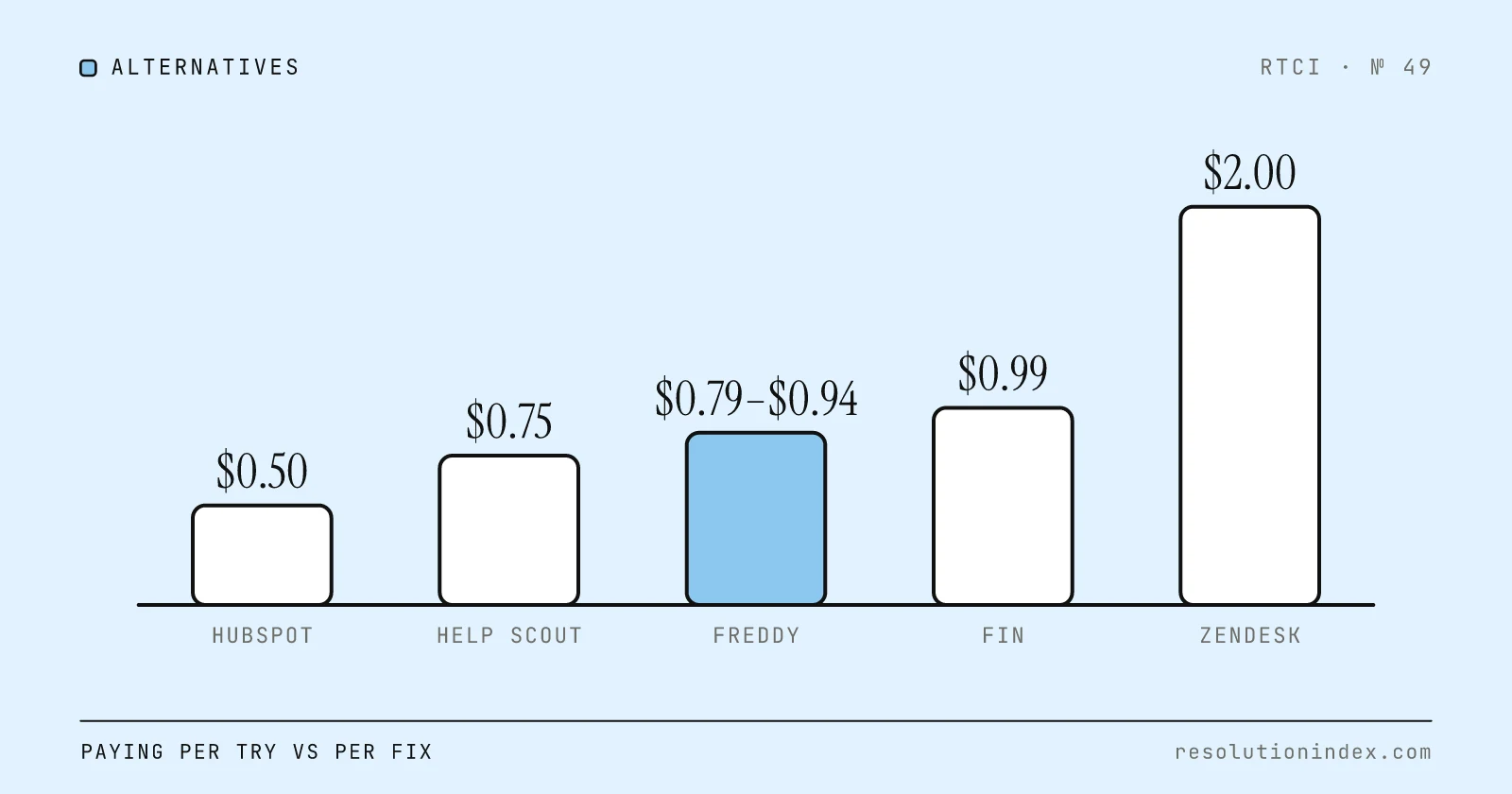
Choose neither yet when: the vendors will not define the billable AI unit, overage, data export, or resolution rule in writing; critical actions fail on your test set; or migration reconciliation is incomplete. Procurement delay is cheaper than signing an unmeasurable outcome. To widen the shortlist, the Freshdesk alternatives guide compares seven options, Zendesk included, on AI cost per resolution.
A 10-day evaluation sequence
Days 1–2: freeze requirements, weights, pilot set, verified-resolution rule, and quote template. Days 3–4: configure the same three representative workflows and document administrator effort. Days 5–6: run the AI pilot set and adjudicate outcomes blind to vendor. Day 7: test roles, audit, exports, and failure recovery. Day 8: run the sample migration and reconciliation. Day 9: normalize both quotes across conservative, base, and peak scenarios. Day 10: hold a decision review where every score must point to evidence.
The output is not one weighted number. Keep the score, evidence confidence, hard failures, cost sensitivity, and migration findings together. A high score cannot override a security or contractual hard failure.
Sources, limits, and final recommendation
Prices and AI billing terms above match RTCI’s Zendesk and Freshdesk reviews, checked against the vendors’ pricing pages on November 17, 2026. Other sources reviewed September 14, 2026 include the Zendesk pricing overview, Zendesk’s current guide to automated resolution tiers, official documentation for Zendesk roles and access and routing, the Freshdesk pricing overview, Freshdesk’s Freddy AI add-on guide, and official Freshdesk documentation for agent roles and audit logs. Public pages can change and may not reflect negotiated, regional, legacy, or product-specific terms. Preserve dated quotes and confirm the exact SKU in your tenant.
The recommendation is conditional: Freshdesk for lower AI cost per resolution and a leaner administration path; Zendesk for operational depth and governance, subject to a matched quote and an identical outcome pilot. If commercial inputs are missing, confidence falls. If an AI claim has not passed your test set, keep it out of the savings model. If migration has not reconciled, keep it out of the implementation plan. For the full bills, see the Zendesk pricing guide and Freshdesk pricing guide.
Frequently asked questions
Is Zendesk better than Freshdesk?
Neither is universally better. Treat Zendesk for complex governance and Freshdesk for leaner administration as buyer-fit hypotheses, then validate both against the same workflows, ticket sample, tenant permissions, and quote inputs.
Which is cheaper, Zendesk or Freshdesk?
On list prices, Freshdesk. Its plans start at $19 per agent a month (Pro $55) and Freddy AI Agent sessions cost $0.49 after 500 included, which RTCI converts to $0.79–$0.94 per resolution. Zendesk starts at $19 on Support Team (Suite Team $55, Suite Professional $115) and charges $1.50 committed or $2.00 pay-as-you-go per automated resolution above a small allowance. A signed decision still needs matched quotes, because onboarding, add-ons and contract terms differ.
How do Zendesk AI agents and Freshdesk Freddy AI differ?
They bill different events. Zendesk includes AI agents in every Support and Suite plan and bills each Verified automated resolution above the plan allowance. Freshdesk bills every Freddy AI Agent session, resolved or not, at $0.49 after 500 one-time included sessions. Copilot is a separate add-on on both: $50 per agent a month on Zendesk, $29 on Freshdesk. Pilot the exact plan, allowance and channels in your quote.
What is a verified AI resolution?
For this comparison, a verified resolution is an eligible customer issue completed without human handoff and without re-contact or reopening inside a declared window, such as 72 hours. Apply the same rule to both vendors.
Can I migrate from Freshdesk to Zendesk or from Zendesk to Freshdesk?
Yes, but migration quality depends on field mapping, identities, attachments, conversation threading, automations, integrations, reporting history, and cutover testing. Run a representative sample migration and reconcile record counts before committing to the final move.
Change log
- Added a dated price table and a worked monthly bill matched to RTCI’s Zendesk and Freshdesk reviews (AI agents in every Zendesk plan, US$1.50 committed rate, Freddy sessions at $0.49); removed em dashes and filler.
- Published.
Read next
Keep reading
Picked for this article: the pieces it cites and the ones that answer the next question buyers usually ask.
Most related
Freshdesk Alternatives 2026: 7 Compared on AI Cost per Resolution
Seven Freshdesk alternatives and competitors compared on what an AI resolution costs as of November 2026, against Freddy's $0.49 per session, with a break-even rate and a worked month for a 10-agent team.
Freshdesk Pricing 2026: Plans, Freddy AI Sessions, Real Costs
Freshdesk pricing as of November 2026: plans from $19 per agent, Freddy AI Agent at $49 per 100 sessions, and what each resolved conversation really costs.
Zendesk Pricing 2026: Plans, AI Agents and Resolution Costs
Zendesk pricing as of November 2026: plans from $19 per agent, AI agents billed per automated resolution, the May 2026 tier change, and worked monthly bills.
Compare AI Support Quotes Apples-to-Apples
A quote normalization worksheet that converts Intercom Fin, Zendesk AI, Freshdesk Freddy, Gorgias, Decagon, Sierra, and YourGPT quotes into one comparable number: cost per verified resolution.
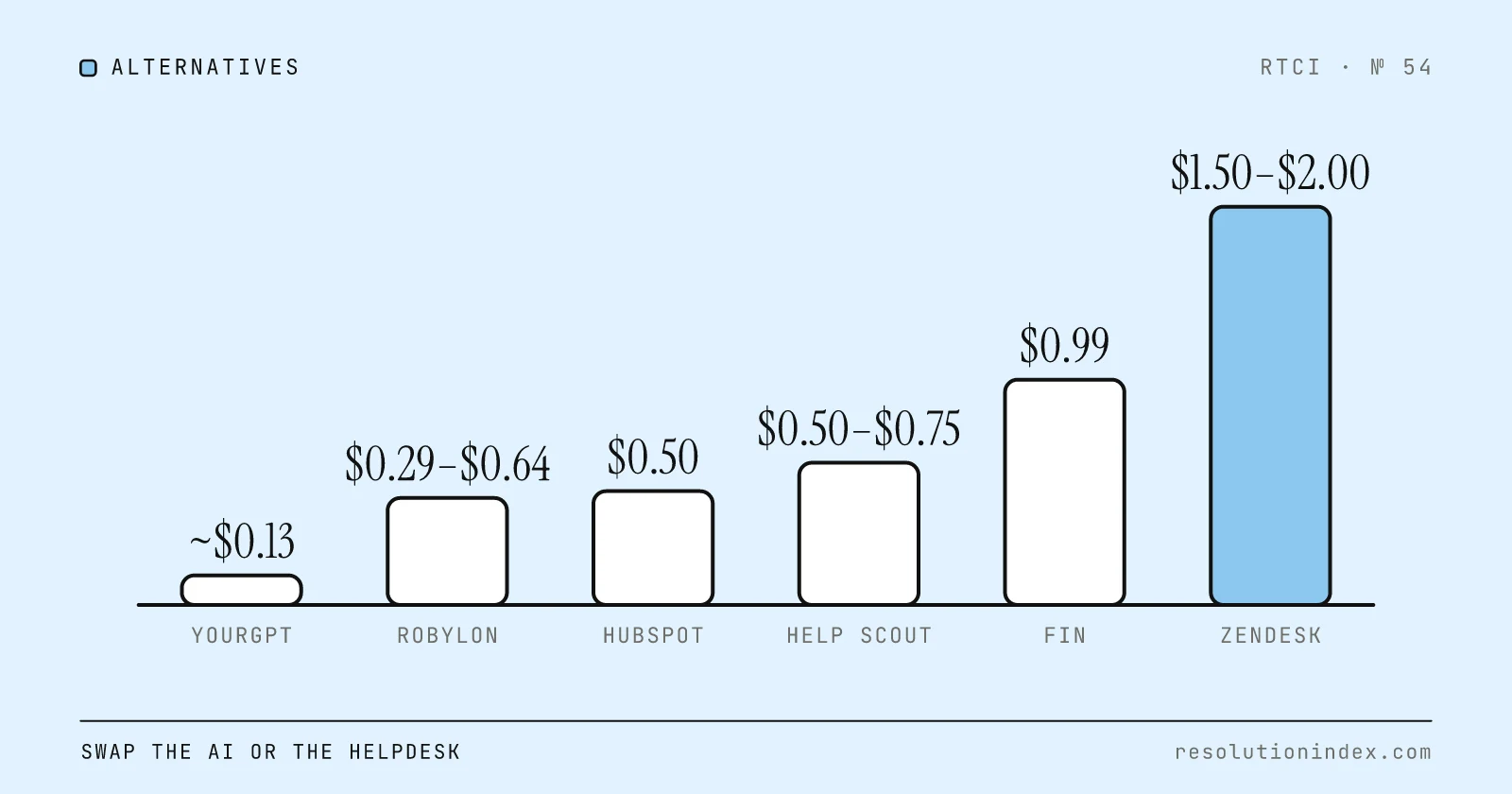
Zendesk Alternatives 2026: 8 Compared on AI Cost per Resolution
Eight Zendesk alternatives ranked on RTCI's score and AI cost per resolution as of November 2026, split into AI layers that run on Zendesk and full helpdesk replacements, with a worked month at 5,000 tickets.