Published Nov 20, 2026 · Updated Nov 20, 2026 · 17 min read
Escalation Management in Customer Service: Process, Tiers, SLAs and AI Handoffs (2026)
A working escalation management system for teams running AI and human agents together: the three kinds of escalation, a copyable nine-row escalation matrix with example targets, a step-by-step process and escalation note template, hard-coded AI handoff triggers and a handoff audit, five metrics with formulas and a worked example, de-escalation scripts, and the FCA and CFPB complaint clocks.
 Written by Andrew Hall, Editor
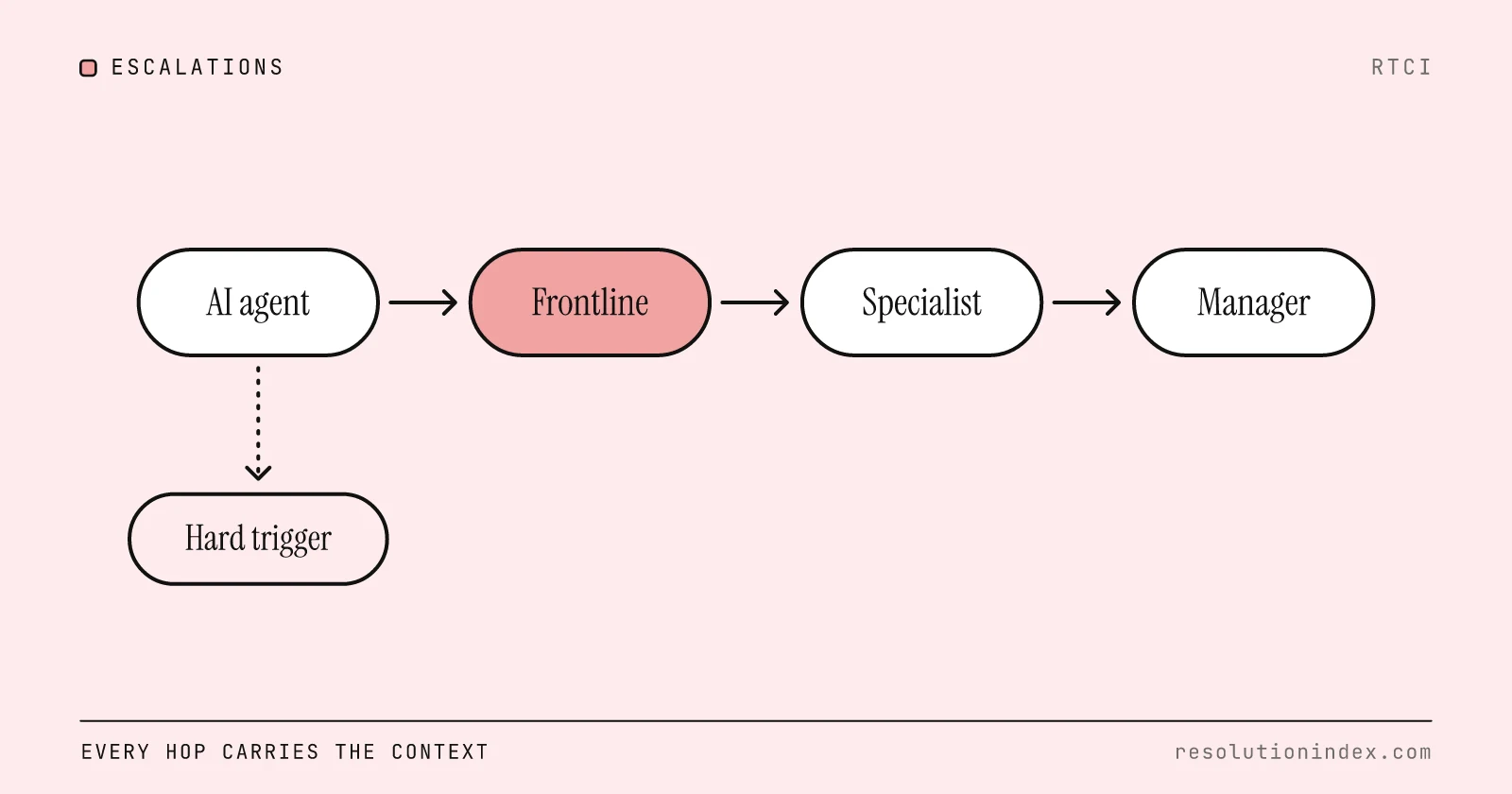
Escalation management is the set of rules that decides when a support ticket moves to someone else and what travels with it. There are three kinds: hierarchical (up to a senior agent or manager), functional (sideways to a specialist team) and AI-to-human handoff. The process in one line: detect the trigger, write the note, route it to a named owner with a response target, tell the customer what happens next, and review a sample every week.
This guide gives a copyable escalation matrix, the step-by-step escalation management process with a note template, the triggers to hard-code for AI escalation management, five metrics with formulas and a worked example, de-escalation scripts, and the complaint deadlines the UK FCA and US CFPB publish. Targets, thresholds and scripts are RTCI's suggestions, not industry standards. If your problem is too many AI escalations rather than how to run them, start with reduce escalations without adding headcount.
What is escalation management?
Customer escalation management covers every case where the person or system holding a ticket cannot finish it well. A good system makes three things predictable: who gets the ticket, how fast they respond, and what they know when they pick it up.
| Kind | Where the ticket goes | Typical triggers | Main failure |
|---|---|---|---|
| Hierarchical | Up: senior agent, team lead, manager | Exception above an agent's limit, a request for a manager, a complaint, legal or safety risk | Managers become a queue for anything difficult |
| Functional | Sideways: billing, technical, logistics, engineering | Missing access or skill, a confirmed bug, a payment dispute, an incident | Ticket bounces between teams with no owner |
| AI-to-human handoff | From the AI agent to a person, usually Tier 1 | Request for a person, repeated failure, low confidence, risk topics | Customer repeats everything to the agent |
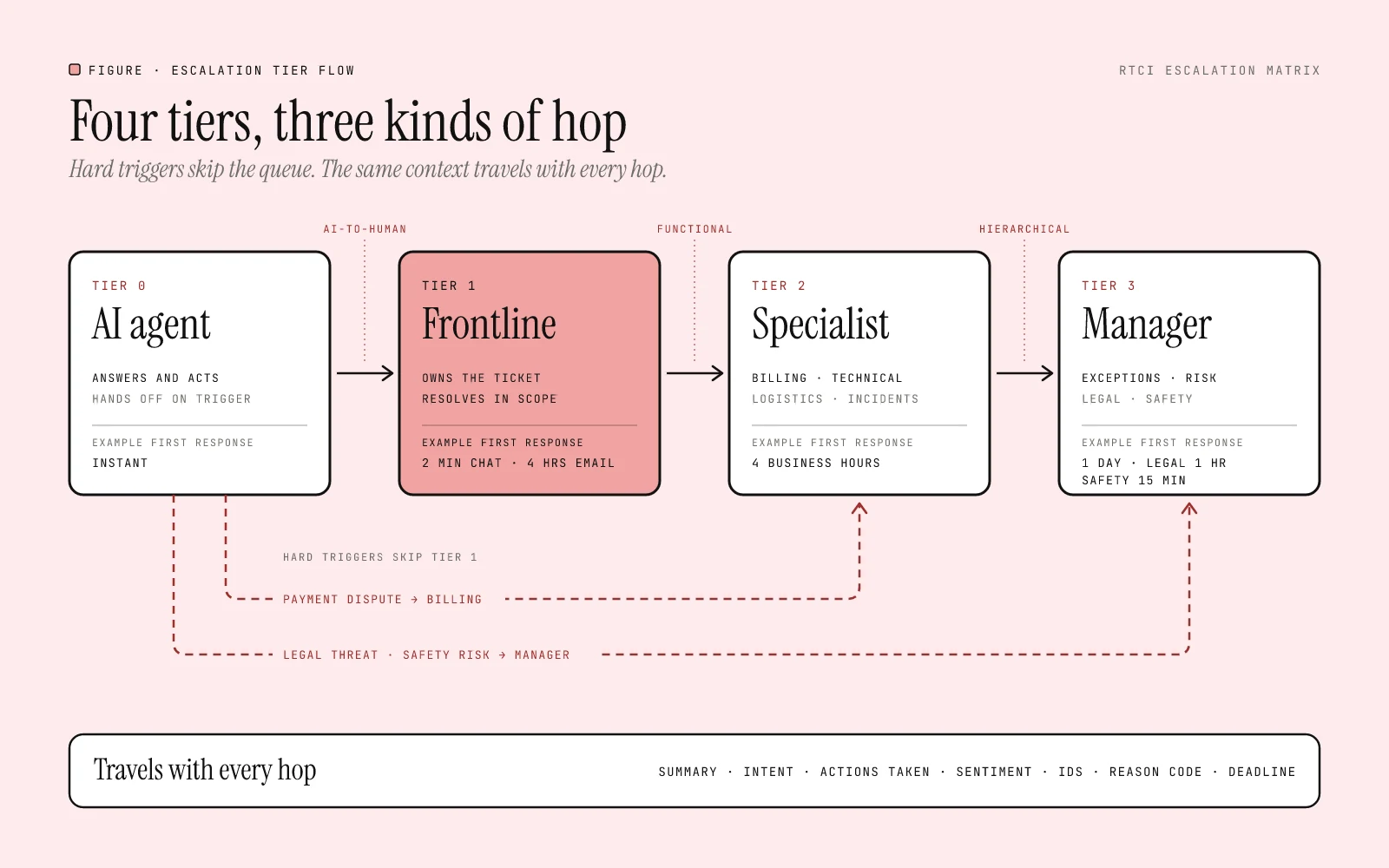
Most teams number their levels as tiers. In this guide Tier 0 is the AI agent and self-service, Tier 1 is frontline agents, Tier 2 is specialist teams and Tier 3 is managers and experts, with legal, compliance and engineering on call behind them. Escalation is not a failure in itself. A safety report that reaches the on-call manager in five minutes is the system working.
The escalation matrix
The escalation matrix is the one table everyone works from. Copy it into your helpdesk documentation and replace the targets. The response targets below are example values RTCI chose to show the shape of a matrix. They are not industry standards. Set yours from your staffing, your contracts and any regulatory clock that applies.
| # | Trigger | Kind | Route to | Owner | Example first-response target | Context that must travel |
|---|---|---|---|---|---|---|
| 1 | Customer asks the AI for a person | AI-to-human | Tier 1 frontline | Frontline queue lead | Chat 2 minutes, email 4 business hours | AI summary, intent, actions taken, sentiment, transcript link |
| 2 | Same intent fails twice in the AI conversation | AI-to-human | Tier 1 frontline | Frontline queue lead | Chat 2 minutes, email 4 business hours | As row 1, plus the two answers that failed |
| 3 | Frontline agent lacks the access or skill to finish | Functional | Tier 2 specialist queue (billing, technical, logistics) | Tier 2 team lead | 4 business hours | Escalation note, what was tried, order or account IDs, reproduction steps for bugs |
| 4 | Payment dispute, chargeback or "I did not authorize this" | Functional | Tier 2 billing | Billing lead | 4 business hours | Amount, payment ID, dates, what the customer has been told so far |
| 5 | Customer asks for a manager, or wants an exception above the agent's limit | Hierarchical | Tier 3 team lead or manager | Support manager | 1 business day | Escalation note, the exception asked for and its cost, prior contacts |
| 6 | Legal threat or regulator mention | Hierarchical | Tier 3 manager, plus legal or the complaints team | Support manager | Acknowledge within 1 business hour, reply in substance only after legal review | The customer's exact words, full history, any deadline the customer stated |
| 7 | Safety risk: injury, threat of harm, a dangerous product | Hierarchical | Tier 3 on-call manager | On-call manager | 15 minutes, around the clock | Exact words, contact details, product or batch, location if given |
| 8 | Ticket at 75% of its response or resolution target with no path to close | Hierarchical | Team lead | Team lead | Before the target is breached | Target clock, blocker, who holds the next action |
| 9 | Many tickets reporting the same fault | Functional | Incident owner in engineering | Incident commander | 30 minutes | Ticket count, first report time, affected product, one representative ticket |
From the AI agent, rows 4, 6 and 7 skip Tier 1 and go straight to the tier that can act. Every row also carries the standard escalation note in the next section. If a ticket matches two rows, it follows the faster target and the more senior owner.
Three rules keep the matrix honest. Each row has one named owner, not a team alias. Each target is something you measure (see the metrics section). And every row has a reason code in the helpdesk so you can count it.
The escalation management process, step by step
- Detect. A trigger from the matrix fires: a rule in the AI agent, a helpdesk automation (for example, a ticket at 75% of its target), or an agent's judgment.
- Classify. Pick the kind (hierarchical, functional or AI-to-human) and the matrix row. The row sets the owner, the target and the reason code.
- Write the note. Use the template below. If the escalation came from the AI agent, the AI fills it and the receiving agent checks it.
- Route to a named owner. Assign the ticket to a queue with an owner who is on shift. For rows 6 and 7, also page the person.
- Tell the customer. Say who has it, what happens next and when they will hear back. Give a time, not "soon".
- Accept and own. The receiving tier accepts the ticket, reads the note and becomes the owner until it is resolved or formally passed on. If the note is incomplete, they ask the sender, not the customer.
- Resolve and close the loop. Reply to the customer, then tell the sending tier the outcome so frontline agents and the AI configuration owner learn what fixed it.
- Review. Each week, sample escalations for wrong routes, late escalations and missing context. Each finding becomes a change to the matrix, the knowledge base, an AI trigger or coaching.
Step 6 is where escalations most often break. A ticket that sits in a shared queue with no owner has no one accountable for its target. A ticket that goes back to the sender should count as a re-escalation in your metrics, not disappear.
Copyable escalation note template. Paste this into a helpdesk macro or internal-note snippet.
ESCALATION NOTE (v1)
Ticket ID:            [id]            Escalated by: [name / AI agent]
Escalated to:         [tier, queue, owner]
Kind:                 [hierarchical / functional / AI-to-human]
Matrix row:           [1-9]           Reason code: [code]
Response target:      [time]          Regulatory clock: [none / date it started]

CUSTOMER
Name / account / tier: [ ]
Verified:             [yes, method / no]
Sentiment:            [calm / frustrated / angry / distressed] Quote: "[ ]"

SUMMARY (3 sentences max)
What the customer wants:  [ ]
What happened so far:     [ ]
Why it cannot be finished at this tier: [ ]

ACTIONS ALREADY TAKEN (with results)
1. [action] -> [result]
2. [action] -> [result]

WHAT THE CUSTOMER HAS BEEN TOLD
[promises, times, amounts; or "nothing beyond acknowledgment"]

IDS AND LINKS
Order / payment / case IDs: [ ]   Transcript: [link]   Logs or screenshots: [ ]

SUGGESTED NEXT STEP
[ ]
Two lines matter more than they look. "What the customer has been told" stops the next tier from contradicting a promise. "Regulatory clock" makes the deadline visible from the first hop, which matters in the sectors covered below.
AI escalation management: AI-to-human handoffs
An AI agent escalates more often than any person on the team, so its handoff rules need the same care as the matrix. Most AI agents decide on a confidence score. Some triggers should not depend on that score at all.
Triggers to hard-code. These fire whatever the AI's confidence, and they should be tested on every release of the AI configuration.
| Trigger | Detect it with | Route | Why it is hard-coded |
|---|---|---|---|
| Explicit request for a human | "agent", "human", "real person", "representative", pressing 0, or the same request rephrased | Tier 1, immediately, no retention prompt | The customer has already told you the outcome they want. Arguing with it costs trust and usually ends in the same handoff later. |
| Repeated failed intent | The same intent classified twice with no progress, the customer rephrasing the question, or "that is not what I asked" | Tier 1 | Loops are where customers give up or get angry. Two failed turns is a starting rule; tune it from your audit. |
| Payment dispute | "chargeback", "dispute", "charged twice", "did not authorize", "fraud", a bank or card issuer named | Tier 2 billing | Money is moving or may need to. The AI should not promise refunds or reversals outside written policy. |
| Legal threat | "lawyer", "solicitor", "attorney", "sue", "court", "small claims", a regulator or ombudsman named | Tier 3 plus legal or complaints | Every word sent after this point may be read by someone else. A person checks the reply first. |
| Safety | Injury, fire, burns, choking, a threat to self or others, a product the customer says is dangerous | Tier 3 on-call | Speed and judgment matter more than containment. The AI should stop troubleshooting and hand off. |
In regulated or complaint-heavy sectors, add a sixth: anything that looks like a formal complaint gets flagged and handed off, because the regulator's clock may already be running (see the section on regulated sectors). For setting confidence floors for everything else, see Step 4 of reduce escalations without adding headcount.
What the handoff must carry. At minimum, four fields, plus the IDs and verification state from the note template:
- Summary: two or three sentences in plain words: what the customer wants and what happened.
- Intent: the classified intent and the AI's confidence, so the agent can tell when the AI misread the request.
- Actions already taken: every lookup, change or promise the AI made, with its result ("order status checked: delivered Nov 12", "refund not issued").
- Customer sentiment: a label and the message that set it, so the agent opens with the right tone.
Train the team on AI handoff workflows covers the full seven-field packet and how to drill agents on reading it.
How to stop customers repeating themselves.
- Show the packet to the agent before they accept the conversation, not in a tab they have to open.
- Keep the customer in the same chat thread or email thread. A new ticket in a new channel resets everything.
- Carry verification state across. If the customer passed verification with the AI, the agent should not ask again unless policy requires a stronger check for the action.
- Have the AI tell the customer what happens next: "I am connecting you with a person. They will see this conversation, so you will not need to repeat yourself." Then make that sentence true.
- Open the human reply with the summary, not a greeting question. The script for this is in the de-escalation section.
- Out of hours, the AI creates the ticket with the full note and tells the customer when the team will reply.
How to audit handoffs. Each week, pull two random samples: one from conversations the AI handed off, and one from conversations the AI marked resolved. The first shows late or incomplete handoffs. The second finds missed handoffs, where a hard trigger should have fired and did not. RTCI suggests at least 50 of each per week to start; size it with the sample math in customer service quality assurance, which also has a scorecard with a missed-handoff auto-fail. Score each conversation on this checklist:
AI HANDOFF AUDIT (weekly, per conversation)
Conversation ID:                     [ ]
Trigger that fired:                  [row / none]
Correct trigger?                     yes / no (should have been: [ ])
Handed off late?                     yes / no (turns before handoff: [n])
Packet complete?                     summary / intent / actions / sentiment / IDs  (tick each)
Customer repeated themselves?        yes / no
First human reply used the packet?   yes / no
Outcome:                             resolved / re-escalated / reopened within 72h
Fix owner and action:                [knowledge / trigger / routing / agent coaching]
Join both samples to 72-hour re-contact before you call an AI resolution real. The 72-hour verified resolution clauses show how to write that window into a vendor contract so a conversation the AI "resolved" and the customer reopened does not count as a billed outcome.
Escalation metrics: formulas and a worked example
Five metrics cover support escalation management. Measure each per tier and per matrix row, not only as one blended number.
| Metric | Formula | Read it with |
|---|---|---|
| Escalation rate (per tier) | Tickets escalated out of the tier ÷ tickets handled at the tier × 100 | Re-escalation rate, so a low rate is not hiding tickets stuck at the wrong tier |
| Time to escalate | Escalation timestamp − first customer message timestamp. Report the median and the 90th percentile | Hard-trigger rows separately: these should be minutes, not hours |
| Post-escalation resolution time | Resolution timestamp − escalation timestamp. Report the median | The example targets in your matrix, row by row |
| Re-escalation rate | Escalated tickets that escalate again, bounce back to the sending tier, or reopen and escalate within 7 days ÷ escalated tickets × 100 | Escalation reason codes, to find which hop is routing to the wrong place |
| AI handoff rate | AI conversations transferred to a person ÷ AI-engaged conversations × 100 | Verified AI resolution rate and 72-hour re-contact, so a falling handoff rate is not trapping customers |
RTCI does not publish benchmarks for these metrics, because teams define tiers, escalations and handoffs differently. Compare against your own baseline month over month.
Worked example (illustrative numbers, not a benchmark). A team receives 20,000 conversations in a month. The AI agent engages 12,000 and hands 4,200 to people. The other 8,000 go straight to agents by email and phone.
- AI handoff rate: 4,200 ÷ 12,000 = 35.0%.
- Tier 1 escalation rate: Tier 1 handles 8,000 + 4,200 = 12,200 tickets and escalates 976 to Tier 2 or 3. 976 ÷ 12,200 = 8.0%.
- Re-escalation rate: 122 of the 976 escalate again or bounce back. 122 ÷ 976 = 12.5%.
- Time to escalate: seven sampled Tier 1 escalations took 12, 25, 40, 55, 90, 180 and 600 minutes from the first customer message. The median is 55 minutes. The mean is 1,002 ÷ 7 ≈ 143 minutes, pulled up by one slow ticket, which is why you report the median and the 90th percentile rather than the mean.
- Post-escalation resolution time: five sampled escalations resolved in 3, 6, 9, 20 and 30 hours after escalation. The median is 9 hours.
Keep AI handoffs and human escalations as separate rates. Adding them into one "escalation rate" makes a change in AI coverage look like a change in agent performance.
De-escalation language for agents
These are RTCI's suggested scripts, not tested phrasings. Each one names the issue, says what will happen and gives a time. Adapt the wording to your brand voice, and score tone after escalation in QA.
| Situation | Say | Avoid |
|---|---|---|
| Customer is angry about a repeat contact | "You have had to contact us more than once about this, and that should not have happened. I have your previous messages in front of me, so you will not need to explain it again." | "I understand your frustration" with nothing specific after it |
| Customer asks for a manager | "I can bring in my team lead. Before I do, here is what I can do right now: [option]. If that does not work for you, I will pass this on with everything we have discussed." | Refusing, or making the customer argue for it |
| First reply after an AI handoff | "I have read your conversation with our assistant. You are asking about [issue], and it has already [actions taken]. The next step is [step]." | "How can I help you today?" |
| Legal threat | "Thank you for telling me. I am passing this to the team that handles these cases, and they will reply by [time]." | Debating liability, admitting fault, or making offers before review |
| You cannot give what they asked for | "I cannot [request] because [reason]. What I can do is [alternative], and I can have that done by [time]." | "That is our policy" with no reason or alternative |
| Waiting on a specialist | "This is with our [billing] team now. They aim to reply within [target]. I will update you by [time] even if they have not finished." | Open-ended promises such as "soon" or "as soon as possible" |
Two habits matter more than any script. Never promise a time the next tier has not agreed to; use the matrix target. And when you hand a ticket on, tell the customer the name of the team, not "someone".
Escalation management in regulated and complaint-heavy sectors
In financial services and other regulated sectors, some escalations are also complaints with a legal deadline. The deadline starts when the complaint arrives, in whatever channel, including a chat with an AI agent. Two regulators publish their timelines plainly:
- UK, Financial Conduct Authority. The FCA's consumer complaints page (last updated May 20, 2025) says that in general firms must tell you the outcome of a complaint in writing within 8 weeks. It also says payment service providers and e-money issuers must normally respond to certain complaints within 15 business days, with a final response within 35 business days of the complaint.
- US, Consumer Financial Protection Bureau. The CFPB's complaint process page (last modified Oct 5, 2026) says companies generally respond in 15 days, and in some cases tell the consumer their response is in progress and give a final response in 60 days. This applies to complaints submitted through the CFPB.
What this changes in the matrix:
- Add a complaint row. Any message that may be a complaint under your regulator's definition gets a reason code, an owner in the complaints team and the regulator's deadline as its target. Your regulator's definition of a complaint may be broader than what your team calls an escalation; check it with compliance.
- Start the clock at receipt. Put the date the complaint arrived in the "Regulatory clock" line of the note, and set helpdesk alerts well before the deadline.
- Do not let the AI decide that something is not a complaint. Have it flag and hand off; a person makes the call.
- Keep the record. The escalation note, the transcript and every reply are part of the complaint file.
- Review final-response templates with compliance, including any required wording about next steps for the customer.
This is an operations guide, not legal advice. For the wider control list (data handling, disclosures, audit trails) see the AI support compliance checklist.
Frequently asked questions
What is escalation management?
Escalation management is the set of rules that decides when a support ticket moves to someone with more authority, a different skill or, for AI agents, a person, and what has to travel with it. It covers triggers, owners, response targets and the escalation note, so the customer gets a faster answer from the right person without repeating themselves.
What are the types of escalation in customer service?
Three. Hierarchical escalation moves a ticket up to a senior agent, team lead or manager, usually for an exception, a complaint or a risk. Functional escalation moves it sideways to a specialist team such as billing, technical support or engineering. AI-to-human handoff moves a conversation from an AI agent to a person.
What is an escalation matrix?
An escalation matrix is a table that lists each escalation trigger with the tier it goes to, the owner, the response target and the context that must travel with the ticket. RTCI's nine-row example covers requests for a person, repeated AI failure, specialist work, payment disputes, manager requests, legal threats, safety risks, tickets about to breach their target, and incidents. Its targets are example values to replace with your own.
What is the escalation management process?
Detect the trigger, classify the escalation kind and matrix row, write the escalation note, route it to the named owner, tell the customer what happens next and by when, let the receiving tier accept and own it, resolve and close the loop with the customer and the sender, then review a sample weekly for wrong routes and missing context.
When should an AI agent hand off to a human?
Hard-code five triggers that fire whatever the AI's confidence: an explicit request for a person, the same intent failing twice, a payment dispute, a legal threat and a safety risk. Add your own low-confidence and out-of-scope rules on top. In regulated sectors, also hand off anything that looks like a formal complaint.
How do you measure escalation management?
Track five metrics: escalation rate per tier, time to escalate (median and 90th percentile), post-escalation resolution time, re-escalation rate, and AI handoff rate. Read them together. A falling escalation rate with a rising re-escalation or re-contact rate means tickets are stuck, not solved.
How long do companies have to respond to complaints?
It depends on the regulator and the product. The UK FCA says firms generally must give the outcome of a complaint in writing within 8 weeks, and payment service providers and e-money issuers must normally respond to certain complaints within 15 business days, with a final response within 35 business days. The US CFPB says companies generally respond to complaints sent through its portal in 15 days, with a final response in 60 days in some cases. Check the rules that apply to you with your compliance team.
Change log
- Published.
Read next
Keep reading
Picked for this article: the pieces it cites and the ones that answer the next question buyers usually ask.
Most related
Reduce AI-to-Human Escalations Without Adding Headcount
Tag a sample of escalations by root cause, fix the knowledge gaps and routing errors behind the avoidable ones, then set confidence thresholds by risk. A four-step loop with an audit template, threshold table and worked cost math.
Train the Team on AI Handoff Workflows
What a clean AI-to-human handoff packet contains, how to measure handoff quality, what vendors bill when a conversation is handed off, and how handoffs move cost per verified resolution.
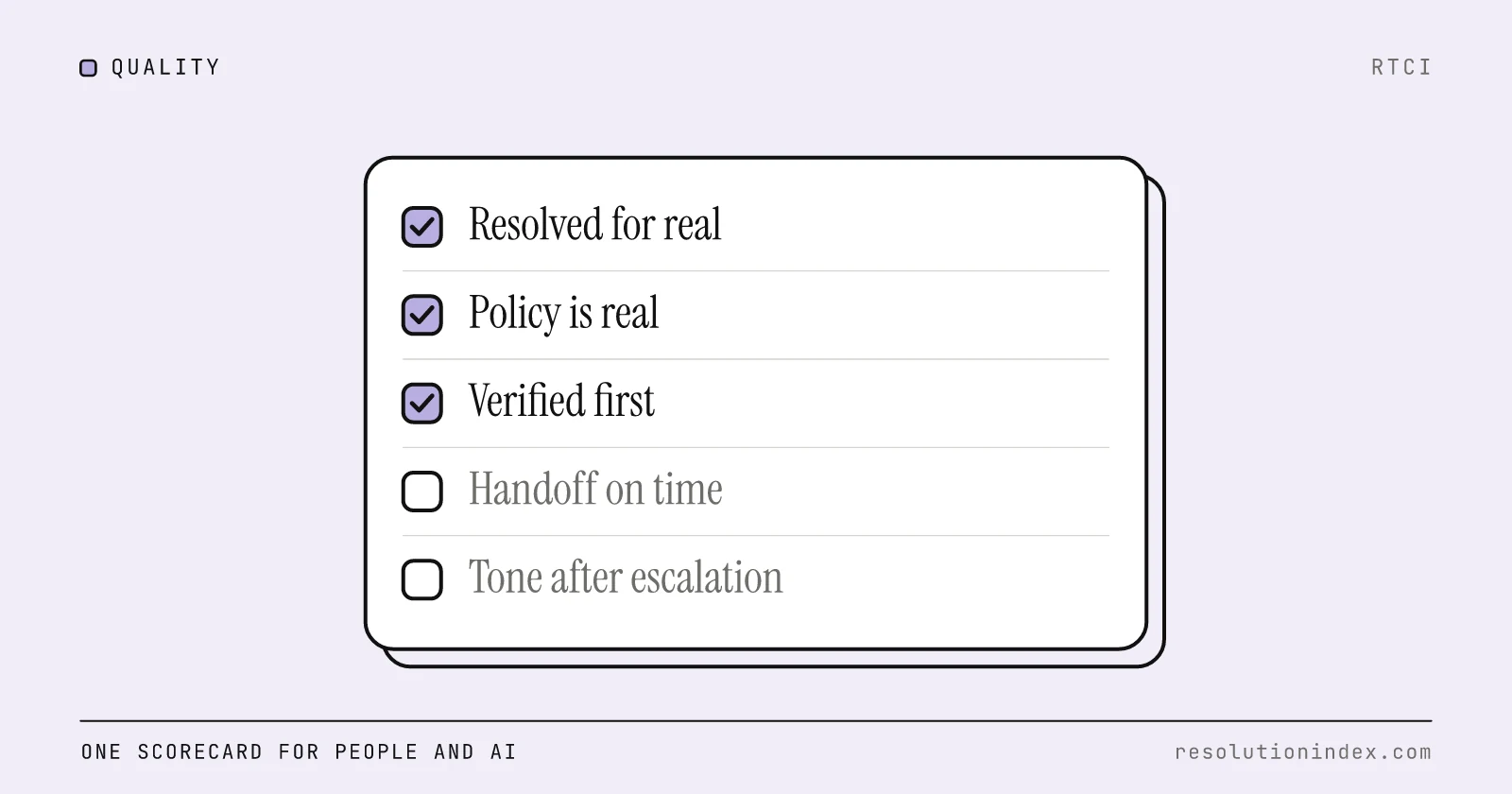
Customer Service Quality Assurance: A QA Scorecard for Human and AI Conversations (2026)
One QA program that grades human agents and the AI agent on the same scorecard: nine weighted criteria with pass/fail definitions, five auto-fail checks for false resolutions, invented policy, missed handoffs, unverified actions and tone after escalation, the sample-size math, calibration with an agreement-rate example, and a cadence by team size.
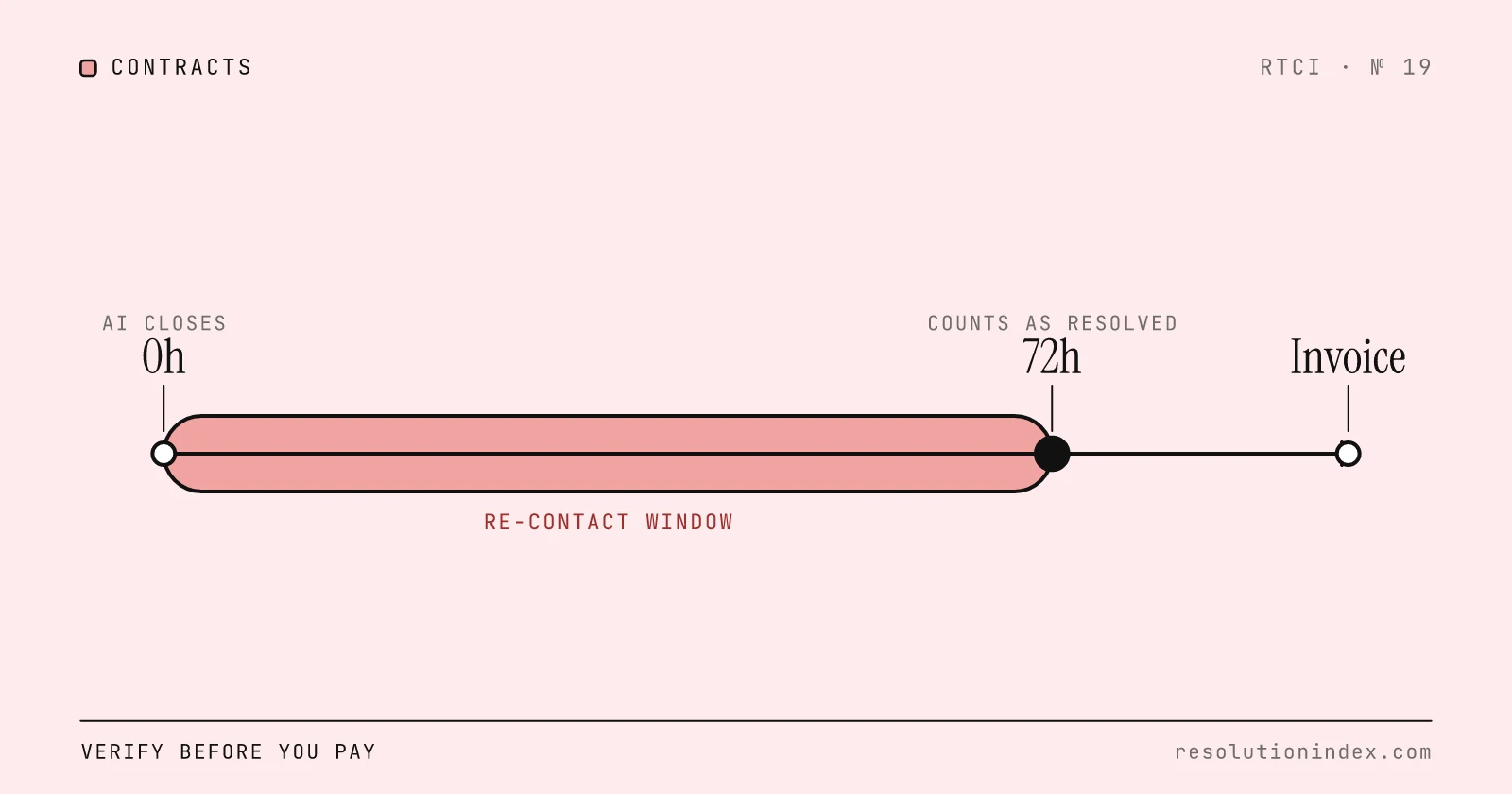
72-Hour Verified Resolution SLA: Copy-Paste Contract Clauses
A buyer-side clause library for defining, measuring, auditing, crediting, and disputing 72-hour verified resolutions in AI support contracts.
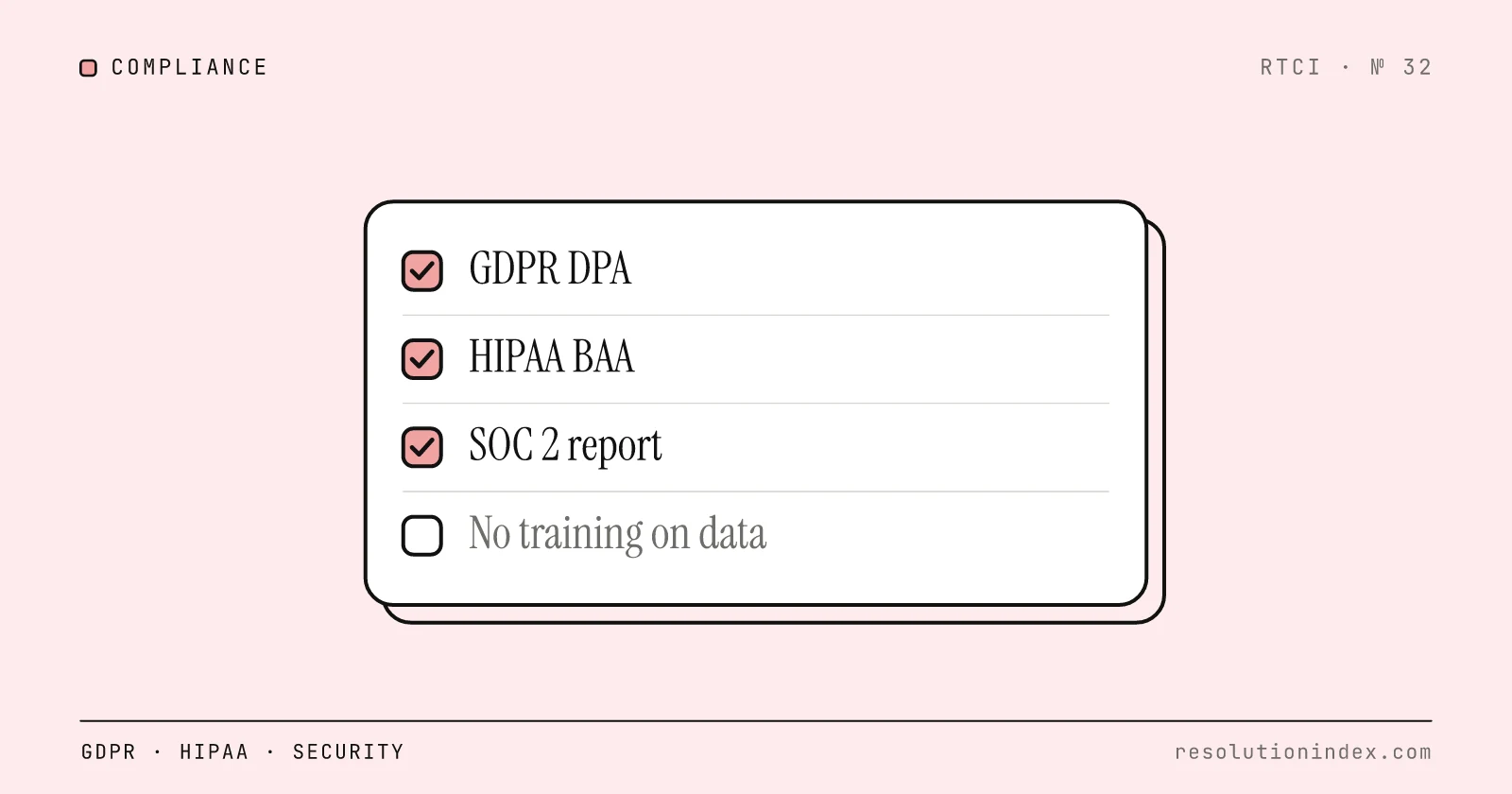
AI Support Compliance Checklist (GDPR / HIPAA / Security) (2026)
A buyer-side compliance checklist for AI customer support: GDPR DPA clauses, when HIPAA and a BAA actually apply, the EU AI Act chatbot disclosure rule, SOC 2 checks, the subprocessor chain and no-training contract language.