· 11 min read
Chatbot Containment Rate: Formula, Benchmarks, Blind Spots
Containment rate is the share of chatbot, AI agent or IVR conversations that never reach a human. The formula, a quality-filtered version, sourced benchmarks and a worked month that goes from 74% containment to 54% verified resolution.
 Written by Andrew Hall, Editor
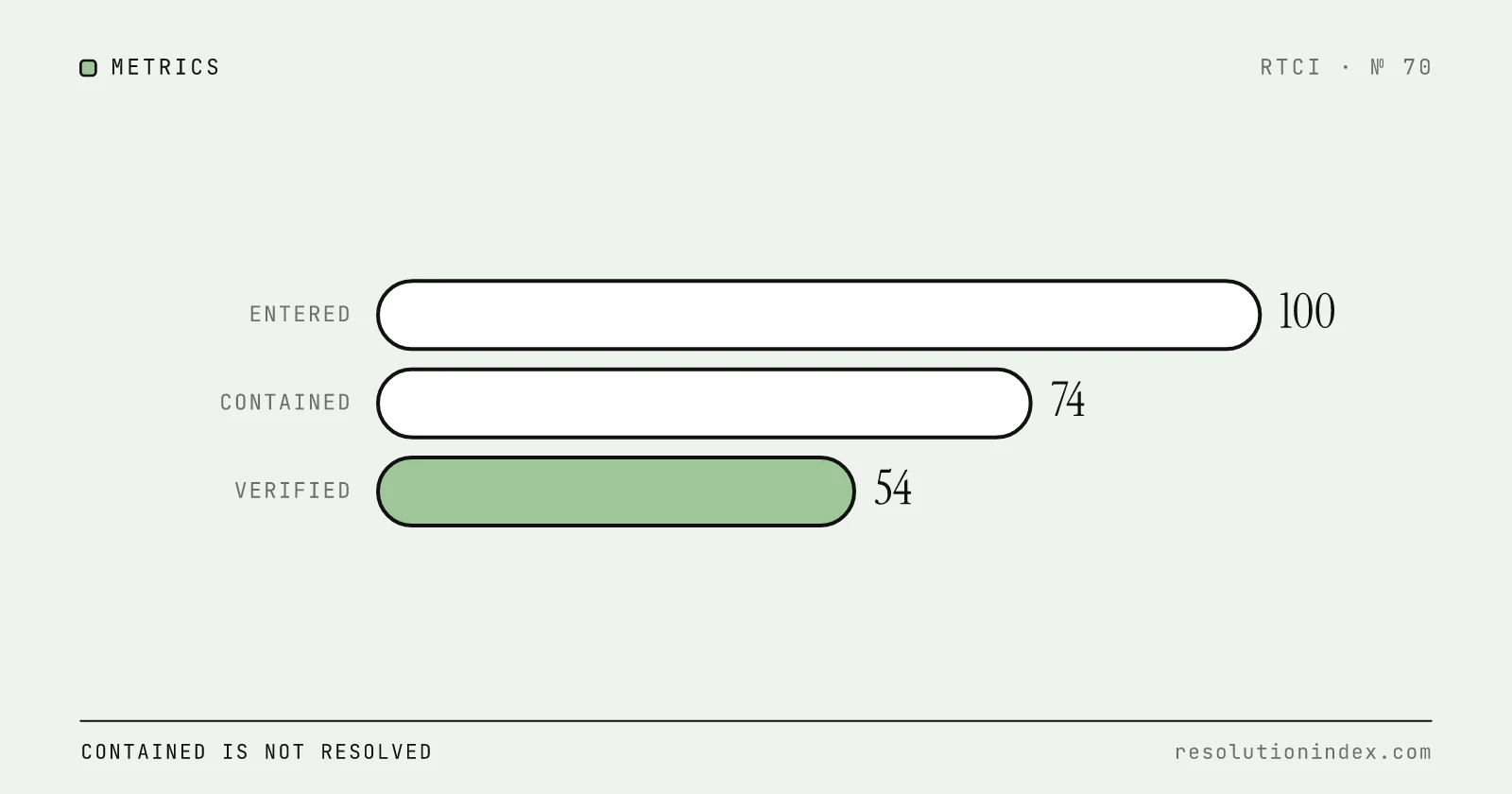
Containment rate is the percentage of conversations that enter a chatbot, AI agent or IVR and end without a transfer to a human: contained conversations ÷ conversations that entered × 100. It does not show whether the issue was solved. Abandoned sessions and customers who come back about the same issue still count as contained, so containment reads higher than verified resolution.
That gap is the reason to care. A vendor quoting 75% containment has told you how often its bot kept the conversation, not how often it finished the job. The sections below give the formula, a version that holds up in a contract, the few sourced benchmarks that exist and a worked month that carries the gap through to cost per resolution.
Key takeaways
- Containment rate counts conversations that never reached a human; abandoned sessions and same-issue returns still count as contained.
- A quality-filtered rate removes abandons before any answer, same-issue re-contacts within 72 hours and negative-survey sessions from the contained count.
- In a 10,000-conversation month, 74% containment fell to 54% verified resolution, raising AI cost per outcome from $1.00 to $1.37.
- No audited cross-vendor chatbot containment benchmark exists; USPS OIG measured 78% IVR containment yet said abandoned calls overstated it.
What is containment rate?
Containment rate measures where a conversation ended, not how it ended. A conversation is contained when it starts in an automated channel (a chat widget, an AI agent, a voice bot or an IVR menu) and finishes without being transferred to a person.
The USPS Office of Inspector General report on 1-800-ASK-USPS (RISC-WP-21-010, September 2021) uses the plain call-center version: containment rate is "the rate of calls that are not transferred to an agent." The same idea goes by several names:
- Call containment or IVR containment: phone calls that stay inside the menu system.
- Chatbot or bot containment: chat sessions the bot closes without a handoff.
- Digital containment: the same measure across web, app and messaging channels together.
- AI agent containment: conversations an LLM-based agent handles without escalation.
One rule applies to all of them: state the denominator. Containment should be divided by every conversation that entered the automated channel, including the ones that left early. A rate calculated over "eligible" or "engaged" conversations only is a different number, and vendors are free to pick either.
How to calculate containment rate (and the version that holds up)
The raw formula is one line:
Containment rate = (conversations that entered the automated channel minus conversations transferred to a human) ÷ conversations that entered × 100
With 10,000 conversations entering a chatbot and 2,600 transferred, containment is 7,400 ÷ 10,000 = 74%.
The raw number has two blind spots. A customer who closes the tab before getting any answer is contained. So is a customer who gets a wrong answer, gives up and emails the next morning about the same problem. Neither was helped, and both improve the metric.
A quality-filtered version removes them. It is the same term RTCI uses for contract acceptance criteria, and it takes five steps:
- Start with raw contained conversations.
- Subtract sessions abandoned before the bot gave any answer.
- Subtract conversations where the customer contacted you again about the same issue within 72 hours, on any channel.
- Subtract sessions with a negative post-chat survey, unless step 3 already removed them.
- Divide what is left by all conversations that entered, not by the contained count.
The 72-hour window is a convention. It mirrors Zendesk, which closes a messaging or email conversation 72 hours after its first message before scoring the outcome, covered below. Whatever window you pick, write it down and keep it fixed, or month-to-month comparisons stop meaning anything.
Step 5 matters more than it looks. Dividing by the contained count gives a success rate among contained conversations, which can stay high while containment itself falls.
Containment vs resolution vs deflection
Containment gets confused with its neighbours. Each answers a different question, and one vendor dashboard can show all of them for the same month.
| Metric | Numerator | Denominator | What it proves | What it hides |
|---|---|---|---|---|
| Containment | Automated conversations not transferred to a human | All conversations that entered the automated channel | The bot kept the conversation | Abandons, wrong answers, later re-contacts |
| Verified resolution | Issues that reached the right end state with no human and no same-issue return in the window | All conversations that entered | The issue was solved | Needs a positive signal or a sample review to measure |
| Deflection | Self-service sessions that did not become a ticket | Inbound attempts, defined differently by each vendor | Fewer tickets were created | Whether anyone got an answer |
| Automation share | Contacts answered or handled by automation | All contacts | How much volume the system touched | Whether the contact ended there |
| Escalation rate | Conversations transferred to a human | All conversations that entered | How often the bot hands off | Whether each handoff was the right call |
| Abandonment rate | Sessions the customer ended before the flow finished | All conversations that entered | Friction in the flow | Why the customer left |
Escalation is the mirror of raw containment: in the worked example below, 26% escalated and 74% were contained. Abandonment sits inside containment, which is the core of the problem. The resolution rate vs deflection rate guide covers deflection and its shifting denominators in detail.
Worked example: 74% containment, 54% verified resolution
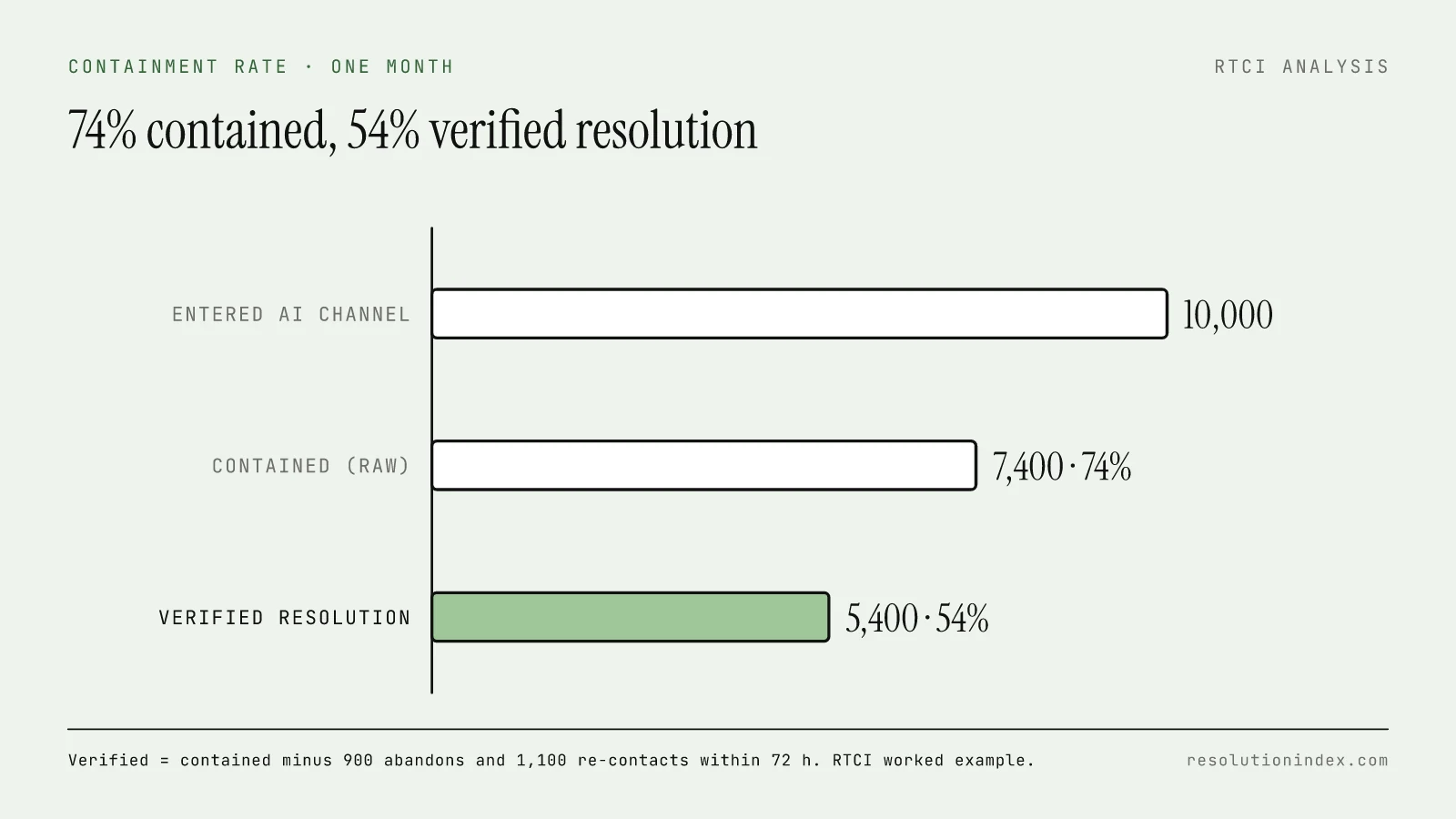
Take a support team whose AI chatbot receives 10,000 conversations in a month. The dashboard shows 74% containment. Here is what sits inside that number.
| Step | Conversations | Share of entered |
|---|---|---|
| Entered the AI channel | 10,000 | 100% |
| Transferred to a human | 2,600 | 26% |
| Contained (raw) | 7,400 | 74% |
| Minus abandoned before any answer | 900 | 9% |
| Minus same-issue re-contact within 72 hours | 1,100 | 11% |
| Verified resolution | 5,400 | 54% |
The arithmetic: 10,000 minus 2,600 is 7,400 contained, and 7,400 minus 900 minus 1,100 is 5,400 verified. In this month the re-contact line also holds the customers who left a negative survey, so nothing is subtracted twice.
Twenty points separate the two rates. Of the conversations the dashboard calls contained, 27% were either abandoned or came back (2,000 ÷ 7,400).
What the gap does to cost per resolution
Now put a price on it. Say the AI costs $7,400 a month. The two rates give very different unit costs.
| Unit | Calculation | Cost |
|---|---|---|
| Per contained conversation | $7,400 ÷ 7,400 | $1.00 |
| Per verified resolution | $7,400 ÷ 5,400 | $1.37 |
| Per verified resolution, with human rework | ($7,400 + 1,100 × $5.91) ÷ 5,400 | $2.57 |
The third line adds human rework. The 1,100 customers who came back were handled by someone, and that work exists only because the first answer failed.
The $5.91 is the one sourced agent cost in this article. USPS OIG put the agent cost of a package-tracking call at about $5.91, from roughly $0.79 a minute over an average of 7 minutes 27 seconds. Swap in your own cost per human contact.
With rework, the total is $7,400 + $6,501 = $13,901, and $13,901 ÷ 5,400 = $2.57 per verified resolution. That is more than two and a half times the $1.00 a containment-based report would show. The cost per verified resolution framework sets out the full formula, including platform fees and add-ons.
The 20-point gap in this month is not a benchmark. Your own gap could be smaller or larger, and only a sample of your own conversations will tell you which.
What vendors count as contained or resolved
Two large helpdesk vendors now define in their billing what counts as a resolution, and Zendesk bills a "verified" resolution but not a "contained" one. That is the clearest evidence that the two are different things.
As of November 2026, Zendesk's automated resolution tiers, introduced on May 18, 2026, sort each AI conversation into one of three outcomes. An assisted escalation means the AI contributed before a human finished. A contained resolution means the AI handled the conversation to completion without the customer asking for more help. A verified resolution means the AI resolved it.
Only verified resolutions count against the resolution allowance. Messaging and email conversations end 72 hours after the first message and voice calls end at hang-up. A large language model then reads the conversation to judge whether the request was resolved, and a conversation that fails the check is classed as contained and not billed.
As of November 2026, Intercom's Fin outcomes article splits resolutions into confirmed, where the customer says the answer was satisfactory, and assumed, where the customer exits without requesting further assistance. On chat and email, both are billed at $0.99 per outcome, at most once per conversation.
Intercom states no time window for an assumed resolution. It does deduct a resolution if the customer returns to the same conversation for help, even in a later billing period, and a customer who explicitly asks for a human does not create an outcome. The article does not say how a return through a different channel, such as an email the next day, is treated.
Side by side, Zendesk bills only after an automated check on the outcome, while Intercom also bills when the customer leaves without asking for more. Both are defensible units. Neither equals your own quality-filtered rate.
Platforms that sell into contact centers often publish containment or deflection figures instead of resolution. RTCI discounts those claims mechanically, as explained in why vendor-claimed resolution rates don't match reality: a company-wide average is multiplied by 0.80 (a median of case studies by 0.70, an "up to" claim by 0.60), a containment or deflection figure by a further 0.85, and the realistic range is that point ±5.
Where RTCI has run its own test, the test result is used instead.
| Platform | Vendor claim | What it measures | RTCI realistic resolution rate | RTCI cost per resolution |
|---|---|---|---|---|
| Cognigy | 80%+ Tier-1 containment | Containment | 49–59% | ~$1.33 (estimate) |
| Kore.ai | 24–90% containment (case studies) | Containment | 60% (RTCI test, Nov 2026) | ~$0.46 (estimate) |
| Freshdesk Freddy | 83% avg deflection | Deflection | 52–62% | $0.79–$0.94 |
For Cognigy the arithmetic is 80 × 0.80 × 0.85 = 54.4, which gives the 49–59% range on RTCI's Cognigy review. The review notes that the figure comes from a NiCE report on early adopters and measures containment, not resolution.
Kore.ai's claims come from single-customer case studies spanning 24% to 90%, and RTCI's Kore.ai review scores its own November 2026 test result of 60% instead. The Freshdesk Freddy figures come from RTCI's Freddy review. All figures in the table are as of November 2026.
Before comparing any of these numbers, ask each vendor for four things in writing: the numerator, the denominator, the exclusions and the time window. Question 8 of the AI support RFP template asks for exactly that.
What is a good containment rate?
There is no audited, cross-vendor benchmark for chatbot containment. Benchmark bands on vendor glossary pages rarely name a dataset, so treat them as marketing. Even USPS OIG, writing about phone systems, said there are "no universal benchmarks for containment, transfer, or abandonment rates" because each IVR system is different.
Three primary sources are worth knowing, and each measures something slightly different.
| Source | Figure | What it measures |
|---|---|---|
| USPS OIG, RISC-WP-21-010 (September 2021) | 62% IVR containment in FY 2018 and 78% for October 2020 to May 2021, against an 80% target | Calls not transferred to an agent; OIG says this overstates success |
| GAO-26-109074 (released August 2026) | 41% of IRS calls answered by automation in 2026, up from 34% in 2025 | Automation share of about 28 million calls, not a containment or resolution rate |
| Gartner customer survey (August 2024 release) | 14% of customer service issues fully resolved in self-service; 36% for issues customers called "very simple" | Customer-reported full resolution in a December 2023 survey of 5,728 customers |
GAO's report on the 2026 filing season also found the average IRS wait rose to 8 minutes from 3 minutes. GAO attributes the longer waits to fewer customer service staff, not to automation, but the two figures show that a higher automation share and better service do not have to move together.
The Gartner self-service survey is the closest thing to a public resolution benchmark for self-service, and its figure is low. It covers all self-service, not only chatbots, and it was run in December 2023.
For a target you can defend, set it on verified resolution rather than containment. RTCI's realistic ranges for AI platforms, and how to read them, are in what a good AI resolution rate looks like.
IVR containment rate
On the phone, containment has its own problems. A call ends when someone hangs up, and a hang-up carries no signal about whether the caller got what they needed. The USPS OIG report shows how that plays out.
USPS counts two kinds of disconnect as contained. Graceful disconnects are callers who stay on for the thank-you message. Customer-ended calls are callers who hang up before it, and they make up the majority of contained calls.
Customer-ended calls include satisfied callers and callers who gave up on the menus, and USPS does not tell them apart. OIG concluded that the containment rate is overstated and recommended separate metrics for complete contained calls and incomplete abandoned calls.
Containment also varied widely by reason for calling. From October 2020 to May 2021 the IVR contained 93% of general inquiries, 91% of passport calls and 90% of post office lookups. It contained 72% of package tracking, 63% of international tracking, 62% of redelivery, 60% of hold mail and 56% of change-of-address calls.
The pattern applies to any channel. Information lookups contain well, while tasks that need input from the caller contain less. OIG also noted that some call types are transferred to specialist teams on purpose and treated their low containment as a good outcome. A single blended rate hides all of this, so report containment per intent.
On voice, also count callers who press 0 or ask for an agent as transfers, never as abandons. Mixing the two makes both rates wrong.
How to raise containment without inflating it
Containment goes up for good reasons and bad ones, and the dashboard cannot tell them apart.
| Raises containment honestly | Inflates it |
|---|---|
| Covering more intents end to end, with tool actions such as order lookups | Hiding the transfer option or burying it behind several prompts |
| Fixing the knowledge-base articles behind the most-transferred intents | Looping the customer through rephrased questions before a handoff |
| Better intent detection, so customers reach the right flow first time | Auto-closing a session after silence and counting it as contained |
| Handing off with context on intents the bot cannot finish | Counting abandoned or disconnected sessions as contained |
The same Gartner survey points at where honest gains come from. The most common reason for self-service failure, in 43% of cases, was that customers could not find content relevant to their issue, and 45% of customers who started in self-service said the company did not understand what they were trying to do.
Watch two numbers beside containment every week: same-issue re-contact within your window, and customer effort or CSAT on contained sessions. If containment rises while re-contact rises too, the bot is moving work around rather than finishing it.
Where containment rate misleads, and where it still helps
Containment is not useless. It is cheap to calculate, available in real time and a fair early signal for a new flow. Its limits are specific:
- It cannot see outcomes. An abandoned session and a solved one look the same.
- It depends on the denominator a vendor chooses, which a sales slide rarely states.
- It rewards friction. Making the handoff harder raises it.
- It mixes intents. A high blended rate can hide a flow that fails most of the time.
- On voice, a hang-up is the only end signal, so the abandonment problem is larger.
Quality filtering has limits too. Matching re-contacts across channels needs a customer ID and issue tagging that many teams lack, and a 72-hour window misses customers who return on day four. Treat the quality-filtered rate as a better estimate, not ground truth, and confirm it with a monthly human review of a sample of contained conversations.
If containment and verified resolution move together within a point or two for three months of your own data, containment becomes a reasonable daily proxy. Until then, report them side by side.
The decision rule
Use containment to watch a flow, never to buy one or pay for one. When a vendor leads with containment, convert it before comparing: get the numerator, denominator, exclusions and window in writing, apply RTCI's discount or your own sample, and divide spend by verified resolutions.
If cost per verified resolution, with human rework added, still comes in below your cost per human contact, the automation is paying for itself. Run that comparison with your own volumes in the AI customer service ROI calculator.
Frequently asked questions
What is containment rate in a call center?
In a call center, containment rate is the share of calls handled entirely by the IVR or voice bot without a transfer to an agent. USPS OIG defines it as the rate of calls not transferred to an agent. Callers who hang up in frustration still count as contained, so the rate overstates how many callers were actually helped.
How do you calculate chatbot containment rate?
Divide the conversations that ended without a transfer to a human by all conversations that entered the chatbot, then multiply by 100. With 10,000 conversations and 2,600 transfers, containment is 74%. For a version that holds up, also subtract sessions abandoned before any answer and same-issue re-contacts within 72 hours, keeping the same denominator.
What is the difference between containment rate and deflection rate?
Containment measures conversations that entered an automated channel and never reached a human. Deflection measures self-service sessions that did not turn into a ticket, and vendors define its denominator in different ways. Neither shows that the issue was solved. Verified resolution, which requires the right outcome and no same-issue return within a set window, is the metric that does.
What is a good chatbot containment rate?
No audited cross-vendor benchmark exists, so treat published bands as marketing. One well-documented public figure is for phone: USPS OIG measured 78% IVR containment against an 80% target and still found the rate overstated. Set targets on verified resolution instead, and judge containment by the gap between the two in your own data.
Can a containment rate be too high?
Yes, when it rises because customers cannot reach a person. Hidden transfer options, forced loops and auto-closing silent sessions all raise containment while making service worse. A rate that climbs alongside re-contacts or falling CSAT is a warning sign. Some intents, such as claims or disputes, should be transferred, and a low rate there is the correct result.
Do Zendesk AI and Intercom Fin bill on containment?
Not on raw containment, as of November 2026. Zendesk bills only verified resolutions, which an LLM checks after the conversation ends; contained resolutions are not billed. Intercom bills $0.99 per Fin outcome on chat and email, including assumed resolutions, where the customer leaves without asking for more help. Its help article states no time window for an assumed resolution.
Read next
Keep reading
Picked for this article: the pieces it cites and the ones that answer the next question buyers usually ask.
Most related
AI Resolution Rates: Why Vendor Claims Are Often Inflated
See how AI support vendors blur resolution, containment and deflection, how RTCI discounts each claim, and the five questions to ask before you compare two rates.
Resolution Rate vs. Deflection Rate: What's the Difference?
Resolution rate measures issues solved end to end; deflection rate measures contacts avoided. Learn the formulas, see examples, and stop vendors from blending them.
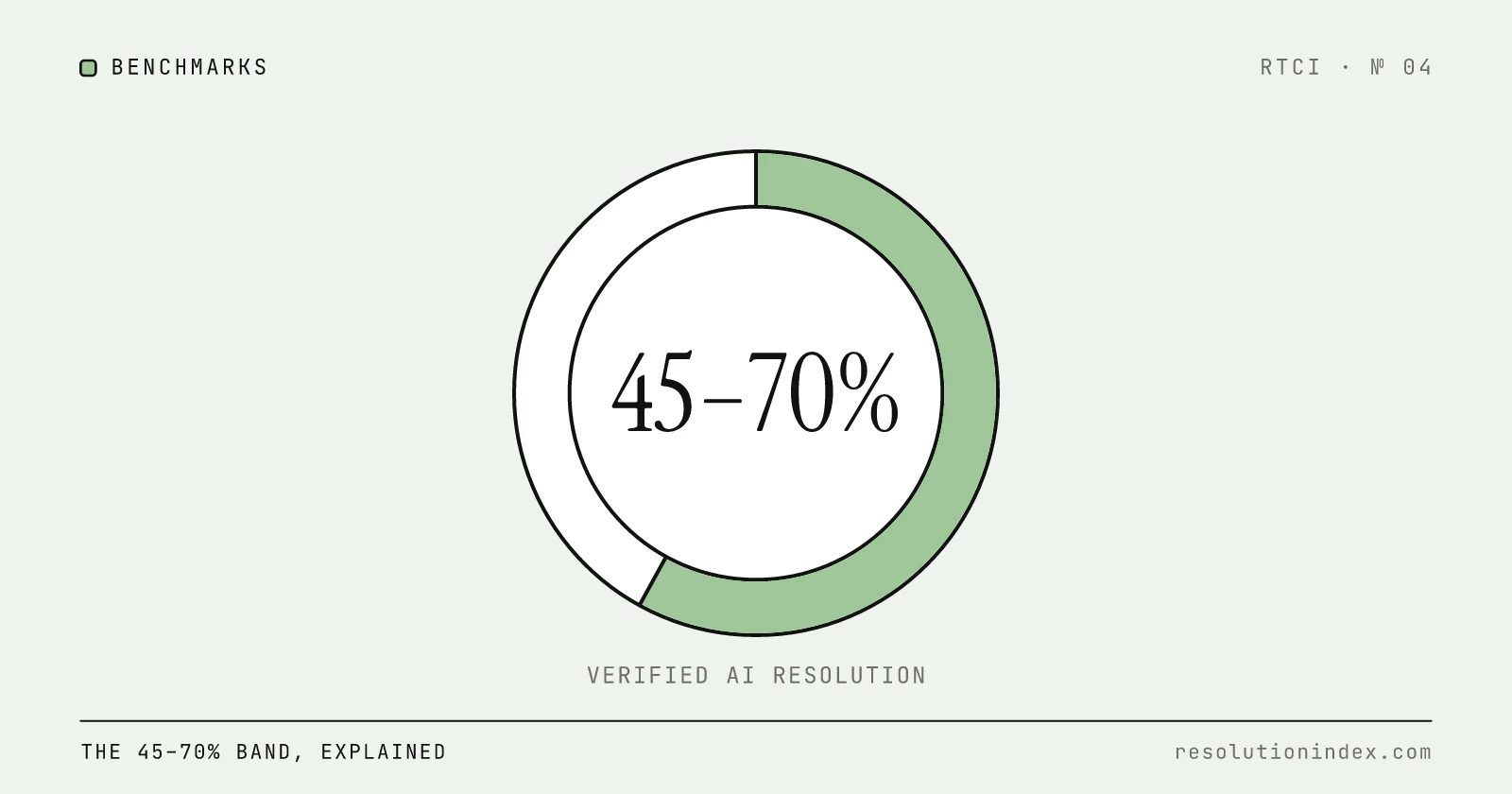
Good AI Resolution Rate: 2026 Benchmarks (45–70%)
A 45–70% realistic AI resolution rate is good for most support teams; above 70% is excellent. 13 of the 20 platforms in RTCI's index land in that band, and the median is 58%.
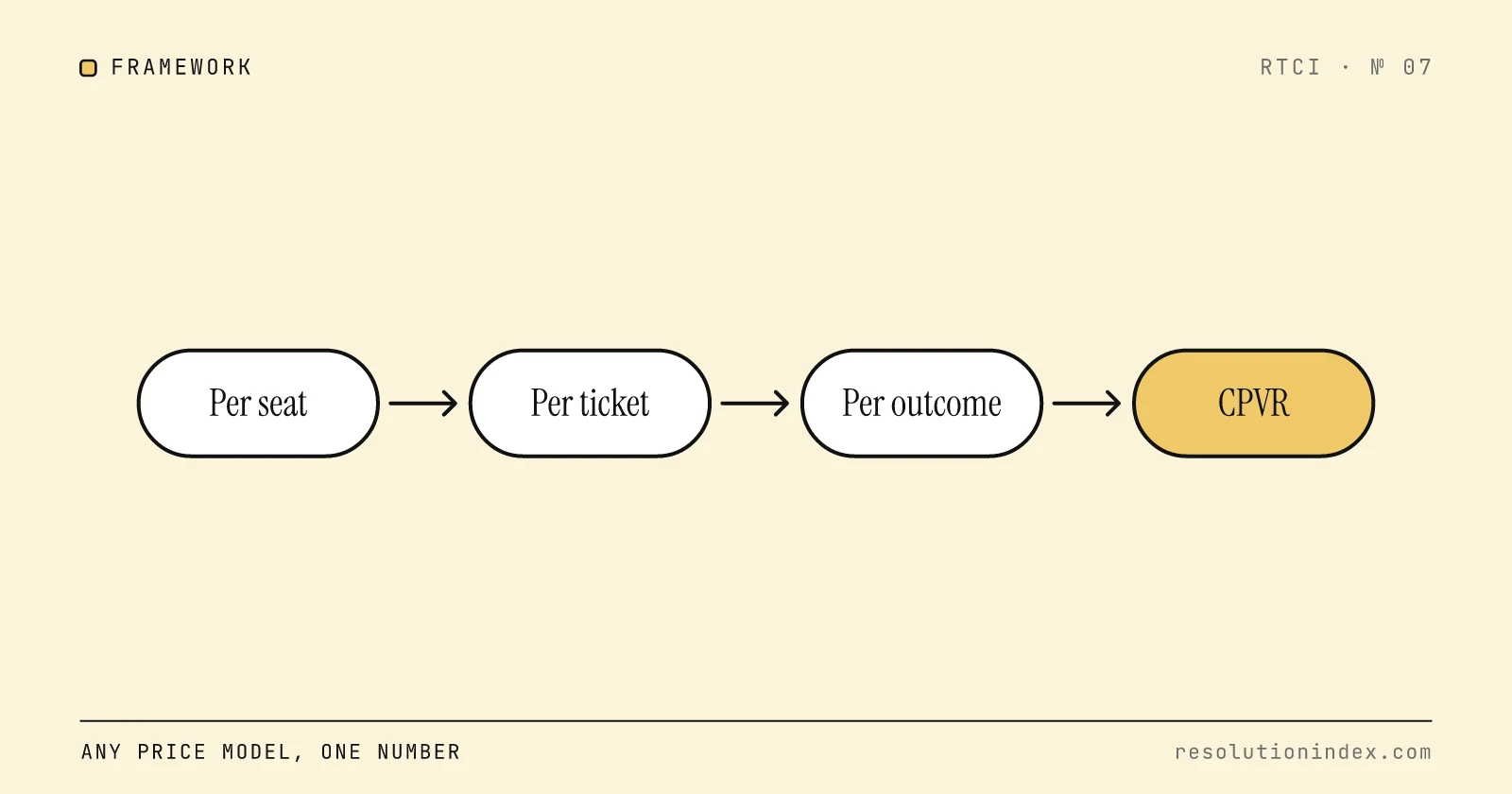
Cost Per Verified Resolution: A New Framework
Per-seat, per-ticket, and per-resolution pricing models all produce different numbers for the same underlying cost. RTCI's three-layer cost model normalizes any vendor's pricing into a single comparable metric: cost per verified resolution.
AI Support RFP Template: 72 Questions, Scoring Model and Ticket Test
A buyer-side RFP template for AI customer support: 72 vendor questions with strong-answer notes, pass/fail gates, a 200-ticket test, weighted scoring profiles, a pricing form and a pilot clause.