Published Aug 8, 2026 · Updated Nov 19, 2026 · 7 min read
Intercom Fin vs Gorgias AI for Ecommerce
Intercom Fin vs Gorgias AI on RTCI numbers: realistic resolution rates, what each one bills, a worked cost comparison, an ecommerce scorecard and a two-week pilot plan.
 Written by Andrew Hall, Editor
For a Shopify store whose tickets are mostly order questions, Gorgias AI is the natural default: its AI acts on live Shopify orders inside the helpdesk, and plans start at $10 a month. On RTCI's numbers, though, Intercom Fin resolves more for less per resolution: a realistic 56–66% at $0.99 per outcome (RTCI score 696, Strong), against Gorgias AI's realistic 27–37% at $0.90–$1.00 per automated interaction (RTCI score 636, Moderate). Choose Fin if you are not Shopify-only or want AI on top of a helpdesk you keep. Choose Gorgias if Shopify order actions decide your ticket mix. Then pilot both on the same tickets.
How do Fin and Gorgias compare on RTCI's numbers?
| Intercom Fin | Gorgias AI | |
|---|---|---|
| Vendor claim | 76% average resolution across 12,000+ customers | 50% automation guarantee (50% of volume in 50 days) |
| RTCI realistic ROAR | 56–66% | 27–37% |
| AI price | $0.99 per outcome | $0.90 annual / $1.00 monthly per automated interaction |
| Fixed floor | $19/seat/mo (Essential) on Intercom; 50 outcomes/mo minimum on another helpdesk | Helpdesk plan from $10/mo; no per-seat pricing |
| Overage and double billing | Outcomes include Procedure handoffs, disqualifications and routings | $1.50 per interaction above the allowance; each interaction also uses a helpdesk ticket |
| RTCI score | 696 (Strong, #1 of 20) | 636 (Moderate, #2 of 20) |
| Best for | Teams on Intercom, or Fin on another helpdesk | Shopify and DTC ecommerce brands |
Figures are from RTCI's Intercom Fin review and Gorgias AI review, both last updated Nov 5, 2026, which cite fin.ai/pricing and gorgias.com/pricing. The realistic ranges apply RTCI's standard discount to each vendor's own claim. Gorgias's range is lower partly because it publishes automation, not a defined resolution rate, and RTCI discounts automation figures more.
Two ownership facts to weigh: Salesforce completed its acquisition of Fin (formerly Intercom) on September 10, 2026, so packaging may change; and Gorgias's autonomous order actions are Shopify-only.
Who is each product for?
Gorgias AI fits stores where the helpdesk is the daily tool and Shopify is the source of order truth: high WISMO, returns, refunds, cancellations and sizing volume. Its AI Agent has a pre-purchase Shopping Assistant role and a post-purchase support role, pulls live Shopify order, product and inventory data, and can track orders, start returns, issue refunds, edit addresses and change subscriptions through integrations such as Recharge. Gorgias does not price per agent seat, which helps larger human teams.
Intercom Fin fits teams whose conversations already run through Intercom's messenger, teams selling on more than one storefront platform, and teams that want an AI agent on top of a helpdesk they plan to keep (Fin runs on Zendesk or Salesforce as well as Intercom). RTCI's Fin review does not score ecommerce order actions, so treat Fin's order-action depth as unproven until your pilot tests it against your own order system.
Comparing Fin with Zendesk instead? Use Intercom Fin vs Zendesk AI; the weights differ.
What does each one cost? A worked example
Assume 4,000 conversations a month, 6 agents, annual billing and one helpdesk ticket per conversation. Set each AI's resolution share at the midpoint of its RTCI realistic range (Fin 60.8%, Gorgias 31.9%), and assume the vendor bills exactly those resolutions. That is the best case for both: Fin's billed handoffs and Gorgias's ticket double count can only add to it.
- Fin on Intercom (Essential seats): 6 × $19 = $114 in seats. 4,000 × 60.8% = 2,432 resolutions × $0.99 = $2,407.68. Total $2,521.68, or $1.04 per verified resolution. People handle the other 1,568 conversations.
- Gorgias Advanced: Gorgias's page lists bundled totals equal to the plan price plus the included interactions at $0.90 (Pro: $300 + 190 × $0.90 = $471), so Advanced is modeled as $750 + 530 × $0.90 = $1,227. 4,000 × 31.9% = 1,276 automated interactions; the 746 above the allowance cost $1.50 each, $1,119. Total $2,346, or $1.84 per verified resolution. People handle the other 2,724 conversations. The 4,000 tickets fit inside Advanced's 5,000, so there is no ticket overage.
Human cost is usually the bigger line. At an assumed $5 per human-handled conversation, the 1,156 extra human conversations in the Gorgias column add $5,780 a month. That gap comes straight from the two realistic ranges, so it is the number your pilot most needs to test.
Where Gorgias costs less. Keep AI volume at Advanced's 530 included interactions: Gorgias is $1,227, while Fin is $524.70 in outcomes plus seats. Fin costs more once seats reach $702.30, which is 37 or more Essential seats at $19, or 9 or more Advanced seats at $85. So Gorgias wins on platform cost for large human teams with modest AI volume, and Fin wins as AI volume grows past the allowance. The Gorgias pricing guide breaks down every plan and its allowance, and Gorgias alternatives ranks the other options for Shopify stores.
Run your own numbers through the cost per verified resolution calculator. If a vendor will not define in writing what counts as a billed outcome or ticket, stop the evaluation. For the broader pricing-model taxonomy, see AI customer support pricing models compared.
Which ecommerce tickets should you test?
- WISMO: live carrier and order state, no invented delivery dates.
- Returns and exchanges: policy windows enforced, portal handoff or in-thread start, restocking fees applied.
- Cancellations: cutoff times respected.
- Pre-purchase: size charts, materials and bundles without inventing stock.
- Subscriptions: skip, swap and cancel with clear confirmation.
- Fraud and chargebacks: fast human handoff, no automated admissions.
Build the test set from a random sample of the last 30 days, not from tickets either vendor picks. A catalog with configurable products stresses different features than a simple apparel range.
How should you score them?
Write the weights before any demo. For a pure ecommerce queue (adjust if you also support an app):
| Criterion | Weight | Fin (0–5) | Gorgias (0–5) | How to score |
|---|---|---|---|---|
| Native commerce actions (order edit, refund, subscription, tracking) | 20 | Run your top 20 macros | ||
| Cost per verified resolution, after recontact | 20 | Same resolution definition for both | ||
| Escalation billing | 15 | Written billing rules for handoffs | ||
| Ticket mix fit (WISMO, returns, sizing, pre-purchase) | 15 | From the random sample | ||
| Admin time to maintain policies and macros | 10 | Hours per week | ||
| Channels as you actually run them | 10 | Email, chat, social, voice | ||
| Reporting (recontact, AI-only CSAT visible?) | 10 | Check the reports exist |
Score each row 0–5, multiply by the weight and add up. Before the demo, ask your own team: Which system holds order truth? How are partial refunds done today? Who will edit AI policies each week? What share of volume is social, email and chat? Do you need on-site shopping help or only post-purchase support?
What does a two-week pilot look like?
Week 1: connect read-only order data. The AI drafts, people send. Label 100 tickets from the random sample. Week 2: turn on automation for WISMO only. Measure verified resolution, 72-hour recontact, handle time and policy violations.
Set the pass gates before the pilot starts: zero invented refund promises, recontact no higher than your current baseline, a target cut in human edit time on WISMO that you pick in advance, and a unit-cost model finance has signed. Also check what each vendor billed during the pilot against your own count of resolutions.
What if neither fits?
Look wider if you need a heavy enterprise workflow engine, depth in a non-retail vertical, or contract pricing at very high volume. The best AI support platforms for ecommerce guide covers the wider shortlist. Do not apply these ecommerce weights to a B2B SaaS queue.
Before you sign: weights written before the demo; finance has signed the unit-cost model; security questionnaire returned; pilot sample unfiltered; recontact measured independently of the vendor; a permission matrix for AI write actions (refunds, cancellations, address changes); seasonal promo policies encoded; an exit and export plan.
Frequently asked questions
Is Gorgias cheaper than Intercom Fin?
Not per resolution in RTCI's worked example: at 4,000 conversations a month, Fin on Intercom costs about $1.04 per verified resolution and Gorgias Advanced about $1.84, mostly because Gorgias charges $1.50 per AI interaction above the included allowance. Gorgias costs less when AI volume stays inside the allowance and your team is large, because it does not charge per agent seat.
Which has the higher resolution rate?
On RTCI's numbers, Intercom Fin, with a realistic 56–66% from its 76% claimed average. Gorgias AI comes in at a realistic 27–37%, from a 50% automation guarantee. Gorgias publishes automation figures rather than a defined resolution rate, which RTCI discounts more heavily. Test both on the same tickets before relying on either range.
Does Fin replace a helpdesk?
It can run on Intercom's own helpdesk, where each agent needs a seat (Essential from $19 a month), or on top of another helpdesk such as Zendesk or Salesforce with no seats and a 50-outcome monthly minimum. Gorgias AI only runs inside the Gorgias helpdesk.
Do Gorgias order actions work outside Shopify?
No. Gorgias documents Order Management and autonomous order actions as Shopify-only, not compatible with BigCommerce or Magento 2. Stores on other platforms get a weaker AI action set.
Can I switch later?
Yes, but macros, policies, AI guidance and channel history all have to move. Run the two-week pilot on both before signing so you do not pay for a second migration.
Change log
- Linked the new Gorgias pricing and Gorgias alternatives guides from the cost comparison.
- Aligned all prices and ranges with RTCI's Fin and Gorgias reviews, replaced an unsourced brand anecdote with a worked cost comparison, and removed unsupported claims.
- Published.
Read next
Keep reading
Picked for this article: the pieces it cites and the ones that answer the next question buyers usually ask.
Most related
Best AI Support Platforms for Ecommerce (2026)
Ecommerce shortlist: Gorgias, Yuma, Richpanel, Intercom Fin, Gladly, Decagon, and Zendesk AI compared on order actions, returns, subscriptions, Shopify depth and cost per verified resolution, with worked cost examples from published prices.
Intercom Fin vs. Zendesk AI: Which Resolves More?
Fin vs Zendesk AI on RTCI's index: realistic resolution rate, cost per resolution with worked bills, minimum commitment, pricing transparency, and what Salesforce's ownership of Fin means for buyers.
AI Customer Support Pricing Models Compared: Per-Seat, Per-Resolution, and Usage
AI support vendors price by seat, by resolution or by usage. A worked example at 10,000 conversations a month shows the same 5,000 resolutions costing $874 to $7,200 depending on the price card.
Cost Per Verified Resolution: A New Framework
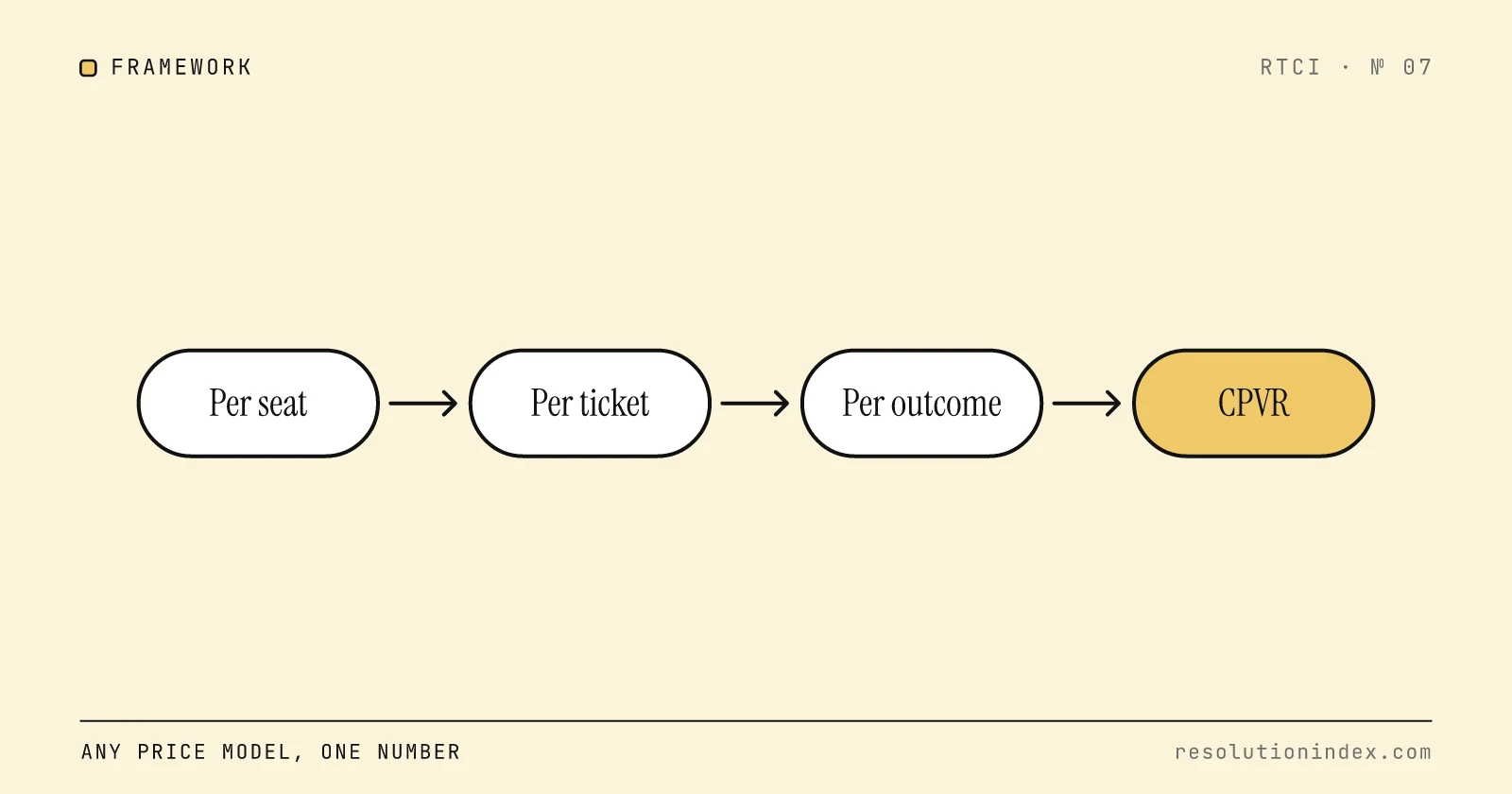
Per-seat, per-ticket, and per-resolution pricing models all produce different numbers for the same underlying cost. RTCI's three-layer cost model normalizes any vendor's pricing into a single comparable metric: cost per verified resolution.
Gorgias Alternatives 2026: 6 Compared for Shopify and DTC Stores
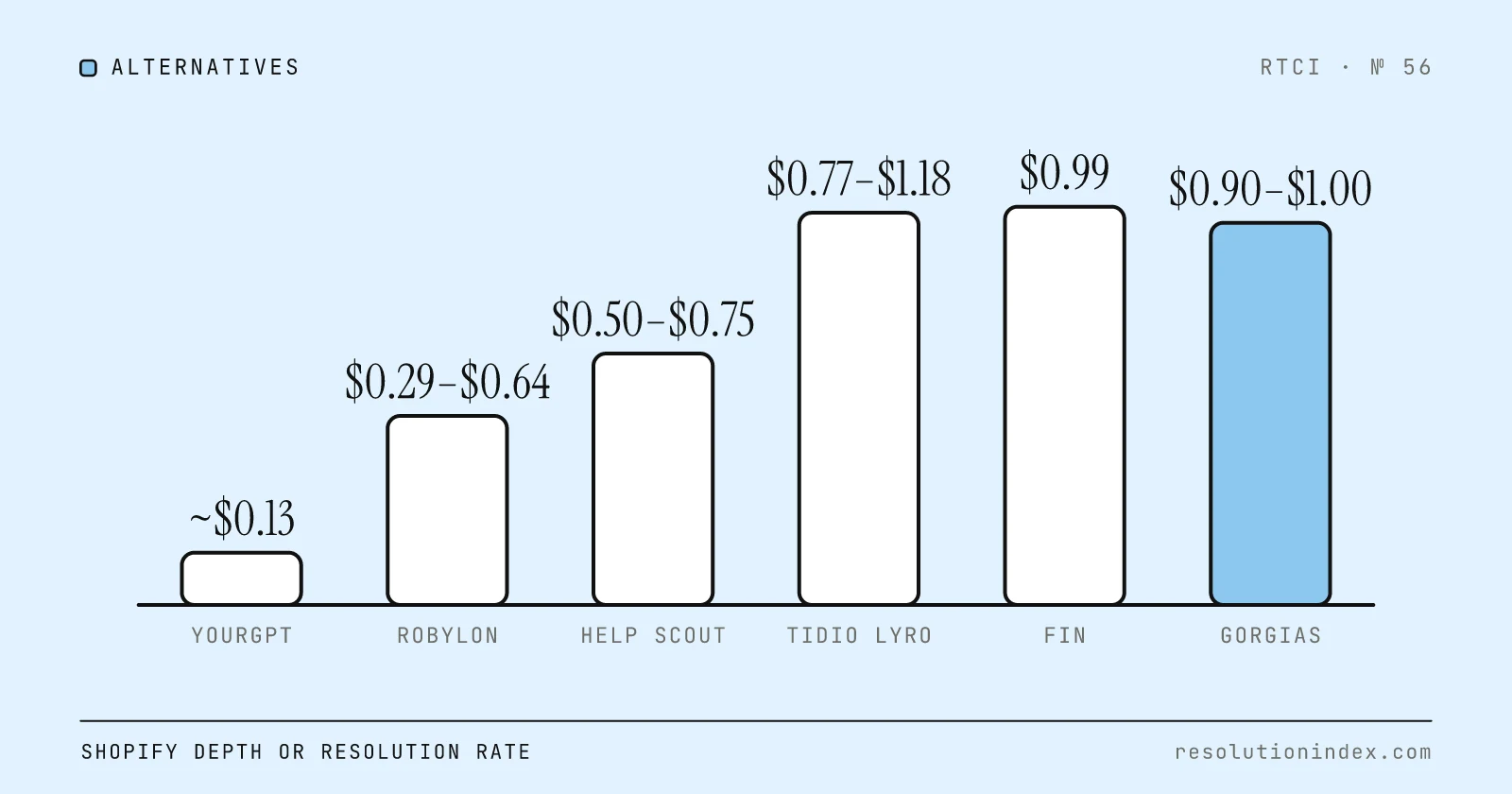
Six Gorgias alternatives ranked on RTCI's score and filtered for Shopify and DTC support, with what each can do on a Shopify order, when staying on Gorgias is the better call, and a worked month at 1,800 tickets.